Business Continuity vs Disaster Recovery: A Guide for Central Indiana Businesses
TL;DR: Key Takeaways
- Business Continuity (BC) is the company-wide plan to keep operations running during a crisis (people, processes, locations).
- Disaster Recovery (DR) is the technical IT subset of BC, focused on restoring data and systems after an outage.
- Downtime can cost a Central Indiana business up to $9,000 per minute. A proactive plan converts this risk into a predictable monthly IT budget.
- Common local risks include aging server hardware in Greenwood business parks or spotty Wi-Fi, which a managed approach permanently fixes.
- We use tools like immutable off-site backups, UniFi networking, and Bitdefender GravityZone to meet compliance standards like HIPAA, CMMC, and NIST CSF.
- True resilience requires moving beyond theory to regular, tested recovery drills.
It’s a classic mix-up I see all the time with Johnson County business owners: confusing Business Continuity (BC) with Disaster Recovery (DR). They sound similar, but treating them as the same thing is a recipe for expensive downtime. Downtime that can cost up to $9,000 per minute. Let's clear this up once and for all.
Think of Business Continuity as the master plan for your entire business. It's about keeping the lights on and the doors open during a crisis. This plan covers your people, your processes, and how you continue serving customers no matter what’s thrown at you.
Disaster Recovery, on the other hand, is a critical piece of that larger plan. It’s the highly technical playbook for bringing your IT infrastructure—your servers, data, and networks—back online after an outage using tools like immutable off-site backups.
Let’s use a real-world example we’ve seen happen more than once in our 17 years of local service. Imagine a nasty spring thunderstorm barrels through Johnson County, knocking out power along the I-65 corridor and taking your Greenwood office completely offline.
Your Disaster Recovery plan is what our team would use to spin up your systems and restore data from an off-site backup. It’s the technical, get-it-working-again part of the puzzle. But your Business Continuity plan answers the much broader questions:
- Where do your employees work now? From home? A temporary office?
- How do you keep taking customer orders?
- How do you communicate the situation to your clients and suppliers?
See the difference? DR fixes the tech. BC keeps the business running while the tech is being fixed. Without both, you're only addressing half the crisis, leaving your business hemorrhaging cash and turning "wasted tech time" into a full-blown financial disaster instead of billable hours.
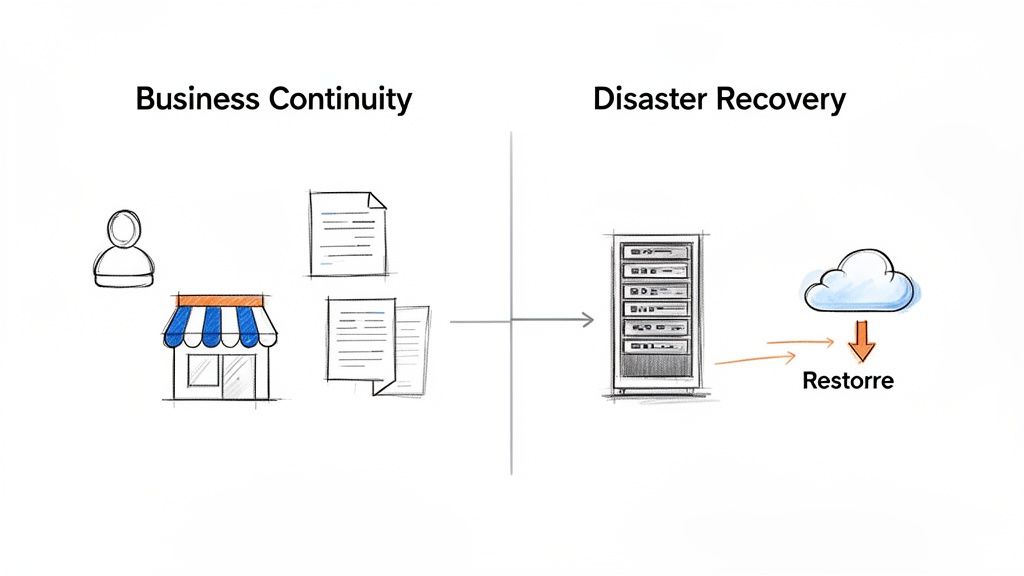
At a Glance: Business Continuity vs. Disaster Recovery
For busy owners, sometimes a simple chart is the best way to see the core differences. Here’s a quick breakdown to help you visualize how these two essential strategies fit together.
| Aspect | Business Continuity (BC) | Disaster Recovery (DR) |
|---|---|---|
| Primary Focus | Maintaining overall business operations and services. | Restoring IT systems, data, and infrastructure. |
| Scope | Organization-wide, including people, processes, and locations. | IT-specific, focused on hardware, software, and networks. |
| Main Objective | Keep the business running, even in a degraded state. | Get technology back online within a set timeframe. |
| Ownership | Business leadership and operational teams. | The IT department or your managed IT partner. |
| Analogy | Keeping the factory lights on and production moving. | Repairing the factory's electrical grid after an outage. |
Ultimately, a well-defined strategy for both BC and DR is what turns a chaotic, money-draining emergency into a predictable and controlled response with a predictable monthly budget.
Why This Isn't Just "IT Stuff"
This isn't just about avoiding frustration. It's about ensuring your teams stay productive and your company keeps generating revenue, even when things go wrong. For any Indiana business handling sensitive information under regulations like HIPAA or CMMC, having robust BC and DR plans isn't just a good idea—it's a strict requirement.
When done right, this planning transforms your technology from a source of anxiety into a stable, strategic asset that protects your bottom line.
The Real Cost of Unpreparedness in Central Indiana
Let's cut right to the chase: what does an IT disruption actually cost your Johnson County business? We’re not talking about some vague, far-off threat. We’re talking about cold, hard cash. Depending on your business, downtime can drain up to $9,000 per minute from your bottom line in lost sales, payroll bleeding out, and a reputation taking a nosedive.
That’s a number that should make any business owner in the Indianapolis area sit up and pay attention.
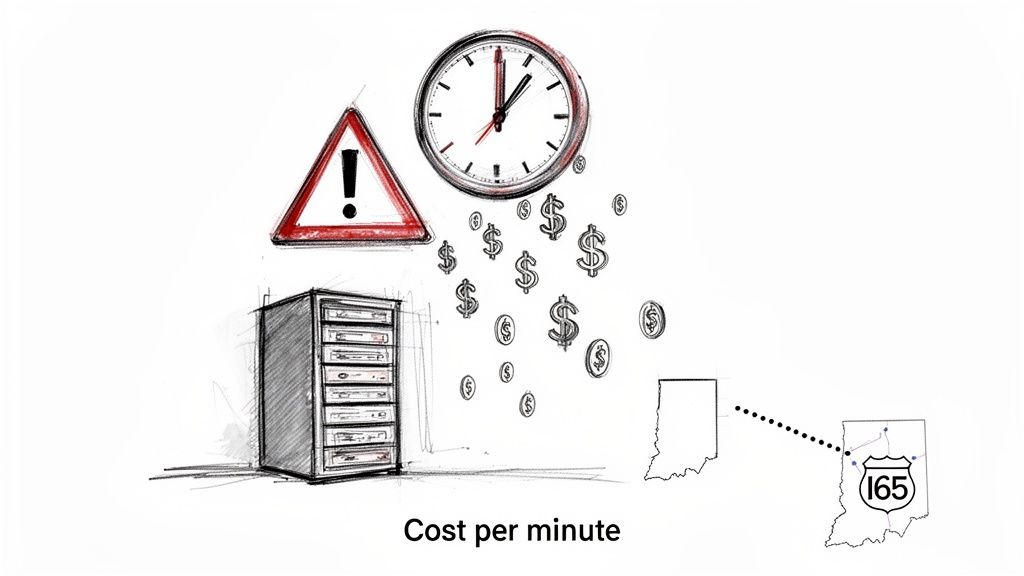
In our 17 years on the ground here, we’ve seen it happen time and again—a single technical failure spirals into a full-blown business collapse. This isn’t just an IT problem; it's a direct threat to your company’s survival.
The Southside Problem-Solution Framework
Let me paint you a picture we see all the time. Imagine a successful manufacturing firm in a Greenwood business park. Their entire operation—all the schedules, client orders, and financials—is humming along on an server that’s been running for eight years. It's way past its prime.
The owner knows it needs replacing but keeps putting it off. It just feels like a huge, unnecessary expense right now. But that server isn't just old hardware; it's a ticking time bomb that could shutter the whole company. One morning, its RAID array gives up the ghost, and everything vanishes.
This isn't a hypothetical. When we dissembled a similar client’s failing RAID array, we saw firsthand how close they came to total data loss. The downtime cost them tens of thousands in lost orders and frantic emergency repair fees before they even thought to call us. Honestly, they were lucky to make it.
Without a plan, the business grinds to a halt. Employees are standing around with nothing to do, customers are left hanging, and every single second is money straight down the drain. Suddenly, that conversation about business continuity vs disaster recovery gets very, very real.
The Financial Fallout of Doing Nothing
The numbers don't lie, and they're brutal. According to FEMA, a staggering 40% of businesses never reopen after a disaster. Another 25% fail within a year. Worse yet, companies that can't get back up and running within five days face a devastating 90% failure rate.
These aren't just statistics; they're cautionary tales. They show exactly why having a plan isn’t optional. In a pinch, some might scramble for emergency business funding to cover the unexpected costs, but that’s a high-stress, high-risk gamble compared to simply preventing the catastrophe in the first place.
Here’s how a proper plan delivers a clear ROI:
- Predictable Monthly Budgets: Instead of getting hit with massive, unplanned bills for data recovery or last-minute hardware replacement, you have a stable, manageable monthly IT budget.
- Convert Wasted Time to Billable Hours: Your team stays on the clock and billing hours. A technician in Carmel or an accountant in Fishers can keep right on working, even if your main office is dark.
- Protect Your Revenue: Your doors stay open (virtually, at least), and the money keeps coming in. What could have been a business-ending disaster becomes a manageable hiccup.
The managed approach fixes it permanently. It's a strategy that includes things like immutable off-site backups, regular system health checks, and a documented recovery process that everyone understands. The first step is to figure out where your weak points are. You can get a head start with our IT infrastructure audit checklist and see where you really stand.
Escaping the Dangerous Confidence Gap
I talk to business owners across the Indy metro area all the time, and most of them feel pretty good about their disaster readiness. The hard truth? They're usually wrong. There’s a massive—and frankly, dangerous—gap between believing you’re ready and actually being resilient.
This isn't just my opinion. A U.S. Chamber of Commerce Foundation survey uncovered a wild discrepancy: while 94% of businesses think they can recover from a disaster, only a measly 26% have a real disaster recovery plan. When theory gets punched in the face by reality, this confidence gap has some seriously painful consequences.
A Hamilton County Cautionary Tale
We saw this play out firsthand with a logistics company right here in Hamilton County. They were a great, successful business and were absolutely positive their nightly backups were running like a Swiss watch. They even had a disaster recovery document printed and sitting in a binder. In their minds, the "preparedness" box was checked.
Then ransomware struck. Not a flood, not a fried server, but a vicious attack that encrypted every single critical file they had. It was the pop quiz they never wanted, and their plan failed spectacularly. Those backups they were so confident in? The ransomware encrypted them, too, making them completely worthless.
In our 17 years of local service, we’ve seen some version of this story play out more times than I can count. A plan collecting dust on a shelf isn't a plan. Real resilience only comes from regular, professional testing that simulates what actually happens when things go sideways.
This client’s nightmare is the perfect illustration of why the difference between business continuity and disaster recovery planning is so critical. Their "plan" to restore data (the DR part) was toast, which brought their business continuity to a screeching halt. They couldn't dispatch drivers, send invoices, or even tell customers what was going on for days. This is exactly what modern attackers bank on.
The ROI of Verified Preparedness
The chaos and panic that followed the attack cost them a fortune in lost revenue and emergency IT fees. It's the ultimate example of "wasted tech time"—unbillable hours spent scrambling, unpredictable emergency costs blowing up the budget, and a hard-earned reputation hanging by a thread.
This is where a managed, proactive strategy flips the entire financial script. You convert the potential for chaos into a predictable, fixed monthly cost for operational stability. We don’t just set up your backups; we test them relentlessly. We don't just write a plan; we actively try to break it to find the weak spots before a real disaster does.
This process includes:
- Regular Restore Tests: We actually perform bit-level data recovery drills from your immutable off-site backups to prove the data is 100% viable.
- Failover Simulations: We test the systems that are supposed to take over when a primary server or switch fails, making sure the handoff is seamless.
- Compliance Verification: For our clients who need to meet standards like HIPAA or CMMC, we document every one of these tests to provide proof of due diligence.
This is how we get beyond just fixing what’s broken. We deliver proven, verified preparedness so that when—not if—a disaster strikes, your confidence comes from real-world results, not just wishful thinking.
How Business Continuity and Disaster Recovery Work Together
So, how do these two plans actually join forces? Let’s get practical. Imagine your business is a factory. Your Disaster Recovery (DR) plan is the elite technical crew that gets the power back on and machines humming after an outage. Meanwhile, your Business Continuity (BC) plan is the savvy operations manager who's already figured out how to pay employees, reroute shipments, and keep customers from jumping ship while the lights are out.
One gets the engine running again; the other keeps the entire business from careening off a cliff. They aren’t interchangeable—they're two sides of the same survival coin.
The split between Business Continuity and Disaster Recovery really boils down to people vs. technology. BC is the big-picture strategy for keeping the business operational, covering everything from your supply chain to customer service. DR, on the other hand, is laser-focused on one thing: getting your IT systems and data back online, fast.
This is where so many Indiana businesses stumble. It’s easy to believe you’re prepared, but without a solid, tested plan, that belief shatters the moment disaster actually strikes. The gap between what you think you can handle and what reality throws at you can be devastating.
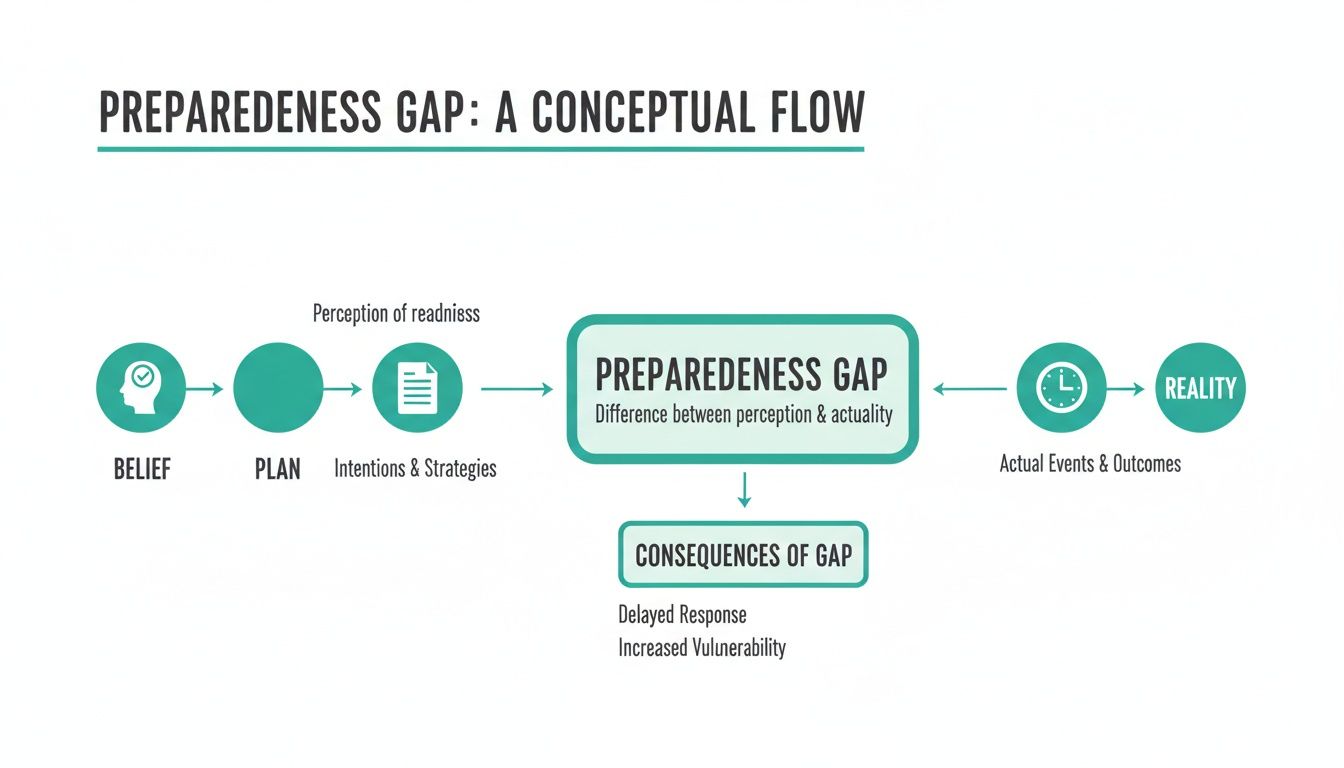
As the image shows, wishful thinking doesn't restore servers. It’s the concrete, tested steps that close that preparedness gap and get you through a crisis.
The Technical Side: Disaster Recovery in Action
The DR plan is where we get our hands dirty with your technology. Everything here is driven by two critical metrics that every Johnson County business owner needs to burn into their brain:
- Recovery Time Objective (RTO): This is your stopwatch. It’s the absolute maximum amount of time a critical system can be offline before your business starts to seriously suffer. Is it one hour? Four hours? A full day?
- Recovery Point Objective (RPO): This is all about data loss. It’s the maximum amount of data—measured in time—you can afford to lose forever. An RPO of 15 minutes means your backups have to be no more than 15 minutes old at any given time.
These aren't just IT buzzwords. RTO and RPO are business decisions that dictate the technology we implement. A zero-minute RTO for a healthcare provider’s patient records system, which is a HIPAA requirement, demands a completely different (and more robust) solution than a 24-hour RTO for an internal marketing server.
This is where we explain the underlying tech to make it happen:
- Immutable Off-site Backups: Think of these as your data’s Fort Knox. They’re ransomware-proof copies of your data, stored in a way that makes them impossible to alter or delete. We perform bit-level data recovery from these backups, ensuring you have a clean restore when you need one. Our guide on enterprise data backup solutions dives deeper into this.
- Zero Trust Architecture: This is a modern security mindset that operates on a simple principle: trust no one. It assumes no user or device is safe by default, which is a massive leap forward from old-school firewalls. It’s what stops an attacker who gets into one system from waltzing through your entire network.
When disaster hits, speed is everything. Minimizing that downtime is the name of the game. Improving your response time comes down to process, and a great resource for this is Mastering Mean Time to Resolution (MTTR), which can seriously tighten up your recovery efforts.
The Operational Side: Business Continuity at Work
While the DR team is busy in the server room, the BC plan is managing the chaos on the human side of things. It’s less about bits and bytes and more about business survival.
A rock-solid BC plan—which we build for everyone from downtown Indy tech hubs to manufacturing plants along the I-65 corridor—answers the tough questions before you’re forced to:
- Alternate Work Sites: If your Carmel office is flooded, what’s the plan? Does everyone work from home? Do you have an arrangement with a co-working space?
- Supply Chain Communication: How do you let your vendors know about delays? More importantly, who are your backup suppliers if your main ones are also down?
- Crisis Communications: You need a clear playbook for talking to customers, employees, and stakeholders. A communication vacuum breeds panic and can wreck your reputation faster than any server outage.
Your DR plan could be flawless, but if your team has no instructions, no place to work, and no way to talk to customers, your business is still dead in the water. That’s why these two plans absolutely must be developed in lockstep, giving you a unified strategy that saves both your tech and your business itself.
Building Your Plan for Indiana's Compliance Landscape
Look, understanding the theory behind business continuity and disaster recovery is one thing. Actually making it work for your Indianapolis-area business is a whole different ballgame. The level of planning you need isn't just a "nice-to-have"—it's often dictated by strict industry regulations like HIPAA and CMMC. Any plan worth its salt has to start there.
Take a healthcare provider in Indianapolis. For them, HIPAA compliance is absolutely non-negotiable. This federal law demands rock-solid data protection and, just as importantly, proof that you can access that data. Your BC/DR plans have to show you can maintain patient care and keep sensitive information safe, even when things go sideways.
Tailoring Your Plan to Local Rules
It’s a completely different story for a defense contractor with offices along the I-65 corridor. They're living in the world of the Cybersecurity Maturity Model Certification (CMMC). Those requirements are intensely specific about how data is handled and how tough your systems are, making a thoroughly tested DR plan a must-have to even bid on, let alone keep, federal contracts.
For most other Johnson County businesses, the NIST Cybersecurity Framework (CSF) offers a fantastic, flexible roadmap. It helps you figure out your risks and build a security posture that actually makes sense for your business without being overly rigid.
Our process always kicks off by turning these regulations into a real-world action plan. In our 17 years of local service, we’ve learned you can't just hand someone a generic template. We start with a detailed risk assessment and a Business Impact Analysis (BIA) to pinpoint your most critical systems and the compliance rules tied to them.
This initial analysis is, without a doubt, the most important step. It tells us exactly what we need to protect and why, making sure every dollar you invest is aimed where it delivers the most protection and ROI. From there, we can build a solution that truly fits.
From Analysis to Action with the Right Tools
Once we know your critical systems and compliance needs, we get down to the "how." This is where we prove we're more than just a "geek with a screwdriver" by putting enterprise-grade tools in place that deliver real-world resilience. A good plan is nothing without the right tech to back it up.
Here’s a peek at the kind of technology we put to work:
- Rock-Solid Connectivity with UniFi Networking: Got an old brick building in a downtown Indy tech hub with spotty Wi-Fi? We design and install latency-optimized mesh nodes to blanket your space in reliable coverage. It’s a core piece of business continuity—keeping your people online and productive.
- Endpoint Security with Bitdefender GravityZone: Your team's laptops and desktops are huge targets. We deploy advanced endpoint protection that includes anti-ransomware defenses and SOC-as-a-Service monitoring, creating a first line of defense that follows Zero Trust architecture principles.
- Guaranteed Recovery with Immutable Backups: This is your ultimate safety net against ransomware. We implement immutable off-site backups that can't be changed or deleted. That means we can perform bit-level data recovery with total confidence, ensuring your DR plan actually works when you desperately need it to.
By mixing a deep understanding of the local compliance rules with hands-on technical skill, we build plans that don't just sit on a shelf—they actively protect your business. We turn wasted tech time into predictable security, transforming your IT from a liability into an asset. You can find more practical steps in our guide to creating a cybersecurity incident response plan.
Turn Your IT from a Liability into an Asset
For a lot of Hamilton County growth businesses, IT feels like a necessary evil. It's the quiet utility humming along in the background—until it’s not. When it breaks, it’s a full-blown, wallet-draining crisis. It's time to stop thinking of your tech as a ticking time bomb and start seeing it as your secret weapon.
A smart, proactive IT strategy is what separates a minor hiccup from a "we're-out-of-business" catastrophe. The whole game is about getting ahead of disasters, not just cleaning up after them.
Proactive Partnership vs. Reactive Panic
Let's be honest. You've got that one aging server in your Greenwood business park or that notoriously flaky Wi-Fi in your old brick building. Every day you cross your fingers and hope for the best, you’re not saving money—you’re gambling. Waiting for that server to finally give up the ghost or for a hacker to slip through means you'll be paying outrageous emergency fees while your team sits on their hands, unable to work. It’s a bad bet.
A proactive partnership completely flips the script. We don't sit around waiting for the phone to ring. We're actively looking for those weak spots and fixing them before they can be used against you.
This approach pays for itself, and you can see it on the balance sheet:
- Predictable Budgets: Say goodbye to those heart-stopping emergency repair bills. Your costs become a stable, predictable monthly line item.
- Maximized Productivity: All that time your staff spends battling slow computers or rebooting the network? That's "wasted tech time" that turns back into productive, billable work.
- Serious Security: We build a digital fortress around your business using proven tools like Bitdefender GravityZone and a Zero Trust architecture, stopping costly breaches before they ever happen.
From Cost Center to Competitive Edge
When your technology just works, something incredible happens. Your team can finally stop fighting IT fires and focus on what they do best: serving your customers and growing the company. Operations get smoother, and your ability to weather a storm—whether it’s a tornado tearing down the I-65 corridor or a ransomware attack—becomes a serious advantage over the competition.
That's how you stop treating IT like an expense and start treating it as an investment in your own resilience.
For Johnson County business owners, making this shift is non-negotiable. A proactive strategy doesn't just help you survive; it helps you thrive. It makes meeting compliance standards like HIPAA or NIST CSF simpler and builds a solid foundation for whatever comes next. You can get a better sense of how managed IT services for small businesses make this a reality.
In our 17 years of serving local businesses, we’ve seen the aftermath of reactive IT more times than we can count. The cost of prevention is always a fraction of the cost of recovery. A good plan isn't just about survival; it's about building a stronger, more profitable business.
Ready to turn your technology into your greatest asset? Let's get a clear, no-strings-attached look at where you stand. A proactive partnership is the first step.
Schedule a Free Network Assessment with our team today. We’ll give you a clear picture of your security, tailored specifically for your Greenwood or Indianapolis-area business.
Got Questions? We've Got Answers.
When we sit down with business owners around Indy, the same questions about business continuity and disaster recovery always pop up. Let's cut through the jargon and get right to what you really want to know.
Where on Earth Do I Start With a Business Continuity Plan?
First things first: you need a Business Impact Analysis (BIA). It sounds corporate and stuffy, but it's really just a straightforward process of figuring out what makes your business tick. Before you can protect your operations, you have to know which parts are absolutely mission-critical.
We walk our clients in Greenwood and beyond through this, asking the tough questions. If a specific process goes down for an hour, a day, or a week, what’s the real damage to your bottom line and reputation? That analysis becomes the bedrock of your entire strategy, ensuring we're spending time and money protecting what actually matters.
How Often Should We Really Test Our Disaster Recovery Plan?
Look, a plan that just sits in a binder is nothing more than a well-intentioned paperweight. We're pretty firm with our clients on this: you need to run at least one full-blown DR test every single year. On top of that, smaller tests—like restoring a single server or a critical file—should happen quarterly.
For any business juggling regulations like HIPAA or CMMC, this isn't optional. It’s a requirement.
We learned this the hard way over our 17 years serving Central Indiana businesses. A client had a "tested" backup, but when a crisis hit, the RAID array wouldn't restore properly. It was a nightmare. That's why we believe real-world fire drills are the only way to know for sure that your fancy immutable off-site backups will actually save your skin.
Is Just Having Cloud Backup Good Enough for Disaster Recovery?
Nope. Not even close. Think of cloud backup as a fantastic, essential ingredient—like flour for a cake. But it’s not the whole cake. True disaster recovery is the full recipe: who does what, what gets restored first, and how you communicate with your team and customers while the fire is being put out.
A backup file floating in the cloud is totally useless if no one has a documented, tested, and understood plan to bring it back online. We weave tools like cloud backup into a comprehensive Zero Trust architecture that ensures your recovery is not only fast but also secure.
Can a Small Business Like Mine Actually Afford a Real Business Continuity Plan?
Let's flip that question around. Can your Johnson County business afford not to have one? When downtime can cost you up to $9,000 per minute, a plan stops being an "expense" and starts looking like the best insurance policy you'll ever buy.
A solid plan doesn't have to cost a fortune. As a managed IT partner, our whole job is to scale a solution that fits your exact needs and budget. We transform the terrifying, unpredictable costs of an emergency into a stable, predictable monthly expense. You aren't just buying a document; you're buying peace of mind and a future for your company.
Ready to stop guessing and get a clear picture of your business's resilience? Finchum Fixes IT offers a no-strings-attached Security Risk Audit for businesses in Greenwood and the greater Indianapolis area. Let's find your weak spots and fix them before they turn into a full-blown catastrophe.