Cybersecurity Business Continuity Plan: Key Steps
A cybersecurity business continuity plan connects incident response, disaster recovery, communications, and executive decisions into one executable process. It identifies critical systems, protects recoverable copies of data, assigns authority, and proves through exercises that the business can contain an attack and restore operations without relying on one person or one document.
A Greenwood manufacturer can have modern Microsoft 365, a carefully configured firewall, and a signed continuity binder, then still lose a morning to a locked file server because nobody knows who can declare an incident. The same failure appears across the I-65 corridor, from aging server hardware in a business park to unstable Wi-Fi in an old brick building. The technical problem is visible. The ownership problem usually isn't.
Downtime can cost up to $9,000 per minute for a mid-sized enterprise, according to AT&T's business internet continuity guidance. Managed IT, cybersecurity, tested backups, and resilient networking turn that exposure into a recovery process, while predictable monthly support costs replace wasted tech time, emergency invoices, and employees waiting for systems to come back.
Why Most Plans Fail Before the First Cyber Attack
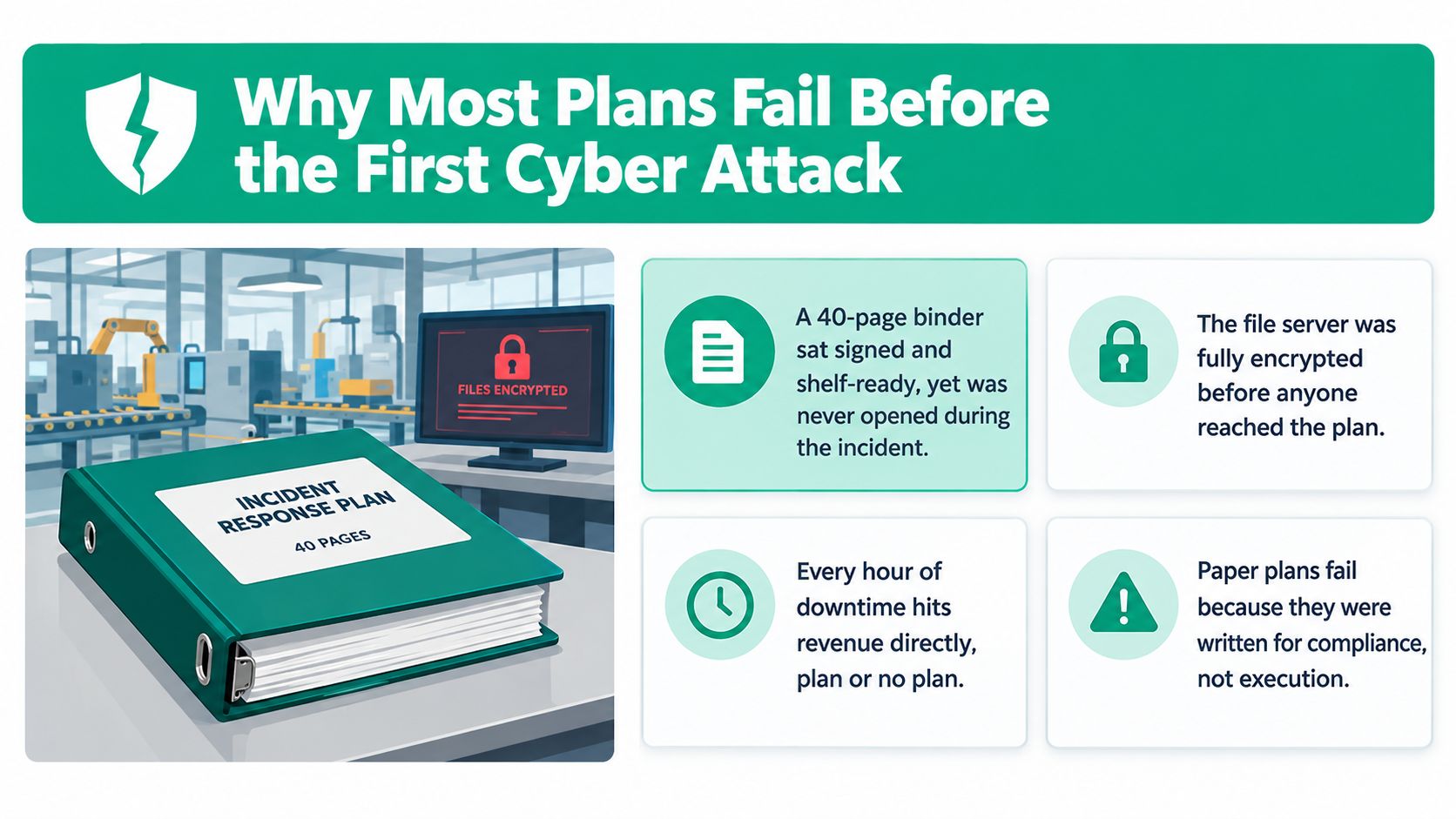
A hypothetical Greenwood machine shop has a familiar setup. Its owner approved a 40-page cybersecurity business continuity plan, the controller printed it, and the binder sat beside the server rack. One morning, the file server displayed a ransom note. The controller couldn't reach the vendor number listed in the binder, the backup administrator was unavailable, and nobody knew whether shutting down the network would protect production or make recovery harder.
The plan existed. It wasn't executable.
The failure wasn't a missing paragraph about ransomware. It was a missing operating model. IT had written technical procedures, but the controller owned payment decisions, operations owned production priorities, and the owner had never agreed on who could authorize emergency spending or customer notifications.
Practical rule: A plan that depends on one administrator, one contact list, or one copy of its instructions isn't a continuity plan. It's a hope document.
The 2026 RSM US Middle Market Business Index survey found that 57% of respondents had developed and maintained a business continuity plan, while 56% had disaster recovery plans for critical systems and 51% had crisis communication plans, as reported in the 2026 business continuity policy reference. Yet only 37% conducted quarterly incident response testing and 29% tested semiannually. Larger firms were more likely than smaller firms to test quarterly, 45% versus 32%, according to the same source.
That gap explains why a signed plan can fail in the first hour. IT may know how to isolate a UniFi gateway, but finance may not know whether payroll can proceed. Security may recognize credential theft, but the executive team may not know when to approve a shutdown. Communications may have no customer message ready, and nobody may have verified that immutable backups can restore clean data.
The incident response team guidance from Finchum Fixes IT is useful for one reason: it treats response as a team function rather than an IT-only assignment. Johnson County business owners need named authority across IT, security, operations, finance, legal, and leadership.
NIST says incident response and recovery plans should be synchronized, exercised, and updated after lessons learned. Its recommended sequence is practical: perform a business impact analysis, define recovery strategies, document and communicate the plan, then validate it after significant organizational or environmental changes.
The plan is only as strong as its rehearsal, cross-team roles, and immutable backup proof. A document can't contain ransomware. People, controls, and tested recovery can.
Mapping Critical Assets and Setting Recovery Priorities
Start with the business process, not the equipment list. A network discovery sweep should identify UniFi gateways and switches, Windows file servers, Microsoft 365 tenants, Entra ID, QuickBooks hosting, line-of-business applications, printers, warehouse systems, vendor portals, and the services that support authentication.
Then ask a harder question: what stops making money first?
A warehouse may depend on an ERP platform, a wireless scanner network, an identity provider, a carrier portal, and an EDI feed. A law office may depend on document management, email, billing, and secure client portals. A medical practice may depend on scheduling, electronic records, and HIPAA-controlled access. Each process needs an owner, an alternate owner, a recovery time objective, a recovery point objective, and an approved manual workaround.
NIST's contingency planning controls require organizations to back up user information, system information, and system documentation at organization-defined frequencies while protecting the confidentiality, integrity, and availability of backup information. The requirement matters because a file server isn't the entire dependency. If identity, DNS, licensing, or vendor access is unavailable, a restored application may still be unusable.
Build a one-page dependency map
Use a worksheet that a business owner can understand during a Saturday incident call.
| Asset | Owner | RTO (hours) | Cost per hour down | Tier |
|---|---|---|---|---|
| Identity provider and administrator access | IT lead | Defined by BIA | Revenue and recovery impact | Foundation |
| Warehouse management system | Operations | Defined by BIA | Orders and fulfillment impact | Critical |
| Windows file server | Department owner | Defined by BIA | Productivity and data access impact | Critical |
| Microsoft 365 and email | Executive sponsor | Defined by BIA | Communication and workflow impact | High |
| Payroll platform | Finance or HR | Defined by BIA | Payroll and compliance impact | High |
| Reporting and archival systems | Department owner | Defined by BIA | Delayed internal work | Standard |
Don't fill the cost column with a guess. Calculate the financial impact from payroll delay, idle staff, missed shipments, service credits, lost orders, and recovery labor. The commonly used downtime model multiplies outage minutes by cost per minute, but the rate must come from the business's own revenue and operating data.
A practical redundancy planning guide by Forge Reliability can help teams compare single points of failure with failover options. A hot failover may be justified for a system that directly controls shipping or production, while a tested restore may be adequate for internal reporting.
Use the business impact analysis template to document owners and dependencies. If the CEO can't name the system, owner, alternate contact, and recovery priority during an emergency call, that asset isn't mapped.
Designing Backups That Survive Ransomware
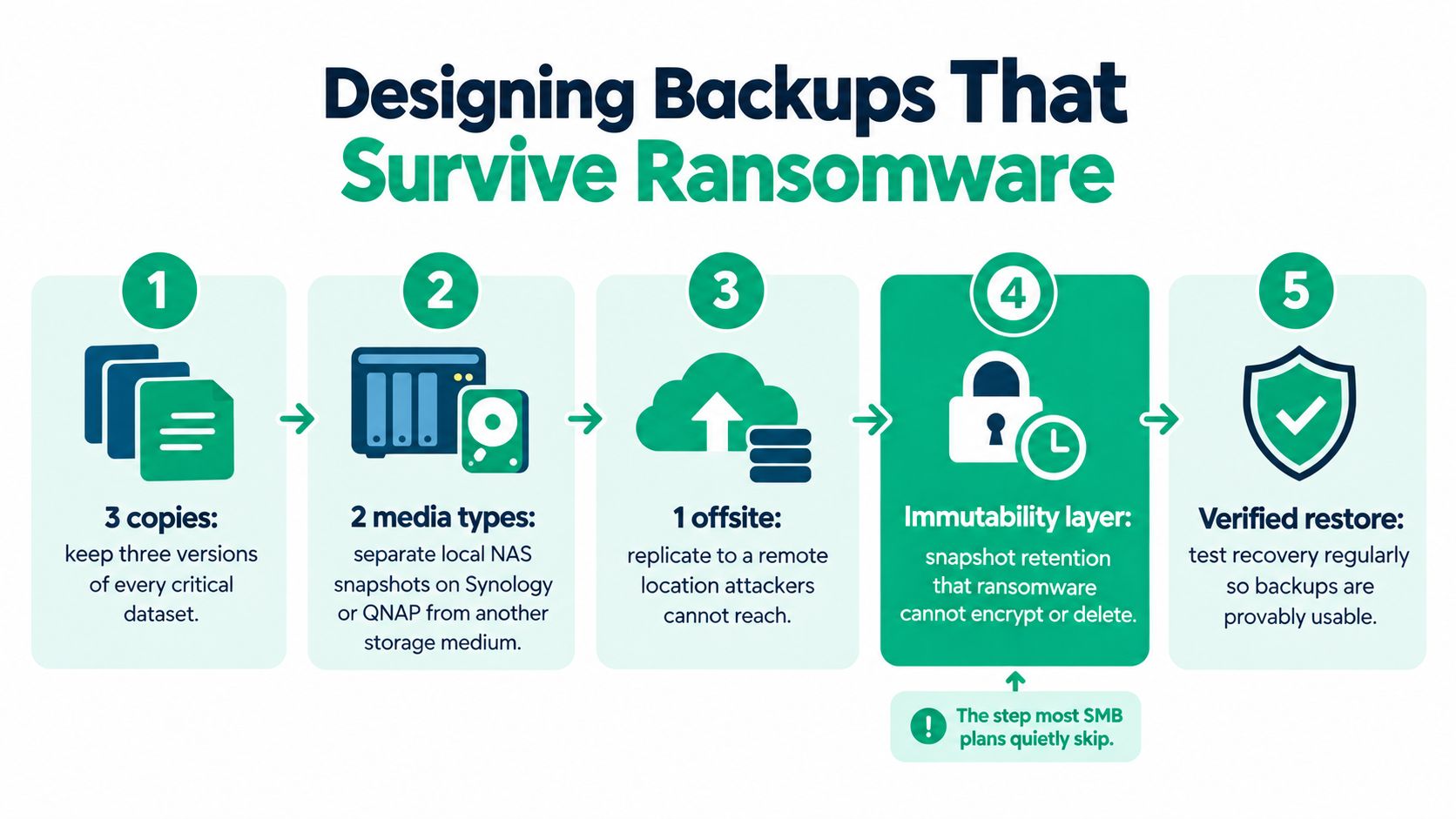
A backup is not a recovery strategy until the business can restore clean data under pressure. The familiar 3-2-1 rule provides a starting point: maintain three copies, use two storage media or locations, and keep one copy offsite. Ransomware resilience adds immutability, separate administration, restore validation, and an offline path.
A practical SMB design might use local snapshots on a Synology or QNAP NAS for fast file recovery, replication to Backblaze B2 or Wasabi for offsite protection, and a rotating USB copy stored away from the building. The exact design depends on data volume, recovery objectives, bandwidth, and the staff available to operate it.
For virtual infrastructure, Veeam can protect VMware or Hyper-V workloads. Datto SIRIS can support endpoint and server continuity where rapid image-based recovery fits the business. Bitdefender GravityZone can harden the backup host, while Windows Defender credential isolation helps reduce exposure around the backup administrator account.
Protect the backup layer
Ransomware operators often target backup agents, administrative credentials, and connected storage before encrypting production systems. A separate backup domain administrator, multifactor authentication, restricted management paths, immutable object lock, and a copy that isn't continuously mounted make that attack harder.
NIST's PR.IP-4 guidance says backups must be conducted, maintained, and tested, and that continuity and resilience plans should be exercised at least annually or after significant changes. A monthly automated restore test and a quarterly bare-metal drill provide more useful evidence than a green backup-job dashboard.
Record the result in a checksum and restore log. The log should identify the recovery point, restored files or systems, validation performed, operator, errors, and corrective action. That proves the last clean copy is usable instead of merely proving that a scheduled job finished.
A useful companion resource is Nutmeg Technologies' guide to test your data recovery. The important question isn't “Do we have backups?” It's “Can we restore clean data fast enough, and can we prove that malware didn't reach the backup layer?”
For SMBs, the trade-off is straightforward. More copies don't automatically mean better recovery. A simpler architecture with immutable retention, separate credentials, and repeated restore tests is often safer than a complicated platform that nobody checks.
The practical backup and recovery playbook for SMBs should end with an owner and a calendar entry. If no one is responsible for reviewing failed jobs and failed restores, the backup system is still unfinished.
The Four Pillars Inside a Working Plan
A cybersecurity business continuity plan needs four connected pillars. Incident response controls the attack, disaster recovery restores technology, communications keeps people aligned, and vendor or network dependencies prevent the recovery team from discovering a missing ISP contact or licensing account during the outage.
Compare the operating responsibilities
| Pillar | Must Contain | Most Common SMB Gap |
|---|---|---|
| Incident response | Detection triggers, escalation paths, containment steps, evidence preservation, and incident commander authority | IT owns the document without executive authority |
| Disaster recovery | Restoration order, RTO and RPO targets, clean backup sources, validation, and return-to-service approval | Backups exist, but restore order and validation are unclear |
| Communications | Call trees, alternate channels, customer language, legal review, and status updates | No approved templates or backup communication method |
| Vendor and network dependencies | ISP failover, Microsoft 365 contacts, SaaS ownership, MSP duties, and contract SLAs | Vendor contacts and failover paths live in individual inboxes |
Incident response should define the trigger for isolating a device, disabling an account, blocking a UniFi gateway rule, or engaging forensic support. It should also state who preserves evidence and who can approve actions that interrupt production.
Disaster recovery follows the asset tiers from the business impact analysis. Identity and communications may need restoration before a line-of-business application, but the correct order depends on actual dependencies. RPO describes acceptable data loss, while RTO describes how quickly the system or process must become usable.
Communications can't be an afterthought. Prepare internal instructions, customer updates, supplier notifications, and regulator escalation language before an attack. Store those templates outside the production environment, and include a phone tree that works if Microsoft 365 is unavailable.
Vendor dependencies deserve the same scrutiny as internal servers. Confirm who can reset a Microsoft 365 tenant, escalate an ISP outage, restore a hosted QuickBooks environment, or approve an emergency license. A plain-language explanation of how cyber insurance works can also help owners understand why insurers ask about controls, response procedures, and recovery evidence.
Zero Trust architecture supports all four pillars by requiring explicit verification rather than assuming that a device, account, or network location is safe. SOC-as-a-Service monitoring can provide continuous alert triage, but it doesn't replace executive decisions, customer communication, or a tested recovery sequence.
The cybersecurity incident response plan template should name a primary and alternate owner for every critical decision. Separate documents may support each pillar, but the people responsible for them must exercise the same scenario together.
Compliance Hooks That Protect Your Contracts
Compliance becomes useful when each requirement protects an operating capability. HIPAA, CMMC, and NIST CSF shouldn't sit in separate binders from the recovery plan. They should point to the same access reviews, audit records, communication trees, backup tests, and incident evidence that protect revenue.
Healthcare organizations handling electronic protected health information need documented risk analysis, contingency planning, access controls, and audit logging. A medical practice that can't restore scheduling or explain access activity may face more than technical disruption. It may also face contract pressure from hospital partners and other covered entities.
Defense contractors working toward CMMC Level 2 need evidence that security practices are implemented and maintained. Incident reporting, access reviews, recovery procedures, and documented corrective actions must be owned and reviewable. A C3PAO assessment doesn't make an untested recovery process operational.
Use NIST CSF as the working middle ground
The NIST Cybersecurity Framework provides a practical structure for general businesses. Its guidance requires organizations to establish, document, approve, communicate, apply, evaluate, and maintain a business continuity plan based on operational resilience strategies and capabilities, as described in the NIST CSF continuity control.
A tracked control register should include:
- Control owner: Name the person accountable for completion and evidence.
- System scope: Identify the applications, devices, data, and vendors covered.
- Evidence location: Record the restore log, access review, exercise notes, or audit record.
- Review date: Set the next review and the trigger for an earlier update.
- Contract connection: Note which customer, insurer, HIPAA obligation, or CMMC practice the control supports.
This approach protects renewals because it turns “we have a plan” into evidence that people tested it. The SOC 2 compliance checklist can help organizations organize controls that clients and auditors commonly request, but no checklist substitutes for a working recovery drill.
Testing the Plan Until It Hurts
Tabletop exercises reveal the gap between a plan's words and a team's behavior. Choose a scenario that matches the business, such as ransomware encrypting a file server during the night, a Microsoft 365 tenant lockout during payroll, or an ISP outage affecting a manufacturing line.
Bring the right decision-makers into the room. The owner or executive sponsor needs to approve risk and emergency spending. The IT lead handles technical containment. Operations identifies what must continue. Finance confirms payment and purchasing authority. Communications, legal, and the managed service provider should join when their decisions affect customers or regulators.
Run the exercise as an incident
Don't let participants research the answer while the clock is running. Provide an initial alert, then introduce new facts: a second account is compromised, the backup console is unreachable, a customer asks for an update, or the primary phone system fails.
Track behavior rather than confidence:
- Detection time: When did the team recognize the event?
- Containment time: When did it isolate the affected account, device, or network segment?
- Contact accuracy: Did staff reach the correct owner through the approved channel?
- Recovery proof: Did the team restore from an immutable copy and validate the result?
- Decision clarity: Did leadership know who could authorize shutdown, spending, and communication?
NIST's incident response guidance says recovery and response plans should be updated after lessons learned. Every exercise should therefore produce an owner, deadline, and retest date for each gap.
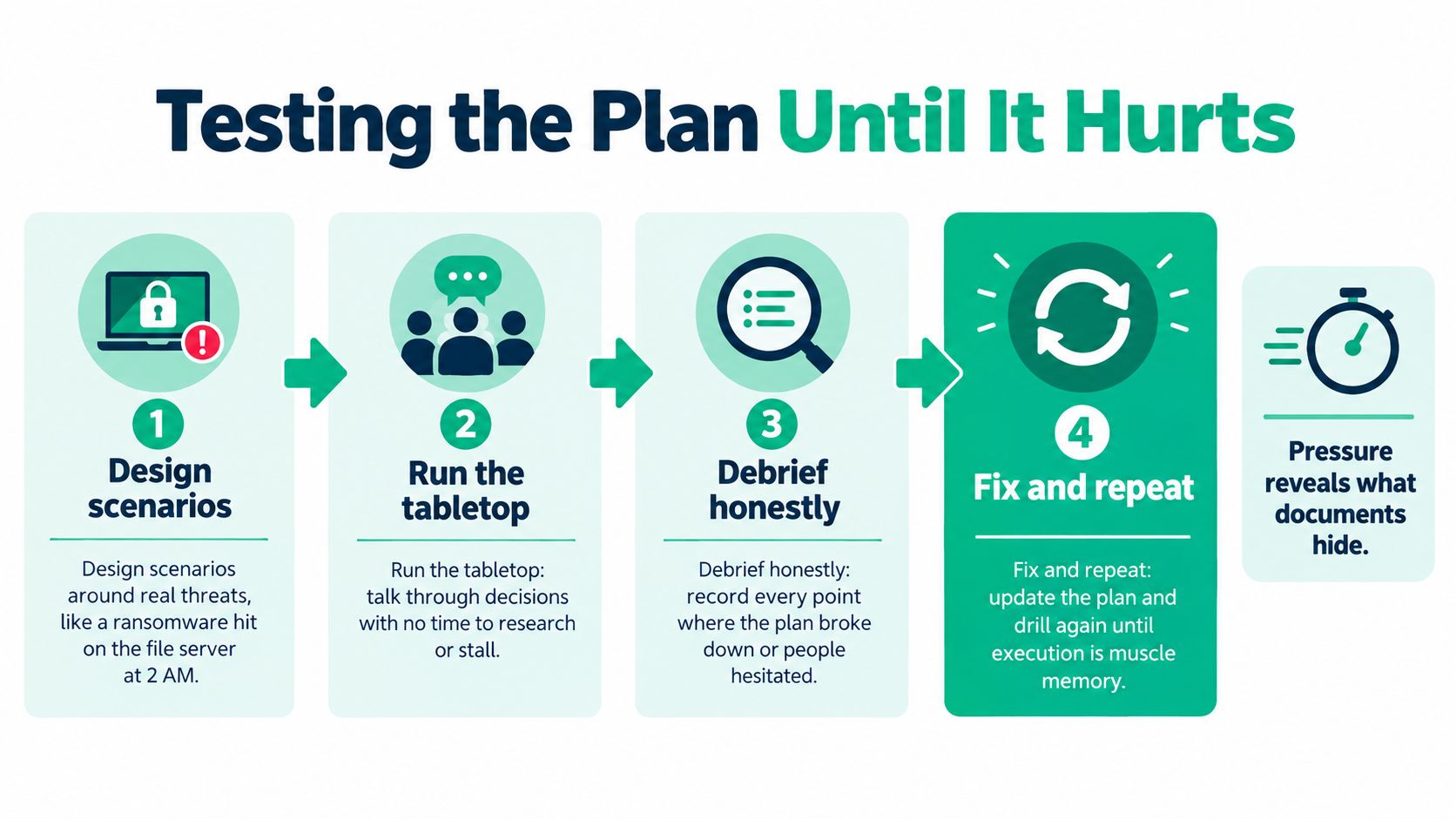
A tabletop can expose a bad phone number. A technical drill can expose a corrupted backup. A failover test can expose a licensing dependency. Use all three, and don't hide failures from leadership. Failed exercises are cheaper than failed recoveries.
Rollout Checklist and Local Support
A ninety-day rollout gives a small business enough structure to move without turning continuity into a year-long project. The first phase establishes what exists, the second assigns ownership and rehearses decisions, and the third tests the complete path from detection through restoration.
Start with the baseline
During the first thirty days, inventory assets and dependencies across the Greenwood office, the I-65 corridor location, remote users, cloud tenants, vendors, and network equipment. Review UniFi configurations, endpoint protection, administrator accounts, Microsoft 365 backup coverage, NAS snapshots, immutable off-site backups, and restore records.
During days thirty-one through sixty, document the plan, agree on RTO and RPO priorities, prepare communications, and run a tabletop dry run. Add network segmentation, Zero Trust access rules, latency-optimized mesh nodes, or SOC-as-a-Service monitoring where the assessment shows a clear continuity benefit.
During days sixty-one through ninety, run a full exercise and report results to leadership. A managed approach should convert unpredictable break-fix work into planned maintenance, security reviews, backup validation, and a monthly budget that protects billable staff time.
| Phase | Days | Key Tasks | KPI Target | Est. Monthly Cost Impact |
|---|---|---|---|---|
| Baseline | 1 to 30 | Asset inventory, dependency map, backup review, account review | Complete the asset tiering sheet and identify untested recovery paths | Establish predictable service and remediation budget |
| Plan and dry run | 31 to 60 | Assign roles, document procedures, prepare communications, run tabletop | Every critical process has an owner, alternate, RTO, RPO, and contact path | Shift emergency work into planned monthly support |
| Full exercise | 61 to 90 | Test containment, immutable restore, communications, and failover | Record detection, recovery, restore success, and downtime results | Fund verified gaps instead of broad, unprioritized purchases |
Track mean time to detect, mean time to recover, backup restore success rate, and unplanned downtime hours per quarter. Don't set a target you can't support with staffing, licensing, bandwidth, or recovery architecture. The first target should be a reliable baseline, followed by measurable improvement after each exercise.
For a 25-seat SMB, the right investment may combine Microsoft 365 protection, Bitdefender GravityZone, a hardened NAS, immutable off-site backups, UniFi networking, managed patching, and scheduled recovery tests. Another company may need server replacement, a second ISP, or bit-level data recovery after a failing RAID array. The plan should follow the dependency map, not a product catalog.
Finchum Fixes IT offers a Free Network Assessment and Security Risk Audit for businesses in the Greenwood and Indianapolis area, including asset tiering, backup validation, network review, and recovery priorities. Visit Finchum Fixes IT to schedule an assessment and replace uncertain recovery assumptions with a documented plan your IT, security, and executive teams can reliably execute.