Data Vault 2.0: Scalable Analytics Architecture for 2026
Data Vault 2.0 isn't just a different warehouse layout. It's a way to keep history intact, load data in parallel, and survive source-system churn without tearing apart your analytics stack, which is why it earns attention in regulated, cloud-heavy, and growth-constrained environments. It's also not free, the modeling and query-acceleration overhead are real, and that trade-off only pays when the business needs auditability and change tolerance more than quick-and-dirty reporting.
Why Data Vault 2.0 Is Not Just Another Warehouse Pattern
Many teams hear Data Vault 2.0 and assume it's just another way to arrange tables. That misses the point. The model was refined in 2013 by Dan Linstedt and Michael Olschimke, and the structure itself is built around hubs, links, and satellites so the warehouse can keep source detail, preserve relationships, and survive change without constant redesign, as Qlik's overview lays out in plain terms Qlik's Data Vault overview.
That matters when the business can't afford downtime or rework. In a Greenwood business park with aging servers or an old brick office with spotty connectivity, what's needed isn't another fragile reporting layer but an architecture that won't collapse when a source system changes a key format or a new feed arrives from the I-65 corridor. The appeal of Data Vault 2.0 is that it treats history as an asset, not collateral damage.
Why the architecture keeps showing up in harder environments
The model is attractive for the same reason good IT support is boring when it works, it prevents drama. Hubs hold business keys, links hold relationships, and satellites retain descriptive history, so source changes don't force you to rewrite everything downstream. That's the same reason it's often discussed in the context of HIPAA, CMMC, and NIST CSF, where lineage and replayability matter more than a pretty dashboard.
Practical rule: if a reporting change regularly forces ETL rewrites, the warehouse is too brittle.
The hidden business case is continuity. When an analytics team spends days reconciling source drift, that's wasted tech time that could've been billable, planned, or automated. A stable model turns that churn into predictable monthly effort instead of emergency rebuilds, which is exactly why some teams treat warehouse design the way they treat immutable off-site backups or Zero Trust architecture, as a control, not a feature.
For a related view on how data design affects ROI in Indiana environments, see database design best practices for Indiana business ROI.
The Core Building Blocks of Data Vault 2.0
A lot of Data Vault 2.0 explanations stop at the modeling diagrams. In practice, the hard part is not drawing the vault, it is keeping it loadable, queryable, and cheap enough to run after the first build. I have seen mid-market teams accept the model's flexibility, then get surprised by the extra work needed to maintain hash logic, history layers, and the reporting structures on top.
Follow one customer order across a CRM, an e-commerce platform, and a legacy ERP. Each system may describe the customer a little differently, but the vault does not force those records into one brittle shape on day one. It keeps the facts in a structure that can absorb variation without turning every source change into a redesign.
Hubs, links, and satellites in plain language
A hub stores the business key, such as the customer or order identifier. A link captures relationships, such as which customer placed which order, or which order touched which product. A satellite stores descriptive attributes and their history, so address changes, status updates, and other descriptive details can be appended without rewriting the past.
The shift that matters most in Data Vault 2.0 is the move to hash keys. The hub primary key is typically a hash of the business key columns, and implementations often use MD5 or SHA-256 for fixed-width keys. That choice separates key generation from ETL identity behavior, which is what makes parallel loading practical and keeps source systems from dictating your surrogate key sequence Qlik's Data Vault overview.
Multiple source systems can feed the same hub without waiting on sequential surrogate key assignment.
The benefit is less about elegance and more about operations. Surrogate integer sequences can turn into a load-order bottleneck, especially when several feeds arrive at once or when a source is unstable. Hashing the normalized business key first gives you a consistent value, and that lets hubs be populated independently while satellites stay append-only for history capture. Roelant Vos explains the technical differences between Data Vault 2.0 and earlier patterns clearly, especially around the implications of fixed-width keys and loading behavior Roelant Vos on Data Vault 2.0 differences.
The mechanics are simple, but they are easy to get wrong. The source-normalized business key has to be concatenated deterministically before hashing, and the hash algorithm has to stay consistent across the stack. If one pipeline trims spaces, another uppercases strings differently, and a third hashes a different composite order, the warehouse stops being trustworthy fast.
The structure stays readable even as sources multiply. You can keep the order, customer, and product concepts intact while letting the raw feeds vary, which is the kind of stability that helps when a CRM, shop system, and ERP do not evolve in lockstep.
Software modernization guide for Indiana businesses is a useful companion if you are deciding whether the vault belongs inside a broader modernization effort.
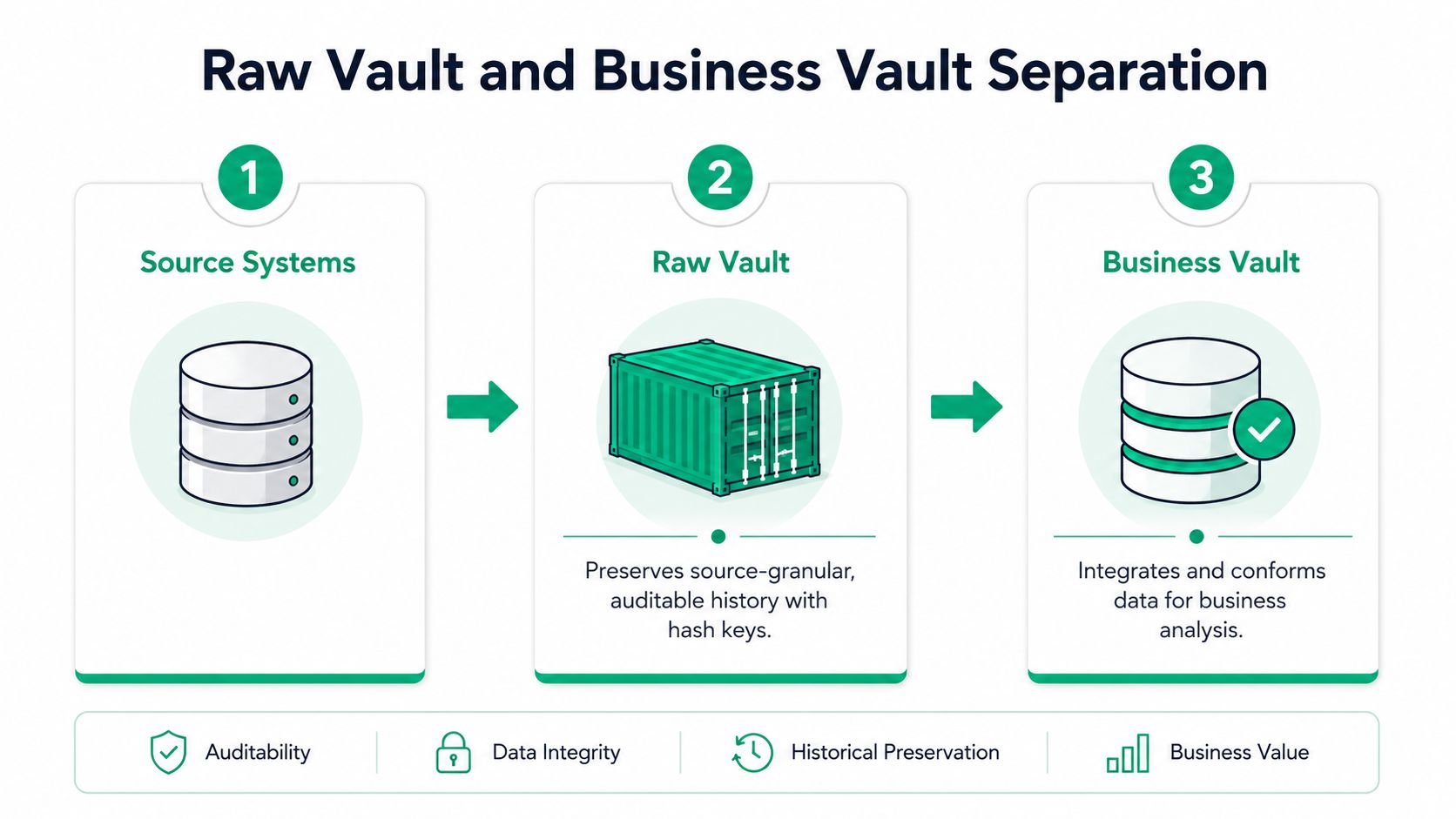
Raw Vault and Business Vault Separation
The biggest misunderstanding I see is that people assume the vault is one uniform layer. It isn't. Raw Vault and Business Vault solve different problems, and mixing them up usually creates the query headaches teams later blame on the methodology.
What belongs in the Raw Vault
The Raw Vault is where source-granular, auditable history stays close to the extract. Minimal transformation happens here, because the point is to preserve what arrived, when it arrived, and how it looked before business rules started reshaping it. That's what makes replayable audits possible, especially in regulated environments where nobody wants to guess what a record looked like six months ago.
This is also where the load-then-rule approach makes sense. Kevin Marshbank's explanation is direct, hard business rules can be applied as raw data lands, while soft business rules are better handled later in the Business Vault as data moves toward dimensions and reports Kevin Marshbank on raw data and business rules. That separation keeps ingestion stable even when the business logic changes.
Why the Business Vault exists
The Business Vault adds derived structures, including PIT tables and bridge tables, so temporal joins don't hammer downstream consumers every time they query history. Wikipedia's summary captures the core idea well, raw ingestion stays stable, while the business layer absorbs derived logic and denormalizations such as standardized addresses or calculated scores Data Vault model overview. That design shifts work away from ad hoc query time and into precomputed structures where it can be tested and controlled.
New calculations should rarely require restating old source data. If they do, the boundary between raw history and business logic is probably wrong.
That boundary matters for cost control too. When rules change, teams can add new calculations in the Business Vault without restating historical source data, which lowers rework risk and keeps spend more predictable. I've seen that difference show up most clearly in organizations that can't afford long reruns because a finance report changed or a compliance team asked for a new derivation.
If you're mapping raw ingestion to migration discipline, 10 data migration best practices that secure Indiana businesses in 2026 is worth a look.
How Data Vault 2.0 Compares to Star Schemas and 3NF Warehouses
Data Vault 2.0 fills a different role than a star schema or a 3NF warehouse. A star schema still makes sense when source systems stay steady and the reporting layer changes slowly. A 3NF warehouse can work when the enterprise wants tight normalization and the team can afford the modeling discipline. Data Vault 2.0 earns its place when the business needs an integration layer that can preserve lineage through messy source changes without forcing constant redesign.
Warehouse Pattern Comparison
| Criteria | Data Vault 2.0 | Star Schema | 3NF Warehouse |
|---|---|---|---|
| Auditability | Strong, with source history preserved in satellites | Usually weaker, because data is shaped for consumption | Stronger than a star in some cases, but often harder to trace end-to-end |
| Schema drift resilience | High, new sources often map to new satellites | Lower, changes can ripple through facts and dimensions | Moderate, but redesign pressure can still be heavy |
| Query performance | Often improved through Business Vault structures like PIT and bridges | Usually fast for common reporting queries | Can be slower for analytics joins and temporal logic |
| Engineering overhead | Higher upfront and in modeling discipline | Lower for straightforward marts | Higher due to normalization and integration complexity |
| Best fit | Changing sources, audit needs, multi-system integration | Stable reporting and simpler business questions | Transaction-heavy or normalization-driven enterprise modeling |
The table leaves out the part that hurts most in production. Data Vault 2.0 pushes complexity out of brittle ETL logic and into precomputed Business Vault structures, so query consumers get a model that is easier to audit and often faster to use, but the build and maintenance effort goes up. That is the trade-off, and it is why I do not recommend the pattern just because it sounds modern.
The operational cost shows up in hash rules, satellite grain, load orchestration, and the extra query acceleration layer you need if analysts expect fast answers. If those pieces are inconsistent, the warehouse becomes harder to trust, not easier. The architecture works best when the team accepts that it is paying more upfront to keep history stable, preserve business continuity, and avoid surprise rework later.
A published performance study of a Data Vault 2.0 implementation analyzed 350 observations and reported an average source-system load time of 49.998 seconds, ranging from 11.10 to 96.23 seconds, with an average of 50,381.43 loaded records per observation and record counts ranging from just over 2,124 to nearly 100,000. The same study found a mean load performance index of 107.05, a strong positive correlation of r = 0.84 between source-system load time and load performance index, and a moderate negative correlation of r = -0.49 between loaded record count and performance.
That kind of result matters for mid-market teams that need predictable IT budgets, not just a cleaner model diagram. More structure does not automatically mean better performance. It means the team has to know exactly where the work moves, and it has to maintain the model with enough discipline that the added layers do not become a drag on delivery.
The decision usually comes down to operating reality. If the warehouse is serving stable dashboards and there is little pressure from source drift, a star schema stays simpler and cheaper to run. If the organization is integrating multiple systems, keeping audit trails intact, and expects schema churn to keep coming, the extra modeling overhead can be a better fit than rebuilding marts every time a source changes.
For teams modernizing older platforms, legacy system modernization strategies that drive business growth gives useful context for when that extra structure pays off.
For partners that need a dependable recovery layer around the rest of the stack, the same thinking applies to the best virtual machine backup solutions. The pattern only works if the surrounding operational pieces are equally controlled.
Fitting Data Vault 2.0 Into a Modern Data Lake and Cloud Stack
The part most Data Vault introductions skip is operations. Hubs, links, and satellites are useful, but they do not explain how the vault sits beside a data lake, a cloud warehouse, and the rest of the stack without creating duplicate storage, brittle handoffs, or a second system that the team has to babysit. That gap is real, and a recent academic review explicitly found a clear lack of research on best practices for designing a data lake architecture optimized for loading into a Data Warehouse, especially a Data Vault 2.0-based EDW academic review on lake to EDW design.
The practical cloud pattern
The cleanest setup is usually boring. Land raw extracts in a durable staging zone, hash business keys consistently across pipelines, and keep the raw vault and business vault responsibilities separate so nobody debates later where a transformation belongs. That keeps duplicate logic out of both the lake and the warehouse.
Canonicalization is where teams feel the pain. If one pipeline treats "ABC-01" differently from another, the hash changes and the hub key stops being reliable. The source-normalized business key has to be concatenated deterministically before hashing, and the hash standard has to stay consistent everywhere, whether the platform uses MD5 or SHA-256.
Where the overhead shows up
PIT tables, effectivity satellites, and late-arriving data handling are the parts that usually get underexplained. They improve query speed and history handling, but they also add maintenance work, especially when analysts expect near-star-schema convenience on top of a vault that was built for auditability first. Community discussion keeps returning to the same trade-offs, where those structures belong, how much query acceleration is enough, and how much added engineering a team can support WhereScape discussion on Data Vault 2.0 trade-offs. That makes the decision less about elegance and more about maintenance capacity.
For teams trying to tie cloud resilience to recovery planning, the same operational mindset shows up in best virtual machine backup solutions. Backup discipline and vault design both fail for the same reason, too many moving parts without a clear restore path.
A Data Vault that is not mapped cleanly into the cloud stack just creates a second system to babysit.
Data migration to cloud, an Indiana SMB's playbook is a useful companion if you are planning the move as part of a wider modernization effort.
When the Overhead Is Worth It for Indiana SMBs
Data Vault 2.0 pays off when the business keeps changing underneath the data team. That's the short version. If a company has frequent source-system changes, multiple operational platforms, or strict compliance needs like HIPAA or CMMC, the model's auditability and resilience are often worth the extra engineering discipline.
The Southside problem that exposes the real value
A Greenwood business park with aging server hardware and a patchwork of disconnected tools is exactly where this architecture gets tested. One team wants finance history, another wants operations detail, and a third wants compliance evidence, but none of them can tolerate the same report breaking every time a source field changes. A managed Data Vault implementation fixes the root problem permanently by separating raw history from business logic and by making source change a loading issue, not a redesign event.
That doesn't mean every SMB should jump straight into it. If the company has only a few stable sources, simple analytics, and limited internal capacity, a star schema or lightweight ELT flow may be the better financial choice. The overhead of hash governance, satellite design, and Business Vault maintenance only pays back when complexity is part of the daily reality.
What the return looks like in practice
The business case is continuity and predictability. Data architecture that avoids repeated rework protects billable hours, reduces emergency change windows, and makes monthly IT spend easier to forecast. That's exactly the sort of improvement local decision-makers care about in Johnson County, downtown Indy tech hubs, and across the I-65 corridor, because downtime doesn't just hurt dashboards, it disrupts payroll, customer service, and revenue operations.
Decision rule: if the warehouse exists mainly to survive change, Data Vault 2.0 is a serious contender. If it exists mainly to answer a fixed set of questions, it may be too much.
A practical implementation partner also matters. For companies that already use tools like UniFi networking, Bitdefender GravityZone, or SOC-as-a-Service monitoring, the point is the same, architecture should reduce operational friction, not add another fragile layer. For an adjacent view on fast integrations, real-time data integration for HubSpot and Stripe is useful context because it shows how quickly upstream systems can create pressure on the warehouse.
Your Implementation Checklist and Next Steps
Start with hash-key governance. Decide how business keys are normalized, which hash algorithm is the standard, and how composite keys are concatenated before anyone writes a loader. If that part is vague, the rest of the warehouse will drift.
Next, define satellite grain with discipline. Use satellites to absorb schema drift, but don't let every attribute live in one catch-all table if change rates and business use cases are clearly different. Then decide where query acceleration belongs, because PIT tables and bridges are powerful only when they solve a known access pattern.
A practical rollout order
- Lock key standards first. Make one hash rule the default and document it before production loads start.
- Separate raw history from business logic. Keep the Raw Vault stable and push derivations into the Business Vault.
- Automate the boring parts. Loader generation, metadata handling, and documentation should not depend on hand-built scripts.
- Test late-arriving data paths. Don't wait for a month-end close to discover a temporal join problem.
- Roll out by source family. Greenwood offices, the I-65 corridor, and downtown Indy tech hubs all have different operational pressure, so phased delivery beats a big-bang cutover.
That's the same kind of thinking that keeps managed IT environments sane. You don't fix everything by adding more tools, you fix the weak point, prove the process, and expand with less risk. For Indiana SMBs, that usually means a controlled rollout, clear ownership, and a partner who can keep production running while the data model matures.
If you're evaluating Data Vault 2.0 for a Greenwood or Indianapolis business, Finchum Fixes IT can help you map the architecture, harden the network, and keep the rollout from turning into downtime. Visit Finchum Fixes IT to ask about a Free Network Assessment or Security Risk Audit that fits your data platform, compliance needs, and growth plan.