Web Design Pricing Explained for Small Business Owners

A small business website usually costs roughly $3,000 to $15,000 upfront, plus $150 to $500 per month for hosting, updates, and support. If you want a professional build instead of a DIY site, that's the number you should budget around, not the fantasy price people hope for.
A Greenwood owner usually learns that lesson when two quotes land on the desk and don't look like they're even for the same job. One quote is for a basic brochure site. The other includes planning, design, setup, integrations, and ongoing care. That's not confusion, that's how web design pricing works.
What Web Design Really Costs in 2026
A lot of owners in Greenwood, or anywhere along the I-65 corridor, start with the same question, “Why is one website quote $2,500 and another one $12,000?” The honest answer is that they're usually not comparing the same scope. A clean template site for a local service company is a different job from a custom build with booking, content management, and support.
Independent pricing summaries show that 56.75% of respondents reported average project prices between $2,500 and $9,999, while only 2.4% said their average project exceeded $10,000 in one 2025 pricing summary, and a separate 2026 compilation put small-business websites commonly around $3,000 to $15,000 depending on whether the work is freelancer-led or boutique-agency-led (state of web designer pricing 2025). That same market picture also shows a long professional middle market, not a single fixed rate.
The spread comes from the service model
DIY builders often sit around $20 to $50 per month, which is fine if the goal is to get online fast and keep expectations low. Professional work moves into a different category because you're paying for strategy, design, development, testing, and launch support. That is why a template site, a boutique build, and a custom agency project can all be called “a website” while living in very different price bands.
Practical rule: Don't ask, “What does a website cost?” Ask, “What does this site need to do, and who is responsible after launch?”
Treat web design like a three-year ownership decision. The launch quote matters, but it does not tell you what the site will cost to keep stable, current, and useful. If the build is cheap and the fixes keep piling up, you do the same math business owners already use for managed IT and security work. A low upfront price that leads to outages, broken forms, or slow updates is not a bargain. It is deferred cost.
For a useful outside reference on how vendors frame the market, compare website creation prices and then compare that to what your own site needs. If you are also sorting staffing and support decisions on the IT side, this guide on managed service vs staff augmentation fits the same budgeting mindset.
Pricing Models and How They Shape Your Quote
A quote is really a billing model with a logo on it. Two vendors can price the same website differently and still be honest, because one is selling time, another is selling a defined scope, and another is selling ongoing support. That is the part owners need to understand before they compare numbers.
Hourly billing trades certainty for visibility
Hourly pricing is simple. You pay for time when the scope is still moving, or when the work is advisory, cleanup, or small enough that a fixed bid would be guesswork. That structure works, but only if you accept that the final bill rises with every added request.
The danger is scope drift. A request for one more page usually means design tweaks, content edits, mobile checks, QA, and launch changes. A site with a checkout form or staff scheduling also needs integration work, and the billing changes because that work has to be configured, tested, and retested.
If you want a concrete comparison, $85 per hour over 60 hours lands at $5,100. The total is the point. Hourly billing does not remove cost, it just makes the cost move with every hour the project consumes.
Fixed-fee projects buy predictability
Fixed-fee pricing works best when the deliverables are clear. You define the scope, the vendor prices that scope, and both sides agree on what counts as extra. That is why fixed pricing is common for launches, redesigns, and brochure sites with limited moving parts.
It also forces discipline. If the site needs a booking flow, CRM sync, or a form that has to connect Google Calendar quickly, the vendor has to account for the build, testing, and failure points up front. That is not a small add-on. It changes the work inside the quote, so the contract model has to spell out exactly who owns each piece.
Retainers cover the living part of the site
Monthly retainers make sense when the website is not a one-time project. If the site needs content updates, support, hosting coordination, and security upkeep, a recurring fee is cleaner than surprise invoices. For a business that wants predictable budgeting, this structure is easier to manage than a pile of small tickets.
A retainer also fits the same ownership logic as managed service vs staff augmentation. You are paying for continuity, response time, and someone staying accountable after launch, not just for the first round of design and development.
| How Pricing Models Compare for Small Business Websites | |||
|---|---|---|---|
| Model | Best For | Typical Range | Risk |
| Hourly | Consulting, small fixes, undefined scope | $25 to $300 per hour | Scope can drift if you are not disciplined |
| Fixed Fee | Defined launches and redesigns | Set by scope | Change orders can raise the final total |
| Monthly Retainer | Ongoing support, updates, and ownership | Recurring fee | You need a clear list of what is included |
Treat the quote as a three-year ownership decision. The launch price matters, but so do updates, fixes, and the cost of avoiding downtime, broken forms, or slow changes later. That is the same math owners already use for managed IT and security work. A cheap build that creates repeat problems is deferred cost, not savings.
What Actually Moves the Price Up or Down
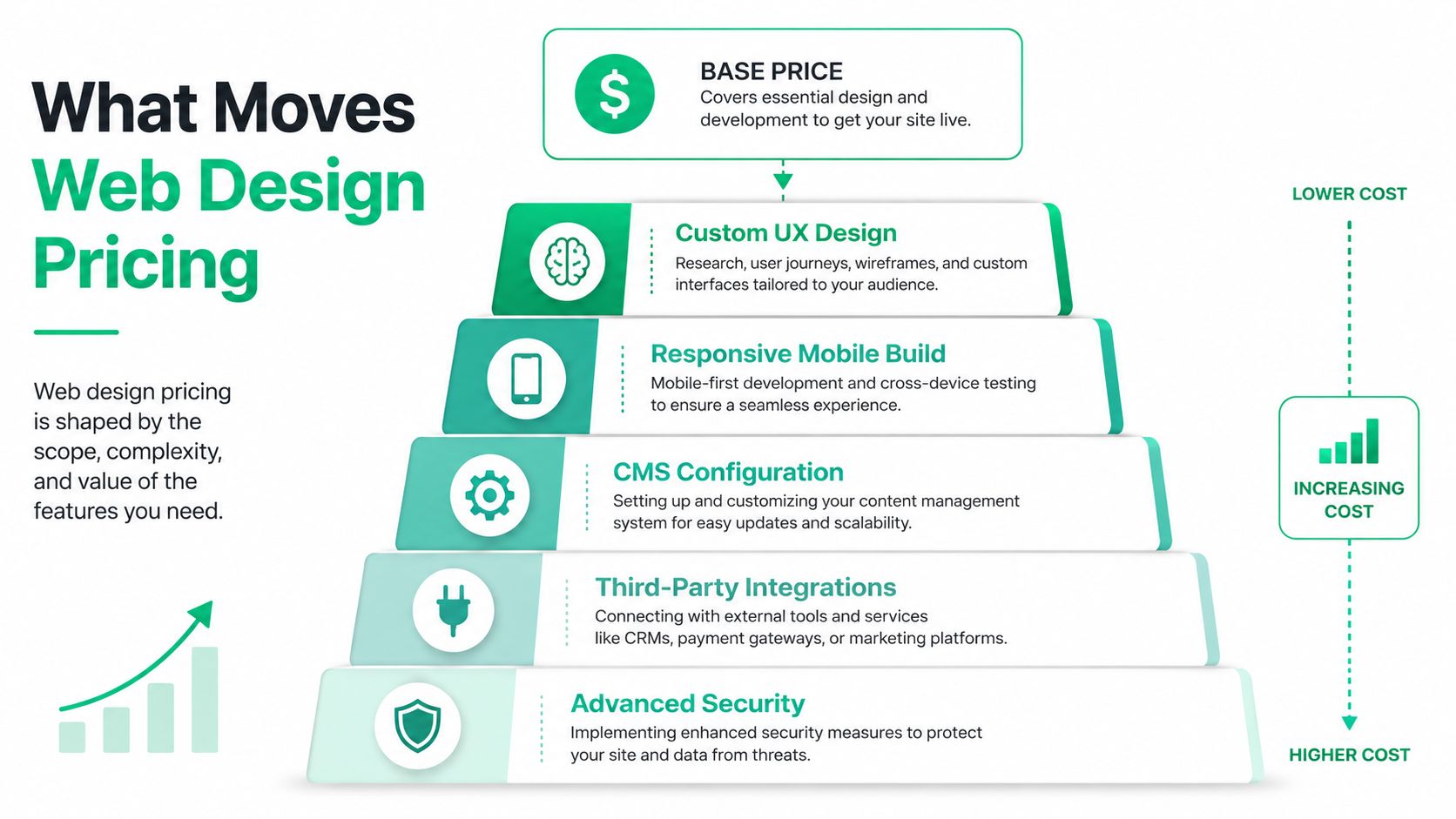
Page count is one of the least useful ways to judge a quote. A five-page brochure site and a five-page storefront can be miles apart in effort. What moves the number is the amount of production work behind the pages.
The expensive parts are the ones nobody sees
Custom UX design takes time because someone has to decide how visitors move through the site, what gets attention, and what gets left out. Responsive mobile builds also add work because the layout has to behave across screen sizes without breaking the experience. CMS configuration, third-party integrations, booking flows, payment handling, accessibility hardening, and SEO foundations all create more engineering and QA work.
That's why two sites with the same page count can price out completely differently. One might just reuse a template and existing brand assets. The other might need a payment gateway, CRM connector, booking logic, and a clean admin workflow for staff. Same page count, very different labor stack.
Budget by functional module, not by page. A site with checkout, customer accounts, and integrations is not a “five-page website” in any practical sense.
The cheaper parts reuse more
Template-based designs lower cost because they reuse proven structure. Reusing logos, photography, and copy blocks reduces production time. Limiting custom animation and keeping the plugin stack tight also keeps the build simpler and easier to support later.
For a local business owner, the cleanest way to read a quote is to ask what has to be built from scratch. A brochure site with contact details, service pages, and a contact form is one level. A product catalog with checkout and customer access is another. In practice, the second one can land three to four times higher because it drags in more engineering, testing, and support work.
The comparison to custom software vs off-the-shelf makes sense. The more the site behaves like a custom system, the more it should be priced like one.
Sample Pricing Tiers and What You Get
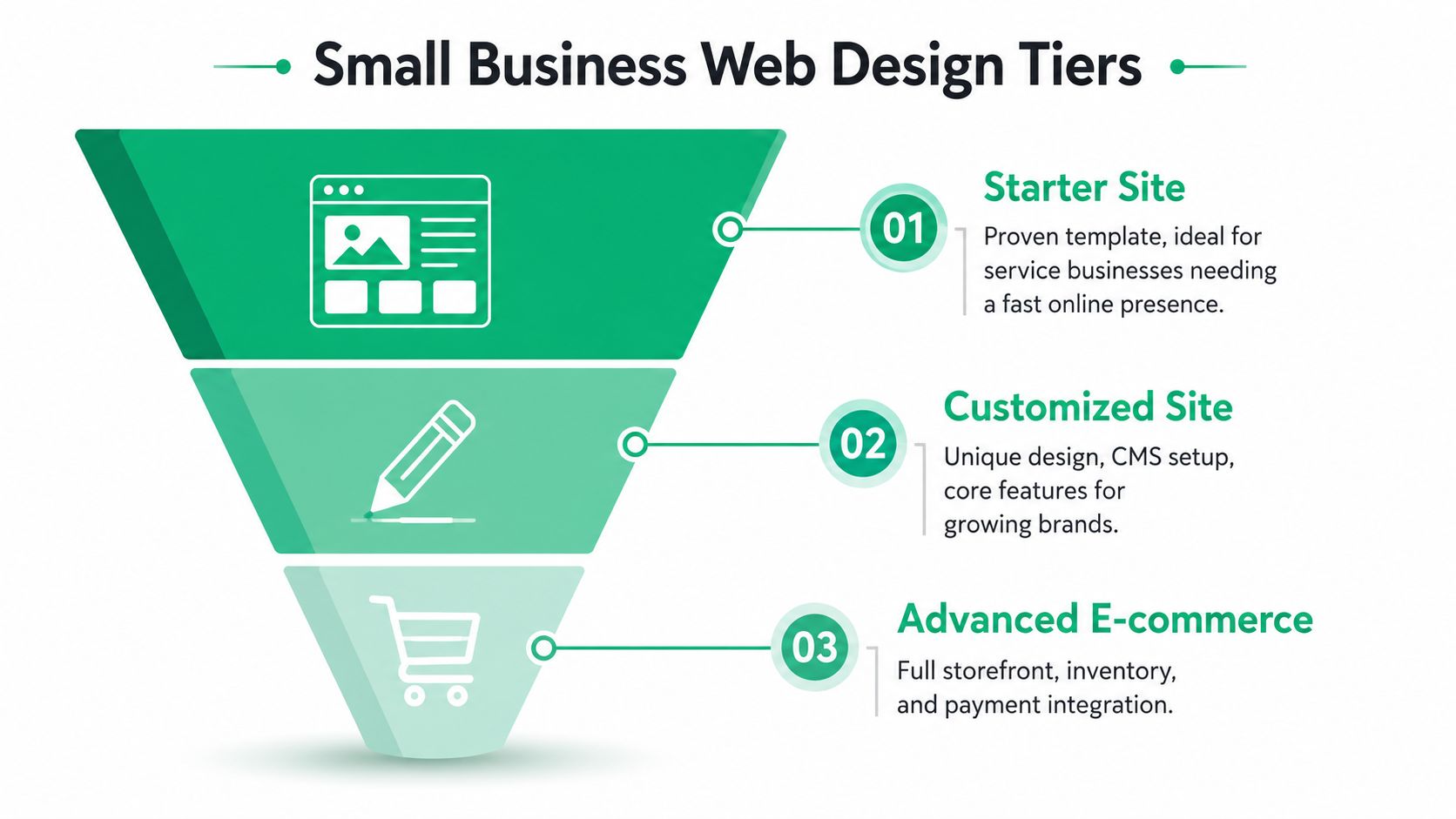
Buy the site by tier. That is the clean way to judge web design pricing over three years, because the first quote never tells the full story. A cheap build that falls apart, needs constant fixes, or forces an early rebuild costs more than a stronger site that runs without drama.
Starter site
A starter site fits a business that needs credibility, contact information, and a simple online presence. These projects usually use a proven template and often land in the $2,500 to $5,000 range. You get speed and lower upfront cost. You do not get much custom functionality.
The usual package includes basic layout, core pages, a contact form, and setup. It leaves out deeper integrations, custom workflows, and ongoing content help. If you add monthly support, the ownership cost rises over time, so factor that in before you sign.
Customized small-business site
This is the middle ground most owners need. It usually includes original design, CMS setup, light SEO, and a few core integrations. At this level, the site starts doing business work instead of just sitting there.
That tier often lands around $6,000 to $15,000. The price moves because the site has more moving parts, not because the proposal is dressed up. If you want something that can grow without a rebuild later, this is usually the smarter buy.
Advanced e-commerce
Add storefront logic, inventory, payment integration, API work, accessibility work, and a defined launch plan, and the price moves again. Complex projects often sit at $15,000 to $40,000 or more. That is the cost of a system that has to stay stable, secure, and easy for staff to run.
The monthly support question matters here. If the vendor handles updates, backups, and changes, those recurring fees belong in the decision from day one. If not, you are buying a launch and taking on the maintenance burden yourself.
For readers who want to see how pricing structure changes by package, find plan options. The broader lesson also matches cloud migration planning for Indianapolis businesses, where the cost includes the move and the operating model that follows.
What a Good Quote Should Include
A good quote reads like a work order. A weak one reads like a sales pitch. Greenwood owners get burned when the scope is fuzzy, because vague pricing turns into vague billing after launch.
The line items that should be there
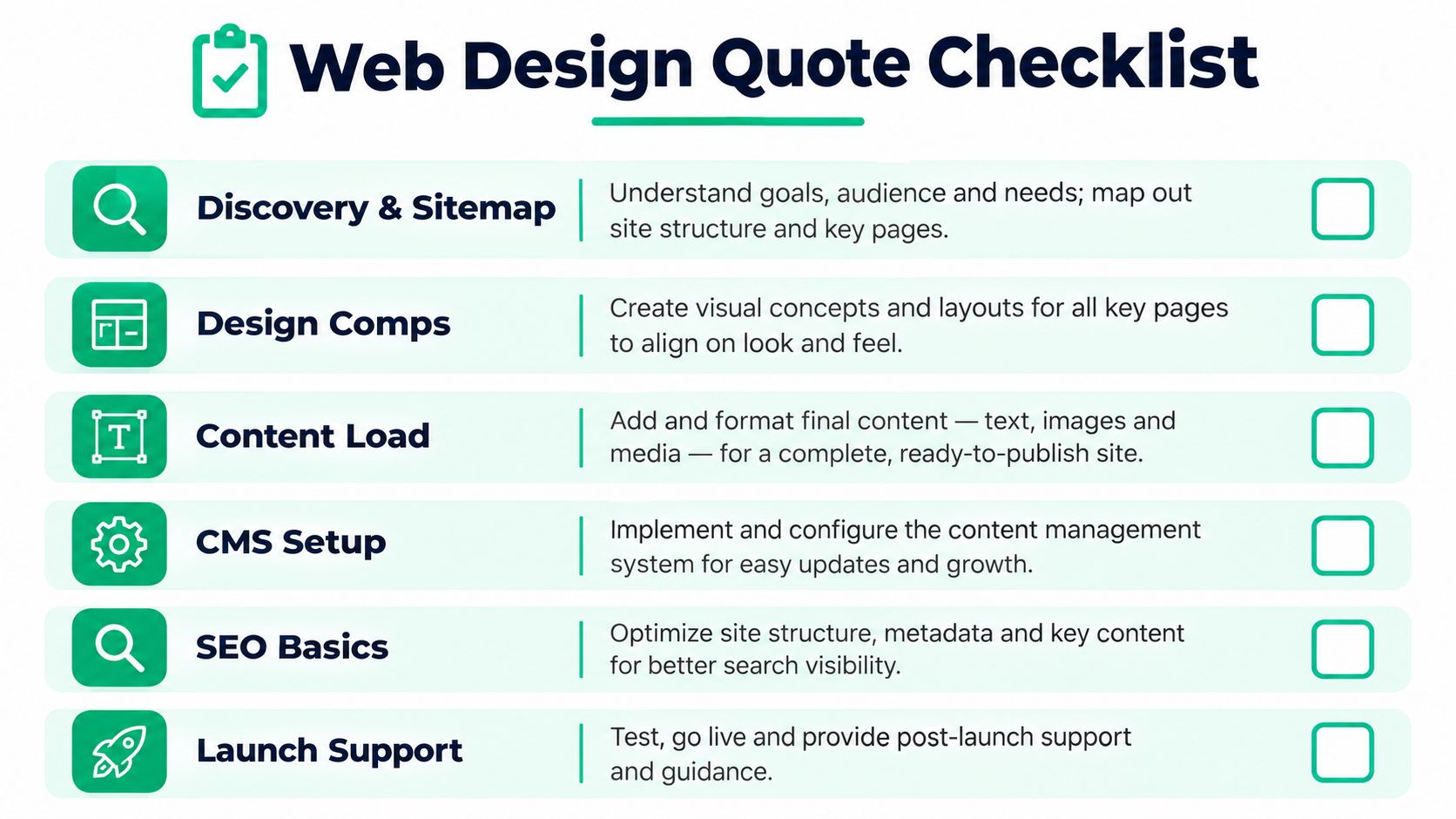
A solid proposal names discovery and sitemap work, design comps, content load, CMS setup, integrations, QA and accessibility checks, training, launch, and post-launch support. If those pieces are missing, you are buying assumptions instead of deliverables.
It also spells out what happens if the scope grows. Owners change their minds once they see the first mockup, and that is normal. Revision rounds, content handoff, and integration changes need a price path before the first file is opened.
Red flags worth taking seriously
- Vague scope: If the proposal says “complete website” and stops there, push back.
- No revision count: You need to know how many rounds are included before extra charges start.
- Missing ownership terms: Domain, code, and source files should not be a mystery.
- Hosting lock-in: If you can't move the site without pain, that's a problem.
- No support window: Launch day is not the end of the project.
Ask who owns the files, who owns the domain, and what the monthly fee covers. If the answers sound slippery, keep shopping.
A useful breakdown of common web-design pricing structures helps only if you treat it as a reference point. If you are comparing vendors, use the same standards you would use for choosing a software development partner.
Questions to ask before signing
- Who owns the code and design files?
- How are revisions counted?
- What happens if the scope grows?
- What's included in the monthly retainer?
- How are security and backups handled?
In my experience, the jobs that stay clean all start the same way. The owner asks hard questions before signing and gets straight answers before money changes hands. That habit keeps website spending predictable, just like managed IT.
The Three-Year Cost Picture Most Owners Miss
The launch invoice is the easy number to see. The number that hits the budget is what the site costs to keep alive over three years. That's where a lot of Indianapolis-area owners get caught, because the first build looked affordable and the surprises came later.
A simple example helps. One business in the south side of Indy bought a site on a one-time build, then paid for fixes, hosting questions, content updates, and plugin cleanup in scattered bursts every quarter. A peer with a similar site paid a fixed monthly amount and stopped treating the website like an emergency machine. Same kind of website, very different stress level.
Ownership costs stack up fast
Recent pricing roundups say small-business websites often land around $3,000 to $8,000 upfront, while monthly hosting, maintenance, updates, and support commonly add $150 to $500 per month (how much an internet site will costs in 2026). Over three years, that recurring layer can outgrow the original build, especially if the site needs content changes, security patches, or platform updates.
A managed retainer changes the math. Instead of waiting for a broken form, a plugin conflict, or a stale homepage to trigger a bill, you turn that work into a predictable monthly line. That's the same budget discipline smart owners already expect from IT support.
| Three-Year Cost of Ownership for a Small Business Site | |||
|---|---|---|---|
| Item | DIY Only | Freelancer On Call | Managed Retainer |
| Build | Lower upfront, more self-service | Midrange launch fee | Higher launch fee, more included support |
| Hosting and upkeep | Usually separate, often self-managed | Separate or ad hoc | Usually bundled or clearly defined |
| Content and changes | Owner handles most of it | Billed as needed | Usually part of the monthly plan |
| Risk of surprise invoices | Low cash outlay, high owner time | Medium | Lower, because the work is scheduled |
| Best fit | Very simple needs | Businesses with occasional changes | Owners who want predictability |
The point isn't that one model is always cheaper. The point is that ownership cost is the budget number. A site that looks cheap at launch can get expensive if every change turns into a ticket.
This is the same kind of thinking we use in IT budget planning and resilience. If you want fewer budget shocks, buy the operating model, not just the pretty homepage.
Pricing, ROI, and the Indianapolis Business Case
A website is part of business continuity now. If it runs slowly, breaks on mobile, or leaves gaps in security, your team loses time and your customers leave. Owners should judge web design the same way they judge managed IT, through the cost of avoidable downtime, lost leads, and constant cleanup. That is the actual price, not the launch quote.
Good web design reduces avoidable friction
A quality site cuts staff time by answering routine questions, routing leads, and reducing the back-and-forth that burns billable hours. It also lowers the odds of a failed form, a broken mobile layout, or a site that looks outdated and hurts trust. That is operational cleanup, plain and simple.
For healthcare, defense contractors, and general business clients, the risk language changes, but the rule stays the same. HIPAA governs healthcare privacy and security obligations in the United States, CMMC is the Department of Defense's cybersecurity certification framework for defense contractors, and NIST CSF is a widely used voluntary risk-management framework for general business security (cost of downtime 2026). If your site handles sensitive inquiries or sits next to regulated systems, the build and support plan need to reflect that.
Predictable support beats panic spending
A good website package looks a lot like a managed IT contract. You pay a known monthly amount, the site gets maintained, and your team does not scramble every time something changes. That predictability is the ROI owners in Greenwood, Indianapolis, and the surrounding counties should care about.
The same logic holds whether the site sits on a simple platform or a more structured stack. If your business is already thinking about infrastructure, cloud migration planning for Indianapolis businesses shows why steady operating costs beat one-time heroics. For owners who want the web side held to the same standards as their networks and security, a single partner can simplify both the build and the ongoing support model.