Cybersecurity Services Pricing for SMBs: A Practical Guide
Most SMBs pay $50 to $200 per user per month or $25 to $150 per device per month for managed cybersecurity, with one-time assessments and incident response billed separately. Your real price depends on endpoint count, compliance scope, log volume, after-hours coverage, and the response time your contract demands.
A Johnson County business owner usually starts thinking about cybersecurity services pricing after a familiar failure. The Wi-Fi drops in an old brick building near the I-65 corridor, a server in a Greenwood business park starts throwing disk errors, or an employee reports a suspicious Microsoft 365 login after hours. The invoice arrives later, but the business cost starts immediately.
That cost can reach about $9,000 per minute of downtime for medium and large organizations, or roughly $540,000 per hour, calculated by multiplying downtime minutes by the cost per minute, as explained in Atlassian's downtime cost guidance. A smaller company may not carry that exact exposure, but the business logic still holds. Security spending should reduce interruption, protect billable labor, and give the owner a predictable operating budget.
In our 17 years of local service, we've seen the same pattern repeatedly. A company pays for tools, but nobody owns alert review, patching, backup verification, or response decisions. That isn't a security program. It's a pile of subscriptions waiting for somebody to notice trouble.
What SMBs Actually Pay for Cybersecurity Services
For most small and mid-sized businesses, managed cybersecurity lands between $50 and $200 per user per month or $25 and $150 per device per month, with assessments, penetration tests, and emergency response priced separately. A business with a simpler environment may sit near the lower end, while regulated operations, distributed teams, and round-the-clock response needs push the bill higher.
That range gives an owner a starting point, not a quote. A Jefferson Street retailer with a stable point-of-sale environment may need endpoint protection, email security, patching, and business-hours monitoring. A 75-employee logistics company may have warehouse devices, cloud applications, remote access, servers, multiple locations, and operational systems that require deeper monitoring. Same city, different attack surface, different labor burden.
The practical split is between recurring managed services and episodic expert work. Endpoint detection and response, monitoring, patch management, and routine alert handling are commonly bundled into a subscription. A penetration test, HIPAA gap assessment, CMMC readiness project, forensic investigation, or breach-containment engagement normally sits outside that recurring fee.
| Service Type | Typical Range | Billing Style |
|---|---|---|
| Managed security per user | $50 to $200 per user per month | Recurring |
| Managed security per device | $25 to $150 per device per month | Recurring |
| MSSP basic service | $45 per endpoint per month | Recurring |
| MSSP premium service | $73 per endpoint per month | Recurring |
| Cybersecurity consulting | $175 to $400 per hour | Project or hourly |
| Incident response or forensics | $300 to $600 per hour | Emergency or retainer |
The endpoint benchmark reports $45 basic and $73 premium average monthly pricing, while all surveyed MSSPs offered SOC services and 98% provided MDR, according to the 2025 MSSP pricing benchmark. That tells you the market has moved beyond simple antivirus monitoring toward bundled detection and response.
For a plain-English explanation of the wider Indiana managed services market, read MY CYBER GUARD's insights. Before requesting proposals, also review the real managed IT services cost in Indiana, because security-only pricing and bundled IT-plus-security pricing can look very different.
Pricing Models Compared Per-Device Per-User Project and MSP
A proposal becomes easier to judge once you identify how the provider counts work. Per-device pricing counts protected endpoints. Per-user pricing counts employees or identities. Project billing covers defined work. An MSP subscription combines recurring support, security, administration, and strategic oversight into a standing agreement.
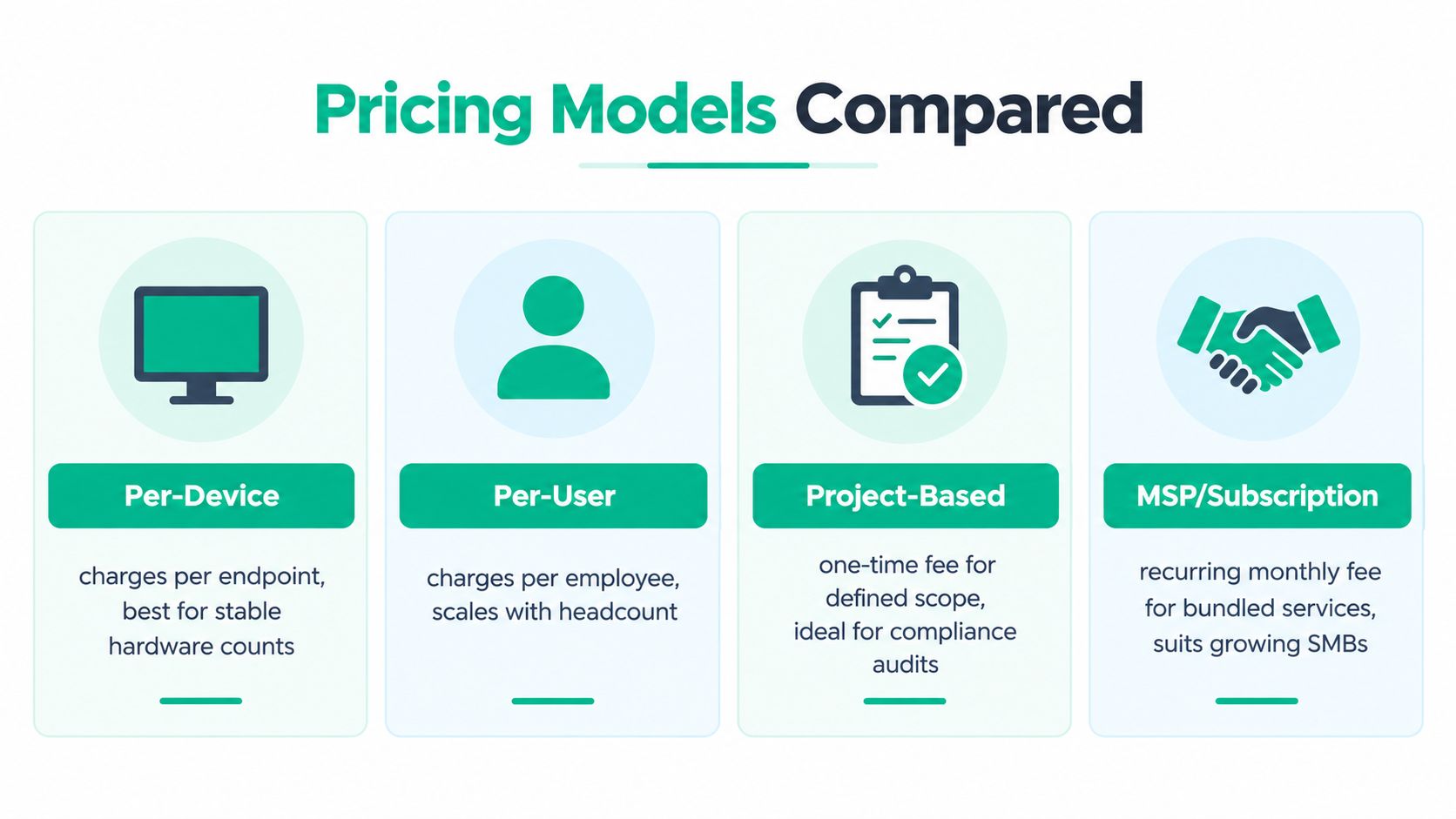
Per-device pricing
This model suits a shop, warehouse, or manufacturing floor where the number of workstations and equipment changes less than the number of applications. A Greenwood dental practice with 18 workstations may find this straightforward. The provider can attach EDR, patching, and monitoring to each machine.
The weakness appears when employees use several devices or when servers, firewalls, and specialized equipment carry separate fees. Ask whether laptops, servers, network appliances, and mobile devices are counted independently.
Per-user pricing
Per-user billing fits professional offices. A Carmel insurance agency may have employees carrying a laptop, phone, and several SaaS identities. Paying by user can cover that broader identity footprint more cleanly than counting every endpoint.
The catch is definition. Ask whether shared accounts, contractors, temporary staff, and service accounts count. A low per-user rate can become expensive if every cloud identity generates a separate charge.
Project-based work
Project billing is the right tool for a HIPAA gap assessment, phishing simulation, penetration test, network segmentation project, or CMMC documentation effort. You pay for a defined outcome instead of carrying a recurring fee forever.
Demand a written scope, deliverables, assumptions, and change-order rules. Incident response and digital forensics commonly cost $300 to $600 per hour, according to this cybersecurity consultant rate guide, so vague emergency language creates budget risk.
MSP subscriptions
An MSP subscription bundles recurring support into a monthly retainer. It can include SOC-as-a-Service monitoring, user support, patching, backup oversight, network administration, and security reporting. Growing firms often prefer this model because one provider owns the operating rhythm.
Hybrid quotes are normal, and mixing models is usually smarter. Use a subscription for routine protection, per-user or per-device pricing for scalable tooling, and project fees for assessments or remediation. For more negotiation guidance, see IT support pricing models and negotiation tips.
Practical rule: Don't compare monthly totals until each proposal uses the same user count, endpoint count, coverage hours, response SLA, and compliance scope.
Common Line Items That Show Up on Your Invoice
A cybersecurity invoice should tell you what the provider is operating, not merely list product names. Start with the recurring stack, then separate one-time work so an unusually large bill doesn't get mistaken for normal monthly service.
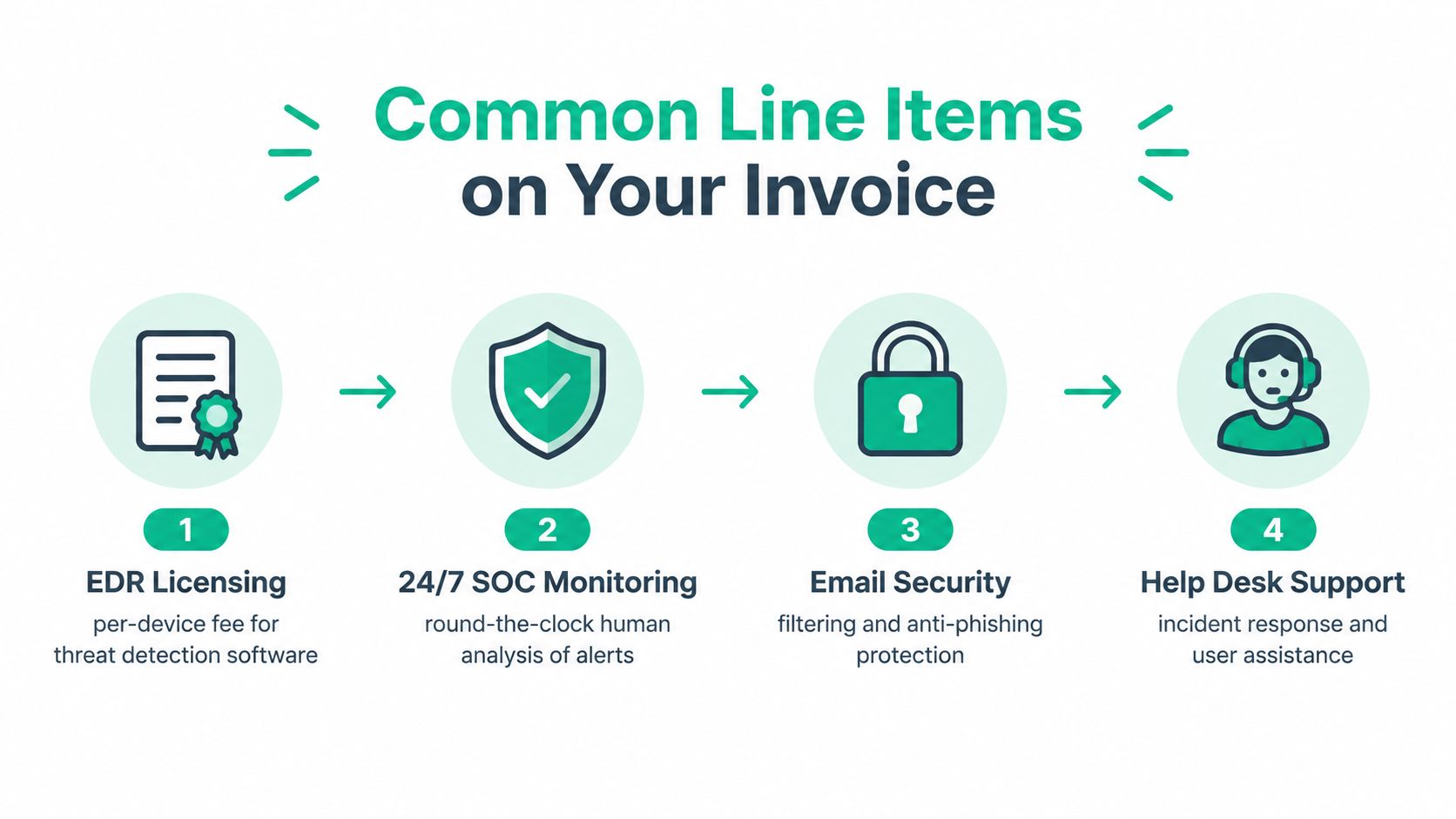
The recurring protection layer
EDR licensing pays for software that watches workstations and servers for suspicious behavior. Bitdefender GravityZone may be one candidate, but the product matters less than deployment coverage, policy management, isolation capability, and who reviews the alerts.
SOC monitoring pays analysts to interpret events rather than forward notifications. A SOC-as-a-Service team should explain escalation, triage, containment authority, and reporting. Ask whether “24/7” means human review or an automated mailbox.
MDR hours cover investigation and response work. Some contracts include routine containment, while others charge for analyst time after an alert crosses a severity threshold.
Other recurring lines commonly include:
- Patch management: Testing and applying updates across operating systems, applications, servers, and network equipment.
- Vulnerability scanning: Finding exposed weaknesses and tracking remediation rather than delivering a one-time report that nobody revisits.
- Phishing simulation and awareness training: Testing behavior and teaching employees how to report suspicious messages.
- Dark-web credential monitoring: Watching for exposed usernames, passwords, or company references.
- Cloud SaaS security: Reviewing Microsoft 365 or Google Workspace settings, identities, audit events, and risky sharing.
Email protection deserves its own review because filtering, impersonation controls, and user reporting can prevent a compromised account from becoming an operations problem. A business evaluating broader communications security can also find fraud filter resources from Premier Broadband.
The episodic invoice
Risk assessments, gap analyses, penetration tests, HIPAA, PCI-DSS, CMMC, and SOC 2 readiness work are usually project fees. Incident response retainers, breach containment, forensic investigations, backup verification, and cyber insurance questionnaire support may appear as separate charges.
Don't accept a percentage allocation from a provider as if it were universal accounting. Providers price these lines differently. Instead, ask for the exact license, analyst labor, included hours, log allowance, and exclusions.
Common overpayment traps include branded awareness portals with features your team won't use and SIEM tiers that charge heavily for unnecessary log ingestion. The Indiana guide to managed detection and response can help clarify what MDR should include before you sign.
What Drives Cybersecurity Costs Up or Down
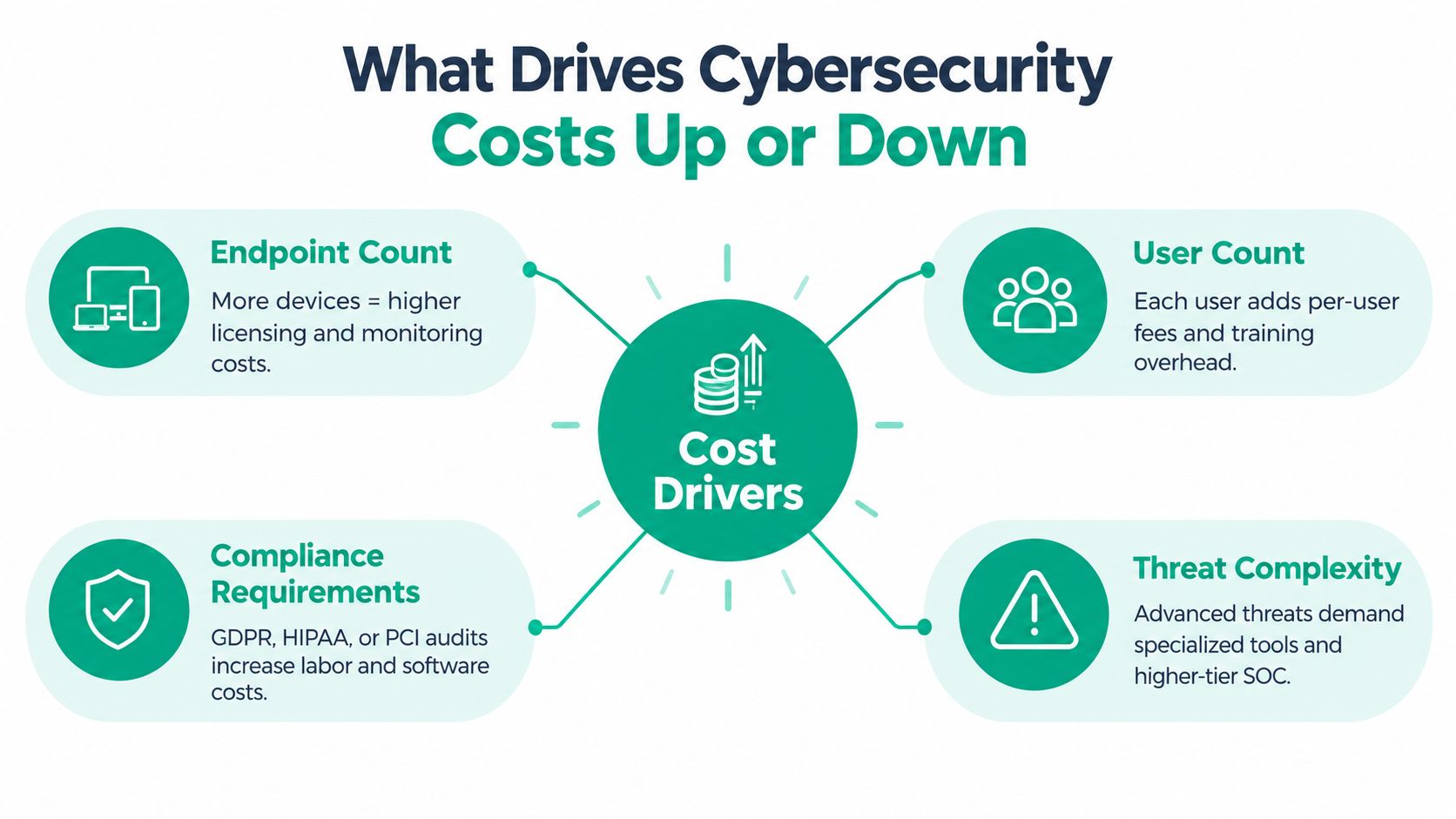
A small environment with modest coverage can remain a manageable monthly expense. Add more endpoints, high-volume logs, regulated data, complex integrations, and strict response commitments, and the provider needs more software, storage, analyst time, and escalation capacity.
The base multiplier
Endpoint and user count establish the first calculation. A provider supporting 32 endpoints has a different licensing burden than one supporting hundreds. Per-user contracts also account for identity administration, training, email protection, and cloud access.
The 2025 MSSP benchmark reports discount pricing often appears at 100 and 500 endpoints, so ask whether your quote changes at a defined volume threshold. Don't assume a discount is automatic. Put the threshold and effective date in writing.
The expensive layers
Log volume can change a quote quickly. Firewalls, cloud applications, servers, identity systems, and network devices all generate events. A SIEM priced around ingestion can become costly when the provider collects everything without first deciding which events support detection or compliance.
Compliance scope adds documentation, evidence collection, control mapping, and review. HIPAA affects healthcare operations, PCI-DSS applies to payment environments, and CMMC matters to defense contractors handling covered information. General businesses can use the NIST CSF as a practical structure, but a framework doesn't remove the labor needed to implement and prove controls.
Coverage hours matter because business-hours monitoring and 24/7 human response are different services. Survey data says 47% of MSP customers are willing to pay more for 24/7 monitoring and faster response, according to WatchGuard's 2026 MSP survey. That demand doesn't mean every company needs the same SLA. It means buyers should decide deliberately.
Response SLAs raise pricing when the provider promises fast acknowledgment, containment, remediation, executive notification, or onsite coordination. Hybrid work, OT systems, third-party integrations, multiple locations, and co-managed responsibilities add complexity.
For a practical way to think about exposed systems across the I-65 corridor, review attack surface management for Indiana businesses. Request separate prices for business-hours coverage, 24/7 coverage, co-managed monitoring, and fully outsourced response. That comparison reveals what drives the bill.
A Realistic Budget Example for a 25-Employee Indiana Business
Consider a representative 25-employee Greenwood professional services firm with 32 endpoints, Microsoft 365, a hybrid workforce, and light HIPAA-adjacent data handling. The firm isn't a hospital, but it still needs disciplined identity protection, email controls, endpoint visibility, and documentation that can withstand client questions.
The proposed recurring stack looks like this:
| Line Item | Monthly Cost | Annual Cost |
|---|---|---|
| MDR with EDR and 24/7 SOC | $1,400 | $16,800 |
| Per-user identity and email protection | $650 | $7,800 |
| Vulnerability scanning and patch management | $275 | $3,300 |
| Recurring subtotal | $2,325 | $27,900 |
| Quarterly phishing simulation | Not monthly | $1,600 |
| Annual risk assessment | Not monthly | $2,400 |
| Incident response retainer covering ten hours | Not monthly | $3,500 |
| Compliance documentation | Not monthly | $1,800 |
| Annual add-ons | Not monthly | $7,700 |
The recurring subtotal is $2,325 per month, not $4,925. The stated $4,925 recurring total requires an additional $2,600 per month in managed IT, help desk, network administration, backup operations, or other services. That's an important distinction. A proposal that combines security and IT should show both the security-only subtotal and the full managed-service total.
If the firm uses the fully loaded figures specified for this scenario, the stack totals $4,925 recurring plus $7,700 in annual add-ons, which equals $66,800 per year. Spread across 25 employees, that comes to roughly $223 per user per month, not $205. The difference matters because owners need arithmetic they can audit.
Adding PCI scope introduces payment-environment controls and evidence. Adding two servers increases endpoint, patching, backup, and monitoring work. Adding after-hours on-call raises labor and SLA expectations. Each change belongs on its own proposal line, so a Greenwood owner can see which decision changed the budget.
Owner's test: If the provider can't reconcile the monthly subtotal, annual add-ons, and per-user equivalent, don't sign the proposal yet.
How to Evaluate MSSPs and Read a Cybersecurity Proposal
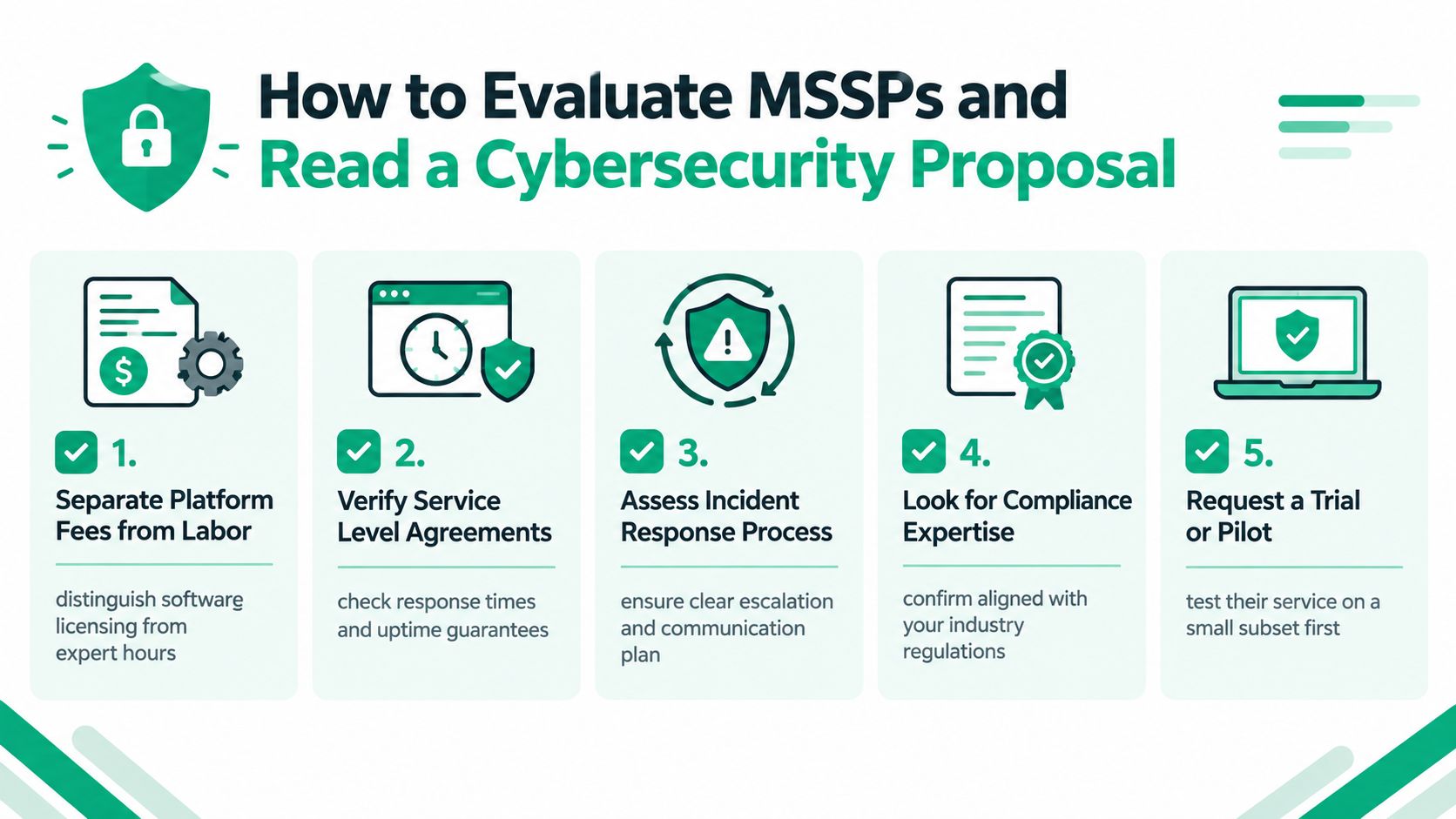
A polished proposal can still hide unclear responsibility. Read it like an operating contract, not a brochure. The first question is whether the platform fee and expert labor appear separately.
Ask what the analysts actually do
A provider should identify the SOC structure, including whether Tier 1 analysts triage alerts, whether Tier 2 or Tier 3 staff investigate complex events, and who has authority to isolate an endpoint or disable an account. Confirm whether the service includes EDR or XDR, threat hunting, email telemetry, identity signals, and firewall data.
“24/7 monitoring” needs definition. Ask whether a human reviews alerts continuously, what happens during a confirmed incident, and how after-hours response is billed. Some contracts include alert review but charge separately for remediation. Others include containment but exclude onsite work, application repair, or restoration.
Read the SLA line by line
Look for acknowledgment time, escalation time, communication rules, remediation targets, and exclusions. A response-time promise means little if the contract excludes weekends, third-party systems, privileged accounts, or the very tools generating the alert.
Ask these questions before approval:
- Platform fees: Which licenses, storage tiers, and log-ingestion allowances are included?
- Labor: How many investigation or remediation hours are included each month?
- Ownership: Who owns logs, detection rules, forensic artifacts, and exported reports if you leave?
- Contract exit: What are the renewal terms, termination rights, transition duties, and data-return process?
- Retainers: Does a prepaid assessment or incident response retainer expire, roll over, or convert to time-and-materials billing?
A prepaid retainer can make sense for incident response because emergency forensic work commonly runs $300 to $600 per hour, as documented in the earlier rate guide. It won't replace insurance, backups, or a tested communications plan.
For buyers in Johnson County and Hamilton County, compare local providers against national MSSPs using the same endpoint inventory, compliance requirements, service hours, escalation contacts, and SLA questions. A local provider may coordinate more easily with your office, network, and physical recovery needs. A national provider may offer broader SOC resources. The right choice depends on who will own the work.
Use this expert guide to choosing a managed service provider in 2026 as a companion checklist, then request a pilot on a limited device group where the contract permits it.
Turning Cybersecurity Spend Into ROI and Next Steps
Cybersecurity is easier to approve when you tie the bill to business continuity. A $1,500 monthly MSP retainer costs $18,000 annually. If it prevents one ransomware-driven two-day outage for a 25-person Greenwood or Carmel business, the retainer can pay for itself during that single event, depending on the company's lost revenue, payroll, recovery, and customer obligations.
The broader downtime benchmark estimates about $9,000 per minute for medium and large organizations, or roughly $540,000 per hour, through the calculation described by Atlassian. Don't apply that figure blindly to a small firm. Use it as a warning that interruption becomes expensive faster than most owners expect.
Build a simple worksheet
Write down the following:
- Annual security investment: Include recurring services, assessments, retainers, compliance documentation, and required remediation.
- Downtime exposure: Estimate lost billable work, payroll that continues during an outage, delayed shipments, missed appointments, and recovery labor.
- Data obligations: Identify PHI under HIPAA, payment data under PCI-DSS, contractor information under CMMC requirements, and customer information subject to Indiana obligations.
- Recovery readiness: Confirm whether backups restore cleanly and whether copies are isolated from production.
- Coverage decision: Compare business-hours monitoring with 24/7 monitoring and the response SLA attached to each.
NIST recommends keeping cyber-attack recovery copies off-site and considering immutable storage mechanisms such as retention locking, vault locking, or immutability policies in its storage infrastructure guidance. For CMMC-oriented environments, an off-site, encrypted, immutable copy should survive primary-site loss, with write-once, read-many or version-locked behavior that prevents alteration during the retention window, as described in this CMMC backup guidance.
Don't measure ROI only by blocked alerts. Measure fewer interruptions, faster recovery decisions, less wasted tech time, clearer audit evidence, and predictable monthly spending. In our local work, that may also mean repairing a failing server, redesigning UniFi networking with latency-optimized mesh nodes, or performing bit-level data recovery before a damaged drive becomes a permanent loss.
Start with four actions:
- Inventory endpoints: Count users, laptops, workstations, servers, firewalls, cloud identities, and remote locations.
- Map obligations: Document HIPAA, PCI-DSS, CMMC, insurance, client-contract, and NIST CSF requirements.
- Normalize proposals: Ask three providers to quote the same coverage, hours, SLA, log scope, and response duties.
- Test continuity: Verify immutable off-site backups and document who makes the recovery call.
Finchum Fixes IT provides managed IT and security services, endpoint and network support, cybersecurity planning, data recovery, cloud assistance, and custom software work for Indiana businesses. The team can also troubleshoot UniFi and UDM environments using a documented workflow, including info, ifstat, arp -a or ip neigh, netstat -plant, and tcpdump, rather than guessing at a Wi-Fi or routing fault.
If your business operates in Greenwood or Indianapolis, visit Finchum Fixes IT to schedule a Free Network Assessment or Security Risk Audit. Bring your current invoice, endpoint count, compliance requirements, and response concerns, and get a clear plan for reducing downtime without paying for services your business doesn't need.