7 Cloud Migration Benefits That Deliver Real ROI for Indiana Businesses
TL;DR: Key Takeaways
- Stop Wasting Money: Cloud migration converts unpredictable, high capital expenses (like buying a $30,000 server) into a predictable, monthly operational cost. This stops downtime—which can cost up to $9,000 per minute—and converts "wasted tech time" into billable hours.
- Gain Bulletproof Uptime: Cloud infrastructure uses geo-redundant data centers and automated failover to deliver 99.99%+ uptime, ensuring your business stays online during local power outages or hardware failures.
- Achieve Effortless Compliance: Properly managed cloud setups simplify adherence to standards like HIPAA for healthcare and CMMC for defense contractors, using tools like immutable off-site backups and Zero Trust architecture.
- Scale on Demand: Easily adjust your IT resources to match business growth, whether you're a growing firm in Hamilton County or a logistics hub on the I-65 corridor facing seasonal spikes.
Let's be honest. The biggest perks of moving your Indiana business to the cloud are having predictable monthly costs, uptime you can count on, and security that actually lets you sleep at night. It’s all about finally ditching that ancient, temperamental server in the back room for something that grows with you and protects you from downtime that can bleed your budget dry—to the tune of $9,000 per minute.
Is Cloud Migration Really Worth It?
In our 17 years of local service, we’ve seen countless Greenwood businesses wrestling with the same problem: an expensive, unreliable on-premise server. The constant worry about hardware failure, surprise repair bills, and security gaps is a huge drain on resources and focus.
That old server humming away in a closet? It isn't just a piece of hardware; it’s a bottleneck waiting to happen. We see this story play out all the time with businesses in Johnson County and up the I-65 corridor. When that server finally gives up the ghost, your entire operation grinds to a halt. Suddenly, your team can't get to their files, you can't serve your customers, and the clock is ticking on lost revenue instead of billable hours.
The Old Way vs. The Smart Way
Let's look at the two different paths. The old way means bracing for a massive capital expense every few years for a new server. The smart way? You shift to a predictable monthly operational budget with the cloud. This isn't just a tech swap; it’s a fundamental upgrade to your financial strategy.
Making the switch gives you some serious advantages:
- Predictable Costs: Say goodbye to those heart-stopping invoices for failed hard drives or emergency weekend repairs. Instead, you get a simple, manageable monthly bill.
- Ironclad Uptime: Cloud platforms are built with a level of resilience that's practically impossible for a single business to replicate. With geo-redundant data centers and automated failover, your business stays online, period.
- Enterprise-Grade Security: You're instantly protected by security muscle that was once only available to massive corporations. We're talking about things like SOC-as-a-Service monitoring and Zero Trust architecture, all hardened to meet tough compliance standards like HIPAA or CMMC.
- Seamless Scalability: As your Hamilton County business lands new clients and adds staff, your infrastructure scales right along with you. No more buying oversized hardware "just in case" you grow into it.
This Isn't a Fad, It's the Standard
This shift is happening for a reason. Cloud adoption is now a core business strategy, and the numbers don't lie. Over 60% of all corporate data now lives in the cloud, and a whopping 94% of enterprises are already using cloud computing to stay sharp and competitive.
For small and medium-sized businesses like yours, the message is clear: the cloud isn't just an option anymore; it's essential. You can find out more about these cloud computing statistics and what they really mean for your bottom line.
This is the exact transition we live and breathe—moving businesses from a reactive, break-fix IT model to a proactive, managed one. We’re here to guide Indiana companies through the process, making sure it’s smooth, secure, and delivers a real return from day one.
Calculating the Real-World ROI of Cloud Migration
Enough with the buzzwords and vague promises. Let's talk about what really matters to your business: cold, hard cash. For any business owner, whether you're in downtown Indy or anywhere along the I-65 corridor, the most compelling benefits of moving to the cloud are financial.
The core idea is refreshingly simple. You stop writing those gut-wrenching, five-figure checks for server hardware and software licenses. Instead, you swap that massive capital expense (CapEx) for a predictable, manageable operational expense (OpEx). This one move gives you something every owner craves: budget clarity.
No more holding your breath when a server starts making a funny noise. No more squirreling away a small fortune for the dreaded five-year hardware refresh. It’s all about creating a stable, forecastable IT budget so you can funnel your capital into growing your business, not just keeping the lights on.
Uncovering the Hidden Costs You're Already Paying
The obvious savings are just the tip of the iceberg. The real ROI comes from wiping out all the hidden costs that come with babysitting an on-premise server. We’ve seen this play out time and again with clients all over Central Indiana.
Think about it. That server closet isn't free; it's valuable real estate. That whirring box is also running up your power bill 24/7/365. But the biggest money pit? Wasted tech time. Every hour your team—or you—spends rebooting a frozen server, troubleshooting a network hiccup, or applying patches is an hour they’re not focused on revenue-generating work.
Those little drains add up fast and represent a huge, often invisible, tax on your profitability. A smart cloud strategy plugs those leaks, putting that money and time right back into your pocket. It's no wonder that cloud adoption continues to surge, as more businesses chase these exact efficiencies.
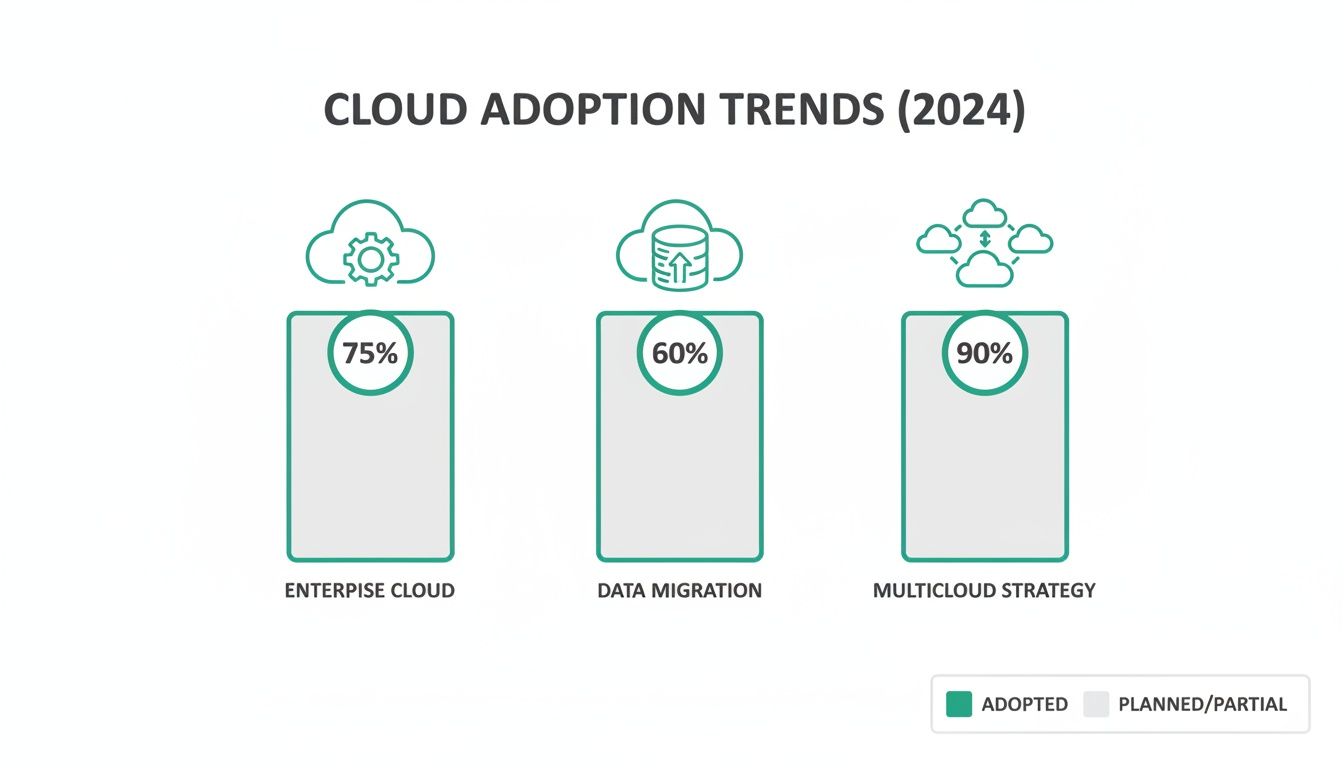
The data here is clear: businesses aren't just moving to the cloud; they're getting strategic about how they use different cloud environments to squeeze out every last drop of value.
On-Premise Server vs Cloud Infrastructure Cost Comparison
Let's put this into perspective with a Total Cost of Ownership (TCO) comparison. The table below breaks down the estimated five-year costs for a typical 50-employee Indiana business, comparing the old way (buying a server) with the new way (the cloud).
| Cost Category | On-Premise Server (5-Year TCO) | Cloud Infrastructure (5-Year TCO) | Key Difference |
|---|---|---|---|
| Initial Hardware | $15,000 - $30,000 | $0 | Eliminates a massive upfront capital expense. |
| Software Licensing | $5,000 - $10,000 | Included in Subscription | Bundled into a predictable monthly fee. |
| Energy & Cooling | $3,000 - $6,000 | $0 | The cloud provider pays for power and cooling. |
| Maintenance/Labor | $10,000 - $25,000 | Included in Subscription | No need for emergency repairs or constant upkeep. |
| Total 5-Year Cost | $33,000 - $71,000 | $45,000 - $60,000 | Predictable OpEx vs. unpredictable and high CapEx. |
As you can see, the on-premise model is front-loaded with huge initial costs and riddled with ongoing, often unpredictable expenses. The cloud turns this chaos into a simple, forecastable line item on your monthly budget.
A Concrete ROI Example
Let’s get even more specific. Picture a 50-person professional services firm in a downtown Indy high-rise. They’re staring down the barrel of a $30,000 server refresh—and that’s before software, installation, and the inevitable maintenance headaches.
That's a $30,000 check that does absolutely nothing to land a new client or improve their service.
By moving to a professionally managed cloud setup, they sidestep that entire expense. That $30,000 is no longer tied up in a depreciating metal box. It’s now free to be invested in a new marketing campaign, hiring a key employee, or expanding their services. That’s how a technology decision becomes a powerful business move. You can read our guide on effective IT infrastructure management to see how these benefits build on each other over time.
Proven Gains You Can Take to the Bank
A well-planned migration delivers results you can actually measure. Research shows that businesses see a 32% improvement in operational efficiency simply by having better, more reliable processes. Better yet, partnering with a certified pro for your migration can lead to an average 25% cost reduction and a 40% boost in application performance.
This isn't just guesswork for us. Before we do anything, we get our hands dirty. We perform a deep-dive analysis of your current setup—from your UniFi network gear to your software licenses—to build a data-driven ROI forecast that's 100% specific to your business.
This way, there are no surprises. You get a crystal-clear picture of the costs, the savings, and the performance gains before you ever commit a dime. To get a quick baseline, you can play around with a generic ROI Calculator to see the potential. This is how you make an informed decision that truly serves your bottom line.
Keeping Your Business Running with Superior Uptime
Let's talk about the four-letter word of business: down. Every minute your system is down, you’re bleeding money. How much? Try up to $9,000 per minute. A short outage isn't just a headache; it can be a financial catastrophe. This is exactly why one of the biggest wins from moving to the cloud is near-bulletproof business continuity.
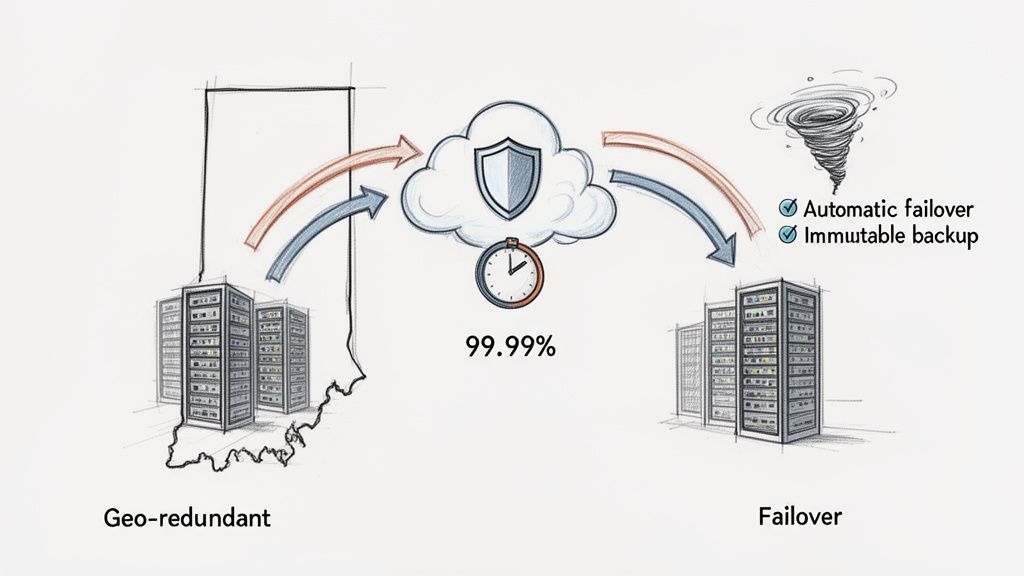
Think about that server humming away in your Greenwood office closet. It's a single point of failure. If that box decides to give up the ghost—thanks to a power surge, a hardware meltdown, or worse—your entire operation grinds to a halt. The cloud completely flips that script by spreading your risk across an infrastructure so vast and resilient it's hard to comprehend.
The Tech Behind 99.99% Uptime
So, how does the cloud pull off this magic trick of near-constant uptime? It’s not magic at all. It's world-class engineering that no small or medium-sized business in Indiana could ever hope to build on its own.
Here's a peek behind the curtain:
- Geo-Redundant Data Centers: Your business data isn't just living on one machine. It's copied and spread across multiple, fortress-like data centers, often hundreds of miles apart. If one location gets hit by a blackout, your traffic is instantly and automatically rerouted to a healthy one.
- Automated Failover: All hardware eventually fails. It's a fact of life. But in the cloud, when a server component dies, the system doesn't wait for a technician to show up. It automatically switches to a backup unit so fast that you and your team will never even know it happened.
- Immutable Off-site Backups: This is your get-out-of-jail-free card. We set up backups that are fundamentally unchangeable—they can't be altered or deleted, even by the most aggressive ransomware. This guarantees you can always restore a clean, working version of your data. If you're curious, we wrote a whole guide on how enterprise data backup solutions guarantee business uptime.
This built-in resilience is why the big cloud providers offer a Service Level Agreement (SLA). An SLA is their contractually-backed promise of uptime, usually 99.99% or more. Trying to achieve that with your own equipment would be astronomically expensive.
Experience That Brings Peace of Mind
This isn't just textbook theory for us. In our 17 years serving Central Indiana, we've seen firsthand how a solid cloud setup shields businesses from very real, local threats.
A while back, a tornado warning blared across Johnson County. Our clients with on-site servers were panicking. Our cloud clients? They were focused on getting their families to safety, not racing to the office to save a server. They had total peace of mind knowing their business was safe, with data replicated hundreds of miles from the storm's path in an immutable backup.
That's the real-world value of a professionally managed cloud. It means your Hamilton County medical practice, your law firm in downtown Indy, or your logistics hub on the I-65 corridor keeps running, no matter what Mother Nature throws at your front door.
Turning Wasted Time into Productive Hours
The stability of the cloud directly pads your payroll. All those hours your team wastes troubleshooting, rebooting, and waiting for a slow server to respond—we call it "wasted tech time"—get converted back into productive, billable work.
Instead of your top people getting sidetracked by a server glitch, they stay focused on their actual jobs. This consistent productivity, guaranteed by the cloud’s incredible uptime, pays you back every single day. You stop paying for downtime and start investing in momentum.
Better Security and Simpler Compliance? Yep, You Read That Right.
Let's be honest, the thought of shipping your company’s sensitive data off to some server in "the cloud" can feel a little unnerving. For many business owners, especially those in regulated fields, it just sounds risky.
But here’s the thing we've seen time and time again: a properly managed cloud migration is actually one of the biggest security upgrades you can make. It puts a level of protection at your fingertips that’s practically impossible to achieve on your own.
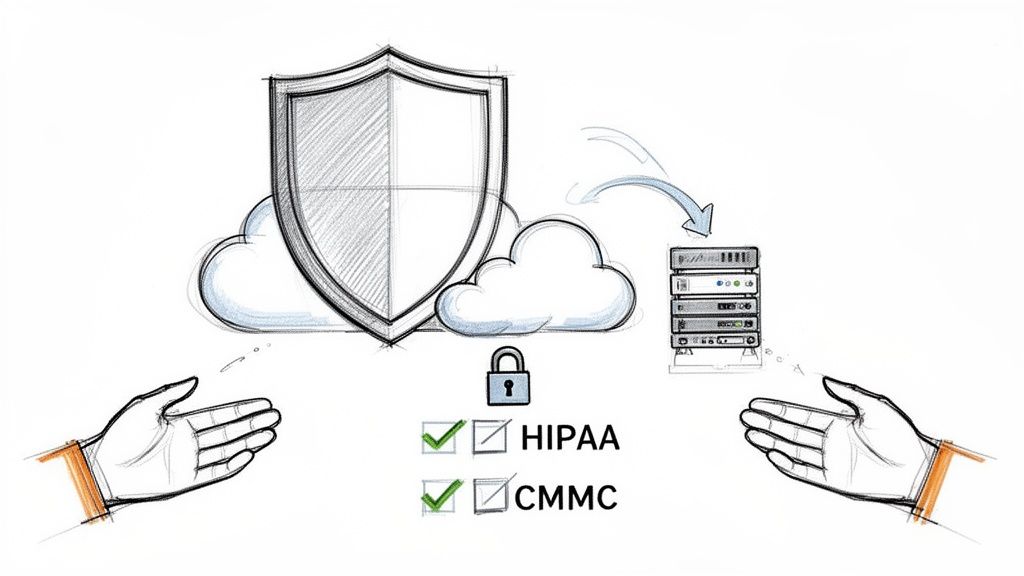
Think about your current server room—or maybe it's just a closet. What's the security like? A decent lock? An alarm system? Now, picture the resources of a global provider like Microsoft or Amazon. They pour billions of dollars a year into security, employing armies of experts and deploying tools that were once exclusive to global corporations.
You’re not just moving your data; you’re moving it into a digital fortress. Suddenly, you're not fighting the security battle alone. You're standing on the shoulders of a massive, worldwide security operation.
Compliance That’s Actually Built for Your World
For many, compliance isn't just an item on a to-do list; it's a license to operate. Whether you’re a healthcare provider in Hamilton County who lives and breathes HIPAA or a defense contractor on the I-65 corridor staring down CMMC requirements, the cloud can make your life so much easier. The big cloud platforms were designed from the ground up to meet these intense standards.
This is where knowing the rulebook is everything. It’s not about just ticking a box—it’s about architecting a truly secure environment that protects your clients, your data, and your reputation.
- For Healthcare: We set up HIPAA-compliant cloud environments that lock down patient data while still giving your authorized staff secure access, whether they’re at the front desk or working from home.
- For Defense & Manufacturing: We can design a CMMC-ready solution that maps directly to the stringent security controls your government contracts demand, helping you sail through NIST CSF guidelines.
- For Professional Services: For law firms and financial advisors, we deploy features like immutable off-site backups and strict access controls to make sure sensitive client information stays that way: sensitive and secure.
Having the right partner is what makes this work. The cloud provider secures the cloud itself, but you’re still responsible for securing what you put in the cloud. We’re the experts who bridge that gap.
Busting the Biggest Myth About Cloud Security
The most common worry we hear is that the cloud is just plain insecure. This fear almost always comes from a misunderstanding of the shared responsibility model. The provider handles the global infrastructure, and we, as your IT partner, take on the job of locking down your corner of it.
Look, this isn’t a "set it and forget it" deal. Over our 17 years in this business, we've had to fix plenty of poorly configured cloud setups that were actually less secure than the dusty old servers they replaced. That’s why our approach is so hands-on.
We don't just dump your data and wish you luck. We build your new environment to be tough as nails. We deploy and manage advanced endpoint protection like Bitdefender GravityZone to guard every single device. We build your network on a Zero Trust architecture—a "guilty until proven innocent" model where nothing gets access by default. Every single request is verified, dramatically shrinking the surface area for a potential attack.
On top of that, we provide SOC-as-a-Service monitoring. Think of it as having a team of elite cybersecurity guards watching your systems 24/7, actively hunting for threats. If you're curious about where your own vulnerabilities might be, a great first step is our cybersecurity risk assessment template designed for Indiana businesses.
Moving to the cloud isn't about giving up control. It’s about upgrading your security to a level you could never afford on your own and turning a major source of business anxiety into a well-managed source of strength.
Your Business is Ready to Grow. Is Your Server Closet?
Let's be honest. That old server humming away in a closet at your Greenwood office has its limits. It's a physical box with a finite amount of power. When your business finally hits that exciting growth spurt, that box becomes an anchor, slowing your team to a crawl and leaving customers tapping their fingers in frustration.
The cloud changes the game entirely. It lets you break free from those physical limitations. Think of it as gaining the ability to grow your business at the speed of a click, without ever worrying if your technology can keep up with your ambition. No more slow, expensive projects to buy and install a new server every time you land a big client.
Putting Agility into Practice
We've been helping Indiana businesses for 17 years, and if there's one thing we've learned, it's that growth is never a straight line. It's messy, unpredictable, and comes in waves. Your IT has to be able to ride those waves with you.
We saw this firsthand with a logistics company near the Indianapolis International Airport. They were staring down their holiday season, projecting a massive 300% spike in activity. Their on-premise server would have melted down, causing catastrophic delays. In the cloud, it was a simple adjustment. We scaled up their resources for two months, then dialed them right back down in January. Easy.
The best part? They only paid for that extra horsepower when they actually needed it. This is how you turn IT from a fixed, clunky expense into a flexible tool that actively helps you make money. For any growing company in Hamilton County or along the I-65 corridor, that kind of flexibility is a serious competitive advantage.
The Tech That Makes It All Work
This isn't some kind of dark art; it's just smart technology working behind the scenes. Two key pieces make this incredible flexibility possible:
- Auto-Scaling Groups: This is like a smart thermostat for your server power. We set rules that automatically add more computing muscle when traffic surges (like for a Black Friday sale) and then remove it when things quiet down. Your website and apps stay fast and responsive for everyone, all the time.
- Load Balancing: A load balancer is your system's traffic cop. Instead of dumping all your users onto one server, it intelligently spreads the work across several. This prevents overloads, ensures your system is always available, and gives everyone a much snappier experience.
When you use tools like these, you stop playing defense—fixing tech problems only after they’ve caused a shutdown—and start playing offense. This proactive approach is the heart of building a truly efficient operation. You can see more on how this works in our guide to business process automation examples for Indiana companies.
Scalability means your technology stops being an obstacle. It ensures that the moment you're ready to make a bold move, your infrastructure is already there waiting to support you.
Your Practical Cloud Migration Roadmap
Dreaming about all the benefits of the cloud is the easy part. Actually getting there? That's where most business owners start to get a headache, picturing a technical mess of downtime and spiraling costs. I get it. It can feel overwhelming.
But a successful move to the cloud isn't some chaotic, flip-the-switch-and-pray scenario. When you have an experienced guide, it's more like a series of smart, deliberate moves. We've been using this exact roadmap for years to help businesses all over Central Indiana make the leap, and it hasn't failed us yet.
Step 1: The Full Inventory and Assessment
First things first, we’ve got to pop the hood and see what we’re working with. This means we take a complete, no-stone-unturned inventory of your entire IT world. What servers are humming away in the closet? What specific software does your team live in every single day?
We document everything, from your UniFi networking gear to the mission-critical apps that keep the lights on. Think of it as creating a blueprint of your current setup. This map helps us spot potential landmines—like weird software dependencies—long before they can blow up your project. It’s the old carpenter’s rule: measure twice, cut once.
Step 2: Define What "Success" Actually Looks Like
With a clear picture of your current state, we get to the most important question: what do you really need the cloud to do for your business? Are we on a mission to chop the IT budget? Do you need a system that absolutely, positively cannot go down, ever? Or maybe you're trying to seamlessly connect a growing remote team spread across Hamilton County.
Getting crystal clear on these business goals is what separates a tech-for-tech's-sake project from a genuine strategic move. This turns the migration into an investment with a real, measurable payoff.
Step 3: Choose Your Cloud Flavor
Not all clouds are built the same, and picking the right one is crucial. Based on your goals, budget, and security requirements, we'll figure out the perfect fit.
- Public Cloud: Think of massive, pay-as-you-go providers like Microsoft Azure or AWS. This is your go-to for incredible scalability and cost efficiency.
- Private Cloud: This is your own dedicated slice of the cloud. It offers maximum control and is often a must-have for businesses with intense compliance needs, but it comes with a bigger price tag.
- Hybrid Cloud: Can't decide? You don't have to. A hybrid approach lets you mix and match, keeping sensitive data on-premise while using the public cloud for everything else. It’s the best of both worlds.
Step 4: Nail Down Security and Compliance
This is where the rubber really meets the road, especially for our clients in regulated industries. If you’re a healthcare provider staring down HIPAA rules or a defense contractor preparing for a CMMC audit, getting this wrong isn't an option.
We build your cloud environment from the ground up to meet these strict demands. We'll map out your obligations under frameworks like the NIST CSF and bake in the necessary safeguards—like a Zero Trust architecture—from day one.
We once handled a migration for a law firm in downtown Indy terrified about their sensitive client files being exposed. We built them a completely isolated, encrypted environment and moved their data in phases. The result? They stayed fully compliant, and their data was never even close to being at risk.
Step 5: Plan Your Method of Attack
Alright, so how do we actually move your stuff? There are a couple of ways to tackle this, and the right one depends on your timeline and goals.
- Lift-and-Shift: This is the fast lane. We essentially pick up your existing servers and applications and plop them down in the cloud with very few changes. It's a quick and direct path to reaping those immediate cloud benefits like lower costs and better uptime.
- Refactoring/Rearchitecting: This is more of a remodel. We rebuild certain parts of your applications to take full advantage of all the cool, cloud-native tools. It's a bigger project, for sure, but the payoff is massive in terms of long-term performance and efficiency.
Step 6: Life After Migration: Optimize and Support
Getting you to the cloud is just the beginning. Our work isn't done once the switch is flipped. We stick around to constantly monitor your new environment, always looking for ways to fine-tune performance and trim costs.
We make sure your backups are flawless, your security tools like Bitdefender GravityZone are on patrol, and your monthly cloud bill doesn't give you a heart attack. This ongoing management is what truly delivers that long-term ROI—and the peace of mind you were after in the first place.
Let's Make This Real: Your Free Security Risk Audit
Okay, enough theory. We've talked about all the great things the cloud can do—predictable costs, tighter security, and the kind of flexibility that lets you sleep at night. But what does that actually look like for your business? It’s time to stop talking in hypotheticals and start looking at real numbers.
We're not in the business of guessing. For our neighbors in Greenwood, Indianapolis, and across Central Indiana, we put our expertise on the line with a Free Security Risk Audit. This isn't a sales pitch disguised as a meeting. It’s a genuine, on-site look under the hood of your current IT setup.
What We Uncover For You
One of our experts will come right to your office to get their hands dirty. We'll map out your entire system to build a report based on cold, hard data—not generic advice. It’s a world beyond what you’d get from a standard checklist, though you can see how it compares to our own ultimate 10-point IT infrastructure audit checklist.
Here’s exactly what you’ll get:
- A Full Infrastructure Teardown: We’ll put eyes on your aging servers, your UniFi network, and every other piece of hardware holding your business together.
- Security Blind Spot Detection: Our team will hunt down the hidden vulnerabilities and weak points in your defenses, giving you a clear-eyed view of your current risk.
- Your True ROI Breakdown: No fluff. We’ll show you exactly where you can save money, how performance will improve, and what it all means for your bottom line.
- A Personalized Migration Playbook: You'll walk away with a clear, step-by-step game plan for a smooth and stress-free move to the cloud, built around what you want to achieve.
We’ve watched Johnson County businesses go from being bogged down by tech headaches to running faster and smarter. This free audit is how we prove we’re here to solve problems, not just sell you a service.
Think of this as a firm handshake and a valuable offer. We want to give you the clarity you need to make the best call for your company's future. It's time to stop pouring money down the drain on "wasted tech time" and start building a more durable, profitable business.
Ready to find out what a smart cloud strategy can do for your bottom line? Schedule your Free Security Risk Audit specifically for businesses in the Greenwood/Indianapolis area with Finchum Fixes IT and get a data-driven plan built just for you. Get started by visiting us at https://finchumfixesit.com.