The Real Benefit of Cloud Migration for Indiana Businesses

TL;DR: Key Takeaways
- Stop Wasting Money: Ditch the unpredictable costs of your aging server in Greenwood for a predictable monthly cloud budget. Converting "wasted tech time" into billable hours generates immediate ROI.
- Prevent Catastrophic Downtime: An old server is a single point of failure. Cloud migration provides geo-redundancy and immutable off-site backups, ensuring business continuity and protecting you from downtime that can cost up to $9,000 per minute.
- Lock Down Your Data: Gain enterprise-grade security that meets compliance standards like HIPAA and CMMC. We implement Zero Trust architecture and SOC-as-a-Service monitoring to protect your business from modern threats.
- Gain a Competitive Edge: The cloud gives Johnson County businesses the agility to scale instantly, allowing you to seize opportunities without being held back by physical hardware limitations.
Let’s be honest. That clunky old server humming away in the back of your Greenwood office? It's more than just a piece of hardware—it's a hidden tax on your business. The real magic of moving to the cloud isn't about fancy new tech; it's about turning that constant worry and unpredictable expense into reliable performance and a predictable monthly budget. It’s about getting your team off the tech hamster wheel and back to doing what they do best: billable work.
Why Your Old Server Is Costing You More Than Just Money
For so many Johnson County business owners I talk to, the server in the closet feels like a paid-for asset. But in our 17 years of local service, we've seen how it’s actually a source of constant, low-grade stress and sneaky, accumulating costs.
You know the feeling. You hold your breath when it makes a weird grinding noise. You say a little prayer during a power flicker. This isn't just a technical headache; it's a business bottleneck that quietly eats away at your bottom line. We call this the "Southside Problem"—a common technical bottleneck where a Greenwood business park company relies on aging server hardware, creating a huge risk.
Think about all that "wasted tech time"—the minutes spent rebooting a sluggish QuickBooks file or waiting for a document to load. That’s time your team isn’t helping customers or closing deals. And when that hardware finally gives up the ghost (and it will), the downtime can cost a staggering $9,000 per minute. For a small business, that’s not just an expense; it’s a catastrophe. It's a reactive, hair-on-fire way to manage something so critical.
From Unpredictable Breakdowns to Predictable Budgets
This is where the cloud changes the game. It’s about shifting from that chaotic break-fix cycle to a smart, proactive model. Instead of bracing for a huge capital expense for a new server every few years, you move to a simple, predictable operational expense.
It’s like this: you stop trying to maintain your own power generator in the backyard and just pay a monthly utility bill for the electricity you actually use. Simple, right?
This approach pays off immediately for businesses here in the Indy metro area:
- No More Surprise Costs: Forget those emergency calls for fried hard drives or overheating processors. Your monthly cloud costs are consistent and easy to budget for.
- Turns 'Wasted Time' into Billable Hours: When your team has faster, more reliable access to their apps and data, they spend less time waiting and more time working.
- Bulletproofs Your Business: Your critical data is no longer vulnerable to a single point of failure, like a fire, flood, or hardware crash at your office along the I-65 corridor.
"In our 17 years serving local businesses, we’ve seen too many companies get absolutely crippled by a single server failure. Moving to the cloud isn't just an upgrade; it’s the best insurance policy you can buy for your company’s future."
Here’s a quick summary of how migrating to the cloud delivers measurable results for your business.
Key Benefits of Cloud Migration at a Glance
| Benefit Category | On-Premise Server Challenges | Cloud Solution Advantages |
|---|---|---|
| Cost & Budgeting | High upfront hardware costs, surprise repair bills | Predictable monthly operational expense (OpEx) |
| Productivity | Slow performance, frustrating downtime | Faster access to apps, minimal downtime |
| Security & Data | Vulnerable to physical theft, local disasters | Enterprise-grade security, geo-redundant backups |
| Scalability | Limited by physical hardware capacity | Easily scale resources up or down as needed |
By moving to the cloud, you’re not just buying new technology. You're buying peace of mind and a serious competitive edge.
To dig deeper into the broader advantages, you can learn more about the true benefit of cloud migration for business growth. And before you make any big decisions, it’s always smart to know exactly where you stand. Check out our guide on how to perform your ultimate 10-point IT infrastructure audit.
Ready to find out how much that old server is really costing you? Let's talk. A Free Network Assessment can uncover the hidden risks and costs in your current setup, giving you a clear roadmap for a more secure and efficient future for your Indianapolis or Greenwood business.
Unpacking the Financial Benefit of Cloud Migration
Let's talk dollars and sense. So many business owners I meet in Johnson County fall for the same myth: "My server is paid off, so it's basically free now." I get it, but that's a dangerous assumption. That hunk of metal humming away in your Greenwood office is a silent budget killer, racking up costs for power, cooling, and those sneaky annual maintenance contracts that mysteriously get more expensive every year.
One of the biggest financial wins of moving to the cloud is how it completely flips your tech spending on its head. You get to say goodbye to massive, unpredictable capital expenditures (CapEx)—those gut-wrenching five-figure checks you have to write for new servers every 3-5 years. Instead, you slide into a flexible, predictable operational expenditure (OpEx) model.
It’s like this: you wouldn't build your own power plant for the office, right? Of course not. You just pay the utility company for the electricity you actually use. The cloud works the same way, freeing up a ton of cash you can pump back into growing your business instead of just keeping the lights on.
From Hidden Costs to Clear ROI
The real savings aren't just about dodging the cost of new hardware. You also stop the slow, constant drain from the electricity needed to cool a server room and the recurring software licensing fees that are tied to on-premise setups. When you actually add it all up, the financial argument is a no-brainer. This shift prevents costly downtime and converts wasted tech time into billable hours, boosting your ROI.
This chart really drives the point home, showing how the cloud gives you predictable costs, slashes expensive downtime, and gets your team working more efficiently.
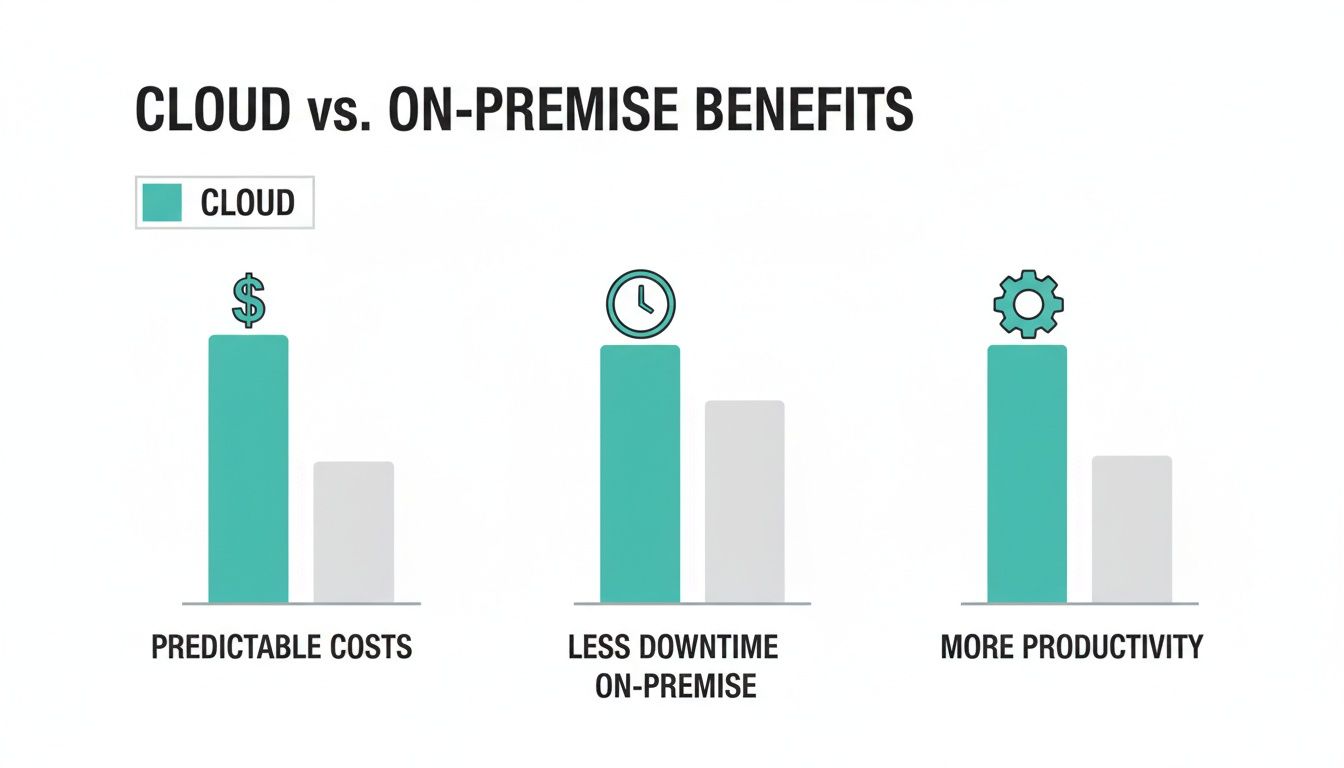
What you're seeing is the fundamental shift: moving away from a reactive, costly hardware cycle to a proactive, budget-friendly way of operating.
And the numbers back this up. A recent report found that the benefit-to-cost ratio for cloud projects has soared to $3.86 for every dollar spent. The number one reason? Getting rid of on-premise costs, which accounts for a whopping 78% of the ROI. For Indiana businesses, that means turning money you used to spend on aging servers into pure growth fuel.
"In our 17 years serving local businesses, we’ve seen it time and again—most companies along the I-65 corridor have no idea what their IT truly costs. Once we map out power, maintenance, and 'wasted tech time,' the ROI on a well-planned cloud migration becomes impossible to ignore."
To illustrate this, let's look at a simplified cost breakdown for a typical small business over three years.
On-Premise vs. Cloud Cost Analysis Over Three Years
This table compares the estimated Total Cost of Ownership (TCO) for a traditional in-house server against a flexible cloud model.
| Cost Factor | On-Premise Server (Estimated 3-Year Cost) | Cloud Infrastructure (Estimated 3-Year Cost) |
|---|---|---|
| Initial Hardware & Software | $12,000 (Server, OS, backup) | $0 (No upfront purchase) |
| Annual Maintenance & Support | $4,500 ($1,500/year) | $0 (Included in service) |
| Power & Cooling | $1,800 (Approx. $50/month) | $0 (Included in service) |
| Monthly Subscription Fees | $0 | $10,800 (Avg. $300/month) |
| Estimated Downtime Costs | $2,500 (Assumes one major incident) | $500 (Reduced risk) |
| TOTAL 3-YEAR TCO | $20,800 | $11,300 |
As you can see, even with a conservative estimate, the cloud offers substantial long-term savings by eliminating the hidden costs that come with owning hardware.
Technical Expertise Drives Deeper Savings
Here’s a crucial point: just moving to the cloud isn't the magic bullet. How you move is what separates a budget-breaking disaster from a cost-saving success. This is where real technical know-how comes into play. We don't just "lift and shift" your stuff and call it a day—we optimize it.
For instance, we can strategically use tools like AWS Graviton processors or secure Azure Reserved Instances. These aren't just industry buzzwords; they are specific technologies that let us slash your monthly bill by committing to resources you use all the time. It’s the kind of cost-saving tactic big corporations use, delivered right here to businesses in the Indianapolis area.
This detailed, careful approach ensures your cloud setup isn't just more reliable and secure, but also perfectly sized for your budget. It's proof that we're more than just a "geek with a screwdriver"—we're a strategic partner invested in your financial success.
For a deeper dive into making a smart move, check out our guide on cloud migration best practices for Indiana businesses. It lays out a solid framework to get you started.
You Can Finally Achieve Real Business Continuity
Let's be blunt: every minute your business is offline, you're losing money. A lot of it. Industry stats show downtime can cost a staggering $9,000 per minute. For a small or medium-sized business right here in the Indianapolis area, that's not just a setback—it's a potential knockout blow.
This is where moving to the cloud really shines. It's not just about new tech; it's about fundamentally changing how you handle disaster, making your business tough as nails.
We saw this firsthand with a logistics client over in Hamilton County. Their whole operation was running on an old server with a rickety RAID array that was spitting out errors left and right. Dispatch, billing, everything was on the brink of collapse. The owner was living in fear of the day that machine would finally give up the ghost. When we dissembled a similar client’s failing RAID array, we saw just how close they were to total data loss.
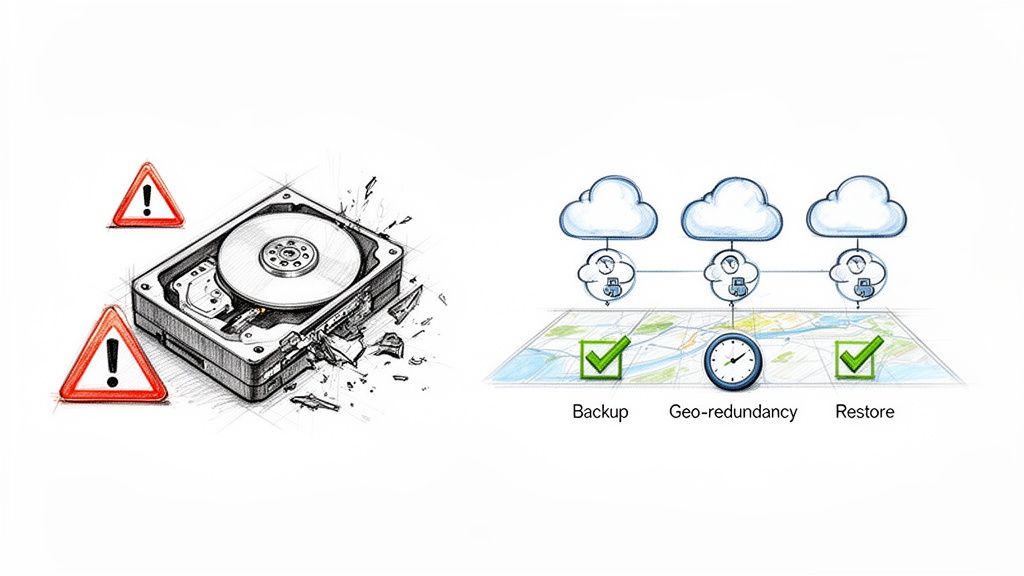
It’s a classic scenario we call the "Southside Problem"—an entire company's fate tied to a single piece of hardware humming away in a closet. Instead of just slapping a bandage on it by replacing the drives, we moved their whole world to the cloud. The result? The constant, gut-wrenching anxiety was gone, replaced by the peace of mind that their business was no longer one fried circuit away from disaster.
From a Single Point of Failure to Geo-Redundancy
That server in your office has one massive vulnerability: it lives in one spot. A fire, a flood, or even a simple power surge at your Greenwood headquarters can instantly vaporize your data and your business along with it. The cloud completely flips the script with two powerful concepts: high availability and geo-redundancy.
Let's translate that from geek-speak:
- High Availability: Think of it like having a team of servers instead of just one. If one machine stumbles, your work is automatically and instantly handed off to another healthy one. You and your customers probably won't even notice a hiccup.
- Geo-Redundancy: This is the big one. Your data isn't just copied to another server in the same building; it's replicated to a data center in a totally different part of the country. A tornado could hit one location, and your information would be safe and sound hundreds of miles away, ready to be fired back up.
For a business owner, this means your operations are no longer hostage to the physical safety of your building on the I-65 corridor. A properly architected cloud environment makes your business fundamentally unbreakable.
Turning Ransomware from a Catastrophe into an Inconvenience
Ransomware is the modern-day boogeyman for business owners, and for good reason. If it hits your on-site server, it can be a company-ending nightmare, locking you out of your own files. The cloud, however, gives you a secret weapon: immutable off-site backups.
This isn't your grandpa's backup tape. "Immutable" means that once a backup is saved, it's set in stone. It cannot be changed or deleted, not even by a hacker who has stolen the admin password. It’s the ultimate defense in bit-level data recovery.
When ransomware strikes a cloud-based system, the game plan changes completely. Instead of panicking and considering paying criminals, you just:
- Isolate the infected computers.
- Wipe them clean.
- Restore everything from the last perfect, untouchable backup.
What was once a potential catastrophe that could shut you down for weeks now becomes a manageable—if annoying—IT project. You're back in business in hours, not weeks. This is a level of protection most small businesses could never dream of building on their own, and it's a built-in benefit of moving to the cloud.
If you want to dig deeper into protecting your company’s data, our article on 10 data loss prevention best practices has some great tips. At the end of the day, true business continuity is about having the right plan and the right tools to make it happen.
Fortifying Your Defenses with Cloud Security
Let's talk security. For any business along the I-65 corridor, especially if you're handling sensitive data, security isn't just a nice-to-have; it's the whole ballgame. If you’re in healthcare, you live and breathe HIPAA. If you’re a defense contractor, CMMC is your world. For general business security, the NIST CSF provides the roadmap.
One of the most powerful moves you can make to lock things down is a professionally managed cloud migration.
I know what you might be thinking. There's this old myth that the cloud is somehow less secure than that humming server in your back office. Let me be blunt: that’s just not true anymore. In fact, it’s the complete opposite.
Think about it. Giants like Microsoft and Amazon pour billions of dollars into their security infrastructure and employ small armies of the world's top cybersecurity experts. No small business in Johnson County could ever dream of matching that kind of firepower on their own.
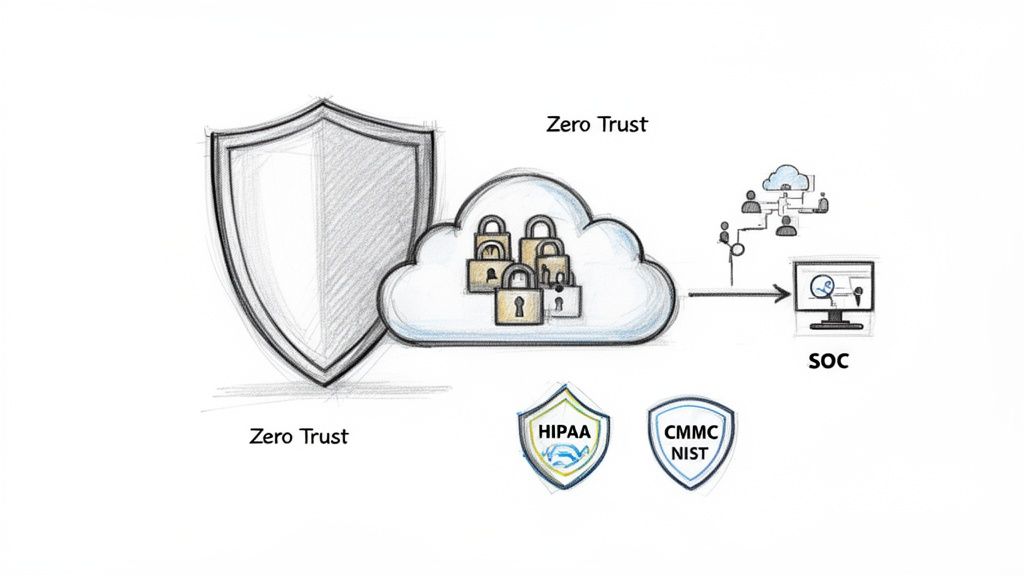
When you move to the cloud, you're essentially putting your data inside a digital Fort Knox. You get to piggyback on defenses you could never afford to build yourself. What might seem like a scary leap is actually how you turn a potential vulnerability into a rock-solid competitive advantage.
Making Enterprise-Grade Security Affordable
Not too long ago, the most advanced security tools were toys for Fortune 500 companies only. The cloud completely flipped that script, making top-tier defenses accessible and affordable for businesses of all sizes.
Two of the biggest game-changers are Zero Trust architecture and SOC-as-a-Service.
- Zero Trust Architecture: The name says it all. This modern security model works on a simple but powerful principle: never trust, always verify. It doesn't matter if a user is inside your network or outside; every single attempt to access data has to be authenticated and authorized. This drastically cuts the risk of a breach from something as simple as a stolen password.
- SOC-as-a-Service: A Security Operations Center (SOC) is a dedicated team of experts watching your network 24/7/365 for any hint of trouble. Instead of trying to hire your own full-time, six-figure team, you can tap into our SOC-as-a-Service monitoring. We become your round-the-clock guardians, spotting and shutting down threats before they ever cause damage.
We recently worked with a medical practice right here in Greenwood. By implementing a Zero Trust framework in their new cloud setup, we immediately helped them nail down tough HIPAA requirements. What was once a major compliance headache became a simple, automated process.
Seamless Integration and Compliance
One of the unsung heroes of cloud migration is how easily you can plug in best-in-class security tools. We integrate solutions like Bitdefender GravityZone—a beast in endpoint protection—that work flawlessly in cloud environments. It gives you advanced threat detection and risk analysis that helps you meet tough standards like the NIST CSF (Cybersecurity Framework).
Moving to the cloud isn't just about battening down the hatches; it also makes you faster and more agile. The data doesn't lie: 45% of companies report fewer security incidents after migrating, while 43% slash the time-to-market for new services. For Indiana businesses, that means you can innovate faster, all while knowing your digital front door is more secure than ever.
If you’re serious about testing your defenses, learning more about Cloud Based Penetration Testing is a smart, proactive step to ensure your new setup is truly airtight.
A well-planned cloud migration, guided by an experienced partner, is one of the single best security investments you can make. You can dig deeper into protecting your business by checking out our guide to the biggest security threats to a network for Indiana businesses.
Gaining Agility to Scale and Grow
So, what happens when your Hamilton County business lands a massive new contract out of the blue? Or when a sudden market shift means you have to pivot your entire service offering overnight? If you’re still running on an in-house server, your hands are tied by the hardware sitting in your closet. Scaling up means a painful waiting game of ordering, installing, and configuring new equipment. By the time it’s ready, that golden opportunity might have already vanished.
This is exactly where the incredible agility of the cloud gives you a serious competitive edge. It's all about breaking free from the physical chains of your hardware and gaining the power to react in the moment.
Instead of waiting weeks for a new server to show up at your Greenwood office, you can spin up new cloud resources in a matter of minutes. Need more horsepower to crunch those month-end reports? Click a button. Have to get a dozen new remote employees set up and working? It can be done in an afternoon. This is the point where you stop letting technology dictate your business strategy and start using it to pounce on opportunities as they appear.
From Rigid Infrastructure to Instant Opportunity
Think of your old server like a fixed-size tool shed. If you suddenly get a whole new set of tools, you’re stuck. You’ve got to build an extension, which costs time and money you might not have. The cloud, on the other hand, is like a magical, elastic warehouse that instantly grows or shrinks to the exact size you need at any given moment. And the best part? You only pay for the space you’re actually using.
This kind of flexibility is a game-changer for growth. Let's say we build a new AI-powered app to automate scheduling for your logistics company. On-premise, you'd be forced to guess how much server capacity to buy, probably overspending "just in case." In the cloud, we can launch the app and let it scale up or down automatically based on real-world demand. That means flawless performance without a dime wasted on resources you don’t need.
"We've seen it happen time and again: a Johnson County business gets a game-changing opportunity, but their old tech holds them back. The ability to scale on demand is no longer a luxury for big corporations; it's a fundamental requirement for survival and growth."
Solving Local Problems with Cloud Power
This agility isn't just for huge growth spurts; it's perfect for solving everyday local headaches, too. Take the classic "Southside Problem" of spotty Wi-Fi in an old brick building downtown Indy. Trying to run a business with unreliable UniFi networking and slow access to a central office server is an absolute productivity killer. Our managed approach, which can include latency-optimized mesh nodes, fixes this permanently.
By moving your essential applications and data to the cloud, you solve this problem for good.
- Boosts Team Productivity: Your team gets fast, reliable access to their tools from literally anywhere, turning frustrating lag time into profitable, billable hours.
- Enables Secure Remote Work: It doesn't matter if your people are in the office, at home, or on the road along the I-65 corridor. They get the same secure access to everything they need to do their jobs.
- Improves Collaboration: Cloud-based tools enable seamless, real-time teamwork that’s just not possible when everything is stuck on a single server in one location.
The move to the cloud is completely changing how businesses operate, often delivering 20-40% cost savings on infrastructure alone. But while giants like AWS and Azure dominate the market, a poorly planned migration can blow up your budget. That's where having expert local guidance is so critical. As you think about what’s next, you might find our guide on adaptive software development in Indiana helpful for seeing how modern development fits into a cloud-first world.
Alright, let's get you from "thinking about the cloud" to actually making it work for your business. Theory is great, but the real magic happens when you roll up your sleeves and create a smart, practical plan. And for businesses here in Central Indiana, that plan needs to fit your specific goals, not some generic template.
Before you even think about moving a single file, it's time for a little self-reflection. Take a hard look at the software that keeps your business running. Which of your current applications are ready to hop into the cloud, and which ones are more like ancient relics that might need a complete overhaul or replacement? That custom-built program from ten years ago might be a workhorse, but is it ready for the modern world?
The Questions That Will Make or Break Your Migration
Once you've taken stock, it's time to dig into the specifics. Nailing down the answers to these questions is how you and your IT partner can build a cloud solution that actually solves problems instead of creating new ones.
- What kind of red tape are we dealing with? A doctor's office in Greenwood has to live and breathe by HIPAA rules. A defense contractor near the downtown Indy tech hub? They're sweating CMMC standards. Your compliance needs dictate the entire structure.
- Seriously, how much downtime can we handle? Don't just say "none." Think about it. Can you be down for an hour? A day? Your honest answer shapes the migration strategy and, more importantly, the disaster recovery plan that will save your bacon when something goes wrong.
- Where are we headed in the next three years? A startup in Fishers gearing up for explosive growth needs a far more elastic cloud setup than a stable, third-generation family business in Johnson County. Plan for the business you're becoming, not just the one you are today.
After 17 years of working with local businesses, we’ve seen it all. The one truth that never changes? A successful migration is 90% planning and 10% execution. The biggest mistake you can make is rushing past the planning stage.
This isn't a DIY project you want to tackle on a weekend. You need a local partner who gets it—someone who brings big-league expertise but still answers the phone and knows the difference between Carmel and Columbus. This is about building a system that fuels your business, not just checking a box.
The first step is always the easiest. Let's figure out where you are right now. We invite any business in the Greenwood and greater Indianapolis area to schedule a Free Network Assessment. It's a simple, no-pressure chat where we'll look at your current IT and give you a clear, honest-to-goodness roadmap for your move to the cloud.
Got Questions About Moving to the Cloud? We've Got Answers.
Even with a solid game plan, it's natural for Indiana business owners to have some last-minute questions before taking the plunge. Let's tackle the ones we hear most often from folks right here in Greenwood and the greater Indianapolis area with some direct, no-fluff answers.
So, How Long Does This Whole Cloud Migration Thing Take?
Honestly, there's no magic number. The timeline really depends on what we're moving. For a small Johnson County business just shifting files and email, we could be looking at a couple of weeks. But for a larger operation with custom-built software or a boatload of sensitive data that needs to meet strict HIPAA rules, it could stretch over a few months.
The secret sauce is a phased approach. At Finchum Fixes IT, we don't just jump in; we start with a deep-dive assessment to map out every single piece of your digital puzzle. This lets us build a realistic timeline that works around your business, not through it, keeping disruptions to an absolute minimum.
Is My Business Data Actually Safe Up There in the Cloud?
This is the big one, isn't it? The short answer is a resounding yes—but only if it's set up correctly. The truth is, major players like Microsoft Azure and AWS pour billions into security—far more than any small business could ever dream of spending on their own server room. The platform itself is a fortress.
Where things can go wrong is the human element. That's where we come in. Our certified pros live and breathe a Zero Trust security model, which is just a fancy way of saying nobody gets access to anything without proving who they are, every single time. We also encrypt your data while it's moving and while it's sitting still, and we lock down access controls so only the right people can touch your sensitive info.
After 17 years of serving local businesses, we can say this with total confidence: a professionally managed cloud setup is worlds more secure than that old server humming away in a closet. You're eliminating single points of failure and adding layers of protection that are just impossible to replicate on your own.
What Are the Biggest Risks, and How Do You Stop Them From Happening?
When migrations go bad, it's almost always one of three culprits: unexpected downtime, lost data, or a surprise bill that makes your jaw hit the floor. We've seen it happen to companies that tried to DIY it, which is exactly why our process is designed to head these problems off at the pass.
Here’s our game plan:
- Downtime: We don’t try to move everything at once. We use a phased strategy, starting with less critical systems and testing obsessively. This way, we can smooth out any wrinkles before we touch the software you rely on to make money. This prevents costly downtime and keeps your team generating billable hours.
- Data Loss: This is a complete non-negotiable for us. We use immutable backups before we start, during the move, and after we finish. Think of it as making perfect, unchangeable photocopies of your data at every stage, so its safety is never in question.
- Surprise Costs: We don't do estimates on the back of a napkin. You'll get clear, upfront cost projections based on a deep analysis of what you actually need. No hidden fees, no mystery line items. Just a predictable budget you can count on.
It's this kind of meticulous, road-tested planning that transforms a potentially nerve-wracking project into a smart, successful move for your business.
Ready to get clear answers tailored to your business? The team at Finchum Fixes IT is here to help. Schedule a Free Network Assessment to get a no-obligation roadmap for your move to the cloud, specifically for your Greenwood or Indianapolis business.