A Cyber Security Risk Assessment Template for Indiana Businesses
A solid cyber security risk assessment template is your secret weapon for turning abstract threats into a concrete defense plan. It's a structured document—a roadmap—that walks you through identifying what you need to protect, what could go wrong, and how bad the fallout would be.
Think of it as the strategic map for your business's digital survival.
Your Best Defense Is a Good Offense
Let’s get one thing straight: cybersecurity isn't just another IT expense on your P&L. For any business owner here in Central Indiana, from a manufacturer on the I-65 corridor to a healthcare provider in Hamilton County, it’s a direct line to your bottom line.
When ransomware hits, the downtime can cost a staggering $9,000 per minute. That's enough to turn a productive Tuesday into a catastrophic financial event. This isn't about fancy tech; it's about business continuity.
A cyber security risk assessment is how you turn unpredictable tech chaos into a predictable monthly IT budget. It's about finding the digital landmines before you step on them, converting wasted tech time spent fighting fires into billable hours.
And believe me, those risks are often hiding in plain sight:
- That aging server hardware in your Greenwood business park office that hasn't been patched in years.
- The spotty, insecure Wi-Fi in that old brick building downtown that everyone from employees to clients connects to daily.
- A glaring lack of multi-factor authentication on the accounting software your team uses from home.
From Vague Worries to Actionable Plans
Without a formal assessment, you’re just guessing. You're throwing darts in the dark, hoping to hit a real threat.
We recently helped a Johnson County logistics firm that was convinced their biggest threat was some shadowy hacker group overseas. But once we got in there and ran our assessment, the real story came out. Their biggest vulnerability was actually an internal one—outdated firmware on their UniFi networking gear. Anyone on their guest network could have exploited it.
Fixing that one issue gave them an immediate, measurable return. It prevented a breach that would have brought their entire shipping operation to a screeching halt.
The hard truth is that cybersecurity has become the number one risk for businesses around the globe. The average data breach now costs $4.44 million, and that’s before you even start to calculate the losses from being down for days or weeks. Companies that actually use a formalized risk assessment slash their likelihood of a breach by up to 30%.
This process isn't some technical chore to be dreaded. It's a fundamental business decision that protects your revenue and delivers a real ROI. To dig deeper into the strategy behind it all, you can learn more about essential cyber security risk management strategies.
This isn't about buying every flashy security gadget on the market. It’s about making smart, targeted investments based on your specific risks, which in turn keeps you compliant with standards like HIPAA or CMMC and, most importantly, keeps the lights on.
The Real Cost of Ignoring Risks vs The ROI of Assessing Them
It's easy to see a risk assessment as just another cost. But when you reframe it, the value becomes crystal clear. Here’s a quick look at how a proactive approach pays for itself, especially for a typical Indiana SMB.
| Business Impact | Ignoring the Risk (The Cost) | Proactive Assessment (The ROI) |
|---|---|---|
| Operational Downtime | Days or weeks of lost revenue. A ransomware attack could cost $100k+ in lost productivity and recovery fees. | Minimal to zero interruption. Identified vulnerabilities are patched before they can be exploited. |
| Client Trust & Reputation | Loss of clients due to data exposure or service unavailability. Years of goodwill destroyed overnight. | Enhanced client confidence. Demonstrates a serious commitment to protecting their data and your partnership. |
| Unexpected Expenses | Emergency IT services, legal fees, regulatory fines (HIPAA, CMMC), and credit monitoring for clients—all unplanned and costly. | Predictable, budgeted IT security spending. You invest in prevention, not panic-driven reaction. |
| Employee Productivity | Team members are locked out of systems, unable to work. Morale plummets as frustration and uncertainty grow. | Smooth, secure operations. The team can focus on their jobs without worrying if their tools will suddenly vanish. |
Putting a number on peace of mind is tough, but the math on prevention versus recovery is simple. A well-executed risk assessment isn't an expense—it's one of the best investments you can make in your company's future.
Let's Pop the Hood on the Risk Assessment Template
Before you start plugging away, let's look at what makes a good cyber security risk assessment template tick. This isn't some generic document. It’s a framework we’ve honed over 17 years of working in the trenches with businesses right here in Central Indiana. We built it to turn fuzzy security ideas into a concrete, actionable plan that actually makes sense for a Johnson County business owner.
The whole thing is built on four core pillars. Each one logically flows into the next, guiding you from a simple inventory of your "stuff" all the way to a prioritized to-do list of what to fix first. It’s a methodical approach that helps you stop just reacting to threats and start strategically getting ahead of them—the entire point of having a managed IT partner.
Asset Identification: What Are You Actually Protecting?
First things first: you have to know what you’re trying to defend. And I’m not just talking about servers and laptops. Your assets are literally anything and everything that provides value to your business.
Think of it this way: a downtown Indy law firm's most valuable asset isn't the pricey server sitting in their closet; it’s the decades of confidential client case files living on it. The data is the crown jewel.
Your asset list should cover a few key areas:
- Hardware: This is the easy stuff. Servers, workstations, company phones, UniFi networking gear, firewalls—you get the picture.
- Software: Jot down your core applications. This includes everything from your accounting software to that custom CRM your sales team can't live without.
- Data: Here's the big one. We're talking client lists, financial records, employee PII (Personally Identifiable Information), and any of your secret sauce (intellectual property).
- People: Don't forget this! Key employees with admin-level access are absolutely assets. If their credentials get snatched, it's game over.
Honestly, for most businesses, just making this initial list is an eye-opening exercise. We almost always uncover "shadow IT"—unapproved software or cloud services—that leadership had zero clue was even connected to their network. That’s a massive blind spot.
Threat Identification: The Bad Guys (and Bad Luck) Lurking Around
Okay, you know what you're protecting. Now, what could actually harm it? Threats aren't just mythical hackers in dark hoodies. They are specific, real-world dangers relevant to your business right here in the Indianapolis area. A phishing email crafted to look like it’s from a local bank is a very real, very direct threat.
Some of the most common threats we see hammering Indiana businesses include:
- Ransomware: The nightmare scenario. An attack that scrambles all your files and demands a small fortune to get them back, often delivered via a phishing email.
- Phishing: Those sneaky, deceptive emails trying to trick your team into giving up login credentials or wiring money.
- Insider Threats: This could be a disgruntled employee causing chaos on purpose or, more often, a well-meaning one who makes an honest mistake.
- Hardware Failure: That ancient, unmonitored server in your Greenwood office finally deciding to call it quits, taking all its data down with it.
It's so important to be realistic here. The threats facing a small medical practice worried about HIPAA are totally different from those staring down a CMMC-regulated defense contractor. This part is all about your specific context.
Vulnerability Analysis: How Could They Get In?
This is where we connect the dots. A vulnerability is simply a weakness—a hole in your defenses—that a threat can wiggle through to hurt an asset. The technical details really start to matter now.
For example, an unpatched server at that Johnson County logistics firm is a gaping vulnerability. The threat is a hacker exploiting that known software flaw, and the asset at risk is the company's entire shipping database.
From what we've seen on the ground, over 70% of successful cyberattacks exploit known vulnerabilities that someone just never got around to patching. It’s rarely about some super-sophisticated, brand-new attack; it's almost always about an unlocked digital door.
This part of the process forces you to take a hard, critical look at your setup. Are people using "Password123" for everything? Is your UniFi guest Wi-Fi network truly separate from your main business network? Do you have a solid endpoint security solution like Bitdefender GravityZone on every single machine?
For a much deeper dive on that last point, you can learn more about endpoint security best practices for Indianapolis SMBs in our guide.
Impact and Likelihood Scoring
Finally, we bring it all home by scoring each risk. This is the magic that turns a scary list into a visual risk matrix that instantly tells you what to tackle first. We use a simple 1-5 scale for two key factors:
- Likelihood: How probable is it that this threat will actually happen? (1 = Very Unlikely, 5 = Very Likely)
- Impact: If it does happen, how bad is the damage going to be? (1 = Minor Headache, 5 = Business-Ending Event)
A phishing email aimed at your accounting department might have a High Likelihood (4) and a Critical Impact (5) if it works. That's a red-alert, top-priority risk. On the other hand, an old printer failing might have a Medium Likelihood (3) but only a Low Impact (1).
By assigning these numbers, you create a risk score that aligns with official frameworks like the NIST CSF—the kind of thing regulators and cyber insurance companies want to see. This process is what transforms a long list of worries into a clear, prioritized action plan.
Putting the Template into Action
Alright, let's get our hands dirty. You have the cyber security risk assessment template, but staring at a blank spreadsheet can feel like facing a mountain. The goal here is to turn that empty file into a powerful, practical security roadmap for your Indiana business.
This is where the rubber meets the road. We're going to walk through filling it out, field by field, so it becomes a tool you actually use.
First, you need to map out every single thing that connects to your network. And I mean everything. I'm talking about the main server humming away in the closet, the smart TV in the breakroom, and every last tablet your sales team uses on the road. For so many business owners we work with around Johnson County, this initial inventory is a real eye-opener. It almost always uncovers "shadow IT"—devices they had no idea were even on their network.
The whole process, while detailed, really boils down to three core stages.
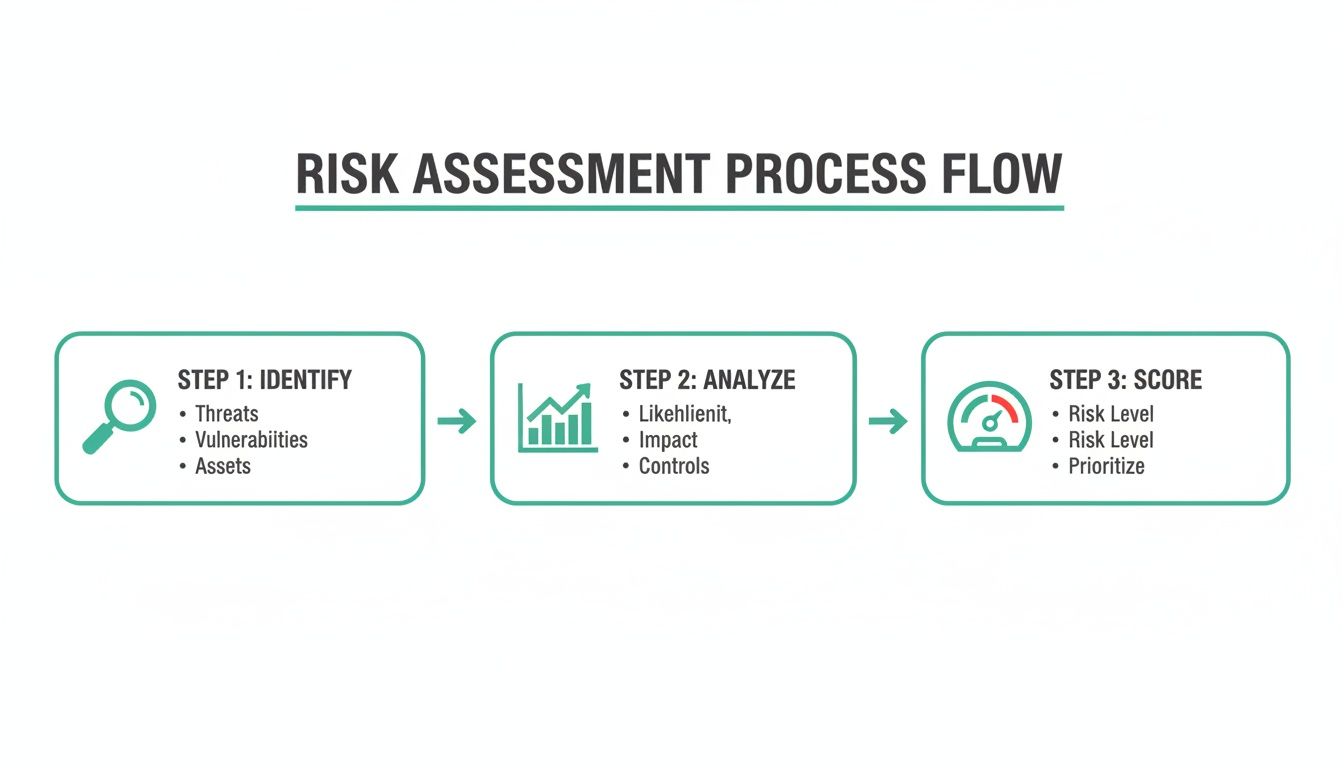
This simple flow—identify, analyze, and score—is the engine that drives a successful assessment. It takes a chaotic list of "what ifs" and turns it into a clear, prioritized action plan.
Identifying Assets and Pinpointing Threats
Once you have your complete asset list, the next step is to think about the threats that could realistically hit them. This isn't the time for vague, Hollywood-style hacking fears. We need to get specific to what could actually happen to your business right here in the Indy metro area.
For instance, a phishing attack is a threat to everyone. But for a financial advisor in Hamilton County, a more specific threat is a spear-phishing email that looks like it’s from a major local bank or one of their high-net-worth clients. That’s the kind of detail that matters.
Think about these common scenarios for Hoosier businesses:
- Ransomware: A direct hit that encrypts your server, bringing your entire operation to a grinding halt.
- Insider Data Theft: A disgruntled employee who’s on their way out decides to copy your entire client list to a personal thumb drive.
- Hardware Failure: That server you bought five years ago finally gives up the ghost, and if your backups aren't solid, you've lost everything.
- Social Engineering: An employee gets a call from someone pretending to be from IT support and is sweet-talked into giving up their password.
Writing down these specific scenarios for each of your critical assets is what gives the assessment its punch. It grounds the entire process in your day-to-day reality.
Evaluating Impact and Scoring the Risk
Now we get to the part where your business know-how really comes into play. The impact of a data breach is completely different for a medical practice than it is for a manufacturing plant. A HIPAA-compliant clinic could face massive fines and lose all patient trust. A defense contractor along the I-65 corridor could see their CMMC compliance and federal contracts go up in smoke.
Our template uses a straightforward 1-5 scoring system for both Likelihood (How likely is this to happen?) and Impact (How bad will it be if it does?). Let's be honest—assigning these numbers can feel a little subjective at first.
The key is to be consistent. A "5" for Impact should always mean a business-ending event, like a total operational shutdown or a major compliance violation. A "1" might just be a minor headache, like a single computer being down for an hour.
Once you’ve scored both, the template multiplies them to generate a Risk Score. This simple number does all the heavy lifting for you, instantly showing you what to tackle first. Anything with a high score becomes a top priority, creating a visual heatmap of your biggest vulnerabilities.
A great way to uncover these weak spots is by performing a full IT audit. To get a head start, you can check out our ultimate 10-point IT infrastructure audit checklist for 2026.
This structured approach is more important than ever. While global cybersecurity spending is projected to hit $240 billion in 2026, there are still huge gaps. A shocking 69% of leaders admit to ignoring critical vulnerabilities even though 81% feel their security is strong. With AI-powered attacks now overwhelming 76% of security teams, a methodical, template-driven process is the only way to close that dangerous gap between feeling safe and being resilient. For a deeper look at these numbers, explore more findings on the state of risk management.
A Real-World Example in Greenwood
To see how this all comes together, let's walk through a sample entry for a small accounting firm we might work with in Greenwood.
Sample Risk Register Entry for a Greenwood Accounting Firm
This table shows exactly how you’d document a single risk, from identification to a concrete plan of action.
| Asset | Threat | Vulnerability | Likelihood (1-5) | Impact (1-5) | Risk Score | Remediation Action |
|---|---|---|---|---|---|---|
| Accounting Server | Ransomware Attack | Unpatched server OS (Windows Server 2016) | 4 (High) | 5 (Critical) | 20 | Immediately patch OS. Schedule quarterly vulnerability scans. Implement Bitdefender GravityZone EDR. |
See how that works? The firm identified its most critical asset: the accounting server. The threat is ransomware, a constant menace for businesses holding sensitive financial data. The specific vulnerability is an old, unpatched operating system—a wide-open door for attackers.
The Likelihood is a 4 because unpatched servers are low-hanging fruit. The Impact is a 5 because if that server gets encrypted during tax season, the business is effectively dead in the water. That gives us a Risk Score of 20, putting this issue squarely in the red zone.
Finally, look at the Remediation Action. It’s not just "fix the server." It's a specific, multi-step plan: patch the OS now, set up ongoing scans to catch future issues, and deploy a modern security tool like Bitdefender. This is how the cyber security risk assessment template transforms from a simple document of problems into a clear, prioritized plan for a much stronger defense.
Turning Your Findings into Real Defenses
So, you've completed the cyber security risk assessment template. Great! But let's be honest, if it just sits there gathering digital dust in a shared drive, it’s nothing more than a security blanket. It might make you feel warm and fuzzy, but it won't stop a real threat.
The real magic happens when you turn those findings—that risk heatmap now glowing with angry red and yellow squares—into a rock-solid, practical defense plan. This is where we move from just looking at problems to actually fixing them.
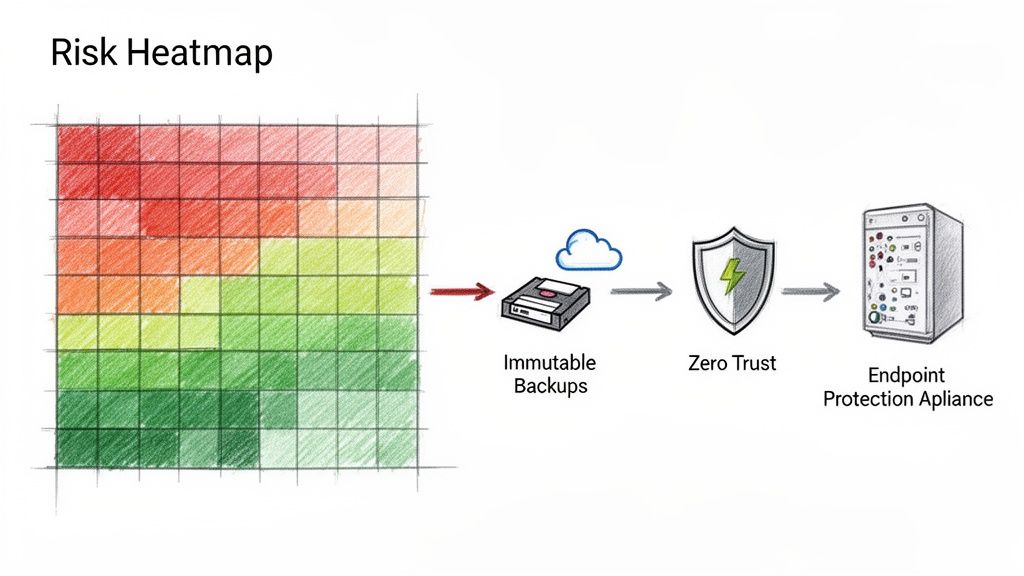
A proper remediation plan isn't about trying to boil the ocean and fix everything at once. It's about triage. You tackle the "Critical" risks first—the ones that pose an immediate, existential threat to your operations and your bottom line. It’s all about making smart, targeted investments that give you the biggest security bang for your buck.
From Risk Score to Technical Solution
This is where the "how" follows the "what." The remediation plan connects the dots between a scary-looking risk score and a specific, technical fix.
For example, your assessment might flag a high risk of someone getting into your sensitive client files. The knee-jerk solution is "better passwords," but the real solution is implementing a Zero Trust architecture. This approach is brilliantly simple in concept: trust no one. It verifies every single access attempt, every time, effectively building a fortress around your most critical data.
Let's look at a few other common high-risk scenarios and how we’d actually solve them:
-
The Nightmare: Critical data gets vaporized by a ransomware attack.
-
The Fix: We roll out immutable off-site backups. "Immutable" is just a technical way of saying your backup data can't be changed or deleted. It's ransomware-proof. Think of it as the ultimate undo button. Our guide on how to prevent ransomware attacks for Indiana businesses goes way deeper on this.
-
The Nightmare: Malware hops from one employee's laptop to the next, spreading like wildfire.
-
The Fix: Install a modern endpoint detection and response (EDR) tool like Bitdefender GravityZone. This isn't your grandpa's antivirus. It actively hunts for and neutralizes advanced threats on every single device.
-
The Nightmare: Your old brick building’s Wi-Fi is wide open, leaving the back door unlocked.
-
The Fix: Upgrade to modern UniFi networking gear with latency-optimized mesh nodes. We’d set up properly segmented guest and internal networks, ensuring that a visitor scrolling through Facebook in your lobby can't accidentally wander into your main business systems.
See the pattern? Each solution is a direct counterpunch to a specific, identified risk. This transforms your security budget from a guessing game into a strategic investment.
A Real-World Indy Tech Hub Turnaround
We see this play out all the time. A few years back, a fast-growing tech firm in a downtown Indy tech hub called us in. They were brilliant developers, but their internal security had been completely neglected during a period of explosive growth.
Their self-assessment, which we guided them through with our template, lit up like a Christmas tree. The biggest vulnerability? A total lack of network segmentation and ancient firewall rules. Their developers, the marketing team, and the guest Wi-Fi were all mingling on one big, flat network. It was a ticking time bomb.
A breach wouldn't have just been embarrassing; it would have been catastrophic. An attacker could have pivoted from the insecure guest network directly into their source code repositories, jeopardizing their most valuable intellectual property and violating the trust of their biggest client.
We immediately put a plan in motion based on their findings. We re-architected their entire network with new UniFi gear, creating secure, isolated segments for each department. We deployed Bitdefender GravityZone on every endpoint and configured a Zero Trust access policy for their code servers.
The result? A month later, they passed their client’s security audit with flying colors, securing a multi-year contract that fueled their next stage of growth.
This is the power of a well-executed remediation plan. It's not about theory; it's about preventing real-world disasters that can shut a Johnson County business down overnight. And in today's climate, this proactive approach is non-negotiable. Geopolitical volatility is reshaping the cybersecurity battlefield, with 64% of organizations now having to factor in state-sponsored attacks. Yet, a massive readiness gap exists—only a tiny 6% of executives feel 'very capable' of handling all vulnerabilities. Recognizing this reality, 60% of leaders now rank cyber investments in their top three priorities, and your risk assessment is the essential first step to ensure that money is spent wisely. To get a better handle on this shifting threat landscape, you can explore the full WEF Global Cybersecurity Outlook report.
Ready to turn your assessment into action but not sure where to start? A professional can help bridge that gap. We offer a Free Network Assessment for businesses in the Greenwood and Indianapolis area to help you build a clear, effective remediation plan.
Why a Professional Audit Uncovers Risks You Can't See
Listen, using the cyber security risk assessment template we've shared already puts you light-years ahead of most businesses around Johnson County. Seriously. You’ve made the leap from just worrying about security to actually measuring it, and that’s a massive win.
But some risks are just plain sneaky. They’re buried so deep in your systems that a spreadsheet will never find them. They lurk in tangled code, hide in invisible data zipping through your network, and masquerade as minor settings that look perfectly harmless. That’s where a professional audit changes the game.
Your template-based assessment is brilliant for getting your arms around the risks you already know exist. An audit, however, is all about hunting for the "unknown unknowns"—the threats you don't even know you should be looking for.
It's like this: your self-assessment is you diligently checking every lock on your doors and windows. Our professional Security Risk Audit is us bringing in a team with thermal cameras and X-ray scanners to find the hidden cracks in your foundation.
Both are critical for a secure business, but they serve completely different purposes.
Diving Deeper Than a Surface-Level Scan
A DIY assessment is limited by what you know. But what about the vulnerabilities you’ve never even heard of? We don’t just ask questions from a checklist; we get our hands dirty and actively try to knock down your defenses.
Our process brings enterprise-grade tools and techniques to the table that most small and medium-sized businesses just can't access. We're talking about things like:
- Penetration Testing: We put on our white hats and simulate a real-world cyberattack to see if we can actually break in. This isn't a theoretical exercise; it’s a live-fire drill on your firewalls, software, and even your team's security awareness.
- Bit-Level Data Analysis: When we disassembled a similar client's failing RAID array, we performed a bit-level data recovery. This digital forensic process goes way beyond a simple file scan to find fragments of deleted files or hidden info a hacker could exploit.
- SOC-as-a-Service Monitoring: Our Security Operations Center (SOC) team can become your digital watchtower, monitoring network traffic in real-time. We use advanced analytics to spot malicious activity patterns that are completely invisible to the naked eye.
This is the kind of deep-dive analysis that separates guesswork from genuine security. A professional audit is the only way to truly uncover those hidden risks and validate your defenses. For a more technical look at what a full review involves, this guide to a security audit in network security is a great resource.
A Real-World Story: The Hidden Firewall Flaw
Let me share a quick story from our 17 years of helping local businesses. A financial services firm right here in Greenwood called us, feeling pretty good about the risk assessment they'd just finished. On paper, they were golden. They had shiny new UniFi networking gear, solid password policies, and what they thought was a rock-solid firewall.
But their spreadsheet couldn't see the firewall's actual rule set.
Our audit immediately flagged a glaring hole. A specific network port—one that should have been sealed tight—was wide open. It was left over from a temporary project six months earlier and never closed. An honest mistake.
The terrifying part? Our threat intelligence tools showed this wasn't just a potential vulnerability. Automated bots were actively scanning for this exact opening and trying to exploit it across the internet. They were on the verge of a data breach that would have brought down a storm of regulatory fines and shattered their clients' trust. We slammed that digital door shut on the spot, preventing a catastrophe that would have easily cost them hundreds of thousands.
Their template was perfect for tracking known issues like patching software. But it took a hands-on, professional audit to find the silent killer already knocking at the gate.
This is exactly the gap a professional audit fills. It takes you beyond the checklist and gives you true validation. For businesses up and down the I-65 corridor, our complimentary Security Risk Audit isn't just another check-up—it's genuine peace of mind.
Ready to See Where You Really Stand?
You've got the theory down and you've seen the templates, but theory doesn't stop a hacker. It's time to find out what's really going on inside your network.
We offer a complimentary, no-strings-attached Security Risk Audit for businesses in Greenwood and the greater Indianapolis area. This isn't a sales call. It's a genuine, hands-on audit where our certified pros use enterprise-grade tools to scan your network for vulnerabilities a spreadsheet will never find.
We’ll pinpoint your actual weak spots and give you a straightforward, actionable report. No jargon, no fluff. You'll see exactly where your Johnson County business is most exposed and get a clear roadmap for plugging the gaps. It's time to stop wondering and start knowing.
This is about making sure your business can keep running. We'll show you how to lock down your tech so you can focus on what you do best—serving your customers and growing your company.
Let's get the ball rolling. Schedule your free Security Risk Audit today and get the peace of mind that comes from having a real plan.
Your Burning Questions Answered
Still have a few questions? Perfect. Here are the straight-up answers to the questions we hear most often from business owners around Johnson County about cyber security risk assessments.
How Often Should We Run Through This Exercise?
At a bare minimum, you need to do a full risk assessment once a year. Treat it like an annual check-up for your company's digital health—it's that important.
But that’s just the baseline. You should also kick one off immediately after any major change to your tech. Think things like moving to the cloud, rolling out a new piece of essential software, opening a new office down the I-65 corridor, or making a big shift to remote work. And if you're in a regulated field like healthcare (HIPAA) or defense (CMMC), you’ll likely need to do them even more often to stay compliant.
What's the Difference Between a Risk Assessment and a Vulnerability Scan?
Great question. People mix these up all the time, but they’re two very different beasts.
A vulnerability scan is a purely technical, automated task. It's like sweeping your network with a metal detector to find known weak spots—a server that's missing a critical patch, old software, that kind of thing. It's a tool that spits out raw data.
A cyber security risk assessment, however, is a strategic business process. It takes the raw data from those scans and layers on crucial business context. It answers the real questions: "What happens to our business if someone actually exploits this weakness?" and "How likely is it that a hacker will even find and attack this system?"
A vulnerability scan tells you a window is unlocked. The risk assessment tells you that the unlocked window is on the first floor, right next to the company safe, and you need to get it secured yesterday. It’s all about context and prioritizing what truly matters.
Does My Little Company Really Need a Formal Assessment?
Yes. A thousand times, yes. In our 17 years working right here in the community, we've seen it firsthand: cybercriminals love targeting small businesses because they assume (and are often right) that their security is weaker. For a small business without a massive bank account, a single ransomware attack can be an extinction-level event.
Going through a formal assessment, even just starting with our template, is the single smartest thing you can do to protect your business on a budget. It forces you to put your limited IT dollars where they will have the biggest impact—fixing the problems that pose a genuine threat to your operations, your money, and your good name. It’s not just another expense; it’s an investment in your company’s survival.
Don't leave your company’s security up to chance. Finchum Fixes IT delivers comprehensive Security Risk Audits that give businesses in Greenwood and Indianapolis a clear, no-nonsense plan to protect what they’ve built.