Attack Surface Management for Indiana Businesses
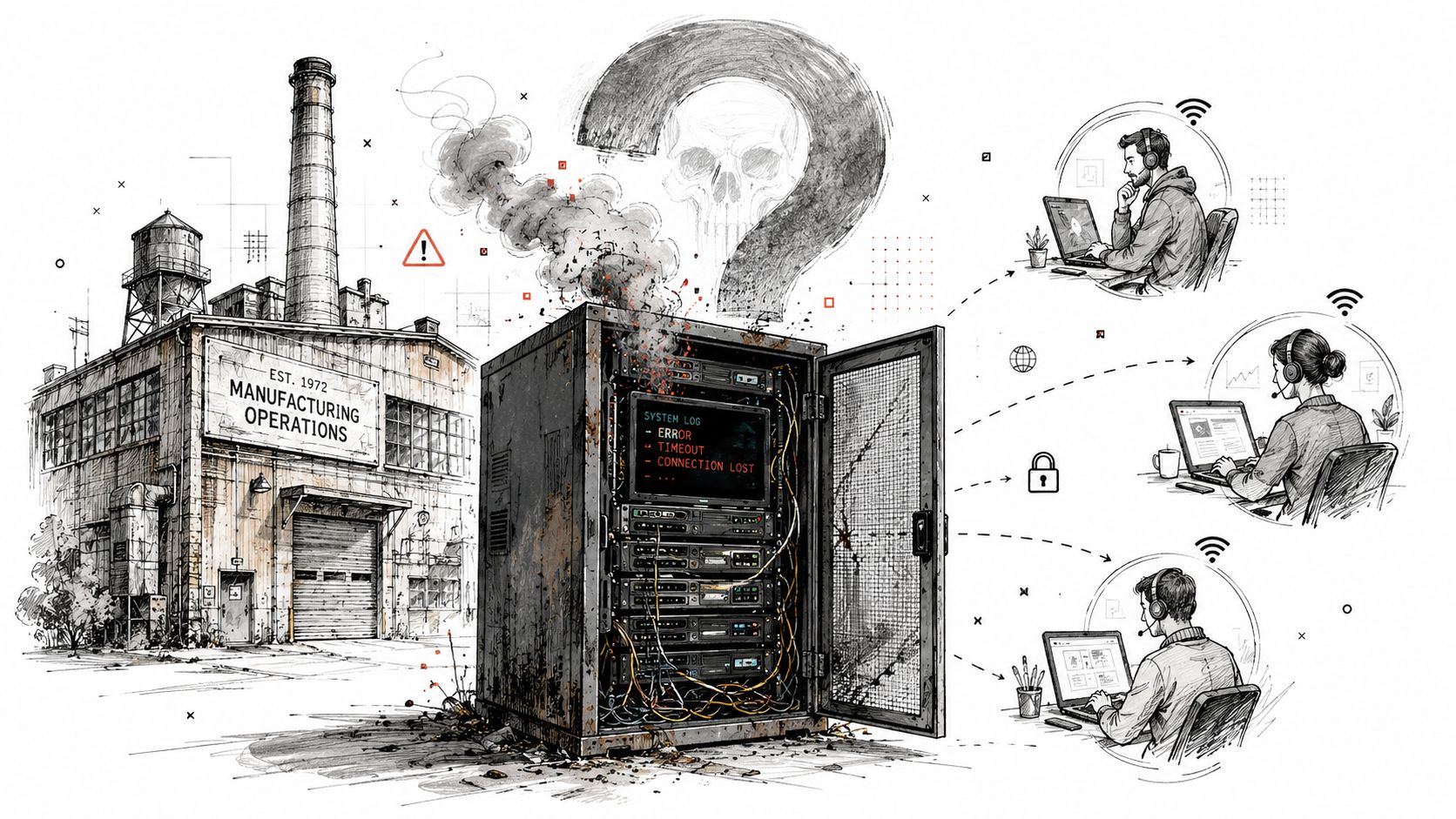
A lot of Johnson County business owners are sitting in this exact spot right now. The server in the back office is older than it should be. The sales team now works from home half the week on a mix of company laptops and personal devices. Marketing signed up for a cloud tool with a credit card and never mentioned it to IT. The Wi-Fi in that old brick building off the Southside drops out in weird corners, so people work around it instead of fixing it.
That mix creates more than inconvenience. It creates blind spots.
When one of those hidden systems gets hit, the damage isn't just technical. It stops quoting, shipping, billing, scheduling, and customer service. Downtime can cost up to $9,000 per minute. For a local manufacturer, medical office, contractor, or logistics firm along the I-65 corridor, that kind of interruption burns cash fast and turns productive staff into people waiting on computers.
Attack surface management is how you stop running security by guesswork. It gives you a disciplined way to find every exposed system, sort what matters, fix what matters first, and keep watching as your environment changes.
Your Biggest Security Risk Is the One You Cannot See
TL;DR
- Attack surface management finds hidden risk across servers, cloud apps, remote devices, websites, and third-party services.
- Unknown assets are often the easiest way in because nobody is watching or patching them.
- For Indiana SMBs, ASM should be practical, not enterprise theater. Start with visibility, ownership, and fast remediation.
- ASM is different from vulnerability scanning. Scanning checks systems you already know about. ASM also finds the ones you missed.
- Good ASM protects business continuity by preventing downtime, reducing wasted tech time, and supporting predictable monthly IT budgets.
- If you handle regulated data, tie ASM to HIPAA, CMMC, or NIST CSF so security work supports compliance instead of fighting it.
A Greenwood manufacturing company can look well run on the surface and still have a messy digital footprint underneath. The office server may still be carrying legacy file shares. The remote sales team may be logging into customer systems from home Wi-Fi. A supervisor may have forwarded plant reports into a personal cloud drive because the VPN felt slow. None of that looks dramatic until ransomware hits, email goes down, or the ERP system stalls during a shipping window.
Why SMBs in Central Indiana feel this first
Most local businesses don't have a full security department. They have an office manager, a controller, a plant lead, maybe an outsourced IT partner, and a pile of systems that grew over time. That's common in Greenwood business parks, downtown Indy offices, and fast-growing Hamilton County operations that added cloud software faster than process.
That sprawl reaches across:
- On-prem systems like aging Windows servers, NAS devices, and line-of-business apps
- Networking gear such as UniFi networking, firewall appliances, and site-to-site connections
- Cloud platforms including Microsoft 365, file sharing tools, CRMs, and niche SaaS products
- Remote access paths like VPNs, RDP gateways, and unmanaged home devices
- Data protection layers such as immutable off-site backups and disaster recovery workflows
If you don't know an asset exists, you won't patch it, monitor it, or include it in incident response.
That is the whole problem in one sentence.
Why attack surface management keeps showing up in serious security conversations
Businesses are putting real money behind visibility because the old model isn't holding up. The global attack surface management market was valued at USD 1.03 billion in 2025 and is projected to surge to USD 5 billion by 2034, a compound annual growth rate of 21.03%, according to Fortune Business Insights' attack surface management market analysis.
That doesn't mean every Johnson County shop needs a giant enterprise platform. It means more businesses have learned the hard way that antivirus plus a firewall plus an annual scan doesn't cover unknown assets.
A practical ASM program helps you keep production moving, protect billable time, and avoid the constant churn of surprise IT work. It also fits naturally beside broader services like cybersecurity, networking, cloud computing, data recovery, software development, and IT support. When your digital footprint is mapped and monitored, every one of those disciplines works better.
Defining Your Business Attack Surface
Think of your business like a commercial building. The front door matters, but so do the loading dock, side windows, roof hatch, maintenance entrance, and the gate someone forgot to lock behind the dumpster. Your attack surface is every digital path someone could use to get into your systems, steal data, impersonate your staff, or interrupt operations.
For a business owner, that's easier to understand when you break it into buckets.
Known and managed assets
These are the systems your team expects to see. They include the office server, Microsoft 365 tenant, company website, firewall, UniFi access points, laptops enrolled in Bitdefender GravityZone, and the line-of-business software your staff uses every day.
These assets aren't automatically safe. They're just visible.
The problem is that many businesses stop here and assume the inventory is complete. It usually isn't. If you're working through the basics of IP address management for Indianapolis businesses, you're already seeing how fast visibility gets messy when devices, subnets, and services grow faster than documentation.
Unknown assets and shadow IT
Here, things get expensive.
Research shows 70% of organizations suffered a cyberattack originating from an unknown, unmanaged, or poorly managed asset in the past year, as cyber asset inventories grew by 133% year-over-year, according to Akamai's overview of attack surface management.
That unknown asset might be:
- A forgotten cloud workload that a developer used for testing and never shut down
- An old domain or subdomain still pointing somewhere it shouldn't
- A SaaS tool bought by a department head without IT review
- A stale remote access path created during a rush to support hybrid work
A lot of owners ask where to start if formal security process feels thin. A good plain-English primer on managing your cyber risk as an SME is useful because it frames cyber risk the way a small business experiences it. Through operations, people, vendors, and cash flow.
Third-party and supply chain exposure
Your attack surface doesn't stop at your building.
If your CPA firm uses a cloud portal, if your phone vendor has access to call recordings, if your web developer still has admin rights, or if a software provider hosts data tied to your operations, those relationships affect your risk. The same goes for healthcare groups dealing with HIPAA, machine shops and defense suppliers handling CMMC requirements, and general businesses trying to align with NIST CSF.
Practical rule: Defend the business you actually run, not the one that's written in last year's IT spreadsheet.
A clean inventory changes everything. Without it, you're securing the obvious systems while a forgotten app, stale DNS record, or unmanaged remote login sits unnoticed in the background waiting to become a bad week.
ASM vs Traditional Vulnerability Scanning
Business owners hear "attack surface management" and often think, "Didn't we already buy a scanner for that?" Not quite.
A vulnerability scanner checks the locks on doors you already know about. Attack surface management starts by finding every door, window, service entrance, and weird side gate first. Then it tells you which ones matter most.
The difference in plain terms
Traditional scanning is useful. You still need it. But it assumes your asset list is already accurate.
ASM doesn't make that assumption. It starts from the outside, the same way an attacker would. That matters because ASM platforms typically discover 30–40% more internet-facing assets than traditional vulnerability scanners because they are designed to find shadow IT and other unknown assets, as explained in Censys' breakdown of ASM and vulnerability management working together.
If you want a related explanation of where assessments fit versus deeper offensive testing, this guide on vulnerability assessment vs. penetration testing helps separate those terms without the usual jargon.
Attack Surface Management vs. Vulnerability Scanning
| Aspect | Vulnerability Scanning | Attack Surface Management (ASM) |
|---|---|---|
| Primary job | Checks known systems for known weaknesses | Finds exposed assets, including unknown ones, then helps assess risk |
| Starting point | Your existing inventory | External discovery plus existing inventory |
| Best at | Patching and remediation workflows on managed systems | Reducing blind spots and uncovering shadow IT |
| Common failure | Misses what IT doesn't know exists | Can create noise if ownership and remediation processes are weak |
| SMB value | Good for routine hygiene | Better first move when visibility is poor |
What works and what wastes money
Buying a scanner before you have decent asset visibility often creates fake confidence. The report looks busy. The dashboard glows red and yellow. But if the scanner never saw the marketing microsite, the abandoned cloud VM, or the vendor-managed admin portal, you didn't reduce the attack surface.
A clean asset inventory saves more wasted tech time than another noisy dashboard.
For most SMBs in Central Indiana, ASM is the smarter first layer. Vulnerability scanning becomes much more useful once you know what belongs in scope.
The Four Pillars of Effective Attack Surface Management
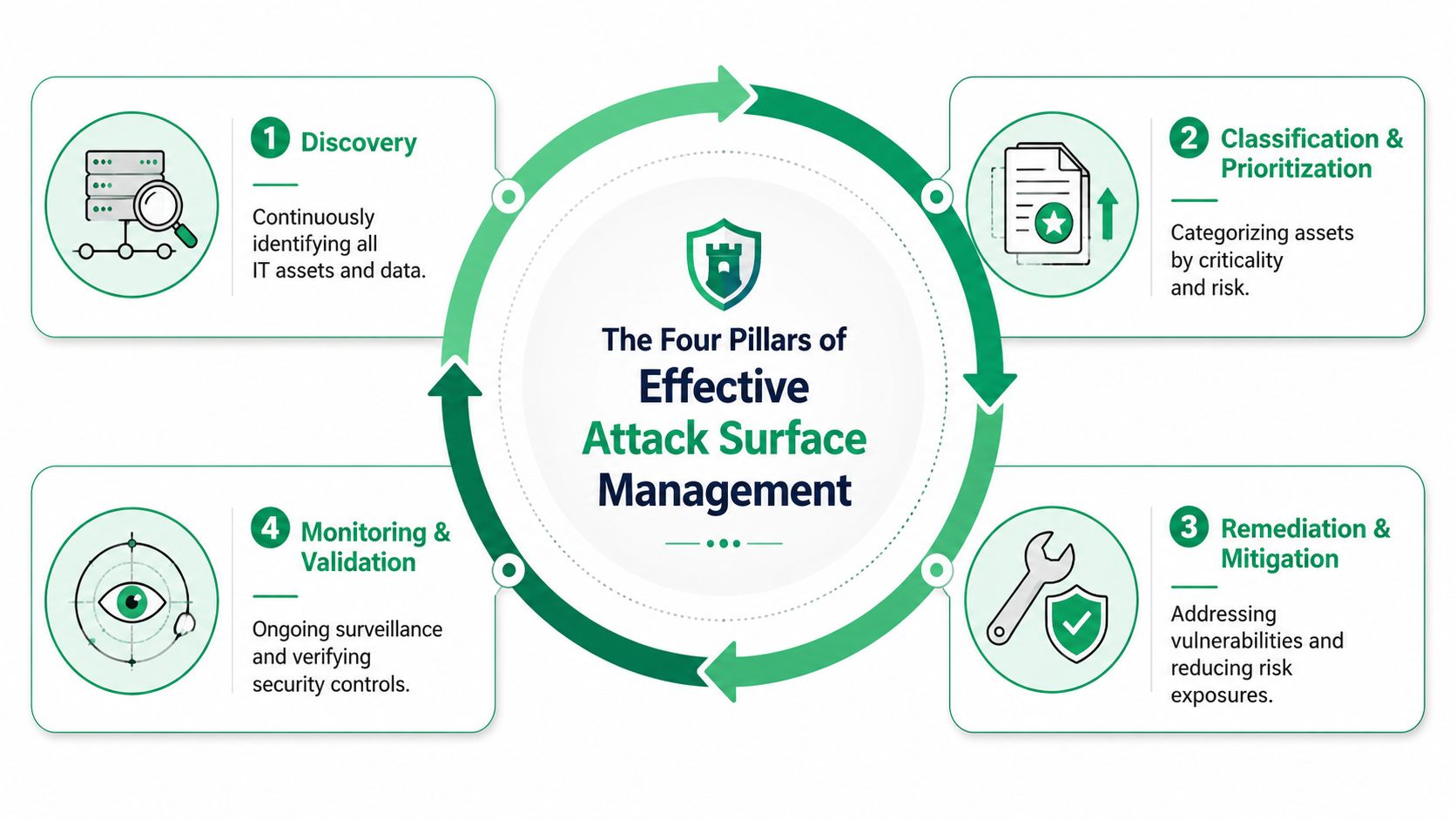
Good attack surface management isn't a one-time project. It runs as a loop. New software appears. Staff changes roles. Vendors come and go. A company acquires another location, opens a warehouse, launches a customer portal, or builds a mobile app. The environment shifts, so the security process has to keep moving too.
That loop starts with visibility. According to Sprocket Security's explanation of key ASM functions and best practices, effective ASM operates as a continuous loop of asset discovery, classification, risk analysis, and prioritization, beginning with mapping all internet-facing assets to eliminate blind spots from shadow IT and rogue cloud services.
Discovery
This is the part most businesses skip or do manually once a year. That's not enough.
Discovery means identifying every internet-facing asset tied to the business. Domains. Subdomains. Cloud apps. Remote access points. Public storage. Old SSL certificates. Test systems. Vendor-exposed portals. If it's visible from outside, it belongs on the map.
For a Southside business, that can include the production server in the office, a hosted customer portal, an old recruiting site, and a neglected third-party tool still connected to company email.
Inventory and classification
Once you find an asset, you need context.
A complete inventory tells you what the thing is, who owns it, what data it touches, how critical it is to operations, and whether it supports a regulated function. A front-desk scheduling app in a healthcare clinic doesn't carry the same risk profile as a public brochure site. A defense subcontractor's file-sharing portal may need to be reviewed through a CMMC lens. A general office workflow may align first to NIST CSF.
This is also where networking and cloud architecture matter. A site with proper segmentation, Zero Trust architecture, and well-documented ownership is easier to defend than a flat network with years of inherited shortcuts.
Prioritization and risk scoring
The wrong way to do ASM is to dump hundreds of findings into a ticket queue and call it progress.
The right way is to sort by actual business risk. Some teams use EPSS probability scores alongside CVSS, asset criticality, and known exploited vulnerability context to decide what needs attention first. That makes a huge difference because a medium-severity issue on a public-facing finance system may deserve faster action than a technically severe issue sitting in an isolated test box.
A local business owner doesn't need a spreadsheet with endless rows. They need answers to three questions:
- What could stop operations
- What could expose customer or regulated data
- What should we fix this week
Remediation and monitoring
At this juncture, theory either becomes business continuity or becomes shelfware.
Remediation means patching, changing configs, removing obsolete systems, tightening access, rotating credentials, and in some cases taking assets offline entirely. Monitoring means you keep checking because the attack surface won't stay still.
If patching discipline needs work, this overview of why patch management matters for business protection connects the dots between routine maintenance and real-world security outcomes.
ASM without remediation is just inventory. Inventory without monitoring goes stale fast.
The best programs also connect to business continuity work. If a server fails, your immutable off-site backups, recovery priorities, and even bit-level data recovery options matter. If Wi-Fi is inconsistent in an older building, latency-optimized mesh nodes and cleaner network design reduce the temptation for staff to invent unsafe workarounds.
A Practical ASM Roadmap for Your Indiana Business
Most guides on attack surface management are written for companies with giant security teams, multiple analysts, and budgets that make small business owners laugh. That's not how most companies in Greenwood, Franklin, or the broader Indianapolis area operate.
The gap is real. The majority of ASM content targets enterprises, yet 74% of SMBs lack formal cybersecurity protocols, which creates a need for lightweight strategies that fit resource-constrained businesses, as noted in Panorays' discussion of automated attack surface management for SMB realities.
So the right roadmap is not "buy the biggest platform." It's "build a system your team can run."
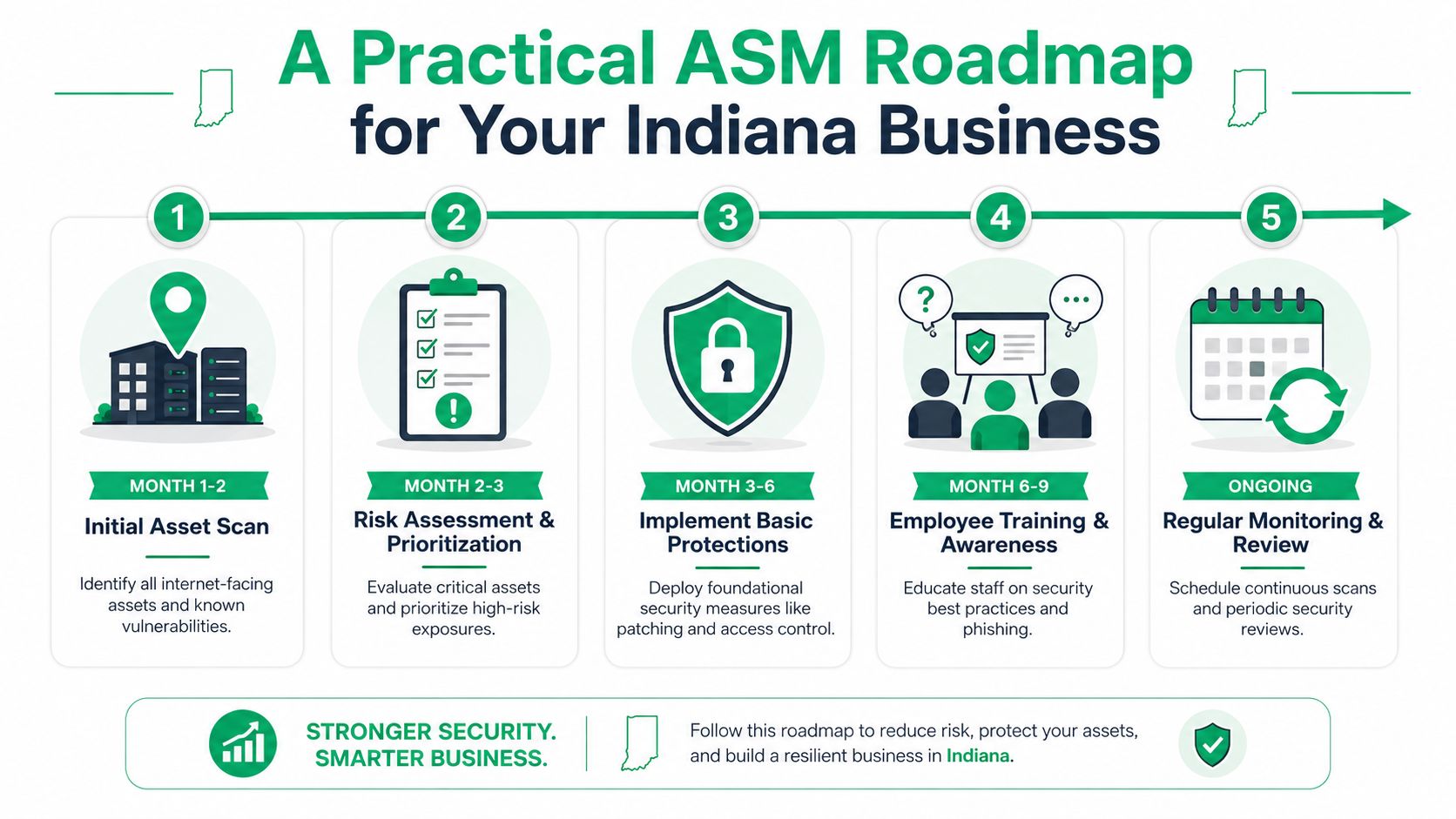
Phase one builds the foundation
Start with what you know.
Make a plain list of hardware, software, users, cloud services, websites, remote access tools, and backups. Include workstations, network gear, Microsoft 365, security products such as Bitdefender GravityZone, line-of-business software, and any custom software development projects. If your team has ever needed emergency data recovery, document where that data lives and whether recovery is supported by tested backups or only hope.
This phase also forces good ownership. Every asset needs an owner, even if that owner is an outside provider.
Phase two finds the unknowns
Now look for what isn't on the spreadsheet.
That means outside-in discovery, cloud review, public exposure checks, old domain review, and a reality check on who has access to what. Consequently, many local businesses uncover stale admin accounts, contractor leftovers, and SaaS sprawl that nobody meant to create.
A broader planning resource like this guide to building an Indiana business IT roadmap for 2026 is helpful because ASM works best when it sits inside a bigger operating plan. Networking, cybersecurity, cloud computing, and IT support should reinforce each other.
Phase three lines security up with compliance
If you don't need a formal framework, use NIST CSF as the backbone. It gives structure without forcing enterprise complexity.
If you're in healthcare, map controls to HIPAA. If you work in the defense supply chain, bring in CMMC. The point isn't paperwork for its own sake. The point is making sure discovery, access control, monitoring, and incident response all support the obligations you already carry.
A few practical control areas usually rise to the top:
- Access control with MFA, role-based permissions, and review of stale accounts
- Patch discipline for servers, endpoints, network gear, and cloud-connected systems
- Backup integrity with immutable off-site backups and documented restore procedures
- Monitoring coverage through centralized logging or SOC-as-a-Service monitoring
Phase four makes ASM operational
Security dies when it stays theoretical.
Pick a few simple measures and review them monthly. Time to remediate critical findings. Number of unknown assets discovered. Number of unsupported systems still online. Open vendor access paths. Those aren't boardroom vanity metrics. They tell you whether exposure is shrinking.
Small businesses don't need security theater. They need a repeatable process that protects payroll, scheduling, revenue, and customer trust.
When this is done right, it also improves ROI. Your internal team spends less time chasing random alerts and surprise outages. That turns wasted tech time back into billable hours and moves IT spending toward predictable monthly budgets instead of emergency invoices.
How Finchum Fixes IT Delivers Managed ASM
A lot of firms talk about security like it's a tool purchase. It isn't. Real attack surface management is an operating model.
In our 17 years of local service, we've seen Indiana companies buy isolated products that generated more noise than clarity. One dashboard watched endpoints. Another watched email. Another scanned for vulnerabilities. Nobody tied the results together, nobody owned remediation, and the business still had blind spots. That's how teams end up paying for multiple products while staff keep losing hours to repeat issues.
What a managed approach looks like
Effective ASM needs automation and integration. Rubrik's guidance on attack surface management points out that successful programs require automated continuous monitoring and integration with security ecosystems such as SIEM and SOAR for centralized visibility and efficient incident response.
That model works well for SMBs because it turns a complex security discipline into a managed service.
A practical managed ASM stack often includes:
- Centralized visibility across on-prem systems, cloud providers, and third-party integrations
- SOC-as-a-Service monitoring so alerts are triaged instead of dumped in someone's inbox
- Zero Trust architecture to reduce broad access and contain mistakes
- Backup and recovery planning that pairs ASM with immutable off-site backups and tested recovery steps
- Network improvements like segmented VLANs, cleaner firewall policy, and latency-optimized mesh nodes where old buildings fight Wi-Fi
When businesses along the I-65 corridor want that kind of support wrapped into day-to-day operations, managed IT services for Indiana organizations make more sense than trying to assemble a patchwork of tools internally.
Why this improves ROI, not just security
Managed ASM protects continuity. That's the obvious value.
The less obvious value is operational focus. Staff stop burning hours on recurring tech fires. Leadership gets a clearer monthly budget. Security work starts feeding other parts of the business, from cloud migrations to IT support to software development and disaster recovery planning.
We've also learned something simple from hands-on recovery work. When we dissembled a similar client's failing RAID array during a data recovery job, the root issue wasn't just hardware age. It was visibility. Nobody had documented dependencies, backup assumptions, or what public-facing systems tied back to that storage. That's the same lesson ASM teaches at a broader level. Unknowns are expensive.
Get a Clear Picture of Your Security Risks Today
You can't protect what you don't know you have. That's true for the forgotten laptop, the old vendor portal, the cloud app bought on a company card, and the website nobody has touched in years. Any one of them can become the problem that halts operations on a Tuesday morning.
Attack surface management gives Indiana businesses a more honest view of risk. Not a polished report for a binder. A working view of what is exposed, what matters most, and what should be fixed before it affects production, payroll, scheduling, customer trust, or compliance.
For SMBs in Greenwood, downtown Indy, and across the surrounding counties, the best ASM program is the one that fits reality. It should support business continuity, reduce wasted tech time, and help turn security spending into a predictable operating cost instead of a string of emergency repairs. It should also fit beside the rest of your environment, including networking, cloud computing, cybersecurity controls, data recovery planning, software development workflows, and everyday IT support.
If your team is growing, opening locations, supporting remote staff, or handling regulated data, this is the right time to get an outside-in look at your exposure. Hidden assets don't stay harmless just because they've been quiet.
Businesses in the Greenwood and Indianapolis area that want a clearer picture of their exposure should schedule a Free Network Assessment or Security Risk Audit with Finchum Fixes IT. It's a practical way to identify blind spots, tighten security, and keep your team focused on billable work instead of surprise downtime.