Build a Bulletproof Indiana Business IT Roadmap for 2026
Let's get one thing straight. An IT roadmap isn't a shopping list for the latest shiny toys. I’ve seen plenty of those, and they're usually just a fast track to wasted money. A real business IT roadmap is a strategic game plan. It’s how you make every single piece of tech in your company—from the servers in the back room to the software on everyone's screen—work toward your actual business goals.
For a business here in Johnson County, that means ditching the constant fire-fighting and starting to make smart, proactive investments that actually grow your bottom line.
TL;DR: Your IT Roadmap in a Nutshell
- Get Real About Your Current Tech: Take a brutally honest inventory of everything you have—from aging server hardware to spotty Wi-Fi in an old brick building—to pinpoint what’s putting you at risk. We find issues like unpatched software (e.g., Bitdefender) or non-compliant setups (HIPAA, CMMC).
- Lead with Business Goals, Not Gadgets: Define where you want the business to go, *then* figure out how technology like cloud migration or a Zero Trust architecture gets you there.
- Prioritize for Impact (ROI): Focus your budget on projects that prevent costly downtime (up to $9,000 per minute) and secure your operations. Tackle critical vulnerabilities first.
- Build a Sensible Timeline & Budget: Map out investments in logical phases to create a predictable monthly budget, converting "wasted tech time" into billable hours.
- Execute, Measure, and Repeat: Work with a partner to put the plan into action, track what’s working, and continuously align your tech with your Central Indiana business goals.
Why You Need a Real IT Roadmap (Not a Wishlist)
So many companies across the Indy metro area are stuck in the "break-fix" cycle. A server crashes, you panic, and you write a huge check for an emergency fix. We see it all the time. One client in a Greenwood business park had their operations grind to a halt because of a failed server, a disaster that can cost a business upwards of $9,000 per minute in downtime. A proper IT roadmap is your way out of that chaos.
Think of it as the blueprint that turns your technology from a money pit into your biggest competitive edge. It’s not about buying the flashiest new thing; it's about making deliberate, planned investments that solve real problems and create new opportunities.
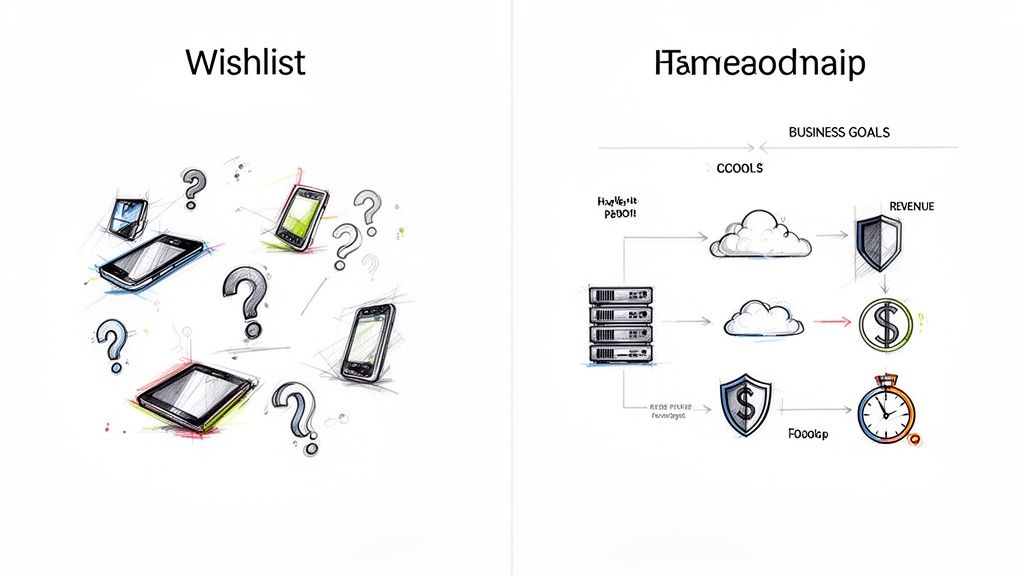
From Reactive Chaos to Predictable Success
A solid roadmap makes you sit down and answer the tough questions that get ignored in the day-to-day grind:
- Are our backups genuinely secure—we’re talking immutable off-site backups?
- Can our network actually support the growth we’re planning for in Hamilton County?
- Are we truly compliant with industry rules like the NIST CSF or HIPAA?
- How do we finally get off the IT spending rollercoaster and onto a flat, predictable monthly budget?
In our 17 years of local service, we’ve guided countless owners through this exact process. I remember a client on the I-65 corridor whose old brick warehouse had Wi-Fi so spotty it was crippling their productivity. Instead of just throwing more access points at the wall, we built a roadmap. It laid out a phased rollout of latency-optimized mesh nodes that systematically turned that bottleneck into a rock-solid asset.
A roadmap transforms your IT from a reactive cost center into a proactive growth engine. It’s about spending money smartly to make more money, not just spending to fix what’s broken.
This guide is built on that kind of firsthand, in-the-trenches experience. We’ll show you how a real plan connects your technology directly to your bottom line, securing your operations and letting your team get back to doing what they do best. For a deeper dive on structuring these big changes, our guide on digital transformation frameworks for Indiana businesses is a great resource.
Ultimately, the goal is simple: turn all that "wasted tech time" into billable hours and operational excellence.
Conducting a Painfully Honest IT Assessment
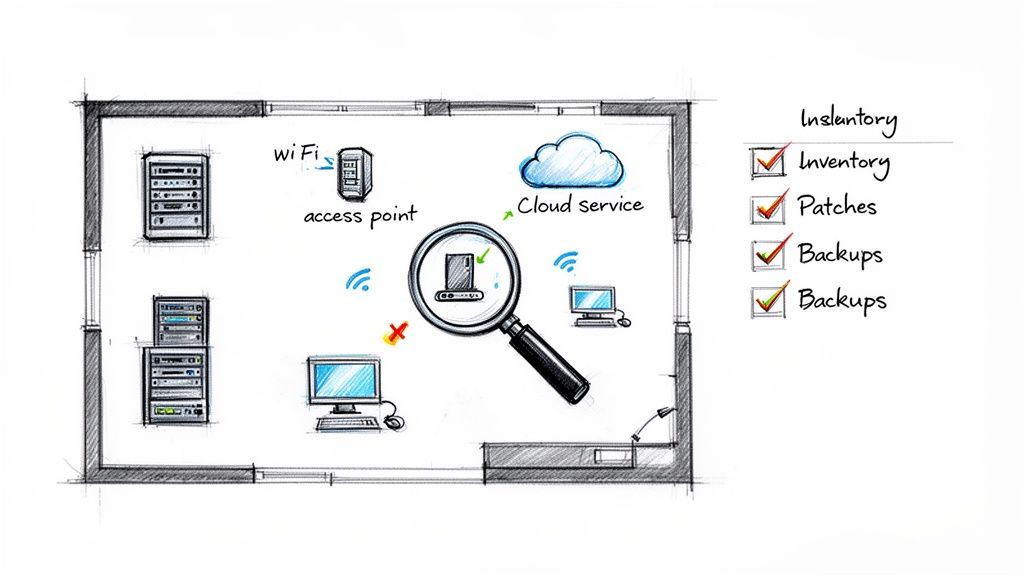
You can't map out a trip to the future without knowing your starting point. The same goes for your business technology. It’s time to get a brutally honest, clear-eyed view of your current setup, and I mean everything. This is way more than just "we have a few computers." It’s about creating a detailed inventory of every single piece of tech your business depends on.
In our 17 years of local service, we've guided Indianapolis-area businesses through this exact process. It means digging in and identifying every device, software license, and network component. We’re talking about everything from the UniFi networking gear in your Greenwood warehouse to that one cloud subscription you forgot you were even paying for.
Uncovering Your Ticking Time Bombs
Look, the goal here isn't to scare you. It’s to build a data-backed picture of your risks and assets. This initial review is where we often find the ticking time bombs—like aging server hardware—that could bring your entire operation to a halt, costing up to $9,000 per minute in downtime.
As you start this assessment, following solid IT asset management best practices is the only way to get an accurate inventory and plan for what's next. Your list should track:
- Hardware: Every server, workstation, laptop, and network switch. Jot down its age, warranty status, and current performance. That ancient server humming in the corner is one power surge away from becoming a very expensive paperweight.
- Software & Licenses: Log all applications, operating systems, and subscriptions. Are they all patched and up to date? Because unpatched software is a wide-open door for cyberattacks.
- Cloud Services: Document every single SaaS platform and cloud account. It's shocking how often we find businesses paying for redundant services or tools the team hasn't touched in months.
- Security & Compliance: What security tools, like Bitdefender GravityZone, do you have running? If you’re a defense contractor, are you actually meeting standards like CMMC? For a healthcare provider, is your tech truly HIPAA compliant?
When we dissembled a similar client’s failing RAID array, we found the 'backup' was an external hard drive sitting right next to the server it was supposedly protecting. That's not a backup; it's a second point of failure waiting to happen. A real assessment finds these gaps before they become catastrophes.
From Inventory to Insight
This detailed inventory isn't just busywork—it's the non-negotiable foundation of your IT roadmap. It’s what moves you from guesswork to making decisions backed by cold, hard data. Everything you gather here will directly shape your priorities, budget, and timeline.
This isn't just a local trend; it's a global shift. Worldwide IT spending is projected to rocket to an incredible $5.61 trillion in 2025, a jump of nearly 10% from 2024. This tells us that smart companies are finally treating IT as the strategic investment it is, with spending on data centers and software leading the charge.
To tackle this systematically, you need a solid framework. Our free guide, Your Ultimate 10-Point IT Infrastructure Audit Checklist for 2026, gives you a practical place to start.
Once you have this complete picture, you can finally stop just reacting to IT problems and start building a technology plan that actually supports where your business is headed.
Let’s Talk Business Goals, Not Just Gadgets
I’m going to let you in on a little secret: if your IT roadmap kicks off with a shopping list of servers and software, it’s already dead in the water. I’ve seen it happen more times than I can count. The tech has to serve the business, plain and simple.
This is the part where we set aside the geek-speak for a minute and get real about what you’re actually trying to accomplish as a business. The whole point is to draw a straight, undeniable line from every single dollar you spend on technology to a specific, measurable business outcome.
Think of it this way: technology is just a tool. You wouldn't buy a sledgehammer without knowing you need to knock down a wall. Your roadmap’s job is to identify the wall first.
Turning Ambition into Actionable Projects
This is where the rubber really meets the road. We take a big-picture goal and break it down into concrete IT initiatives. It’s a process we’ve fine-tuned over years of working with companies all over the Indianapolis metro area.
For instance, we recently worked with a manufacturing firm in Hamilton County whose primary goal was to double their production capacity within three years. That one objective immediately set off a chain reaction of critical IT questions:
- Can their current network even handle the data tsunami from all that new machinery?
- Is their server setup ready to scale, or is it going to keel over?
- Do they have the right software to manage twice the inventory and logistics?
Their IT roadmap took that single "double capacity" goal and translated it into a clear, phased plan: a UniFi networking upgrade in year one, a strategic cloud migration in year two, and a new ERP software launch in year three.
We see this all the time with growing businesses along the I-65 corridor. A company gets excited about hiring 20 new people but completely forgets their ancient phone system only supports 15. A solid roadmap sees that coming, turning a potential fire drill into a planned, budgeted upgrade.
From Fuzzy Ideas to Crystal-Clear Actions
Connecting your goals to the right tech isn’t just for growth; it’s also your best defense against risk and inefficiency. A healthcare provider on the southside of Indy might have a core business objective to "ensure 100% HIPAA compliance and patient data security."
For that organization, this goal translates directly into a high-priority IT project: building a Zero Trust security architecture. Their roadmap is going to put things like deploying Bitdefender GravityZone for endpoint protection and setting up immutable off-site backups (your best friend against ransomware) at the very top of the list.
Here’s a quick look at how we often translate common business goals into specific IT projects for our Indiana clients.
Translating Business Goals into IT Initiatives
This table gives you some practical examples of how a high-level business objective can be broken down into a specific, actionable IT project.
| Business Goal | IT Initiative | Key Technologies Involved |
|---|---|---|
| Improve Customer Service Response Times | Implement a new cloud-based CRM and VoIP phone system. | Salesforce, Microsoft Dynamics, RingCentral, Cloud-based phone systems |
| Reduce Operational Costs by 15% | Automate manual back-office tasks like invoicing and data entry. | Custom Software, Microsoft Power Automate, Zapier integrations |
| Enable a Secure Hybrid Work Environment | Deploy a Zero Trust framework and secure remote access tools. | VPNs, Multi-Factor Authentication (MFA), SOC-as-a-Service |
| Increase Sales Team Productivity | Provide mobile access to all sales and inventory systems. | Cloud migration (Azure/AWS), Mobile Device Management (MDM) |
This process ensures your IT budget becomes a powerful investment, not just another line-item expense. And frankly, this strategic approach is becoming the standard.
Regional spending forecasts show that IT services are now the largest single category of tech spending in North America, with projected U.S. spending hitting $1.7 trillion. As detailed in recent Forrester research on global tech spending, this highlights a major shift: businesses are funding strategic guidance over just "keeping the lights on."
By tying every project to a clear "why," you build an airtight business case for your roadmap. If you're looking for inspiration on where to start, you can find some fantastic smart business process automation examples for Indiana companies that link directly to boosting efficiency.
How to Prioritize Projects for Maximum Impact
So, you've done the hard work of aligning technology with your business goals. The result? A wish list of IT projects that’s probably a mile long. You can't do it all at once, so how do you decide what to tackle first? This is where a smart, simple way of prioritizing your business IT roadmap becomes your secret weapon.
It’s all about making savvy choices based on urgency, impact, and cost. For a growing company in the Indy metro area, this is what keeps you from blowing your budget on a "nice-to-have" gadget when a critical security hole is wide open. A little method to the madness ensures your first moves deliver the biggest bang for your buck and prevent downtime.
I’ll never forget walking into a new client's server room in Greenwood and seeing a critical server with multiple blinking amber lights on its drive array. That’s the universal sign for "this thing is about to die a fiery, data-destroying death." We immediately dropped everything and made its replacement priority #1. That one quick decision saved them from a total shutdown that would have cost them a fortune in lost billable hours.
The Impact vs. Urgency Matrix
A surprisingly simple but powerful tool for sorting through the noise is a prioritization matrix. It helps you toss every potential project into one of four buckets, giving you an instant visual of what needs to happen right now versus what can wait.
Think of it as a four-quadrant map for your to-do list:
- Critical Now (High Urgency, High Impact): These are the five-alarm fires. We’re talking about severe security risks like unpatched vulnerabilities or major operational bottlenecks that are actively losing you money.
- Strategic Impact (Low Urgency, High Impact): These are your big-picture, future-proofing projects. They might not feel urgent today, but they're the foundation for your long-term growth and competitive edge.
- Quick Wins (High Urgency, Low Impact): Think low-hanging fruit. These are usually cheaper, faster to implement, and give everyone a nice, immediate morale or productivity boost.
- Future Considerations (Low Urgency, Low Impact): These are the "someday, maybe" ideas. Keep them on the back burner, but don’t let them distract you from what really matters today.
This simple exercise forces you to weigh each project against all the others, not just on its own merits.
Why Security Always Jumps to the Front of the Line
In our 17 years of serving local businesses, we’ve learned one unshakable truth: security initiatives almost always land in the "Critical Now" bucket. Why? Because a single breach can demolish years of hard work. With the cost of downtime soaring as high as $9,000 per minute, it’s a gamble no Indiana business can afford to take.
For example, if you’re a defense contractor along the I-65 corridor, meeting CMMC (Cybersecurity Maturity Model Certification) isn't a strategic option; it's a non-negotiable requirement to stay in business. Likewise, using a tool like Bitdefender GravityZone to patch a known software vulnerability isn't just a good idea—it's an emergency fix for a gaping hole in your defenses.
A proactive security posture is the bedrock of any real IT roadmap. It’s about preventing the fire in the first place, not just getting good at putting it out. Delaying security work is like ignoring the check engine light—it might seem fine for a bit, but the eventual breakdown will be spectacular.
Turning Your Matrix into an Action Plan
Once you've sorted your projects, the action plan practically writes itself. Your "Critical Now" items become your immediate 90-day to-do list. Those "Quick Wins," like finally fixing the spotty Wi-Fi in that old downtown Indy tech hub's brick building, can be slotted in to show some fast progress and build momentum.
Your "Strategic Impact" projects, like a full cloud migration, are the marathon runners. They need more detailed planning and are often broken into smaller phases over several quarters. This is where you connect your IT investments directly to business outcomes. A framework like Technology Business Management is perfect for this, as it provides the strategic lens to tie large-scale projects directly to long-term profitability and efficiency. This is how your business IT roadmap transforms from a simple list into a powerful engine for growth.
Building Your Roadmap Timeline and Budget
Alright, let's talk brass tacks. You’ve figured out what you need to do. Now it’s time to figure out when and for how much. This is where your IT roadmap goes from a wishlist to a real financial and operational plan that will guide your business for years.
I see a lot of Indiana business owners get a little wide-eyed at this point, picturing a single, massive invoice that could sink the whole year's budget. Relax. That’s not how this works. A smart roadmap breaks down huge, scary projects into bite-sized pieces.
For example, instead of a crippling, one-time server replacement, we might plan a phased migration to the cloud over 12-18 months. This spreads the cost out and minimizes the chaos, letting you get the benefits of modern tech without draining your bank account.
This is all about organizing your projects into clear, manageable chunks.
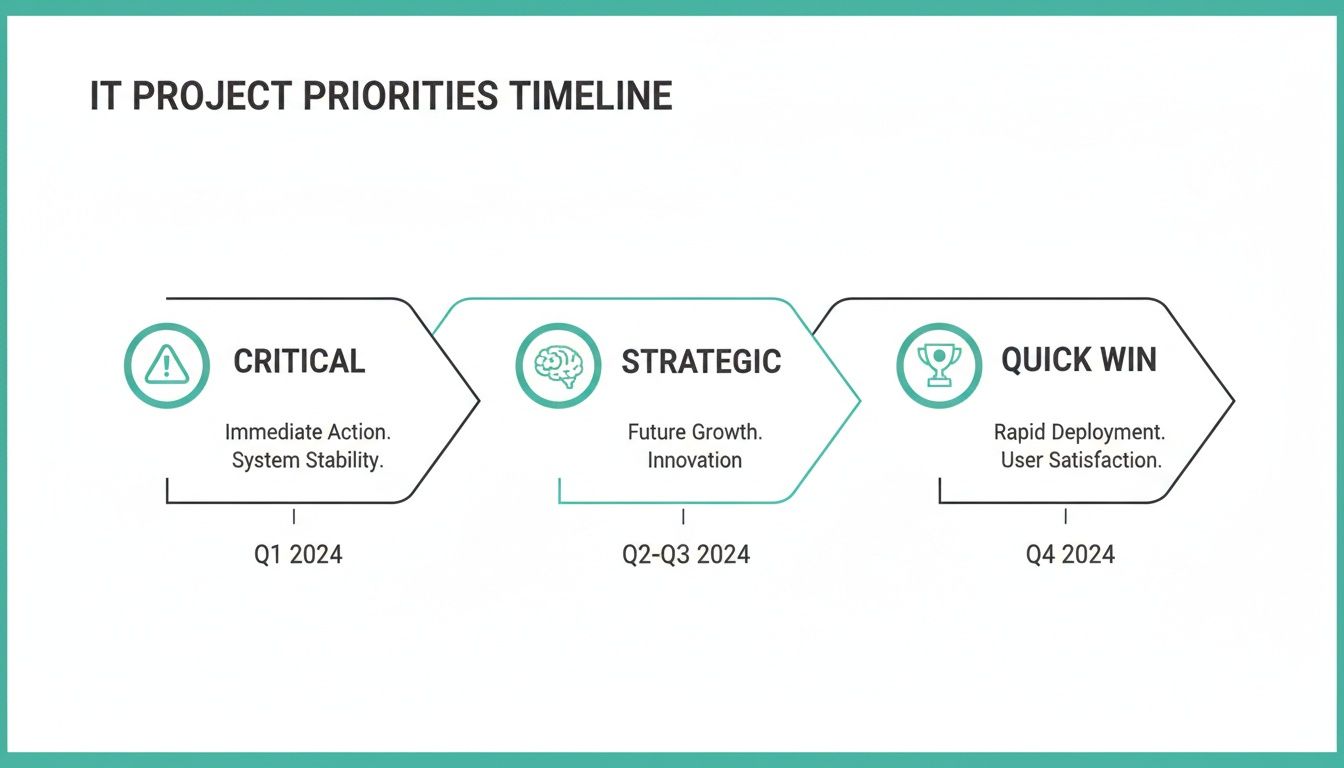
You absolutely have to separate the must-do-now items (Critical) from the long-term game-changers (Strategic) and the easy wins that get everyone excited (Quick Win).
Phasing Your Investments
The best way to map this out is by quarters and years. For most small and mid-sized businesses around Indy, a three-year outlook is the sweet spot. It gives you enough runway for those big strategic moves without losing sight of what needs to happen right now.
Your "Critical Now" items? Those are your top priority for the first couple of quarters. No excuses. These are the projects that plug your biggest security holes or fix the most painful productivity drains. Your "Quick Wins" can be sprinkled throughout the first year to build momentum and show your team that things are genuinely getting better.
The bigger "Strategic Impact" projects are the marathons, not sprints. These might take several quarters or even a few years. We recently helped a manufacturing client in an older Greenwood building that needed a complete network overhaul. Their roadmap included new latency-optimized mesh nodes, but we planned the physical installation around their production schedule, doing it in phases so they never had to shut down the line. It's all about planning for reality.
Budgeting for Predictability Not Chaos
When you think about your IT budget, you have to look beyond just the price tag on a new computer. A realistic budget covers three key areas:
- Hardware: This is your one-time physical stuff—servers, workstations, and networking gear like UniFi switches.
- Software: Think licensing fees for operating systems, security tools like Bitdefender GravityZone, and all those business apps. Don’t forget to account for recurring subscriptions!
- Services: This is the human element—the cost of labor for installation, ongoing management, and support. This is where you can completely change your financial approach to IT.
The most powerful shift a business IT roadmap creates is moving from a chaotic break-fix model to a predictable, flat monthly operational expense. Instead of facing surprise five-figure repair bills, you have a stable managed services fee that covers everything from proactive monitoring to 24/7 support and data recovery.
This move turns "wasted tech time"—your people wrestling with a slow network or your accountant paying an emergency invoice—into predictable costs and productive, billable hours. It’s a financial game-changer that makes forecasting accurate and gets rid of the anxiety that comes with aging equipment. To see what this looks like in practice, check out our guide on what real managed IT services cost in Indiana.
A Sample Roadmap for an Indiana SMB
To bring this all together, here’s a high-level look at what a roadmap might look like for a growing Johnson County business. This isn't a rigid template, but it shows how you can phase your initiatives to make huge goals feel surprisingly achievable.
Sample 3-Year IT Roadmap for an Indiana SMB
| Year/Quarter | Cybersecurity | Networking & Infrastructure | Software & Cloud | IT Support & Continuity |
|---|---|---|---|---|
| Year 1 - Q1/Q2 | Deploy EDR (Bitdefender); Conduct NIST CSF Gap Analysis | Upgrade Core Switches; Install Mesh Wi-Fi Nodes | Migrate Email to Microsoft 365 | Implement Managed IT & Helpdesk Support |
| Year 1 - Q3/Q4 | Implement Multi-Factor Auth (MFA); Employee Security Training | Replace Aging Firewall | Consolidate SaaS Subscriptions | Test Immutable Backups and Disaster Recovery Plan |
| Year 2 | Achieve CMMC Level 1 (if applicable); Zero Trust Pilot | Phased Server-to-Cloud Migration (Begin) | Launch New CRM Platform | Quarterly Business Reviews (QBRs) to Track KPIs |
| Year 3 | Implement SOC-as-a-Service Monitoring | Complete Cloud Migration; Decommission Old Hardware | Explore Custom App for Workflow Automation | Annual Roadmap Review and Update |
See how that works? The plan tackles the foundational stuff—security and stability—first. Once that solid base is in place, you can confidently move on to the bigger, strategic projects that will fuel your growth for years to come.
Bringing the Plan to Life and Tracking What Counts
Let's be honest, a beautifully crafted IT roadmap that ends up as a paperweight on your desk is completely useless. All that planning is just talk until you start doing the work. This is where the rubber meets the road—turning your strategy into real, measurable results.
The first, most critical step? Put a name next to every single item on that roadmap. No exceptions. Every project needs an owner who is on the hook for getting it done. Whether that’s someone on your team or your IT partner here in Indianapolis, accountability is everything.
Measure What Moves the Needle
Forget about fluffy "vanity metrics." We're not trying to win an award for the most technical-sounding report. The only numbers that matter are the ones that actually affect your company's performance and profitability.
We help our clients track the KPIs that tell the real story:
- Fewer IT Support Tickets: This is the big one. When your team isn't constantly putting out tech fires, they're actually doing the jobs you hired them for. This is how you convert wasted tech time into billable hours.
- Rock-Solid Network Uptime: We shoot for 99.99% uptime, and for good reason. Downtime can cost a business up to $9,000 per minute. This metric is a direct measure of your business continuity.
- Speedy Data Recovery: If disaster strikes, how quickly can you be back in business? We don't just hope for the best; we test this. A successful bit-level data recovery test can be the difference between a small headache and a full-blown catastrophe.
This is precisely where our SOC-as-a-Service (Security Operations Center) comes into play. We give you dead-simple reports that show your security posture and system performance in plain English. No techno-babble, just clear data proving your risk is shrinking and your investment is working. If you want to dig deeper into how we keep these systems running smoothly, our guide on IT infrastructure management is a great place to start.
Your Roadmap Is a Living, Breathing Document
Your business changes. New opportunities arise and fresh challenges appear. Your IT roadmap can't be a static, one-and-done document; it has to evolve right along with you.
That’s why we sit down with our Johnson County clients every quarter. We look at what we’ve accomplished, see what’s changed in their business, and adjust the plan. A roadmap has to be agile.
The sharpest business owners we work with along the I-65 corridor treat their IT roadmap like a GPS. It shows the best route right now, but they're always ready to reroute when a shortcut opens up or a roadblock appears.
From that initial look under the hood all the way to execution, the whole journey starts with knowing exactly where you are today. It's the only way to build a plan that truly gets you where you want to go.
That’s why a professional evaluation is the best first step you can take. For businesses in Greenwood and the greater Indianapolis area, we offer a Free Network Assessment to kickstart your roadmap and build a solid foundation for success you can actually see and measure.
Got Questions About Your IT Roadmap? We've Got Answers.
We’ve thrown a lot at you, I know. But after years of helping Indiana businesses hash these plans out, we've found a few questions pop up time and time again. Let's tackle the ones we hear most often.
So, How Often Do I Need to Look at This Thing?
Your IT roadmap isn't a dusty binder you create once and then shove on a shelf. It’s a living, breathing guide for your business. We tell our clients to give it a full, top-to-bottom review once a year.
But you also need to check in on it every quarter. Business moves fast. A new opportunity might pop up, a nasty security threat could emerge, or your growth could suddenly take off. For a fast-growing business in, say, Hamilton County, those quarterly tweaks are absolutely essential to keep your tech plan from falling behind your ambition.
Can a Small Business Really Afford a Multi-Year IT Plan?
We get this one a lot from Johnson County business owners. The honest answer? You can't afford not to have one.
Think about it: a roadmap is your best defense against those heart-stopping, budget-wrecking tech emergencies that always seem to happen at the worst possible time. By planning projects out and shifting to a predictable managed services model, you stop lurching from one expensive crisis to the next. You turn chaotic, unpredictable costs into a stable, manageable line item. You stop reacting to downtime and start investing in uptime and business continuity.
What's the Single Most Important Piece of the Puzzle?
Easy. Cybersecurity. No question.
Everything else—new software, faster networking like UniFi, or cloud migrations—is built on top of your security posture. A single breach can be an extinction-level event for a small business, wiping out your finances and the trust you've built with customers.
That’s why security initiatives always come first. Things like a Zero Trust security model, making sure you have immutable off-site backups, and continuous monitoring with SOC-as-a-Service aren't optional. They're the bedrock.
A roadmap that doesn't put security first is just a house of cards waiting for a strong gust of wind. In our 17 years of local service, we've seen that the most successful companies are the ones that treat security as an investment, not an expense.
Your roadmap is the key to turning your IT from a necessary evil into a genuine competitive edge. It all starts with knowing exactly where you stand today.
Finchum Fixes IT offers a Free Network Assessment to help businesses in Greenwood and across the greater Indianapolis area get an expert, no-strings-attached look at their current technology.