IT Infrastructure Management: Your Guide to Slashing Downtime and Boosting ROI
TL;DR
- Effective IT infrastructure management is not an expense; it's a core business strategy that prevents costly downtime (up to $9,000 per minute) and converts wasted tech time into billable hours.
- Your infrastructure includes networking, servers, storage, and cybersecurity. Neglecting any one part, like an aging server in a Greenwood business park, creates a major financial risk.
- Modern solutions involve UniFi networking to fix spotty Wi-Fi, immutable off-site backups to make ransomware powerless, and Zero Trust architecture to secure your data.
- For businesses in Central Indiana, compliance with standards like HIPAA or CMMC is non-negotiable. Proactive management ensures you meet these legal requirements.
- Partnering with a Managed Services Provider (MSP) gives you a predictable monthly budget and access to a full team of experts, turning IT from a liability into a growth engine.
Let's be honest, "IT infrastructure management" sounds like corporate jargon. But what it really means is keeping your company's entire tech world—every computer, server, cable, and piece of software—running smoothly so you can actually do business.
It’s the behind-the-scenes work that turns your technology from a ticking time bomb of potential expenses into a powerhouse that makes you money. For businesses here in the Indianapolis metro, it's about getting ahead of problems before they shut you down.
Your Guide to Bulletproof IT Infrastructure
Picture this: it's Tuesday morning at your Greenwood manufacturing firm, and everything just stops. The server that runs your production line finally gave up. This isn't just a hassle; it's a full-blown financial disaster. Downtime can cost businesses a staggering $9,000 per minute.
This guide is designed to shift your thinking. We're moving IT infrastructure management out of the "headache" column and into the "essential for survival" column. A smart, proactive approach means your team spends their time on billable work, not on fighting with technology, which directly improves your ROI.
Your IT infrastructure is the skeleton of your entire company. It’s the network that lets your team collaborate, the servers holding your most precious data, and the security that keeps the bad guys out. When it's working perfectly, you barely even know it's there. But when it breaks, everything screeches to a halt.
For a lot of Johnson County business owners we talk to, IT is an afterthought… until it becomes a five-alarm fire. A well-managed infrastructure is your fire prevention plan, guaranteeing you stay operational and swapping unpredictable emergency repair bills for a stable, predictable monthly budget.
This isn't just a local concern; it’s a global one. The worldwide IT Infrastructure Market was valued at US$120.15 billion in 2025 and is on track to hit US$241.69 billion by 2032. That explosive growth shows just how critical it is for businesses everywhere to keep their systems modern and reliable. Kicking the can down the road on upgrades just isn't an option anymore.
What’s at Stake for Your Indiana Business
In our 17 years of local service, we’ve seen it all. We’ve seen a logistics company on the I-65 corridor lose a full day of shipments because their network went down. We've helped a Hamilton County medical practice navigate a potential HIPAA nightmare caused by a simple security oversight. When we disassembled a similar client’s failing RAID array, we performed a bit-level data recovery to save their financials.
These aren't just stories; they're expensive realities that good IT management prevents. Understanding what goes into comprehensive infrastructure management services is the first real step toward building a truly resilient business.
A fantastic place to start is by figuring out where you are right now. Our team put together a simple checklist to help you spot the weak links in your current setup. Take a look at our guide on how to perform a Your Ultimate 10-Point IT Infrastructure Audit Checklist for 2026.
Ultimately, our goal is to give you the clarity you need. We'll break down all the core pieces, explain the real-world risks, and show you how a local partner can build a future-proof foundation for your Indiana business. Don't wait for a crisis to make you take action.
Breaking Down Your IT Infrastructure Components
Think of your business's technology like the engine in an IndyCar. It’s not just one big part; it’s a complex system of interconnected components. IT infrastructure management is the art and science of making sure every single one of those parts—from the wiring to the software—is perfectly tuned and working together. If one little piece fails, the whole car can end up in the wall.
This is the fundamental relationship between your hardware, software, and networking—the trifecta that makes your business run.
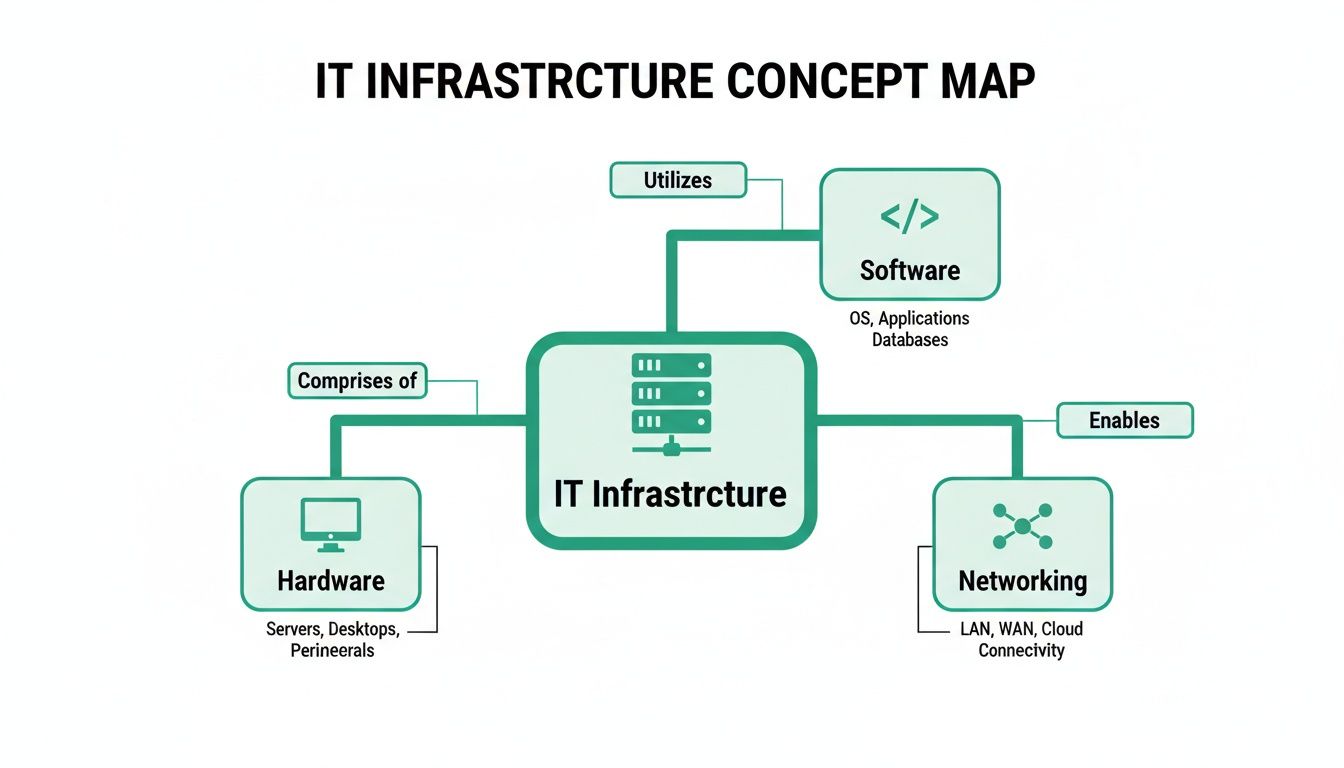
Hardware is the physical chassis and engine block. Software is the onboard computer telling it what to do. And networking? That’s the communication system sending data from the sensors to the driver. Let’s pop the hood and see what these pieces really are and why they matter to your bottom line.
To make this crystal clear, here’s a quick breakdown of each component and how it directly impacts an Indiana small business.
IT Infrastructure Components and Their Business Impact
| Component | What It Is (Simple Terms) | How It Prevents Downtime | Relevant Finchum Fixes IT Solution |
|---|---|---|---|
| Networking | The digital "highway" connecting all your devices. Think routers, switches, and Wi-Fi. | A well-designed network prevents slowdowns and connection drops that kill productivity. | UniFi networking with strategically placed mesh nodes to eliminate Wi-Fi dead zones. |
| Servers | The powerful central computers that run your core applications and store your data. | Proactive server maintenance and replacement prevent catastrophic hardware failures that can take your entire business offline. | Hybrid solutions combining on-premise servers for control and cloud servers for flexibility. |
| Storage | The digital filing cabinets where your business data lives (hard drives, cloud storage). | Fast, reliable storage ensures your team can access critical files instantly, avoiding frustrating delays. | Secure, high-speed storage arrays and cloud backup solutions. |
| Virtualization | A clever way to make one physical server act like multiple "virtual" servers. | Reduces the number of physical machines that can fail, consolidating your risk and making recovery faster. | Server virtualization setups that maximize hardware efficiency and minimize costs. |
| Software Development | The custom tools and applications that give your business a competitive edge. | Properly managed and updated software prevents bugs and security holes that can halt operations. | Custom application support and secure development lifecycle management. |
| Security | Your digital defense system—firewalls, antivirus, and security policies. | A multi-layered security approach stops threats before they can cause damage, from ransomware to data breaches. | Managed firewall services and advanced antivirus like Bitdefender GravityZone. |
| Data Recovery | Your "get out of jail free" card—a system for restoring data after a disaster. | Immutable off-site backups ensure you can recover from anything (ransomware, fire, flood) without paying a ransom. | Business continuity plans with rapid-restore capabilities to get you back online in hours, not weeks. |
| IT Support | The human expertise that keeps everything running and helps your team with tech issues. | Immediate access to expert help resolves minor issues before they become major downtime events. | Dedicated helpdesk support for rapid problem resolution. |
Each of these elements is a critical gear in your operational machine. Neglecting even one can have a massive ripple effect, leading to lost revenue and customer trust.
Networking: The Backbone of Your Business
Your network is the highway that connects every single device in your business. When it's slow or spotty, it’s like hitting a traffic jam on I-465 during the morning commute—everything grinds to a halt, and nobody gets anything done.
We see this constantly in old brick buildings downtown, where thick walls absolutely murder Wi-Fi signals. The solution isn't just buying a more powerful router; it’s about smart design using professional tools like UniFi networking. By mapping out the space and placing latency-optimized mesh nodes, we can kill dead spots for good. This simple fix turns frustrating "tech time" back into productive, billable hours.
Servers and Storage: The Brains and Memory
Your servers are the heavy lifters, the central computers where your most important applications and data live. That dusty old server humming away in a closet at your Greenwood office? It's a ticking time bomb. When it finally gives up, your entire business could go offline, costing you thousands of dollars for every minute you're down.
Modern IT strategy uses a mix of on-site hardware and cloud-based power.
- On-Premise Servers: These are the physical machines you own and keep in your office. They give you total control, which is a must-have for businesses in fields like healthcare or finance with strict data compliance rules.
- Cloud Computing: This means you're essentially renting computing power from giants like Amazon Web Services (AWS) or Microsoft Azure. It’s incredibly flexible and lets you scale up or down without buying expensive new hardware.
- Virtualization: Now this is a real game-changer. It’s a technology that lets a single physical server run multiple "virtual" machines, each acting as its own independent server. It's a fantastic way to boost efficiency and slash hardware costs. We wrote a whole guide on how virtualization can benefit your Indiana business that breaks it all down.
Regardless of the setup, your data storage has to be fast, accessible, and, above all, secure.
Cybersecurity and Data Recovery: Your Insurance Policy
Cybersecurity isn’t a single product you buy; it's a protective shield that wraps around everything else. It’s your firewall, your antivirus software like Bitdefender GravityZone, and smarter strategies like a "Zero Trust" model, which basically operates on the principle of "never trust, always verify" for every user and device.
And data recovery? That's what saves your bacon when a threat gets through. This is so much more than just having copies of your files. Real business continuity depends on having immutable off-site backups—that means secure, unchangeable copies of your data stored in a totally separate physical location.
If a ransomware attack locks up all your files, you don't even think about paying. We just wipe the infected systems and restore everything from that clean, untouchable backup. You're back in business in a matter of hours, not weeks. It’s the ultimate do-over button for your business.
The High Cost of Infrastructure Neglect
Generic warnings about “downtime” are easy to ignore—until it’s your business on the line. The true cost of ignoring your IT infrastructure isn't some abstract figure. It’s the raw, unfiltered chaos that explodes when a critical piece of tech dies at the worst possible moment. It’s about turning all those minutes your team spends waiting on slow computers back into productive, billable hours.
Picture a busy Hamilton County medical clinic during the morning rush. The network goes down. Suddenly, you can’t pull up patient records, you can’t process co-pays, and you can’t even check appointments. This isn't just an operational headache; it’s a full-blown HIPAA compliance fire drill, with sensitive patient data hanging in the balance and the threat of massive fines looming.
Downtime Isn't Just an Inconvenience—It's a Financial Hemorrhage
For a logistics company running freight up and down the I-65 corridor, a server crash is a catastrophe. Every single minute the system is down, trucks are parked, shipments are missed, and contracts are broken. The financial bleed is immediate and brutal. Industry data shows that downtime can cost a staggering $9,000 per minute.
This is the cold, hard reality of the old "break-fix" mindset. If you wait for something to break, you're guaranteeing it will happen at the most painful and expensive time.
In our 17 years of serving local businesses, we've walked into this exact firestorm more times than we can count. We've been the ones called in after a ransomware attack has crippled a company, forcing them to stare down a six-figure recovery bill. All because they thought their outdated firewall was "good enough." They learned a brutal lesson: gambling with your IT infrastructure is a bet you will eventually lose.
The Ticking Time Bomb in That Greenwood Server Closet
Let's zoom in on a classic problem we see all over the business parks in Greenwood and Johnson County: the ancient server. You know the one. It’s been humming away in a closet for seven, eight, maybe even ten years. It seems to be working, so the decision to upgrade gets kicked down the road to "save money."
Here’s what’s actually going on:
- The Slow Bleed: That old server is a boat anchor on your team's productivity. They waste precious minutes every single hour waiting for files to open or apps to load. Add it all up, and you're losing thousands of dollars a year to a slow machine.
- It's Going to Fail: Like an old car, aging hardware is living on borrowed time. Its components are worn, and a catastrophic failure isn't a matter of if, but when.
- A Hacker's Welcome Mat: Old hardware often can't run the latest security patches or support modern protection like Bitdefender GravityZone. It becomes the single easiest way for a cybercriminal to walk right into your network.
When that server finally gives up the ghost, the business grinds to a dead halt. That's when the real costs hit: emergency hardware fees, desperate data recovery attempts, and the crushing weight of lost revenue for every hour you're offline.
A predictable monthly investment in managed services completely flips this script. Instead of a catastrophic, five-figure emergency, you have a fixed operational cost that includes proactive monitoring and a planned hardware refresh cycle, ensuring you never face a crisis.
This proactive approach is all about business continuity. We don't just solve problems; we stop them from happening in the first place. We make sure your systems are strong, secure, and ready when you need them. A huge part of this strategy is having rock-solid backups. To see just how vital this is, check out our guide on enterprise data backup solutions that guarantee business uptime.
Ignoring your infrastructure means signing up for unpredictable, catastrophic costs. A proper IT management plan gives you a predictable budget, vaporizes downtime, and turns your technology from a ticking time bomb into an asset that fuels your growth.
Architecting a Future-Proof Business Strategy
Today's business problems can't be solved with yesterday's tech. If you're only reacting to IT issues as they pop up, you're already behind. Building a truly resilient business means architecting your technology to not only solve today's headaches but also to anticipate what's coming around the corner. It’s about building a smarter, more secure foundation from the ground up.
This isn't just theory; it's becoming critical. Think about the explosive growth of artificial intelligence. The AI infrastructure market is expected to rake in over $250 billion in 2026 alone. But here's the catch: more than half of the companies pouring money into AI are hitting major roadblocks with their existing compute, storage, and security. It's a classic case of trying to build a skyscraper on a cracked foundation.

So, what does a future-proof strategy actually look like for an Indiana business? It's all about blending the hands-on control of in-house systems with the agility of the cloud, then wrapping the entire thing in an ironclad security blanket.
Embracing Hybrid Environments
For most businesses we see up and down the I-65 corridor, the answer isn’t a simple “all cloud” or “all on-premise” decision. The magic is in the mix.
Take a local defense contractor, for instance. They absolutely must keep their most sensitive data on-site to meet strict CMMC (Cybersecurity Maturity Model Certification) requirements. That data simply cannot leave the building.
But that same company can—and should—use the cloud for everything else, like their sales CRM or marketing platforms. This hybrid environment gives them the best of both worlds:
- Total Control: On-premise servers give them complete command over their crown jewels, which is non-negotiable in their industry.
- Scalability & Flexibility: The cloud lets them spin up resources as needed without shelling out for expensive new hardware, paying only for what they use.
This blended model delivers security where it counts without killing the agility you need to stay competitive. A smart hybrid system is really the heart of modern IT infrastructure management.
Implementing a Zero Trust Architecture
Remember the old castle-and-moat approach to security? Once you got past the firewall, you were trusted. In today's world of remote work and ever-smarter cyberattacks, that model is a recipe for disaster. This is where a Zero Trust architecture changes the game completely.
The core idea behind Zero Trust is simple but powerful: never trust, always verify. It assumes every single request to access your network is a potential threat until it's proven safe.
This means every user and every device has to prove who they are, every single time they try to access a file, an application, or anything else. For a tech company in downtown Indy with people working from home, coffee shops, and client offices, this isn't just a nice-to-have. It’s essential. It stops a single stolen password from becoming a full-blown network catastrophe.
Accessing Enterprise-Grade Security with SOC-as-a-Service
Most small and medium-sized businesses in Johnson County don't have the budget to build their own Security Operations Center (SOC)—a dedicated command center with analysts watching for threats 24/7. That's where SOC-as-a-Service comes in.
This model plugs your business into a team of elite security pros for a flat monthly fee. They use high-end tools to monitor everything, spot trouble, and shut down threats before they can do any real damage.
Think of it as having a Fortune 500 security team on your payroll without the Fortune 500 price tag. It turns a massive capital expense into a predictable operational one, finally making top-tier protection accessible to everyone. If you're looking to build out a more flexible IT setup, check out our guide on cloud migration best practices for Indiana businesses.
So, How Should You Actually Manage All This Stuff?
When it comes to managing all this mission-critical tech, a business owner in Johnson County really has three choices. You can hire a full-time IT guy, call a "break-fix" shop every time something breaks, or partner with a Managed Services Provider (MSP) for complete IT infrastructure management.
Each path has huge consequences for your budget, your team's ability to get work done, and your company's odds of staying online. The smart move is to look beyond the upfront cost and think about the real return on your investment. It's about turning time wasted on tech headaches back into profitable work.
Breaking Down Your Options
Let's cut to the chase. Hiring an in-house IT person might seem like the traditional path, but it's a minefield of hidden costs and limitations. A single person only knows what they know, needs vacation, and can't be in two places at once when things go sideways.
The break-fix model is even worse. It’s like waiting until your building is on fire to call the fire department. You’re paying for damage control, not prevention.
A Managed Services Provider (MSP) flips that whole model on its head. Instead of reacting to disasters, we get paid to prevent them from ever happening. Our success is directly tied to your uptime, making us a true partner in your business. For any company that can't afford to be offline, this proactive approach is an absolute game-changer.
Think about the real cost of a single IT employee here in the Indy metro area. It's not just their salary. You're on the hook for benefits, ongoing training, and all the expensive diagnostic tools they need. An MSP gives you a whole team of certified experts—specialists in networking, cybersecurity, and the cloud—for a predictable monthly fee that's often less than what you’d pay that one person.
You can see this shift happening across the industry. Just look at the growth in specialized fields like data center infrastructure management (DCIM), which is on track to become a $7 billion market by 2029. That kind of explosive growth tells you one thing: businesses are realizing that professional, specialized management isn't a luxury—it's a necessity.
In-House IT vs. a Managed Services Provider (MSP)
So, what does this look like in a head-to-head comparison? For most small and mid-sized businesses, the numbers don't lie. Hiring internally often creates more problems than it solves, while partnering with an MSP like us offers a clear path to stability and growth.
| Factor | In-House IT Staff | Managed Services Provider (MSP) |
|---|---|---|
| Cost Structure | High fixed cost (salary, benefits, training) plus unpredictable project expenses. | Predictable, flat monthly fee that covers everything from support to strategic planning. |
| Expertise | Limited to the knowledge of one or two individuals. Gaps in cybersecurity or cloud are common. | Access to a deep bench of certified specialists in networking, security, and compliance (HIPAA, CMMC). |
| Availability | Standard business hours. What happens when your server fails at 2 AM or they're on vacation? | 24/7/365 monitoring and support. Problems are often fixed before you even know they exist. |
| Scalability | Scaling up means going through a slow and expensive hiring process. | Instantly scales with your business. Adding new employees or locations is seamless. |
Ultimately, choosing your IT model is a critical business decision, and it’s important to see the full picture. Understanding the 10 Key Benefits of IT Outsourcing Services can really highlight how a partnership frees you up to focus on what you do best.
And if you want to get into the nitty-gritty of how this applies to businesses right here in Indiana, check out our guide on Managed Service vs. Staff Augmentation.
The goal is to find a model that protects your revenue by keeping you online and gives you a budget you can actually count on. For most small and mid-sized businesses, the financial and strategic upside of an MSP is just too big to ignore. It’s time to stop paying for downtime and start investing in productivity.
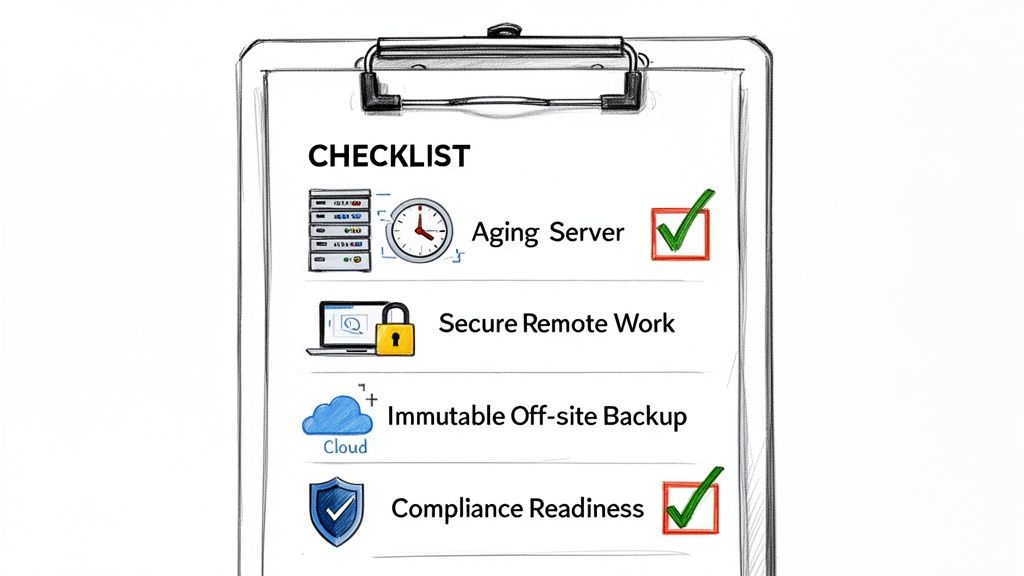
Your Indiana Business IT Health Checklist
Alright, let's cut through the noise. Forget the tech-speak for a minute and let's talk about what really matters: Is your technology helping you make money, or is it a disaster waiting to happen?
Think of this as a quick, honest check-up for your company's IT. These aren't trick questions; they’re the very same things we look at to spot the hidden risks that can bring a Johnson County business to its knees.
Hardware and Performance
First things first: is your main server older than five years? Outdated hardware is, without a doubt, the #1 reason we see for surprise downtime. It’s not just slow and unreliable; it often can’t even run the latest security software, painting a giant target on your back for hackers.
Every minute your team spends staring at a loading screen is a billable hour down the drain. This slow bleed of productivity—what we call "wasted tech time"—can easily add up to thousands of dollars a year. That’s far more than a proactive hardware refresh would cost.
Security and Data Protection
Do you have immutable off-site backups? This is your ultimate get-out-of-jail-free card when ransomware strikes. But here’s the million-dollar question: have you ever actually tried to restore anything from them? A backup you haven’t tested isn’t a strategy; it’s a prayer.
And what about your team's computers? Is every single laptop and desktop armed with real, enterprise-grade security software, like Bitdefender GravityZone? All it takes is one unprotected device to open the floodgates to your entire network.
Accessibility and Remote Work
Can your people work from anywhere, securely and without wanting to throw their laptops out the window? Since 2020, this has become a non-negotiable. If your team is wrestling with a clunky VPN or can't get to the files they need from home, your business isn't just inefficient—it's fragile. Solid remote access is a cornerstone of modern IT infrastructure management.
Compliance and Regulations
Are you actually ready to prove you meet industry rules? This isn't just about security; it's about the law.
- Healthcare providers in Hamilton County need to be fully HIPAA compliant to keep patient data safe.
- Defense contractors up and down the I-65 corridor have to meet rigid CMMC requirements to keep their contracts.
- Just about everyone else should be following the NIST CSF as the gold standard for basic cybersecurity hygiene.
Failing on compliance isn’t just a tech problem. It’s a legal and financial nightmare that can lead to eye-watering fines and a reputation that’s hard to rebuild.
If you answered "no" or "I'm not sure" to a few of these, that's a huge red flag. These are ticking time bombs guaranteed to go off at the worst possible moment.
Don't wait for a system failure to force you into action. Let’s get you some real answers and a clear path forward. Schedule a Free Network Assessment with our team, and we'll build a plan that makes sense for your Greenwood or Indianapolis-area business.
We Hear You: Common Questions About IT Infrastructure Management
Look, we get it. When you're busy running your business, the last thing you want to do is decipher a bunch of tech jargon. So let's cut to the chase. Here are some of the most common questions we hear from Indiana business owners who just want their IT to work, answered in plain English.
Where in the World Do We Even Start Improving Our IT?
The best first step, hands down, is a professional assessment. It’s tempting to just start buying new gear or software, but that's like trying to build a house without a blueprint. A proper audit cuts through all the clutter.
Think of it this way: an audit might reveal that the ancient server humming away in your Greenwood office's back closet is a ticking time bomb, representing the single biggest threat to your entire operation. It gives you a clear, prioritized roadmap. You’ll know exactly where to put your money first to get the biggest bang for your buck and keep the lights on.
Trying to fix everything at once is a recipe for frustration and wasted money. A proper assessment acts like a battle plan, showing you exactly which hills to take—and in what order—to win the war against downtime.
How Much Should a Small Business in Indianapolis Budget for This Stuff?
There’s no magic number, since it really depends on your team's size and how complex your setup is. The real game-changer is shifting your mindset. Stop thinking of IT as a series of expensive, unpredictable emergencies and start treating it as a flat, predictable monthly operational cost.
For a growing business in Hamilton County, partnering with a Managed Services Provider (MSP) is almost always a smarter financial move than hiring a full-time IT person. Once you factor in salary, benefits, sick days, and ongoing training, a flat-fee partnership that gives you access to an entire team of experts is a much better return on your investment.
Can You Work with the Gear and Software We Already Have?
Absolutely. A huge part of our job is to get to know the tech you already use to run your business day in and day out. We're not here to force you into a massive, expensive overhaul right out of the gate.
We start by figuring out what’s working well, what needs a tune-up, and what’s putting you at risk. From there, we build a plan to make everything work together seamlessly, without disrupting the tools your team already relies on.
Don't let unanswered questions create unnecessary risks for your business. The team at Finchum Fixes IT is here to give you clear, no-nonsense answers that make sense for you. Get the clarity you deserve by scheduling a Free Network Assessment for your Greenwood or Indianapolis-area business today.