Benefits of Outsourcing IT Support: Boost Indy Business

TL;DR
- Outsourcing IT support works best when your team is losing time to recurring tech fires, spotty Wi-Fi, aging servers, and slow security response.
- The biggest financial win is predictability. Businesses can cut IT support costs by about 25% to 45% through outsourcing, depending on scope and structure, according to ReformIT's cost breakdown.
- You're not just buying helpdesk coverage. You're getting access to network, cloud, cybersecurity, and recovery specialists.
- Good outsourcing improves uptime, project delivery, and security response. Poor outsourcing creates vendor lock-in and finger-pointing.
- The difference is governance. Clear SLAs, data ownership terms, escalation paths, and an exit plan keep you in control.
- For Johnson County businesses, the real payoff is less downtime, more billable hours, and a cleaner monthly IT budget.
A Greenwood company doesn't call for outside IT support because things are going great.
They call when the server starts throwing errors on a Monday morning, the office Wi-Fi drops every time the conference room fills up, or QuickBooks crawls because a years-old workstation is hanging on by a thread. Around the I-65 corridor, I've seen the same pattern for years. The business grows, the tech stack gets patched together, and eventually somebody on staff becomes the unofficial IT department by accident.
That setup looks cheap until it starts eating payroll.
When a shipping team can't print labels, when a dental office can't reach cloud records, or when a law firm in an old downtown Indy brick building keeps losing client video calls because the wireless layout was never designed for plaster, steel, and dead zones, that's not a small annoyance. That's wasted tech time. It steals productive hours, delays revenue work, and turns managers into part-time troubleshooters.
Is Your Tech Holding Your Indiana Business Back
A lot of local businesses put up with broken systems longer than they should. They reboot routers. They swap cables. They cross their fingers and hope the old server in the closet survives one more quarter.
Then peak season hits, and the weak spot finally gives out.
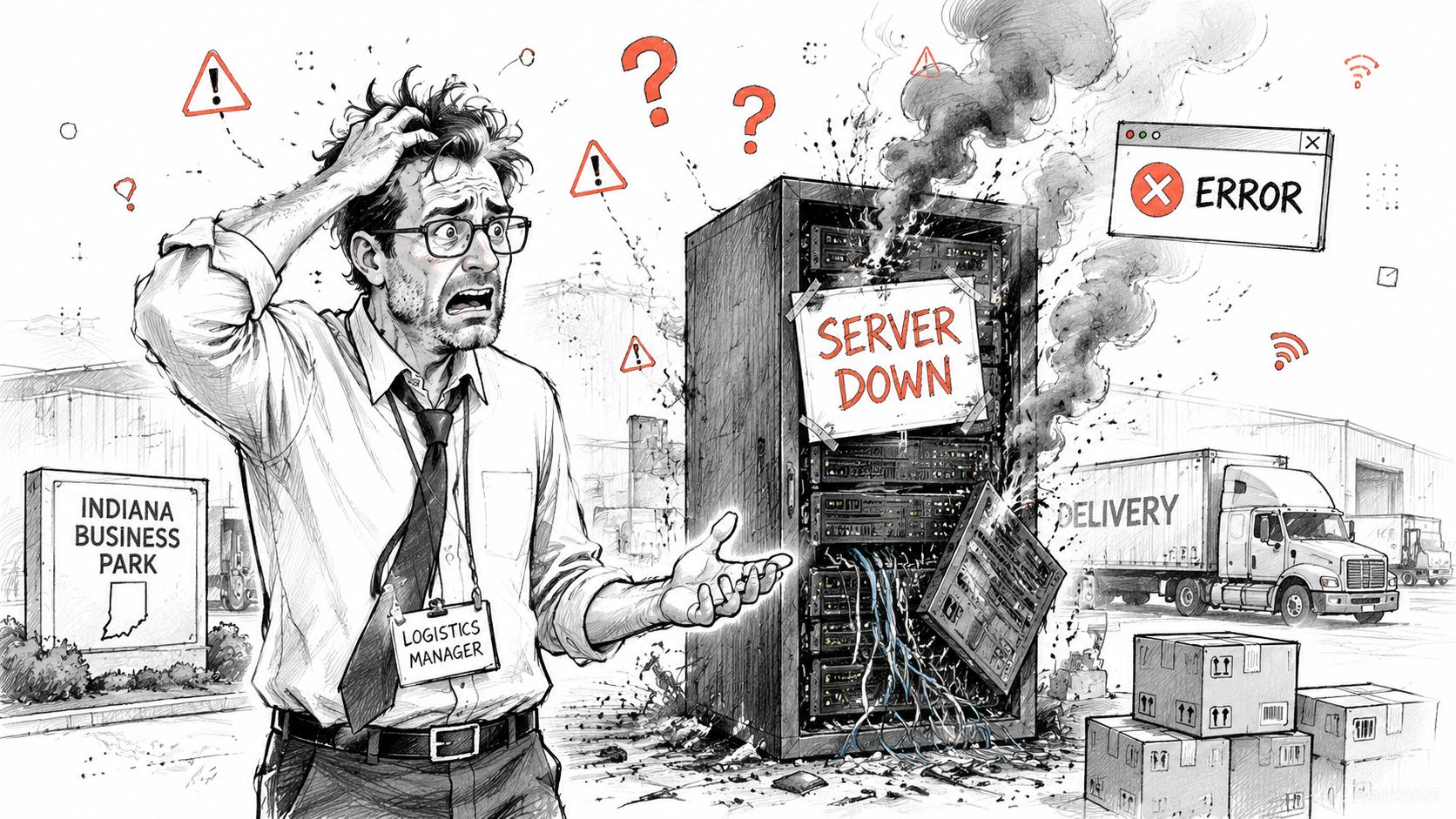
In Johnson County, that might be a logistics operation in a Greenwood business park trying to move freight while an aging file server keeps dropping connections. In downtown Indy, it might be a professional office dealing with Wi-Fi that was never built for modern VoIP, cloud apps, and back-to-back video meetings. Different business. Same result. Staff stop working and start waiting.
The hidden cost is wasted momentum
Most owners look at IT problems as one-off headaches. In practice, they pile up.
- Staff interruption: Employees stop serving customers and start chasing printer errors, login problems, and sluggish systems.
- Management drag: Owners and operations managers get pulled into decisions they shouldn't have to make, like whether to replace a firewall, patch a switch, or reset a backup appliance.
- Revenue delay: When systems stall, invoices go out late, orders slow down, and customer confidence takes a hit.
Businesses feel IT pain first as frustration, but it shows up in the books as delayed work and avoidable downtime.
After 17 years of local service, that's the pattern I trust most. The first complaint is usually technical. The underlying problem is operational.
What outsourced support fixes
The main benefits of outsourcing IT support aren't just about having someone to call when a laptop dies. A managed approach changes the whole model from reactive to preventative.
A good provider monitors systems before they fail, patches vulnerabilities before they get exploited, and standardizes hardware so one flaky workstation doesn't become a recurring expense. That can include UniFi networking for cleaner wireless coverage, Bitdefender GravityZone for endpoint defense, immutable off-site backups for recovery, and Zero Trust access rules so one compromised login doesn't become a company-wide incident.
That's the shift Indiana business owners care about most. Less chaos. Less guessing. More working time.
From Unpredictable Costs to a Flat-Fee IT Budget
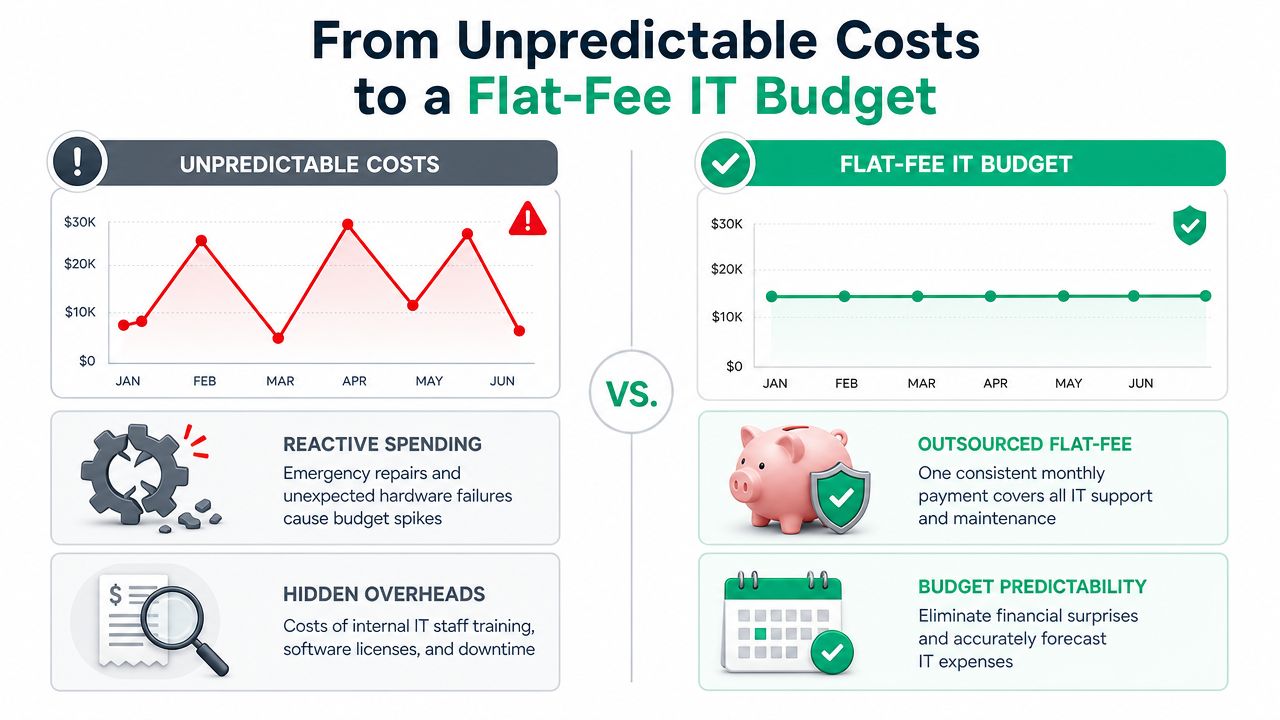
A Johnson County owner usually notices the cost problem after a bad month. A server issue hits on a Thursday, staff lose half a day, the outside consultant bills emergency hours, and a hardware replacement lands in the same week as payroll. Nothing about that month was planned, and that is the point.
In-house IT carries fixed costs on paper, but day-to-day spending often stays uneven.
Salary is only one line item. Benefits, hiring time, certifications, vacation coverage, after-hours response, monitoring tools, security software, and replacement hardware all add up. If one internal generalist is out sick or tied up on a project, work still stacks up and business risk does not pause.
What the numbers show
Research on outsourced support points in the same direction. Businesses can cut IT support costs by about 25% to 45%, according to ReformIT's outsourcing cost data.
ReformIT also notes annual outsourced IT cost ranges that many owners use as a budgeting reference point, from small business support around $60,000 per year to larger environments near $200,000, with mid-sized firms often landing in between. For Indianapolis-area companies trying to plan cash flow, the appeal is not only lower spend. It is a more stable monthly number.
SupportSave makes a similar point in its outsourced tech support analysis for SMBs. Shifting support from scattered labor costs to an operating expense gives owners a cleaner way to forecast.
That matters more in Indiana than many firms expect. A medical office in Greenwood may need HIPAA controls, encrypted backups, and documented user access. A machine shop bidding on defense work may be preparing for CMMC requirements. Those costs do not disappear with an internal hire. They still need to be funded, scheduled, and maintained.
Why flat-fee beats reactive spending
Many Indianapolis metro businesses think they are keeping costs down by avoiding a managed services agreement. In practice, they are paying through a mix of emergency invoices, aging equipment, delayed patching, and staff time lost to recurring issues.
A healthier model looks like this:
| Cost model | What usually happens |
|---|---|
| Break-fix IT | You pay when something breaks, usually at the worst possible time |
| Single internal generalist | You get familiar support, but broad coverage gaps and rising overhead |
| Flat-fee managed IT | You trade surprise incidents for planned support, maintenance, and accountability |
For Johnson County businesses, the payoff is fewer surprise invoices and fewer operational hits from preventable outages. A flat-fee agreement also makes it easier to decide when to standardize gear, such as replacing pieced-together Wi-Fi with UniFi access points or consolidating endpoint protection under Bitdefender, because those decisions happen inside a plan instead of during a fire drill.
If you want a local benchmark, this breakdown of managed IT services cost in Indiana is worth reviewing before you choose a model. Some firms also reduce overhead in other departments by using outside specialists to Hire LATAM talent, which follows the same budgeting logic. Use targeted outside expertise where full-time payroll does not make financial sense.
Practical rule: If your monthly IT costs swing with emergencies, you do not have an IT strategy. You have a repair habit.
Accessing an Entire Team of Certified Experts
A single in-house IT person can be excellent and still be outmatched by the job.
Modern support isn't one discipline. It's networking, cloud administration, endpoint security, Microsoft 365 hygiene, vendor coordination, backup validation, access control, compliance documentation, and sometimes bit-level data recovery when hardware fails badly. One generalist usually ends up strong in two or three areas and stretched thin everywhere else.
One person can't cover every specialty
In our 17 years of local service, we've seen this over and over. A manufacturer has a storage issue that looks like “the server is down,” but the actual problem spans a failing RAID set, a backup job that hasn't been tested, and a switch stack that's dropping traffic under load.
When we disassembled a similar client's failing RAID array, the recovery work wasn't just about swapping drives and hoping for the best. It took a data recovery specialist handling the disk health and file integrity side, while a network engineer stabilized access paths and isolated affected systems so production could resume in a controlled way. A one-person department usually can't do all of that at once.
The depth matters more than the ticket count
Benefits of outsourcing IT support show up when the issue crosses specialties.
- Networking expertise: Proper VLAN design, firewall policy cleanup, and Wi-Fi planning matter in old buildings with thick walls and ugly interference.
- Cybersecurity depth: Zero Trust architecture, endpoint hardening, SOC-as-a-Service monitoring, and email protection aren't side jobs anymore.
- Recovery capability: If a machine won't boot or a storage array starts degrading, you need more than password reset skills.
For some companies, staffing options can include internal hiring plus outside specialists. If you're weighing broader recruiting strategies, resources like Hire LATAM talent can help explain another path for building technical capacity. That said, staffing people and managing an IT operation are not the same thing.
A managed model gives you process along with people. That includes documentation, escalation paths, patch discipline, and platform standards. For Indiana businesses comparing support structures, managed services for business IT operations gives a useful picture of what an ongoing team-based arrangement looks like in practice.
Fortifying Your Business Against Modern Cyber Threats
A Carmel medical office gets hit with a fake Microsoft 365 login page at 8:12 a.m. By 9:00, one compromised password can expose patient data, shared files, and email conversations if access controls are loose and no one is watching the alerts.
That kind of failure usually is not about one bad product choice. It comes from gaps between tools, policies, and day-to-day operations.
I see the same pattern across the Indianapolis metro. A manufacturer in Johnson County has antivirus but no tested recovery process. A law office on the north side has backups but weak admin controls. A clinic has MFA in place but no clear response plan if a user account starts sending phishing emails. Attackers do not need many openings. One weak password, one missed patch, or one over-permissioned account is often enough.
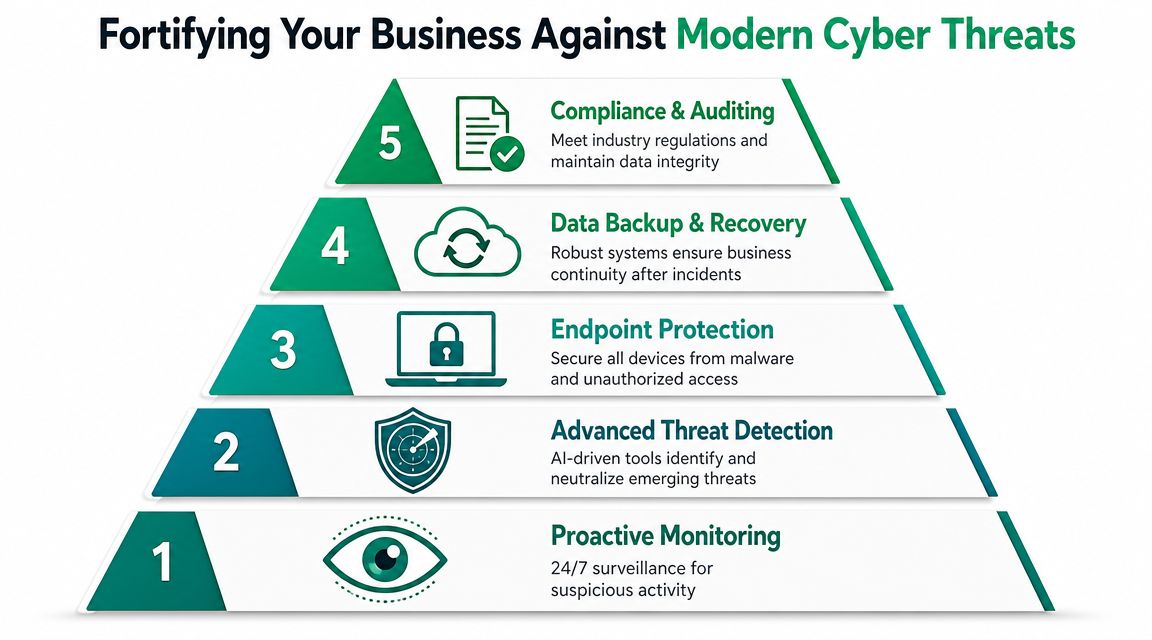
What a serious security stack includes
Good outsourced IT support builds controls that work together and can be checked.
- Endpoint protection: Tools like Bitdefender GravityZone help detect malware, suspicious scripts, and unusual device behavior before a bad click turns into a business outage.
- Access control: Zero Trust architecture and conditional access policies limit what users, devices, and vendors can reach. That matters when a stolen login would otherwise expose your whole network.
- Monitoring: SOC-as-a-Service monitoring gives ongoing review of failed logins, privilege changes, odd sign-in locations, and other activity that small internal teams often miss.
- Backup protection: Immutable, off-site backups protect recovery points from being changed or encrypted by the same attacker who hit production systems.
- Standards and evidence: HIPAA, CMMC, and security programs mapped to NIST CSF all depend on written policy, repeatable review, and proof that controls are being followed.
Tools matter. Configuration matters more.
A cheap firewall with clean rules, MFA enforcement, and documented admin access will beat an expensive stack that nobody maintains. That is one reason outsourcing can improve security for Indiana businesses. You get process, accountability, and review cadence, not just software licenses.
Compliance problems usually start with weak process
Healthcare groups around Indy need restricted access, audit trails, and documented safeguards that hold up under HIPAA scrutiny. Machine shops and defense suppliers working toward CMMC need cleaner user separation, better asset tracking, and evidence of policy enforcement. Even companies outside regulated fields still face insurance questionnaires, client security reviews, and the cost of downtime after a preventable incident.
Weak outsourcing shows up fast here. If your provider cannot tell you who has admin rights, when backups were last tested, or how alerts escalate after hours, the risk is operational, not theoretical.
I advise clients to review security the same way they review accounting controls. Who approves changes. Who can access sensitive data. How incidents are documented. How recovery is tested. If you want a practical baseline, this small business cybersecurity checklist for 2026 covers the controls Indiana SMBs should verify first.
Security programs also need a framework for governance, not just detection. This article on AI-powered risk detection with ISO 27001 is useful because it focuses on standards, documentation, and risk control instead of vendor hype.
Security is a business process. It controls who gets access, how fast threats are caught, what evidence you keep, and how quickly operations recover after a bad day.
For Indianapolis-area businesses, the benefit of outsourced IT support is not fear-based protection. It is fewer expensive mistakes, better audit readiness, and a lower chance that one phishing email turns into days of downtime.
Maximizing Uptime and Business Continuity
Outsourced support earns its keep when your people stop waiting on technology.
That's the part too many vendors gloss over. They talk about tickets closed and tools deployed. Owners care about something simpler. Can the team work today, and can they keep working if hardware fails, a threat gets through, or the office network starts dropping traffic during the busiest hour of the week?
Uptime is a revenue issue
In old buildings across Indianapolis, Wi-Fi problems are a perfect example. The issue usually isn't “bad internet.” It's poor access point placement, interference, weak roaming behavior, or consumer gear trying to serve a business floor plan.
For a client dealing with that kind of environment, latency-optimized UniFi mesh nodes can clean up coverage and roaming in a way random extenders never will. Once that design is done correctly, staff stop burning time reconnecting laptops, restarting calls, and apologizing to customers during frozen meetings.
That's what business continuity looks like in real life. Fewer interruptions. Fewer workarounds. More billable hours.
Better outcomes are measurable
Some of the newer data around outsourcing is more useful than the old “save money and move on” pitch. External IT partners can improve project delivery timelines by 55% and reduce security response time by 40%, according to Meriplex's summary of outsourcing outcomes.
Those are meaningful outcomes because they connect support to business speed and risk reduction, not just helpdesk volume.
Here's where that shows up operationally:
- Projects move faster: Migrations, workstation rollouts, cloud cleanup, and policy changes don't sit in limbo behind day-to-day interruptions.
- Incidents get contained sooner: Faster response cuts the damage window when a mailbox gets compromised or malware lands on an endpoint.
- Recovery gets cleaner: Tested backup chains, documented runbooks, and vendor coordination reduce confusion when things do go sideways.
A good IT partner doesn't just fix what broke. They reduce the number of times your staff has to stop doing paid work.
If continuity is the target, this guide to business continuity management for Indiana SMBs is the right next read. It connects uptime planning to operations, not just servers and software.
Addressing Common Objections to Outsourcing
A Greenwood medical office loses access to its practice management system at 8:10 a.m. The phones are already ringing, patients are walking in, and the owner has one question. Who is accountable right now?
That question sits underneath almost every objection to outsourced IT support. Johnson County owners usually are not arguing about the concept of outside help. They are asking whether they will lose visibility, response speed, or decision-making authority once another company touches their systems.
Those concerns are legitimate. I have taken over plenty of environments where the previous provider kept admin passwords, left no usable documentation, and turned every simple question into a support ticket maze. Outsourcing fails when the provider builds dependency instead of control.
Control comes from the contract and the documentation
A good agreement should make ownership plain. Your business should retain access to Microsoft 365, firewall consoles, backup platforms, domain records, vendor accounts, and configuration documentation. If the relationship ends, you should be able to transition cleanly without scrambling to recover credentials or rebuild network knowledge from scratch.
For Indiana businesses with compliance pressure, that clarity matters even more. A healthcare practice dealing with HIPAA or a manufacturer working toward CMMC cannot afford vague language around incident reporting, admin access, logging, or who is responsible for policy enforcement.
Review these points before signing:
- Data and admin ownership: Your company should control the tenant, the licenses, and the core credentials.
- Escalation rules: After-hours security events, server failures, and internet outages need named contacts and response steps.
- Standards of work: Patch schedules, Bitdefender policy management, backup checks, and firewall review cadence should be written down.
- Exit process: The provider should hand over documentation, configs, and access without delay or extra drama.
Local support still matters in Indianapolis
Remote support handles a lot. It does not rack a switch, replace a failed access point, trace a bad cable run, or rebuild a small office network after a storm surge.
That is why local coverage matters. A business in Franklin, Whiteland, or the south side of Indy may be fine with remote help for password resets and software issues, but it still needs someone who can show up when a UniFi gateway fails, the front office loses connectivity, or a new suite needs to be brought online.
The actual trade-off is not in-house versus outsourced. It is whether you want to manage one or two internal hires with narrow skill coverage, or get a broader bench with defined processes and clear accountability. If you are weighing those options, this guide to managed service vs staff augmentation for Indy business owners lays out the differences in plain terms.
Process matters more than proximity alone.
If you want control, require documented standards, shared access, regular reporting, and an agreement that protects your business if the provider changes, misses something, or needs to be replaced. That is what good outsourcing looks like in practice.
Your Next Steps toward Smarter IT Support
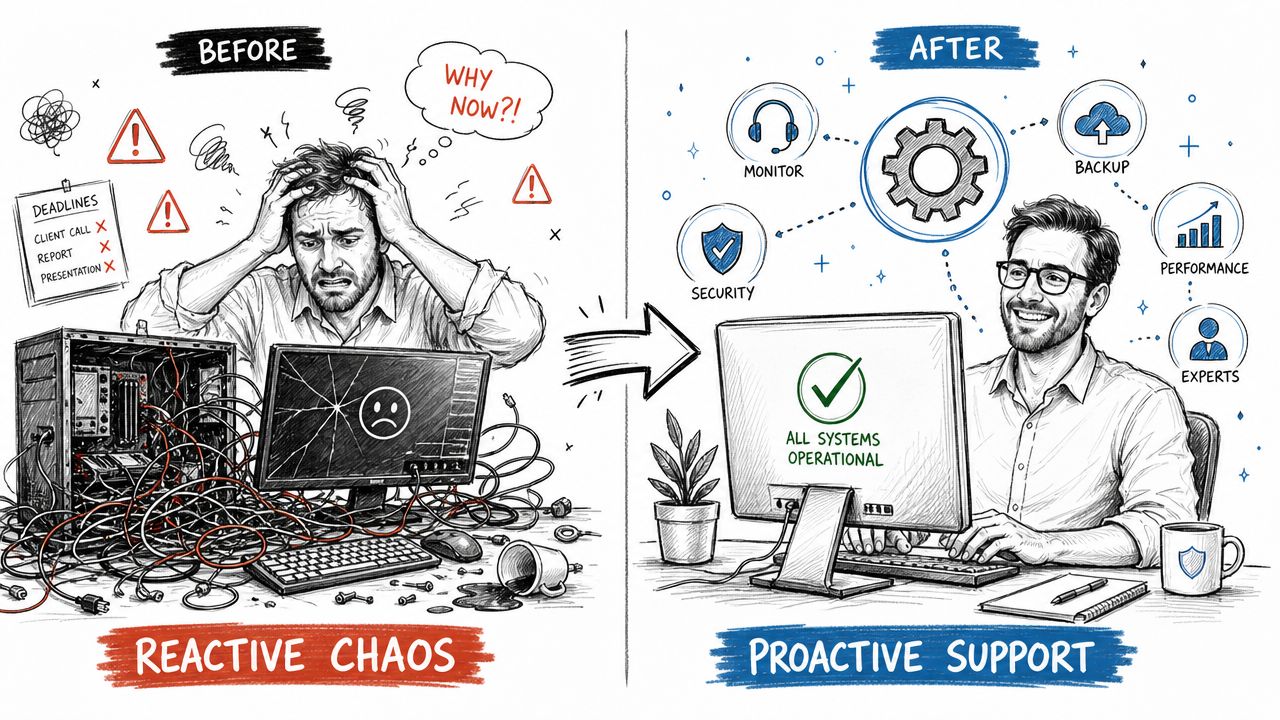
Most business owners don't need more tech. They need fewer recurring problems.
If your team is fighting login issues, random slowness, unstable wireless, backup uncertainty, or constant security anxiety, you're already paying for weak IT. You're paying in lost time, delayed work, and preventable disruption.
Start with a short internal audit
Don't overcomplicate this. Write down the issues that keep repeating.
Look for patterns such as recurring Wi-Fi complaints, old endpoints that fail too often, backup jobs nobody tests, shared passwords, or line-of-business software that slows down every busy week. Then connect each issue to business impact. Missed calls. Delayed orders. Extra admin time. Interrupted client work.
Vet providers like an operator, not a shopper
A strong outsourcing partner should be able to explain how they handle support, security, documentation, and recovery in plain language.
Check for these basics:
- Clear SLA language: You should know response expectations and escalation paths before signing.
- Tool transparency: Ask what they use for endpoint protection, monitoring, backup verification, and remote management.
- Exit planning: If the relationship ends, there should be a documented offboarding process, not a hostage situation.
- Compliance awareness: If your business touches HIPAA, CMMC, or client security questionnaires, make sure the provider can speak that language comfortably.
Take the lowest-risk first step
You don't need to commit to a full overhaul on day one. Start with an assessment.
A good review should uncover obvious failure points, identify where downtime risk is highest, and tell you whether your current environment is helping the business or subtly slowing it down. That's how you move from reactive support to a cleaner, more strategic setup.
If you're in Greenwood, Indianapolis, or anywhere around Johnson County and want a clear read on what's putting your operations at risk, schedule a Free Network Assessment with Finchum Fixes IT. It's a practical first step for businesses that want tighter security, less downtime, and IT support that protects the workday.