Best Firewall for Small Business: An Indiana Guide for 2026

[!NOTE] TL;DR: Your Quick Guide
- Your internet provider's router is not a real firewall and leaves your business exposed to attacks that can cost up to $9,000 per minute in downtime.
- A proper firewall (UTM/NGFW) uses Deep Packet Inspection (DPI) to block modern threats like ransomware, which is critical for compliance with HIPAA or CMMC.
- For most small businesses in the Indy metro area, a Unified Threat Management (UTM) device from brands like Fortinet or SonicWall offers the best balance of security and cost.
- A managed firewall service converts unpredictable tech disasters into a fixed monthly cost, ensuring the device is always updated and monitored 24/7 by experts. This stops "wasted tech time" and improves ROI.
- Critical features include VPN for remote staff, Intrusion Prevention (IPS) to stop attacks proactively, and web filtering to block malware.
Let's get straight to the point. If you're running a business in Johnson County and relying on the basic firewall that came with your internet router, you're taking a massive gamble. We see this all the time with new clients in Greenwood business parks—they have an old, unmanaged router trying to protect sensitive client data. It’s simply not enough to stop the kinds of cyberattacks targeting Indiana businesses right now.
That little box is an open invitation for a data breach. The resulting downtime can cost up to $9,000 per minute, turning a simple tech oversight into a business-ending event. This guide is here to help you choose a real firewall that actually protects your business and ensures business continuity.
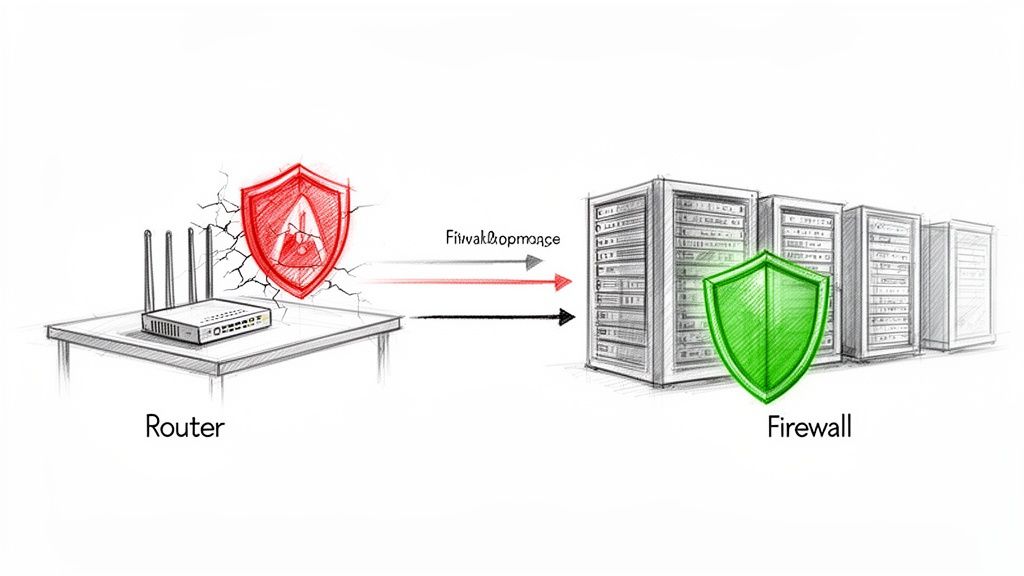
Why Your Router's Firewall Just Doesn't Cut It
Look, I get it. You're busy running your company. You don't have time to become a cybersecurity expert overnight. So here’s the quick-and-dirty breakdown of what you need to know.
Modern Threats vs. Old-School Guards: The firewall on your standard router is like a night watchman from the 1980s—it can check for basic things, but it's completely unprepared for a modern, sophisticated break-in. It can’t spot advanced attacks like ransomware, making your business low-hanging fruit for criminals.
Not All Firewalls Are Created Equal: We'll walk through the different flavors—hardware boxes, cloud-based firewalls (FWaaS), and the all-in-one "UTM" devices. Each has its place, and we'll help you figure out which one makes sense for your budget and how you operate.
Compliance Isn't Optional: If you handle sensitive data for healthcare (HIPAA) or government contracts (CMMC), a proper firewall is a non-negotiable part of the deal. Getting this wrong can lead to fines that could sink a small business. You can learn more about general security threats that Indiana businesses face in our other guide.
The Smart Money is on Managed Services: Instead of dealing with unpredictable tech disasters and expensive emergency calls, a managed approach turns your cybersecurity into a predictable, fixed monthly cost. This frees up you and your team to focus on billable work, not IT headaches.
Is Your First Line of Defense Already Compromised?
Let’s get real for a minute. A common problem we see in the Indianapolis metro area, from a Greenwood business park with aging server hardware to an old brick building downtown with spotty Wi-Fi, is a dangerous assumption about security. Far too many Johnson County business owners think the little firewall box their internet provider gave them is all the protection they need.
That’s a critical mistake, and it’s one that cybercriminals are counting on you to make.
The simple, consumer-grade router sitting in your office isn't built for business-level threats. Its entire defense is based on a flimsy technology called stateful packet inspection (SPI). Think of it like a bouncer at a club who only checks IDs. It looks at the "who" and "where" of your data traffic, but has no clue about the "what" or "why."
This leaves your network wide open to attacks that are a whole lot smarter than a fake ID.
When Basic Protection Fails
Picture an accounting firm in a Greenwood business park running on an older UniFi networking setup. Their router’s basic firewall might stop a clumsy, direct attack. But it’s completely useless when an employee clicks a phishing link that unleashes ransomware into the system.
Why? Because the SPI firewall just sees an "allowed" connection and happily waves the malicious code right through the door.
That one innocent-looking click could encrypt every single client file you have, trigger a HIPAA compliance disaster, and slam the brakes on your entire operation. At a potential cost of $9,000 per minute in downtime, you can see how "wasted tech time" quickly snowballs into a business-ending catastrophe.
This isn’t some made-up horror story; it's a daily reality for small businesses. It's tragic, but 25% of small businesses are still getting by on nothing more than these weak router firewalls.
The Modern Standard: Unified and Next-Generation Security
To actually defend your business, you need to step up to a system built for the threats we face today. This is where Unified Threat Management (UTM) and Next-Generation Firewalls (NGFW) enter the picture. These aren’t just bouncers; they're full-blown security intelligence teams.
Instead of basic SPI, they use powerful tech like deep packet inspection (DPI). DPI doesn't just glance at the ID—it frisks every single data packet trying to get in, searching for malicious code, viruses, and other nasty surprises before they can do any harm. A business-grade firewall is a non-negotiable part of a modern security plan. For a complete overview, check out this ultimate guide to protecting your business online, which covers all the bases.
Putting a real firewall in place isn't just an expense; it's a direct investment in business continuity and ROI. It converts "wasted tech time" from emergency fixes into predictable, productive hours. The first step is figuring out where you stand, and you can get a head start with our free cybersecurity risk assessment template for Indiana businesses.
Choosing Your Firewall: Hardware vs. Cloud vs. UTM
Okay, let's talk turkey. You know that flimsy firewall built into your office router isn't cutting it anymore, but what’s the right next step? This isn't about just grabbing a new box off the shelf. It’s about matching the right security tool to the way your Central Indiana business actually runs.
You’re essentially looking at three distinct paths: the old-school hardware firewall, the modern and flexible cloud-based firewall, or the do-it-all Unified Threat Management (UTM) system. Each plays a different role, and knowing the real-world trade-offs is the key to making a smart investment.
This decision tree nails the first, most critical point: graduating from that basic, vulnerable router is non-negotiable for any serious business.
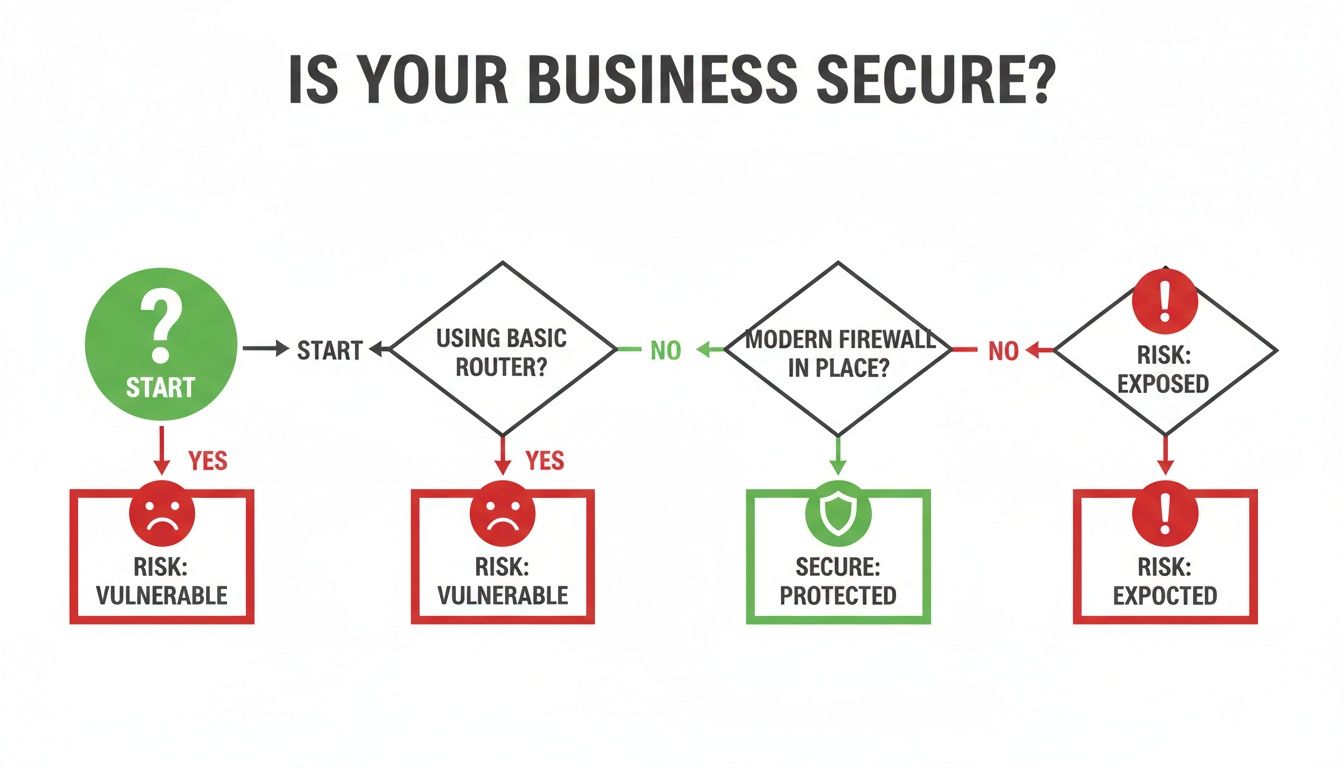
The takeaway here is painfully simple. Sticking with a consumer-grade router is a recipe for disaster. A proper business firewall is your first line of defense.
To make the choice a bit clearer, we've broken down the three main deployment models. Think of this as your cheat sheet for matching a firewall's style to your company's workflow, budget, and IT know-how.
Firewall Deployment Models At a Glance
| Deployment Model | Best For This Indiana Business | Management Burden | Typical Cost Structure | Key Advantage |
|---|---|---|---|---|
| Hardware | A single-location business, like a Franklin law firm or a Plainfield manufacturing plant with everyone on-site. | High. Requires in-house or managed IT expertise for setup, updates, and troubleshooting. | Capital Expense. You buy the physical box upfront, with ongoing licensing/support fees. | Unbeatable performance and total control over your local network traffic. |
| Cloud (FWaaS) | A growing tech firm in Fishers with remote workers or a business with multiple branch offices. | Low. The provider handles all the infrastructure, maintenance, and updates. | Operational Expense. A predictable monthly or annual subscription fee. No large upfront cost. | Consistent, powerful security that follows your users everywhere they go, on any device. |
| Unified Threat Management (UTM) | The vast majority of SMBs, from a Greenwood healthcare clinic to a Carmel accounting firm. | Medium. Consolidates management into one interface, simplifying a complex security stack. | Hybrid. Upfront hardware cost plus annual subscriptions for security services (IPS, AV, etc.). | All-in-one security without the headache and cost of buying and managing multiple separate tools. |
Ultimately, this isn't just a technical decision—it's an operational one. The right choice supports how you work, while the wrong one can create security gaps or unnecessary costs.
Hardware Firewalls: The On-Site Fortress
A hardware firewall is that trusty physical box that sits in your server closet, standing guard at the edge of your network. It’s the traditional workhorse, inspecting every bit of data that comes in or goes out of your office.
For a business with deep roots in a single, central location—think a manufacturing plant in Franklin or a law firm downtown Indy—this is often the most straightforward solution.
- Best For: Businesses where almost everyone works from one primary physical location.
- Key Advantage: You get maximum performance and granular control for your on-site operations. It’s your box, your rules.
- The Catch: It’s a capital investment, meaning a bigger bill upfront. And it requires someone on-site to manage it. If that box fails, your internet is down until it's fixed or swapped out.
This model is perfect if your world revolves around a central office and you have the IT chops to manage it. But for businesses with people scattered everywhere? It quickly becomes a security bottleneck.
Cloud Firewalls: Security for the Modern Workforce
A cloud-based firewall, often called Firewall-as-a-Service (FWaaS), doesn't live in your office at all—it lives in the cloud. It works by routing all your traffic through the provider's massive security infrastructure before it ever gets to you. This protects everyone, everywhere.
Picture a growing tech company in a Hamilton County hub. Their team is everywhere: working from home, coffee shops, and client sites. A physical firewall sitting in a lonely office does nothing to protect them out in the wild.
For these businesses, a cloud firewall is a game-changer. It provides consistent security for every user, no matter where they connect from. This is a core principle of a Zero Trust architecture, where you don’t automatically trust any connection, internal or external.
Best of all, a cloud firewall shifts your security spending from a big capital expense to a predictable operational expense (a monthly subscription). That's often a much easier pill for a small business budget to swallow.
UTM and NGFW: The All-in-One Powerhouse
A Unified Threat Management (UTM) system, which has largely evolved into what we now call a Next-Generation Firewall (NGFW), is the Swiss Army knife of network security. It’s usually a hardware appliance, but it’s packed with multiple security functions that used to require separate, expensive devices.
We're talking about a single box that handles:
- Standard stateful firewalling
- Intrusion Prevention System (IPS)
- Gateway antivirus like Bitdefender GravityZone
- Web content filtering
- Secure VPN for remote access
For most small businesses in Johnson County, a UTM is the best firewall for small business hands down. It delivers serious, enterprise-level security without the mind-numbing complexity of managing five different systems. A healthcare clinic in Greenwood, for instance, can use a UTM from a vendor like Fortinet or SonicWall to enforce HIPAA-compliant web filtering and provide secure remote access for doctors, all from a single dashboard.
In our 17 years of local service, we've found that a well-configured UTM offers the best blend of performance, security, and value for most SMBs. It simplifies your security stack, and simplification is your best friend when it comes to avoiding the dangerous misconfigurations that hackers love to find.
What to Look For: The Firewall Features That Actually Matter
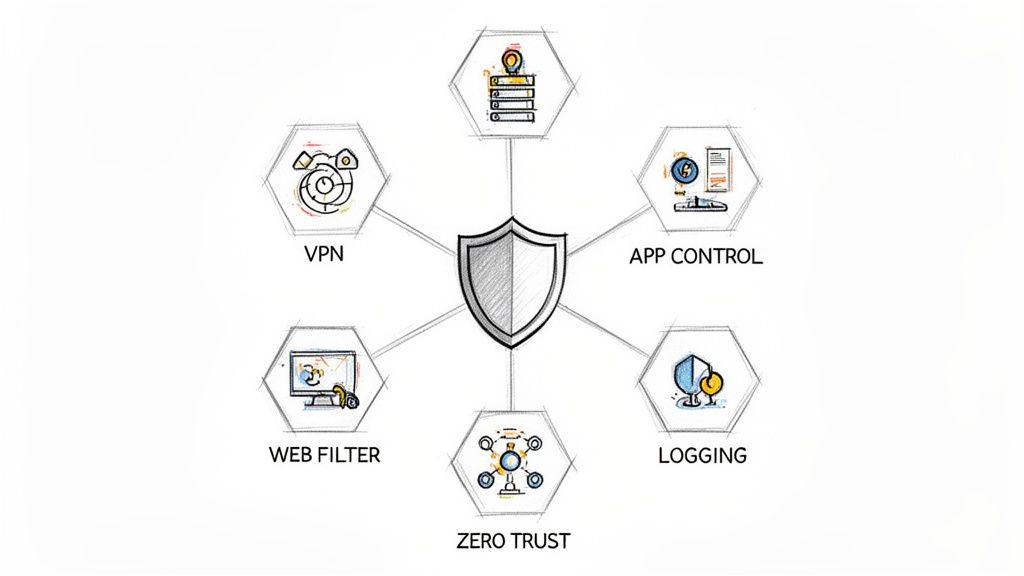
So, you’re ready to graduate from the flimsy firewall built into your internet router. Smart move. But what features should you actually look for when you start comparing boxes and services? Modern Network Security is a whole lot more than just blocking bad traffic.
A real firewall gives your business the tools it needs to run smoothly and securely, without constant interruptions. Let's ditch the confusing marketing jargon and get straight to the non-negotiable features your next firewall absolutely must have.
Secure VPN for a Hybrid World
If you have employees working from home, hitting the road for sales calls along the I-65 corridor, or logging in from client sites in Hamilton County, secure Virtual Private Network (VPN) support is a must-have. A proper business-grade firewall should handle two types of VPNs, no sweat.
- Remote Access VPN: Think of this as a private, encrypted tunnel for a single user. It lets your remote employee securely connect to the office network as if they were sitting at their desk, protecting company data from prying eyes on the public Wi-Fi at that downtown Indy coffee shop.
- Site-to-Site VPN: This is for connecting entire offices. Got a headquarters in Greenwood and a satellite office over in Carmel? A site-to-site VPN links both networks securely over the internet, so everyone can share files and resources like they're in the same building.
Without solid VPN capabilities, your team is either risking a data breach or getting bogged down by clunky, inefficient workarounds. If you want a deeper dive, check out our guide on the 7 best VPNs for small business in Indiana.
An Intrusion Prevention System (IPS) on Guard Duty
This feature alone is one of the single biggest upgrades from a basic router. An Intrusion Prevention System (IPS) acts as your network’s 24/7 security guard. It doesn't just check where data is coming from; it actually inspects the data itself, hunting for the tell-tale signs of an attack.
It has two primary methods of detection:
- Signature-Based Analysis: The IPS keeps a massive library of known attack "fingerprints." When it spots traffic that matches a known baddie, it shuts it down on the spot.
- Behavior-Based Analysis: This is where things get really clever. More advanced systems learn what "normal" looks like on your network. If a user's computer suddenly tries to access sensitive files it never touches, the IPS can flag or block the activity, stopping a potential ransomware attack before it can lock you down.
This proactive defense is what turns a potential threat into a non-event, saving you from costly downtime.
Application and Web Content Filtering
Let's be real—you can't have your team streaming Netflix all day or wandering onto shady websites. Application Control gives you the power to decide exactly which apps can run on your network. Want to block Facebook and TikTok but keep Microsoft 365 running full speed? Easy.
Web Content Filtering takes it a step further by letting you block entire categories of websites, like gambling or adult content, that absolutely murder productivity and are crawling with malware. This isn't about micromanaging your people; it's about closing huge security loopholes and keeping your team focused.
In our 17 years of local service, we’ve seen firsthand that unrestricted web access is a primary culprit behind malware infections. A properly configured web filter is a simple fix that prevents a world of hurt.
Advanced Logging and Reporting for Peace of Mind (and Compliance)
For many businesses, a firewall isn’t just for security—it’s a mandatory compliance tool. If you're a healthcare provider in Johnson County dealing with HIPAA or a defense contractor working toward CMMC certification, you have to prove you're protecting sensitive data. A firewall is a key component of meeting standards like the NIST CSF as well.
A modern firewall gives you a detailed paper trail of all network activity. These logs show who accessed what, when they did it, and from where, giving you the audit trail needed to satisfy regulators. For small businesses in these fields, compliance is often the main reason they invest in a firewall in the first place. In fact, 68% of SMBs in regulated sectors now make sure their firewalls meet these strict standards.
A Realistic Look at Top Firewall Brands for SMBs
Picking the right firewall for your small business isn't about chasing the brand with the most bells and whistles. It’s about finding the right tool for your job, right here in Central Indiana. After more than 17 years wrestling with these devices, we’ve seen it all, and we’re here to cut through the marketing fluff and give you our unvarnished take on the big names.
The firewall world is packed with contenders, but for small businesses, it really boils down to a few heavy hitters: Fortinet, Cisco Meraki, and SonicWall. Each has a totally different personality, and picking the wrong one is a recipe for headaches, security gaps, or a fancy box that’s too complicated to ever use correctly.
Fortinet FortiGate: The Security Powerhouse
Fortinet is the go-to for tech folks and businesses with serious security or compliance burdens. If you're a defense contractor near Crane trying to wrap your head around CMMC requirements, a FortiGate UTM is probably already on your radar. And for good reason.
Their secret sauce is the Security Fabric. This isn't just a marketing term; it means the firewall, switches, and wireless access points are all designed to communicate and act as one cohesive security blanket. It’s powerful stuff, giving you a single pane of glass to manage security across your entire UniFi networking environment.
FortiGate is perfect for regulated industries like healthcare, defense, or finance. We see it a lot with Johnson County businesses that need granular, iron-clad control. The flip side? That power comes with complexity. It’s incredibly easy to misconfigure a FortiGate if you don't know what you're doing, which is why a managed approach is almost always the smartest play.
Cisco Meraki: The Cloud-Managed Champion
Got multiple locations or a team that’s always on the move? Say hello to Cisco Meraki. Imagine you run a growing retail chain with shops in downtown Indy, a boutique in Carmel, and a new spot in Fishers. Meraki was practically built for you.
Its superpower is a ridiculously simple, cloud-managed dashboard. You can manage firewalls, Wi-Fi, and even security cameras at every single location from a web browser. Seriously. It turns what used to be a monumental IT nightmare into a few clicks.
In our 17 years of local service, we've learned a hard lesson: a firewall's power is useless if its complexity leads to mistakes. Meraki's dead-simple interface is one of the best defenses against the biggest threat of all—human error.
The whole system is designed for easy scalability, making it a dream for businesses focused on Hamilton County growth, not on tinkering with network settings. For a busy business owner, that means less time fighting with tech and more time running your company.
SonicWall: The SMB All-Rounder
For years, SonicWall has been a staple in the small business world because it hits that sweet spot between powerful features and genuine usability. Think of a typical professional services firm in a Greenwood business park—they need solid security without needing a full-time cybersecurity guru on staff. That’s SonicWall’s bread and butter.
They’re well-known for top-notch deep packet inspection and reliable VPN performance, which are non-negotiable features for just about any business these days. It delivers excellent, all-around security in a single box without the intimidating learning curve of its enterprise-grade cousins.
While it’s more user-friendly out of the box, don't be fooled. To truly lock things down with advanced features like application control and content filtering, you still need someone who knows how to set it up properly.
The Bottom Line on Brands
The logo on the box is far less important than how that box is configured, updated, and managed. We’ve seen six-figure FortiGate setups rendered useless by a default password and simple Meraki networks that were practically Fort Knox because they were set up by a pro. When we disassembled a similar client’s failing RAID array, we found their firewall logs had been ignored for years.
The best firewall for your business is the one that fits your workflow, satisfies your compliance needs, and is actively watched over 24/7. Don’t let a slick sales pitch decide your company's security.
Why a Managed Firewall Is Your Smartest Investment
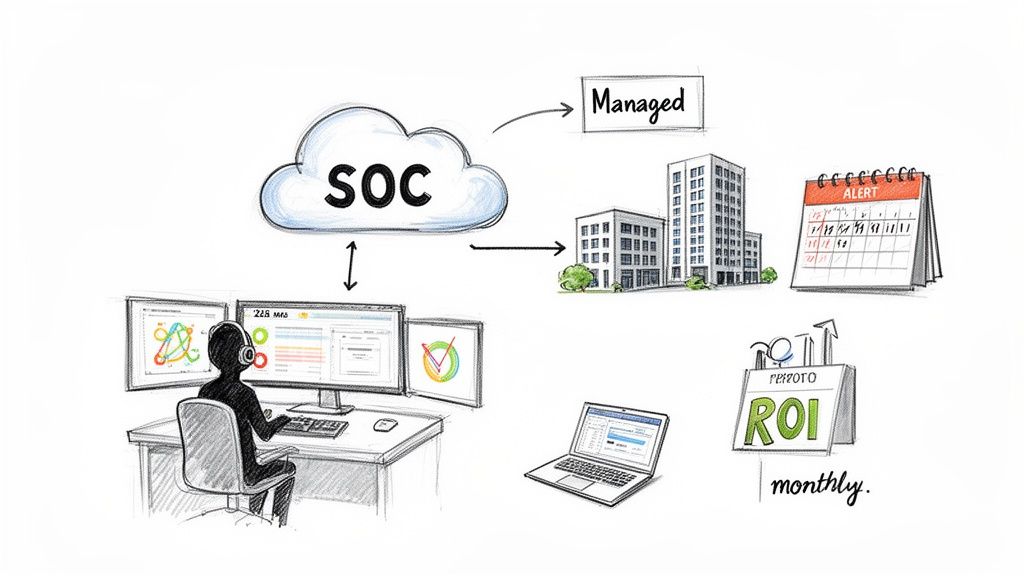
So you’ve bought a top-of-the-line firewall for your small business. That’s a great start, but let's be honest—the hardware itself is only half the story. The idea that you can just plug it in and forget about it is a dangerous myth. A firewall needs constant care and feeding to be anything more than a pricey paperweight with blinking lights.
To have any chance against modern cyber threats, that box needs expert configuration, around-the-clock monitoring, and firmware updates the second a new vulnerability is found. This is where a managed firewall service stops being a luxury and becomes an absolute necessity for businesses here in Central Indiana.
Reclaim Your Time and Boost Your ROI
Every minute someone on your team spends wrestling with a network glitch, puzzling over a security policy, or trying to diagnose a connection problem is a minute they aren't helping customers or making money. That "wasted tech time" adds up fast, slowly eating away at your bottom line. It’s a huge issue for industries like retail and finance, which account for 34% of enterprise firewall use and can’t afford even a moment of downtime.
By handing the keys to a managed service provider, you sidestep the chaos. You avoid the kind of breaches that, according to data from Data Insights Market, cost small businesses an average of $25,000 per incident. Suddenly, your cybersecurity isn't a series of unpredictable fire drills; it's a stable, predictable monthly operating cost.
When we take on a new client in Greenwood, the first thing we do is a full network audit. It’s shocking how often we find firewalls with default passwords, ancient firmware, or gaping holes left open from some old IT project. A managed service catches and fixes those critical mistakes on day one.
Our proactive management and SOC-as-a-Service monitoring keeps a 24/7 watch on your network's perimeter. We handle the updates, patch the holes, and sift through the traffic logs for you. This gives your team the freedom to focus on what they do best, turning those lost hours directly back into billable work and ensuring business continuity.
Expertise That Prevents Business-Ending Mistakes
The line between a secure network and the next data breach headline often comes down to tiny configuration details that are easy to miss. Without years of experience, it’s all too easy to make a simple mistake that leaves the front door wide open for attackers. Our team’s deep expertise ensures those common—and costly—errors never happen on our watch.
Here’s a classic scenario we see all the time:
- The Problem: A Johnson County business invests in a powerful firewall but doesn't properly configure its web filtering or application control. Before you know it, employees are clicking on malicious links or using unapproved cloud apps that are full of security holes.
- The Managed Fix: We build a Zero Trust architecture from the ground up. We create and enforce strict policies that block risky websites and unauthorized apps by default. This simple step closes a massive attack vector before it can ever be used against you.
In our 17 years of local service, we’ve seen firsthand how expert management transforms a firewall from a passive gatekeeper into an active, intelligent defender. It’s not just about blocking attacks—it's about optimizing your network’s performance, ensuring you meet compliance standards like HIPAA or NIST CSF, and giving you complete peace of mind.
When you entrust your firewall to experts, you’re making a direct investment in keeping your business running, no matter what. If you're ready to take a more strategic approach to your company's technology, you can see how to grow with managed IT services for small business in our detailed guide.
Ready to See Where You Really Stand? Let's Talk.
Okay, so we've pulled back the curtain. You now know that the flimsy "firewall" on your office router isn't a real security tool. It's just a checkbox. The best protection for your business isn't about a specific brand—it’s about having the right tool configured by an expert who is constantly watching your back.
Doing nothing is a huge gamble. For any business in Johnson County, the cost of a single day of downtime is just too high to risk. So, the big question is: what's the next logical step?
Let's Start with a No-Strings-Attached Security Audit
Forget the high-pressure sales pitch. This isn't that. We've been helping businesses in Greenwood, Indianapolis, and across Central Indiana for over 17 years, and we’ve learned that the most powerful thing we can offer is a clear, honest assessment of where you are right now.
Our complimentary Security Risk Audit is a straightforward look under the hood of your network. Here's what we'll do:
- Pinpoint the current weak spots in your network that hackers love to find.
- Show you exactly where your vulnerabilities are and what they could cost you.
- Give you a plain-English snapshot of your company's actual security.
You wouldn't dream of running your business without insurance, right? A weak or misconfigured firewall is the digital equivalent of leaving the front door wide open with the cash register in plain sight.
Knowing exactly where your blind spots are is the first step toward genuine business continuity. If you want a sneak peek at how we approach this, check out our 10-point IT infrastructure audit checklist.
This audit is all about giving you clarity. We show you exactly where you're exposed so you can make a smart, informed decision to protect your employees, your customers, and your bottom line.
Don't wait for a crisis to make a change. It's time to stop wasting money on tech headaches and start securing your business for the long haul.
Schedule your complimentary Security Risk Audit with Finchum Fixes IT today. Let's provide real protection for your Greenwood or Indianapolis area business. Secure your spot now!