Finding The Best Endpoint Protection Software For Indiana Businesses in 2026
TL;DR Summary:
- Traditional antivirus is obsolete. Modern Endpoint Protection Platforms (EPP) with Endpoint Detection and Response (EDR) are essential for stopping today’s sophisticated cyberattacks.
- Upgrading to EPP/EDR is a business continuity decision. It prevents downtime—which costs up to $9,000 per minute—and converts "wasted tech time" into billable hours by proactively stopping threats.
- We evaluate top tools like CrowdStrike Falcon, SentinelOne Singularity, and Sophos Intercept X based on their ability to stop zero-day threats, automate incident response, and maintain system performance.
- For businesses in the Indianapolis metro area, especially those dealing with HIPAA or CMMC compliance, a managed security strategy (SOC-as-a-Service) is the most effective approach. It provides expert 24/7 monitoring and response, turning security into a predictable operational expense.
Let's be blunt: for a business in Greenwood or anywhere along the I-65 corridor, endpoint protection has rocketed from a "maybe someday" IT expense to an absolute must-have. A single breach can slam your operations to a halt, costing thousands per minute and destroying the trust you've built. That's not just a number; it's a direct threat to your business continuity.
Your old-school antivirus software? It’s a liability. It won’t stop the sophisticated ransomware and zero-day exploits that are now common threats targeting Johnson County businesses. We've seen aging server hardware in a local business park become the entry point for an attack that simple antivirus completely missed.
We're going to cut through the noise, look at the best endpoint security solutions for 2026, and figure out which one is the right fit to keep your business safe and profitable.
Why Old Antivirus is a Financial Risk
Think of traditional antivirus like a bouncer at a nightclub with a printed-out list of troublemakers. It’s okay at stopping known threats. But what about a brand-new threat actor who just rolled into town? The bouncer has no idea who they are until they've already started a fight, causing chaos and downtime.
That's the problem. Cybercriminals are churning out new threats at a terrifying pace. Your signature-based antivirus just can't keep up.
This is where modern Endpoint Protection Platforms (EPP) and Endpoint Detection and Response (EDR) solutions change the game. They're proactive. Instead of just checking a list, they watch for suspicious behavior using a Zero Trust architecture. They're the savvy security guard who notices someone casing the joint, even if they've never seen their face before. You can read more about how these modern tools shield your business and why making the switch is critical for your ROI.
Your Old Antivirus Is a Ticking Time Bomb
Let’s be honest. That trusty old antivirus you’ve had for years? It’s a relic. Think of it like a security guard who only recognizes bad guys from a 10-year-old wanted poster. He’s completely useless against a new crew of criminals using clever disguises and modern tactics.
That’s exactly what’s happening on your network. Your old-school antivirus relies on a list of known viruses, making it hopelessly blind to today’s threats. We’re talking about fileless malware, sneaky phishing attacks, and ransomware that slips past those outdated defenses like a ghost. For businesses right here in the Johnson County area, this isn't just a scare tactic—it’s a disaster waiting to strike.
The result is always the same: catastrophic downtime, stolen data, and a financial hit that converts billable hours into wasted recovery time. This is why we don't just talk about antivirus anymore. The conversation has moved on to full-blown Endpoint Protection Platforms (EPP).
From Passive Scans to Proactive Defense
Traditional antivirus was simple: it scanned files and checked them against a list of known troublemakers. It worked fine a decade ago, but it’s completely outmatched today when thousands of new malware variants pop up every single day.
This is where Endpoint Detection and Response (EDR) changes the game entirely. Think of EDR as having a SOC-as-a-Service team of digital detectives watching over your systems 24/7. Instead of just looking for known criminals, it analyzes behavior. It spots suspicious activity and can tell when something is off, even if it's from a brand-new, never-before-seen threat.
In our 17 years of local service, we've had a front-row seat to the chaos a single undetected threat can cause. When we dissembled a similar client’s failing RAID array after a ransomware hit, the root cause was an attack that their old AV never saw. Shifting from a passive, signature-based antivirus to an active, AI-driven EDR isn't an upgrade anymore. It's a basic survival tool.
Why Your Business Can't Afford to Wait
Making the jump from basic antivirus to a real Endpoint Protection Platform isn't just about getting new software; it's a fundamental shift in how you defend your business and ensure continuity.
Here’s the breakdown:
- The Threats Have Evolved: Cybercriminals are smarter and more creative than ever. Fileless malware, for example, runs entirely in your computer's memory, leaving no files behind for a traditional antivirus to even find. Your old software doesn't stand a chance.
- It's Proactive, Not Reactive: EDR gives you real-time threat hunting. It can spot and neutralize an attack before it locks up your files or brings your operations to a grinding halt—preventing downtime that can cost up to $9,000 per minute. This is how you convert wasted tech time into a predictable monthly security budget.
- Compliance and Your Reputation Are on the Line: If you handle sensitive data, especially in fields like healthcare (HIPAA), defense contracting (CMMC), or finance (NIST CSF), robust endpoint security isn't just a good practice. It’s a legal and reputational must-have. A breach can destroy the trust you've worked so hard to build with your Indiana clients.
Don't wait for a security incident to force your hand. To get a better handle on the basics, check out our guide on the best antivirus software for small businesses in 2026. Understanding the fundamentals is the first step to making a smart decision for your company's future.
Our Playbook for Picking the Right Endpoint Protection
Choosing endpoint protection software can feel like navigating a minefield of marketing fluff. Every vendor claims to be the best. So, how do you figure out what actually works? We’ve developed a battle-tested playbook based on 17 years of experience protecting businesses up and down the I-65 corridor.
Here’s how we cut through the noise and evaluate what truly matters for your ROI.
Threat Detection and Prevention
First things first: can it stop the bad guys? This is the absolute core of any security tool. All the fancy dashboards in the world are useless if the software can't actually prevent a breach. We go way beyond the sales pitch and get our hands dirty with the technology itself.
Is it still leaning on outdated signature-based detection, which is like trying to catch a master of disguise with a single wanted poster? Or does it use modern, brainy techniques like behavioral analysis and machine learning to spot threats by how they act?
Think about it this way: a traditional antivirus might never see a brand-new ransomware variant before. It has no "signature" to match. But a modern tool like SentinelOne or CrowdStrike sees a program suddenly trying to encrypt thousands of files and thinks, "Nope, not on my watch." It shuts the process down cold based on that suspicious behavior alone, preventing costly downtime.
We specifically analyze:
- Behavioral & Heuristic Analysis: How smart is it? We need to know if it can spot never-before-seen threats, zero-day attacks, and fileless malware that live only in your computer's memory.
- Malware & Ransomware Blocking: We look at real-world test results from labs like AV-Comparatives, but more importantly, we trust our own data. How does it hold up against the nasty stuff we see trying to hit our clients in downtown Indy tech hubs every single day?
- Exploit & Phishing Protection: Most attacks start with one click. We need to know how well the software can slam the door on malicious links and block exploits that target the software you use every day, like your web browser.
Incident Response and Remediation
Let's be realistic—no defense is 100% perfect. When a threat does manage to poke its head through, the game becomes about speed. How fast can you slam it down and clean up the mess? This is where strong Endpoint Detection and Response (EDR) capabilities separate the pros from the amateurs.
We evaluate:
- Visibility and Forensics: Can we actually see what happened? A good EDR gives us a crystal-clear, step-by-step replay of an attack. This isn't just for curiosity; it's critical for making sure we've kicked the intruder out for good and can prove it for compliance audits.
- Automated Remediation: The best tools don't just send up a flare and hope you see it. They help you fix the problem, fast. We love features like one-click rollback, which can literally turn back time and undo all the damage malware caused. This is a game-changer for business continuity.
- Ease of Investigation: Our team at Finchum's needs to sort through alerts quickly without getting buried in false positives. An intuitive console with powerful search tools is non-negotiable. For a deeper dive into what this process looks like, check out our Cyber Security Risk Assessment Template for Indiana Businesses.
Performance Impact
Security software that brings your computers to a screeching halt is a failure. Period. We've walked into so many new client offices in Indianapolis only to find out their old security software was so clunky that employees were disabling it just to get work done. That’s a massive security risk born from pure frustration.
"A common complaint we hear from new clients is, 'Our old antivirus was so bloated, our employees would disable it just to get their work done.' That's a security risk in itself. A good solution should be both effective and lightweight."
We put each solution under the microscope to measure:
- CPU and Memory Usage: How much horsepower is this thing using just to sit there? What about during a full scan?
- Impact on Boot Time and Application Speed: We measure the "annoyance factor." Does it make starting your computer a coffee-break-worthy event? Does QuickBooks suddenly feel like it's running in molasses?
- User Experience: Is it a constant pest? We look for software that does its job quietly in the background, not something that bombards users with cryptic pop-ups.
Management and Usability
If you're running a business in Carmel or Fishers, you've got better things to do than spend your days deciphering a complex security dashboard. The management console has to be straightforward, whether your internal team is running it or you've partnered with a provider like us.
We look for:
- Centralized Management: Can we see and manage every single device—laptops on the road, servers in the office, desktops at home—from one single pane of glass? A cloud-based console is a must-have in 2026.
- Policy and Configuration: How easily can we tailor the security rules? A great system gives us granular control to set tight restrictions on servers but more flexible policies for the sales team, all without needing a PhD in the software.
- Reporting and Alerts: We need reports that are clear, concise, and actionable. We want to know what's happening without needing a translator to decode the alerts.
Compliance and Reporting
For many businesses, especially in healthcare (HIPAA) or manufacturing (CMMC), following the rules isn't optional. Your endpoint protection is a huge piece of your compliance puzzle, and it needs to be able to prove you're doing your due diligence.
We assess:
- Logging and Auditing: Does the software keep a detailed, immutable record of every security event? When auditors for standards like NIST CSF show up, this is one of the first things they'll ask for.
- Data Protection Features: We look for tools like device control (to block unauthorized USB drives) and Data Loss Prevention (DLP) that actively help you prevent sensitive data from walking out the door.
- Customizable Reporting: Can you push a button and get a report that shows your compliance with a specific framework? This feature alone can save you dozens of hours of headache and paperwork.
By running every potential solution through this five-point gauntlet, we separate the contenders from the pretenders and find the tools that deliver real-world protection for businesses like yours.
CrowdStrike Falcon: The Cloud-Native Powerhouse
If you’re looking for security that was born in the cloud and built for modern threats, you need to be looking at CrowdStrike Falcon. It operates on a completely different level than old-school antivirus, which is why it’s so ridiculously good at catching the nasty, evasive stuff that keeps business owners up at night. This is especially true for businesses around Indianapolis with folks working from home—that traditional office network perimeter is long gone.
Threat Hunting That’s Actually Proactive
The secret sauce for CrowdStrike is its Threat Graph. Think of it as a colossal, cloud-based brain that’s constantly learning. It ingests and analyzes trillions of security events every single week from millions of devices all over the world. When a program even thinks about running on one of your computers, the tiny Falcon agent on the device sends behavioral data up to this brain for a split-second analysis.
This is how it spots malicious activity in real time, even if it’s a brand-new, never-before-seen piece of malware.
We’ve seen this Zero Trust architecture stop attacks dead in their tracks. Instead of just looking for known bad guys, CrowdStrike's AI recognizes the behaviors of a break-in. It’s like spotting a burglar because they’re jiggling a window, not because you have a photo of their face. This is how we shield our clients from zero-day exploits and the latest ransomware that would waltz right past legacy antivirus.
A Lightweight Agent That Packs a Heavy Punch
Let’s be honest. One of the biggest complaints we hear, especially from growing companies in Hamilton County, is that their security software grinds their computers to a halt. It’s infuriating for employees and a quiet killer of productivity. That "wasted tech time" we talked about? This is a prime example, costing businesses a small fortune in lost time over a year and wrecking their ROI.
CrowdStrike’s Falcon sensor flips the script entirely. It's a single, feather-light agent that sips, rather than gulps, system resources. In our 17 years of wrangling IT, we’ve rolled Falcon out across countless Microsoft-heavy environments, and the feedback is always the same: people forget it’s even there. It just works, providing top-shelf protection without the performance hit.
Here’s why that tiny agent is such a big deal for your business:
- No More Lag: Your team can finally work at full throttle without their computers slowing to a crawl, even during scans, converting tech frustration into billable hours.
- Less IT Babysitting: With one agent and a cloud-based console, you can say goodbye to managing on-site servers and pushing constant updates. This is how you achieve a predictable monthly budget for security.
- Plays Nice with Others: Falcon integrates beautifully with Windows, macOS, and Linux, making it a perfect fit for the mixed-device environments we see all over the Indy area.
The Proof Is in the Performance
The entire security industry is sold on Falcon. Independent testing organizations and top analysts consistently put it at the top of the heap for its incredible detection and response muscle.
For instance, it nailed a 99% detection rate in recent MITRE ATT&CK evaluations and blocks over 1.2 billion malware attempts every day across its global network of over 20 million endpoints. That's the kind of battle-tested performance that ensures business continuity.
To get a better handle on the kinds of threats Falcon is designed to neutralize, you can read our guide on ransomware prevention for Indiana businesses.
SentinelOne Singularity: Your On-Device Security Robot
Let's talk about SentinelOne. What really sets them apart is their focus on autonomous security. Think of it as having a tiny, hyper-vigilant security guard living inside every single one of your computers, ready to act instantly without waiting for instructions.
Picture this: one of your team members in a busy downtown Indy office accidentally clicks a bad link. Before anyone even has time to panic, ransomware starts creeping into your shared drive. This is where SentinelOne’s Singularity platform truly earns its keep. Its onboard behavioral AI—which works even if the device is offline—doesn't just spot the weird activity. It kills the malicious process on the spot.
But here’s the magic trick. It then automatically rolls back any damage, restoring the encrypted files like nothing ever happened. We're not just talking about blocking an attack; we're talking about a complete, automated rewind that slashes downtime and saves your bacon. For any business, that's a massive win for business continuity.
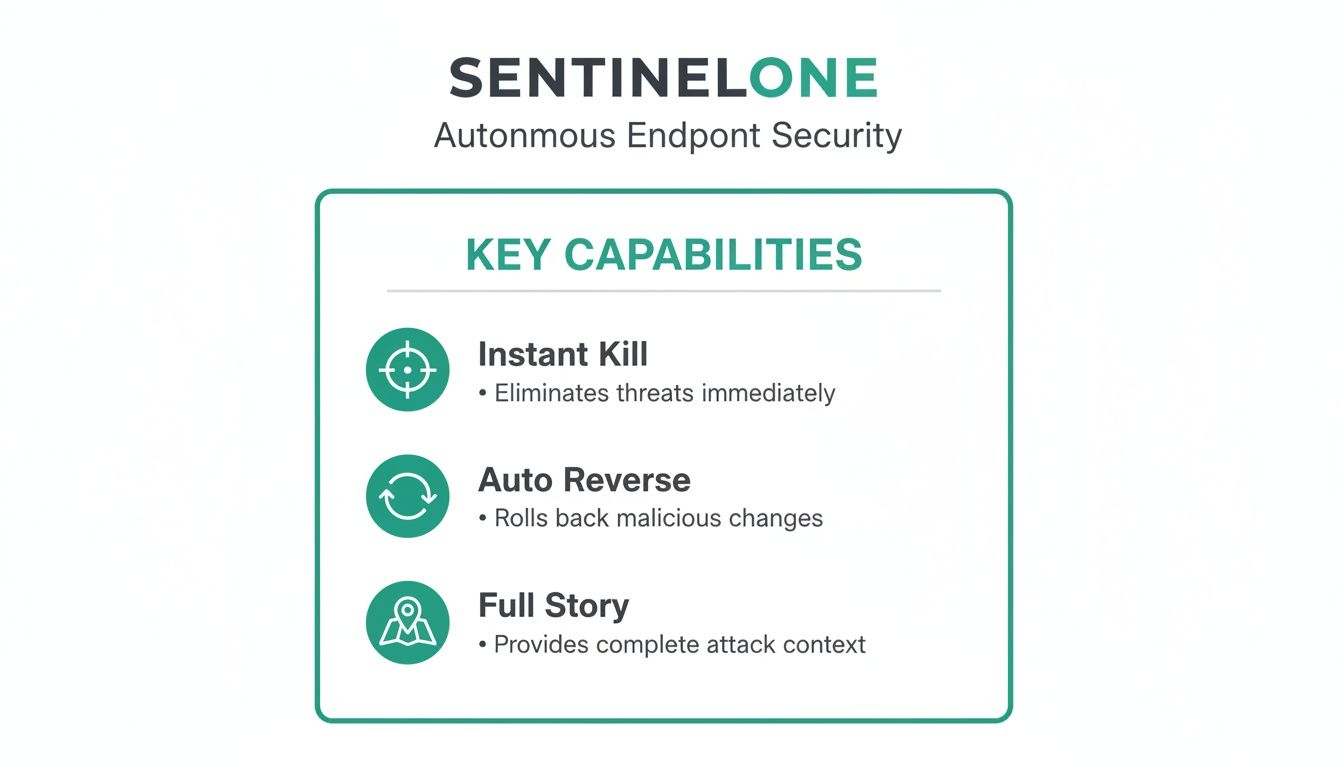
The image above really nails SentinelOne's three-punch combo: instant threat termination, automatic damage control, and a full forensic story of what went down. It’s a system designed to handle the worst-case scenario long before it becomes a full-blown disaster.
Where It Really Shines
-
Hands-Off Remediation: SentinelOne's crown jewel is its ability to act on its own. It doesn’t just detect—it kills, quarantines, and, most importantly, rolls back the endpoint to its pre-attack state. This is a business continuity powerhouse, directly preventing downtime costs.
-
Road Warrior Protection: Because the AI lives on the device itself, it doesn't need a constant internet connection. This is fantastic for remote employees or staff who are always on the move up and down I-65, ensuring their laptops are locked down even on spotty coffee shop Wi-Fi in an old brick building.
-
One Platform to Rule Them All: The Singularity XDR platform brings EPP (Endpoint Protection Platform) and EDR (Endpoint Detection and Response) together under one roof. This unified approach gives you a complete picture of your security across every device, from workstations to servers, all in one console. A Forrester study even noted this can cut down the time your IT team spends managing things by as much as 80%. You can dig into the numbers in SentinelOne's 2024 Total Economic Impact study.
Unraveling the Attack Story
Another killer feature is called Storyline. Forget trying to piece together an attack from thousands of cryptic log entries. Storyline gives you a visual map that tells the entire tale of an attack, from the moment it got in to the second it was stopped.
We’ve seen this be a lifesaver for our clients in Indianapolis, especially those in healthcare or finance. When auditors come knocking, having this kind of detailed forensic evidence is non-negotiable for meeting compliance rules like HIPAA and NIST CSF. It's concrete proof that you're taking security seriously.
A Few Things to Keep in Mind
While SentinelOne’s autonomous power is incredible, it isn't a silver bullet you can just "set and forget." To get the most out of it, you need proper initial configuration and someone to keep an eye on things. The sheer number of features can feel a bit much for an IT team that's already wearing too many hats.
That's why it's a perfect candidate for a managed service. For businesses in the Greenwood area or beyond, pairing SentinelOne with expert oversight gives you the best of both worlds. You get that top-tier, AI-driven protection without adding a single task to your team's plate.
Sophos Intercept X: The Security Ecosystem That Talks to Itself
If you're the kind of person who loves it when things just work together, you're going to appreciate what Sophos has built. Their secret sauce is something they call ‘Synchronized Security,’ which is a fancy way of saying their different security products, like their endpoints and UniFi networking gear, actually talk to each other. This creates an automated defense shield that moves way faster than a human ever could.
We often pair their endpoint protection with a Sophos XG Firewall for our clients. It's a killer combination, especially for folks in manufacturing or healthcare who are navigating the tough compliance waters of standards like CMMC or HIPAA.
A Unified Defense in Action
Let’s play this out. Say an employee at your Indianapolis office gets a little click-happy and opens a nasty email link. With a lot of security stacks, the antivirus on their laptop might flag the problem, but the damage could already be spreading.
This is where the Sophos magic happens. The endpoint agent doesn't just sit there—it instantly alerts the Sophos firewall. In response, the firewall immediately boots the compromised computer off the network, isolating it from everything else. No human has to lift a finger. This digital quarantine happens in seconds, slamming the door shut before a minor infection can mushroom into a full-blown ransomware nightmare and a massive bill from downtime.
Threat Intelligence That’s Actually Intelligent
Beyond the synchronized teamwork, Sophos Intercept X is packing some serious heat. It’s not just looking for fingerprints of old malware like traditional antivirus does. Instead, it uses a deep learning neural network—a brainy form of AI—to analyze files and sniff out malware before it ever gets a chance to run.
And it works. Recent tests from SE Labs showed Intercept X had a 100% detection rate against ransomware, even catching tricky fileless attacks. This is the kind of stuff that stops zero-day threats dead in their tracks. It’s also a beast at web filtering, blocking 99.5% of phishing sites in the same tests and protecting your team from the number one way attackers get in.
According to the 2025 State of Ransomware report from Sophos, businesses using their tools recovered from attacks 40% faster than those without. This directly translates to less downtime and a better ROI. You can dig into their performance accolades in the SoftwareReviews Data Quadrant awards.
One Console to Rule Them All
What really seals the deal for many of the businesses we work with—from small creative shops in Fountain Square to bigger players up in Carmel—is the Sophos Central management console. It’s a true “single pane of glass” where you can manage your endpoint agents, firewalls, email security, and even mobile devices.
Having it all under one roof pays off big time for your bottom line:
- No PhD Required: You don’t need a dedicated security guru to run the show. The console is clean, policies are easy to build, and you can push them out to hundreds of devices in a few clicks. This minimizes wasted tech time.
- Total Visibility: You get a crystal-clear, live picture of your security posture without having to bounce between five different dashboards to figure out what’s going on.
- Compliance on Easy Mode: For businesses staring down HIPAA or CMMC requirements, being able to pull reports and prove you’re compliant from one spot is a massive time-saver.
In our experience on the ground, this blend of next-gen protection and dead-simple management makes Sophos a rock-solid choice for businesses that demand top-tier security without the usual headaches.
Why a Managed Strategy is the Smartest Choice for Business Continuity
Here's the hard truth: even the absolute best endpoint protection software is just a fancy, expensive paperweight if no one is actually watching the alerts. This is where having a managed strategy completely changes the game. Buying the software is only half the battle; the real security and ROI come from having an expert team proactively managing it around the clock.
This is exactly what we do with our SOC-as-a-Service. We don't just sell you a box of software like Bitdefender GravityZone and wish you luck. We manage its entire lifecycle, from deploying it to your endpoints to creating immutable off-site backups of your critical data.
Think of it this way: we handle the custom deployment, fine-tune the policies for your specific business risks, and then our team provides 24/7 monitoring and expert threat hunting. If something suspicious pops up, we're on it immediately to respond. It turns a complex, often overwhelming security need into a predictable and manageable monthly expense. You get the peace of mind that a seasoned pro is always standing guard.
This takes the burden completely off your team, converting their 'wasted tech time' into our responsibility. For businesses here in Greenwood and the S. Indy area, the next step is simple. Let's work together to find the gaps in your armor before a threat does.
If you're curious about how this fits into a bigger picture, you can learn more from our blog on how managed IT services can help your small business grow.
Are you really confident your current security can prevent downtime that costs $9,000 per minute? Let's find out for sure. Finchum's offers a no-obligation Security Risk Audit for businesses in the Greenwood/Indianapolis area to pinpoint vulnerabilities and show you exactly how our managed approach can protect your bottom line. Schedule your free network assessment today!