Certificate Management Playbook for Indiana Businesses
A certificate expires without warning, then the warehouse VPN stops authenticating at 2 a.m. The right answer isn't another spreadsheet reminder. Certificate management means discovering every certificate, assigning an owner, automating its lifecycle, and testing renewal and revocation before an outage reaches an Indiana business.
An aging server in a Greenwood business park, a forgotten IIS binding, or a certificate installed only on one node behind a load balancer can interrupt work across the I-65 corridor. The technical fix is straightforward, but the operational discipline matters more. A complete inventory, clear ownership, automated renewal, and tested recovery turn wasted tech time into billable hours and predictable monthly budgets. That protects continuity when downtime can cost up to $9,000 per minute, a business-impact figure that must be validated for the specific organization before it drives an ROI model.
What Certificate Management Actually Means
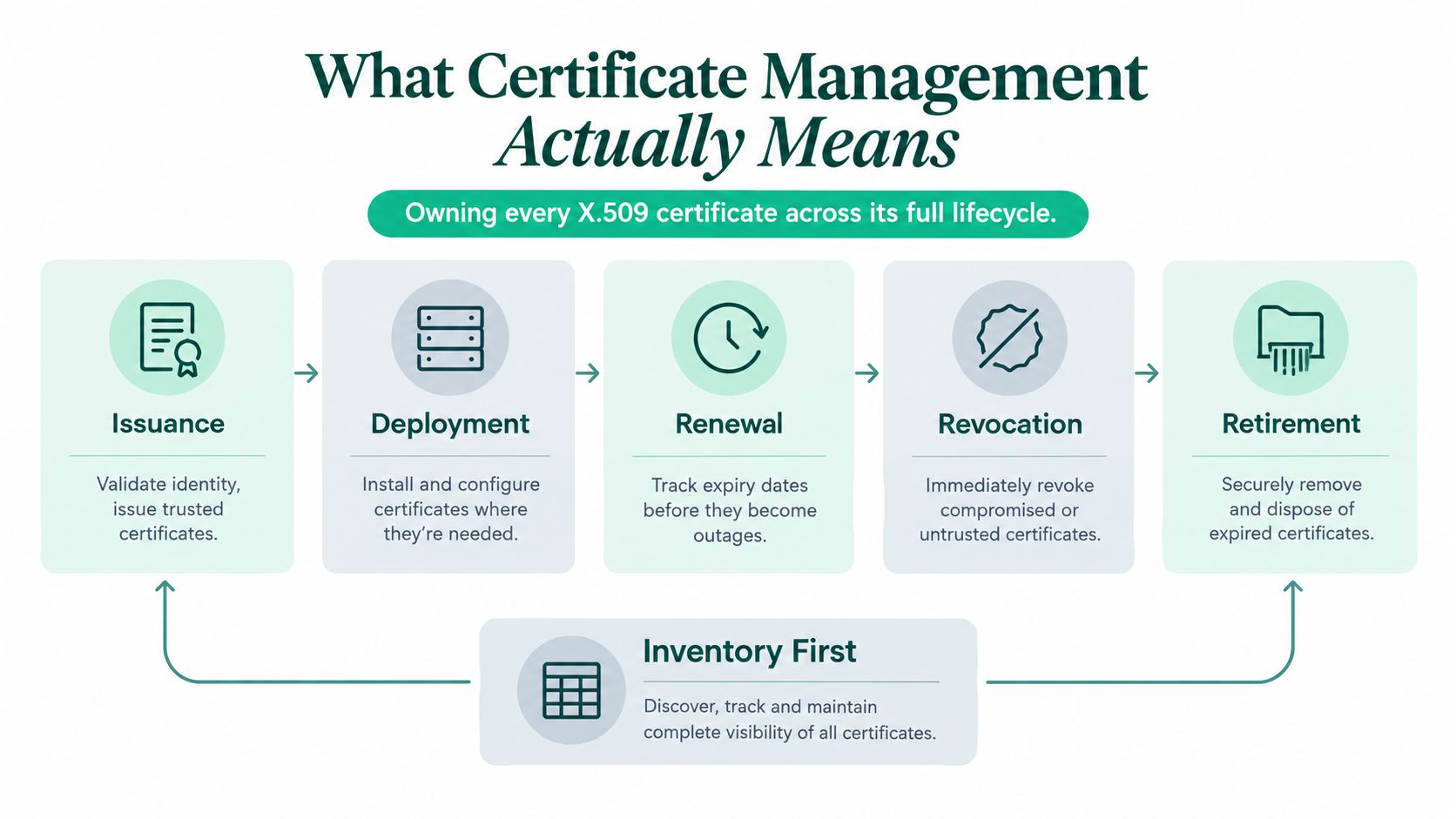
Certificate management is the discipline of owning every X.509 certificate from request through retirement. It covers issuance, deployment, monitoring, renewal, revocation, replacement, and disposal. The practical priority is inventory first, renewal calendar second. If a team doesn't know where a certificate lives or who depends on it, an accurate expiration date won't save the application.
Consider a TLS certificate protecting an Indiana e-commerce site running on IIS or Nginx. The lifecycle looks like this:
- Request: An administrator or automation system creates a certificate signing request, or CSR, for the required hostname. Someone must confirm the requester is authorized and that the hostname belongs in the certificate.
- Validation: The certificate authority validates control of the domain or the organization's identity. If the DNS, file, or approval step has no named owner, renewal can stall here.
- Issuance: The CA signs and delivers the certificate chain. The team must record the serial number, issuer, algorithm, SANs, expiration, and business service.
- Installation: The certificate and private key are loaded into IIS, Nginx, a reverse proxy, CDN, WAF, or load balancer. Installation on one server doesn't mean installation everywhere.
- Monitoring: A monitoring system checks expiration, chain validity, hostname coverage, deployment status, and handshake behavior. An alert without a response owner is noise.
- Renewal: Automation requests a replacement, validates it, deploys it, and confirms that clients can complete the TLS handshake.
- Revocation or replacement: A compromised key, retired hostname, or distrusted CA requires revocation and new key material. Retirement also means removing the old certificate and secret from systems, backups, and documentation.
The ownership test
For each certificate, record the service owner, technical owner, environment, deployment targets, issuing CA, private-key location, renewal method, and escalation path. A certificate with no accountable owner is an outage waiting for a trigger, whether it sits in a downtown Indy tech hub or on a warehouse appliance in Hamilton County.
A proper inventory also includes internal certificates, S/MIME certificates, code-signing certificates, mobile device identities, IoT credentials, and certificates hidden inside appliances. PKI, or Public Key Infrastructure, appears at every point where an organization issues, trusts, stores, validates, or revokes those identities. The terminology gets easier once each component is tied to a real system.
PKI Building Blocks You Need Before the Acronyms Hurt
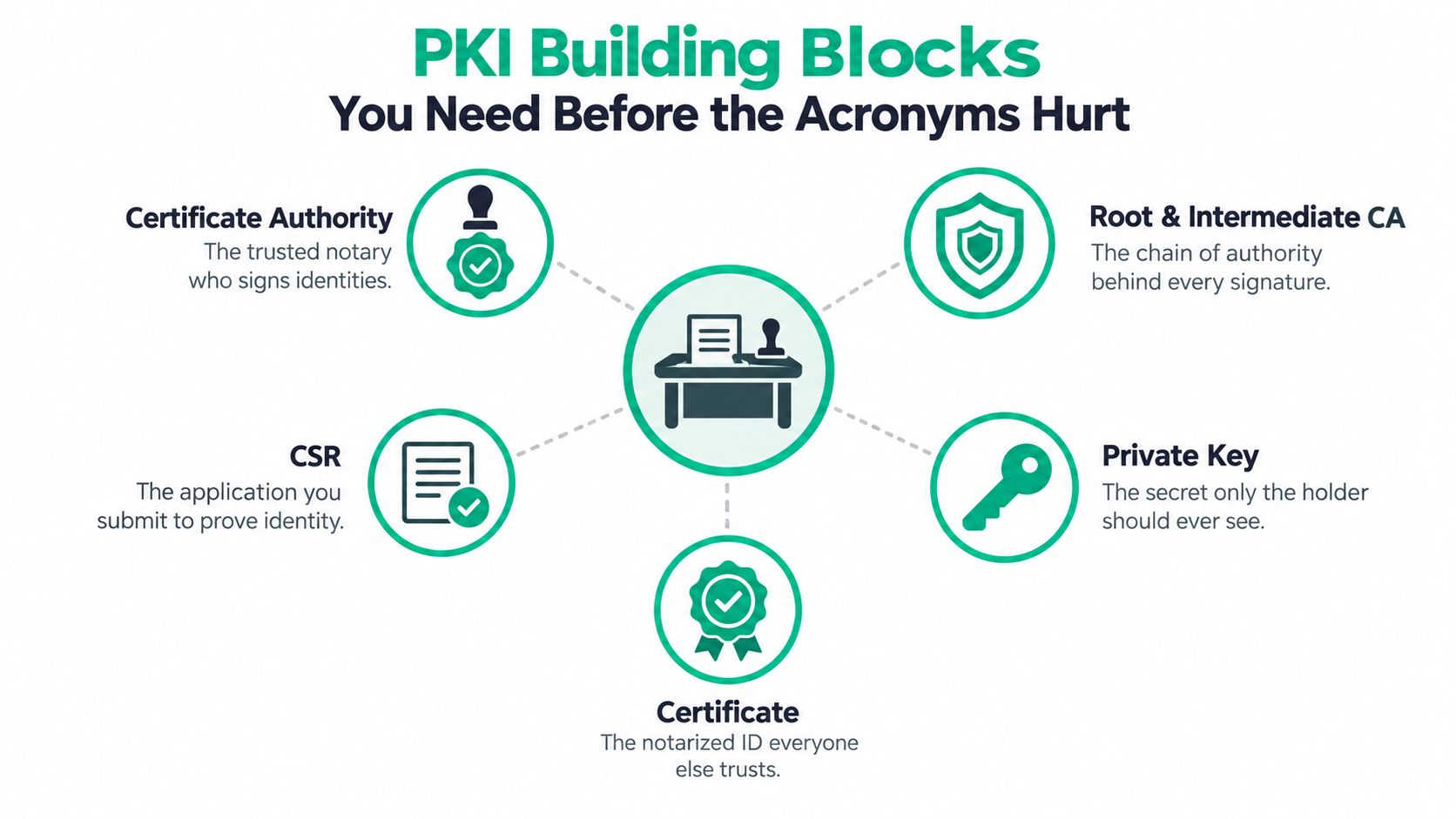
PKI works like a notary system for digital identities. The certificate authority is the trusted notary. The root and intermediate CAs form the chain of authority. A CSR is the application submitted for approval, the private key is the secret signature stamp, and the certificate is the signed identity that other systems trust.
What each component does
- Certificate authority: Signs certificates after validating the requested identity. Public CAs support internet-facing sites, while Microsoft AD CS can issue certificates inside an organization's private trust boundary.
- Root and intermediate CA: The root is the anchor trusted by operating systems and browsers. The intermediate performs much of the issuing work, which helps keep the root protected.
- CSR: Contains the public key, subject information, and requested SANs. It doesn't contain the private key.
- Private key: Proves possession of the certificate identity. On a Windows server, it may reside in the machine certificate store. In a stronger design, a hardware security module, or HSM, generates and protects it so applications can't freely export it.
- Certificate: Binds an identity to a public key and includes issuer, validity, usage, and SAN information.
- OCSP and CRL: These help relying systems determine whether a certificate has been revoked. OCSP answers a status query, while a certificate revocation list distributes revoked serial numbers.
A TLS certificate on a web server is the common example, but the same model applies to an S/MIME certificate in Outlook and a code-signing certificate used to sign an MSI. The private key for code signing deserves tighter controls than a routine web key because compromise can undermine trust in software updates.
Teams handling user identities should also understand how certificates interact with access controls. A practical MFA and SSO authentication guide helps separate authentication factors and federation from PKI, even though the systems often work together. In an SMB, certificate records may also intersect with Active Directory management for Indy SMBs, especially when internal enrollment depends on domain policy.
Each building block connects to the lifecycle. The CSR supports request and validation, the CA handles issuance, the private key and certificate support installation and use, monitoring checks trust and expiry, and OCSP or CRL services support revocation. That connection is what turns PKI from acronym-heavy theory into an operating process.
Why Certificate Management Became an Outage Problem
At 2 a.m., a warehouse VPN certificate expires. The forklift tablets still power on, the warehouse management system still runs, and the network appears healthy. Authentication fails because the certificate wasn't on the inventory list. A 90-day certificate slipped through a spreadsheet, and the morning shift in a Greenwood-style operation starts with paper workarounds and angry calls.
The failure isn't simply “someone forgot a date.” The real failure is that nobody had a trustworthy view of the certificate estate. The spreadsheet contained the public web certificate but not the VPN gateway, a certificate on a backup appliance, or the internal identity used by a service account. Even if an alert existed, it may have gone to a former employee or a shared mailbox no one monitored.
Shorter lifetimes remove slack
Publicly trusted TLS certificate validity is moving through a major policy shift. The CA/Browser Forum approved a phased reduction from 398 days to 47 days, with the first step reducing lifetimes to 200 days in March 2026 and further reductions scheduled to reach 47 days by 2029, as documented in the 2026 TLS security report. That schedule is a projection for future stages, not a claim that every certificate already has the final lifetime.
Shorter lifetimes increase the number of renewals and compress the time available to find an ownership or deployment error. The same report says 45% of organizations experienced service downtime from certificate-related incidents, 37.5% traced an outage specifically to an expired certificate, and 51% identified automated certificate lifecycle management as a top strategic priority. Each figure belongs to the report and should be interpreted within its survey methodology.
Let's Encrypt's operating model also illustrates why certificate issuance must be automated at scale. Manual approval, download, installation, and verification can't remain the default as certificates multiply across cloud workloads, legacy servers, and network devices. For local operators, proactive system monitoring should include certificate discovery and endpoint validation, not just CPU, disk, and uptime checks.
The Hamilton County growth pattern makes this harder. New offices, warehouses, SaaS services, cameras, and remote access gateways arrive faster than a lean IT team can document them. A certificate policy that works for one office can fail across a distributed environment unless discovery and ownership are continuous.
Automating Issuance, Renewal, and Revocation
Manual certificate operations usually follow this path: an engineer receives an alert, finds the server, creates a CSR, submits it to a CA, downloads the chain, installs it, restarts or reloads the service, tests the endpoint, and updates a spreadsheet. The process works until a server is missed, a SAN is wrong, a private key is unavailable, or a deployment change reaches production without validation.
Automation removes repetitive handling, but it doesn't remove accountability. The source of truth must identify every certificate and its dependencies before an ACME client, Kubernetes controller, or network appliance begins renewing anything.
| Task | Manual Process | Automated Process | Failure Cost |
|---|---|---|---|
| Discovery | Search servers, appliances, and shared files | Scan endpoints and reconcile records with a CMDB | Unknown certificates remain invisible |
| Request | Create a CSR and submit a ticket | ACME client or policy workflow requests issuance | Delayed issuance blocks deployment |
| Deployment | Import the chain on each target | Push through hooks, APIs, or controllers | One missed node creates inconsistent service |
| Renewal | Track dates in a spreadsheet | Renew before expiry and validate the live endpoint | Expiration can interrupt VPN, web, or API access |
| Revocation | Call the CA and replace manually | Trigger a runbook, revoke, issue new key material, and verify trust | A compromised key may remain active |
| Evidence | Assemble screenshots and tickets | Retain logs, approvals, serials, and deployment results | Audit preparation becomes disruptive |
A workable automation path
For a public web service, an ACME client such as Certbot can request and renew a certificate:
sudo certbot certonly --webroot -w /var/www/html -d shop.example.com
sudo certbot renew --dry-run
sudo certbot revoke --cert-path /etc/letsencrypt/live/shop.example.com/cert.pem
Use a nonproduction hostname in real testing. The --dry-run check verifies the renewal workflow without replacing the production certificate. A deploy hook should reload Nginx or IIS only after the new certificate and chain pass validation.
For Kubernetes, cert-manager can create an internal issuer and attach certificates to Ingress or workload resources. The controller handles renewal, while admission policy and RBAC determine who can request which identity. SCEP remains useful for network gear and devices that support automated enrollment but don't run ACME clients.
Microsoft's operational guidance recommends triggering renewal at about 80% of a certificate's lifetime and tracking near-expiry events 30 days before expiration, according to its certificate automation guidance. Those thresholds provide runway for change control, but the team still needs exception handling for systems that can't reload certificates automatically.
Practical rule: Automate the normal path, then document the exception path for legacy appliances, offline systems, and business-critical endpoints.
Revocation should trigger for private-key compromise, hostname deprecation, and CA distrust events. Code-signing pipelines should fail a build when the signing certificate is expired, unavailable, or outside policy, rather than publishing an unsigned or improperly signed MSI. Organizations building repeatable workflows can apply the same thinking described in this business process automation guide for Indy SMBs.
The ROI is a comparison between outage exposure and engineering effort. A four-hour unplanned outage has a different financial effect for a warehouse, clinic, manufacturer, or SaaS provider, so don't invent a universal savings figure. Calculate lost transactions, idle staff, recovery labor, delayed shipments, and contractual impact, then compare that with the recurring cost of automation and the engineer hours currently spent on calendar-based renewals.
Tooling and Integration Choices for SMBs and Enterprises
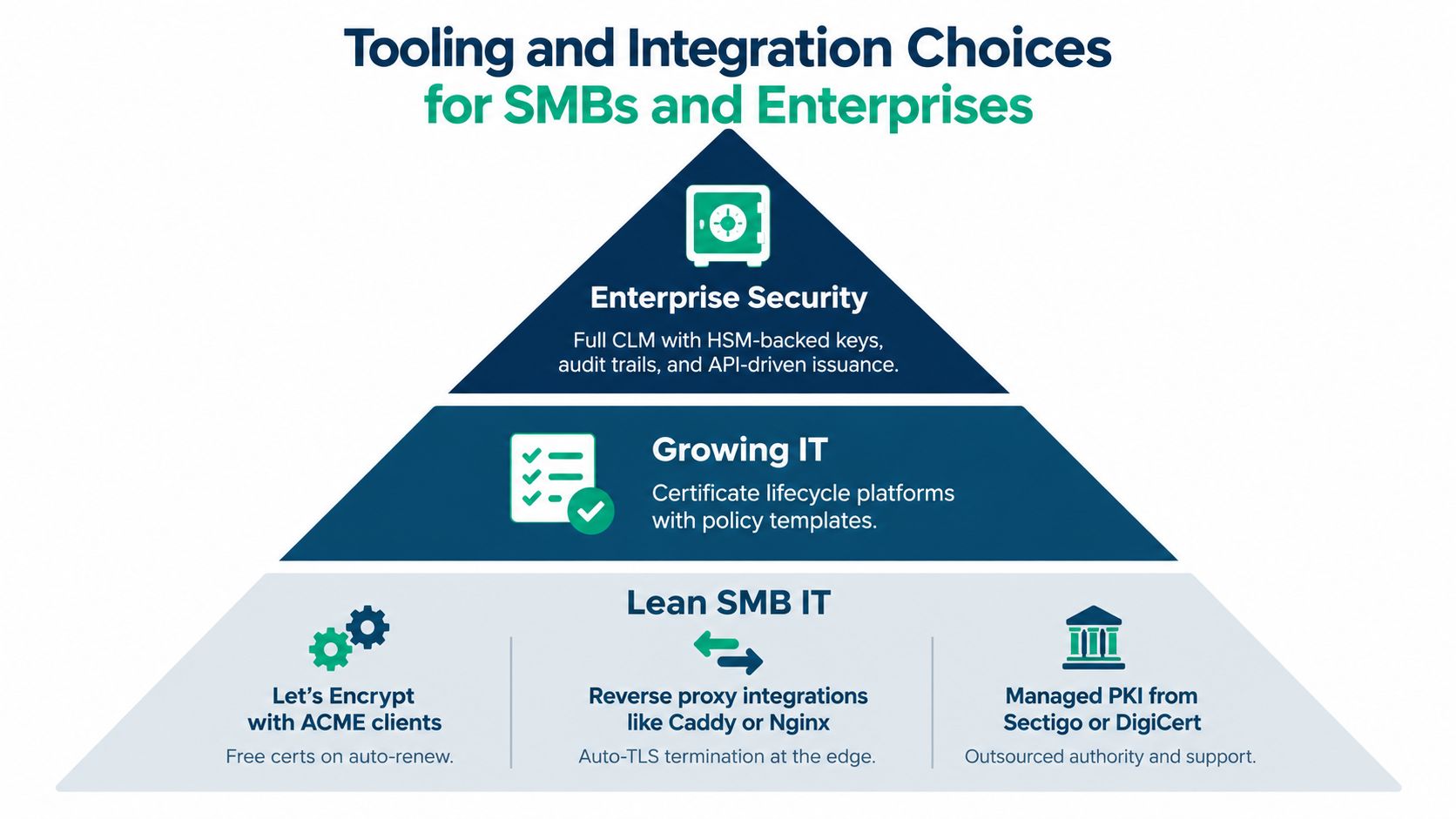
The right tool depends on team maturity, infrastructure, and how many certificate types must be governed. A small business with one reverse proxy doesn't need an enterprise platform on day one. An enterprise with cloud workloads, load balancers, mobile devices, internal services, and code-signing keys shouldn't manage trust through a shared spreadsheet.
Lean SMB IT
For a straightforward public site, Let's Encrypt with an ACME client can provide automated issuance and renewal. Caddy handles automatic HTTPS in suitable deployments, while Traefik and Nginx can integrate with ACME workflows at the edge. Managed PKI from Sectigo or DigiCert may make more sense when the business needs support, governance, multiple certificate types, or formal reporting.
The trade-off is control versus operational simplicity. A free public certificate doesn't solve internal PKI, code signing, mobile authentication, or certificate ownership. A managed service costs more, but it can reduce the number of custom scripts a lean IT team must maintain.
Growing IT and enterprise environments
Mid-market and enterprise teams may need platforms such as Venafi, Keyfactor, or AppViewX for discovery, policy, workflow, and audit reporting. Microsoft AD CS supports internal issuance, with certutil available for diagnostics and administration. HashiCorp Vault's PKI secrets engine can issue short-lived internal certificates, while cert-manager fits Kubernetes clusters and service meshes.
Map every tool to the system that consumes the certificate:
- Load balancers and WAFs: Confirm automated import, chain order, and rollback.
- CDNs and reverse proxies: Verify API permissions and propagation checks.
- MDM platforms: Enroll mobile certificates without manual tickets.
- HSM-backed signing: Keep code-signing keys protected while the build pipeline receives controlled signing access.
- Internal CAs: Ensure agents and workloads can reach the CA from every required network segment.
Common traps are predictable. An agent may not reach an internal CA from a private subnet. A certificate may omit a required SAN even though the common name looks correct. A wildcard may simplify deployment while expanding the impact of a compromised key and making revocation harder to contain. Test the exact client path, not just the certificate record.
Identity and access choices affect the same control plane. A practical comparison of identity and access management tools can help teams decide where certificate-based authentication belongs beside MFA, SSO, device posture, and privileged access.
Revocation as Risk Engineering, Not Cleanup
Revocation is a safety control that must be designed before compromise. If a web server key is stolen, the response should not require an organization to understand its entire PKI while customers are waiting. The certificate's scope, issuer, private-key location, and downstream trust relationships should already be documented.
Microsoft's Azure Device Registry guidance shows why scope matters. Revoking a device certificate can revoke all certificates ever issued to that device, while revoking a policy rotates the issuing CA and affects every certificate issued under that policy, as described in its certificate policy management documentation. The operational lesson is clear. Broad certificate groupings can turn a contained response into a widespread outage.
Design the blast radius
Separate web, code-signing, device, and internal service hierarchies where the design allows it. Segment by device cohort, site, environment, or application tier. Don't put an internet-facing web key and a software-signing key under one operational boundary merely because the CA supports it.
A sound revocation workflow captures evidence first, then contains and replaces the identity:
- Preserve logs, certificate serials, key-store evidence, and affected host details.
- Disable or isolate the compromised system without destroying evidence.
- Revoke the certificate through the CA and confirm CRL or OCSP status.
- Notify subscribers, owners, and dependent application teams.
- Escalate to the CA if a trust chain or policy is affected.
- Issue replacement certificates with new key material.
- Deploy and validate the replacement across every dependent endpoint.
- Record the incident, decision trail, and lessons for the next tabletop exercise.
Apple and Google root program requirements can impose rapid revocation obligations for code-signing keys under certain conditions, so software vendors should verify the current program rules that apply to their signing chain. CRL refresh behavior, OCSP stapling, and short-lived certificates change how quickly clients observe trust changes. They don't replace a tested response plan.
A revoked leaf should never sink the chain.
Security teams can use RapidNative security articles for broader operational context, but certificate revocation still needs a local runbook tied to the actual CA, systems, and owners. Keep the runbook beside the cybersecurity incident response plan template, then test it with a compromised web certificate and a separate code-signing scenario.
Frequently Asked Questions for Indiana Operators
How does certificate management support PCI DSS 4.0, HIPAA, and CMMC
Auditors usually want evidence that the organization knows what it owns, who is responsible, how keys are protected, and how changes are approved. For PCI DSS 4.0, connect certificates to protected payment flows, access control, vulnerability management, and change records. For HIPAA, show how certificates support transmission security, access controls, risk analysis, and incident handling. For CMMC, map internal PKI, authentication, cryptographic protection, and audit evidence to the applicable practices.
Don't hand over a certificate dump without context. Provide the inventory, ownership records, approved CA policy, private-key protection standard, renewal logs, revocation procedure, monitoring alerts, and samples of successful deployment validation. The evidence should prove that the control operates, not merely that a certificate exists.
How should manufacturers handle code-signing certificates
Indiana manufacturers shipping updates to PLCs or Windows endpoints need to protect the signing key as carefully as production credentials. Store it in an HSM or an approved signing service, restrict pipeline access, require review for release signing, and use a trusted timestamp server so signatures remain useful after the certificate expires.
EV and OV are not interchangeable labels for every software workflow. Compare the trust presentation, issuance requirements, ecosystem support, and operational cost against the actual update channel. A build should fail if the certificate is expired, revoked, missing its intended EKU, or unavailable from the controlled signing environment.
How do teams manage machine identities without renewal tickets
Service meshes, plant-floor sensors, warehouse robotics, and industrial gateways need identity that machines can obtain and rotate automatically. Use workload identity, cert-manager, SCEP, or an internal CA based on device capability. Assign certificates to a device cohort or workload role, record the owner and dependency, and make the renewal controller report failures to an operations queue.
The important distinction is between automated renewal and invisible renewal. A machine may renew successfully while the application still trusts the wrong CA or a downstream device still holds the old chain. Monitor both issuance and real connection behavior.
What does crypto agility mean in practical terms
Crypto agility means the business can replace algorithms, key types, certificate profiles, and trust chains without rebuilding every application under pressure. Start by recording algorithm, key size, signature type, issuer, usage, software dependency, hardware dependency, and replacement path for every important certificate.
Include SHA-1 dependencies, embedded firmware, old Java runtimes, appliance trust stores, and code-signing tools. Track which systems can accept new algorithms and which require upgrades. That inventory supports future post-quantum planning without turning a migration into a fire drill.
Your Certificate Management Checklist This Quarter
Run the engagement in four blocks, and make every item produce evidence someone else can use.
Inventory and ownership
- Build the estate: Discover certificates across cloud, on-premises servers, IIS, Nginx, load balancers, VPNs, MDM, Kubernetes, appliances, code-signing systems, and machine identities.
- Assign accountability: Record a business owner, technical owner, environment, dependency, issuer, private-key location, and replacement path.
- Monitor the truth: Create expiration dashboards that show certificate status and live endpoint validation, not just dates copied from files.
Policy and standards
- Set cryptographic rules: Define approved algorithms, minimum key sizes, permitted CAs, SAN requirements, key-storage controls, and certificate purposes.
- Control scope: Restrict wildcard use and separate public web, internal service, device, and code-signing boundaries.
- Map evidence: Tie records and logs to HIPAA, CMMC, PCI DSS 4.0, or NIST CSF expectations where they apply.
Automation readiness
- Choose the normal path: Use ACME for compatible public services, cert-manager for Kubernetes, SCEP for supported network and device equipment, and managed PKI or enterprise CLM where governance requires it.
- Set renewal controls: Trigger renewal before expiry, validate the deployed endpoint, and alert a named responder when automation fails.
- Test integrations: Confirm that load balancers, CDNs, WAFs, reverse proxies, mobile platforms, and HSM-backed signing workflows accept the replacement correctly.
Incident response
- Write the runbook: Document evidence capture, isolation, revocation, CRL and OCSP checks, CA escalation, replacement, and verification.
- Test compromise: Run a tabletop for a stolen web key and a separate code-signing compromise.
- Review exceptions: Remove abandoned certificates, close ownership gaps, and document every manual process that automation could safely replace.
A Free Network Assessment and certificate review for a Greenwood or Indianapolis business should aim at one result, preventing the next warehouse VPN or office application outage. The point isn't to collect another report. It's to identify the certificates nobody owns, the systems nobody monitors, and the renewal steps that will fail during a busy Monday.
Finchum Fixes IT can audit your certificate inventory, network dependencies, renewal workflows, and business-continuity risks for Indiana operations. Visit Finchum Fixes IT to arrange a Free Network Assessment or Security Risk Audit for your Greenwood or Indianapolis business before an overlooked certificate becomes an outage.