Agile Project Management Guide for Indiana Businesses
A server refresh, a HIPAA audit, and a growing queue of software requests are competing for the same small Indiana IT team. The work sits in a spreadsheet, priorities change by email, and urgent tickets interrupt planned projects. Agile project management replaces that confusion with visible work, short delivery cycles, frequent feedback, and deliberate priority decisions.
For businesses along the I-65 corridor, that structure matters beyond software delivery. A well-run agile workflow can protect billable hours, schedule cybersecurity and data-recovery work before an outage, and give owners a clearer monthly technology budget.
What Agile Project Management Actually Means for Your Team
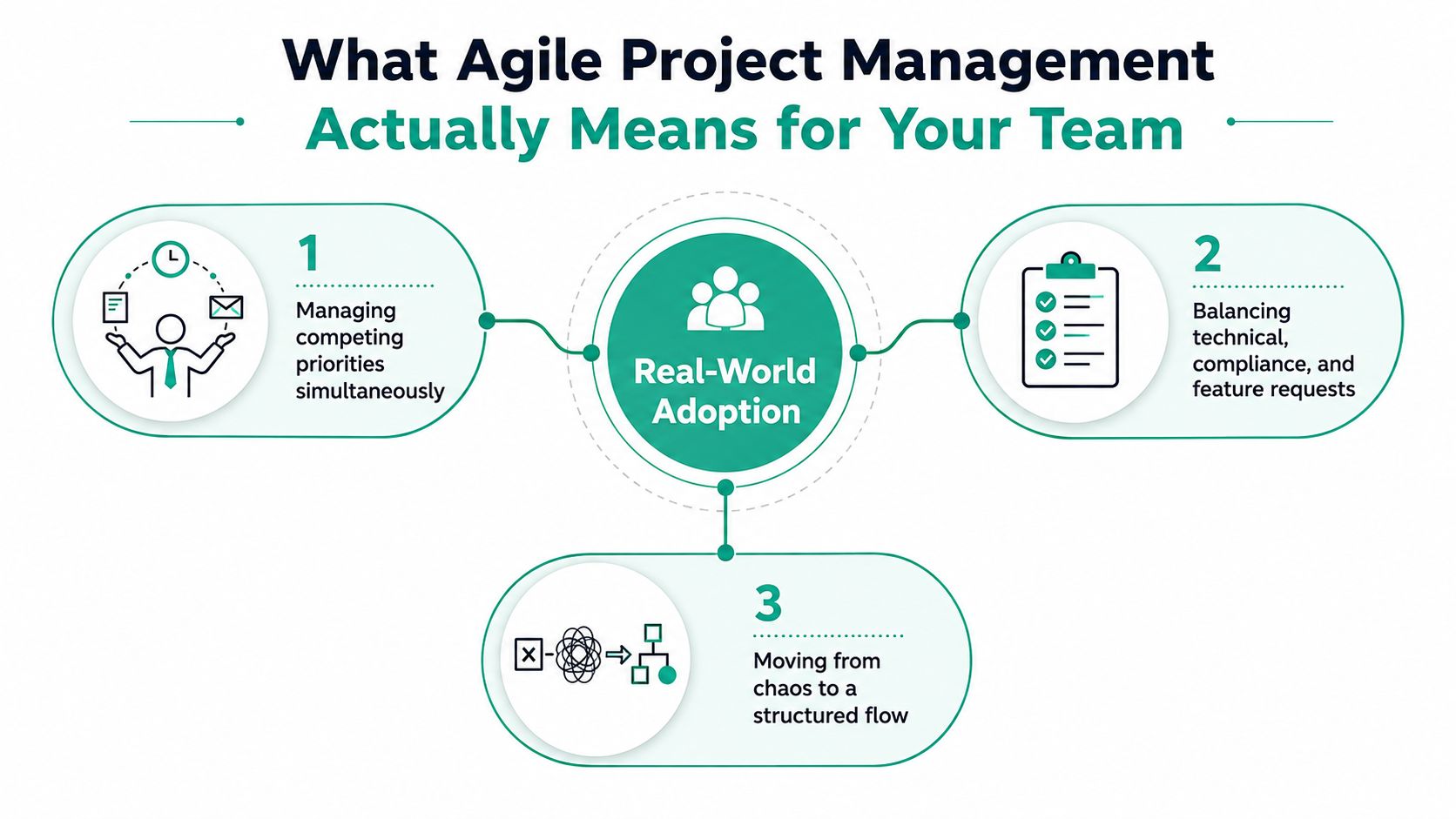
A Johnson County operations lead may start Monday with an aging server refresh, a compliance audit, a wireless complaint from an old brick office, and several internal application requests. By Tuesday, a sales manager has added a dashboard request. By Wednesday, the server vendor has changed its delivery date. The shared spreadsheet still says everything is urgent.
That isn't an agile system. It's a list with no operating rules.
Agile project management means breaking meaningful work into small batches, moving those batches through a visible workflow, collecting feedback early, and adjusting priorities before the team wastes a month building the wrong thing. The method doesn't promise that requirements won't change. It gives the team a controlled way to respond when they do.
A workable definition
For an SMB, agile usually has four practical parts:
- Small batches: Break “refresh the network” into discovery, switch replacement, access-point installation, validation, and documentation.
- Short feedback loops: Demonstrate a usable result before the entire project is finished.
- Visible work: Put requests in Jira, Azure DevOps, GitHub Projects, or a disciplined board instead of hiding them in inboxes.
- Stop-and-adjust discipline: Pause when new information changes the business case, rather than continuing because an old plan says so.
The point isn't ceremony for its own sake. The point is predictable throughput. A team should know what it's working on, why it matters, what blocks it, and what leadership must decide.
Where managed IT fits
Agile doesn't replace technical standards or operational controls. A managed-IT team still needs change windows, endpoint policies, asset records, backup verification, and escalation paths. It organizes that work so a UniFi networking refresh, Bitdefender GravityZone policy change, software release, or immutable off-site backup test gets planned instead of handled as a last-minute interruption.
A useful first move this week is simple. List every active request, assign one business owner to each, identify the next useful deliverable, and limit how much work can be active at once. That small change exposes scope creep quickly and gives a Greenwood business owner something more useful than a perfect project plan, a reliable view of what will happen next.
Where Agile Came From and Why the Data Still Backs It
Agile emerged as a formal movement in 2001, when 17 software practitioners signed the Agile Manifesto. They defined four core values and twelve principles centered on working results, customer collaboration, feedback, and responding to change. The historical importance isn't just philosophical. It changed how teams think about risk, especially when requirements are uncertain.
Waterfall assumes that a team can define the work early, sequence it, and avoid major disruption during delivery. That approach can still fit work with stable requirements and strict dependencies. It struggles when users discover what they need only after seeing a working result.
The project-outcome record gives agile a strong practical case. Standish Group tracking began in 1994, and later analyses reported that, after the manifesto era, success rates improved by about 9 percentage points while failure rates fell by about 9 points. The Standish Group project-outcome report frames that shift as a durable change in delivery performance, not a short-lived management fad.
What the comparison means for an SMB
Summaries based on Standish Group data covering more than 10,000 software projects from FY2011 to FY2015 found that agile projects succeeded at almost four times the rate of waterfall projects, while waterfall projects failed at roughly three times the agile rate. Those figures don't mean every Scrum board will rescue a troubled project. They show why smaller releases and earlier feedback improve the odds of finding problems while correction remains affordable. The project management statistics summary provides the underlying comparison and the later baseline figures.
The same source cites a Standish 2020-era distribution of 31% successful, 50% challenged, and 19% failed projects. That baseline should make Indiana owners cautious about declaring victory because a team held daily stand-ups. Agile helps when it changes decisions, sequencing, and feedback. It doesn't help when leadership keeps the same approval bottlenecks and adds meetings.
For a deeper comparison of delivery approaches, see this guide to software development life cycle models for Indiana businesses. The right model depends on uncertainty, compliance needs, technical dependencies, and how quickly users can review working results.
Scrum, Kanban, and Scrumban Compared for SMB IT Teams
Frameworks aren't identities. They're operating choices, and a 5-to-50-person IT team should choose based on incoming work rather than adopting the framework with the most impressive training vocabulary.
| Framework | Cadence | Roles Required | Best Fit |
|---|---|---|---|
| Scrum | Fixed sprints with planning, review, and retrospective | Product Owner, Scrum Master, developers | Product or software work that can be planned in batches |
| Kanban | Continuous flow with work-in-progress limits | No required formal roles | Support queues, infrastructure work, and unpredictable requests |
| Scrumban | A delivery cadence combined with continuous-flow practices | Lightweight ownership and facilitation | SMB teams balancing projects with interrupt-driven support |
Scrum
Scrum works when a team can protect a sprint goal from constant interruption. The Product Owner sets priority, the Scrum Master removes blockers, and developers produce a usable increment. Sprint planning and review create useful accountability, but Scrum becomes expensive when the team spends more time discussing tickets than completing them.
A Greenwood application team building an internal service portal may benefit from Scrum. A help desk handling outages, onboarding, laptop failures, and access requests probably won't benefit from a rigid sprint commitment.
Kanban
Kanban makes work visible and limits work in progress. A support team might use columns such as Ready, In Progress, Waiting on Customer, Testing, and Done. The value comes from controlling flow. If every engineer starts another ticket whenever a request arrives, the board becomes a parking lot. WIP limits force the team to finish work before opening more work.
A well-structured collaborative project board can help a small team make that flow visible without buying a large enterprise platform. The tool matters less than the policies behind it, including what qualifies as ready, who can interrupt the queue, and how blocked work gets escalated.
Scrumban
Scrumban often fits managed IT because it preserves a regular planning and review rhythm without pretending that every incoming ticket can wait for the next sprint. The team can reserve capacity for planned projects, use a Kanban queue for support, and review service trends on a consistent cadence.
The trade-off is ambiguity. Without clear policies, Scrumban can become “whatever process people remember today.” Teams considering that middle path can also review this adaptive software development guide for Indiana businesses. Pick one framework, write its working rules on the board, and revisit those rules after real delivery experience.
Roles, Ceremonies, and Artifacts That Actually Run the Work
Agile mechanics work when each person knows what decision they own. In a small IT group, one person may hold more than one role, but the responsibilities still need to be explicit.
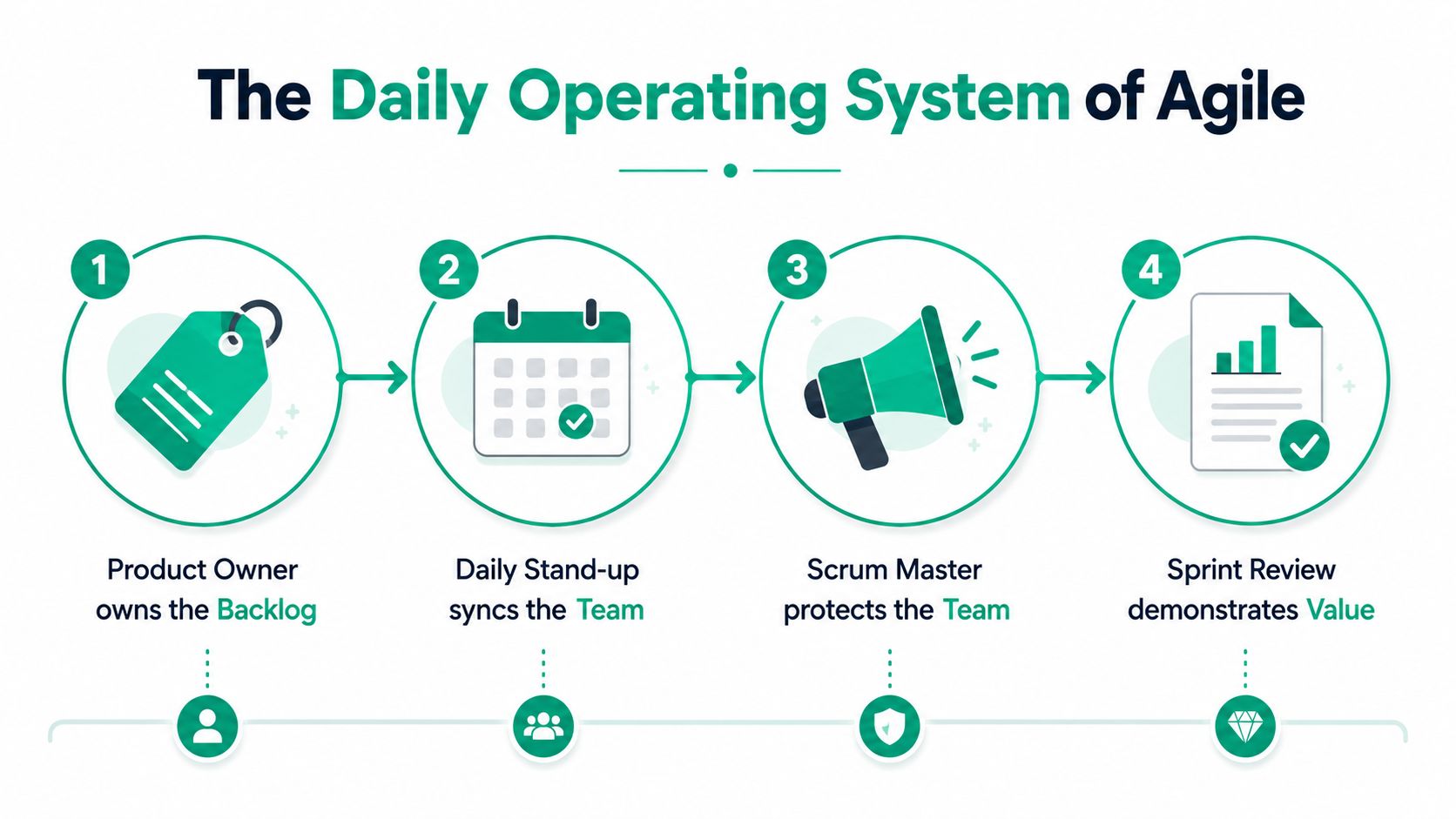
The Product Owner owns priority and speaks for the business. The Scrum Master or Delivery Lead protects the workflow, exposes blockers, and keeps meetings from becoming status theater. Developers, engineers, and technicians do the work and help determine how much the team can responsibly take on.
The operating rhythm
A practical sprint cycle can run like this:
- Refine the backlog: Clarify the request, business outcome, acceptance criteria, dependencies, and risk.
- Plan the sprint: Select work that supports one goal. Leave room for operational interruptions if the team supports live systems.
- Run the daily stand-up: Each person states what changed, what comes next, and what is blocked. The meeting is for coordination, not a manager's interrogation.
- Review the result: Show working software, a validated firewall rule, a tested restore, or a documented network change to the people who can give useful feedback.
- Retrospect: Choose a small process improvement, assign an owner, and inspect whether the change helped.
A backlog item should explain the requested outcome. The sprint backlog is the selected work and its plan. The increment is the usable result. A ticket that says “fix Wi-Fi” is not ready. A stronger item identifies the affected area, the observed symptom, the validation test, and the person who accepts the result.
A diagnostic workflow for day one
When a ticket enters the board, ask:
- Is the requester and business impact clear?
- Does the team have access, credentials, equipment, and a decision-maker?
- What proves the work is complete?
- Does the change require a maintenance window or rollback plan?
- Does it affect HIPAA, CMMC, or the organization's NIST CSF controls?
Jira, Azure DevOps, and Trello can all support this workflow if the team keeps the board current. A short software development best-practices guide can complement the workflow for teams that also maintain custom applications.
A brief visual demonstration can help new team members understand how the roles and events connect.
Metrics That Tie Agile to ROI and Uptime
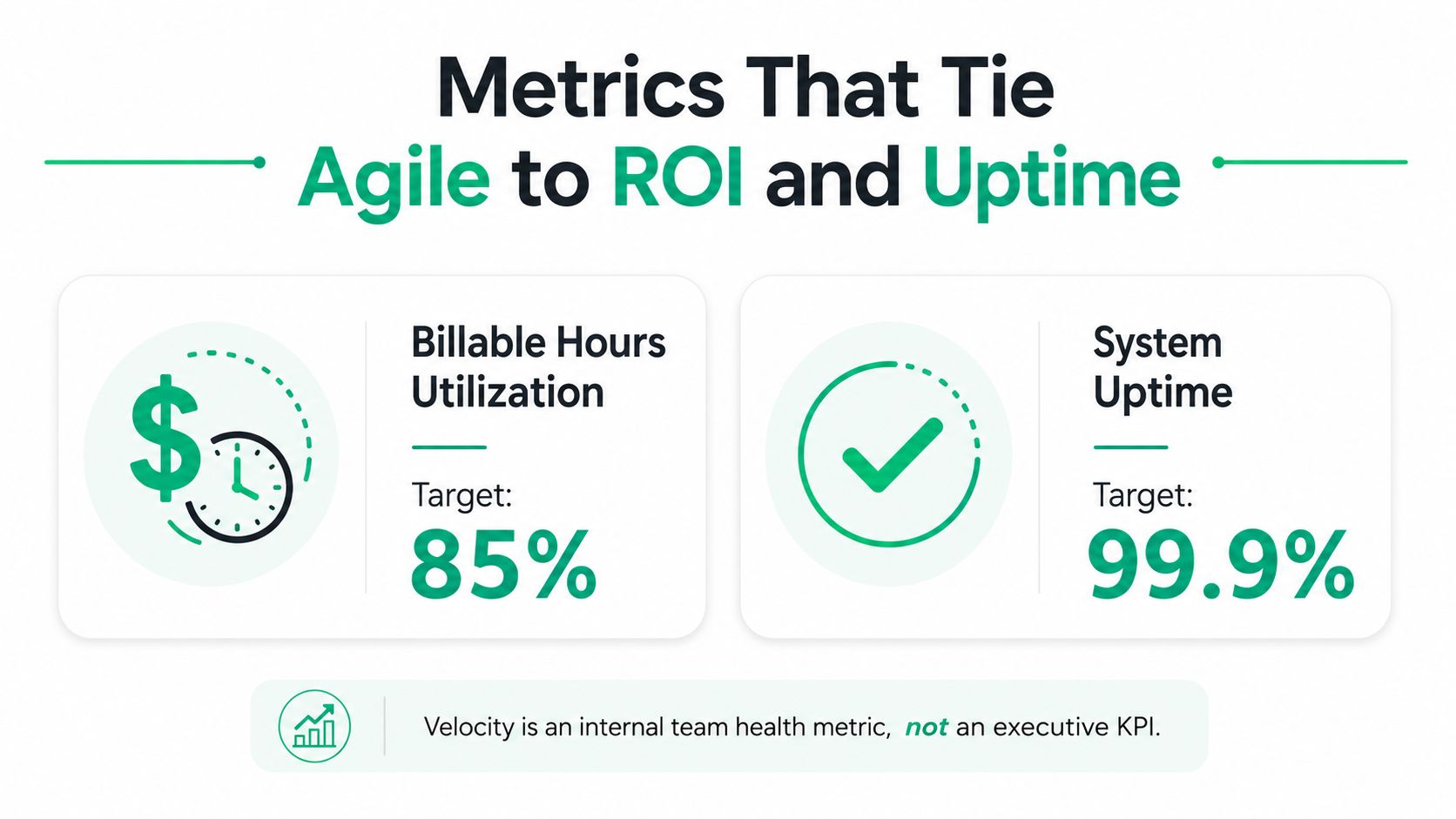
Executives rarely need a larger velocity number. They need to know whether technology work is reaching the business, whether engineers are spending time on planned outcomes, and whether preventable incidents are consuming the operating budget.
Track lead time, the period from request to delivery, to see how long users wait. Track cycle time, the period from active work to completion, to find bottlenecks inside the team. Throughput shows how much work reaches completion, while escaped defects reveal quality problems that force technicians back into finished work. Sprint goal completion can help a team inspect planning quality, but it shouldn't become a punishment score.
Convert delivery data into financial language
A rising lead time for access requests can delay onboarding. A growing cycle time for security remediation can leave known exposure open longer. Escaped defects can pull senior staff away from billable projects. Those connections let an owner discuss technology in terms of capacity, risk, and customer service instead of story points.
The business-continuity case is direct. Downtime can cost large organizations nearly $9,000 per minute, according to industry summaries that trace the estimate to the Ponemon Institute and related downtime research, as described in Atlassian's cost-of-downtime guidance. A planned agile item for a restore test, endpoint policy review, UniFi networking change, or incident runbook can prevent a much more expensive interruption.
Use the right control at the right layer
Agile is the planning layer, not a substitute for infrastructure protection. Bitdefender GravityZone helps manage endpoint security. UniFi networking can support a documented wireless and switching refresh. Immutable off-site backups create a recovery option when ransomware or hardware failure compromises primary systems. For sensitive environments, Zero Trust architecture and SOC-as-a-Service monitoring add control and visibility that a project board can't provide.
The Indiana IT prioritization playbook can help leadership rank work by business value, operational risk, compliance exposure, and dependency. The useful dashboard connects completed work to fewer interruptions and more predictable use of technical capacity. It doesn't celebrate motion for its own sake.
A Practical Adoption Roadmap for a Central Indiana SMB
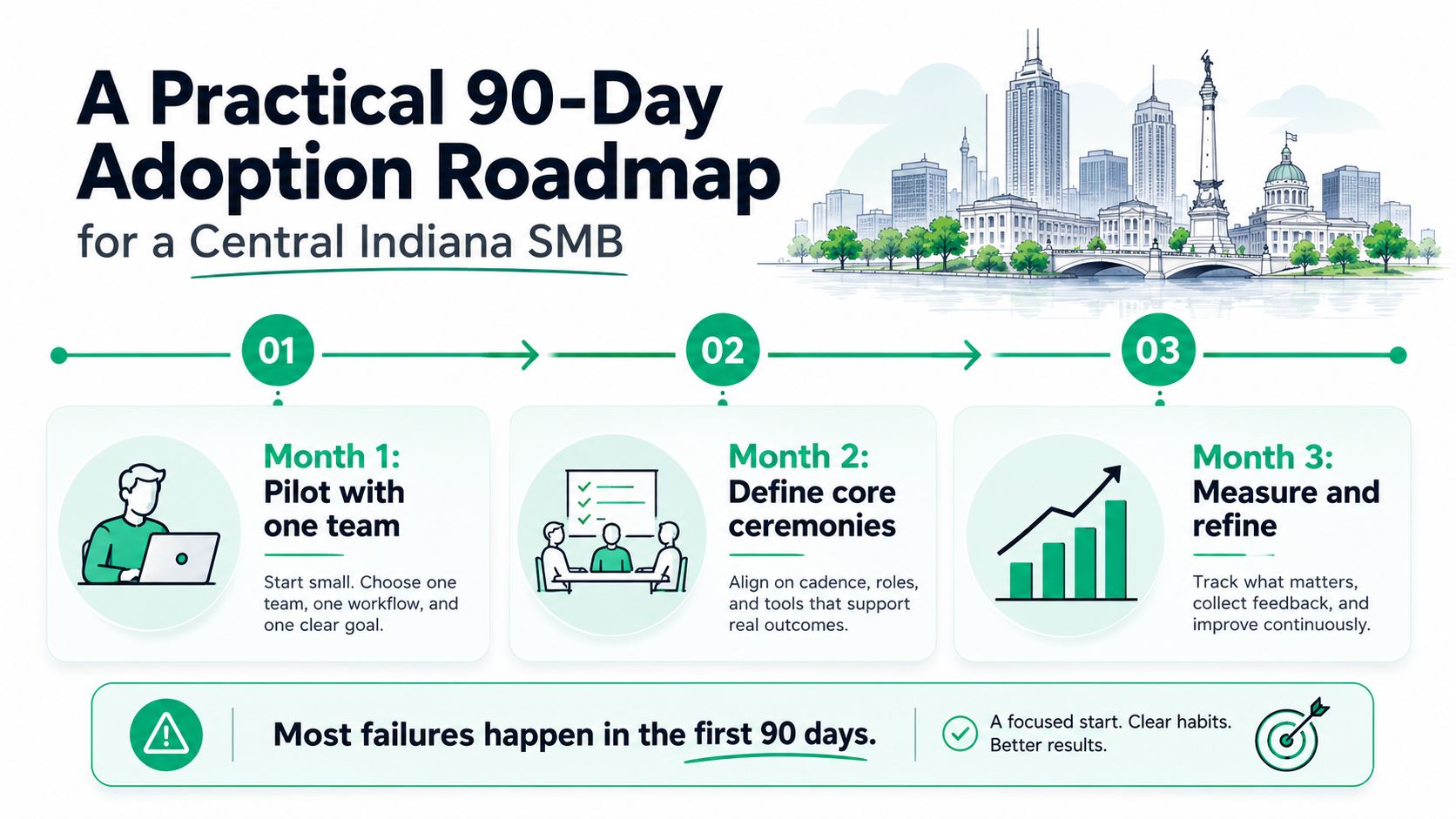
A Central Indiana SMB doesn't need an enterprise PMO to test agile. It needs a bounded pilot, a visible queue, and leadership willing to protect the experiment from random priority changes.
Start with one cross-functional team. That team might include help desk staff, an infrastructure specialist, a developer, an operations representative, and a business owner for the selected outcome. Keep the scope narrow enough that the team can inspect its workflow.
Establish the pilot
Write down the problem, the desired business result, what is excluded, and who can make priority decisions. Select Jira, Azure DevOps, or GitHub Projects according to the team's existing code, support, and reporting needs. Don't begin by configuring every field. Start with a few workflow states, a definition of done, an owner, and a clear escalation path.
Run the first sprint with an intentionally modest scope. Use the review to show actual work, not a slide deck. Run another sprint before expanding the process, because one cycle often reflects setup effort more than normal delivery.
Fit compliance into the cadence
Healthcare teams must treat HIPAA controls as part of delivery, not as paperwork added after a technical change. NIST SP 800-66 Rev. 2 maps HIPAA Security Rule contingency-planning controls to NIST CSF backup-related subcategories and calls for a data backup plan, a disaster recovery plan, and retrievable exact copies of ePHI, which fits naturally into a sprint-sized compliance cadence. See the NIST SP 800-66 Rev. 2 guidance for that mapping.
A backlog can include restore-test evidence, recovery documentation, access reviews, and remediation tasks. CMMC requirements for defense contractors and NIST CSF work for general business security can follow the same pattern, with an owner, acceptance evidence, and a review date.
Review without creating bureaucracy
Hold a leadership review at regular operating intervals. Discuss delivery flow, blocked work, business risk, and uptime events. Don't create a committee to approve every ticket. A Central Indiana IT roadmap can help an owner or COO connect the pilot to infrastructure planning, budget decisions, and continuity priorities.
Common Pitfalls and How to Dodge Each One
Agile rollouts usually fail through ordinary management habits, not obscure technical problems. The board exists, the meetings happen, and the old approval system controls everything.
Seven failure patterns
-
Waterfall with stand-ups attached: The team still waits for a complete specification and final approval. Define a usable first slice and review it with the business before expanding scope.
-
A Product Owner without time: A title doesn't create availability. Give one person authority to rank the backlog and a scheduled path to obtain quick business decisions.
-
Commitment theater: Every request gets marked urgent, so the sprint has no real goal. Require leadership to choose what will not be done when capacity is limited.
-
No definition of done: “Configured” may mean something different to an engineer, an auditor, and an owner. Include testing, documentation, security validation, user acceptance, and rollback notes where relevant.
-
Retrospective fatigue: Teams skip improvement because previous discussions produced no change. Select one action, name its owner, and inspect it in the next review.
-
Tooling before workflow: A new Jira project won't fix unclear ownership. Draw the work on a whiteboard first, then configure only the states and fields the team needs.
-
IT-only adoption: Finance, operations, compliance, and department managers still send side requests. Give those stakeholders a visible intake path and explain how priority decisions affect delivery.
Practical rule: If leadership can add work without removing work, the team doesn't have a priority system.
A managed-IT partner can enforce intake rules, maintain board hygiene, prepare change evidence, and facilitate reviews without becoming the bottleneck. The partner should make decisions visible, not make every decision itself.
Agile works when leaders let the team finish, learn, and change course. It collapses when executives demand flexibility from technicians while preserving every old interruption.
Pulling It All Together for Your Indiana Business
A Hamilton County manufacturer once had support tickets in one inbox and project requests in another. The technical team saw both streams, but the CFO saw only delayed work and unpredictable effort. A single pilot team put the requests on one shared board, separated urgent operational work from planned improvements, and brought business owners into reviews. The important change wasn't a dramatic software purchase. It was a shared conversation about what deserved attention first.
That pattern applies across Hamilton County growth areas, downtown Indy tech hubs, and older Greenwood facilities. Agile gives the business a way to decide whether a server refresh, latency-optimized mesh nodes, a custom application change, bit-level data recovery, or a security remediation task should move now, wait, or be broken into a safer first step.
Use the coming quarter to establish five concrete habits:
- Choose one pilot team: Keep the scope narrow and name the decision-maker.
- Choose one framework: Use Scrum for protected product work, Kanban for continuous support, or Scrumban for a deliberate mix.
- Run two sprints: Inspect real behavior before expanding the rollout.
- Measure flow and reliability: Track lead time, cycle time, completed work, defects, and outage prevention activities.
- Review at 30, 60, and 90 days: Ask whether the process protects capacity and improves business decisions.
In our 17 years of local service, we've seen agile succeed and fail in the same buildings. We've also seen infrastructure problems derail carefully planned work, from unstable wireless coverage in older construction to failing storage arrays that demanded disciplined recovery rather than guesswork. The difference is rarely the ceremony diagram. It's whether leadership, the delivery team, and the technical partner can make clear decisions before a bad sprint becomes a business interruption.
Finchum Fixes IT helps Greenwood and Indianapolis-area businesses organize managed IT work around uptime, security, infrastructure changes, software delivery, and recoverability. Visit Finchum Fixes IT to request a Free Network Assessment or Security Risk Audit, and turn your next agile pilot into a practical continuity and ROI plan.