Choosing Software Development Life Cycle Models for Indiana Businesses
[!NOTE] TL;DR: Key Takeaways
- Choosing the right Software Development Life Cycle (SDLC) model is a critical financial decision for your Indiana business, not just a technical one.
- A poor choice leads to project delays, budget overruns, and downtime, which can cost up to $9,000 per minute. The right model turns wasted tech time into profitable hours.
- Traditional models like Waterfall are rigid but work for projects with fixed requirements, such as those needing strict HIPAA compliance.
- Modern models like Agile and Scrum offer the flexibility needed to adapt to changing market demands, which is essential for most businesses along the I-65 corridor.
- Advanced strategies like DevOps and the Spiral model manage risk for high-stakes projects, like those requiring CMMC compliance for defense contractors.
- The right local partner helps you select a model that aligns with your business goals, ensuring a strong return on your investment.
Think of a Software Development Life Cycle (SDLC) model as the architectural plans for your project. You wouldn't start building a new office in a downtown Indy tech hub without a solid blueprint, right? The same logic applies to software. Picking the right software development life cycle models is the first step to avoiding expensive rework, keeping your budget in check, and making sure the final product actually solves your business problems. A common issue we see is a Greenwood business park firm stuck with aging server hardware trying to run modern applications—the wrong SDLC choice can make this problem ten times worse by delivering software that’s incompatible with their infrastructure, causing system-wide failures.
Why Your SDLC Model Is a Critical Business Decision
For a Johnson County business owner, this isn't just a technical decision. It’s a financial one that directly impacts your bottom line. Getting it wrong can turn a project into a frustrating money pit. When software fails, the resulting downtime can cost a staggering $9,000 per minute. The right model, however, flips that script, turning wasted tech time into profitable, billable hours by creating a clear roadmap for success and ensuring a predictable monthly budget for your IT.
Imagine trying to build a new warehouse without a schedule. Materials show up randomly, crews are sitting around idle, and costs are exploding. Software projects without a plan are just like that—pure chaos. A structured SDLC framework brings order to that chaos and ensures business continuity.
The Foundation for Predictable Results
A well-chosen SDLC model gives everyone on the project—from the developers to the stakeholders—a shared vision of the finish line. It allows our team to map out tasks, spot potential risks, and anticipate bottlenecks long before they become emergencies. This structure is also a lifesaver for project continuity, especially if team members come and go.
This structured approach is no longer a niche idea. The global market for SDLC tools, valued at $16.5 billion, is on a rocket ship trajectory, projected to hit $44.7 billion by 2033. That explosive growth tells you one thing: businesses are finally getting serious about investing in processes that deliver efficiency and quality.
A proper SDLC isn't just about writing code. It's about building a reliable asset for your business that operates efficiently, meets compliance standards like HIPAA or CMMC, and doesn't require constant, costly fixes. It’s the difference between a tool that makes you money and a project that drains it.
Building Your Competitive Edge
Ultimately, the goal is to create software that gives your Indiana business a real leg up on the competition. To get there, it’s helpful to understand the core software development life cycle best practices that underpin all the different models. This foundational knowledge ensures your project is built on solid ground, no matter which path you take.
Here at Finchum Fixes IT, we’ve been doing this for 17 years. We’ve seen firsthand how a strategic plan prevents disaster. We don't just write code; our custom https://finchumfixesit.com/services/software-development services are built around finding the perfect SDLC model for your specific goals. This guide will cut through the jargon and help you understand your options, so you can make sure your investment truly pays off.
The Old Guard: Waterfall and the V-Model
Before getting into modern software development, we need to acknowledge the classics. Let's talk about the foundational models that started it all—think of them as the reliable, old-school pickup trucks of the software world. They’re not flashy, but they were built on a solid chassis of discipline and order.
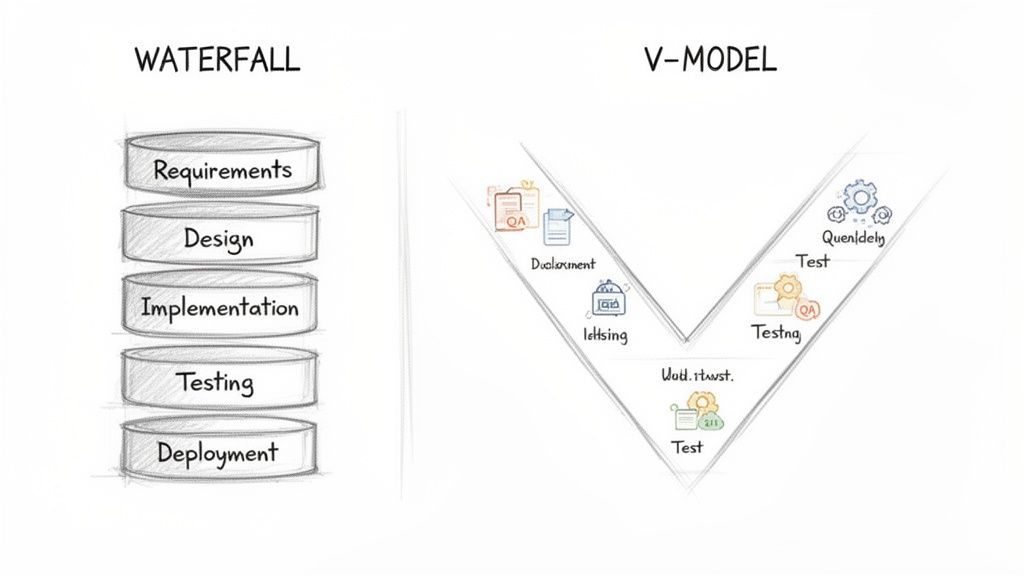
First up is the Waterfall model, the granddaddy of them all. It’s as linear as it sounds. You complete one phase 100% before a single drop of work spills into the next. It’s like building a custom home on a plot in Bargersville: you lay the foundation, frame the house, run the electrical, and then put up the drywall. You absolutely don’t start hanging pictures before the roof is on.
This rigid, step-by-step process is Waterfall’s biggest virtue and its fatal flaw. For a project where the requirements are etched in stone from day one—say, software for a medical device that has to meet strict HIPAA compliance—this predictability is golden. You know your timeline and your budget, period.
The Trade-offs of the Waterfall Model
The main draw of Waterfall is its iron-fisted control and simplicity. Everything gets documented to the nth degree, which is fantastic for regulatory audits or when you need to hand the project off to a new team.
Why Some Still Use Waterfall:
- Rock-Solid Budgets: Costs are locked in early, giving business owners the financial clarity they crave.
- Crystal-Clear Paper Trail: Every decision and detail is recorded, making it easy to trace the project’s lineage.
- No-Nonsense Management: Progress is a straight line, so it's incredibly simple to manage and track.
But here’s the catch. That rigidity can snap under pressure. If a competitor suddenly launches a game-changing feature or market needs shift, you’re stuck. There’s no easy way to turn the ship around. You either scrap the project and start over or push forward with a product that might be obsolete on arrival.
The V-Model: Waterfall's Quality-Obsessed Sibling
Enter the V-Model. Think of it as Waterfall's cousin who double-checks everything. It follows the same sequential flow, but with a clever twist: every development phase is mirrored by a corresponding testing phase. The process moves down one side of the 'V' (development) and back up the other (testing).
This simple change forces quality assurance into the conversation from the get-go. While your developers are busy writing code for a feature, your QA team is already crafting the exact tests needed to validate it.
The big idea behind the V-Model is catching mistakes early. It’s monumentally cheaper and faster to fix a flaw you find in a blueprint than to discover a crack in the foundation after the house is built. This prevents the kind of project-derailing bugs that cause business-stopping downtime.
A Cautionary Tale from a Greenwood Warehouse
This all sounds great, but that intense upfront planning can backfire. In our 17 years of local service, a story from a manufacturing client in a Greenwood business park sticks with us. They chose the Waterfall model to build a new inventory management system because their requirements felt airtight.
Then, disaster struck. A massive supply chain disruption hit halfway through the project, forcing them to completely change how they tracked parts. Their Waterfall plan had zero wiggle room. The project screeched to a halt, costing them money every single day their team was idle. The downtime was killing their bottom line.
They called us in a panic. When we looked at their failing project, we saw how a more flexible model could have saved them. We helped them salvage the work by injecting some much-needed flexibility into their process, saving their initial investment. It was a stark lesson: while classic models promise stability, they can become a massive liability when your business, like most along the I-65 corridor, needs to adapt.
Flexible Models for Modern Business Needs
Let's be honest, the classic, rigid software development models just don't cut it anymore for most businesses. They look great on paper but often fall apart when they meet the real world of a fast-moving market. A startup in Hamilton County can't afford to spend a year building something in a vacuum, only to launch and discover their customers wanted something completely different.
This is exactly why modern, flexible models were born. They're built for speed, welcome feedback, and are designed to adapt on the fly.
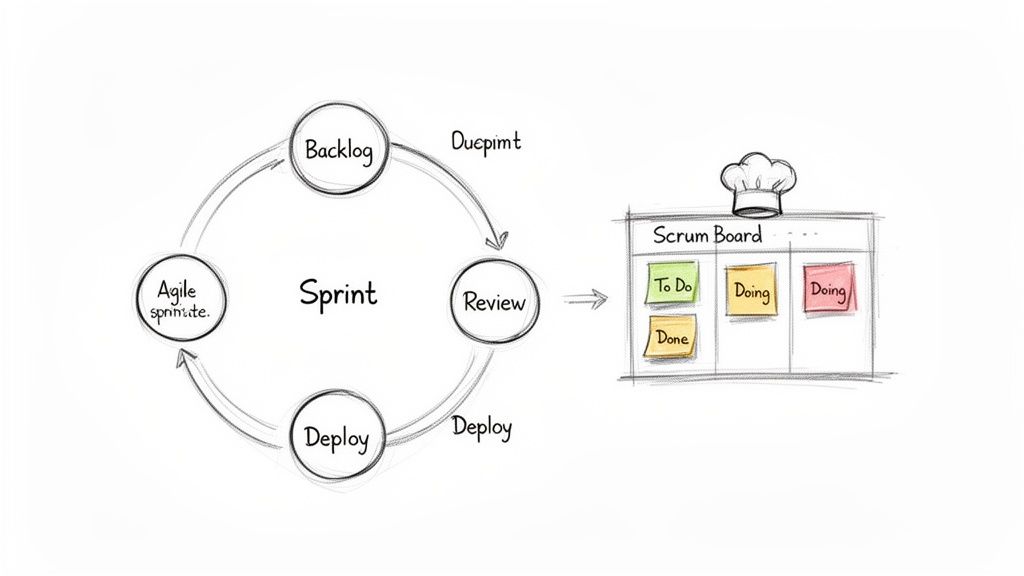
Unlike the strict, step-by-step blueprint of Waterfall, Agile is more of a mindset. It’s all about collaboration, listening to customer feedback, and shipping working software in small, manageable pieces. The core belief? You don't know everything at the start of a project, and that’s perfectly fine.
Breaking Down Agile with Scrum
So how do you actually do Agile? The most popular way is by using a framework called Scrum. Picture running a busy, high-end restaurant kitchen in downtown Indy. You wouldn't try to cook an entire five-course meal all at once, right? Of course not. You work in short, focused bursts—or "sprints"—to get those delicious appetizers out to the tables as quickly as possible.
In the world of Scrum, a sprint is a set timeframe (usually one to four weeks) where the development team focuses on completing a small batch of features. This rapid-fire cycle gets a functional piece of the product into users' hands fast. That early feedback is pure gold. It tells you exactly what to build next, ensuring the team is always working on what people truly want.
Agile and Scrum are about crushing risk and preventing downtime. By building and testing in small chunks, you find and fix bugs and design flaws early on. This helps you avoid the catastrophic failure—and massive expense—of launching a product that’s fundamentally broken from the start. It’s business continuity baked right into your development process.
This approach is a lifesaver for projects where you know things are going to change. A new competitor pops up? User testing uncovers an unexpected need? With Agile, you can pivot without throwing the entire project into chaos.
The Iterative Model: Build, Refine, Repeat
A close cousin to Agile is the Iterative model. The idea here is beautifully simple: start with a basic, stripped-down version of the software, and then improve it through repeated cycles, or iterations. Each new cycle adds more features and polishes what's already there.
Think of it like building a custom app for a logistics company running up and down the I-65 corridor.
- Iteration 1: We build the absolute core function: basic package tracking.
- Iteration 2: Next, we add a feature for scanning barcodes to update the package status.
- Iteration 3: Finally, we integrate a notification system to automatically alert customers.
With every iteration, the product becomes more complete and more valuable to the business. This process allows for constant improvement and gets the most critical functions delivered first, providing an immediate return on your investment. When we work with business owners in Johnson County, this method lets them see real, tangible progress fast, which keeps stakeholders happy and budgets in check.
Want to dive deeper? Check out our guide to adaptive software development in Indiana.
SDLC Model Comparison At a Glance
Feeling a bit lost in the jargon? No worries. This table breaks down the key differences to help Indiana business owners see which framework might be the right fit for their project, budget, and stomach for risk.
| Model | Flexibility | Best For | Risk Level | Example Use Case (Indiana) |
|---|---|---|---|---|
| Waterfall | Very Low | Projects with fixed, unchanging requirements. | High | Building a simple, static website for a Noblesville law firm with all content finalized upfront. |
| Agile/Scrum | Very High | Projects where requirements will evolve; fast-moving markets. | Low | Developing a new mobile app for a Carmel-based tech startup that needs user feedback. |
| Iterative | High | Large, complex systems that can be built and deployed in phases. | Low | Creating an internal inventory management system for a Plainfield warehouse, adding features over time. |
| V-Model | Low | Critical systems where failure is not an option (e.g., medical devices). | Very Low | Software for a medical device manufacturer in Warsaw that requires rigorous testing and validation at each stage. |
| Spiral | Medium | Large, high-risk projects with unclear requirements at the start. | Medium | A multi-year R&D project for an Indianapolis aerospace company exploring new technologies. |
| DevOps/CD | Highest | Web-based applications that need constant updates and high reliability. | Very Low | Managing a high-traffic e-commerce site for a Zionsville retailer that deploys updates daily. |
Choosing the right model is a huge decision. It impacts everything from your budget to your launch date. The key is to match the model to the reality of your project, not the other way around.
Staying Secure in a Fast-Paced World
A common worry with speedy models like Agile is that security gets pushed to the back burner in the race to ship features. It’s a valid concern, and one we’ve learned to tackle head-on over our 17 years of experience. The secret is building security into each sprint, not slapping it on at the end. We use tools like Bitdefender GravityZone to provide endpoint protection from the very start.
We start by implementing a Zero Trust architecture from the very first line of code. This modern security model works on a simple but powerful principle: "never trust, always verify."
- During Sprint Planning: We pinpoint potential security soft spots related to the new features.
- During Development: We use automated tools that scan code for vulnerabilities as it's being written.
- During Sprint Review: We conduct security-focused testing right alongside the standard functional tests.
This makes security a continuous part of the conversation, not a frantic, last-minute checklist. For businesses that have to meet tough compliance standards like the NIST CSF, this integrated approach isn't just a good idea—it's essential. It helps you avoid the crippling downtime and hefty fines that come from a data breach caused by a rushed, insecure launch. Flexible models don't have to mean fragile security.
Advanced Strategies for High-Stakes Projects
Sometimes, a project is just too important to wing it. When you're dealing with massive risks, complex requirements, or ironclad compliance rules, you need a game plan that’s built for battle.
Think about developing a system for a defense contractor in Indiana. They've got to meet strict CMMC compliance standards, and failure is simply not an option. A simple, flexible model just won't cut it. This is where the heavy hitters of software development life cycle models come into play.
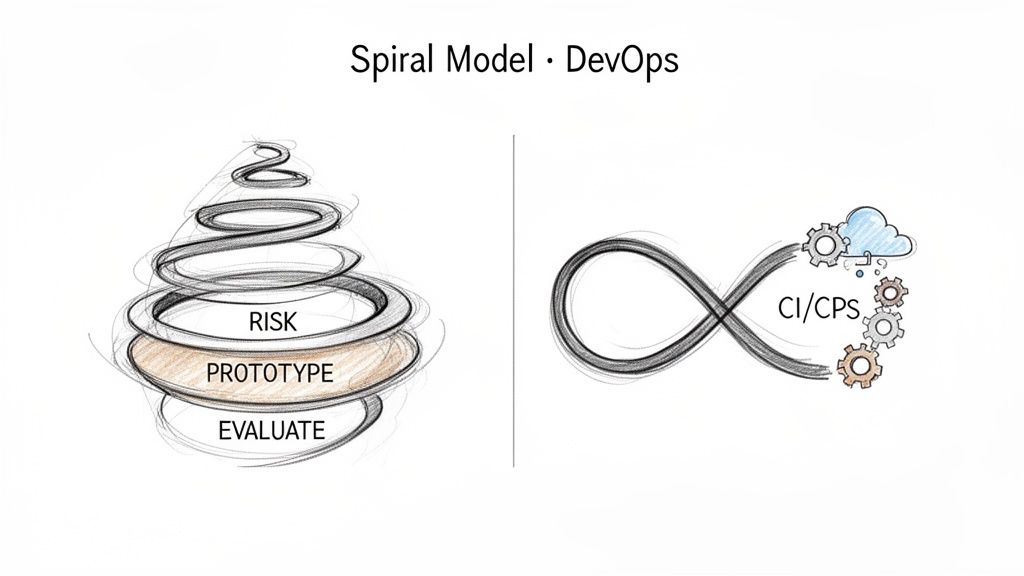
This is where the Spiral model shines. It's a clever hybrid, taking the disciplined, step-by-step march of the Waterfall model and fusing it with the build-and-refine loop of prototyping. The whole process is obsessed with one thing: risk management.
Taming Risk with the Spiral Model
Picture your project as a spiral, growing outward from the center. Each full trip around the spiral represents a complete mini-project with four crucial phases:
- Set Objectives: Nail down exactly what you're trying to achieve in this loop.
- Find and Fix Risks: Hunt down every potential problem—technical glitches, budget overruns, you name it—and figure out how to neutralize it before it happens.
- Develop and Test: Get to building! Create and validate the next piece of the software.
- Plan the Next Loop: Look at what you've accomplished and map out the next turn of the spiral.
This methodical approach forces you to confront the scariest parts of the project head-on. For that defense contractor, we’d spend the first few spirals hammering on security protocols. We would test and re-test them until they were bulletproof, long before we wrote a single line of the main application code. This prevents the absolute nightmare of finding a critical security hole months down the road, saving a fortune in rework and avoiding a compliance disaster. This is where our SOC-as-a-Service monitoring proves its value.
DevOps: Turning a Model into a Mindset
While the Spiral model is your go-to for wrangling risk, DevOps is all about moving fast without breaking things. It's less of a rigid process and more of a cultural philosophy that tears down the wall between the people who build the software (Development) and the people who keep it running (Operations).
In the bad old days, developers would finish their code and just chuck it "over the wall" to the Ops team. When things inevitably broke, the finger-pointing would begin.
DevOps gets everyone on the same team, making them jointly responsible for the software’s success from day one. This partnership gets a serious boost from a Continuous Integration/Continuous Delivery (CI/CD) pipeline.
Think of a CI/CD pipeline as an automated assembly line for your software. It automatically builds, tests, and preps code changes for release. This is the secret sauce for deploying updates quickly and reliably, turning your software into a stable, revenue-generating asset instead of a source of constant headaches. This automation prevents downtime and turns tech management into a predictable, fixed cost.
This steady stream of small, verified updates drastically cuts the risk of a catastrophic failure. Instead of a massive, terrifying release every six months, you can confidently push dozens of tiny, low-risk updates every single day. The market is screaming for this kind of agility; cloud deployment is on track to snag 71.26% of revenue by 2025.
A Real-World DevOps Example
We saw this firsthand with a client running a bustling e-commerce site out of a Greenwood business park. Before we came along, every software update was a white-knuckle ride that frequently crashed their website, costing them sales and torching customer trust.
We helped them build a true DevOps culture, complete with a powerful CI/CD pipeline. By using tools like Docker to package their application into predictable containers, we made deployments a non-event.
Now, their team can push out multiple updates a day with zero downtime. If a bug happens to sneak through, they can roll back the change in seconds. Their software is no longer a ticking time bomb; it’s a dependable, money-making machine. If you're looking at a similar project, it's worth learning how to handle the data migration process properly.
How AI Is Reshaping the Game
Let's be real: "AI" gets thrown around a lot these days, often sounding more like corporate jargon than a useful tool. But in software development, it’s not just talk. We're actually plugging it into the development lifecycle to build better, stronger custom apps for our clients right here in Indiana. It’s how we deliver enterprise-level results without the enterprise-level price tag.
Think of AI as the sharpest, quickest junior developer you've ever seen. Its whole job is to tear through the repetitive, soul-crushing tasks that used to eat up time and bloat project budgets.
AI That Writes Code For You
One of the biggest ways AI is making waves is with AI-powered code generation. These tools can spit out all the boilerplate code, basic functions, and even the initial unit tests. This isn't about replacing our senior developers; it's about unleashing them.
Instead of getting bogged down in mundane setup tasks, they can focus their brainpower on the tricky business logic that actually solves your problems and gives your Hamilton County business a leg up on the competition. No more wasting billable hours on code that’s been written a million times before.
This isn't some niche trend, either. The market for this tech was valued at $265.9 million back in 2022 and is on track to explode to $2.8 billion by 2030. Tools in this space are already giving developers a productivity boost of up to 55% just by handling the grunt work. You can dig into this explosive market growth for yourself.
Finding Bugs Before They Find You
The other game-changer is AI-enhanced testing. In the old days, testing meant a human developer had to dream up every single weird thing a user might do to break the software. It’s a decent method, but it’s also slow and, well, human. We miss things.
AI, on the other hand, can scan an entire application and predict where the weak spots and likely bugs are hiding. It’s like having a crystal ball for code.
AI doesn't just find bugs; it anticipates them. This predictive power means we can squash potential issues before they ever impact your customers, preventing costly downtime and protecting your good name. It transforms "wasted" testing time into an ROI-generating activity that directly boosts business continuity.
This proactive approach is a lifesaver for any Johnson County business where service interruptions are simply not an option. It also allows us to weave stronger security into the fabric of your application from day one, helping you stay aligned with frameworks like the NIST CSF.
What This Means for Your Bottom Line
So, what does all this AI wizardry actually mean for your business? It boils down to a few key benefits:
- Get to Market Faster: When code and testing are automated, development cycles shrink. That means your brilliant idea gets into your customers' hands sooner.
- Keep Costs Down: More efficiency means fewer developer hours are billed to your project, dramatically lowering the total cost of your custom software.
- Launch with Confidence: AI-driven testing catches more potential problems, leading to a rock-solid, reliable product from day one.
This is about building smarter, not just faster. It’s what allows a small business in Greenwood to punch above its weight and compete with the big guys. Even specialized tasks like training AI chatbots bring their own data and strategic challenges that are changing how we think about development. By weaving AI into the different software development life cycle models, we speed things up, cut down on human error, and deliver a much better return on your investment.
Making the Right Choice for Your Indiana Business
Let’s be honest, picking a software development life cycle model isn't just a technical decision—it's a critical business move with real money on the line. Get it wrong, and you're not just looking at a bit of a delay. You're facing blown budgets, trashed timelines, and a final product that your team can't even use. We're talking thousands of dollars down the drain in wasted time and lost productivity. A common mistake we see is a business in an old brick building trying to deploy software designed for a modern office, leading to constant crashes because the underlying network can't handle the load.
This isn't about plucking a fancy-sounding model from a textbook. It’s about matching a development strategy to the very real pressures facing your business, whether you're in Johnson County or Hamilton County. The right choice can be the difference between a project that sinks your budget—remember, downtime can cost up to $9,000 per minute—and one that gives you a serious leg up on the competition.
Key Questions to Guide Your Decision
Before my team even thinks about writing a single line of code, we sit down with our clients and walk through a few simple but incredibly important questions. There are no wrong answers here, only what’s right for your project.
Here's what we need to figure out together:
- Are your requirements locked in, or are they going to shift? If you're building software for a medical practice that absolutely must meet HIPAA compliance, you need a very structured approach. But if you're creating a new customer portal and need to adapt based on early user feedback, you need something far more flexible.
- How fast do you need this thing out the door? When speed to market is everything and you need to beat a competitor to the punch, an Agile approach is almost always the way to go.
- What's your budget and appetite for risk? Some models, like Spiral, are tailor-made for high-risk, big-budget projects where you need to test concepts early and often. A simple internal tool for your team? That just doesn't need all the overhead.
- What compliance rules are you playing by? Whether it’s CMMC for a defense contractor or the NIST CSF for general security, your development model has to have compliance baked in from the start, not slapped on as an afterthought.
This simple decision tree shows how you might think about applying AI based on how stable your project's needs are.
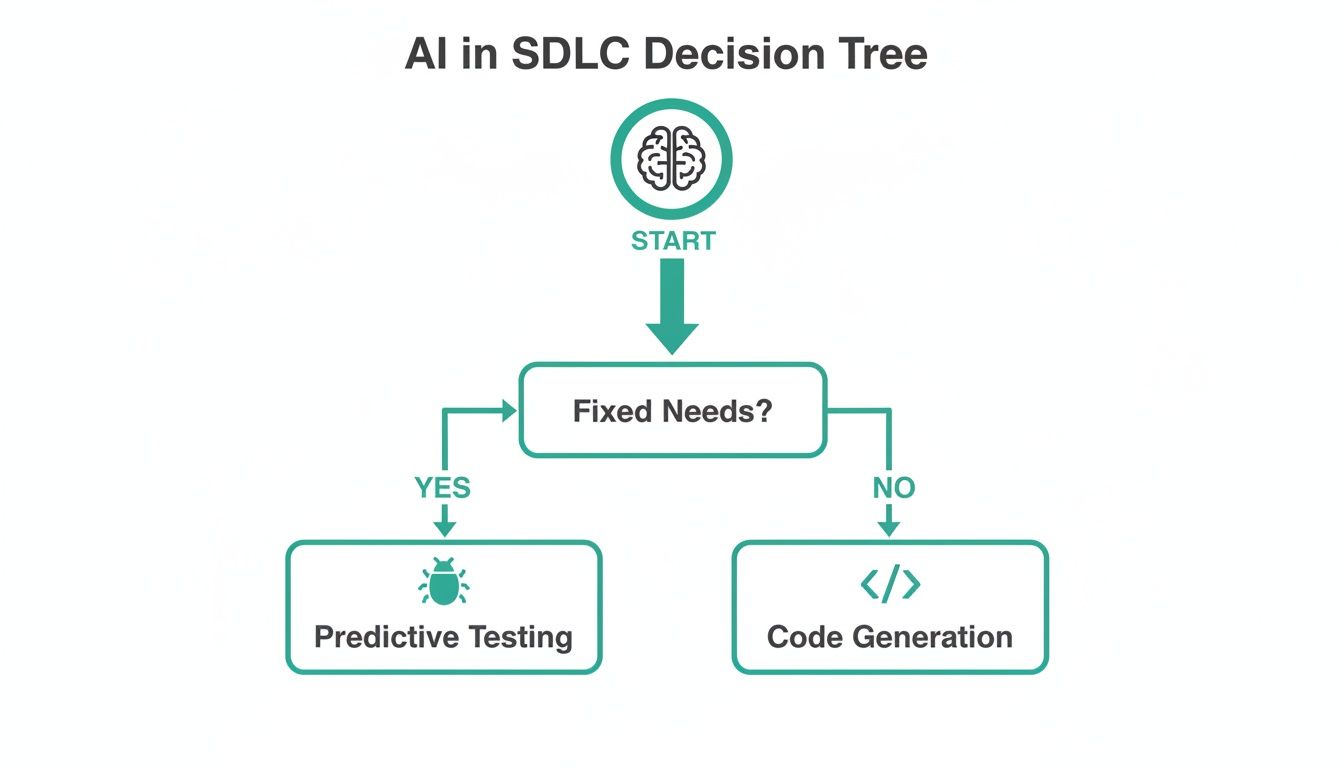
As you can see, projects with rock-solid requirements can really benefit from AI doing predictive testing, while projects that are constantly evolving can get a huge speed boost from automated code generation.
Your Local Partner in Building Smart Software
With 17 years serving businesses right here in the community, we've seen it all. We’ve untangled projects stalled by ancient server hardware in a Greenwood business park and fixed spotty Wi-Fi in old brick buildings that was crippling new cloud software. We don't just sling code; we dig into your business goals to pick and run the SDLC model that’s going to give you the best return on your investment.
Choosing an SDLC model is really all about managing risk. A smart framework gives you a clear roadmap, predictable costs, and makes sure the final product actually lines up with your business goals, saving you from expensive and frustrating rework down the line.
The goal is to build something that makes your business more efficient and profitable. That means building the software right, but it also means protecting the network it lives on with things like UniFi networking and immutable off-site backups. For a deeper dive on that topic, check out our guide to security threats for Indiana businesses.
As your technology partner here in the Indianapolis area, we help turn software from a line-item expense into a powerful asset. Let us help you make the right call from day one.
Got Questions? We've Got Answers.
Wondering about these software development life cycle models? You're definitely not the only one. We get a lot of questions from Indiana business owners who find the lingo a bit overwhelming. Let's clear up some of the most common ones.
What's the Most Popular Software Development Model These Days?
Hands down, it’s Agile and its various flavors, like Scrum. The reason is simple: flexibility. For any business trying to keep up in a fast-paced market—like so many in the Hamilton County growth corridor—Agile's knack for rolling with the punches is a game-changer.
Instead of getting bogged down in a massive, rigid plan, Agile works in quick sprints. The goal is to get a functional piece of the product in front of actual users as soon as possible, see what they think, and adjust. This feedback loop dramatically cuts the risk of spending a fortune building something nobody wants, saving you from the costly downtime and rework that comes with a botched launch.
How Do I Pick the Right SDLC Model for My Business?
There's no magic bullet here; the "best" model is always the one that actually fits your project. It’s all about context.
To figure out what’s right for you, you’ll need to weigh a few key factors:
- Project Complexity: Are we talking about a huge, multi-year undertaking or a simple internal tool?
- Requirement Clarity: Are the project goals carved in stone, or do you expect them to change as you go?
- Compliance Needs: Do you operate in a regulated industry that demands strict adherence to standards like HIPAA for healthcare or CMMC for government contracts?
- Budget and Timeline: What's your tolerance for risk, and how quickly do you need to hit the market?
For a project where the requirements are crystal clear and won't change, an old-school model like Waterfall can provide a predictable path. But if you need to innovate, adapt, and respond to customer feedback, Agile is almost always the smarter play. You can dig into more common questions on our FAQ page.
Can We Switch SDLC Models Halfway Through a Project?
You can, but you probably shouldn't. Trying to swap methodologies mid-project is a masterclass in chaos. Think of it like deciding to change the blueprints for a new building in a Greenwood business park after the foundation has already been poured. It’s a messy, expensive nightmare that guarantees huge delays.
Making a switch like that will confuse your team, shred your budget, and set your timeline back by months, if not more.
The smart money is on partnering with an experienced team from the very beginning. A thorough initial analysis makes sure the model you choose actually lines up with your business goals, preventing the kind of project meltdowns that kill productivity and burn through cash. In our 17 years of serving local businesses, we've learned that a solid plan is the best insurance against wasted time and money.
At Finchum Fixes IT, we guide Indiana businesses down the right development path to make sure their tech investment pays off. If you're scratching your head about which model fits your next software project, let's figure it out together. Schedule your Security Risk Audit specifically for businesses in the Greenwood/Indianapolis area today.