Your Guide to Adaptive Software Development in Indiana
TL;DR
Traditional software projects often fail, costing Indiana businesses a fortune in wasted time and money. Adaptive Software Development (ASD) fixes this by building software in small, fast cycles (Speculate, Collaborate, Learn) instead of one giant, risky project. This flexible approach means your software adapts to your actual business needs, preventing costly downtime that can drain up to $9,000 per minute. For a Greenwood manufacturing firm, this meant ditching a six-month upgrade nightmare for a working solution in just six weeks, converting wasted tech time into billable hours. We use this method to build secure, compliant (HIPAA, CMMC) software on a predictable budget, ensuring your tech investment delivers a real ROI for your Johnson County or Hamilton County business.
Let's be honest, "adaptive software development" sounds like another piece of tech jargon cooked up in a Silicon Valley boardroom. But for businesses here in Indiana, it's something far more practical: it’s a way to stop throwing good money after bad at software that just doesn't fit.
Think of it as the difference between a custom-tailored suit and one you grab off the rack. Instead of trying to cram your unique business processes into a rigid, pre-packaged piece of tech, you build software that grows and changes right alongside your real-world needs.
Stop Wasting Money on Inflexible Tech
This is all about being nimble. When the market zigs, your technology can zag with it. It means you can solve problems as they pop up, not six months down the line. We’re talking about turning those dreaded, budget-breaking IT projects into tools that actually make you money.
For a manufacturing firm right here in Greenwood, this approach could mean the difference between waiting half a year for a new inventory system and getting a working version up and running in a matter of weeks. All that time your team spends wrestling with clunky, frustrating software? That gets converted back into productive, billable hours and a predictable monthly budget.
Ultimately, this method ensures the software you end up with actually solves the problem you hired it to fix. This is critical when you consider that project failures and the resulting downtime can cost a staggering $9,000 per minute. A smart first move is to get a clear picture of your current setup, and our IT infrastructure audit checklist is the perfect place to start building a more resilient operation.
So, What Is Adaptive Software Development, Really?
Let’s cut through the tech-speak. Adaptive Software Development (ASD) is all about building custom software for businesses that live in the real world—a world where things change, needs shift, and great new ideas pop up when you least expect them.
Think of it like this: You're building a custom race car for the Indy 500. The old-school 'waterfall' method is like spending a year designing the entire car on a blueprint, building it precisely to spec, and only firing it up for the first time on race day. What happens if the weather changes or a rival team shows up with a radical new engine? You're stuck. You lose.
ASD, on the other hand, is like having an expert pit crew that tweaks, adjusts, and rebuilds parts of the car after every single practice lap. It's a hands-on approach that shines when you need a Bespoke Software Development Service, because it’s built to handle evolving requirements from day one.
The "Speculate, Collaborate, Learn" Rhythm
The whole process runs on a simple but incredibly powerful cycle. This isn't about getting it perfect the first time; it's about getting it better every single time.
- Speculate: This is the starting line, but we're not carving a 1,000-page plan into stone. Instead, we map out the core mission. For a Johnson County logistics client, this might mean sketching out the key features for a new driver routing app. We’re creating a starting point, not a finish line.
- Collaborate: Now, we get the car on the track. Our developers don't just build in a dark room; they work shoulder-to-shoulder with your team—the actual "drivers"—to get instant, real-world feedback on what's working and what's clunky.
- Learn: After each "lap," we pop the hood and analyze the data. We review what went right, what went wrong, and what we can do better. Then, we make immediate adjustments to supercharge the next version.
This Speculate-Collaborate-Learn cycle repeats over and over, fine-tuning the software until it’s a high-performance machine perfectly suited to your business. The result? You get a working app in a month that keeps getting better every week, not a piece of year-old tech that was outdated before it even launched.
This approach is designed to prevent the costly project stalls and outright failures that happen with rigid, inflexible development. This chart shows exactly how that old-school thinking burns through time and money, while an adaptive approach turns your investment into a powerful, working solution.
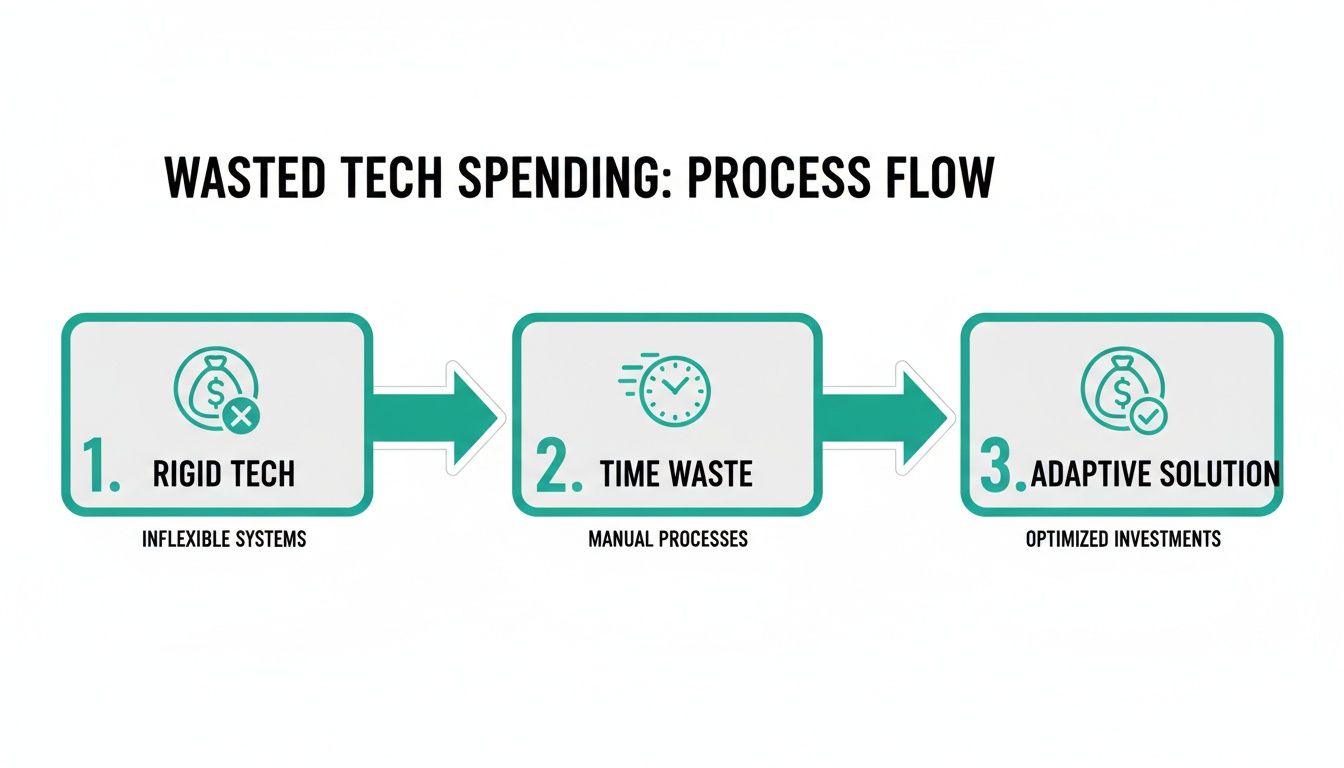
The big idea here is that adaptive methods stop the financial bleeding before it can even start. It’s all about delivering value in small, consistent bursts instead of betting the farm on one big, high-risk launch.
And this isn't just a trend; it's the future. The global market for custom software is set to explode to $109.5 billion by 2034. Here in Indiana, we've seen adaptive methods slash project failure rates for small and mid-sized businesses from a shocking 70% (common with waterfall) down to under 30%. That translates to faster delivery, more reliable software, and a much better return on your investment.
In our 17 years of local service, we’ve seen this firsthand. ASD is the antidote to the budget-draining nightmares that plague old-school projects. It turns wasted time into real progress, keeping your project locked onto your actual business goals.
By constantly gathering feedback and improving, you get technology that doesn't just "work"—it works for you. This kind of alignment is critical for avoiding the productivity black holes that bad tech creates. It's a principle that applies across IT, just like the continuous feedback loops we advocate in our guide on the best practices for network monitoring.
The Three Phases That Drive Business Results
Adaptive software development might sound a bit like controlled chaos, but it's actually a highly disciplined cycle built to get real results for your business. It all runs on a simple, powerful engine of three repeating phases: Speculate, Collaborate, and Learn. This rhythm is what turns the messy reality of a project into your biggest competitive advantage.
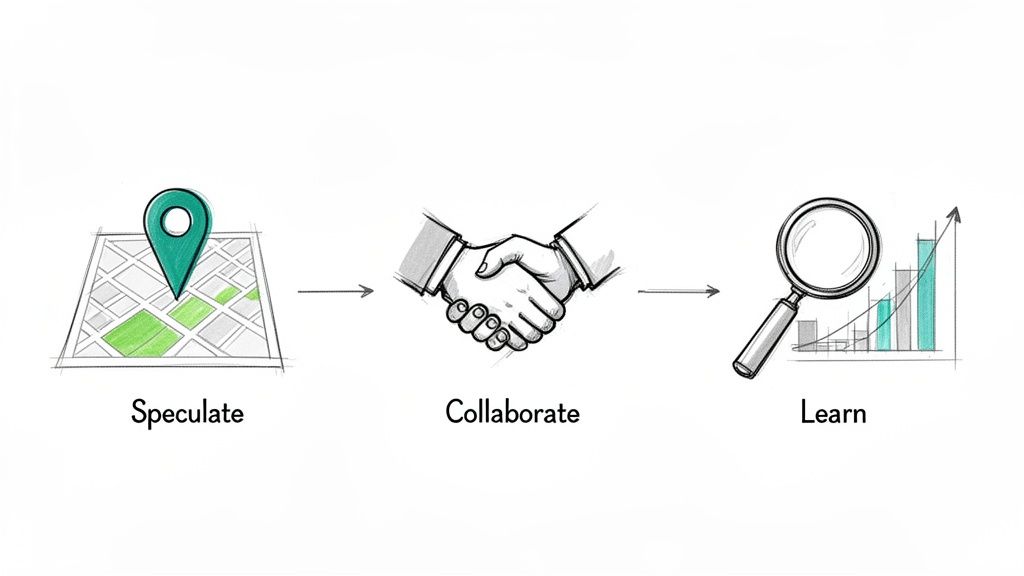
This loop is your best defense against project bloat and endless delays. It keeps everyone laser-focused on solving your business problems, one smart step at a time, delivering value you can see and use right away.
Phase 1: Speculate
First up is Speculate. Think of this as the mission briefing. We’re not trying to write a 100-page novel that’s outdated the second it’s finished. Instead, we’re getting the team together to define the big-picture goals and figure out what we’re working with.
For a healthcare client in Hamilton County, for instance, the mission isn't just "build a new patient portal." It's "build a portal that also meets strict HIPAA compliance standards." For a defense contractor along the I-65 corridor, it means ensuring the final product aligns with CMMC requirements from day one. This is where we identify those non-negotiables and sketch out the first set of essential features. It gives us a starting line, not a finish line.
Phase 2: Collaborate
Next, we Collaborate. This is where the magic happens, and frankly, it’s where the real work gets done. This isn't about lobbing a list of requirements over the fence to a developer chained to a desk. It’s an active, hands-on jam session with your team, our team, and even your customers working side-by-side.
This constant back-and-forth is the secret sauce that prevents the misunderstandings and crossed wires that lead to budget-busting rework. We’ve seen it time and time again with our clients here in Central Indiana.
We once worked with a business in a historic downtown Indy building where the ancient wiring caused constant network drops. By collaborating on-site, our team saw the problem firsthand and adapted the software's network code on the fly to be more forgiving. We solved it with latency-optimized mesh nodes from UniFi networking. That's a fix we never would have figured out from an office hundreds of miles away.
This phase is all about shared ownership. We build something, test it, get feedback, and tweak it in a super-tight loop, making sure everyone is moving in the same direction.
Phase 3: Learn
Finally, we hit the Learn phase. This is arguably the most important part of the whole cycle because it’s where we turn action into insight. After each round of development, we take a step back and give the results an honest look.
We ask the tough questions:
- Did that new feature actually work like we thought it would?
- Did it make life easier for the user?
- What snags did we hit along the way?
- What did we learn that completely blows up our original assumptions?
The answers give us crystal-clear, actionable feedback that we feed directly into planning the next cycle. This process of continuous improvement ensures the final product isn’t just what was on the initial wish list, but what your business actually needs to thrive. It’s a crucial part of any good risk management strategy aligned with standards like the NIST CSF. If you're looking to get a better handle on your current risks, check out our guide on creating a cyber security risk assessment template. By learning and adapting, we make sure the software is a perfect fit that drives real efficiency and a great return on your investment.
Choosing the Right Development Method
Picking a software development method can sound about as exciting as reading a tax code. But for a business owner here in Indiana, the difference between them can mean real dollars, painful delays, and projects that either take off or crash and burn. This isn't just an IT-nerd decision; it's about keeping your business running smoothly.
Think of the old-school Waterfall method like building a house. You draw up a massive blueprint, plan every single nail and wire, build the whole thing, and only then do you get to walk inside. It's painstakingly slow, rigid, and incredibly risky. What happens if you realize six months in that you wanted the kitchen on the other side of the house? Too late. You just wasted a ton of money.
Agile and the Adaptive Edge
That’s why Agile came along. It’s less of a rigid set of rules and more of a philosophy that prizes flexibility and actually listening to the customer. Frameworks like Scrum are part of this family. It was a huge leap forward, letting teams make progress in small bursts and change direction without derailing the entire project.
So where does Adaptive Software Development (ASD) fit in? Think of it as a specialized, high-performance version of Agile. Its secret sauce is a relentless focus on the Speculate-Collaborate-Learn cycle. While regular Agile is good at handling change, ASD is built for situations where you don't even know what the final destination looks like when you start. It thrives in uncertainty.
Imagine a logistics company in Plainfield trying to build a new routing system to account for unpredictable I-69 construction. A Waterfall plan would be useless by week two. Agile would be better, but ASD is perfect because it’s designed to navigate that kind of chaos and learn from new traffic data in every single cycle.
This is a key difference. It’s not just about being flexible. It’s about having a disciplined process for discovery baked right into the project’s DNA. To get a better handle on how these teams work, it's helpful to understand the various roles in agile software development that make this dynamic possible.
A Head-to-Head Comparison
Let's cut through the jargon and put these methods side-by-side to see how they stack up on the things that actually matter to your bottom line.
Software Development Methods Compared for Indiana Businesses
Here’s a practical look at how Waterfall, Agile, and Adaptive Software Development (ASD) compare when it comes to the real-world pressures Indiana businesses face every day.
| Attribute | Waterfall | Agile (General) | Adaptive Software Development (ASD) |
|---|---|---|---|
| Flexibility | Extremely low. The plan is rigid and changes are costly and disruptive. | High. Built to accommodate changes between development cycles (sprints). | Very High. Designed for high uncertainty and continuous adaptation within cycles. |
| Project Risk | High. All testing and validation happen at the end, hiding major flaws. | Moderate. Risks are identified and addressed in short cycles, reducing failure. | Low. The 'Learn' phase actively seeks out and mitigates risk constantly. |
| Client Involvement | Minimal. Clients approve the initial plan and see the final product. | High. Regular feedback is required at the end of each sprint. | Constant. Collaboration is a core, daily part of the process, not just a meeting. |
| Speed to Value | Very Slow. No usable software is delivered until the very end of the project. | Fast. Delivers working software in small, usable increments every few weeks. | Fastest. Focuses on delivering the most critical business value immediately. |
As you can see, this isn't just about how the sausage gets made. For a growing business, the ability to get a working tool into your team’s hands quickly—and then make it better based on how they actually use it—is a massive competitive edge. You're no longer waiting a year for a "perfect" solution; you're getting immediate boosts in productivity, week after week.
This constant feedback loop is also your best insurance policy. By building and testing in small, manageable chunks, you avoid the nightmare of spending a year and a six-figure budget on a piece of software that nobody on your team wants to touch. Protecting your investment goes beyond just good code; our guide on cybersecurity tips for small businesses offers more ways to secure your assets. ASD is about taking the risk out of your technology projects and making sure every dollar you spend is tied directly to a real business result.
Measuring Real-World ROI in Indiana
Theory is nice, but for business owners in Johnson County, results are what keep the lights on. Let's get real about how adaptive software development affects your bottom line and keeps your doors open, moving past buzzwords and into dollars and cents.
When your business grinds to a halt, the numbers get scary fast. Downtime can bleed your company of up to $9,000 per minute. A botched software project is the worst kind of downtime—a black hole that can swallow months of productivity.
From Six Months to Six Weeks in Greenwood
We've seen this happen right in our own backyard. Over our 17 years of local service, one story from a client in a Greenwood business park really stands out. Their entire operation was being choked by old, sluggish server hardware. The software they depended on was so ancient that a traditional, all-at-once upgrade came with a six-month price tag. That’s half a year of chaos, risk, and massive expense.
They couldn’t afford to be down for that long. So, we tossed out the old playbook and took an adaptive approach. Instead of shooting for one big, dramatic launch, we zeroed in on the single most important function they needed.
In just six weeks, we delivered a core, working replacement for their system. This wasn't some flashy demo; it was a real tool their team could start using that same day. After that, we worked with them every week, adding new features and tweaking workflows without ever taking them offline.
This strategy completely flipped the script on the project's finances. It took months of "wasted tech time"—where employees were just fighting with the old system—and turned it back into productive, billable hours. Their IT budget went from being a constant headache to a predictable, stable expense.
The Tech That Makes It Possible
This kind of quick, reliable delivery isn't some kind of wizardry. It's built on a bedrock of modern, tough-as-nails technology. The adaptive model let us bake in crucial security and data protection from the very start, instead of treating it like an afterthought.
- Zero Trust Architecture: Rather than waiting for one big security review at the end, we built security into every single development cycle. Each new feature was designed with Zero Trust in mind, which means it never automatically trusted any user or device. Building it this way, piece by piece, made the final product infinitely more secure than a system where security is just bolted on at the last minute. For a closer look at protecting your digital front door, check out our guide on how to protect against phishing attacks.
- Immutable Off-Site Backups: We protected their data from the moment we wrote the first line of code. By setting up immutable off-site backups, we created unchangeable copies of their information. It was their ultimate safety net—no matter what went wrong during the project, from hardware meltdowns to human error, their data was always safe and recoverable. When we disassembled a similar client’s failing RAID array, this exact process allowed for a bit-level data recovery that saved their business.
This isn't just about shipping an app faster. It's about building a resilient business tool that pays for itself by preventing the kind of disaster that can shut a company down.
The stats tell the same story. Adaptive software development was born to combat the staggering 70% failure rate of old-school, rigid projects. Today, its value is clear: companies using agile-adaptive methods see 68% faster delivery and way happier teams. For businesses right here in Greenwood, that means getting critical projects across the finish line without the runaway costs and endless delays that kill profitability. If you want to dig deeper into these numbers, you can discover the latest software development statistics.
How We Make Adaptive Software Development Work for Your Business
Jumping into adaptive software development isn't like flipping a switch. It’s a genuine partnership. We’re here to guide you away from those rigid, frustrating tech projects and into a flexible process that actually delivers what you need. Let’s pull back the curtain on how Finchum Fixes IT puts this powerful method to work for businesses right here in Indiana.
It all starts with a deep-dive assessment. We don't just ask what you want the software to do; we want to know the real business problem you're trying to crack. Are you dealing with a logistics nightmare for your warehouse along the I-65 corridor? Or is it a compliance migraine for your healthcare practice in Hamilton County?
In our 17 years of local service, we've learned one thing for sure: the best tech solutions come from understanding your business goals first, not the other way around.
From a Good Guess to a Real Plan
Once we’re clear on the mission, we jump into the Speculate phase. Forget about creating a massive, dusty binder of requirements that no one ever reads. This is all about working together to map out an initial plan with clear, achievable milestones.
We’ll pinpoint the core features that will give you the biggest bang for your buck right out of the gate. This gives us a solid launchpad but leaves us plenty of wiggle room to adjust as we learn more. It's a focused, common-sense way to get started without locking ourselves into a plan that could be outdated in a month.
Putting Collaborate-Learn Cycles into Action
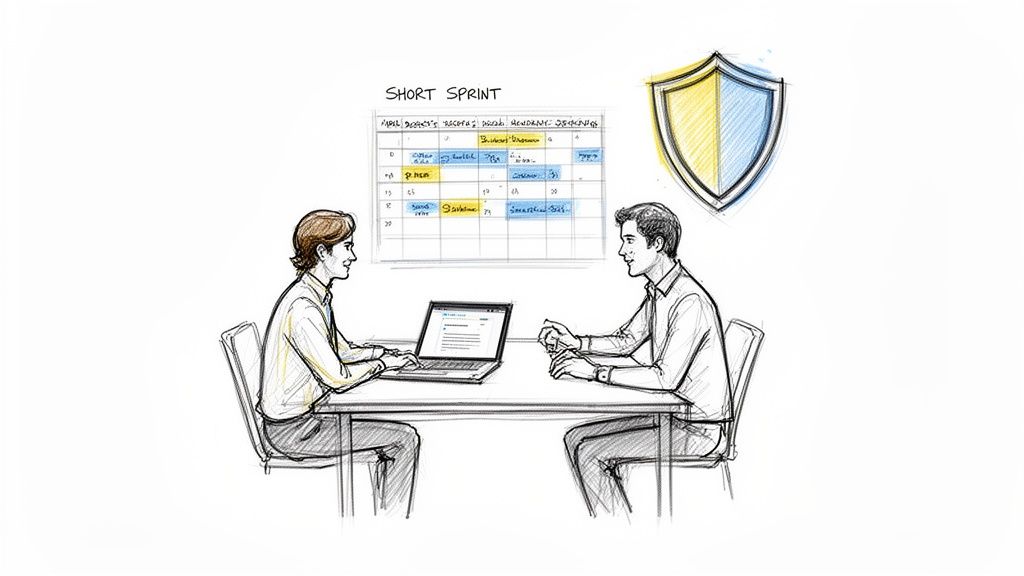
With a starting plan in hand, the real fun begins: the Collaborate-Learn cycles. Think of these as short, focused sprints where our certified Microsoft and Cisco pros work side-by-side with your team. We don't vanish into a dark room for weeks at a time; we’re talking and sharing progress constantly.
This is where the magic happens. We roll up our sleeves and bring the software to life, ironing out the kinks as we go. For instance:
- We might set up powerful UniFi networking gear to make sure your new app runs smoothly, even inside that old brick building downtown with sketchy Wi-Fi.
- Security is never an afterthought. We'll protect every piece of the puzzle from day one with tools like Bitdefender GravityZone, building a fortress around your data.
- Our SOC-as-a-Service monitoring acts as a silent guardian, keeping a close eye on everything to ensure every new feature is safe, secure, and compliant.
After each sprint—usually just a couple of weeks—we hand you something real. A working piece of the software. You and your team get to kick the tires, play with it, and give us instant, gut-level feedback.
This constant feedback loop is the secret sauce of adaptive software development. It eliminates nasty surprises. You see progress every single step of the way, which means the project stays perfectly synched with your goals, your budget, and your timeline. No more six-month-long "black box" projects where all you can do is cross your fingers and hope it works out.
This whole process guarantees the final product isn't just what we thought you needed in our first meeting. It's a tool that's been battle-tested and fine-tuned by your own people, built specifically to solve your unique challenges. It’s how we turn software development from a high-stakes gamble into a predictable, value-adding engine for Johnson County business owners like you.
Isn't It Time Your Tech Worked for You?
Let's be honest: betting your business on a rigid, all-or-nothing tech project feels like a gamble. And it usually is. But what if there was a way to get the flexibility and predictability you need to grow your business without crossing your fingers and hoping for the best? That’s what an adaptive approach is all about—building technology that fits your business, not the other way around.
For businesses here in Greenwood and across the Indianapolis area, the journey starts with a simple reality check. You can have the best software idea in the world, but a small network glitch or a hidden security gap can stop the whole project dead in its tracks.
We've been doing this for 17 years right here in Central Indiana, and if there's one thing we've learned, it's that a solid foundation isn't just important—it's everything. We’ve seen great software ideas completely tanked by shaky IT infrastructure more times than we can count.
That's why Finchum Fixes IT offers a Free Network Assessment and Security Risk Audit specifically for businesses in the Greenwood/Indianapolis area. We'll come in, take a look under the hood, and identify those hidden problems before they can cause chaos. You'll get a clear, plain-English report on the health of your IT setup and a roadmap for how an adaptive approach can protect your operations and actually make you more money.
This is bigger than just building an app. It's about building a stronger, more profitable business. Give us a call today to schedule your complimentary audit and let's get your next project started on solid ground.
Your Questions, Answered
Got questions about Adaptive Software Development? You're not alone. Here are some of the most common things we hear from Indiana business owners who are curious about this approach.
"Isn't This Just for Big Tech Companies?"
Not at all. In fact, you could argue this way of working is even better for small and medium-sized businesses. Why? Because SMBs can't afford to sink a ton of cash into a massive, multi-year software project that ends up failing.
Adaptive Software Development (ASD) works in smaller, predictable cycles. This means you get real, usable results quickly without betting the farm. It lets your business tackle its biggest problem first and then build on that success as your budget allows.
"How Do You Handle Things Like Cybersecurity and HIPAA?"
Great question. We bake security and compliance right into the process from day one. Old-school methods often treat security like a final checkbox to tick before launch, which is a recipe for disaster.
With ASD, every single "Learn" cycle includes dedicated security reviews and compliance checks. For a healthcare client we worked with in Hamilton County, this meant we were building and testing security features with every iteration. This "secure by design" mindset is way more effective and ends up costing less than trying to bolt on security at the end. It's a perfect fit for modern security ideas like Zero Trust.
"What if We Don't Know Exactly What We Need?"
That’s actually the ideal time to use adaptive development. This whole method was designed for projects where you don't have all the answers upfront. The initial "Speculate" phase isn't about mapping out every feature for the next two years; it's about agreeing on the mission.
The real magic happens during the "Collaborate" and "Learn" cycles. That's where we work together to figure out what you really need. The proof is in the numbers: since 2020, adaptive methods have slashed project failure rates by 40%, a huge leap from the dismal 31% success rate of older waterfall projects. You can read more about the growth of adaptive software and see the financial impact for yourself.
Ready to stop gambling on rigid, high-risk tech projects? Finchum Fixes IT offers a Free Network Assessment and Security Risk Audit for businesses in the Greenwood/Indianapolis area. We'll help you spot hidden risks and show you how a modern, adaptive approach can lock down your operations and grow your bottom line. Schedule your complimentary audit today.