Compliance and Security for Indiana SMBs
In 2024, the average breach cost hit $4.88 million and climbed 10% from 2023, which is why compliance and security can't be treated like separate chores anymore, especially for Indiana businesses that also need to keep the doors open and the invoices moving. If your controls don't reduce downtime, they're just expensive paperwork.
A Greenwood shop with a ten-year-old server that crashes twice a month doesn't need another policy binder. It needs fewer interruptions, cleaner evidence, and controls that hold up when a regulator, an auditor, or an attacker shows up. That's the core job for Johnson County business owners, and it matters even more when a slow outage can turn into missed revenue, frustrated staff, and a budget surprise nobody wanted.
What Compliance and Security Actually Mean for Your Business
Compliance is proving you met the rules. Security is making sure the rules still hold when somebody tries to break in, steal data, or knock your systems offline. One is the receipt, the other is the building.
That's the difference a lot of owners miss. A law office on Meridian Street might have a polished policy packet and still be one phishing email away from a mess if MFA isn't enforced, logs aren't reviewed, and backups aren't immutable. A manufacturer in Greenwood can pass an audit and still eat a painful outage if the server under the desk is doing all the work and nobody has a tested recovery plan.

What Indiana owners should care about first
The frameworks you're most likely to run into are HIPAA, CMMC, NIST CSF, PCI DSS, and the FTC Safeguards Rule. If you're in healthcare, defense work, payments, or financial services, the overlap between cyber hygiene and legal obligation gets real fast. If you want a plain-English overview of how a hardened network fits into that picture, this network security guide for businesses is a useful reference.
For local shops, the first question isn't “Which acronym is newest?” It's “Which controls reduce downtime, shrink exposure, and give us proof when somebody asks?” That's where the ROI shows up. A stable network, clean logs, and reliable backups turn wasted tech time into billable hours, and they keep the staff from losing half a day to preventable nonsense.
Practical rule: If a control doesn't help you survive an outage, an audit, or both, it's not a priority.
A decent starting point is the 90-day cadence Finchum Fixes IT uses for Johnson County and Hamilton County clients. First, figure out what applies. Then fix the gaps that stop incidents from becoming breaches. Then keep the evidence flowing so the next review isn't a panic session.
Compliance Is the Inspection, Security Is the Building
A business can pass an audit and still be easy to break into. That is why data minimization and Zero Trust architecture belong at the center of the conversation, not as side notes.

Collecting less data lowers what you have to protect, narrows the scope of what an attacker can reach, and trims the mess you have to explain later. That is the practical value of role-based access and targeted retention. If a clinic, contractor, or retailer keeps only the records it needs, it has fewer systems to defend, fewer logs to maintain, and fewer places for sensitive information to drift into the wrong hands.
The same logic applies to trust inside the network. Zero Trust assumes access should be limited, verified, and reviewed every time, not granted because a device or user was inside the perimeter yesterday. A business that ties access to role, device health, and need-to-know reduces the odds that one stolen password turns into a full network problem. For owners who want a plain way to align policy, access, and evidence, this guide to secure Indiana SMBs with an IT governance framework lays out the structure without jargon.
The other win is audit scope. Fewer systems hold sensitive data, so fewer systems need to be documented, monitored, and tested. That cuts the amount of paperwork and the amount of tech you have to babysit. It also makes the controls you keep more defensible, because each one has a clear purpose instead of existing because nobody cleaned up the default settings.
Compliance should never push you to store more than you need. If a retention policy exists only because it was never challenged, that is exposure, not discipline. Sensitive records should stay only where they are needed, for as long as they are needed, and no longer. That is how you reduce risk without weakening the controls auditors expect.
A tighter environment also makes the important evidence easier to collect. When access is limited and logging is focused, security teams can see who touched what, when they touched it, and whether anything looked off. That matters for incident response, and it matters when you need to show a regulator or customer that the controls were real, not just written down.
Bottom line: Keep less data, restrict access harder, and review the evidence on a schedule. That gives you a smaller attack surface and cleaner proof when someone asks questions.
The Frameworks Indiana SMBs Actually Touch
The frameworks most Indiana SMBs run into aren't abstract. They're tied to the kind of data you hold, the customers you serve, and the contracts you want to keep. A clinic around the I-65 corridor, a defense supplier in Indianapolis, a retailer running cards, and a credit union vendor all have different obligations, but the technical backbone looks similar.
| Framework | Who It Applies To | Key Controls Required | Evidence Finchum Fixes IT Delivers |
|---|---|---|---|
| HIPAA | Healthcare practices and vendors handling protected health information | MFA on PHI access, audit logging, business associate agreements, breach notification within the required window | Access logs, MFA enforcement records, backup reports, incident timelines |
| CMMC Level 1-2 | Defense contractors and suppliers in the Indianapolis area | Basic to more advanced protection of controlled information, access restriction, monitoring, and documented processes | Segmented network design, endpoint protection, monitoring logs, remediation records |
| NIST CSF 2.0 | General baseline for most SMBs | Identify, protect, detect, respond, recover | Risk register, asset inventory, logging, recovery tests, control mapping |
| PCI DSS 4.0 | Any business handling card data | Strong access control, segmentation, logging, patching, and testing | Network segmentation evidence, endpoint protection, vulnerability records |
| FTC Safeguards Rule | Covered financial institutions | Qualified Individual designation, risk assessment, MFA on customer info access, secure disposal within two years, monitoring and testing, breach notification within 30 days for qualifying events affecting 500 or more consumers | Risk assessment report, MFA status, disposal logs, monitoring reports, incident documentation |
If you want a broader governance map for an Indiana SMB, this internal guide is a good companion, secure Indiana SMBs IT governance framework guide. It helps translate the alphabet soup into a sane operating model without turning your shop into a compliance museum.
The FTC Safeguards Rule is the one finance-related owners tend to underestimate. It isn't vague. It calls for a Qualified Individual, a risk assessment, MFA for anyone accessing customer information on the system, secure disposal of customer data no later than two years after its last use, regular monitoring and testing, and breach notification within 30 days for qualifying events involving at least 500 consumers FTC Safeguards Rule. That's a control set, not a slogan.
For card environments, a useful outside comparison is this find PCI compliance UK requirements overview, because it shows how card-security expectations still boil down to the same basics, segmentation, logging, access control, and evidence. The geography changes, the mechanics don't.
The Metrics That Prove Your Controls Work
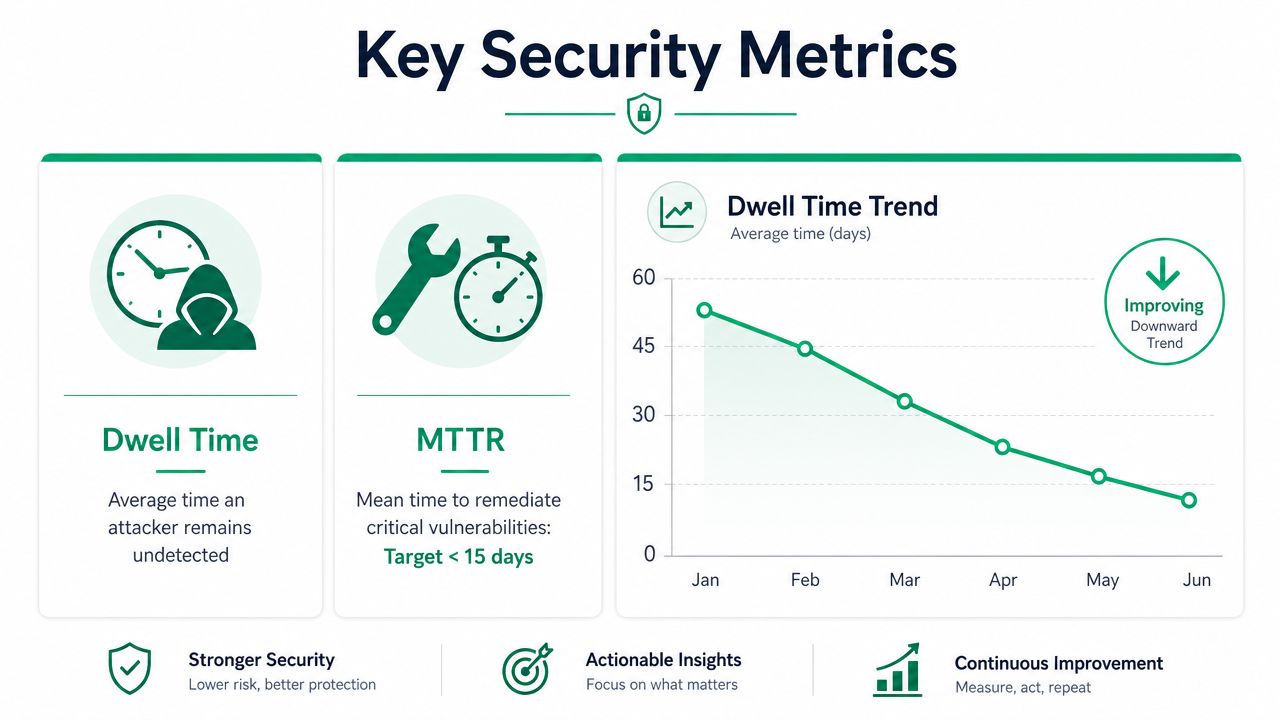
MFA on a slide deck proves nothing. What matters is whether your controls cut attacker dwell time, speed up remediation, and close gaps before privilege creep turns into an incident. That is the scorecard auditors can defend and owners can use to make spending decisions.
The four numbers that matter
Dwell time shows how long an intruder stayed hidden. If you never measure it, you will not know whether detection is happening early or after the damage is done. Vulnerability MTTR by severity shows whether you are fixing critical issues faster than attackers can use them, which is the whole point of patching.
MFA adoption rate has to mean actual account coverage, not how many licenses you bought. Access-review completion rate shows whether someone is regularly checking who still needs access and who does not. When reviews lag, stale entitlements pile up, and the blast radius of a stolen password gets bigger than it should.
Operational rule: If a critical issue sits longer than your patch window, the control has failed, even if the policy says it exists.
The technical stack should make these metrics easy to see. Bitdefender GravityZone gives endpoint detection data you can trend. UniFi networking gives segmentation and traffic evidence. SOC-as-a-Service monitoring turns noisy raw logs into something a manager can read. For a local comparison of tools, the top network monitoring tools for Indiana businesses guide is a practical place to compare options.
Why logs matter even beyond the U.S.
Logging is part of the proof. The CNIL security guide treats logging, backup of logs, protection of the logging system, and restoration testing as part of the evidentiary chain, not a nice-to-have. That matters for U.S. businesses with European customers or employees too, because breach notification can move fast. GDPR's 72-hour reporting window makes log quality and detection speed directly tied to legal exposure.
In plain terms, logs are your memory. If the memory is sloppy, the response is sloppy, and the paperwork gets ugly.
Real Southside Bottlenecks and How Managed IT Fixes Them
A Greenwood logistics company came in with a server past its seven-year mark and a RAID array that was starting to wobble. The QuickBooks database and shipment records were still on the box, but the second drive was already showing signs of failure. During the recovery, bit-level data recovery pulled the business through long enough to preserve the records, then the whole stack was moved to a modern hypervisor with immutable off-site backups so the same panic doesn't happen again.
That's not a theoretical story. That's the kind of problem that turns a normal Monday into a week of lost productivity if nobody catches it early. We've been doing local service for 17 years, so the pattern is familiar, hardware ages out, people ignore the warnings, and then the business acts surprised when the old machine finally quits.
A downtown Indy coworking tenant in a 1920s brick building on Massachusetts Avenue had the opposite problem. The internet connection was fine, but the Wi-Fi was dead in the wrong places because the building ate signal for breakfast. A latency-optimized mesh-node deployment on UniFi networking filled the dead zones, stabilized video calls, and gave tenants the bandwidth they needed without turning the place into a cable mess.
What a managed response fixes that break-fix never does
The point of managed IT isn't just faster repairs. It's getting rid of the root cause. That starts with an assessment that finds aging hardware, bad segmentation, weak access control, and backup gaps before they become a ticket storm. It continues with remediation that replaces the fragile stuff and locks in the standards.
Been-there-done-that advice: If the recovery plan depends on the oldest device in the rack behaving itself, you don't have a recovery plan.
For businesses in the I-65 corridor, the value shows up in three places. You lose less time to unplanned outages. You stop paying random break-fix bills every time a server or access point gets weird. And you get a predictable monthly number instead of a surprise invoice after the damage is already done.
If you want a service model that's built around that kind of cleanup, this grow with managed IT services for small business guide lines up with the same idea. It's less about shiny tools and more about making the environment boring, which is exactly what an owner wants when payroll is due.
Your 90-Day Compliance and Security Roadmap
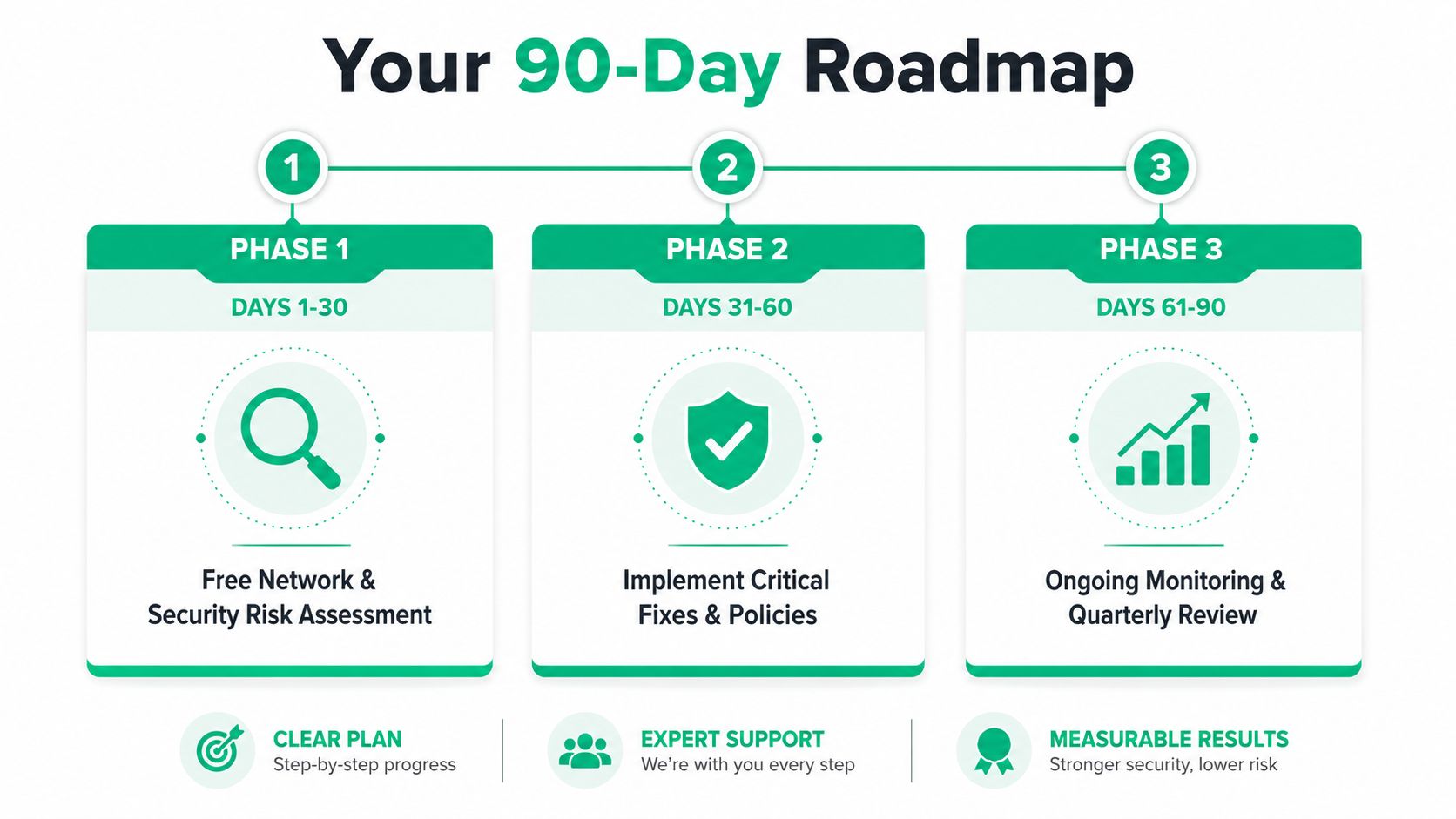
Start with the audit trail, not the panic. If you're a Greenwood or Indianapolis business, the first move is a Free Network Assessment and Security Risk Audit that tells you what you own, what's exposed, and which frameworks apply. That assessment should reconcile asset inventory against MDM and EDR enrollment, then sort out whether HIPAA, CMMC, NIST CSF, PCI DSS, or the FTC Safeguards Rule touches your shop.
Days 1 through 30
The first month is for discovery and gap ranking. You want a written report that says what's missing, what's at risk, and what needs to happen first. That means framework scoping, a real asset count, and evidence of where the weak links sit.
Days 31 through 60
The environment gets hardened. Deploy MFA across all accounts, roll out Bitdefender GravityZone or an equivalent endpoint platform, segment the network with UniFi, and set patch cadence so critical fixes land within 7 days and high-severity fixes within 30. Stand up immutable off-site backups and test restores every quarter, because backups you've never restored are just expensive hope.
Days 61 through 90
Turn detection and evidence into an everyday routine. Activate SOC-as-a-Service monitoring with alerting for failed logins, privilege escalation, and unusual data access. Run monthly access reviews. Start exporting evidence on a quarterly schedule so the next audit feels like paperwork, not a fire drill.
For owners, the ROI argument is simple. Downtime can cost up to $9,000 per minute, so every hour spent on reactive cleanup is an hour not spent serving customers or billing work. A disciplined roadmap turns wasted tech time into predictable monthly spend and less drama.
If you want a quick read on what a managed provider should bring to the table, this your 2026 small business cybersecurity checklist guide gives you a clean benchmark for what's missing.
The Uncomfortable Question and Your Next Step
Can a business become more compliant by storing less data? Yes, if it documents retention, limits access, and keeps only what it needs. That shrinks the audit surface and makes a breach less damaging, which is exactly the kind of trade-off smart owners should want.
How do you keep evidence aligned without hiring a full GRC team? Automate reconciliation, review drift weekly, and bake logging, approvals, and remediation records into normal operations, the same way good teams already handle backups and patching. What's the cheapest first control with the biggest payoff? MFA. It's not glamorous, but it blocks a lot of trouble and gives auditors something concrete to verify.
If you're sorting out who should manage that mix, this how to choose a managed service provider expert guide 2026 article is worth a look. It's the same practical filter I'd use for any Johnson County owner who wants fewer surprises and better documentation.
A business in Greenwood or Indianapolis doesn't need more fear. It needs a partner that can map the frameworks, fix the controls, and keep the evidence ready without creating extra noise. If you're ready to stop guessing, ask Finchum Fixes IT for a Free Network Assessment or a Security Risk Audit and get a clear plan for turning compliance and security into one predictable monthly investment.
A CTA for Finchum Fixes IT.