Cybersecurity Compliance Solutions: Indiana SMB Guide
A practice near Greenwood discovers that its aging server still stores patient files, a contractor shares a privileged login, and nobody can prove the last backup restored correctly. Cybersecurity compliance solutions turn that uncertainty into assigned controls, tested safeguards, documented evidence, and ongoing monitoring aligned with requirements such as HIPAA, PCI DSS, CMMC, and NIST CSF.
The practical answer is to start small and prioritize risk. Inventory systems, identify the rules that apply, protect identities and endpoints, test recovery, and review evidence on a recurring schedule. That approach works better for a 10-person office or a 250-person manufacturer along the I-65 corridor than buying every security product on a vendor's price sheet.
What Cybersecurity Compliance Solutions Actually Are
A Greenwood clinic may operate smoothly until a former employee retains access to a cloud application containing protected health information. A financial firm near downtown Indianapolis may secure card payments yet lack records showing who reviews logs, how vendors are assessed, or whether backups can restore operations. These failures share a practical cause: a requirement has not been translated into an owned, testable control.
Cybersecurity compliance solutions are coordinated policies, processes, technologies, and evidence that help a business meet security obligations while reducing exposure to real attacks. They connect regulatory expectations with daily work such as account administration, patching, encryption, vendor oversight, incident response, and recovery.
Practical rule: A control is unfinished if it exists only in a policy document. An assigned person must operate it, test it, and retain evidence.
For a small business along the I-65 corridor, the work starts with priorities rather than a large product list. A Current Profile might show unmanaged laptops, shared administrator accounts, and unclear vendor access. A Target Profile can then define MFA, endpoint protection, an accurate asset register, and tested backups. NIST's CSF 2.0, published February 26, 2024, adds Govern alongside Identify, Protect, Detect, Respond, and Recover. The framework gives owners and IT teams a common way to assess risk, assign work, and explain progress.
The result should be usable evidence, not an audit binder assembled at the last minute. It should also reduce the chance that a compromised account, failed server, or supplier incident interrupts payroll, scheduling, production, or billable work.
IBM examined 600 organizations that experienced breaches between March 2024 and February 2025. Its research reported a global average breach cost of $4.44 million, while the U.S. average reached a record $10.22 million. Supply-chain compromise represented 15% of initial attack vectors and carried an average cost of $4.91 million. IBM's 2025 Cost of a Data Breach report supports treating vendor access, evidence management, and response planning as operating responsibilities, not paperwork.
Documentation also matters between audits. The AI Video Detector compliance guide illustrates how policies, approvals, and operating records should connect. For a practical prioritization approach, Indiana owners can review this compliance and security guide for Indiana SMBs, then fund controls according to business risk and contractual requirements.
Understanding the Major Compliance Frameworks
A Greenwood dental office should not build its compliance program like a software company selling into downtown Indy tech hubs. The right starting point is the information handled, the services provided, and the contracts customers require. A retailer processing cards faces different priorities from a defense supplier preparing for CMMC requirements, especially for a small business along the I-65 corridor with limited staff and budget.
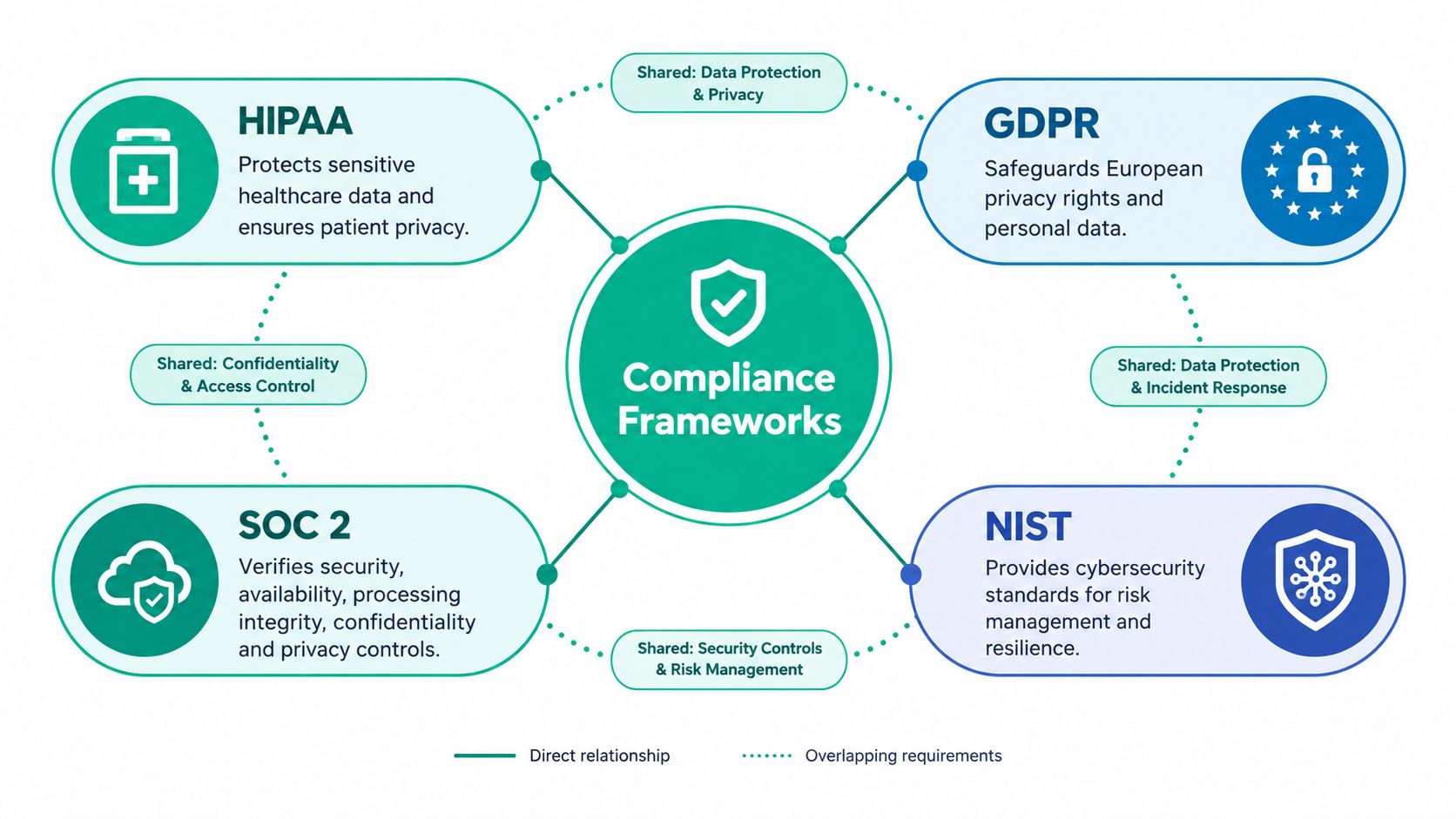
Match the framework to the business
- HIPAA: Healthcare organizations and their business associates need safeguards for protected health information. Access control, audit activity, risk analysis, workforce procedures, and recovery planning should reflect how the practice stores, shares, and uses patient data.
- PCI DSS: Businesses that process payment cards need a secure payment environment. Reducing scope, separating payment systems, encrypting data, managing vulnerabilities, and restricting access can matter more than buying another general security product.
- NIST CSF 2.0: NIST provides a flexible, vendor-neutral structure for organizations of different sizes, sectors, and maturity levels. Its six functions are Govern, Identify, Protect, Detect, Respond, and Recover. Govern connects cybersecurity with enterprise risk, policies, legal duties, and supplier oversight. NIST published CSF 2.0 on February 26, 2024, expanding its audience beyond critical infrastructure. Its overview and scope were linked earlier in this guide.
- SOC 2: Service organizations use SOC 2 to demonstrate controls related to security and other trust service criteria tied to customer commitments. Readiness often involves consistent evidence for access, change management, availability, and vendor processes.
These frameworks can share one control set. A single access review may support HIPAA, PCI DSS, SOC 2, and a NIST profile when the company defines scope and maps evidence correctly. The same MFA policy can satisfy several obligations, while a healthcare provider still needs protections specific to PHI.
The expensive mistake is treating every framework as a separate binder. Build one control set, then map its evidence to each obligation.
Workforce ownership belongs in that plan. Acceptable use, training, offboarding, and incident reporting connect employee responsibilities with technical safeguards. The HR Management 365 compliance insights provide useful context for that connection. A service provider organizing customer evidence can also use this SOC 2 compliance checklist to structure readiness work, while keeping in mind that a checklist supports an operating program but cannot replace one.
Technical Controls That Power Compliance Programs
A compliance program fails when the technical environment can't produce reliable evidence. A policy may require least privilege, but if every employee uses a shared administrator account, the policy doesn't protect the business. A backup policy may look polished, but it has little value until a restoration test proves that files and applications can return to service.
Build the control stack in layers
Start with an asset and identity baseline. Record laptops, servers, SaaS applications, cloud workloads, network devices, and privileged accounts. Then connect each asset to an owner, business purpose, data classification, and required safeguard.
Endpoint protection should include centrally managed detection and response. Bitdefender GravityZone can be evaluated as an endpoint platform, provided the configuration, alert review, exclusions, and response process are documented. MDM should enforce encryption, screen-lock rules, supported operating systems, and remote-wipe capability on company-managed mobile devices.
Identity deserves special attention. Enforce MFA for email, remote access, administrator accounts, and important cloud applications. Use separate privileged accounts, disable stale users promptly, and review access when roles change. Role-based permission design helps keep access tied to job duties. This explanation of role-based access control and permission roles is a useful reference when managers need to understand why “everyone gets access” creates unnecessary exposure.
A SIEM or managed logging service should collect authentication, endpoint, email, firewall, backup, and cloud events. Logs need retention, restricted access, time consistency, and an escalation path. Detection without ownership creates noise, not protection.
Encryption protects information at rest and in transit. Network segmentation limits how far an intruder can move, while Zero Trust architecture treats every request as something to verify rather than assuming that an internal device is safe. For an old brick building with uneven wireless coverage, latency-optimized mesh nodes and properly placed UniFi networking equipment can improve reliable access, but the design still needs separate staff, guest, and sensitive-device networks.
Make evidence part of the workflow
Automated checks should flag unsupported software, missing patches, excessive privileges, exposed services, configuration drift, and unapproved applications. Each finding needs a control owner, due date, exception record, and attached evidence.
A useful identity and access management guide can help teams turn access reviews into a repeatable process. The technical goal isn't maximum tooling. It's measurable coverage and a clear answer to one question: can the business prove that the safeguard operates?
The Business Case for Compliance Investment
A manufacturer along the I-65 corridor can lose productive hours when one locked account, failed server, or ransomware incident stops scheduling, shipping, invoicing, or customer service. A compliance program earns its keep by reducing that interruption risk while giving the business evidence an assessor, insurer, or customer may request.

For a Johnson County business, the cost is often visible in ordinary work. Technicians spend time chasing unmanaged devices, repeated malware alerts, or failed backups, while customer-facing staff wait for answers. A managed compliance program converts those recurring tasks into a planned monthly expense and gives leadership a prioritized risk list instead of surprise repair invoices.
IBM's 2025 research found that organizations using AI and automation extensively shortened breach timelines by 80 days and reduced average breach costs by $1.9 million compared with organizations that did not use those capabilities. The practical benefit comes from faster investigation, consistent evidence collection, automated policy checks, and earlier escalation. A dashboard with an AI label does not create those results by itself. The figures come from IBM's breach-cost research cited earlier in this guide.
The right investment is selective. A managed provider can automate routine checks, while business leaders decide how to handle exceptions, legal obligations, and operational limits. A manufacturer may need to delay patching a production controller until a maintenance window. A clinic may need controls that protect PHI without making patient access unreliable.
Use this practical guide to cybersecurity services pricing for SMBs to compare recurring service costs with internal labor, recovery risk, and audit preparation. Ask providers to report MFA coverage, the age of critical vulnerabilities, backup recovery results, mean time to detect, and mean time to remediate.
Compliance controls can also support cyber insurance requirements. IBM's breach study found that one-third of organizations paid a regulatory fine after a breach. That makes documented evidence and notification procedures operating safeguards, not paperwork filed for an audit.
Watch the short video below for another perspective on how security controls protect business operations.
Implementation Roadmap for Indiana SMBs
A practical implementation starts with the environment you have, not the environment a software brochure assumes. A Greenwood office with aging server hardware, Microsoft 365, a few remote workers, and a UniFi firewall needs a different sequence from a Hamilton County SaaS company running entirely in the cloud.
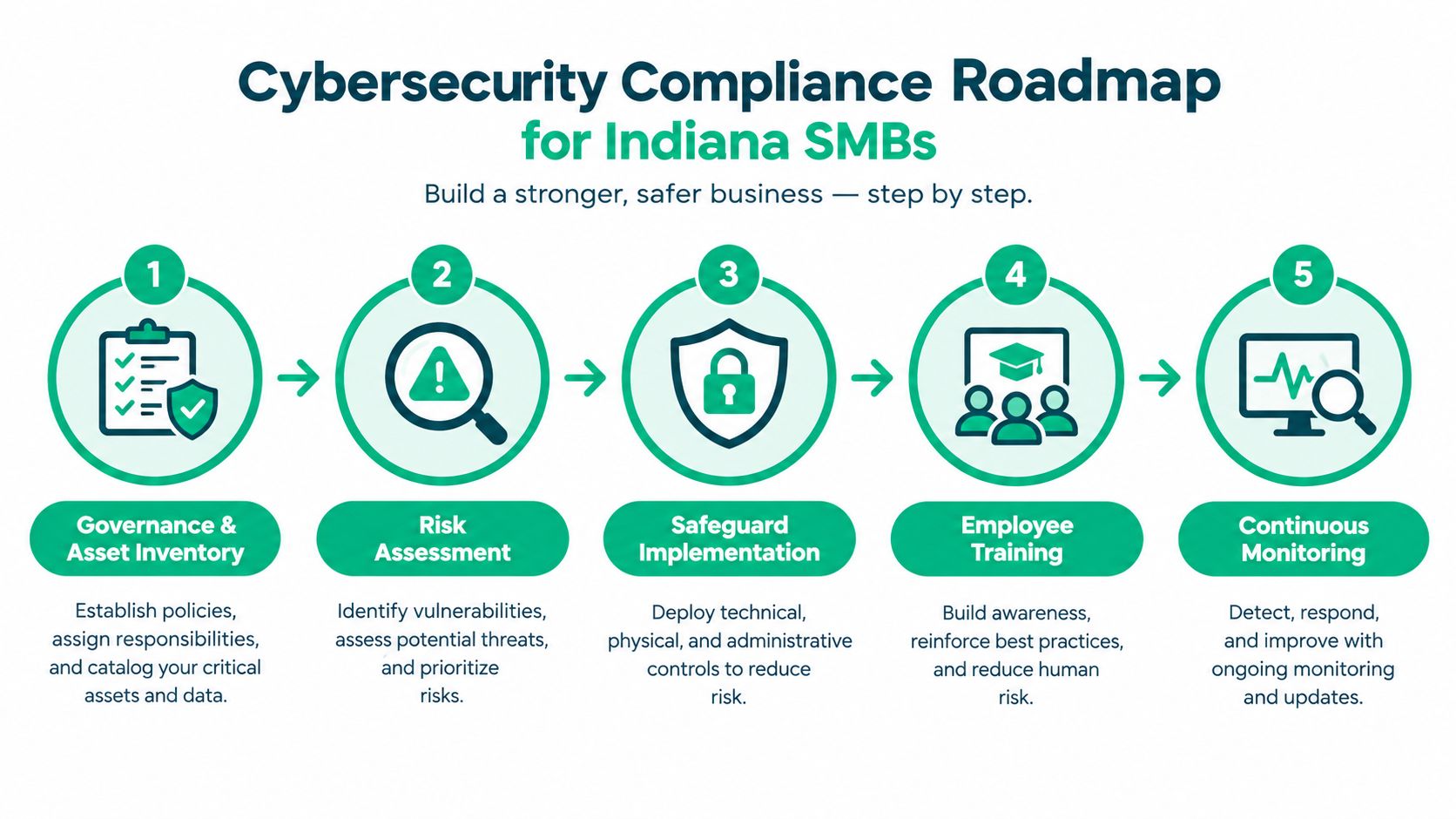
Start with ownership and evidence
1. Govern and inventory. Name an executive sponsor and control owners. Inventory endpoints, applications, vendors, accounts, sensitive data, and recovery dependencies. Record what is unknown instead of pretending the list is complete.
2. Assess risk. Create a Current Profile and a Target Profile using NIST CSF 2.0. Rank exceptions by business impact, exploitability, contractual pressure, and recovery difficulty. A recurring risk register keeps decisions visible when a patch must wait or a legacy application can't support modern authentication.
3. Apply safeguards. Remove default passwords, enforce MFA, separate privileged access, patch known exploited vulnerabilities on internet-facing systems within a risk-informed timeframe, secure remote access, and deploy endpoint protection. CISA's Cross-Sector Cybersecurity Performance Goals provide a prioritized baseline for these high-impact actions.
4. Train and rehearse. Annual security awareness training is a baseline, not the finish line. Teach employees how to report suspicious messages, handle sensitive data, and escalate a suspected incident. Run a tabletop exercise using a realistic scenario, such as a compromised vendor account or ransomware on a file server.
5. Monitor and recover. Use centralized logging or SOC-as-a-Service monitoring to connect alerts with owners and escalation paths. Maintain immutable off-site backups and test restoration. A healthcare organization should also review the CMS contingency-plan specification, which calls for daily incremental backups, weekly full backups, and three backup generations, with at least one generation available online, plus protections for confidentiality, integrity, and availability. The NIST cybersecurity insights on CSF 2.0 resources provides that reference.
Select a partner that can operate the plan
Ask prospective providers to show sample evidence, not just a service catalog. The proposal should identify who reviews alerts, how exceptions are approved, how vendors are assessed, how backups are tested, and how an incident reaches your leadership team.
A credible managed service should produce endpoint and asset inventories, privileged-access reviews, vulnerability-aging reports, training logs, incident exercises, supplier-risk records, backup-restore records, and compensating controls. It should also explain how the service integrates with Microsoft 365, cloud applications, existing firewalls, and line-of-business software.
NIST CSF 2.0 organizes security programs around Govern, Identify, Protect, Detect, Respond, and Recover, with Govern covering strategy, expectations, and policy. That structure gives an SMB a repeatable operating cycle instead of a one-time audit target.
Choosing the Right Managed IT Partner
A local managed IT partner earns trust through the details that appear after the sales meeting. Ask how urgent incidents are handled, where logs are stored, who owns the tenant, how access is removed when the contract ends, and which evidence arrives each month. If the answer is “we'll figure it out,” keep interviewing.
The provider should understand the difference between break-fix support and managed risk reduction. Break-fix gets a laptop running again. A compliance-minded service reviews why the laptop failed, whether it was patched, whether the user had excess privilege, whether similar devices are exposed, and whether the event needs to enter an incident register.
Questions worth asking
- Framework experience: Can the team work with HIPAA, PCI DSS, NIST CSF, SOC 2, or CMMC-related requirements that affect your contracts?
- Monitoring model: Does the service provide SOC-as-a-Service monitoring, or does it just forward alerts to your office?
- Recovery proof: Will the provider document backup jobs and restoration tests for immutable off-site backups?
- Response ownership: Who makes the call during a suspected breach, and how are legal counsel, insurers, vendors, and customers coordinated?
- Local support: Can technicians reach a Greenwood site, an I-65 corridor warehouse, or a downtown Indy office when remote troubleshooting isn't enough?
- Exit and access: Can you retrieve your documentation, configurations, logs, and administrative credentials if the relationship ends?
A managed provider should make risk visible every month, not make compliance visible only when an audit arrives.
Finchum Fixes IT is one local option for organizations seeking managed IT, cybersecurity, networking, data recovery, and support services in Indiana. Its published service profile includes Microsoft, CompTIA, and Cisco-certified professionals, urgent response averaging under two hours, and a Security Risk Audit covering environment, identity controls, integrations, backup readiness, and security weaknesses.
The managed service provider selection guide can help owners compare response practices, technical scope, reporting, and contract terms. The best fit isn't automatically the provider with the biggest toolset. It's the one that can explain what it will measure, who will act, and how the evidence supports your business obligations.
Next Steps for Your Business
Cybersecurity compliance solutions work when they connect governance to the equipment and applications employees use every day. Start with the systems that could stop revenue, the identities that could open sensitive data, the vendors that connect to your environment, and the backups that would carry the business through a serious outage.
A Hamilton County practice may begin with HIPAA scope, MFA, PHI access reviews, and tested recovery. A Johnson County retailer may prioritize PCI DSS scope reduction, payment-network segmentation, and vendor controls. A defense supplier near the I-65 corridor may need to organize its NIST CSF baseline while preparing for CMMC-related customer expectations. A downtown Indianapolis software company may need disciplined SOC 2 evidence and cloud access governance.
Don't buy another dashboard until you know which controls are missing and who owns them. A Free Network Assessment or Security Risk Audit can expose unmanaged devices, weak identity controls, integration risks, backup gaps, and configuration issues before a breach, failed audit, or hardware failure forces the decision.
The goal is practical: fewer surprises, shorter outages, clearer accountability, and a predictable security budget that lets employees spend time serving customers instead of fighting recurring technology problems.
Finchum Fixes IT helps Greenwood and Indianapolis businesses assess networks, strengthen cybersecurity compliance controls, improve UniFi and business Wi-Fi environments, and validate immutable off-site backups. Visit Finchum Fixes IT to request a Free Network Assessment or Security Risk Audit and turn your current gaps into a prioritized action plan.