Custom CRM Software Development That Drives Business Growth
TL;DR
- Off-the-shelf CRMs often create bottlenecks, forcing Indiana businesses to waste time on workarounds instead of billable tasks. This "wasted tech time" can cost up to $9,000 per minute.
- Custom CRM software development builds a tool around your specific workflow, integrating with existing systems like UniFi networking and Bitdefender GravityZone to eliminate inefficiency.
- A custom solution ensures compliance with standards like HIPAA or CMMC is built-in, not bolted on, protecting your business continuity.
- The investment pays for itself by converting administrative overhead into billable hours, boosting user adoption, and creating a predictable monthly budget by eliminating downtime and manual data entry.
- The goal is to stop fighting your software and build a reliable business asset that drives growth for companies along the I-65 corridor and beyond.
Let's be blunt: fighting with an off-the-shelf CRM is a fantastic way to burn time and money. For many Indiana businesses, these generic platforms create more headaches than they solve, forcing your team to work around the software instead of with it.
It’s not just a minor annoyance; it’s a strategic flaw that hits your bottom line.
Why Your Business Needs a Custom CRM Now
Think about all the wasted hours your team spends wrestling with clunky software that just doesn't fit your process. Every minute spent on a workaround is a minute not spent on productive, billable work. That’s real revenue slipping through your fingers, and downtime can cost a business up to $9,000 per minute.
A custom-built CRM flips the script entirely. Instead of forcing a square peg into a round hole, you get a system designed precisely for your workflow. This isn’t about luxury—it’s about eliminating the bottlenecks that are quietly killing your team's efficiency and morale, turning wasted tech time into a predictable monthly budget.
When your software actually makes sense to the people using it, adoption skyrockets. Suddenly, the tool becomes an asset that supports your team, not an obstacle they have to conquer. For businesses dealing with complex rules like HIPAA or CMMC, a custom system can build compliance right into the workflow, strengthening your security and business continuity from the ground up.
Ultimately, it’s about turning those tech frustrations into a competitive advantage. You stop hemorrhaging cash on downtime and inefficiency and start paving the way for serious, sustainable growth.
When Your Off-The-Shelf CRM Starts Working Against You
Let's talk about a manufacturer we know down in a Greenwood business park. They were wrestling with a generic CRM that absolutely refused to play nice with their aging server hardware and shop-floor systems. The result? A daily nightmare of manual data entry, expensive mistakes, and production delays that left everyone frustrated. This isn't just a story; it's a reality for businesses all up and down the I-65 corridor.
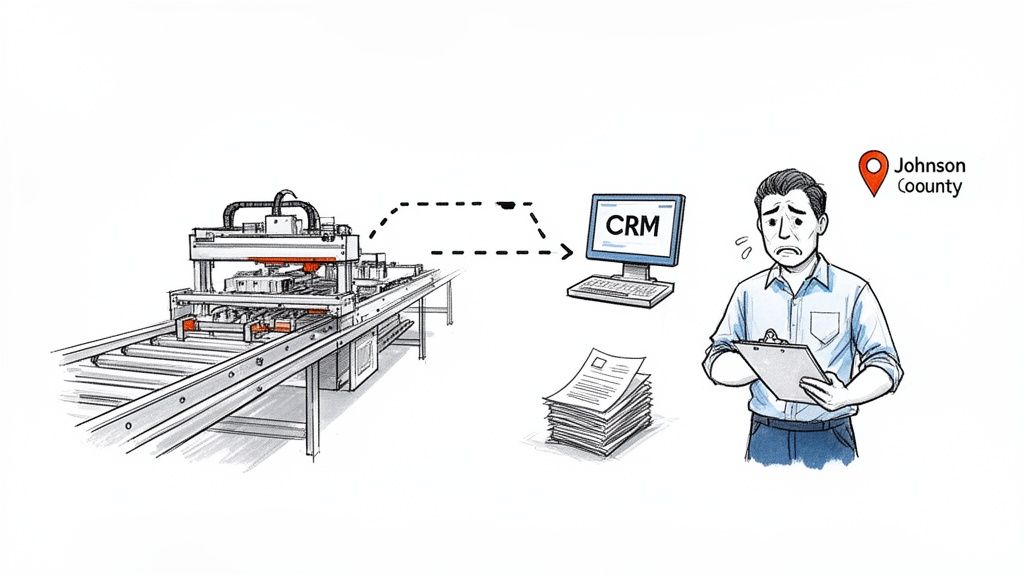
Off-the-shelf CRMs promise the world, but for most Indiana companies, they're a one-size-fits-none solution. You end up bending your own successful processes to fit the software's rigid rules, instead of the other way around. It’s like putting a governor on your engine—everything just feels sluggish and inefficient.
The Hidden Costs of a "Good Enough" CRM
Those little annoyances with your generic CRM aren't so little when you add them up. They're actually quiet, consistent drains on your bank account. We see the same problems time and again, from growing businesses in Greenwood to the tech hubs in downtown Indy.
These are the most common culprits:
- Clunky, Confusing Interfaces: If your team has to fight the software just to log a call, they’ll eventually stop trying. That leads to spotty data, missed opportunities, and a sales pipeline that's pure fiction. The most expensive CRM is always the one nobody uses.
- Paying for Bloat You'll Never Use: Big-box CRMs are stuffed with features built for giant corporations. Your business gets stuck paying a premium for a bunch of tools you don't need, while the ones you actually need are either missing or just plain bad.
- Workflows That Just Don't Fit: Your business didn't get where it is by being generic. Forcing your team into a pre-canned sales process that doesn't match how you actually work creates bottlenecks and kills momentum. This is a huge problem when you're trying to connect to older equipment, a topic we cover in our guide to legacy system modernization strategies.
- No Way to Connect Your Key Systems: That Johnson County manufacturer couldn't get their CRM and production software to talk to each other. It’s a classic tech gap that forces people into doing robotic, error-prone data entry, burning through hours that could have been spent on billable work.
These "small" frustrations snowball fast. Every hour your team wastes wrestling with software or manually copying data is what we call "wasted tech time." This kind of downtime can cost a business up to $9,000 per minute, turning a simple software headache into a serious threat to your bottom line.
Moving Beyond the Generic Box
Trying to make a generic CRM work for your unique business is like trying to navigate the I-465 loop during rush hour using a map of Chicago. It's confusing, wildly inefficient, and you're definitely not going to get where you need to go. That gap between what the software does and what you need it to do is a constant drag on your profitability.
This is exactly where custom CRM software development stops being a luxury and becomes a strategic move. The point isn't to build something with more features. It's to build a focused tool that erases all those daily points of failure.
The goal is a CRM that feels like a natural part of your team's day, not an obstacle. A well-built system makes their jobs easier, stops downtime in its tracks, and turns all those wasted hours back into predictable revenue.
The Strategic Case for Custom CRM Software Development
So, you've finally hit the wall with your off-the-shelf CRM. It's a familiar story. You've tried to make it work, but a generic tool just forces your Indiana business into a box it was never meant to fit in, leading to constant friction and costly downtime. The smart move isn't to find another box—it's to build a tool that actually works for you, not against you. That’s exactly what custom CRM software development is all about.
Stop thinking of a CRM as just another monthly expense. A custom-built system is a core business asset that actively prevents downtime and makes you money. By wiping out the system conflicts and soul-crushing manual data entry that plague generic software, you get back all those hours lost to "wasted tech time." Every minute your team isn't fighting their software is a minute they can spend on billable work, directly pumping up your bottom line and giving you a predictable budget.
This isn't some fringe idea for Silicon Valley giants, either. It's a proven strategy that growth-focused companies are jumping on. The global custom software development market is expected to rocket from $53.95 billion in 2025 to $65.85 billion in 2026—that's a staggering 22.1% annual growth rate. It’s on track to hit $141.13 billion by 2030 as more businesses get fed up with one-size-fits-none solutions.
From Overhead to Billable Hours in Hamilton County
Let's bring this down to earth with a real-world example. We recently helped a law firm right here in Hamilton County that was practically drowning in paperwork. Their client intake was a chaotic jumble of spreadsheets and manual data entry, which was not only inefficient but also a major compliance risk. The generic CRM they were paying for didn't have a clue about their specific workflow or the strict HIPAA rules they had to follow.
We jumped in and built a custom CRM designed specifically around their intake process.
- Automated Document Handling: The system now automatically sorts and secures every client document, making sure they’re always stored in compliance with HIPAA. No more frantic searching.
- Streamlined Client Onboarding: We created a simple, step-by-step workflow for bringing on new clients. This cut out all the guesswork and brought errors down to nearly zero.
- Integrated Billing Triggers: As soon as a client was officially onboarded, the CRM automatically cued up entries in their billing software. No billable minute was ever lost again.
The result? It was a game-changer. The firm turned almost all of its administrative dead weight into profitable, billable hours. The system quickly paid for itself by eliminating wasted time and capturing revenue that used to slip through the cracks. Now that's what you call a solid ROI.
Building for Reliability and Growth
The real magic of a custom solution is baked into its architecture. Unlike a generic platform where you're stuck with whatever they give you, a custom build is designed from the ground up for absolute reliability and growth. We make this happen by obsessing over the technical foundation from day one.
For example, we use a Zero Trust architecture. In simple terms, this means the system verifies every single interaction, which dramatically cuts down security risks. We build systems that grow right alongside your business, whether you’re a busy firm in a Greenwood business park or a tech startup expanding in downtown Indy. This forward-thinking method is a key part of what we do, which you can learn more about in our guide to adaptive software development in Indiana.
In our 17 years of serving local businesses, we’ve seen it time and again: a well-designed system becomes the backbone of the company. It’s not just about a list of features; it's about building a dependable tool that puts a stop to downtime and clears the path for your growth.
What Should a Custom CRM Actually Do?
So, you’re thinking about a custom CRM. Let’s get down to brass tacks—what features actually matter? We’re not talking about adding a few shiny new buttons to a dashboard. We’re talking about building a high-performance engine specifically tuned for your Indiana business, designed to turn wasted tech time back into billable hours.
The right features depend entirely on how you operate. A defense contractor near the Crane naval base needs a system with built-in CMMC compliance tracking from day one. A logistics company hustling freight up and down the I-65 corridor needs bulletproof mobile tools for drivers. One size has never fit anyone particularly well, and in business, it’s a recipe for failure.
Before we dive deep, let's clear up a common misconception. Many businesses think they need to choose between a generic, off-the-shelf system and a complex, expensive custom build. The reality is much more nuanced, especially for small and medium-sized businesses right here in Indiana.
Off-the-Shelf vs. Custom CRM for Indiana Businesses
| Feature/Aspect | Off-the-Shelf CRM | Custom CRM by Finchum Fixes IT |
|---|---|---|
| Workflow Fit | You adapt your process to the software. | The software is built around your exact process. |
| Feature Set | Bloated with features you don't need; missing ones you do. | Every feature has a purpose, designed to solve your specific bottlenecks. |
| User Adoption | Can be a struggle; feels clunky and irrelevant to your team. | Intuitive and easy to use because it mirrors their daily tasks. |
| Integration | Limited, often requiring clunky third-party connectors. | Seamlessly connects to your accounting, security, and other essential tools. |
| Scalability | You're stuck with their upgrade path and pricing tiers. | Grows with you. We can add new features as your business evolves. |
| Cost | "Cheaper" upfront, but hidden costs in lost productivity. | An investment in efficiency with a clear ROI, eliminating wasted time. |
The choice isn't just about software; it's about whether you want a tool that forces you into a box or one that gives you the freedom to grow. A custom CRM is an investment in doing business your way, only faster and smarter.
The Non-Negotiables: Core Features That Drive Profit
Before we get fancy, let’s talk about the foundation. Every great CRM has a few core functions that are absolutely non-negotiable. Think of this as the chassis and engine of your custom-built race car—if these parts aren't solid, the spoilers and paint job don't matter.
After 17 years of working with local businesses, we’ve seen that the features with the biggest impact are the ones that ruthlessly eliminate bottlenecks.
- A Single Source of Truth: This is the heart of it all. You need one central hub for every customer detail, from their first phone call to their last payment. No more digging through emails or spreadsheets.
- A Sales Pipeline That Actually Works: Your sales process isn't a generic template, so why should your CRM be? We build a visual map of your exact stages, automatically moving deals along and flagging your team when something gets stuck.
- Effortless Task & Activity Tracking: Logging calls, scheduling follow-ups, and assigning tasks should be second nature. This data is pure gold for seeing who’s performing and accurately forecasting the next quarter.
A powerful custom CRM doesn’t just hold your data hostage. It puts that data to work. By automating the grunt work, it frees your team to focus on what they were hired to do: build relationships and bring in revenue.
The Fun Stuff: Advanced Features for Indiana’s Top Industries
Once the foundation is poured, we can start adding the features that give you an almost unfair advantage. For our clients in booming areas like Johnson and Hamilton County, this is where a custom solution leaves off-the-shelf software in the dust. This kind of automation is a true game-changer, something we cover in our guide on smart business process automation examples.
Here are a few high-impact additions we’ve recently built for local companies:
- AI-Powered Sales Forecasting: Stop guessing what next quarter looks like. We can build a simple AI model that analyzes your past sales, spots trends you’d never see, and delivers shockingly accurate revenue forecasts. Now you can make hiring and budget decisions with real confidence.
- Mobile-First Tools for Teams on the Go: If your people are in the field, their CRM needs to work perfectly on a phone. That means instant access to job histories, parts inventory, and client notes from a truck, a job site, or a client’s office.
- "Set It and Forget It" Compliance Reporting: Whether you're a healthcare provider navigating HIPAA or a manufacturer managing NIST CSF, we can build a system that automates your compliance reports. It generates the right documents, on schedule, making audits a breeze.
The Glue: Seamless System Integration
Here’s the thing—a CRM that doesn't talk to your other software is worse than useless; it’s a liability. Real power comes when your CRM acts as the central nervous system for your entire business, connecting every critical application.
Think about the tools you already use every single day:
- Your Network: Tying the CRM directly into your UniFi networking gear ensures that data is fast and reliable, whether you're in the office in downtown Indy or working from home in an old brick building with spotty Wi-Fi.
- Your Security: The CRM must integrate with your security platform, like Bitdefender GravityZone, to wrap your customer data in a unified Zero Trust security blanket.
- Your Accounting Software: Connecting your CRM to QuickBooks or another platform automates invoicing the moment a deal is won. No more double-entry and no more costly typos.
- Your Industry-Specific Tools: A law firm needs its CRM to sync with its case management software. A machine shop needs it to pull data from its floor ERP.
When we start a project, we map every single one of these connections. By building these bridges from the start, we ensure your new CRM doesn't just work—it makes your entire tech stack work better, preventing the conflicts and downtime that kill productivity.
Our Battle-Tested Custom CRM Development Process
Let’s be honest: building custom software can feel like you’re gambling with your business. I’ve seen it countless times—business owners right here in Greenwood or Fishers get absolutely torched by developers who talk a big game but leave them with a buggy, half-baked product and a wallet-emptying invoice.
We do things differently. Our approach to custom CRM software development isn't a mystery box. Think of it more like building a custom home with an architect who’s been on the block for years. It's a structured, transparent process we've perfected over 17 years to eliminate surprises, budget blowouts, and the kind of tech-induced downtime that can bleed your business of up to $9,000 per minute.
We’ve built our process to turn "wasted tech time" into a powerhouse asset that actually makes you money. It all comes down to a clear, three-stage plan.
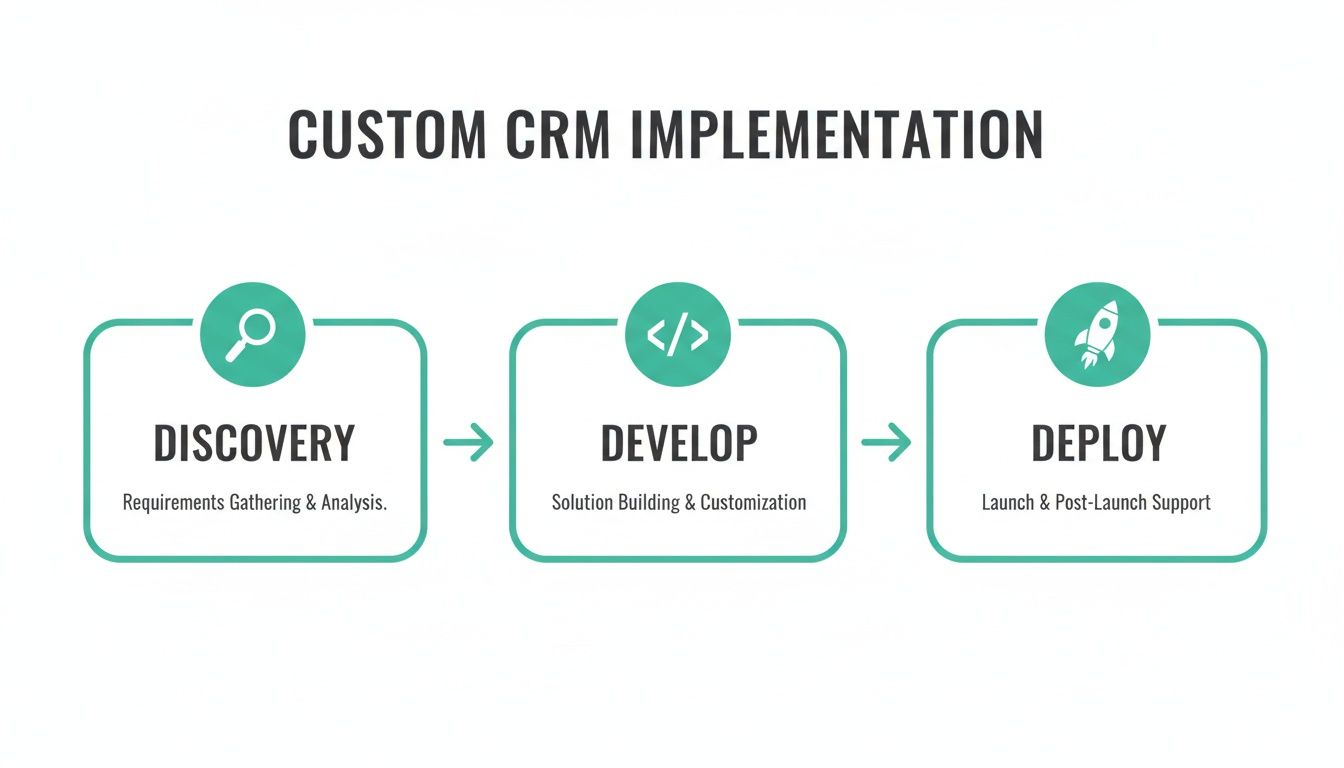
This diagram gives you the 30,000-foot view, breaking a huge project into three straightforward stages: Discovery, Develop, and Deploy. Here's how we make it happen.
Phase 1: The Blueprint (Discovery and Strategy)
This is where the magic really starts, and it’s the single most important step. We absolutely refuse to write a single line of code until we know your business like the back of our hand.
We'll sit down with your team—whether you're running a fast-paced shop in a downtown Indy tech hub or a manufacturing plant in Johnson County—and map out exactly how you work. We’re on the hunt for the real-world bottlenecks, the mind-numbing compliance hoops you have to jump through (like HIPAA or NIST CSF), and the must-have connections to your other systems, right down to your UniFi networking gear.
This deep dive is what makes our custom CRMs feel like they were built by one of your own. It also informs the big picture, since many CRMs need a mobile-friendly side. Understanding the wider custom mobile app development process is often a key part of the conversation.
Phase 2: The Build (UI/UX Design and Agile Development)
With a rock-solid blueprint in hand, we start building. We kick things off with UI/UX design, which is just a fancy way of saying we obsess over making the software incredibly simple and intuitive to use.
Why? Because if your team hates the tool, they won’t use it. It's that simple.
From there, we get to coding using an agile method. Instead of disappearing for six months and coming back with a "finished" product, we build your CRM in small, functional pieces called "sprints." Every couple of weeks, you get a working version to click around in, test out, and give feedback on. This back-and-forth completely eliminates nasty surprises and keeps us locked in on your vision. It's a core part of our playbook, which you can read more about in our guide to a rock-solid enterprise software development process.
Phase 3: The Launch (Rigorous Testing and Deployment)
Before your new CRM sees the light of day, we put it through the wringer. Our testing is relentless. We try to break it, crash it, and throw every bizarre scenario at it that we can dream up. The goal is to find and squash every bug before it can ever touch your live operations.
We recently put a new system through its paces and found a sneaky vulnerability. It would have only appeared under a very specific set of network conditions, but it could have exposed sensitive client data. Our Zero Trust security principles and obsessive testing caught it, and we slammed the door shut on a potential disaster.
Once it survives our boot camp, we manage the entire deployment. That includes carefully migrating all your existing data. When we dissembled a similar client’s failing RAID array to get their data, we found a critical hardware flaw. We didn't just fix it; we built a more powerful, immutable off-site backup module right into their new CRM to make sure it never happened again.
That's the kind of "been-there, fixed-that" experience that prevents catastrophes. Your system not only works on day one, but it also grows with you. That's why custom builds have such a massive impact. A huge 78% of companies using off-the-shelf CRMs feel stuck, unable to customize them. In contrast, custom CRMs are proven to increase user adoption by 55% and can even speed up sales cycles by 40%.
Let's Talk Turkey: Calculating the Real ROI of Your Custom CRM
Alright, let's address the elephant in the room: the cost. A custom CRM isn't a throwaway monthly subscription, and any developer who claims it is isn't giving you the whole story. Yes, the upfront investment is bigger, but the long-term value it creates can completely transform your business's financial health.
Comparing a custom CRM project to an off-the-shelf license is like comparing the cost of building your dream home to renting an apartment. They're just not in the same league.
The final price tag comes down to a few key things: how complex your dream features are, how many other systems we need it to talk to (like your accounting software or shop-floor ERP), and any specific compliance hoops we have to jump through, like HIPAA or CMMC. We’ll map all of this out for you, plain as day, right from the start.
From a Money Pit to a Money-Maker
Here's the thing about those generic CRMs: they are a forever expense. You're on the hook for that monthly payment until the end of time, and you never actually own a thing. A custom CRM, on the other hand, is a capital investment. Once we build it, it's your asset. You stop hemorrhaging cash on per-user license fees, and that money can go right back into growing your business.
This mindset shift is why so many businesses are making the switch. In the world of custom software, a whopping 72% of companies are now outsourcing the work. Why? To get more efficient (35%), slash costs (34%), and frankly, to get a much better product (33%). As this in-depth market research on custom development shows, they're teaming up with certified pros—like our Microsoft and CompTIA-certified crew—to build tools that pay for themselves over and over again.
Think about it. If your current CRM costs you $100 per user per month, a 20-person team is setting you back $24,000 every single year. That’s money vanishing into thin air for a tool that, let's be honest, probably causes more headaches than it solves.
How to Actually Measure Your Return
The real return on investment (ROI) isn't just about ditching those license fees. The true magic happens when we turn all that "wasted tech time" back into profitable, billable hours. For our clients right here in Johnson and Hamilton County, this is the secret sauce. It’s how the investment often pays for itself in less than a year.
Here’s a simple framework for seeing the real ROI of a system built just for you:
- Time Is Money (Literally): Start tracking how many hours your team burns fighting with clunky software, doing manual data entry, or fixing silly mistakes. If you get back just five hours per employee each week at their average billable rate, the savings are staggering.
- Sell Faster, Earn More: Imagine a CRM that automatically handles follow-ups and keeps your pipeline moving like a well-oiled machine. Closing deals just 10% faster doesn't just feel good—it has a massive compounding effect on your annual revenue.
- Stop Paying for Mistakes: What’s the price tag on a botched order, an incorrect invoice, or a compliance slip-up? A custom system with built-in guardrails and automated workflows can nearly eliminate these errors, saving you from costly rework and unhappy customers.
- The Obvious Win: This one's easy. Just add up what you're currently paying in annual CRM licenses. Once your custom system is up and running, that entire amount goes from an expense line to pure profit.
Don't Get Stuck with the Wrong CRM Partner in Indianapolis
Let's be honest—choosing a developer for your custom CRM is the single most important call you'll make in this whole process. Get it right, and you've got a strategic asset who turns wasted tech time into billable hours. Get it wrong? You've just signed up for another expensive bottleneck.
For any business owner here in the Indianapolis metro area, from Greenwood up to Hamilton County, finding a truly local partner is everything. You need a team that's more than just a "geek with a screwdriver." You need experts who get the tech, sure, but who also get the unique grind of doing business in Central Indiana.
Think about it. When your entire operation grinds to a halt, do you want a partner who's just a face on a Zoom call, hours away? Or do you want a team that can actually be in your office, solving the problem?
Your Vetting Checklist: Separating the Pros from the Pretenders
Before you even think about signing a contract, it's time to ask some tough questions. A great partner will have solid, confident answers. A bad one will start tap-dancing. Use this checklist to tell the difference.
- Are they actually local? Don't just take their word for it. Ask about their office location and what their real-world response time is for an urgent issue in Greenwood or downtown Indy. After 17 years of serving this community, we've seen countless situations where a local team fixed an issue in hours that would have taken a remote provider days.
- Can they prove they know your industry? If you run a medical practice, they need to show you examples of their HIPAA-compliant work. If you're a defense contractor, they better have real experience with CMMC. A vague "Oh yeah, we can do that" is a giant red flag.
- How deep does their technical skill go? Ask them to talk shop about security and reliability. They should be able to clearly explain their approach to things like a Zero Trust architecture for security, how they guarantee immutable off-site backups for disaster recovery, and how they’ll integrate with your existing tech stack, like your UniFi networking hardware.
A potential partner's answers here will tell you everything you need to know. You're listening for the "been-there, done-that" confidence that only comes from firsthand experience solving real, complex problems for businesses just like yours.
Three Questions Every Indy Business Owner Must Ask
When you finally sit down with a potential developer, it's time to put them on the spot. Your mission is to get a feel for their competence, their process, and whether they're truly invested in your success.
- "How, exactly, will you make our new CRM talk to our other software?" A custom CRM that operates in a silo is a failure from the start. They must have a rock-solid plan for connecting to your accounting, security, and operational tools from day one. You can see our own approach in our custom software development services.
- "Walk me through your security and compliance process." This is non-negotiable. They need to show you a clear, baked-in strategy for security, especially if you're working under frameworks like the NIST CSF or HIPAA. Security can't be an afterthought.
- "What does your development and ongoing support look like?" You're looking for transparency and structure. A good partner will walk you through a clear process, from discovery to launch and beyond. If their answers are vague, run.
Picking a development partner isn't a one-off transaction; it's about building a long-term relationship. The right firm becomes an extension of your own team, dedicated to building a tool that solves today’s headaches and sets you up for tomorrow's growth.
Ready to find out if your current tech is helping or hurting your bottom line? The team at Finchum Fixes IT offers a no-obligation Free Network Assessment specifically for businesses in the Greenwood and Indianapolis area. We'll help you identify system bottlenecks and explore how a custom CRM can drive your success.
Schedule your assessment today: https://finchumfixesit.com