Elevate Your Business with a Rock-Solid Enterprise Software Development Process
TL;DR: Key Takeaways
- An unstructured approach to software development for your Indiana business is a recipe for downtime, which can cost up to $9,000 per minute. A defined enterprise software development process turns that chaos into a predictable, high-ROI investment.
- We build security and compliance (HIPAA, CMMC, NIST CSF) in from day one using a Zero Trust architecture, not as an afterthought. This protects your data and your reputation.
- For businesses in the Indy metro area, from Greenwood to Hamilton County, a structured process converts wasted tech time into billable hours by solving real-world bottlenecks, like aging server hardware or inefficient manual tasks.
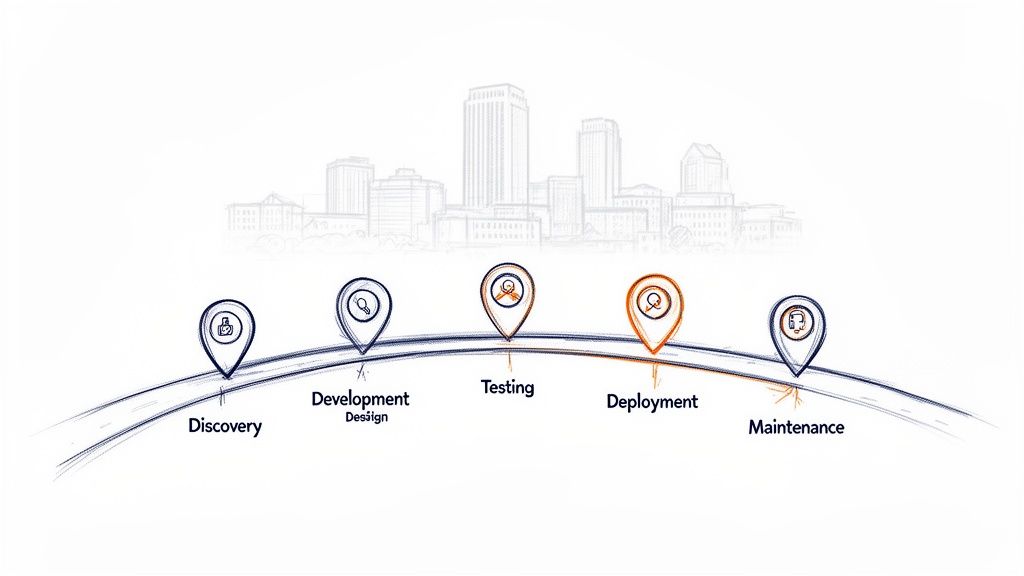
- Our process includes five core stages: Discovery, UI/UX Design, Development, QA Testing, and Deployment/Maintenance, ensuring the final product solves the right business problem.
- We end with a no-obligation Security Risk Audit to show you exactly how a custom solution can drive your business forward.
Let's be honest, building custom software can feel like navigating a minefield. For businesses right here along the I-65 corridor, a "let's just start coding" approach is a recipe for disaster. It almost always ends in glitchy apps, surprise compliance issues, and soul-crushing project delays that bring your business to a screeching halt—costing you thousands in lost revenue.
This is where having a battle-tested enterprise software development process saves the day. It’s not just a fancy term; it's the strategic blueprint that prevents that chaos. Think of it as the step-by-step guide that takes your project from a back-of-the-napkin idea all the way to a smooth, successful launch.
In this guide, we'll pull back the curtain on how a structured process completely de-risks a project, especially when you’re dealing with tricky standards like HIPAA or CMMC. We're all about turning wasted tech time back into billable hours. See exactly how we build powerful, custom software development solutions that give Indiana businesses a real competitive edge.
Why Your Business Needs a Real Development Process
Is your Johnson County business stuck using clunky, off-the-shelf software that just doesn't cut it anymore? It’s a story we’ve heard countless times in our 17 years of local service. Jumping into building a custom solution without a solid plan is like trying to put up a new office building on the I-65 corridor without blueprints. It's a surefire recipe for chaos, blown budgets, and spectacular failures.
A real, honest-to-goodness development process is that blueprint. It's what stands between you and a software crash that can cost businesses up to $9,000 per minute. A structured plan turns all that time your employees waste wrestling with frustrating software back into productive, billable hours and creates a predictable monthly budget for your IT.
From Costly Chaos to Predictable ROI
When there's no defined process, software projects have a nasty habit of flying off the rails. Teams end up working in their own little worlds, features get tacked on for no good reason, and the final product is a far cry from what you actually needed. That kind of disorganization hits your bottom line, hard.
Picture a manufacturing plant in a Greenwood business park. They're limping along with aging server hardware and an inventory system that belongs in a museum. Their "process" is just reacting to whatever fire pops up next. The result? Constant downtime, lost orders, and a team that’s pulling their hair out. A structured development process fixes it permanently.
A defined process makes things predictable. It sets up clear stages, concrete deliverables, and open lines of communication. Suddenly, every dollar you spend is tied directly to a business goal. That's how you turn an IT expense into a strategic investment that prevents downtime and boosts your ROI.
This is all about building a system that not only works perfectly on day one but also grows and flexes right along with your business. For companies that want to build that kind of consistency, mastering a standard operating procedure template is a great way to create a repeatable framework for getting things done right every time. It's about systemizing success.
Meeting Compliance and Security Head-On
For a lot of businesses in Hamilton County, compliance isn't just a good idea—it's a matter of survival. If you're a healthcare provider tangled up in HIPAA or a defense contractor navigating CMMC, trying to build software without a plan is just asking for trouble.
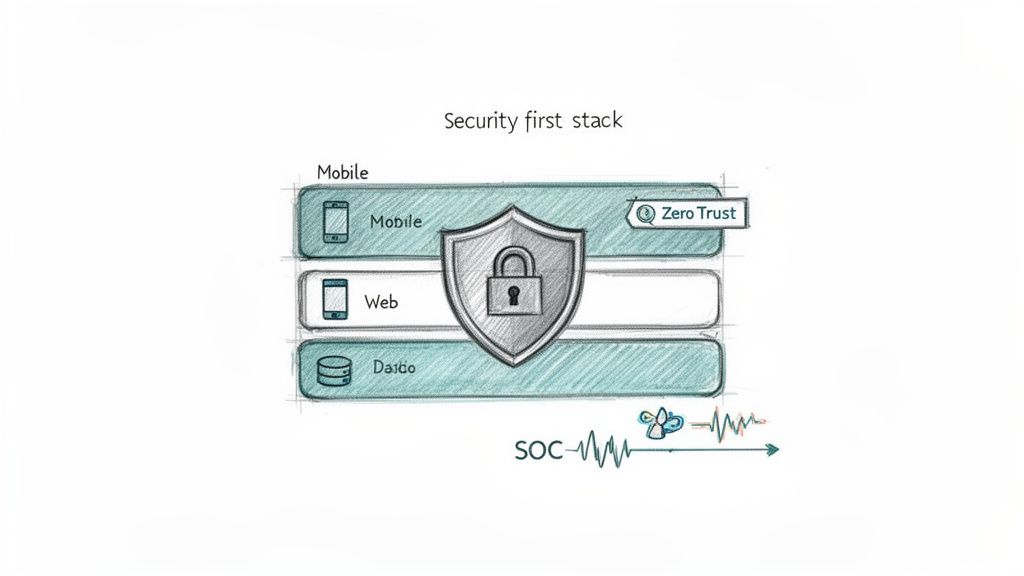
We bake security and compliance into the process from the very first conversation. We don't just build software; we build secure, compliant business assets based on the NIST CSF framework. This isn't an afterthought for us. It means we’re implementing things like:
- Zero Trust Architecture: We operate on a "never trust, always verify" model for every request, which drastically shrinks your potential attack surface.
- Immutable Off-site Backups: Your data gets locked down with backups that can't be changed or deleted, making them a powerful defense against ransomware.
- SOC-as-a-Service Monitoring: We keep a close watch 24/7 to spot and shut down threats before they can ever do any real damage.
This isn't about just ticking a box on a checklist. It's about protecting the future of your business. You can dive deeper into how a structured plan makes all the difference by reading our guide on adaptive software development in Indiana. It’s what keeps you safe from costly data breaches and makes sure your custom tools are a competitive advantage, not a liability.
The Core Stages of Building Custom Software
Think about building a new facility for your business out in a Greenwood business park. You wouldn't just show up with a cement mixer and start pouring a foundation, right? You'd need a detailed blueprint, permits, and a solid plan. Building custom software is no different. The process is that blueprint, breaking down a massive, complex project into stages you can actually manage and understand.
This isn't your grandfather's software development. Gone are the days of rigid, year-long projects that were outdated before they even launched. Today, it’s all about speed and flexibility. In fact, a whopping 94% of organizations now use Agile methods to deliver software in quick, iterative sprints. When you pair that with modern DevOps practices, you get a system that recovers from hiccups faster and allows for constant, meaningful updates. It's a total game-changer, and you can see more on these trends over at Codave.com.
This image perfectly captures the journey from a chaotic mess of ideas to a successful, streamlined launch.
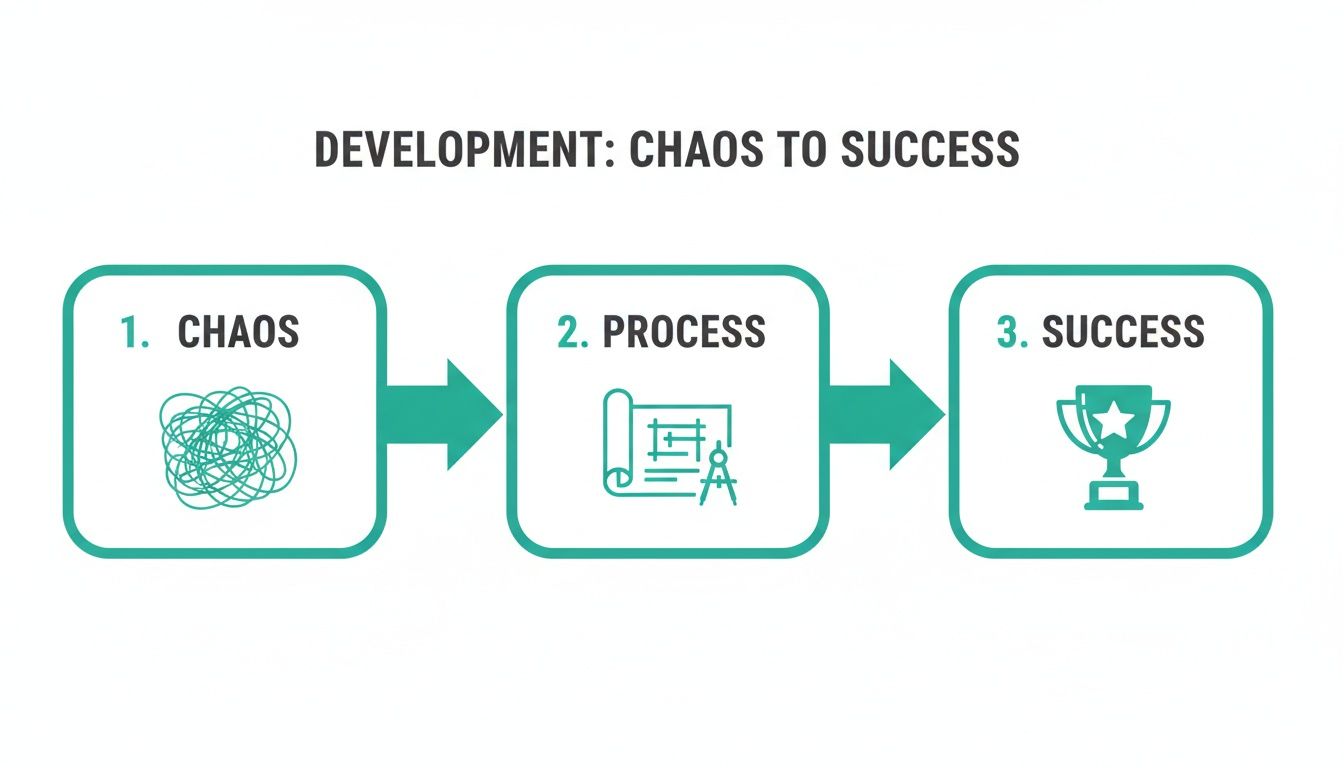
As you can see, a structured plan is the only thing standing between a tangled nightmare and measurable success.
Stage 1: Discovery and Strategy
This is, without a doubt, the most important part of the entire project. Before anyone even thinks about writing code, we need to sit down and figure out the real problem. We're not just asking, "What do you want this to do?" We’re digging deeper to answer, "Why does this need to exist?"
For a logistics company running up and down the I-65 corridor, this means mapping out precisely how a new app will cut down on shipping errors or slash fuel costs. We define what success looks like, calculate the potential ROI, and pinpoint compliance needs—like HIPAA for a clinic in Hamilton County. It's a business conversation first, a tech conversation second.
Stage 2: UI/UX Design
Once we’ve locked down the "what" and the "why," it’s time to tackle the "how." This is where User Interface (UI) and User Experience (UX) design come in. The most powerful software in the world is completely useless if your team hates using it because it's confusing or clunky.
We build interactive wireframes and clickable prototypes that let you get your hands on the application before the real development starts. It’s like taking a virtual walkthrough of your new building before the first wall goes up. This lets us catch design flaws early and guarantees the final product feels natural and efficient for your team.
Stage 3: Development and Implementation
With a solid blueprint in hand, our developers can finally start laying the foundation and building the application. This is where the technical magic happens, but it’s all guided by the strategic decisions we made back in the discovery phase. We use modern, clean coding practices to build software that’s secure, can grow with your business, and won’t be a nightmare to maintain.
We’re big believers in transparency. Throughout the build, we'll give you regular updates and demos so you can see the progress for yourself. This keeps you in the loop and avoids those awful "big reveal" moments where the finished product is nothing like what you imagined.
After 17 years of local service, we’ve seen countless projects go off the rails because the development team was locked away in a dark room. When we dissembled a similar client’s failing RAID array, clear communication was key to recovery. For us, constant communication isn’t just a nice-to-have; it’s the only way to ensure the software we build is the software you actually need.
Stage 4: Quality Assurance and Testing
Before your new software sees the light of day, it has to get through our Quality Assurance (QA) team. Think of them as your toughest critics—their entire job is to try and break the application in every way they can think of. They hunt for bugs, probe for security holes, and double-check that every single feature works exactly as it's supposed to.
This is way more than just clicking buttons. We run thousands of automated tests that check every nook and cranny, and then we follow up with manual testing to see how it holds up in a real-world scenario. This brutal process prevents those launch-day meltdowns that cause expensive downtime and shatter your team's confidence. You can dig deeper into the different frameworks for this by exploring how to start choosing software development life cycle models for Indiana businesses.
Stage 5: Deployment and Maintenance
Deployment day is when we finally flip the switch and take the system live. But our work is far from over. We handle the entire rollout, from migrating your old data to training your staff on the new system. We’ll be watching it like a hawk to make sure the transition is smooth and to squash any little issues that pop up.
After the launch, we shift into maintenance and evolution. Software isn’t a one-and-done deal; it's a living asset that needs care. We provide ongoing support that covers security patches, performance tune-ups, and adding new features as your business grows. This way, your investment keeps paying you back for years to come.
Building Security in from Day One
Let's talk about a classic mistake we see all the time with businesses in the Indy metro area. They treat cybersecurity like the last coat of paint on a new house—something you slap on at the very end. That's a recipe for disaster. It’s like building a bank vault and only checking for cracks after you've stuffed it with cash.
A real enterprise software development process doesn't just add security; it's built on security. It's the foundation, the steel beams, the concrete. Everything else rests on it.
We make security part of the conversation from the first sketch on the whiteboard. This approach has a name: DevSecOps. It's not just a buzzword; it's a practical way to weave security into every single stage of development. We start with a Zero Trust architecture, which means we don't trust anyone by default. Every single request to access data has to prove it belongs. Think of it less like a single bouncer at the front door and more like a security guard in every single room.
From Compliance Mandates to Bulletproof Code
For a lot of downtown Indy tech hubs, rock-solid security isn't just a good idea—it's the law. We’ve seen firsthand how overlooking this can stop a project dead in its tracks and open a company up to some seriously scary legal and financial trouble.
Think about a defense contractor with facilities along the I-65 corridor. They can't just sprinkle some CMMC compliance on top at the end. It has to be baked in from the very first line of code. The same goes for a healthcare provider handling HIPAA-protected data; end-to-end encryption can't be an optional extra. It has to be part of the application's DNA.
In our 17 years of local service, we’ve learned a hard lesson: trying to fix security problems after the fact is at least 10 times more expensive than getting it right from the start. A security-first mindset saves you a fortune in budget overruns and protects the one thing you can't buy back—your reputation.
When you do it this way, compliance goes from being a bureaucratic nightmare to a genuine competitive edge. Your software doesn't just work; it acts as a fortress for your most valuable data. You can see how we put these shields in place by checking out our cyber security services.
Continuous Monitoring and Threat Hunting
Here's a secret: the day your software launches is just day one of its security story. The bad guys are always coming up with new tricks, so your defenses can't ever afford to sleep. That's where continuous monitoring comes in, acting as a 24/7 bodyguard for your application.
We provide SOC-as-a-Service (that's a Security Operations Center), which means our team of experts is always watching your system. They're not just waiting for an alarm from your Bitdefender GravityZone console to go off; they're actively hunting for threats around the clock, using sophisticated tools to spot and shut down suspicious activity before it can do any real damage.
This constant vigilance gives you some huge advantages:
- Catching Threats in Minutes, Not Weeks: We spot potential trouble fast, which dramatically shrinks the window for damage and keeps you from suffering costly downtime.
- Staying Ahead of the Curve: Our team finds vulnerabilities as soon as they're discovered and gets them patched, keeping you one step ahead of the latest threats.
- True Peace of Mind: You get to focus on what you do best—running your business—knowing your custom software is being guarded by a dedicated team of pros.
For a business owner in Johnson County, this means your custom app is never flying solo. By building security in from the start and keeping watch long after launch, we protect your investment, keep your operations running smoothly, and make sure your software remains the powerful, secure tool you need it to be.
How Modern Tools and AI Supercharge Your Software Build
In today's business world, speed is the name of the game. Waiting around for months while a new piece of software gets built is a great way to fall behind. That's why our enterprise software development process isn't just about using fancy new tools—it's about using them to deliver better software, faster, so your business can run circles around the competition.
Think about it like building a house. You could spend a month cutting every single two-by-four by hand, or you could use prefabricated walls and have the frame up in a week. We take the second approach, using low-code platforms to assemble working prototypes from pre-built, battle-tested components.
For Johnson County business owners, this means you get to see, touch, and play with your new software almost right away. This rapid feedback loop ensures the final product is a perfect fit for what you actually need, not just what was on the initial blueprint.
AI: The Coder’s Best Friend
To kick things into an even higher gear, we bring AI-powered code assistants into our workflow. These aren't just glorified spell-checkers. They’re more like an expert co-pilot sitting next to our developers, spotting potential errors, suggesting smarter code, and taking care of the boring, repetitive stuff.
This frees up our certified developers to focus on what humans do best: solving your unique and complex business challenges.
Modern tools, especially those leveraging Large Language Models, can completely change the timeline and outcome of a project. For a Hamilton County business, this translates directly to fewer bugs, a rock-solid application, and a much lower cost to own and operate it over time.
Our Microsoft and Cisco certified pros use this tech-forward mindset for everything we do, from building custom automation to deploying robust UniFi networking with latency-optimized mesh nodes. The result is always a predictable, high-quality outcome that gives your ROI a serious boost.
This is a massive shift in how software gets made. Gartner even predicts that by 2030, a whopping 80% of organizations will have ditched massive engineering teams in favor of smaller, AI-supercharged units. They're expecting productivity to jump by 30-35% as AI starts handling entire workflows, from development to fighting off cyber threats, shrinking projects from months into weeks.
Automation That Works While You Sleep
So, what does all this speed mean for your wallet? It's simple: faster development means lower costs. And getting the finished software to your team sooner means you start seeing a return on that investment sooner.
Our secret weapon is a powerful suite of automated testing tools. A human tester might check a few dozen scenarios in an hour. Our automated systems can rip through thousands of checks in just a few minutes. They work around the clock, simulating user clicks, probing for security weak points, and making sure every piece of the puzzle fits together perfectly.
This approach to quality gives you some major advantages:
- Fewer Annoying Errors: We squash bugs long before your employees ever see them, preventing the kind of tech headaches that can cost a business up to $9,000 per minute in downtime.
- Faster, Safer Updates: With testing running 24/7, we can confidently roll out new features and improvements far more frequently.
- Airtight Security: Automated security scans are constantly on the lookout for new vulnerabilities, protecting your valuable data from threats.
This blend of low-code speed, AI precision, and automated quality isn't just about building software. It's about building a competitive edge for your Indiana business, turning wasted tech time into profitable, billable hours. It’s time to stop waiting and start winning.
Instead of guessing where technology could improve your business, let's find out for sure. We offer a Free Network Assessment for businesses in the Greenwood and Indianapolis area to pinpoint exactly how custom solutions can drive growth and efficiency.
Let's Talk Money: Costs, Timelines, and the Real Payoff
Alright, let's get down to brass tacks. When you're thinking about building custom software for your business, the first questions are always about money and time. You need a straight answer on what it costs, how long it takes, and—most importantly—what you actually get back for your investment. This isn't just about a price tag; it's about what this new tool will do for your bottom line.
A project's budget isn't pulled out of thin air. It's a mix of a few key ingredients: how complex the software is, the specific technology we need to use, and how deeply it needs to plug into the other systems you're already using. We lay all that out for you from day one. But the financial story doesn't just stop when the software goes live.
Looking Beyond the Initial Invoice
A critical piece of the puzzle is the ongoing care and feeding of your new software. Think of it like the regular maintenance on your company's vehicles—you can't just buy them and forget about them. This upkeep, which typically runs about 15-20% of the initial project cost each year, covers things like security patches, essential updates, and making sure everything keeps running at peak performance.
But let's be honest, the real story here is the return on investment. The magic happens when we calculate the hidden costs that are already holding your business back. That clunky spreadsheet your team wrestles with for hours? The manual data entry that’s a breeding ground for mistakes? Those aren't just annoyances; they are actively draining money from your business.
The enterprise software market is massive for a reason, valued at an eye-popping $1.02 trillion recently. A big part of that growth comes from smarter, low-code platforms that can bring costs down. Those yearly maintenance fees? They often shrink because these modern platforms build things right from the start, meaning fewer nasty surprises down the road. If you want to dive deeper into the numbers, the folks at Keyhole Software have some great stats.
Turning Wasted Clicks into Cash
Let's make this real. Picture a local Johnson County business with a team of 10 people. We build a custom app that saves each employee just 30 minutes a day from some tedious task.
- Daily Time Saved: 10 employees x 30 minutes = 300 minutes (that's 5 hours!)
- Monthly Time Saved: 5 hours/day x 21 workdays = 105 hours
- Annual Time Saved: 105 hours/month x 12 months = 1,260 hours
Boom. You've just reclaimed over a thousand hours of lost time and turned it back into productive, billable work. Suddenly, the software isn't an "expense" anymore. It's an investment—an efficiency machine that starts paying for itself from day one.
We've been doing this for 17 years right here in Central Indiana, and we've seen this story unfold over and over. A logistics company in Greenwood slashes dispatch errors by 90%. A professional services firm in Hamilton County automates its invoicing and gets cash in the door weeks faster. The software becomes a vital part of their growth.
A Predictable Budget for Peace of Mind
One of the biggest headaches for any small business owner is the rollercoaster of IT spending. One month it's quiet, the next you're slapped with a huge, unplanned bill to fix an old server. That's exactly the kind of chaos a managed approach eliminates.
When you partner with a managed service provider like Finchum Fixes IT for your software project, you get a predictable monthly budget. You get a local team that’s genuinely invested in your success for the long haul, not some faceless company that vanishes after launch day. This relationship ensures your software stays secure, powerful, and perfectly tuned to your business goals for years to come, preventing the kind of crippling downtime that can cost a business up to $9,000 per minute.
Ready to Build Your Custom Software Roadmap?
Alright, we've walked through the entire playbook—from the initial spark of an idea to the nuts and bolts of the enterprise software development process. You've seen the tools, the team roles, and the real-world ROI. Now, it's time to get the ball rolling.
This is where the rubber meets the road. It's the moment you go from wrestling with a business bottleneck that drives you crazy—like spotty Wi-Fi in an old brick building downtown—to designing a custom-built solution that just works. We're not some faceless vendor halfway across the country; we're your local IT partners, right here, dedicated to solving the real problems Indiana businesses like yours face every day.
Think of it this way: a custom application can help you wrangle your resources and get everything running smoothly, much like when you follow the best practices for cloud migration in Indiana. It's all about making technology work for you, not against you.
Instead of just tossing a generic "contact us" form at you, we want to start by giving you something genuinely useful. Let's kick things off with a Free Network Assessment or a full-blown Security Risk Audit. This isn't a sales pitch; it's a deep dive into your operations to pinpoint exactly where a custom software solution can plug leaks, boost growth, and keep you up and running.
Got Questions? We've Got Answers.
We hear these questions all the time from business owners right here in Indiana who are dipping their toes into the world of custom enterprise software. Asking these questions isn't just smart—it's essential. After 17 years of building solutions for companies just like yours, we've got the straight-up answers you need.
So, How Long Is This Really Going to Take?
Look, anyone who gives you a hard date without knowing the details is just guessing. The honest answer is: it depends. A simple, focused app for one department might be up and running in three to six months. A more complex beast that has to talk to all your existing systems? That's going to take longer.
But here’s the good news. We don't lock ourselves in a room for a year and then surprise you with the finished product. We use Agile methods, which means we build your project in small, bite-sized pieces. You get to see and use new features every few weeks, meaning the software starts paying for itself almost immediately instead of making you wait until the very end.
Isn't Custom Software Crazy Expensive?
We get it. That's the first thing that comes to mind, especially for small businesses in Johnson County or growing companies in Hamilton County. It used to be a massive, all-or-nothing gamble that only the big corporations could afford. Not anymore.
Modern development tools have changed the game, and our phased approach breaks the cost into predictable chunks. We don't just hand you a bill; we build a business case. We'll show you exactly how this software will pay you back—by automating tedious tasks, eliminating costly human errors, and converting all that "wasted tech time" into real, billable work. It stops being an expense and becomes a money-making machine for your business.
What Happens After It's Live? Do You Just Disappear?
Absolutely not. Hitting "launch" is the start of our relationship, not the end. Think of your new software like a high-performance company vehicle; it needs regular tune-ups to keep running smoothly and safely. It's a living part of your business, and we're here to make sure it stays that way.
Our support plans are designed to give you total peace of mind. We handle:
- Ironclad Security: We're constantly patching and updating to stay ahead of the bad guys.
- Peak Performance: As you add more users and data, we'll keep it running fast and smooth.
- Team Support: When your staff has a question or needs a hand, we're here to help.
This isn’t just about fixing bugs; it’s about ensuring your investment continues to deliver value and prevents the kind of catastrophic downtime that can cost a business up to $9,000 per minute.
Your business deserves software that works for you, not against you. The team at Finchum Fixes IT has spent over 17 years building problem-solving tools for companies all over Indiana. Let's find out where your biggest opportunities are hiding.
It all starts with a simple conversation. Schedule your Free Network Assessment today for your Greenwood or Indianapolis area business.