Cyber Security Consulting for Indiana SMBs: 2026 Partner
TL;DR
- A ransomware hit in Greenwood or a phishing click in Carmel isn't just an IT problem. It's a business continuity problem.
- Good cyber security consulting finds weak spots before attackers do, then builds a plan to keep operations moving.
- The fastest wins usually come from risk assessments, incident response planning, endpoint protection, backup review, and staff training.
- Regular red team work can uncover more critical issues than automated scans alone, and focused training can cut phishing success sharply.
- If you handle HIPAA, CMMC, payment data, or sensitive client files, outside guidance usually costs less than a messy recovery.
- The goal isn't buying more tools. It's reducing downtime, tightening process, and turning surprise tech bills into a predictable budget.
Monday, 8:07 a.m. A Johnson County owner opens the office, grabs coffee, and sees a ransom note on the file server. Shared folders are scrambled. The accounting workstation won't open QuickBooks. The front desk can't pull customer records. Someone asks the question every owner hates hearing: “Can we still work today?”
That's the true cost of a cyber attack in Indiana. Not just the cleanup. Not just the stress. It's the lost day, the stalled invoices, the missed appointments, the idle payroll, and the scramble to decide whether your backups are truly usable.
For a lot of Central Indiana shops, this starts with ordinary stuff. An aging server in a Greenwood business park. Spotty Wi-Fi in an old brick building in Franklin. A remote employee using a personal laptop. An office manager who's also the accidental IT department. Nothing dramatic. Until it is.
Downtime gets expensive fast. The author brief for this piece frames it plainly: downtime can cost up to $9,000 per minute. Whether your actual number is lower or higher, the business lesson is the same. Every minute your systems are frozen, your team stops billing, shipping, answering, scheduling, or serving.
Cyber security consulting makes sense when you stop treating security as a software purchase and start treating it as operational insurance with a technical backbone.
That's why this space keeps growing. One market estimate values the cybersecurity consulting market at USD 22.7 billion in 2024, rising to USD 24.4 billion in 2025 and projected to reach USD 50.0 billion by 2035, with incident response as the largest service line at USD 7 billion in 2024 (Wise Guy Reports market estimate). Businesses are paying for guidance before, during, and after attacks because tool sprawl alone doesn't keep the doors open.
If you're already in damage-control mode, a practical first move is this guide on how to recover from a ransomware attack for SMBs. If you're not there yet, good. The better move is making sure you never need it.
Introduction The Real Cost of a Cyber Attack in Indiana
A cyber event rarely announces itself like a movie villain. In Indiana, it usually looks boring at first. A fake Microsoft 365 login page. A “shared invoice” email. A dead switch in a back office that turns out not to be dead at all, but isolated because something inside the network started behaving badly.
In a Greenwood warehouse or a clinic near Carmel, that kind of disruption lands the same way. Work stops. Staff starts guessing. The owner calls whoever touched the network last.
Why this hits local SMBs harder
Small and midsize businesses along the I-65 corridor often run lean. They don't have a full security team, a compliance officer, and a backup engineer sitting around waiting for trouble. They have one IT generalist, or an office manager with admin passwords, or a managed provider that handles the basics but not deeper security planning.
That's where cyber security consulting changes the conversation. Instead of reacting to a breach with panic, you map out the failure points in advance:
- Aging infrastructure: Old Windows servers, unsupported firewalls, and neglected switches create easy openings.
- Weak identity controls: Shared accounts, stale permissions, and inconsistent MFA create silent risk.
- Backup false confidence: Plenty of businesses have backups. Fewer have tested restores, immutable off-site backups, and a recovery sequence that works under pressure.
- No incident playbook: If nobody knows who isolates devices, who contacts vendors, and who talks to staff, the first hours disappear in confusion.
What owners actually buy when they hire a consultant
They're not buying fear. They're buying less chaos.
A useful consultant helps a business answer practical questions fast. Which systems matter most? How long can each one be down? Which risks justify immediate spending? Which ones can wait until the next quarter? Where does a tool like Bitdefender GravityZone fit, and where does process matter more than another dashboard?
Practical rule: If your recovery plan lives only in one person's head, you do not have a recovery plan.
That's why the strongest engagements tie security back to continuity. Keep phones up. Keep line-of-business apps reachable. Keep cloud identities protected. Keep backups recoverable. Keep your team from turning one bad click into a week-long outage.
What Cyber Security Consulting Actually Is
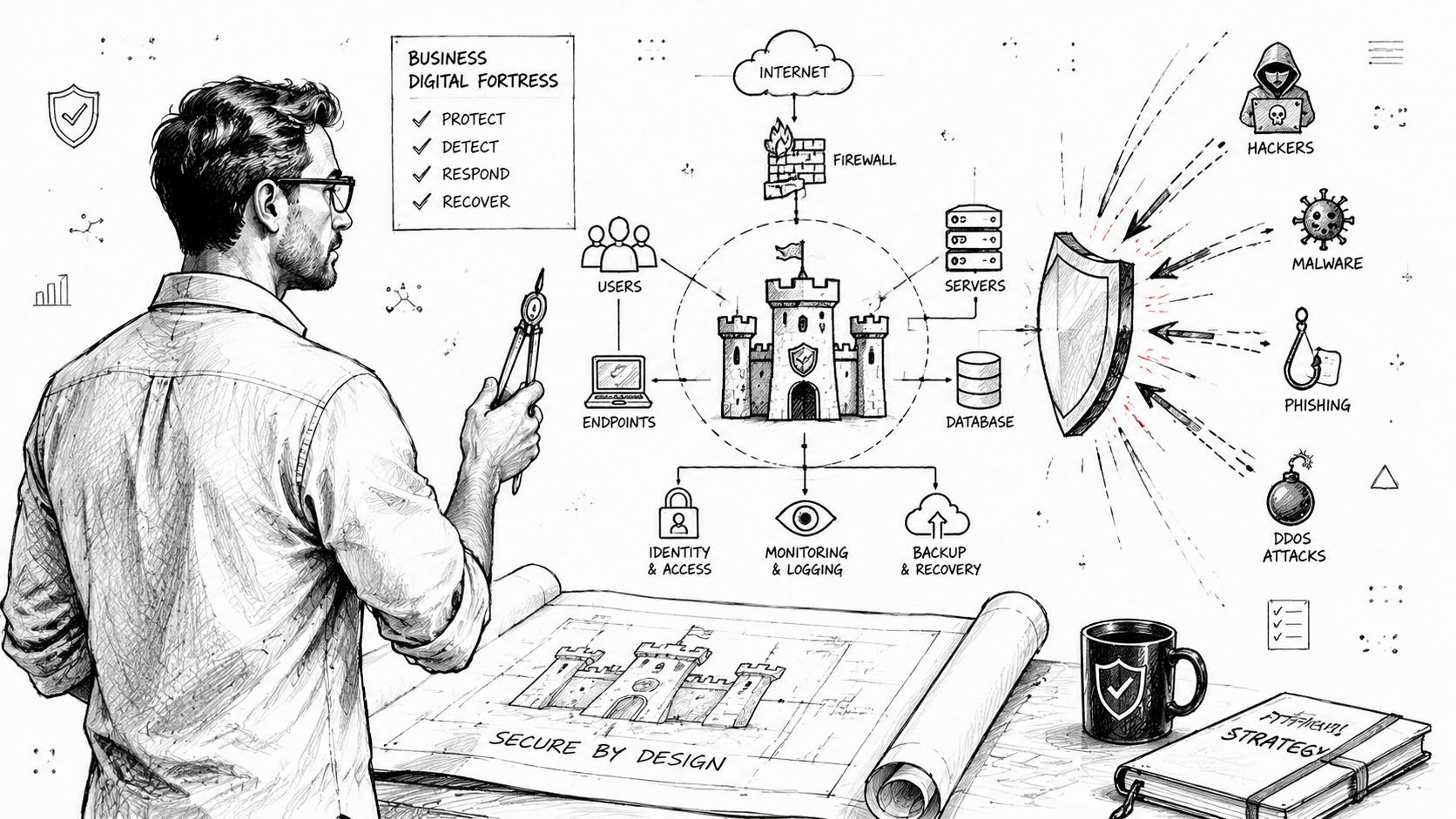
Cyber security consulting is part architect, part inspector, part incident coach. A good consultant doesn't just drop software on your network and leave. They study how your business runs, where it's exposed, and what would hurt most if something failed.
Imagine hiring someone to design a fortress that people can still work inside. The walls matter. So do the doors, the keys, the alarms, the cameras, the fire exits, and the drill everyone follows when something goes wrong.
It's different from everyday IT support
Your regular IT person keeps systems running. They patch machines, reset passwords, troubleshoot printers, and make sure Microsoft 365 and line-of-business apps behave. That work matters. It just isn't the same thing as security strategy.
Security consulting gets more specialized. It deals with questions like:
- Risk modeling: Which systems would cripple the business if compromised?
- Control design: Where do Zero Trust architecture, MFA, RBAC, and endpoint isolation fit?
- Validation: Can your current firewall rules, EDR policies, and backup protections withstand real attacker behavior?
- Compliance mapping: How does your setup line up with NIST CSF, HIPAA, or CMMC expectations?
There's a huge labor reason this matters. A 2026 industry summary says the world faces a shortage of 4.8 million cybersecurity workers, including over 70,000 vacancies in North America (SentinelOne cybersecurity workforce summary). That gap is exactly why local businesses outsource the hard parts instead of trying to hire a full bench of specialists.
What a solid consultant actually does
The useful ones translate technical controls into operating decisions. They'll review your Microsoft 365 tenant, your backup chain, your wireless design, your vendor access, your remote devices, and your endpoint stack. They'll tell you where a UniFi deployment is fine and where it needs segmentation work. They'll explain why a cheap flat network in an old office building becomes a problem the second one infected device shows up.
For businesses with devices beyond ordinary laptops and desktops, Sheridan Technologies' security insights are worth reading because embedded systems bring a different class of risk that many SMBs miss during normal IT planning.
A practical starting point for owners comparing options is this guide to IT consulting services for small business. It helps separate general support from the narrower, higher-stakes security work.
The right consultant doesn't try to impress you with acronyms. They make your attack surface smaller and your bad days shorter.
Core Consulting Services Your Business Needs
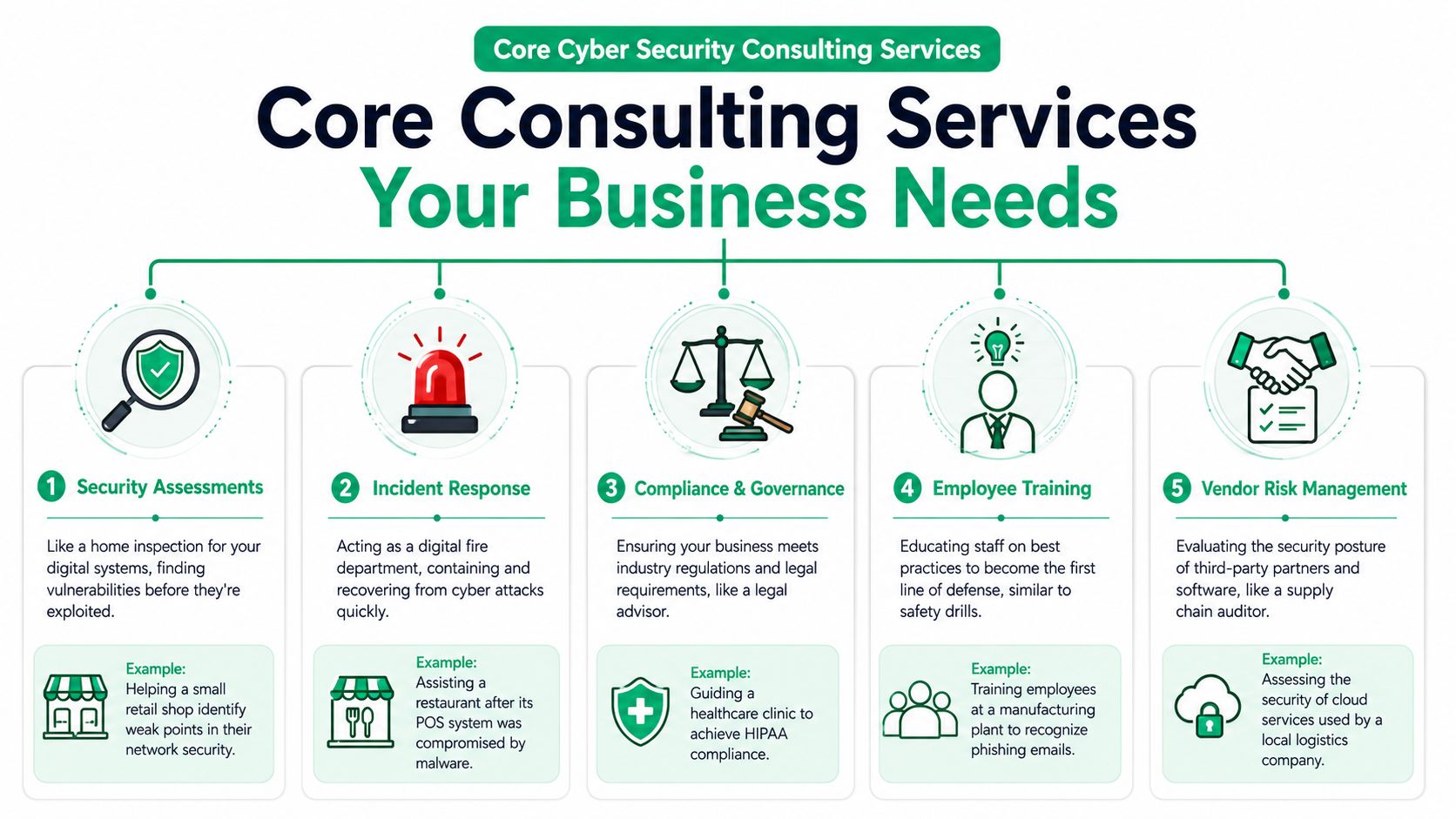
Most owners hear “cyber security consulting” and picture a vague mix of audits, software, and scary reports. In practice, the work usually breaks down into a handful of concrete services.
Here's the short version in visual form.
Security assessments
This is the home inspection of your network. A consultant reviews endpoints, identity controls, patch status, remote access, backup design, firewall rules, cloud apps, and user permissions to find what's weak before someone else does.
For a retail shop on the Southside, that might mean discovering that the POS network and guest Wi-Fi share too much trust. For a small legal office downtown, it might mean stale admin accounts still active for former staff.
If you want a deeper look at what this should cover, this Indiana SMB network security assessment guide lays out the practical checklist.
Managed detection and response
MDR is the overnight guard your business can't hire internally. It combines endpoint telemetry, alert review, threat hunting, and escalation so somebody's watching when your staff is asleep.
A lot of attacks don't smash the front door; they sign in with valid credentials, move slowly, and abuse ordinary tools. Good MDR catches suspicious behavior and helps isolate it before one laptop turns into a domain-wide mess.
Incident response and remediation
When something already happened, this is the emergency crew. They contain the spread, preserve evidence, remove persistence, reset access, validate clean systems, and guide recovery order.
That can include disabling compromised accounts, segmenting infected devices, rebuilding systems, and checking whether your immutable off-site backups are both intact and recent enough to matter. If you've never lived through a bad restore, count yourself lucky. Backup success and recovery success are not the same thing.
A useful outside read on adjacent risk discipline is this piece on preventing corporate fraud with risk management. Different domain, same business truth. Controls matter most before the incident.
Compliance and governance
If you run a healthcare practice in Hamilton County, HIPAA changes the conversation. If you support defense work, CMMC changes it. If you want a sane baseline, NIST CSF gives you a common language for controls and maturity.
This service turns requirements into action. Policies. Access controls. logging. Vendor review. Device encryption. Documentation. Executive sign-off. All the boring things that save you later.
Here's where expert testing earns its keep. Organizations that perform regular red team engagements identify 40% more critical vulnerabilities than those relying on automated scans alone. After targeted post-engagement training, organizations can see a 60% decrease in successful phishing incidents. Those are strong reminders that software-only security misses real-world behavior.
Employee training and vendor risk review
Most Indiana breaches don't start with movie-grade exploitation. They start with a person. A rushed click. A reused password. A fake login page that looked close enough.
Training works when it's short, repeated, and tied to what staff sees. Pair that with vendor review. Your payroll platform, industry software, outside bookkeeper, and cloud file sharing setup all affect your exposure.
One practical option in this space is Finchum Fixes IT, which offers cybersecurity and managed support in the Greenwood area. For SMBs, that kind of provider can sit between general IT support and formal consulting, especially when paired with backup review, endpoint controls, and SOC-as-a-Service monitoring.
Engagement Models and Pricing Demystified
Owners usually ask the cost question first, even if they ask it politely. That's fair. Security spending competes with payroll, rent, inventory, and every other real bill in the building.
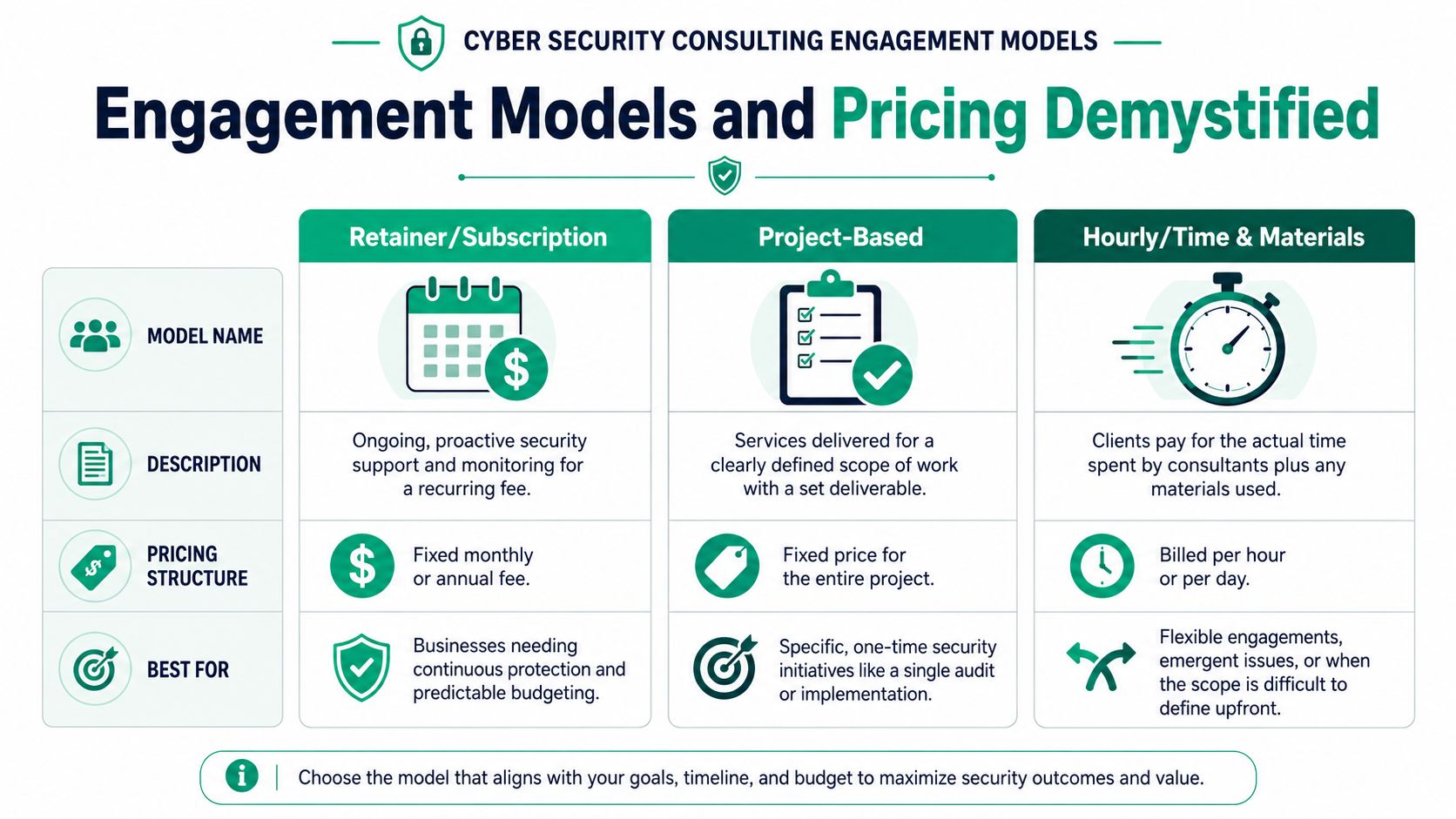
The good news is you don't need to buy everything the same way. Cyber security consulting usually comes in three models, and each fits a different business stage.
The simple breakdown
| Model | Best For | Cost Structure | Example Finchum Fixes IT Service |
|---|---|---|---|
| Retainer or subscription | Businesses that want ongoing security oversight and predictable budgeting | Recurring monthly or annual fee | Ongoing managed IT and security oversight |
| Project-based | A defined need with a clear start and finish | Fixed project scope and price | Network security assessment or compliance review |
| Hourly or time and materials | Urgent issues or work with unclear scope | Billed for actual time spent | Emergency incident response or cleanup |
Project work
This fits businesses that need one big thing done right. A security assessment. A Microsoft 365 hardening project. A backup redesign. A HIPAA gap review. A wireless segmentation cleanup in an old building where the network grew in layers over the years.
The upside is clarity. The downside is drift. Once the project ends, somebody still has to maintain the controls.
Retainers
Retainers work better when the problem isn't one-time. Threats change. Users change. Vendors change. New devices appear. A monthly agreement gives you advisory support, policy review, change guidance, and often some monitoring or recurring testing.
For many SMBs, this is the budget sweet spot. It turns random emergency invoices into a planned operating expense. That matters when you're trying to reduce wasted tech time and keep staff producing billable work instead of waiting on a crisis.
Budget rule: If your current IT spend swings wildly based on disasters, you don't have a technology budget. You have a repair habit.
Fully managed security support
This is the closest thing to outsourcing your security team. Think SOC-as-a-Service monitoring, endpoint management, incident escalation, policy guidance, and regular risk review under one umbrella.
It's a strong fit for growing companies in the Indy metro that need mature protection but aren't ready to hire internal security leadership.
A helpful comparison point is this breakdown of managed IT services cost in Indiana. It's useful when you're trying to decide whether to pay for isolated fixes or move toward a more stable monthly model.
Signs Your Indiana Business Needs a Consultant
Some owners call after a breach. The sharper ones call when the warning lights start blinking.
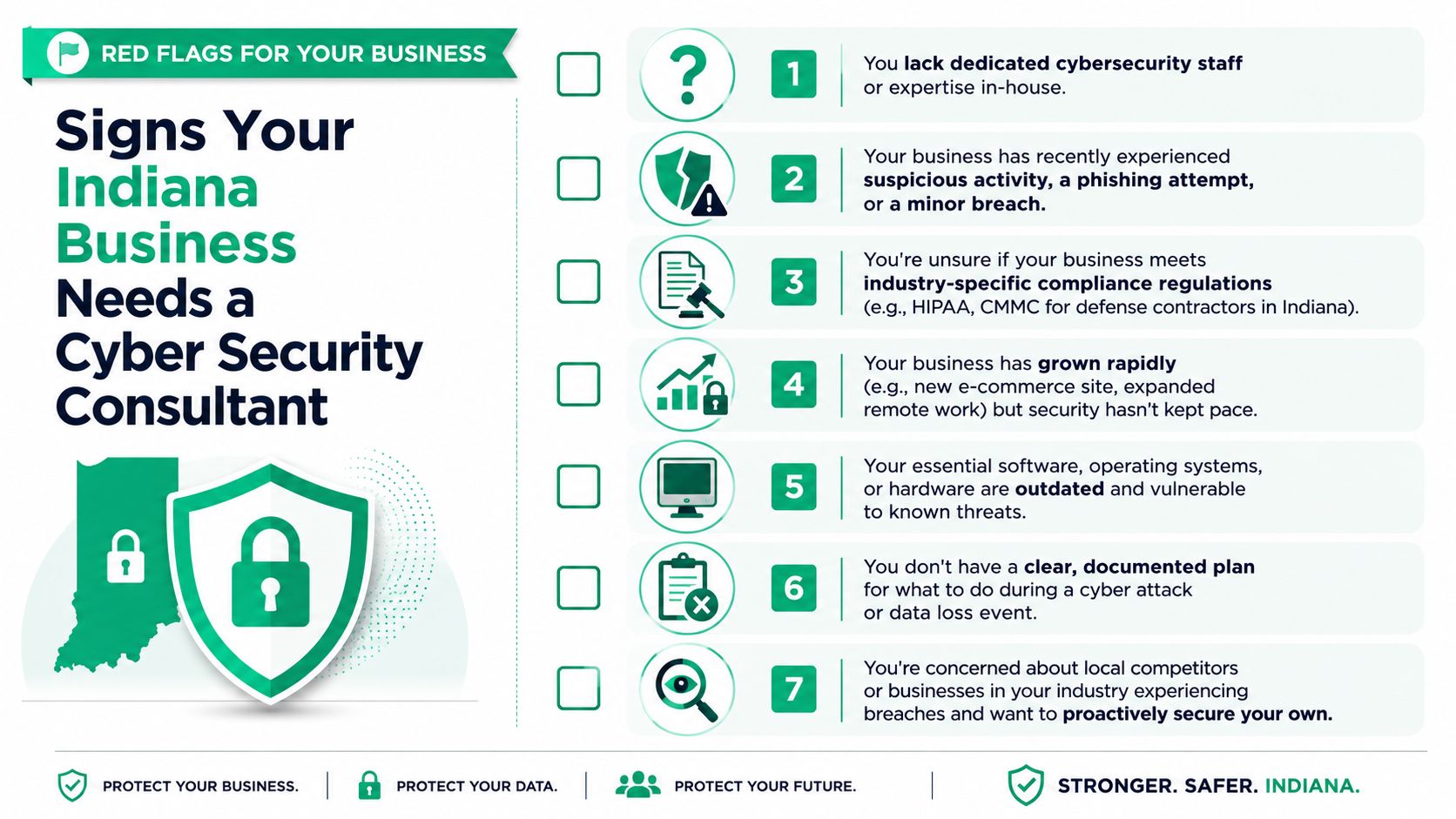
If any of the situations below feel familiar, your business probably needs outside security help.
The red flags that show up first
- You're not sure who owns security. Your MSP handles support, your office manager handles onboarding, and nobody clearly owns policy, permissions, or incident response.
- Your hardware is old enough to be “still working.” That phrase usually means unsupported operating systems, outdated firewalls, and servers one reboot away from a bad week.
- Your Wi-Fi falls apart in older buildings. In Franklin, Greenwood, and parts of downtown Indy, old brick and patched-together expansions create strange dead zones and poor segmentation. Spotty connectivity often points to wider network design issues.
- A phishing email almost got someone. “Almost” is useful. It means you got a warning shot.
- You're adding remote staff or cloud apps faster than controls. Microsoft 365, file sharing, VPN access, BYOD, and third-party SaaS can sprawl.
Compliance fear is a real sign
Healthcare groups in Carmel and elsewhere often know they need HIPAA safeguards, but they're fuzzy on audit trails, device encryption, access reviews, and incident documentation. Manufacturers and specialty contractors near the I-65 corridor hear “CMMC” for the first time and realize their existing IT setup was never built for that standard.
Consulting directly helps here. Aligning with frameworks like NIST CSF through consulting can lead to a 50% reduction in compliance-related fines, and a consultant-developed incident response plan can reduce breach containment time from an average of 287 days to under 72 hours. Those are major differences in both legal exposure and operational disruption.
You don't have a real incident plan
A lot of businesses think they do. Then you ask three questions.
- Who isolates infected devices
- Who contacts cyber insurance and vendors
- Which systems come back first
If those answers aren't written down, tested, and shared, you're still improvising.
A good self-check starts with a practical IT security audit checklist for Indiana businesses. It helps owners move from vague concern to a clear list of risks, controls, and next actions.
You don't need a consultant because your business is large. You need one when your systems became important enough that guessing is expensive.
Hiring the Right Partner A Checklist for SMBs
Not every consultant is useful. Some sell tools they barely configure. Some hand you a thick report, then disappear. Some know enterprise jargon but can't explain how a Greenwood office should recover from a failed server, a compromised Microsoft 365 account, and a broken backup chain in the same week.
A good hiring process filters that out quickly.
Questions worth asking in the first meeting
Ask these plainly and listen for clear answers.
- What do you do in the first week? You want a concrete answer involving discovery, access review, backup validation, endpoint review, and risk ranking.
- How do you handle HIPAA, CMMC, or NIST CSF mapping? If they talk only about antivirus, keep looking.
- What's your approach to immutable off-site backups? They should explain retention, separation, restore testing, and recovery order in business terms.
- How do you validate controls? Look for mention of assessments, pentesting, red team exercises, and incident simulations, not just checkbox audits.
- What happens during a live incident? They should be able to describe containment, communications, evidence handling, credential resets, and staged recovery without sounding rehearsed.
What strong answers sound like
They ask about your line-of-business apps. They care which files keep revenue moving. They want to know whether your plant floor equipment, scheduling software, or cloud ERP can tolerate downtime. They don't jump straight to product catalogs.
In our 17 years of local service, one lesson keeps repeating. The best technical fix fails if it doesn't match the business workflow. A beautifully hardened setup that blocks your staff from doing normal work will be bypassed by Friday. Good consultants understand that tension and design around it.
Hiring test: Ask them to explain Zero Trust architecture and backup recovery to your operations manager without using buzzwords. If they can't, they probably can't run your incident calmly either.
A practical checklist before you sign
| Checkpoint | What to look for |
|---|---|
| Local responsiveness | Can they support urgent issues in Greenwood, Indianapolis, and nearby counties without a long handoff chain? |
| Technical range | Do they understand endpoint security, cloud identity, Wi-Fi design, backup architecture, and compliance work? |
| Business continuity focus | Do they ask what must stay online first, not just what tool you want to buy? |
| Documentation quality | Will they leave you with usable runbooks, asset records, and access controls, not just slide decks? |
| Testing discipline | Do they talk about restore tests, policy reviews, and validation, not assumptions? |
One more thing. Ask for plain-English reporting. If a provider can't summarize risk in a way an owner, controller, or office manager can act on, the engagement will stall.
Your Next Step Toward a Secure Business
Cyber security consulting isn't a luxury line item for big companies. For Indiana SMBs, it's often the difference between a bad morning and a lost week. The value isn't abstract. You reduce downtime, tighten process, make budgets more predictable, and stop relying on luck.
For some firms, outside consulting is also the bridge while they sort out long-term hiring. If that's on your roadmap, resources like Nexus IT Group cybersecurity recruitment can help you understand the staffing side while you stabilize operations now.
If you're in Greenwood, Indianapolis, or the surrounding metro, the smart next step is simple. Get a clear picture of your current risk before you have to make decisions under pressure.
If you want that picture, schedule a Free Security Risk Audit with Finchum Fixes IT. It's a straightforward way for Greenwood and Indianapolis businesses to review weak points, backup readiness, compliance exposure, and the practical steps needed to keep operations running when something goes wrong.