Indiana Cybersecurity Insurance Requirements: SMB Guide
TL;DR
- Cybersecurity insurance requirements are tighter than they were even a year ago. Carriers now ask for proof that controls are in place and working.
- Indiana small and midsize businesses are getting tougher renewal questions about MFA, endpoint detection, backups, security awareness training, patching, vendor risk, and incident response documentation.
- Small companies are still frequent targets, and many remain underinsured or uninsured. That leaves owners exposed to both the attack and the recovery bill.
- Generic insurance checklists miss local compliance pressure. For Indiana businesses, that includes state breach obligations now and the Indiana Data Privacy Act taking effect in 2026, plus sector rules tied to HIPAA, CMMC, and customer contract requirements.
- The practical path is straightforward. Assess the gaps, fix the highest-risk issues first, document the controls, and give the underwriter evidence they can verify.
- Strong security reduces claim risk, but it also limits downtime, protects receivables, and makes IT spending easier to plan.
A Greenwood owner gets a renewal notice on Monday morning and realizes the policy is no longer a simple yes-or-no purchase. The carrier wants screenshots, policy documents, backup details, and answers that can survive technical review.
That shift is hitting businesses from Greenwood to Carmel to the I-65 corridor because many local environments grew in layers. A company added Microsoft 365, kept the old file server, left remote access in place for a vendor, and never fully cleaned up admin rights or backup testing. Underwriters know that pattern. They price for it.
For Indiana businesses, the insurance question is also becoming a compliance question. If you collect consumer data, store employee records, process cards, support healthcare clients, or serve manufacturers with defense work, your controls now affect coverage, contract risk, and legal exposure at the same time. The Indiana Data Privacy Act in 2026 will add more pressure on companies that already run lean and do not have an internal security team.
Owners usually do not need a bigger stack first. They need the basics configured correctly and documented well. If the renewal paperwork is still a few months out, these cybersecurity tips for Indiana small business owners are a solid starting point for cleaning up the issues underwriters ask about most often.
Introduction: That Shocking Cyber Insurance Renewal Notice
A Johnson County business owner opens a renewal packet and sees new language that wasn’t there last year. The carrier wants evidence of controls. Not a verbal confirmation. Not “our IT guy handles it.” Evidence.
That’s become normal from downtown Indy to Hamilton County growth corridors. Cyber insurers don’t just ask what industry you’re in. They want to know whether your environment is easy to break into, easy to contain, and possible to recover.
What changed
Insurance carriers got tired of paying claims from preventable failures. Weak remote access, old servers, poor patching, bad backups, shared admin accounts, and no response plan turned too many incidents into expensive disasters.
Now underwriters treat cybersecurity insurance requirements like underwriting for fire protection. If the sprinklers are disconnected and the exits are blocked, coverage gets harder and more expensive.
A cyber policy used to feel like a safety net. Now it feels like a building inspection.
Why this hits Indiana SMBs harder
A lot of local businesses still run a mix of old and new systems. That’s common in older brick buildings with stubborn wiring, repurposed office space near Greenwood business parks, and small operations that added cloud apps without fully cleaning up on-prem equipment.
That hybrid mess creates blind spots. One old line-of-business server, one open remote access path, or one unmanaged laptop can sink a renewal.
The hard truth is that cyber insurance is now tied directly to business continuity. If your controls are weak, the insurer sees higher odds of a long outage. If your controls are solid, the carrier sees a business that can contain damage and get back online fast.
Why Your Cyber Insurance Renewal Became an Inquisition
The insurance market changed from “tell us about your environment” to “prove your environment won’t melt down.”
As of 2025, insurers are mandating that organizations demonstrate strong security practices before approval, and 85% of cyber insurance underwriters use AI and predictive analytics during policy issuance and renewal to assess risk, according to All Covered’s review of cyber insurance requirements. That means your answers are being tested against patterns, not skimmed by someone checking boxes.

The Greenwood version of the problem
Take a common setup in a Southside office park. There’s an aging Windows server humming in a closet, a firewall that hasn’t had its rule set cleaned up in years, remote desktop exposed somewhere it shouldn’t be, and staff using the same laptop at the office and at home.
That environment may “work” day to day. An underwriter sees something else. They see old attack paths, weak containment, and a high chance that one stolen password turns into a full outage.
What underwriters actually care about
They want proof that your business can do three things:
- Stop easy attacks: MFA, email protection, and account controls shut down the cheap attacks that still work.
- Detect bad behavior fast: EDR and monitoring catch the attacker who slips past the first layer.
- Recover without begging: Backups, documented recovery steps, and tested procedures keep a bad day from becoming a business-ending event.
That’s why renewal forms now read like technical audits. Carriers aren’t being dramatic. They’re trying to avoid writing policies for companies that can’t survive an incident.
Why questionnaires aren't enough anymore
A lot of businesses answer renewal forms optimistically. “Yes, we have backups.” But are they immutable off-site backups, or just a sync that ransomware can encrypt too? “Yes, we use MFA.” But is it enforced for admin accounts, VPN, cloud email, and remote access, or only for one app?
That gap between “we have something” and “we have the right control, fully enforced, documented, and testable” is where deals fall apart.
If you’re trying to figure out what your insurer is really asking for, start by understanding the difference between a simple scan and a deeper security exercise like vulnerability assessments versus penetration testing. Underwriters increasingly expect the first and pay close attention when a business can show maturity beyond it.
Practical rule: If a control can’t be verified with logs, screenshots, policies, or reports, don’t assume the underwriter will give you credit for it.
The Underwriter's Hit List Core Security Controls
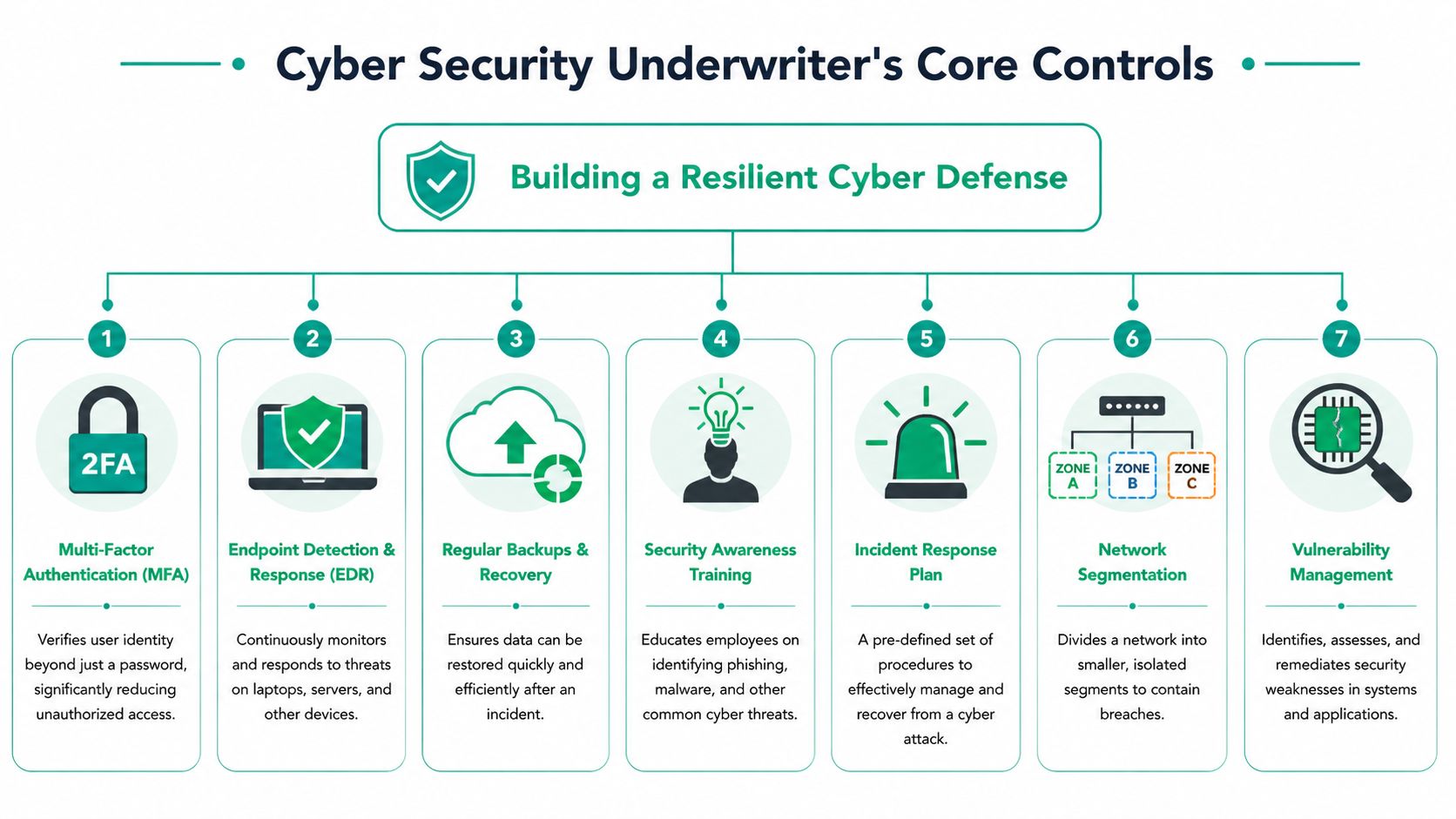
Most cybersecurity insurance requirements boil down to a short list of controls that reduce claim severity. Some are technical. Some are procedural. All of them matter because they shape how far an attack can spread and how long your business stays down.
The visual below captures the controls most carriers care about first.
MFA has to be everywhere that matters
Multi-Factor Authentication is no longer a nice extra. It’s the floor.
According to KuppingerCole’s analysis of cyber insurance coverage requirements, MFA blocks over 90% of credential-stuffing attacks, insurers demand it on admin accounts, remote access points like RDP, and cloud email, and implementation can reduce premiums by 15% to 30%. That same analysis notes EDR is universally mandated and can reduce mean time to detect a breach from days to under an hour.
What good looks like in practice:
- Admin protection: Every admin account gets MFA. No exceptions for executives, legacy service access, or “trusted” users.
- Remote access lockdown: RDP, VPN, and third-party remote tools must require MFA before a session opens.
- Cloud identity coverage: Microsoft 365, Google Workspace, and line-of-business SaaS need enforcement, not optional enrollment.
For local companies, this usually means centralizing identity instead of letting every app manage logins differently. Tools like Microsoft Entra ID, Duo, and Okta make that realistic. The bad version is SMS-only for one app while old remote tools still allow password-only access.
If you want the deeper implementation side, this guide on multi-factor authentication best practices is worth keeping handy.
EDR is the control that tells you what actually happened
Traditional antivirus looks for known bad files. Endpoint Detection and Response watches behavior. It tracks process execution, suspicious scripts, strange network activity, persistence attempts, and the kind of living-off-the-land behavior that slips past old-school tools.
For insurers, that matters because EDR shortens the time between compromise and containment. A laptop gets isolated. A malicious process gets killed. An analyst sees whether the attacker touched one machine or many.
Common SMB options include Microsoft Defender for Endpoint, Bitdefender GravityZone, SentinelOne, and CrowdStrike Falcon. The best results come when EDR feeds into a monitored workflow such as SOC-as-a-Service or managed detection and response.
What doesn’t work:
- Installing EDR on some devices but not servers
- Leaving stale laptops unmanaged
- Ignoring alerts because nobody owns after-hours response
If the tool sees the attack at 2:13 a.m. and nobody reacts until staff clock in, you paid for visibility without buying containment.
Here’s a solid primer if you want a quick walkthrough before going further:
Backups must survive the attack
A backup only matters if ransomware can’t touch it.
That’s why insurers push for immutable off-site backups, isolated storage, and recovery testing. In plain English, your backup system should make it hard or impossible for an attacker with admin access to encrypt, delete, or covertly corrupt the only clean copy of your data.
A lot of Indiana SMBs still confuse file sync with backup. OneDrive sync, SharePoint sync, and mirrored NAS replication all have value, but none of them automatically count as recovery-grade protection.
Good backup posture usually includes:
- Server image protection: Full system recovery for key infrastructure.
- Data-level backups: Databases, file shares, line-of-business app data.
- Cloud app backup: Microsoft 365 and other SaaS data that businesses assume is fully recoverable until it isn’t.
- Immutable or air-gapped copies: Copies an attacker can’t rewrite during the blast.
- Tested restore procedures: Somebody has to prove recovery works.
In our 17 years of local service, one of the most painful recoveries involved a business that believed its RAID array was the backup. It wasn’t. When the array failed and the synced copy had already replicated damaged data, bit-level recovery became a last resort instead of a planned restore. That’s a brutal way to learn the difference.
Access control, training, and response planning close the gap
Insurers also look hard at the controls around the technology.
Privileged access management
Too many SMBs still have shared admin passwords, domain-wide rights handed out for convenience, or old vendor accounts left active forever. That’s the opposite of Zero Trust architecture.
Underwriters want to see least privilege. Admin rights should be separate from day-to-day accounts. Privileged access should be limited, reviewed, and logged.
Security awareness training
Employees don’t need a lecture. They need repetition and realism. Short phishing simulations, role-based reminders, and practical examples beat annual checkbox training every time.
The business reason is simple. If users keep handing over credentials, your shiny stack still gets tested the hard way.
Incident response plan
You need a written plan that names who does what when systems go sideways. Not a folder called “incident response” that nobody has opened in two years.
A usable incident response plan should answer:
- Who authorizes shutdowns
- Who calls legal or cyber insurance contacts
- Which systems are restored first
- How evidence is preserved
- How staff communicate if email is down
The first hour of an incident is no time to decide who owns the decision.
Network segmentation and vulnerability management
Flat networks make life easy for attackers. Segmenting workstations from servers, isolating sensitive systems, and limiting east-west movement gives defenders time and options. UniFi networking can support sensible segmentation for many SMB environments when it’s designed correctly, but merely owning the hardware isn’t the same as enforcing the policy.
Vulnerability management matters for the same reason. Carriers don’t expect perfection. They do expect you to know what assets you have, which ones are exposed, and how you’re handling patching for operating systems, firmware, and critical applications.
Your Practical Remediation Checklist for Indiana Businesses
The fastest way to fail cybersecurity insurance requirements is to treat them like paperwork. The right way is to build an evidence package around actual controls.
Generic compliance advice usually misses the local context. An Indiana business has to think beyond the standard insurer checklist and account for its industry obligations, data handling practices, and how state requirements affect notification and response.
Start with inventory, not tools
Before buying anything, build a real asset inventory. That means servers, laptops, firewalls, cloud tenants, Microsoft 365 admins, vendor access paths, backup platforms, wireless gear, and line-of-business applications.
A proper audit isn’t just “what devices are online today.” It should identify who owns each asset, how critical it is to operations, and what would happen if it went down during a Monday morning rush.
For a practical framework, use an Indiana business IT security audit checklist as the basis for your review.
Fix the controls that block underwriting first
If you’re in Greenwood, Carmel, or Fishers, don’t waste weeks polishing lower-risk items while the insurer is waiting on the basics.
Use this order:
- Identity first: Enforce MFA on admin, remote access, email, and key cloud apps.
- Endpoint next: Roll out EDR across laptops, desktops, and servers. Verify policy coverage for every device.
- Backups after that: Confirm immutable off-site copies and test restores.
- Exposure cleanup: Remove stale accounts, close unnecessary remote access, patch internet-facing systems.
- Documentation: Save policy screenshots, export reports, keep training records, and write response procedures.
Build the packet the underwriter wants
An insurer usually responds better to clean proof than long explanations. Give them a tight set of artifacts.
That packet should include items such as:
- Policy evidence: MFA enforcement screenshots and access policies
- Endpoint reports: EDR deployment summaries showing coverage
- Backup proof: Job success reports, retention settings, and restore test notes
- Training records: Completion logs and phishing simulation summaries
- Response documents: An incident response plan with current contacts
- Vulnerability workflow: How findings are tracked and remediated
Here’s a working checklist you can adapt internally:
| Control Area | Requirement / Action Item | Status (Not Started / In Progress / Complete) |
|---|---|---|
| Identity Security | Enforce MFA for admin accounts, remote access, cloud email, and key SaaS platforms | |
| Endpoint Protection | Deploy EDR to all workstations, laptops, and servers | |
| Backup and Recovery | Verify immutable off-site backups and test restores for critical systems | |
| Access Control | Remove shared admin accounts and review privileged access | |
| Training | Run recurring security awareness training and phishing exercises | |
| Incident Response | Create and review a documented incident response plan | |
| Vulnerability Management | Scan, prioritize, patch, and document remediation activity | |
| Network Security | Segment sensitive systems and review firewall and remote access rules | |
| Documentation | Prepare an evidence package for underwriting and renewal |
Good remediation work is boring on paper. That’s a compliment. Underwriters like boring because boring is predictable.
The Indiana Advantage Meeting Local Compliance Demands
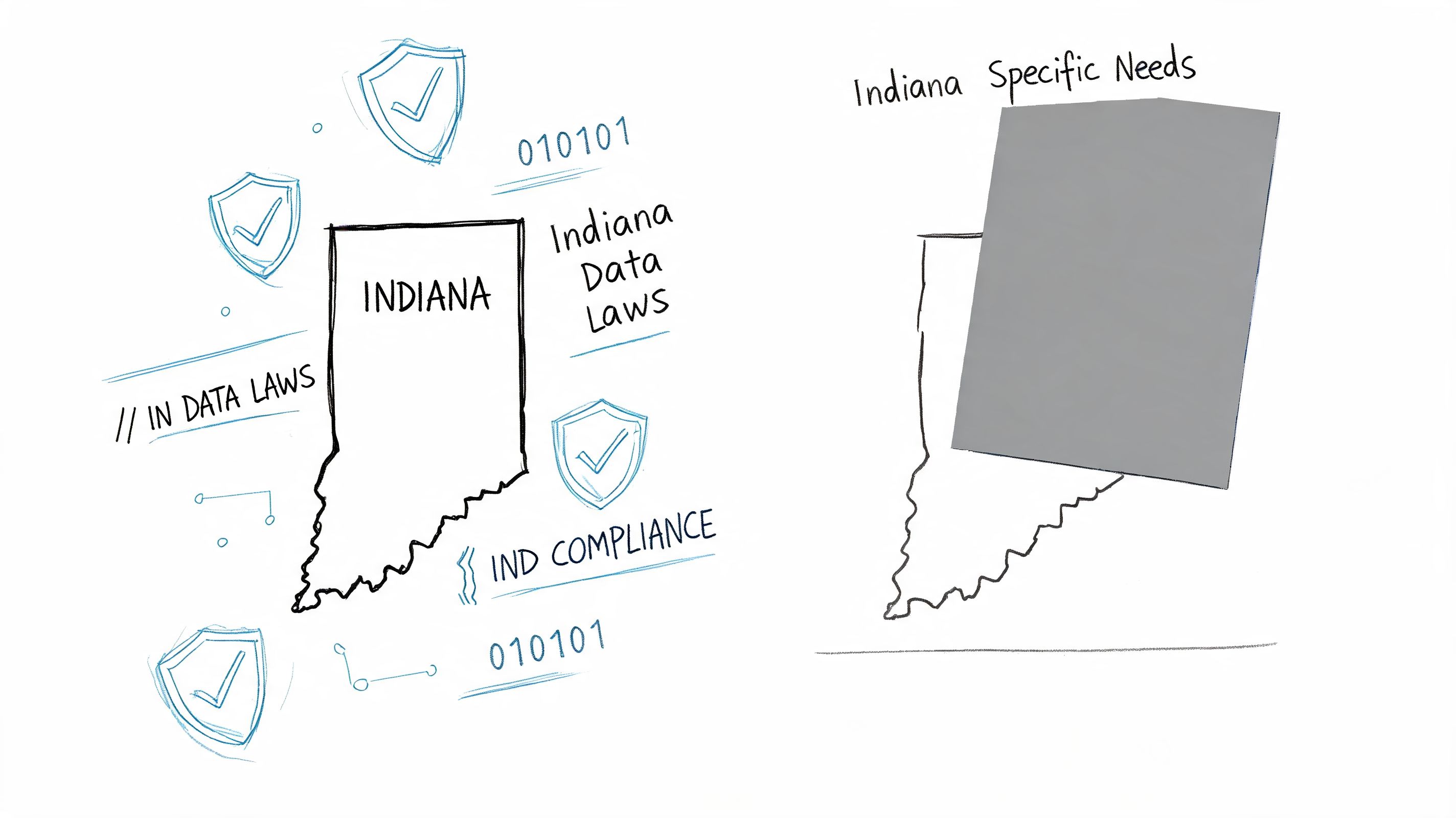
A Greenwood business can answer every underwriter question on a national form and still be exposed locally. I see it with clinics off State Road 135, professional offices in Carmel, and manufacturers shipping up and down the I-65 corridor. The controls may look fine on paper. The problem starts when the policy, your incident process, and Indiana-specific obligations do not line up.
That matters more with the Indiana Data Privacy Act taking effect in 2026. For many Indiana companies, cyber insurance is no longer just a transfer-of-risk purchase. It is tied to whether the business can show reasonable security practices, a documented response process, and a defensible path for handling consumer data, regulated records, and third-party access.
Where Indiana firms get tripped up
The weak spot is usually not one missing product. It is the gap between a generic security answer and the way the business operates in Indiana.
A renewal application asks whether you have an incident response plan. A Greenwood medical practice may answer yes because a document exists in SharePoint. Under stress, that same practice may still struggle to decide who calls counsel, who preserves logs, who handles patient communications, and how insurance notice requirements fit beside HIPAA duties and state obligations. That is the kind of mismatch that creates coverage disputes and compliance pain at the same time.
Indiana businesses run into the same issue with vendors, franchises, and multi-site operations. A company in Carmel might outsource IT, use a cloud ERP, and rely on a payroll provider, while a warehouse south of Indy uses older line-of-business systems and remote access for outside support. Both can tell an insurer they have security controls. Only one may be able to prove who had access, what data was touched, and how a breach response would run on a bad Monday morning.
Sector examples around Central Indiana
Healthcare and HIPAA
Healthcare groups in Johnson County and across the south Indy suburbs have a narrower margin for error. Access logging, workforce training, device control, and downtime procedures all affect both compliance and insurability. If protected health information is involved, the policy application and the response plan need to match how the practice really handles records, imaging systems, email, and third-party billing support.
Defense and CMMC
Shops supporting defense work around Indianapolis and along the I-69 corridor face a different problem. Contract language often drives stricter logging, access control, and documentation requirements than a small manufacturer expects. If the insurer asks about MFA, privileged access, and monitored endpoints, those answers should line up with CMMC and NIST 800-171 obligations, not just with what the MSP says is installed.
General business under the Indiana Data Privacy Act
Retail, logistics, professional services, and multi-location SMBs need to pay closer attention to consumer data handling before 2026. The Indiana law raises the stakes on data inventories, vendor oversight, and how the business documents its privacy and security decisions. A company does not need to be large to create a real compliance problem. It just needs to collect enough personal data and fail to manage it consistently.
Why local assessments reduce renewal friction
A useful local assessment asks harder questions than a canned checklist:
- What personal, financial, health, or operational data sits inside this business right now?
- Which Indiana and industry-specific obligations apply when systems are unavailable or data is exposed?
- Do vendor contracts create stricter security or reporting duties than the policy assumes?
- Can the business show a clear chain from control implementation to claim-time evidence?
That work pays off because it forces decisions before a renewal or incident. It also gives owners something underwriters respect. Clear documentation, current diagrams, named response roles, and a tested process. If your team needs a starting point, use this cybersecurity incident response plan template for Indiana businesses and tailor it to your actual vendors, counsel, and reporting obligations.
Insurance underwriting follows the same logic as understanding commercial truck insurance premiums. Carriers price the risk they can verify, not the story a business hopes is true.
A policy is easier to defend when your Indiana compliance duties, technical controls, and incident process all point in the same direction.
Reading the Fine Print Exclusions Limits and Cost Drivers
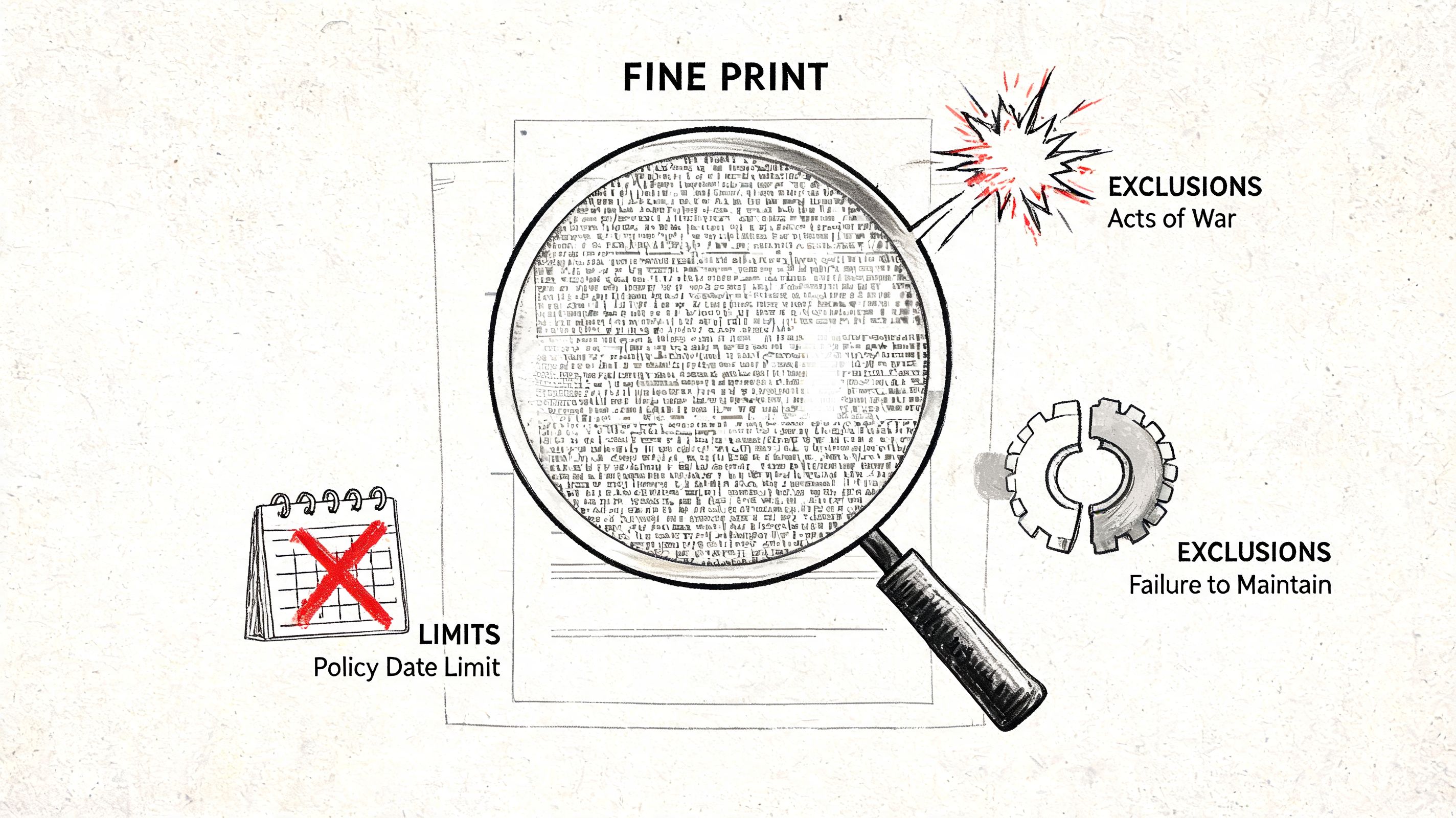
A cyber policy helps. It doesn’t erase negligence, bad assumptions, or sloppy maintenance.
That’s why the fine print matters as much as the declarations page. Many business owners focus on the coverage amount and miss the operational conditions tied to it. If your policy says you must maintain certain controls and you stop maintaining them, you’ve created a claims problem.
Common trouble spots
Some policies carve out losses tied to pre-existing incidents, failures to maintain stated controls, or specific categories of cyber events. Others place sub-limits on expenses like extortion response, forensics, legal work, or business interruption.
That’s why an owner shouldn’t read cyber insurance like a commodity purchase. It’s closer to other business insurance categories where underwriting depends on operational reality. If you’ve ever looked at understanding commercial truck insurance premiums, the pattern feels familiar. The insurer prices visible risk, maintenance discipline, and loss exposure, not just the asset itself.
What actually influences cost
From a technical standpoint, insurers pay attention to whether your controls reduce the blast radius and shorten outage time. A business running well-enforced MFA, full EDR coverage, tested backups, and continuous monitoring looks more insurable than a business with scattered tools and no proof.
A mature setup often includes:
- SOC-as-a-Service monitoring: Someone watches alerts after hours.
- Documented IR procedures: Staff know what to isolate first and who gets called.
- Stable patch workflow: Critical systems don’t sit exposed because updates are “on the list.”
- Quarterly control reviews: Security settings don’t drift over time.
If your policy language feels vague, compare it against a working incident response plan template for Indiana businesses. The exercise usually exposes whether your documented process is real enough to stand up during a claim.
Conclusion How We Get Your Indiana Business Insurable
Cybersecurity insurance requirements aren’t just an insurance issue anymore. They’re a business operations issue.
If your company can’t prove MFA coverage, endpoint visibility, recovery capability, and documented response discipline, the insurer sees a future claim. If you can prove those things, the conversation changes. You look insurable because you look recoverable.
That matters for businesses across Greenwood, Indianapolis, Carmel, Fishers, and the wider Central Indiana market. The local pattern is familiar. A company grows fast, adds cloud apps, keeps one old server alive too long, lets remote access sprawl, and discovers the weak spots only when renewal season arrives.
In our 17 years of local service, we’ve seen that the businesses with the smoothest renewals usually do three things well:
They simplify the environment
They retire what nobody should be relying on. They standardize laptops, identity, backup platforms, and security tooling. Fewer exceptions mean fewer underwriting headaches.
They document what they already do
A lot of SMBs have decent controls but terrible evidence. Underwriters can’t score what they can’t verify. Screenshots, policy exports, deployment reports, restore notes, and training records turn “we think so” into “here’s proof.”
They tie security to continuity
ROI is realized when security contains an incident quickly, protecting billable hours, reducing wasted tech time, keeping staff productive, and making IT spending more predictable. That’s the difference between a security stack that sits on an invoice and one that protects the business.
For Indiana companies, the local angle matters too. The Indiana Data Privacy Act, HIPAA, CMMC, and NIST CSF expectations don’t sit outside cyber insurance. They shape the insurer’s view of your readiness, your notification discipline, and your likelihood of a messy claim.
If your renewal has already turned ugly, don’t guess your way through it. Start with an actual security review, not another rushed questionnaire. Identify the blockers, remediate the highest-risk gaps, test recovery, and package the evidence cleanly. That’s how a business gets from “high-risk applicant” to “defensible risk.”
If your company is in Greenwood, Indianapolis, or anywhere along the I-65 corridor, Finchum Fixes IT can help you sort out the gap between your current environment and what insurers now expect. A Free Network Assessment or Security Risk Audit is the practical first step if you want clearer answers, a tighter security posture, and a better shot at affordable, defensible coverage.