Digital Transformation Frameworks: A Guide for Indiana Businesses
TL;DR
- A digital transformation framework is a strategic plan to stop reactive IT spending and turn technology into a revenue driver. It prevents costly downtime—which can reach $9,000 per minute—and converts "wasted tech time" into billable hours.
- Ad-hoc tech fixes, like patching an aging server in a Greenwood business park, lead to system failures and security gaps. A structured framework aligns every tech decision with business goals and compliance needs like HIPAA or CMMC.
- Key frameworks include Composable Architecture (flexibility), Cybersecurity-First (risk mitigation), and Process-First (efficiency), each solving different problems for Central Indiana businesses.
- The process involves four steps: Assessment, Strategy, Implementation, and Optimization, using advanced tools like SOC-as-a-Service and immutable backups to ensure predictable budgets and proven ROI.
Let's get real for a moment. A "digital transformation framework" sounds like a stuffy, corporate buzzword, doesn't it? But all it really is is a game plan. It’s your blueprint for making smart, deliberate tech decisions that actually grow your Indiana business, instead of just throwing money at problems as they pop up.
Without a plan, your tech budget becomes a chaotic mess of expensive, reactive fixes.
Turning Your Tech From a Cost Center to a Revenue Driver
For so many business owners in Johnson County, "IT" is a headache that just costs money. An ancient server finally gives up the ghost in a Greenwood office park, or the spotty Wi-Fi in that charming old brick building downtown goes out again, grinding everything to a halt. This firefighting approach is a constant drain, and with downtime costing up to $9,000 per minute, it’s a gamble you can't afford.
This is exactly the cycle that a digital transformation framework is built to break.
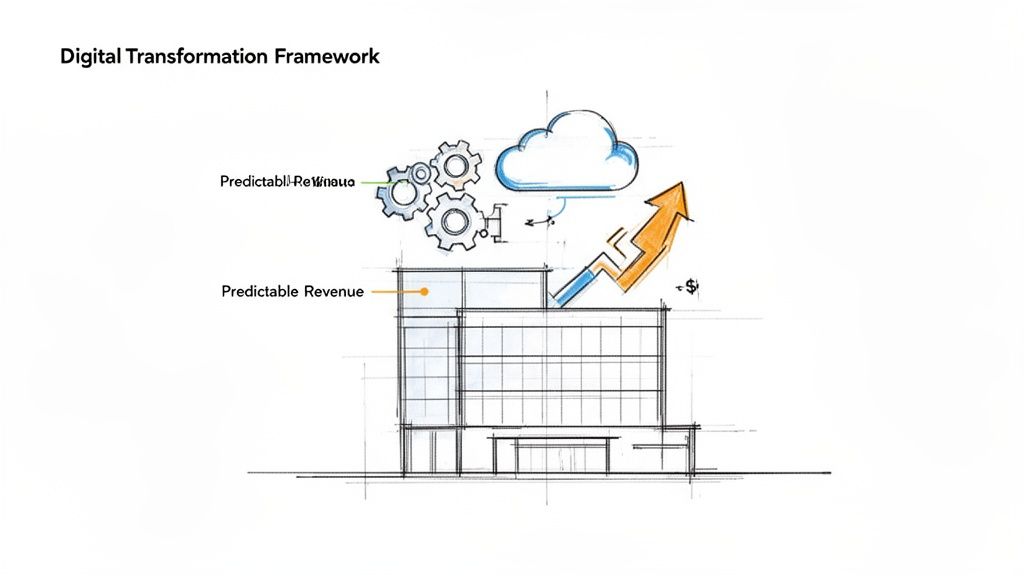
Think of it like building a house. You wouldn't just start nailing boards together without architectural plans, right? A framework is that plan for your business—it helps you build something modern and resilient on purpose, so your technology starts working for you, not against you.
What a Framework Actually Does
A good framework forces you to stop and ask the tough questions before you swipe the company card on that shiny new software.
- Strategy: How is this tool going to help us make more money or stop wasting it?
- Processes: Can we automate repetitive tasks and turn that wasted time into billable hours and create a predictable monthly budget?
- Security: How do we make sure this new system keeps our client data safe and meets compliance rules like HIPAA or NIST CSF?
- People: Who needs training on this, and how do we get the team excited to use it?
For instance, a huge win for many businesses is finally getting a proper customer relationship management system. Before you get lost in the options, understanding what is CRM software is a classic first step. It's the perfect example of moving from a clunky spreadsheet to a tool that gives you intelligence you can actually use.
In our 17 years of local service, we’ve seen the aftermath of "modernizing" without a plan. It always ends the same way: mismatched systems, gaping security holes, and a stack of invoices for tech that never delivered a return. A framework turns that chaos into predictable growth.
Using a structured plan is how you graduate from buying random gadgets to building a cohesive engine for your business. We talk more about this in our guide on legacy system modernization strategies that drive business growth.
It’s about making every single dollar you spend on technology work toward building predictable, reliable revenue. That’s the whole point.
Why Ad-Hoc Tech Upgrades Almost Always Fail
We’ve all seen it happen. A Greenwood manufacturing firm buys a shiny new server because the old one is groaning. Another business slaps on a random software patch to plug a security hole, or they stick a few consumer-grade Wi-Fi extenders on the walls of an old brick building downtown, hoping to kill the dead spots.
We call this the "duct tape and prayers" approach. It's a classic Southside Problem we see all the time, where every tech decision is a reaction. While it feels like you're making progress, you're almost always creating a bigger mess down the road.
You’re left with a chaotic jumble of systems that refuse to talk to each other. Security turns into a nightmare, because every new gadget is another unlocked door for attackers, especially when it’s not part of a unified security plan that meets standards like NIST CSF. This disjointed strategy is more than just inefficient—it's a massive budget drain, causing good digital projects to stumble before they even start.
The True Cost of a Fragmented Strategy
The real problem with these one-off upgrades is the total lack of a strategic "why." When there’s no formal plan, technology decisions happen in a vacuum. Sales buys a new tool without telling IT, operations installs equipment that’s incompatible with the network, and the finance team is left pulling their hair out, wondering why the tech budget is spiraling out of control with nothing to show for it.
This is exactly why so many digital initiatives fail. Even with global spending on these projects expected to hit nearly $4 trillion by 2027, a jaw-dropping 65% of them don't deliver. The good news? Companies using holistic digital transformation frameworks are 20% more likely to hit their targets because they’re forced to think about how every single tech decision affects costs, customers, and daily operations. You can see more data on why a good partner can bridge that success gap for Indiana businesses.
A formal framework prevents these headaches from the start. It forces every technology decision to align with clear business goals, turning random acts of IT into a coordinated strategy.
From Reactive Fixes to a Cohesive Roadmap
Instead of just reacting to failures—like that time when we dissembled a similar client’s failing RAID array to perform bit-level data recovery—a strategic partner builds a roadmap that looks to the future. Our work with businesses all along the I-65 corridor has shown us one thing: the most successful ones build a cohesive strategy first.
They don't just buy a new server. They ask, "Would moving to the cloud give us a better ROI and bulletproof disaster recovery with immutable off-site backups?" We help them weigh the pros and cons for their specific situation. You can actually see how that works in our guide to cloud migration best practices for Indiana businesses.
That’s the fundamental difference right there. Ad-hoc upgrades are just temporary patches for yesterday’s problems. A digital transformation framework is a deliberate plan to build a stronger, more profitable business for tomorrow. It makes sure every dollar you spend on tech is a real investment, turning "wasted tech time" into billable hours and a predictable monthly budget.
So, Which Blueprint is Right for Your Indiana Business?
Let's be honest, the term "digital transformation framework" sounds like something you'd hear in a stuffy corporate boardroom, not something that helps a small business in Carmel thrive. But here's the secret: choosing the right one is the single biggest difference between a tech upgrade that pays for itself and one that becomes a frustrating money pit.
Think of it this way—you wouldn't use the blueprints for a downtown Indy skyscraper to build a new shop in Greenwood. You need a plan that fits your specific build. For businesses here in Central Indiana, that means a plan that solves your real-world problems, whether it's getting an aging server in a Plainfield warehouse up to speed or finally nailing down CMMC compliance to land that defense contract.
The path you choose has a clear outcome. Going at it without a plan—reacting to problems as they pop up—is a recipe for disaster. Using a structured framework, on the other hand, is how you build for success.
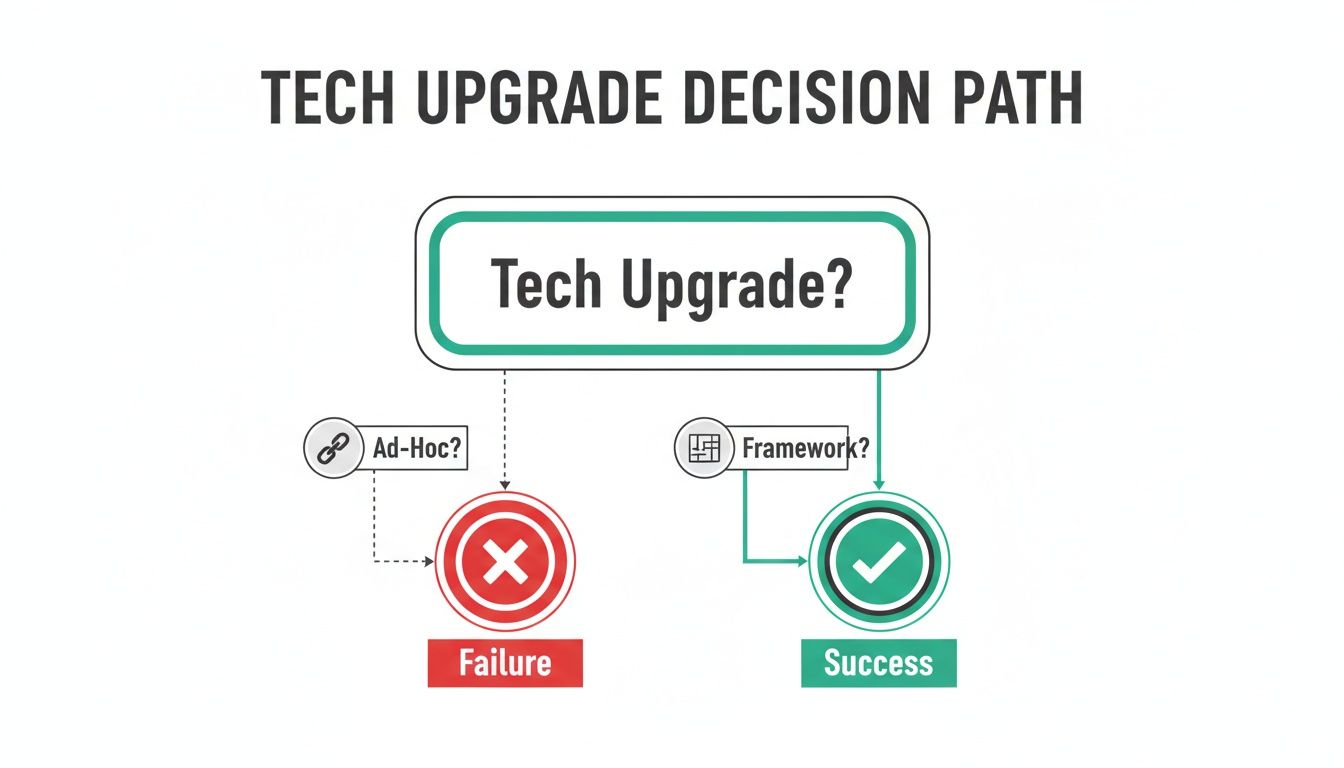
It really is that simple. A framework is the intentional plan that turns your tech spending into a genuine asset instead of just another expense.
Composable Architecture: The LEGO Approach
One of the most practical ideas in IT today is Composable Architecture. The best way to picture it is a box of high-tech LEGOs for your business. Instead of buying one giant, all-or-nothing software package where a single glitch can crash your whole operation, you build your systems from smaller, independent, best-of-breed pieces.
This means you can swap out your sales software, upgrade your security tools, or plug in a new inventory app without having to bulldoze your entire IT setup. For a growing company in a Hamilton County growth area like Noblesville, this kind of agility is everything. It lets you scale up what you need, when you need it, turning a huge capital expense into a manageable operational one.
- Pros: Gives you incredible flexibility, makes it easy to try new tech, and you're never held hostage by a single vendor.
- Cons: You need an expert to make sure all the "LEGOs"—like your Bitdefender GravityZone endpoint protection and your cloud database—snap together securely and work without a hitch. This is where a deep understanding of Zero Trust architecture is non-negotiable.
Cybersecurity-First Frameworks
For many Indiana businesses, especially in healthcare, finance, or the defense supply chain, security isn't just a line item. It's the entire foundation. A cybersecurity-first framework puts protecting your data and your reputation at the center of every single tech decision.
A framework built around a standard like the NIST Cybersecurity Framework (CSF) is more than a checklist for passing an audit. It’s a proven battle plan for making your business tough as nails against attacks, preventing the kind of downtime that can cost a company $9,000 per minute.
This approach forces you to map out your sensitive data, pinpoint your weak spots, and implement rock-solid controls like immutable off-site backups and constant SOC-as-a-Service monitoring before you even think about adding new software.
- Pros: Massively lowers your risk profile, ensures you meet strict compliance standards like HIPAA or CMMC, and builds unshakable trust with your customers.
- Cons: It can feel restrictive if it's not applied with common sense. You need a partner who knows how to lock things down without grinding your team’s daily work to a halt.
Process-First Frameworks
Is your team drowning in repetitive, manual tasks? Do you ever feel like you're paying people just to copy and paste data all day? A process-first framework takes a laser-focused look at your team's day-to-day work to find and eliminate those bottlenecks with smart automation.
We recently worked with a logistics company right on the I-65 corridor whose shipping department was buried under manual data entry. By applying a process-first approach, we integrated their systems and instantly eliminated hours of tedious tech work every single day. That time went right back into productive, billable work. It’s a core principle we use when helping clients find the right software development life cycle models for Indiana businesses.
- Pros: Delivers a fast, measurable return on investment by slashing waste, makes your employees far more productive, and creates consistent, predictable results.
- Cons: This approach can backfire if you only focus on the tech and forget the people using it. Success hinges on getting your team excited about the change and giving them the training to make it stick.
Choosing Your Digital Transformation Framework
So, how do you pick? It's not about finding the "best" framework, but the best one for you. This table breaks down which approach might fit your business here in Indiana.
| Framework Type | Best For | Key Benefit (ROI) | Local Example |
|---|---|---|---|
| Composable | Growing SMBs in dynamic fields like tech or marketing. | Scalability & Agility. Pay for what you need now, add on later without massive reinvestment. | A Fishers-based SaaS startup that needs to add new features quickly without being locked into one platform. |
| Cybersecurity-First | Businesses in regulated industries (healthcare, defense, finance). | Risk Mitigation. Avoids catastrophic fines and downtime, which deliver massive ROI by preventing loss. | An Avon medical clinic handling sensitive patient data that must be HIPAA compliant. |
| Process-First | Businesses with complex operations (manufacturing, logistics, professional services). | Operational Efficiency. Directly converts wasted time into productive, revenue-generating hours. | A Johnson County manufacturer automating its inventory and order-processing workflow to reduce errors. |
Ultimately, the best digital transformation frameworks are not rigid rulebooks. They are flexible guides. In the hands of an experienced IT partner, they can be adapted to fit your unique business, whether you’re a professional services firm in a downtown Indy tech hub or a family-owned manufacturer getting things done in Martinsville.
Building Your Transformation Roadmap
All this talk about digital transformation frameworks is great, but how do you actually put one into action? This is where the real work begins—the part that separates wishful thinking from a successful outcome. A genuine transformation doesn't just happen; it's engineered with a clear, repeatable roadmap.
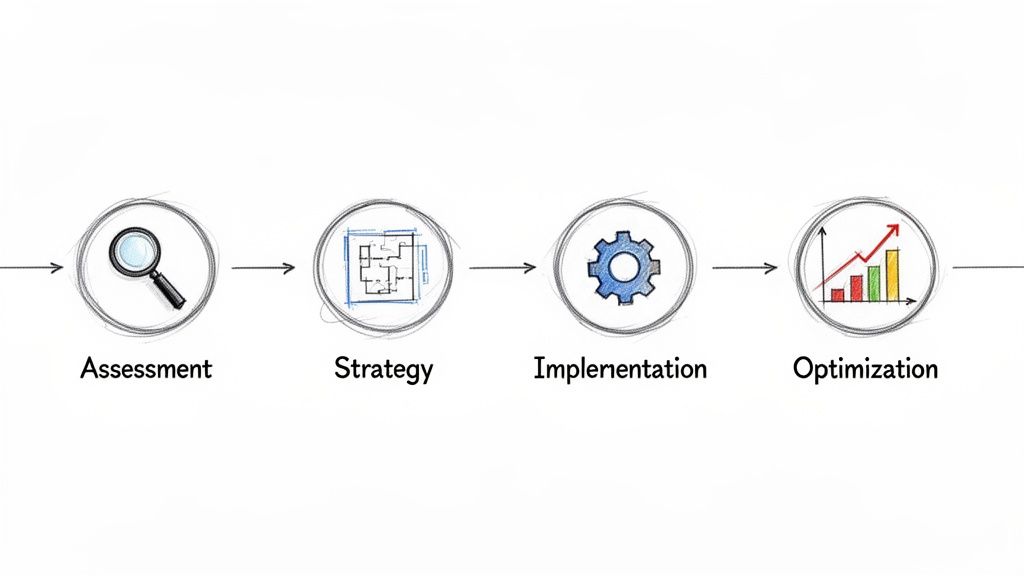
For the businesses we partner with across Central Indiana, we’ve boiled this journey down into four straightforward phases. This isn't some textbook theory. It's the same process we've refined over 17 years of pulling companies out of reactive IT chaos and into a state of proactive control.
Phase 1: The Assessment
You can't get where you're going if you don't know where you are. The assessment phase is all about taking a hard, honest look at your current situation. We dig deep, looking past the symptoms to unearth the root causes of your tech frustrations.
For one client in an old brick building downtown, that meant using network analyzers to find the real source of their spotty Wi-Fi—not just blindly adding more consumer-grade access points but designing a professional UniFi networking solution with latency-optimized mesh nodes. For another, it was a full audit of their hardware and software, revealing unsupported systems that were just ticking time bombs. This is also where you should start building your inventory; you can learn more in our guide covering IT asset management best practices for Indiana businesses.
During the Assessment, we pinpoint:
- Security Gaps: Where are you exposed? Are you meeting compliance standards like HIPAA or CMMC?
- Performance Bottlenecks: What's slowing your team down and causing that dreaded "wasted tech time"?
- Operational Inefficiencies: Which manual tasks are practically begging to be automated?
Phase 2: The Strategy
Okay, we've got our starting point. Now, let’s design the destination. The strategy phase is where we connect your biggest business goals directly to tangible technology solutions. This isn't about chasing the shiniest new toy; it's about architecting a system that delivers a measurable return.
A strong strategy turns a fuzzy goal like "we need better security" into a concrete action plan. For a defense contractor along the I-65 corridor, this meant designing a complete Zero Trust architecture to meet tough CMMC requirements. Suddenly, every user and device had to be verified before touching anything.
This is where we draw up the actual blueprint. We’ll decide which framework—be it Composable, Cybersecurity-First, or Process-First—is the best fit and create a detailed plan with a clear timeline, budget, and set of technologies.
Phase 3: The Implementation
Time to make the plan a reality. Our team gets to work executing the strategy with military precision, all while causing as little disruption to your daily grind as possible. Experience is everything here. We've done this hundreds of times, so we know how to sidestep the common tripwires that derail these kinds of projects.
A huge part of this is making sure your business never stops running. For a Greenwood financial services firm, implementation involved setting up immutable off-site backups. This creates unchangeable copies of their data, making them almost completely invulnerable to ransomware and ensuring they can be back up and running in minutes, not days. This is how you trade unpredictable IT bills for a stable monthly budget and true business continuity.
Phase 4: The Optimization
Your business doesn’t stand still, and your technology shouldn't either. The final phase is a continuous loop of monitoring, measuring, and refining. We use tools like SOC-as-a-Service to keep a 24/7 watch for threats and performance hiccups, ensuring your systems stay secure and humming along.
This ongoing work is absolutely critical. With 89% of companies now running on digital-first strategies, the pressure to keep up is immense. Global spending on digital transformation is projected to leap from $2.5 trillion in 2024 to $3.4 trillion by 2026, with AI-powered systems becoming the norm.
For Indiana businesses, having an IT partner who gets these trends isn't a luxury—it's essential for growth. This proactive approach ensures your tech remains a powerful asset that actively pushes your business forward.
How to Measure Real-World Success and ROI
Alright, you’ve picked a framework and you're putting the plan into motion. So… is it working? The biggest trap you can fall into is chasing "vanity metrics"—numbers that look impressive on a spreadsheet but don't actually add a dime to your bank account.
Real success isn't about how many fancy new software licenses you bought. It’s measured by cold, hard results that directly fatten up your bottom line. Let's cut through the fluff and talk about the numbers that actually matter to a business owner right here in Indiana.
Key Metrics That Prove Your ROI
The only numbers worth your time are the ones tied directly to your company's financial health. These metrics prove your digital transformation framework isn't just a fancy idea; it's a money-making engine.
- Crushing Downtime: This is the big one. When downtime can cost you up to $9,000 per minute, every single hour you get back is pure profit. We track this obsessively, showing a straight line from system stability to money saved.
- Recapturing "Wasted Tech Time": Think about all the hours your team spent fighting with slow software or a temperamental network. We measure that lost time and show you how automation and better systems turn those frustrating hours back into productive, billable work.
- Creating a Predictable Budget: A successful digital shift takes you from the chaos of surprise repair bills to a stable, predictable monthly IT budget. For any Johnson County business, that makes financial planning a whole lot less stressful.
When we dissembled a similar client’s failing RAID array, it was a ticking time bomb of stress and constant crashes. Instead of just swapping it for another expensive box, our framework pointed us to a cloud solution. Not only did it wipe out their hardware costs, but it also sped up data access for the whole team, turning a huge headache into a real competitive edge.
Making Success Visible with Advanced Tools
It's one thing for us to say things are better; it's another thing entirely to prove it. This is where top-tier tools really shine. For example, our SOC-as-a-Service monitoring isn't just some utility humming in the background. It’s a dashboard that gives you a crystal-clear report card on every security incident we stop and every minute of uptime we secure.
This data gives you an honest, transparent look at your IT's health. You can literally see how many cyber threats were neutralized before they could cause a data breach, or how our proactive work kept a server from dying during your busiest hours. You can get a deeper look at this in our guide on how effective IT infrastructure management slashes downtime and boosts ROI.
This kind of proof is absolutely essential today, especially when 92% of business leaders worldwide are already on board with cloud technology. Getting smarter with data processing is what separates the businesses that thrive from those that just survive.
As you map out your own digital journey, it’s also smart to keep an eye on what's next. Exploring things like AI in business automation can open your eyes to new ways to get more efficient and find opportunities you didn't even know existed. A great framework doesn't just fix today's problems—it gives you the tools and the data to build a more profitable, resilient future.
Secure Your Business's Future in Indiana
Let’s be honest, "digital transformation" can sound like a buzzword meant for giant corporations. But as we've walked through in this guide, it's really about having a smart plan—a digital transformation framework—to stop wasting money on tech that constantly breaks. It's the difference between lurching from one IT crisis to the next and building a business that actually runs smoothly and makes more money.
For any business owner in Greenwood, along the I-65 corridor, or anywhere in the Indianapolis area, the old way of doing things is a losing game. Patching up old servers and crossing your fingers on security isn't a strategy; it’s a direct hit to your profits. We've seen it time and again in our 17 years of local service. The only way to win is to get a solid plan in place with a local partner who knows what they’re doing.
Real change happens when a good plan is executed by people who live and breathe this stuff. We’re talking about building a real Zero Trust architecture that meets tough standards like NIST CSF, or finally moving to the cloud and ditching that money-pit server in the closet. It’s not about slapping a band-aid on a problem; it’s about building a better, stronger business from the tech up.
It's time to trade in that "wasted tech time" for more billable hours. It's time to get off the IT rollercoaster and find the financial predictability you've been looking for. The next step is simple, but it's the one that changes everything.
Take the first step toward business continuity and a predictable IT budget. Schedule a Free Network Assessment or Security Risk Audit with our team. We'll give you a clear, no-nonsense look at your current IT setup and a practical roadmap specifically for your Greenwood/Indianapolis area business.
Your Digital Transformation Questions Answered
We get it. All this talk about "frameworks" and "roadmaps" can feel a bit up in the clouds, especially when you’re just trying to keep the lights on. Let's cut through the jargon and get straight to the practical questions we hear every day from business owners right here in the Indianapolis area.
What’s the First Step for My Small Business?
The very first, most critical step is to get out of firefighting mode. For most businesses we see in Johnson County, that means fighting the urge to just buy a new piece of gear when something breaks. Instead, stop and take a full inventory of everything you have.
A real, honest assessment is the only true starting point. This isn't just about listing servers and software licenses. It’s about figuring out what tech is actually helping you make money and what's secretly holding you back. Only then can you build a smart plan based on facts, not just frustration.
How Much Does Implementing a Framework Cost?
That's a lot like asking, "How much does a vehicle cost?" Are you in the market for a reliable work truck or a souped-up sports car? The cost isn't in the "framework" itself—those are just the blueprints. The real cost comes from the technology and support you choose to build with those blueprints.
The better question isn't "what's the cost?" but "what's the return?" The goal is to stop bleeding money on unpredictable, high-stress emergency repairs. Instead, you shift to a stable, predictable budget that prevents downtime and turns all that "wasted tech time" back into billable hours.
For instance, putting a cybersecurity-focused plan in place might mean investing in tools like Bitdefender GravityZone and professional SOC-as-a-Service monitoring. But that cost is a drop in the bucket compared to the $9,000 per minute a single ransomware attack could drain from your business.
How Do I Get My Employees to Adopt New Tech?
You can’t just drop a new piece of software on your team's desk and walk away, expecting them to embrace it. Nine times out of ten, when people push back, it's because they don't see what's in it for them.
Getting your team on board comes down to three simple things:
- Explain the "Why": Show them exactly how this new tool makes their specific job easier, not more complicated.
- Provide Real Training: A quick memo isn't training. You need hands-on sessions and a person they can actually ask for help, so they feel confident, not foolish.
- Get Early Buy-In: Pull a few key team members into the selection process. When they have a little skin in the game, they'll become your biggest cheerleaders.
In our 17 years working with local businesses, we've learned a simple truth: the moment employees realize new tech eliminates their most tedious tasks, they adopt it in a heartbeat.
How Do Frameworks Help with HIPAA or CMMC Compliance?
Think of compliance as more than just a pesky checklist; it's a way of doing business. A good digital framework gives you the structure to weave compliance into your daily operations, instead of trying to bolt it on at the last minute during an audit.
For a healthcare provider in Avon, a cybersecurity-first framework ensures every decision—from choosing software to setting up a UniFi networking system—is seen through the lens of HIPAA and protecting patient data. For a defense contractor over on the I-65 corridor, the same approach maps every action to CMMC controls, building a security posture that can be defended with a Zero Trust architecture. It turns compliance from a source of anxiety into a manageable, documented system.
The right plan makes all the difference, but you need a partner who actually knows the local terrain. Finchum Fixes IT has the on-the-ground experience to turn your tech headaches into a real competitive advantage.
Get a clear picture of your IT health with a Free Network Assessment, designed specifically for businesses in the Greenwood and Indianapolis area. Contact us to get started.