Secure Indiana SMBs: IT Governance Framework Guide
A lot of Indiana business owners are in the same spot right now. The server in the back office is old enough to have a personality. Wi-Fi drops in that brick building off the I-65 corridor every time the office gets busy. Somebody signs a new client agreement, then realizes it mentions HIPAA, CMMC, or NIST CSF, and suddenly “we'll deal with IT later” stops working.
That mess usually gets blamed on bad hardware, flaky internet, or employees clicking the wrong thing. Sometimes those are part of it. More often, the core issue is simpler. There's no plan for how technology decisions get made, protected, measured, and enforced.
- An IT governance framework is a business rulebook for technology. It sets who decides what, which systems matter most, and how risk gets managed.
- It protects business continuity. Downtime can cost up to $9,000 per minute, and governance helps prevent that while turning wasted tech time into billable hours through stronger continuity planning, as explained in BCM ROI guidance.
- It supports compliance. SMBs dealing with HIPAA, CMMC, and NIST CSF need documented controls, not guesswork.
- COBIT, ITIL, and ISO/IEC 38500 each solve different problems.
- Small Indiana businesses shouldn't copy enterprise programs. They need a phased, affordable version that fits their staff, budget, and risk level.
The Hidden Costs of Tech Chaos in Indiana
Monday starts with a password reset. By lunch, the scheduling system is lagging, the copier has stopped scanning to email, and someone forwards a customer questionnaire asking about HIPAA, CMMC, or NIST controls. By 3 p.m., the owner is no longer thinking about growth. They are trying to keep the day from falling apart.
I see this pattern across Greenwood, Johnson County, and the south side of Indianapolis. A medical office adds another cloud tool without checking how it handles patient data. A manufacturer keeps an aging server in service because replacement never made it into the budget. A professional services firm signs a contract with security requirements that nobody reviewed until after the ink dried. None of those decisions look catastrophic on their own. Together, they create expensive disorder.
Downtime spreads beyond IT
A system outage rarely stays in the server room. It slows billing, interrupts scheduling, stalls production, and leaves staff improvising around missing information. Customers feel that confusion fast.
For small and mid-sized businesses, the cost usually shows up in labor waste, delayed cash flow, missed deadlines, and rushed vendor spending. Compliance pressure raises the stakes. If your team cannot show how systems are approved, secured, backed up, and recovered, an audit or customer review gets harder than it should be.
Practical rule: If a server failure, internet outage, or cloud access problem can interrupt revenue, service delivery, or regulated data handling, it needs an owner, a policy, and a documented response.
The deeper cost is unmanaged decisions
Small businesses rarely get in trouble because of one bad purchase. The pattern I see more often is a lack of decision rules. Technology gets added one request at a time, usually by whoever is under the most pressure that week.
That leads to familiar problems across Indiana SMBs:
- Old hardware stays in place too long, then fails at the worst time and forces an emergency replacement.
- Weak Wi-Fi planning in older buildings causes dropped calls, poor coverage, and support tickets that never really stop.
- Software gets bought department by department, which creates overlap, extra license costs, and data living in too many places.
- Backups exist but recovery is untested, so nobody knows how long a restore will take until there is a real incident.
- Compliance gets handled after the contract is signed, which turns HIPAA or CMMC requirements into a scramble instead of a planned control set.
A workable governance model fixes that by setting approval paths, review points, minimum standards, and accountability. It does not need to be corporate or bloated. Indiana companies usually need a right-sized structure that fits a lean staff and a real budget. If you need a starting point, this Indiana IT strategic plan example for small businesses shows how to tie technology decisions to business priorities instead of reacting to the latest problem.
Large organizations often build governance with layers of committees, dedicated compliance staff, and formal review boards. That approach can work in enterprise settings, and Kogifi's article on enterprise IT governance gives useful context on that side of the problem. For a Greenwood clinic, local manufacturer, or growing office with 20 to 150 employees, copying that model usually creates overhead without solving the daily breakdowns. A smaller framework works better when it is clear, documented, and enforced consistently.
That is the hidden cost of tech chaos. The issue is not only bad equipment or a missed patch. It is a business running technology without agreed rules for how decisions get made.
What Exactly Is an IT Governance Framework
Think of an IT governance framework like the building code for your company's technology. You can still choose the layout, the tools, and the finishes. But the code decides what's safe, what's compliant, and what won't collapse when business pressure hits.
Without that code, companies build tech environments the same way some people finish basements. One fix at a time, no shared blueprint, lots of crossed fingers. That works until the first inspection, outage, or cyber incident.
The core job of the framework
An IT governance framework gives structure to decisions that usually drift around informally. It answers questions like these:
- Who approves software purchases?
- Which systems are critical enough to require tested recovery plans?
- How do we know if our cybersecurity controls match our business risk?
- What happens when a vendor pushes a cloud tool into production without proper review?
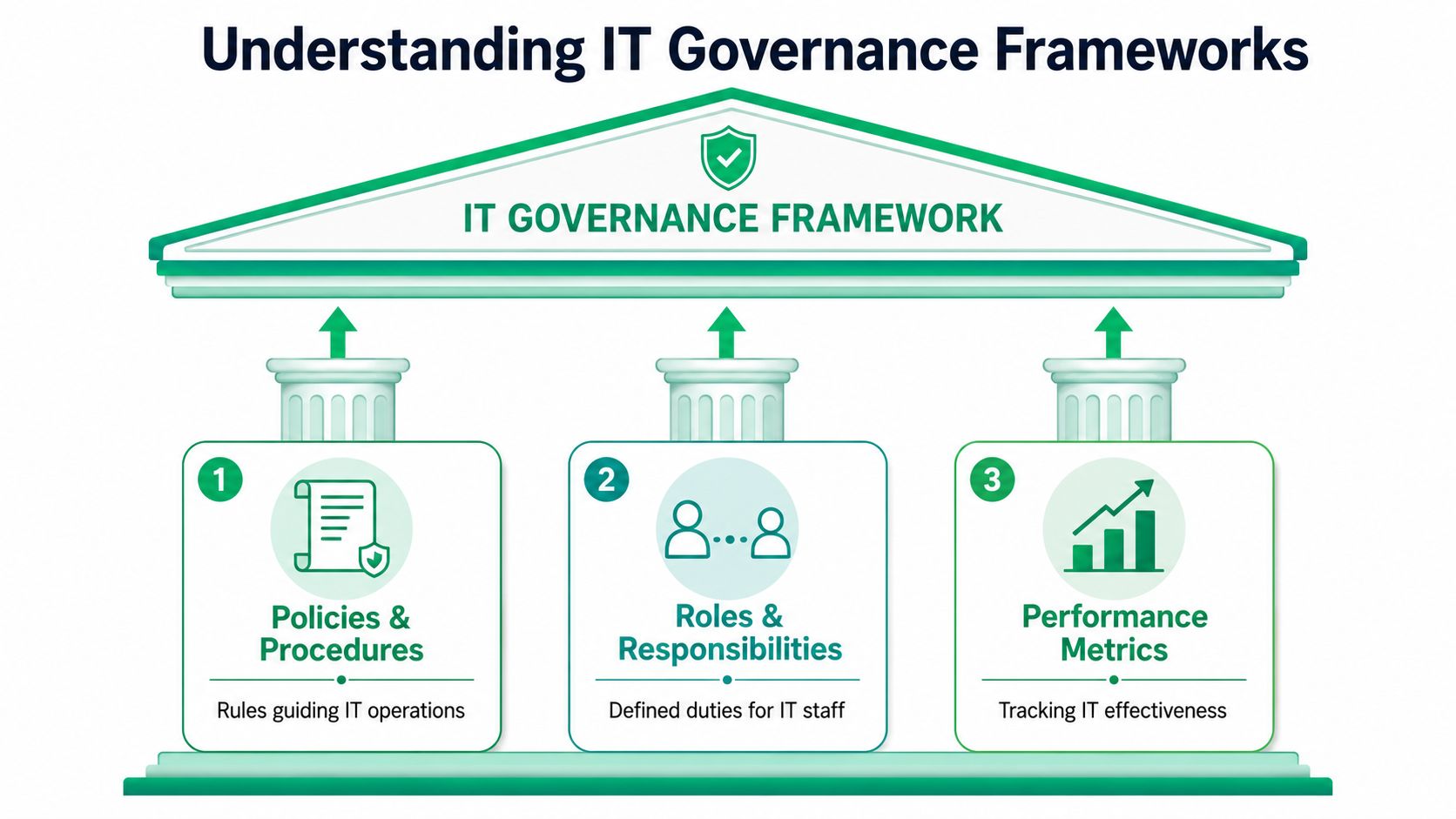
Effective IT governance frameworks rely on standards such as COBIT, ITIL, and ISO/IEC 38500 to keep IT aligned with business strategy and reduce risks that cause downtime. To establish a strong framework, organizations need to define roles and responsibilities, adopt a governance framework, and implement continuous monitoring, as outlined in this practical governance overview.
The five parts business owners actually care about
Most owners don't need a pile of framework terminology. They need plain-English outcomes.
| Area | What it means in practice |
|---|---|
| Strategic alignment | Tech spending supports a real business goal, not just somebody's preference |
| Value delivery | You get useful outcomes from cloud, networking, software, and support spend |
| Risk management | Cybersecurity, access control, backup, and vendor risk get handled before trouble hits |
| Resource management | Hardware, software licenses, IT staff time, and outside vendors are used wisely |
| Performance measurement | You track whether systems are stable, recoverable, secure, and worth the money |
That's why the framework matters in Greenwood, Carmel, and downtown Indy alike. It's not about adding red tape. It's about making sure your UniFi networking rollout, Bitdefender GravityZone deployment, or Microsoft 365 changes don't create side problems nobody saw coming.
A business that wants a broader view of governance in mixed environments can also review Kogifi's article on enterprise IT governance, especially if hybrid cloud and interoperability are already creating friction.
For Indiana SMBs trying to connect governance to an actual business roadmap, a useful next read is this example of an IT strategic plan for Indiana companies.
A good framework doesn't tell you to buy more technology. It tells you which technology deserves attention, who owns it, and how to prove it's doing its job.
From Expense to Investment The ROI of Governance
A Greenwood business usually feels the cost of weak governance before it ever uses that term. A server change goes in without review. A cloud app renews that nobody uses. A HIPAA question lands on the owner's desk, and no one can show who approved access, who reviews logs, or what the process is when something fails.
That is where governance starts paying for itself. It turns reactive spending into planned spending, and it cuts the kind of waste that does not show up neatly on an invoice. Downtime, duplicate tools, stalled projects, and messy audits all cost real money.
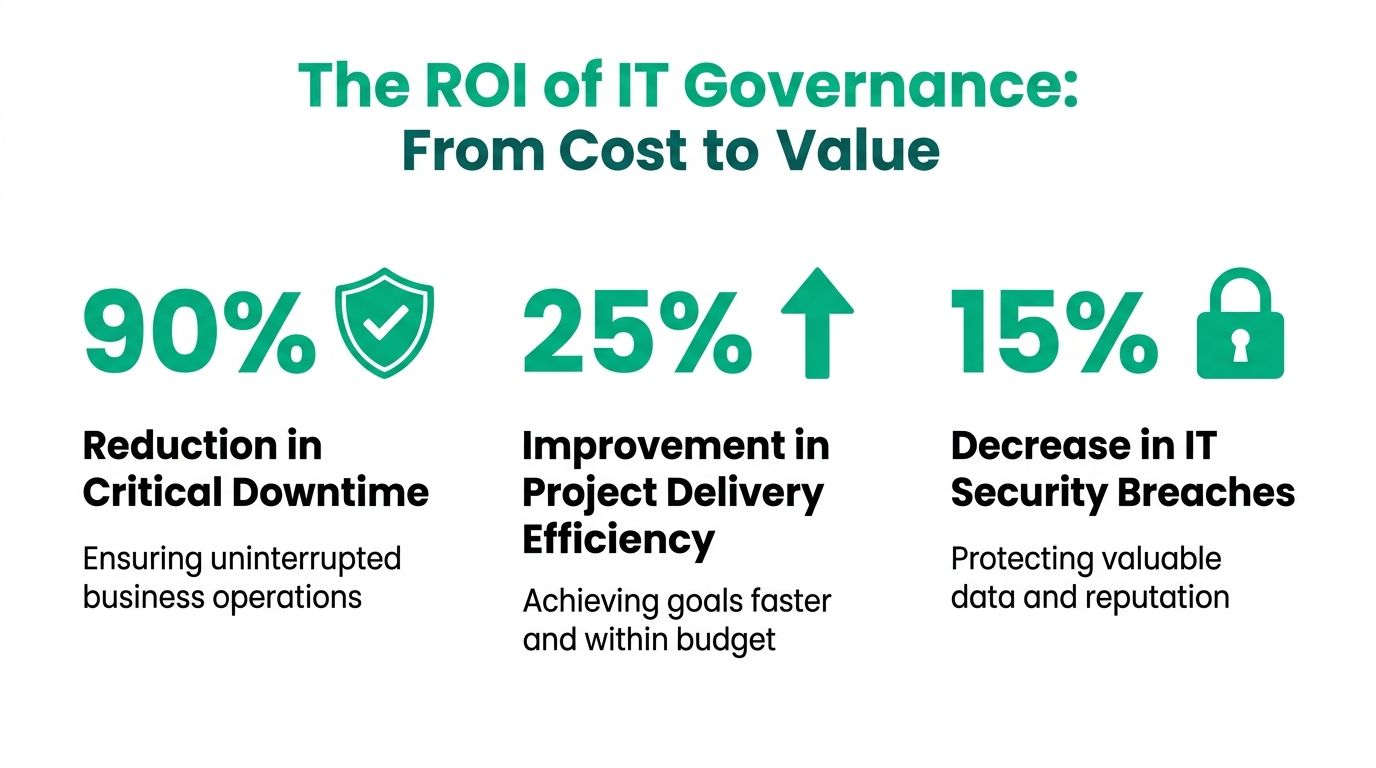
A 2024 McKinsey-backed summary of framework implementation outcomes reports that a formal IT governance framework typically reduces IT project failure rates by 20 to 30%, improves return on IT investments by 15 to 25%, and usually takes about 12 months to implement across four phases.
Governance protects margin and decision speed
For Indiana SMBs, ROI is not just about buying less technology. It is about preventing expensive mistakes while keeping the business eligible for the work it wants to win.
A small defense subcontractor near Indianapolis may need cleaner documentation and approval records to support CMMC work. A medical practice in Hamilton County needs policies that hold up during HIPAA reviews. A manufacturer running cloud ERP needs change control that keeps one rushed update from disrupting operations on the floor. Large companies can absorb some of those mistakes. Smaller firms usually cannot.
Governance also determines whether your security tools do useful work or just generate noise. Zero Trust projects break down when identity ownership is unclear. Monitoring services lose value when alerts go to the wrong person or nobody knows what needs escalation. Teams that want a practical view of response structure can review this ITIL incident management guide.
Where owners usually see the return
The return shows up in familiar places:
- Cost avoidance from fewer compliance surprises, lower breach exposure, and less audit rework
- Labor savings because staff spends less time reconciling bad data and cleaning up preventable issues
- Infrastructure savings after retiring duplicate tools, stale storage, and systems nobody owns clearly
Those three categories are outlined in this data governance ROI analysis. In practice, I also see gains in faster approvals, cleaner vendor decisions, and fewer projects that drift because nobody defined ownership at the start.
Later in implementation, governance can also reduce friction inside the business. The ConnectWise summary cited earlier notes that clear decision rights and governance committees can reduce redundant approvals by 35% and speed IT investment decisions by an average of 2.5 weeks per project. For an Indiana SMB, that can mean getting a security upgrade approved before renewal season, replacing a failing firewall before an outage, or pushing a compliance control into production before a customer asks for evidence.
The mistake many smaller companies make is copying an enterprise governance model and burying themselves in meetings, templates, and committee layers they do not need. Good SMB governance is lighter. It defines who approves what, what gets reviewed, how risk is documented, and which controls support compliance. No extra ceremony.
This short video gives a useful high-level view before you get into process design:
If you're trying to connect governance work to monthly planning instead of treating it like an abstract compliance project, this guide to IT budget planning for ROI and resilience is worth keeping nearby.
Comparing Frameworks COBIT ITIL and ISO 38500
There isn't one perfect framework for every Indiana business. There's a right fit for the kind of pressure you're under.
A medical office with compliance obligations, a small defense subcontractor, and a growing logistics company near the airport all need structure. They don't need the same structure. That's where framework selection gets practical.
The quick read on each option
COBIT is the heavyweight choice for governance, control, and audit-readiness. It's strong when a company needs documented accountability and clean alignment between technology decisions and business risk. Organizations that fully implement COBIT reduce IT-related risks by an average of 25% and cut compliance audit costs by approximately $120,000 annually, according to this COBIT overview.
ITIL is a better fit when service consistency is the pain point. If users complain that support is reactive, change management is sloppy, or incidents get handled differently every time, ITIL gives structure to service delivery. If you want a plain-language view of one of its most important disciplines, Cyber Command has a useful ITIL incident management guide.
ISO/IEC 38500 sits higher up. It's principles-based and useful for owners, boards, and senior leaders who need to direct and monitor IT without adopting a huge operating model all at once.
IT governance frameworks at a glance
| Framework | Primary Focus | Best For | Key Benefit for SMBs |
|---|---|---|---|
| COBIT | Governance, controls, risk, accountability | Regulated firms, audit-heavy environments, compliance-driven growth | Stronger control structure and cleaner audit preparation |
| ITIL | Service management and support operations | Businesses that depend on reliable help desk, uptime, and change discipline | Better consistency in support, incidents, and service delivery |
| ISO/IEC 38500 | Executive oversight and decision principles | Owners and leadership teams needing governance direction without deep process sprawl | Clearer board-level and owner-level technology oversight |
Bottom line: Pick the framework that matches your problem. Don't buy a governance library when what you really need is cleaner service operations, and don't settle for service tickets alone when regulators want documented control ownership.
A lot of Indianapolis companies eventually blend these. They may use COBIT for governance, ITIL for service management, and NIST CSF for cybersecurity control mapping. That hybrid approach often makes more sense than trying to force one framework to do everything.
If broader modernization is already on your plate, this guide to digital transformation frameworks for Indiana businesses helps connect governance choices to bigger operational changes.
A Realistic Governance Plan for Indiana SMBs
Many small businesses experience difficulties when they download an enterprise framework, assign nobody to maintain it, create too many policies, and end up with a binder nobody reads.
That approach fails because SMBs don't have enterprise staffing. They have owners, office managers, a few department leads, maybe an outsourced IT partner, and not much spare time. The framework has to fit that reality.
The gap is real. 78% of SMBs under 500 employees lack appropriate governance models, which leads to a 3.2x higher risk of non-compliance penalties, and 64% fail initial compliance audits due to over-engineered frameworks, according to research highlighted here.
Start with crawl, then walk, then run
In our 17 years of local service, the businesses that get this right don't start with complexity. They start with control.
Crawl
Get the basics nailed down first.
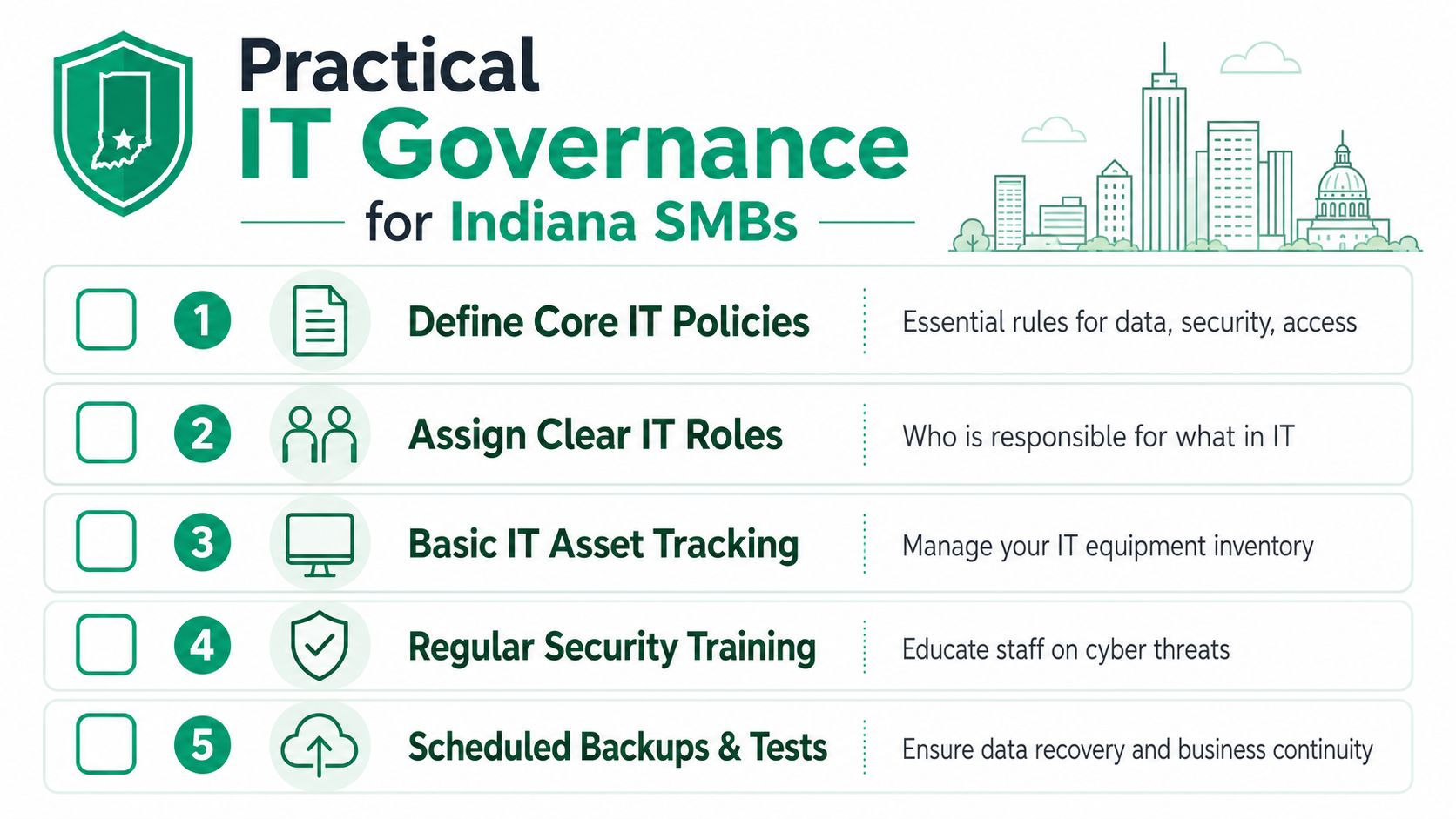
- Inventory what you own: Every workstation, laptop, firewall, switch, server, cloud app, and business-critical subscription should be on one list.
- Clean up access: Decide who has admin rights, who approves new accounts, and how departing staff gets removed.
- Set backup rules: Use tested, immutable off-site backups for critical systems so ransomware or accidental deletion doesn't become a business-ending event.
- Map your weak spots: Old RAID storage, unsupported PCs, unmanaged Wi-Fi, and mystery cloud apps all belong on the list.
This phase is also where networking gets fixed properly. In older Southside buildings, that often means replacing dead zones with latency-optimized mesh nodes or redesigning office coverage with UniFi networking instead of piling on random access points.
Walk
Now document and standardize the stuff that causes repeat headaches.
A good walk phase usually includes endpoint security with a platform like Bitdefender GravityZone, a simple change approval process, minimum password and MFA rules, and written expectations for patching, backups, and vendor access. If custom software development is part of your environment, governance should cover who approves production changes and how rollback gets handled.
When we dissembled a similar client's failing RAID array during a recovery job, the technical lesson wasn't just about bit-level data recovery. It was about process. Nobody had documented the storage lifecycle, no one had assigned replacement responsibility, and the business treated a critical system like an afterthought until it failed.
Run the plan without turning it into red tape
The run phase adds structure, not bureaucracy.
- Review risk on a schedule. Quarterly is often enough for an SMB.
- Track a few business-facing metrics. Downtime incidents, backup test results, device protection status.
- Assign ownership. A named person for security, a named person for vendors, a named person for approvals.
- Tie controls to compliance. HIPAA for healthcare, CMMC for defense work, NIST CSF for general security maturity.
- Use outside monitoring wisely. SOC-as-a-Service can extend visibility without forcing an SMB to build a 24/7 security team from scratch.
For Indiana companies trying to make this practical, this guide on how to build a bulletproof Indiana business IT roadmap for 2026 pairs well with a governance rollout.
The best SMB governance plan is the one your team will actually maintain six months from now.
How to Know If Your Governance Plan Is Working
A framework isn't useful because it exists. It's useful when your business stops tripping over the same problems.
That means you need a short scorecard. Not an enterprise dashboard with a hundred widgets. Just enough to tell whether your environment is moving from chaotic to managed.
Watch recovery and interruption metrics
Business continuity indicators should include recovery times versus expected RTOs and the percentage of systems meeting their RTOs during tests, according to this resilience metrics guide. It also says you should track data loss versus expected RPOs to verify whether backups are protecting the business.
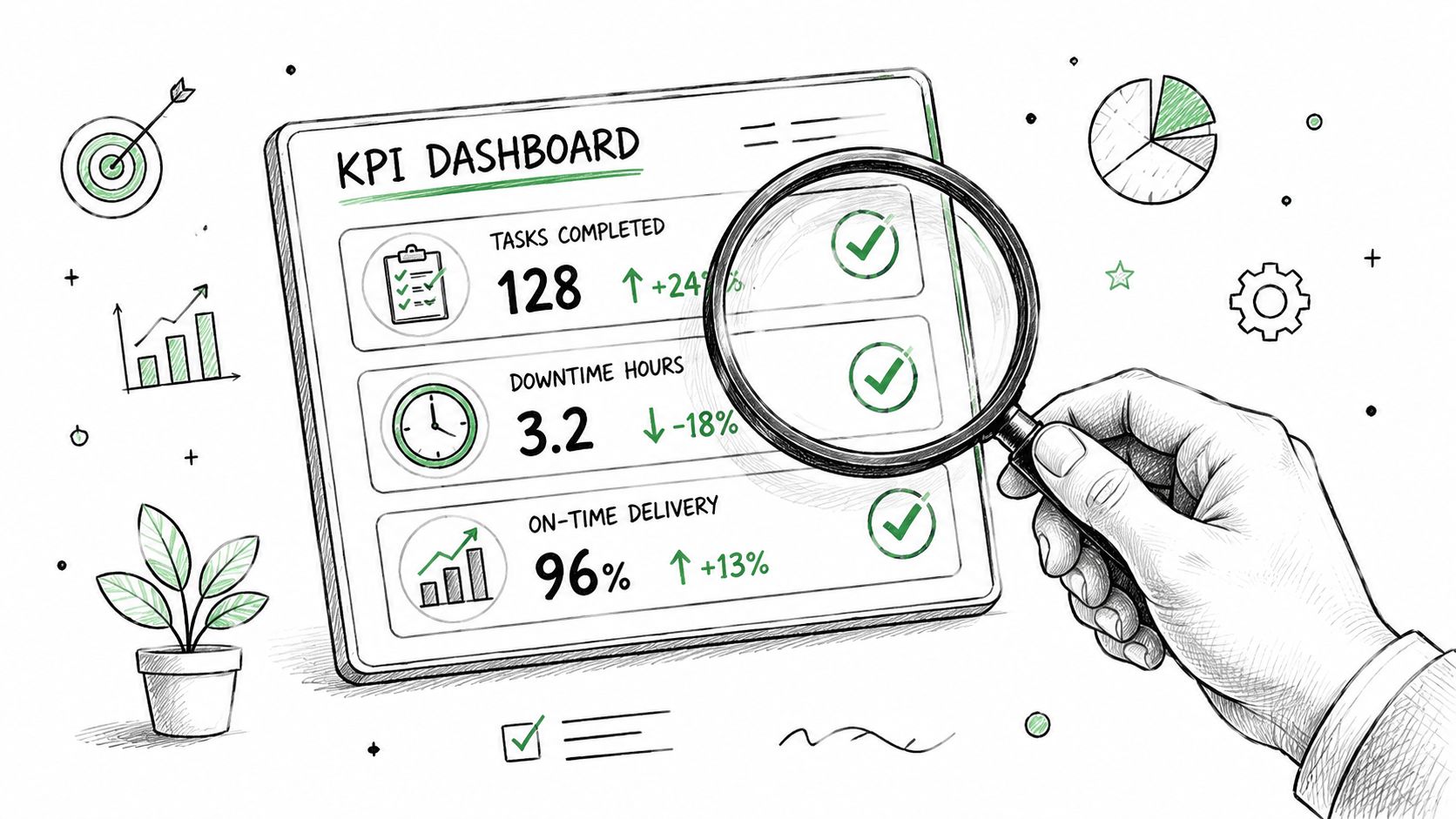
For a small company, those ideas can be translated into plain operational checks:
- How many IT interruptions happened this month
- How long it took to restore a file, server, or cloud account
- Whether backup tests met the recovery target
- How many devices are fully patched and protected
- How quickly security alerts got reviewed and escalated
That's enough to spot trends without drowning in reporting.
Use a simple maturity model
You don't need a consultant's slide deck to understand maturity. Ask which description sounds like your business today.
| Maturity level | What it looks like |
|---|---|
| Chaotic | IT decisions happen ad hoc, outages surprise everyone, and documentation is thin |
| Managed | Core systems are inventoried, access is controlled, backups are tested, and responsibilities are assigned |
| Optimized | Leadership reviews metrics, improvements are planned, and technology supports growth instead of interrupting it |
For regulated Microsoft 365 environments, especially in healthcare and other audit-heavy sectors, this checklist on M365 governance for regulated sectors adds a useful layer of operational detail.
If you want a practical benchmark for your current state, this IT security audit checklist for Indiana businesses helps turn governance from a vague idea into visible controls.
If your team can restore data, explain who approved a major change, and show which devices are protected, your governance plan is working. If every incident still starts with “who owns this,” it isn't.
Take Control of Your Technology Today
The point of an IT governance framework isn't to make a small business act like a Fortune 500 company. The point is to stop preventable messes from draining money, time, and trust.
For Johnson County business owners, that often starts with basic order. Stable networking instead of flaky coverage in older buildings. Clear access rules instead of shared logins. Reliable cybersecurity instead of random tools. Tested recovery instead of hope. Sensible cloud decisions instead of subscription sprawl. Better support processes so staff can work without waiting on constant fixes.
That's what turns technology from a source of stress into a business asset.
A strong framework also gives owners a way to talk about risk without getting buried in jargon. HIPAA, CMMC, NIST CSF, backups, endpoint protection, cloud controls, vendor access, software development approvals, and incident response all fit into one operating model. Different businesses need different levels of rigor, but every serious business needs some structure.
If your company sits anywhere from Greenwood to the broader Indianapolis market, the opportunity is straightforward. Build a governance model that fits your size, budget, compliance pressure, and growth plan. Don't copy a giant enterprise template. Don't wait for the next outage, failed audit, or recovery scare to force the issue.
Control beats chaos. Every time.
If your business in Greenwood, Indianapolis, or the surrounding Central Indiana area feels like it's one server crash, Wi-Fi outage, or compliance request away from a bad month, Finchum Fixes IT can help you get clear on where you stand. Schedule a Free Network Assessment or a Security Risk Audit to identify weak points, tighten your technology plan, and build a practical roadmap that supports uptime, compliance, and growth.