10 Crucial IT Vendor Management Best Practices for Indiana Businesses in 2026
TL;DR: Key Takeaways
- Vet Vigorously: Don’t just hire a vendor; audit them. Verify security compliance (HIPAA, CMMC), check certifications, and demand proof of performance before signing.
- Define the Deal: Use ironclad Service Level Agreements (SLAs) to set clear expectations for uptime, response times, and issue resolution. Vague promises lead to expensive downtime.
- Manage Actively: Establish a governance structure with regular reviews (QBRs) and performance scorecards. A "set it and forget it" approach guarantees poor service.
- Plan for Failure: Every vendor relationship will end. Create an exit plan from day one, identify backup vendors for critical services, and ensure your contract allows for a smooth transition.
- Maximize ROI: Proactive vendor management prevents costly downtime (up to $9,000/minute), converts "wasted tech time" into billable hours, and locks in a predictable monthly IT budget for your Greenwood-area business.
Imagine this: your team is stalled because the cloud software you rely on is down again. You call your IT vendor, but you’re stuck in a support queue, losing billable hours with every minute that passes, a cost that can reach up to $9,000 per minute for some businesses. This isn’t just bad luck; it’s a failure of vendor management, a common story for business owners all along the I-65 corridor.
Too many Johnson County businesses are shackled to IT partners who don’t understand their specific needs, can't meet critical compliance standards like HIPAA or CMMC, and lack the expertise to fix deep-seated issues permanently. We see it constantly—a Greenwood business with aging server hardware gets a quick fix instead of a permanent solution, leading to recurring crashes that kill productivity. The result is unpredictable IT spending and a constant drag on your company’s growth. Effective IT vendor management best practices are the antidote, transforming your tech partners from a liability into a strategic asset.
This article is not a theoretical guide filled with vague advice. It’s a field manual built on our 17 years of experience helping local companies escape this frustrating cycle. We will break down 10 specific, actionable best practices that put you back in control. By implementing these strategies, you can lock in predictable monthly budgets, convert wasted tech time into productive work, and ensure your business continuity is never compromised by a third party’s poor performance. You'll stop paying for downtime and start investing in progress.
1. Master Vendor Selection, Due Diligence, and Security Vetting
Choosing an IT vendor is like picking a co-pilot for your business; a wrong move can send you into a nosedive. This first step in IT vendor management best practices isn't about finding the cheapest option. It’s a systematic process to ensure a potential partner has the technical chops, financial stability, and security posture to protect your operations, especially for businesses along the I-65 corridor facing specific compliance demands.
Think of it as building a case file on each potential vendor. You wouldn't hire a key employee without a background check, so why onboard a vendor with access to your entire network without the same scrutiny? A healthcare provider in Greenwood, for instance, can’t afford to guess if a cloud vendor is actually HIPAA compliant. In our 17 years of local service, we’ve seen businesses get burned by partners who talked a big game on Zero Trust architecture but couldn't back it up.
How to Implement It:
A structured approach prevents costly mistakes. Start by creating a weighted evaluation scorecard that prioritizes your non-negotiables, such as support for specific UniFi networking equipment or CMMC compliance for government contract work.
- Request for Proposal (RFP): Clearly define your needs and ask vendors to detail their solutions, pricing, and security protocols.
- Security Audits: Don't just take their word for it. Request and review their current SOC 2 Type II audit report and recent penetration test results.
- Certification Verification: Check their claimed credentials (Microsoft, Cisco, CompTIA) directly with the issuing bodies.
- Proof of Concept (POC): Before signing a multi-year contract, ask for a trial period or a small-scale POC to see them in action. For startups, understanding this vetting process is foundational. If you’re building an app, the same principles apply; our friends at Vermillion have a great guide on how to hire a mobile app agency for your startup that covers similar due diligence.
Key Insight: The goal isn't just to find a vendor who can fix a problem. It's to find a partner whose security and operational standards are as high as your own. Documenting every step of this evaluation is crucial for future compliance audits and forms the backbone of your risk management strategy. You can start by building a framework with our cybersecurity risk assessment template for Indiana businesses.
2. Service Level Agreements (SLAs) and Performance Metrics
A handshake and a promise won't cut it when your server goes down during tax season. Service Level Agreements (SLAs) are the guardrails of your vendor relationship; they are legally binding contracts that define exactly what level of service you can expect, what happens when it's not met, and how success is measured. This is a core component of effective IT vendor management best practices, turning vague promises into concrete, accountable benchmarks.
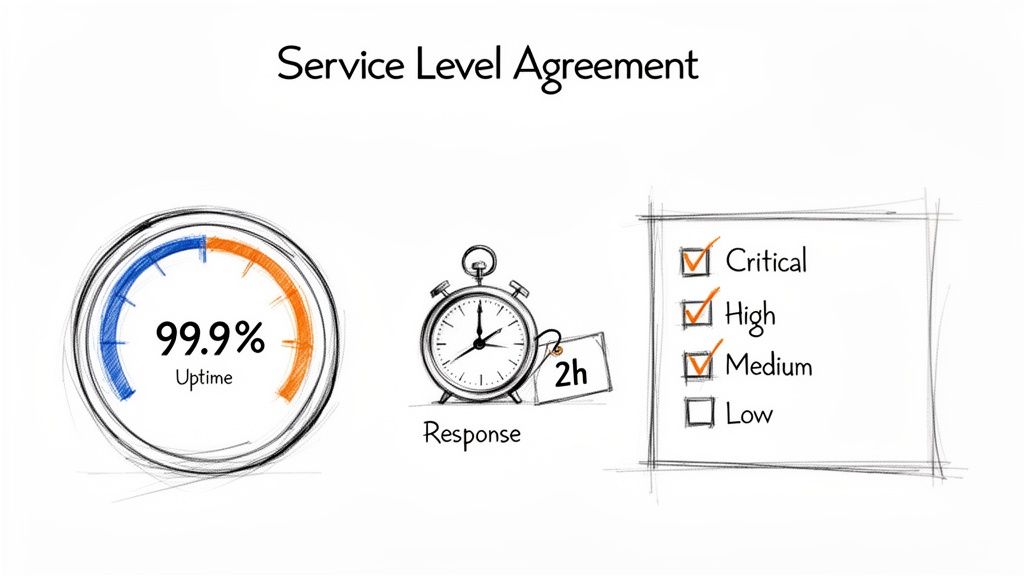
Think of it this way: for a logistics company in Plainfield, an internet outage isn't an inconvenience; it's a complete operational halt. A proper SLA with their internet provider would specify a 99.9% uptime guarantee and a four-hour Mean Time To Repair (MTTR) for critical outages. Without this documented commitment, they're just another ticket in the queue. We've seen Johnson County businesses get stuck for days because their contracts lacked clear resolution targets, bleeding money with every hour of downtime.
How to Implement It:
Never accept a vendor’s boilerplate SLA without scrutiny. Your agreement must reflect your specific operational needs and risk tolerance. Get granular with metrics and define everything, leaving no room for interpretation during a crisis.
- Define Severity Levels: Classify issues as Critical, High, Medium, or Low. Assign specific response and resolution times to each, like a 15-minute response for a "Critical" server-down event.
- Specify Core Metrics: Insist on including key performance indicators like MTTR (Mean Time to Repair) and uptime guarantees (e.g., 99.99%).
- Establish Escalation Paths: Clearly outline who to contact and when if an SLA is breached. What happens if the first-tier tech can’t solve the problem within the agreed time?
- Schedule Regular Reviews: Build quarterly business reviews into the contract to discuss SLA performance, review trouble tickets, and plan for future needs. A regular check-in helps you understand how your infrastructure is performing over time, similar to the process outlined in our 10-point IT infrastructure audit checklist for 2026.
Key Insight: A strong SLA isn't just a safety net; it's a tool for alignment. It ensures both you and your vendor share the same definition of "good service" and provides a clear, non-emotional framework for holding them accountable when things go wrong.
3. Vendor Relationship Management (VRM) and Governance Structure
Once a vendor is onboard, the real work begins. Treating the relationship as a “set it and forget it” utility is a fast track to misaligned expectations, service degradation, and costly surprises. Effective IT vendor management best practices demand a formal governance structure. This isn't just bureaucratic red tape; it's the framework that keeps your vendor accountable and aligned with your business goals, ensuring the partnership delivers continuous value.
Think of it as the difference between a casual handshake deal and a structured joint venture. A manufacturing firm in Franklin can't afford for their cloud ERP provider to go rogue on updates or change support tiers without warning. Establishing a governance model turns a simple transaction into a strategic alliance. In our 17 years managing tech for businesses along the I-65 corridor, we’ve seen that vendors who participate in regular, structured reviews perform better and resolve issues faster because they understand their role in your success.
How to Implement It:
A proactive governance plan prevents minor issues from spiraling into major operational disruptions. It establishes clear channels for communication, performance reviews, and strategic planning, keeping both parties on the same page.
- Establish Quarterly Business Reviews (QBRs): Schedule formal meetings with a set agenda. Review performance against SLAs, discuss upcoming projects, and address any challenges.
- Create a Vendor Scorecard: Track key metrics beyond just uptime. Include things like ticket resolution times, security incident responses, and user satisfaction to get a full picture of their performance.
- Assign Relationship Owners: Designate a primary and secondary contact on both your team and the vendor's. This prevents communication breakdowns and ensures someone is always accountable.
- Document Everything: All agreements, change requests, and key decisions must be documented in writing. This creates an official record that protects your business and clarifies expectations for everyone involved.
Key Insight: Strong vendor governance isn't about micromanagement; it's about mutual respect and strategic alignment. The goal is to build a partnership where your vendor acts as an extension of your team, proactively contributing to your business objectives rather than just reacting to problems. This structured communication is a cornerstone of a mature IT vendor management program.
4. Cost Management and Contract Optimization
Letting IT vendor costs run wild is like leaving the meter running on a taxi stuck in I-465 rush hour traffic; it’s an expensive, avoidable mistake. Effective cost management isn't about nickel-and-diming your partners. It's about ensuring every dollar spent on a vendor contract delivers real value, preventing budget blowouts, and maximizing your return on technology investment. This is a critical part of IT vendor management best practices for any cost-conscious Indiana business.
Think of your vendor contracts as living documents, not "set it and forget it" paperwork. A Franklin-based manufacturing firm we worked with was paying for 200 Microsoft 365 licenses but only had 150 active employees. That kind of budget leak, multiplied across several SaaS vendors, can sink an otherwise healthy P&L. For 17 years, we’ve seen that proactive contract optimization is where smart businesses separate themselves from the pack, turning IT from a cost center into a competitive advantage.
How to Implement It:
A disciplined review process is your best defense against wasteful spending. It involves regular audits and strategic negotiations to ensure you’re not overpaying for underutilized services or missing out on better terms.
- Quarterly License Audits: Regularly review all software and cloud service subscriptions. Identify and eliminate "shelfware" - licenses paid for but not used.
- Annual Pricing Benchmarks: Compare your current vendor rates against market averages. Services like Gartner or even peer discussions in local tech councils can reveal if you’re getting a fair deal.
- Negotiate Price Caps: When signing or renewing, insist on a price escalation clause that limits annual increases to a reasonable figure, like 3-4%, to avoid surprise hikes.
- Seek Bundled Services: For SMBs, managed services contracts that bundle things like cybersecurity monitoring with Bitdefender GravityZone, network support for your UniFi gear, and immutable off-site backups into a fixed monthly cost can be far more predictable and cost-effective than à la carte pricing.
Key Insight: The goal is to create a predictable and efficient IT budget. Don't be afraid to renegotiate mid-contract if your business needs change significantly, such as downsizing or shifting to a remote workforce. True partners will work with you; vendors who won’t are showing you their true colors.
5. Vendor Risk Assessment and Continuity Planning
Relying on a single vendor for a critical function is like building your office on a fault line without an earthquake plan. This essential step in IT vendor management best practices is about preparing for the day a vendor stumbles, whether from a cyberattack, financial collapse, or simple service failure. It’s a proactive strategy to ensure your business doesn't go down with them.
For a logistics company in Johnson County, a sudden outage from their GPS tracking software vendor could halt their entire fleet. A catastrophic failure isn’t a matter of if, but when. When we dissembled a similar client’s failing RAID array, we discovered their data backup vendor had also been compromised, leaving them with no recovery option. Proactive risk assessment and continuity planning turn a potential disaster into a manageable inconvenience.
How to Implement It:
Treat your vendor relationships like a portfolio; diversification and risk mitigation are key. Begin by mapping out all your vendors and classifying them by how critical their service is to your daily operations. This isn't just a paperwork exercise; it's a core component of your business's survival strategy.
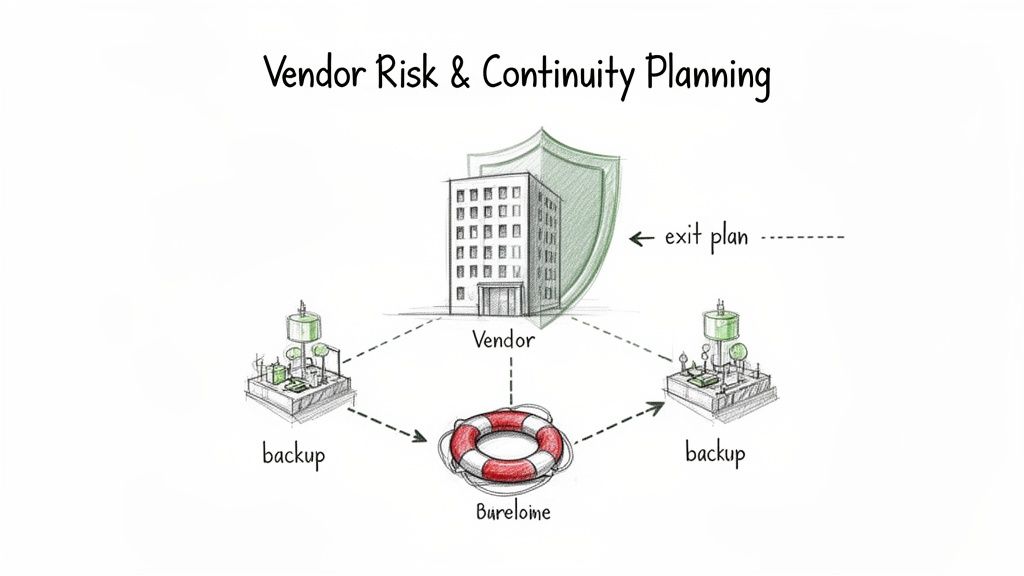
- Develop an Exit Plan First: Before you’re fully dependent, define the breakup. Your plan must detail data ownership, secure data extraction procedures, and knowledge transfer requirements.
- Review Vendor BCDR Plans: Ask for and scrutinize your vendor's Business Continuity and Disaster Recovery (BCDR) plans. Do their recovery time objectives (RTOs) align with your needs?
- Establish Backup Vendors: For mission-critical services like internet connectivity or cloud hosting, identify and build relationships with alternative providers. Don't wait for an outage to start shopping.
- Contractual Safeguards: Insist on a "transition assistance" clause in your contract. This legally obligates the vendor to support your move to a new provider, ensuring a smoother handover of data and operations.
- Monitor Financial Health: For vendors handling critical data or operations, run periodic credit checks and monitor industry news for signs of financial instability or disruptive acquisitions.
Key Insight: The best time to plan your exit from a vendor relationship is before it even begins. Building a robust continuity plan ensures that a vendor’s failure doesn’t become your own. Strong BCDR protocols are fundamental, which is why having reliable enterprise data backup solutions that guarantee business uptime is a non-negotiable part of modern risk management.
6. Vendor Performance Monitoring and Analytics
Signing a contract with an IT vendor without a plan to monitor their performance is like buying a race car and never checking the speedometer. It’s not enough to hope they’re meeting their Service Level Agreements (SLAs); you need objective, data-driven proof. This core tenet of IT vendor management best practices involves the ongoing collection and analysis of vendor metrics to ensure they are delivering the value promised and to proactively identify issues before they cause downtime.
Think of the data as your accountability engine. For a manufacturing company in Johnson County, a supplier scorecard isn't just paperwork; it’s the difference between a smooth production run and a costly halt. We've seen local businesses get stuck in bad contracts because they relied on feelings instead of facts. When their MSP claimed a "fast response," there was no data to prove that "fast" actually meant a four-hour delay that shut down their operations.
How to Implement It:
A systematic monitoring framework turns vague expectations into measurable outcomes. The goal is to create a transparent feedback loop with your vendor, using shared data to drive improvements. This is especially critical when tracking the performance of your network security and infrastructure.
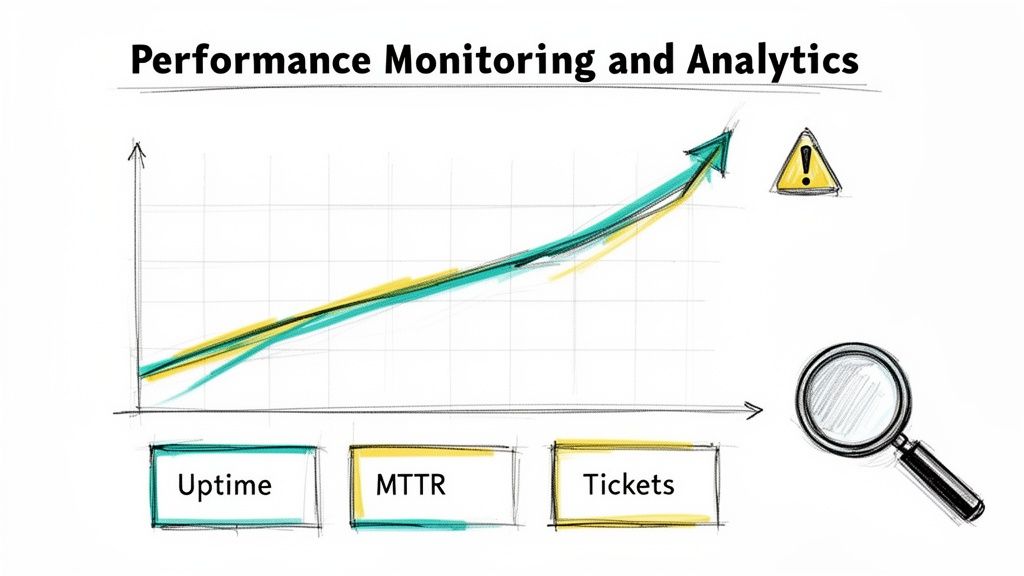
- Establish Clear KPIs: Before the contract is signed, define what success looks like. Key Performance Indicators (KPIs) like Mean Time to Resolution (MTTR), system uptime, and first-contact resolution rate must be specified.
- Automate Data Collection: Use your ITSM platform (Jira, Zendesk, etc.) to automatically track ticket metrics and SLA compliance. For cloud services like AWS or Azure, their built-in dashboards provide a wealth of performance data.
- Schedule Regular Reviews: Hold monthly or quarterly performance reviews. Share a dashboard or report with the vendor that highlights trends, celebrates wins, and pinpoints areas needing attention.
- Systematize Contract Management: To make these reviews more effective, you need a solid grasp of the contractual obligations. To further systematize vendor contract management and enhance efficiency, consider using modern tools like dedicated platforms for AI contract review.
Key Insight: Don't just track failures. Monitor positive trends and share them with your vendor to reinforce good performance. This collaborative approach, backed by hard data, builds a stronger partnership and ensures the vendor is aligned with your business goals. You can learn more about implementing similar oversight with these 10 best practices for network monitoring.
7. Vendor Contract Management and Renewal Planning
Letting an IT vendor contract auto-renew without a review is like letting your GPS keep running after you've arrived; it’s a quiet drain on resources you’ve forgotten about. Proper contract management isn't just about filing paperwork. It's an active process of tracking obligations, performance, and expiration dates to ensure you’re not paying for outdated services or missing opportunities to negotiate better terms.
Forgetting a crucial renewal date for a key software license or a cybersecurity monitoring service can cause operational chaos. A manufacturing client of ours in Franklin nearly had their production line halted because a critical software license lapsed, a detail buried in a 50-page contract that no one had looked at in three years. Effective IT vendor management best practices demand a system that prevents these costly surprises and puts you in the driver’s seat during renewal discussions.
How to Implement It:
A proactive approach to contracts stops you from being reactive. The goal is to build a centralized system that provides a single source of truth for all vendor agreements, turning chaotic spreadsheets and email attachments into an organized, actionable database.
- Centralize Your Contracts: Create a dedicated contract repository. This can be as simple as a structured folder system in SharePoint or a dedicated Contract Lifecycle Management (CLM) tool like Ironclad for more complex needs.
- Set Up Renewal Alerts: Establish a calendar with automated reminders set for 90-120 days before a contract expires. This gives your team ample time to evaluate performance and negotiate new terms without being rushed.
- Create Contract Summaries: Not everyone needs to read the fine print. For each vendor, create a one-page summary highlighting key terms, service level agreements (SLAs), renewal dates, data ownership clauses, and termination requirements.
- Document Everything: Any change, no matter how small, must be documented in a formal amendment. Verbal agreements are a recipe for future disputes and are incredibly difficult to enforce.
Key Insight: The history of a vendor's performance is your most powerful negotiation tool. By tracking KPIs and incident reports against the contract's stated SLAs, you can enter renewal talks with concrete data to justify better pricing, improved service levels, or the decision to switch providers. This turns renewal from a passive event into a strategic business decision.
8. Vendor Collaboration and Strategic Partnership Development
Treating your IT vendors like interchangeable parts in a machine is a rookie mistake. The best IT vendor management practices involve shifting from a purely transactional relationship to a strategic partnership. This isn't about getting a better price; it's about aligning a vendor's expertise directly with your business goals to create mutual success and drive real innovation.
Think of it this way: a transactional vendor just fixes what's broken. A strategic partner sits down with you to plan how to prevent it from breaking in the first place and suggests technology that can help your Hamilton County business outpace the competition. For example, a healthcare system might partner with its EHR vendor on optimization initiatives, co-developing workflows that save doctors time and improve patient outcomes. It’s the difference between buying a tool and hiring a master craftsman who helps you build your vision.
How to Implement It:
Building a strategic partnership requires intention and consistent communication from both sides. It moves beyond simple support tickets and into joint planning sessions that shape your technology roadmap for the next two years, not just the next two quarters.
- Schedule Quarterly Business Reviews (QBRs): Get executive leadership from both companies in the same room. These meetings shouldn't focus on operational hang-ups but on high-level goals, upcoming challenges, and opportunities for alignment.
- Develop Joint Roadmaps: Work with your partner to create a 12-to-24-month plan. How will their technology support your business objectives? What new features or services can you pilot together?
- Invite Them to the Table: When you’re having internal strategic planning discussions, invite your key vendor partners. Their outside perspective can be invaluable, especially when it comes to custom development projects where their early input can shape a better final product.
- Establish Metrics for Mutual Success: Move beyond standard SLAs. Create performance indicators that tie vendor success directly to your business outcomes, such as reduced operational downtime or successful CMMC audit preparations.
Key Insight: A strategic partner earns a seat at your table by investing in your success, not just by fulfilling a contract. When vendors understand your biggest challenges, they can proactively bring solutions. This collaborative approach is essential, especially when developing custom software, as it aligns technical work with real-world business needs. For a closer look at this process, see our guide on the best practices for software development to drive business growth.
9. Documentation, Knowledge Management, and Institutional Memory
When a key IT person leaves your company, they shouldn’t take all your vendor knowledge with them. Effective documentation acts as your business's institutional memory, ensuring that critical information about configurations, contracts, and issue resolutions isn't trapped in one person's head. It’s a foundational piece of IT vendor management best practices that prevents chaos and ensures continuity.
Think of it like the detailed schematics for your office building. Without them, every plumbing or electrical issue becomes a frantic, expensive guessing game. For a healthcare system in Johnson County, losing the undocumented customizations made to their EHR vendor’s software could create massive operational and HIPAA compliance headaches. We’ve seen businesses scramble when a trusted vendor contact leaves, simply because no one else knew the escalation path or the history of past support tickets.
How to Implement It:
A proactive documentation strategy prevents future fire drills and speeds up problem-solving. Start by creating a centralized, accessible repository, like a company wiki or a dedicated section in your IT Service Management (ITSM) platform. This becomes the single source of truth for all vendor-related information.
- Standardized Vendor Templates: Create a uniform document for each vendor that includes their contact info, escalation matrix, contract renewal dates, specific hardware configurations (like for UniFi access points), and a log of known issues.
- Centralized Contact Directory: Don't rely on one person's email contacts. Maintain a shared directory with multiple contacts for each vendor, from account managers to senior technical support, and clearly define when to contact each one.
- Document Customizations: Any special configurations, API integrations, or unique workarounds must be documented immediately. This prevents a new technician from accidentally breaking a critical business process during a routine update.
- Create a Knowledge Base: Build a living library of common vendor-related problems and their proven solutions. Require that documentation is updated as part of every change management ticket and vendor interaction.
Key Insight: Documentation isn't a one-and-done task; it's an ongoing discipline. The goal is to build a robust knowledge management system that reduces dependency on individuals and empowers your entire team. Regular quarterly reviews ensure the information remains accurate and useful, turning historical data into a powerful tool for future decision-making.
10. Vendor Diversification and Multi-Source Strategy
Putting all your business-critical eggs in one vendor's basket is a high-stakes gamble. A single point of failure, whether from a vendor outage, a sudden price hike, or a security breach, can bring your operations to a screeching halt. This IT vendor management best practice is about strategic diversification to build resilience, maintain competitive leverage, and ensure you always have a Plan B ready to go.
Think of it like having multiple routes to get from Greenwood to downtown Indy during rush hour. Relying solely on I-65 is a recipe for disaster when there’s a major accident. Smart commuters know the side roads. Likewise, a financial services firm in Carmel can't afford to have its only payment processor go down during a peak transaction period. In our 17 years of supporting Indiana businesses, we've seen companies paralyzed because their sole cloud provider had a regional outage, and they had no alternative. A multi-source strategy is your operational insurance policy.
How to Implement It:
Building a diversified vendor portfolio doesn't mean creating chaos; it requires a calculated approach to mitigate risk in your most vital areas. Start by identifying the top two or three services where a vendor failure would cause significant business disruption and focus your efforts there first.
- Identify Critical Functions: Pinpoint services like cloud infrastructure (AWS, Azure), payment processing, or your core line-of-business software.
- Cultivate Backup Relationships: Actively maintain relationships with at least two capable vendors for each critical service. Don't just have names on a list; have them vetted and ready.
- Standardize for Portability: Insist on open data formats and APIs that allow you to move your data between vendors without a complete overhaul. This prevents vendor lock-in.
- Conduct Regular Re-Bidding: Re-evaluate and competitively bid major contracts every two to three years. This keeps your primary vendor honest on pricing and service, and keeps you aware of market alternatives.
- Plan for the Exit: Ensure your contracts include clear terms for data export and transition support, making it easier to switch providers if necessary.
Key Insight: The goal isn't to duplicate every service but to build redundancy where it matters most. For a healthcare practice, this might mean having a secondary, HIPAA-compliant data backup provider. For a manufacturer, it could be having two internet service providers. Diversification turns a potential crisis into a manageable inconvenience, which is the core of a strong business continuity plan.
Top 10 Vendor Management Best Practices Comparison
| Item | Implementation Complexity 🔄 | Resource Requirements ⚡ | Expected Outcomes 📊 | Ideal Use Cases 💡 | Key Advantages ⭐ |
|---|---|---|---|---|---|
| Vendor Selection, Due Diligence, and Security Vetting | High 🔄 Extensive RFI/RFP, scoring and audits | High ⚡ Security expertise, time, audit resources | Strong compliance, reduced vendor risk and informed selection 📊 | New vendor onboarding, regulated industries, critical services 💡 | Thorough risk reduction; audit-ready evidence ⭐ |
| Service Level Agreements (SLAs) and Performance Metrics | Medium 🔄 Define metrics, escalation, monitoring | Medium ⚡ Monitoring tools, legal review, reporting | Predictable service levels, measurable remedies for breaches 📊 | Systems requiring uptime and fast response (cloud, MSPs) 💡 | Clear accountability and financial recourse ⭐ |
| Vendor Relationship Management (VRM) and Governance Structure | Medium-high 🔄 Governance bodies, regular reviews | Medium ⚡ Dedicated manager, meeting cadence | Ongoing alignment, early issue identification, smoother escalations 📊 | Multi-service engagements and long-term vendor relationships 💡 | Improved communication and strategic coordination ⭐ |
| Cost Management and Contract Optimization | Medium 🔄 Negotiation, benchmarking, license audits | Medium ⚡ Financial analysts, license tools, procurement time | Lower TCO, better budget predictability and eliminated waste 📊 | Cost-sensitive SMBs, large license/subscription portfolios 💡 | Cost savings and predictable spend (pricing leverage) ⭐ |
| Vendor Risk Assessment and Continuity Planning | High 🔄 Continuous risk monitoring and contingency plans | High ⚡ Risk analysts, backup vendors, insurance | Increased resilience; faster recovery from vendor failures 📊 | Mission-critical services, financial/healthcare sectors 💡 | Business continuity and reduced single-point failures ⭐ |
| Vendor Performance Monitoring and Analytics | Medium 🔄 KPI design, dashboards, automated alerts | Medium-high ⚡ Monitoring platforms, data integration, analysts | Data-driven insights, trend detection, proactive remediation 📊 | High-SLA environments and large vendor portfolios 💡 | Objective measurement and early-warning capability ⭐ |
| Vendor Contract Management and Renewal Planning | Medium 🔄 Lifecycle workflows, renewal tracking | Medium ⚡ CLM tools, legal support, administrative effort | Prevents lapses, enables proactive renewal negotiations 📊 | Organizations with many or complex contracts 💡 | Reduced interruptions and stronger renewal terms ⭐ |
| Vendor Collaboration and Strategic Partnership Development | High 🔄 Executive alignment, joint roadmaps | High ⚡ Leadership time, joint planning, long-term commitments | Co-innovation, strategic alignment, improved outcomes 📊 | Custom development, long-term transformation programs 💡 | Trusted-advisor relationships and innovation acceleration ⭐ |
| Documentation, Knowledge Management, and Institutional Memory | Medium 🔄 Establish templates, repos, update practices | Medium ⚡ KM systems, disciplined documentation effort | Faster onboarding, reduced key-person risk, audit support 📊 | Organizations with turnover or complex configurations 💡 | Continuity, faster issue resolution, preserved IP ⭐ |
| Vendor Diversification and Multi-Source Strategy | Medium-high 🔄 Multi-vendor coordination and standards | High ⚡ Multiple contracts, integrations, management overhead | Reduced concentration risk and improved vendor leverage 📊 | Critical services needing redundancy (cloud, payment) 💡 | Resilience and competitive negotiation leverage ⭐ |
Turn Your IT Vendors into a Competitive Advantage
We’ve covered a lot of ground, from scrutinizing potential vendors like a seasoned detective to building ironclad SLAs that protect your business. The journey through these ten IT vendor management best practices isn't just an administrative checklist; it's a strategic roadmap. It’s the difference between treating your tech partners like interchangeable utility providers and building a powerful external team that actively drives your business forward. For a growing business in Johnson County, this shift is critical.
Think about it. A poorly managed vendor relationship is a direct drain on your resources. It’s the unexpected downtime from a failing server that your IT provider should have flagged, costing your operations thousands per minute. It’s the "wasted tech time" your staff spends on the phone with subpar support instead of focusing on their actual jobs. Effective vendor management plugs these leaks, converting those lost dollars and hours back into a predictable, productive, and secure operational budget. It ensures your cybersecurity partner understands HIPAA compliance as well as you do, or that your networking provider knows how to solve spotty Wi-Fi in an old brick building.
From Reactive Fixes to Proactive Partnerships
The core takeaway is this: you get the vendor relationship you demand. Simply signing a contract and hoping for the best is a recipe for frustration and financial loss. Instead, proactive engagement is key.
- Don't "Set and Forget": Continuously monitor performance using scorecards and KPIs.
- Communicate Constantly: Regular governance meetings turn vendors into strategic partners who understand your goals.
- Plan Your Exits: Knowing how and when to end a contract is just as important as knowing how to start one.
This disciplined approach transforms your vendor ecosystem from a necessary expense into a genuine competitive advantage. You’ll have partners who proactively suggest improvements, help you navigate complex standards like CMMC or NIST CSF, and respond with urgency when an incident occurs. In our 17 years of local service, we’ve seen firsthand that businesses that master these practices suffer fewer outages, face fewer security breaches, and get a significantly higher return on their technology investments. They stop being victims of their technology and start using it to outmaneuver the competition along the I-65 corridor.
Ultimately, mastering these IT vendor management best practices means you're no longer just buying services; you're building a resilient, secure, and efficient operational backbone. You're ensuring that every technology partner, from your cloud provider to your data recovery specialist, is perfectly aligned with your business objectives. This isn't just about managing vendors; it's about leading them. It’s about building an ecosystem that powers your growth, protects your assets, and gives you the peace of mind to focus on what you do best.
Are you concerned your current vendors aren't meeting these standards? As specialists in managed IT, Finchum Fixes IT acts as a single point of accountability, managing your entire tech ecosystem so you can focus on your business. If you're a business in the Greenwood or Indianapolis area, schedule your complimentary Security Risk Audit to get a clear, no-obligation assessment of your infrastructure.