How to Prioritize IT Projects: A Playbook for Indiana Businesses
Figuring out how to prioritize IT projects really boils down to one thing: connecting every dollar you spend on tech directly to keeping your business running and making money. It's time to trade guesswork for a solid, data-backed strategy that slashes downtime and turns your IT budget into a tool for real growth.
TL;DR Key Takeaways
- Focus on ROI and Business Continuity: Every single IT project needs to answer the question, "How does this prevent downtime and help our bottom line?" Downtime can cost businesses up to $9,000 per minute, so this is non-negotiable.
- Use Proven Scoring Models: Get emotions out of the boardroom. Frameworks like Value vs. Effort or MoSCoW give you an objective way to make tough calls.
- Fix Foundational Issues First: Address aging server hardware in a Greenwood business park or spotty Wi-Fi in an old brick building before chasing shiny objects. This is key to turning "wasted tech time" into billable hours.
- Align IT with Business Goals: Turn abstract needs—like hitting HIPAA for a healthcare clinic or CMMC for a defense contractor—into concrete, actionable IT projects with predictable monthly budgets.
- Get a Clear Starting Point: Start with a professional network assessment to understand your true risks and opportunities, from implementing a Zero Trust architecture to ensuring you have immutable off-site backups.
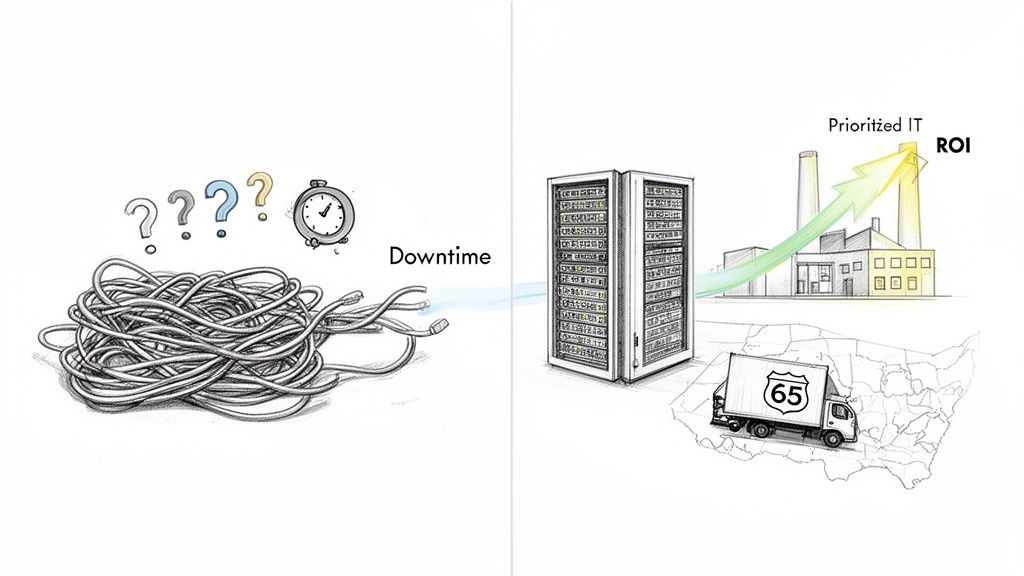
For too many businesses I meet, "IT prioritization" is a fancy term for reacting to whatever's currently on fire. One week, it’s a fried server. The next, it’s a panicked response to the latest cybersecurity headline. This frantic approach feels productive, but it's really a hidden tax on your business, draining employee time that could be spent on actual work.
A huge piece of the puzzle is learning How to Manage Competing Priorities when everything feels urgent. Without a clear plan, you’re just throwing money at problems as they pop up, not investing in solutions that prevent them in the first place and give you a predictable monthly budget.
The Real Cost of Disorganized IT
I see this story play out all the time with businesses up and down the I-65 corridor. A manufacturing plant in Greenwood is running on aging server hardware, a common bottleneck for local businesses. The constant glitches and crashes cause production line delays, turning potential profit into wasted tech time. The leadership team is talking about fancy new software, but the real priority is the crumbling infrastructure their entire operation depends on.
This is where the true cost of bad prioritization smacks you in the face. It isn't just the bill for a new server; it's the lost production from downtime, which can cost up to $9,000 per minute. It's the delayed shipments, the angry customers, and the damage to your hard-won reputation. It's the difference between a predictable IT budget and a constant string of expensive emergencies.
When you finally shift from this reactive firefighting to a strategic plan, something amazing happens. Your IT stops being a frustrating cost center and starts becoming a powerful engine for growth.
Instead of just patching holes, you’re building a resilient foundation. This is what allows you to confidently implement more advanced solutions, like a Zero Trust architecture for ironclad security or immutable off-site backups that make data recovery a non-event.
A great first step is to get a clear picture of where you stand. You can get a head start by walking through our 10-point IT infrastructure audit checklist. A structured approach like this is how you turn chaos into clarity and make sure every dollar you spend is pushing your business forward.
From Big Dreams to Actionable IT
Let's cut to the chase. Before you can even think about ranking projects, you need to know what you're actually trying to accomplish. It’s easy to get lost in generic advice, but this is where we get real: turning your business goals into a concrete IT to-do list.
It's a classic mistake, treating the IT department like it lives on a separate island. The truth is, your IT projects are business projects. They just happen to involve technology. Every single one needs to be measured against two fundamental pillars: Business Continuity and Return on Investment (ROI).
Drawing a Straight Line from Tech to a Better Bottom Line
Think about a busy healthcare clinic right here in Hamilton County that wants to roll out telehealth services. Their goals are crystal clear: see more patients, improve appointment attendance, and keep everything locked down for HIPAA compliance.
Those goals become an immediate IT shopping list:
-
The Goal: Keep patient data secure and stay on the right side of HIPAA.
-
The Action: We'd look at rolling out a tough endpoint security solution like Bitdefender GravityZone on every single machine. This is a direct answer to the "Protect" function in the NIST CSF framework, ensuring business continuity.
-
The Goal: Reduce no-shows and make it easier for patients to connect.
-
The Action: Build a secure and easy-to-use patient portal. Suddenly, you have a system that sends appointment reminders automatically, converting what was once "wasted tech time" into actual billable hours.
This isn't rocket science. It's about forcing every potential project to answer the simple question: "Does this keep the doors open and help us make more money?" If you can't draw that straight line from the tech project back to a core business goal, it has no business being on your priority list.
A Real-World Story of Substance Over Flash
With our 17 years of local service, we've seen it all. I'm reminded of a logistics company in Greenwood that got starry-eyed over some flashy new analytics software. The sales pitch was amazing, promising all sorts of incredible insights. The problem? Their network, a common casualty for businesses tucked along the I-65 corridor, was slow and constantly dropping out.
We had to be the voice of reason. We ran the numbers and showed them that the slick new software would be completely worthless when the network crashed, taking their entire shipping operation down with it. The real priority wasn't a shiny new toy; it was the network upgrade that guaranteed their business continuity.
We got them to focus on a UniFi networking overhaul before even thinking about that software again. It was a move that saved them from a costly disaster and what would have been catastrophic downtime. That's the kind of strategic thinking that makes IT a real advantage. For businesses in Indiana, getting the sequence right on these changes is everything. You can learn more by exploring our guide on digital transformation frameworks for Indiana businesses.
This whole process isn't about just making a list. It’s about building a portfolio of smart IT investments, where every dollar you spend is a calculated move to make your company stronger and more profitable.
Simple Scoring Models to End the Guesswork
So, you've got your wish list of IT projects, all neatly tied to your business goals. Fantastic. Now for the fun part: picking a winner. This is usually where the loudest voice in the room wins, but it doesn't have to be that way.
Let's cut through the noise with a few simple scoring frameworks. Don't worry, this isn't about building soul-crushing spreadsheets. It's about having a structured conversation about what really matters—value, effort, and risk. These models turn subjective debates into objective decisions.
The Value vs. Effort Matrix: Your Best First Step
The quickest way to get your bearings is with a Value vs. Effort matrix. Seriously, it's the most powerful gut-check tool I know. You just grab a whiteboard (or a napkin, we don't judge) and plot your projects on a simple four-quadrant grid.
For any Johnson County business owner, this is the fastest way to separate the genuine game-changers from the expensive distractions.
Here's how a local business could use this to make sense of their options.
Sample Value vs. Effort Matrix for an Indiana Business
| Project | Business Value (1-10) | Effort (1-10) | Quadrant | Action |
|---|---|---|---|---|
| New Firewall & Cybersecurity Training | 9 | 4 | Quick Win | Do It Now. High impact on business continuity with manageable effort. |
| Cloud Migration (Entire Server Room) | 10 | 9 | Major Project | Plan Carefully. This is a strategic move that needs a detailed roadmap and budget. |
| Upgrade Office Printer Fleet | 3 | 3 | Fill-In Task | Do It Later. Low impact, low effort. Squeeze it in when you have free time or budget. |
| Build a Custom Mobile App | 5 | 10 | Thankless Task | Avoid. A potential money pit. The effort far outweighs the likely business value. |
This simple exercise brings instant clarity. You smash out the "Quick Wins" to build momentum, meticulously plan your "Major Projects," and put everything else on the back burner where it belongs.
The RICE Model: Adding Numbers to Your Intuition
When you need to get a bit more granular, the RICE model is your friend. It's perfect for when you're stuck comparing two completely different but equally "important" projects, like a cloud migration versus a new data recovery plan.
RICE stands for Reach, Impact, Confidence, and Effort.
- Reach: How many people does this touch? (e.g., 50 employees, 2,000 customers)
- Impact: How much does it move the needle? (Use a scale: 3 for massive impact, 2 for high, 1 for medium, 0.5 for low, 0.25 for minimal.)
- Confidence: How sure are you about your numbers? (Express as a percentage, like 80% confident.)
- Effort: How much time will this devour? (Estimate in "person-months" – one person working full-time for a month.)
The math is simple: (Reach x Impact x Confidence) / Effort = RICE Score
A higher RICE score points to a higher priority. This forces you to put real numbers behind your assumptions, which is a massive upgrade from a gut feeling. It's a lot like using a disciplined bid qualification process to decide if a new client opportunity is worth the chase—both methods use clear criteria to stop you from wasting resources on bad bets.
Ultimately, every IT project should trace back to a core business driver.
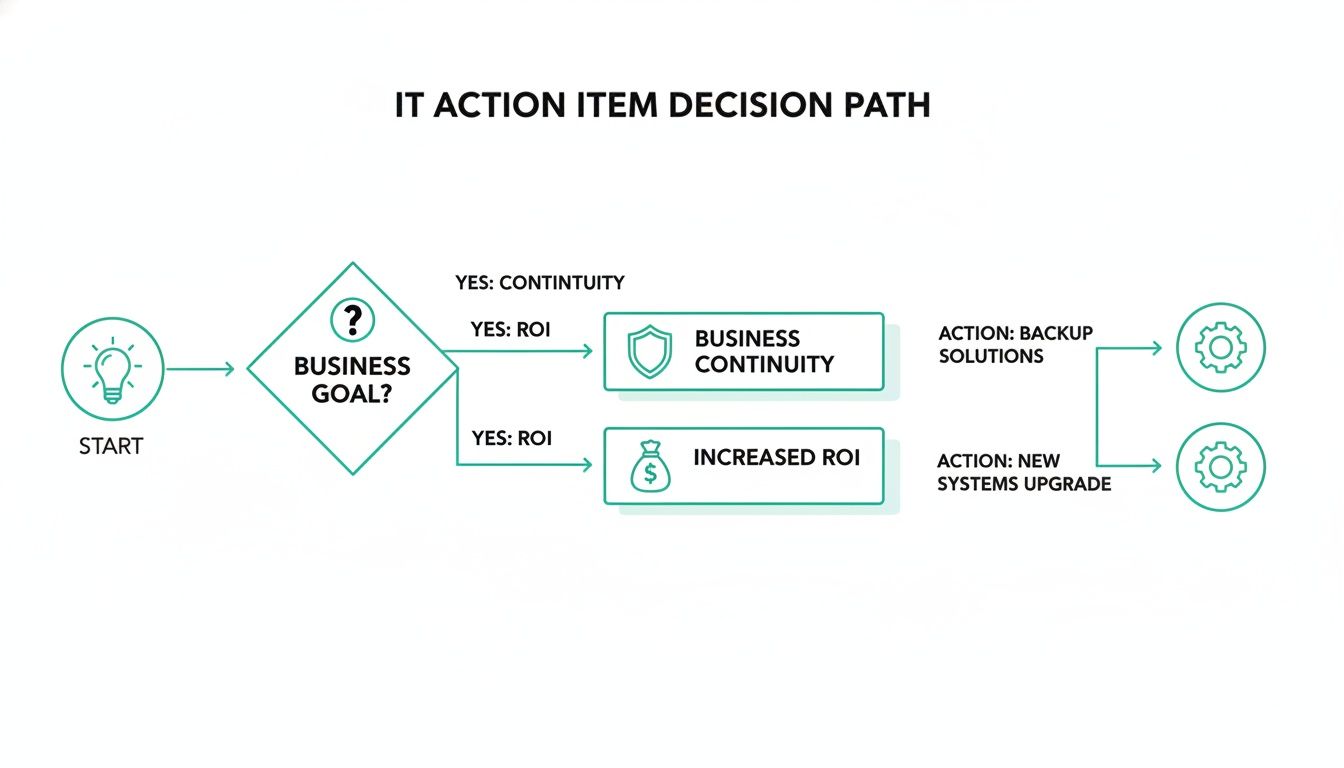
The takeaway here is simple: if a project doesn't directly protect your business (Business Continuity) or make it more money (ROI), you have to question why you're even talking about it.
The MoSCoW Method: For When You Have To
Sometimes, prioritization isn't about ROI; it's about staying in business or staying out of jail. This is where the MoSCoW method is pure gold. We use this constantly with our clients, especially the defense contractors along the I-65 corridor who are navigating CMMC compliance.
MoSCoW is an acronym for:
- Must-Have: Absolutely non-negotiable. The project is a failure without these. For CMMC, this is stuff like implementing multi-factor authentication or setting up proper access controls. You don't do it, you don't pass.
- Should-Have: These are important but not essential for day-one launch. Think of adding a SOC-as-a-Service for 24/7 monitoring. It's a great idea and you need it eventually, but you can add it in phase two.
- Could-Have: Nice additions if time and money permit, but nobody will notice if they're missing. Maybe a fancy new security dashboard that impresses the C-suite.
- Won't-Have (This Time): Things you are explicitly kicking out of the project's scope. It's just as important to define what you aren't doing.
MoSCoW is brilliant for separating the legal or contractual "musts" from the operational "shoulds" and "coulds." It puts an end to arguments about what's truly required versus what's just a nice-to-have. For a healthcare provider buried in HIPAA rules, this framework is a lifesaver.
Defining your scope with MoSCoW is a cornerstone of a solid Business Impact Analysis. To see how these pieces fit together, you can check out our guide on the Business Impact Analysis template and build a more resilient strategy.
Look, these models aren't magic wands. But they are a powerful dose of reality. They shift the conversation from "what I want to do" to "what we must do to hit our goals." And that's a conversation worth having.
Running a Workshop That Actually Works
Good ideas are cheap. Getting everyone to agree on which good idea comes first? That's priceless. All those fancy scoring models we just talked about are just numbers on a spreadsheet until you get the team to hash out what those numbers mean.
This is where a proper IT prioritization workshop comes in. It's not about making a to-do list; it’s about forging a consensus. You want to walk out with a ranked project backlog that everyone understands and—more importantly—actually buys into. This is how you kill the back-channel lobbying and "quick question" meetings that quietly sabotage the best-laid plans.
The Right People in the Room
Getting the right folks around the table is more than half the battle. If a key player is missing, you’re basically guessing. You're making decisions with blind spots, and those blind spots often lead to very expensive rework down the line.
Think of it as assembling a team of specialists for a high-stakes mission. You need a 360-degree view of every potential project:
- Executive Leadership (CEO/CFO): They hold the company credit card. They need to see the straight line from tech spending to business goals and ROI.
- Department Heads: These are your customers on the inside. The marketing director, the head of sales, the office manager—they live with the daily friction and can speak to the "Value" side of any Value vs. Effort score.
- Your IT Crew (Leadership & The Front Lines): These are your reality checks. The IT manager knows the ugly dependencies and hidden constraints. The tech who answers the helpdesk calls knows which "minor" glitch is secretly causing the most lost productivity across the company.
- A Neutral Facilitator: This is often where we come in. A good facilitator isn't there to vote. They're there to keep the conversation from going off the rails, to challenge shaky assumptions, and to make sure the quietest person in the room gets heard.
I’ll never forget when we dissembled a similar client’s failing RAID array at their Greenwood office. It was a complete disaster. The root cause wasn't faulty hardware; it was a communication breakdown. Finance had shot down a proactive replacement months earlier because they didn't get the business continuity risk. IT never explained it in terms of downtime costs. A single, one-hour workshop could have saved them weeks of chaos and lost revenue.
An Agenda That Respects Everyone's Time
A productive workshop is not a free-for-all brainstorming session. It needs a tight agenda and a laser-focused goal. You're there to make decisions, not just to talk about making decisions.
Here's a simple, effective flow we've used countless times:
Start by putting the main goal on the whiteboard: "Our mission today is to agree on and rank the top 5 IT projects for the next six months."
Then, give each project sponsor a few minutes—no more than four—to make their case. They should focus on the business value, not the technical weeds. After the pitches, you move into group scoring. Put a model like RICE or Value vs. Effort up on the screen and score each project together, debating the numbers as a team. This is where hidden assumptions are dragged into the light.
Finally, do a quick "sanity check" on your newly ranked list. What has to happen before we can even start this other project? This is where you realize that the spotty Wi-Fi in your old downtown Indy brick building—a classic technical bottleneck—might just be the root cause of three other "high-priority" problems.
This whole process forces everyone to see how interconnected the business really is. The industry trends all point this way, too. Formal governance and planning are no longer optional. For example, while AI optimization became the top buzzword for enterprises in 2026, the real story was the surge in formal IT governance, jumping from just 12% of companies in 2020 to 47% today. You can read more about these top enterprise tech priorities and their implications for 2026 on NetworkWorld.com.
For Indiana businesses, the lesson is clear: you have to get your foundation right before you can build anything new.
Building Your Strategic IT Roadmap and KPIs
So, you’ve wrestled your way through a prioritization workshop and now you have a ranked list of IT projects. That's a huge win! But let's be honest, a list sitting in a spreadsheet isn't going to fix anything. Now it’s time for the real work: turning that list into a visual, living IT roadmap that actually gets things done.
This is where abstract goals become a concrete plan of attack.
The first, and most critical, part of this process is sequencing. It’s not just about what’s most important, but what has to happen first. After 17 years of local service for businesses across Central Indiana, I can tell you that getting the order wrong is the fastest way to derail a perfectly good plan.
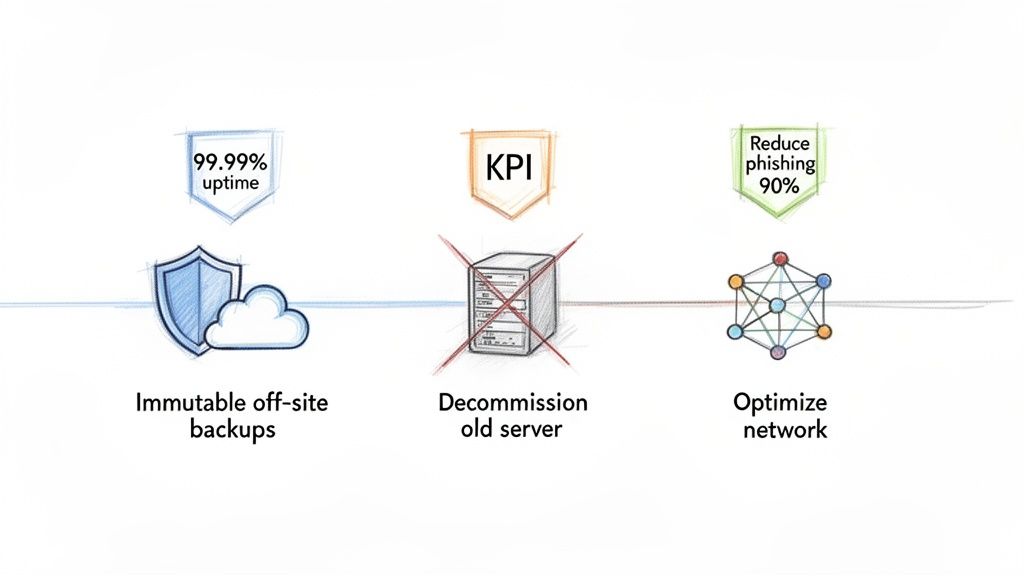
For example, you absolutely have to nail down your immutable off-site backups before you even dream of pulling the plug on that ancient, wheezing server in your Greenwood office. Do it the other way around, and you're practically inviting catastrophic data loss, a business continuity nightmare, and a whole lot of downtime.
Defining What Success Looks Like with KPIs
A roadmap without a finish line is just a wish list. To make sure these projects deliver real value, every single one needs its own Key Performance Indicators (KPIs). These are the hard numbers that prove a project did what it was supposed to do and gave you a solid return on your investment.
And please, let’s forget vague goals. Good KPIs are sharp, specific, and have a deadline.
- For a Cybersecurity Project: A strong KPI sounds like this: Reduce phishing-related support tickets by 90% within six months of rolling out Bitdefender GravityZone and our employee security training. This is a number you can track, and it directly impacts your bottom line by converting "wasted tech time" into billable hours.
- For a Networking Upgrade: An effective KPI would be: Achieve 99.99% uptime and reduce latency to under 20ms across all UniFi mesh nodes within the first quarter after installation. This translates directly to employee productivity—no more spinning wheels and lost billable hours.
These KPIs aren't just for show. They’re how you hold us accountable. We don't just promise results; we believe in proving them with cold, hard data.
Connecting Your Roadmap to Real Business Outcomes
Ultimately, every KPI should tie directly back to Business Continuity and ROI. The goal isn’t just to check a technical box; it’s about making your company stronger and more profitable.
When we help a Johnson County business owner track these metrics, we’re showing them exactly how a new firewall or cloud migration makes a tangible difference. A 90% drop in phishing incidents means your staff isn’t wasting time on security scares and can focus on what they do best—serving your customers.
By tying every project and its KPIs back to preventing downtime—which can cost up to $9,000 per minute—we demonstrate how a predictable monthly IT budget actively protects and grows your revenue. This turns your IT roadmap into a financial strategy.
This shift toward measurable, flexible IT is happening everywhere. Global cloud spending is projected to hit $679 billion in 2026 as businesses ditch expensive hardware for nimble cloud services. But here’s the kicker: without a solid plan, a staggering 85% of big data projects fail, proving that just throwing money at tech isn't a strategy. You can see more data transformation statistics on Integrate.io that really drive home the need for a clear, measurable plan.
Your IT roadmap is a living document, a powerful tool that guides your technology investments. To get a deeper look at how to structure this long-term vision, you can explore our guide to building a bulletproof IT roadmap. This is how you stop reacting and start driving your business forward.
So, Where Do We Go From Here?
Look, juggling IT priorities is what separates the businesses barely hanging on from the ones thriving up and down the I-65 corridor. It’s the difference between tech being a constant money pit and it being the engine that actually drives your growth.
You can stop playing whack-a-mole with tech problems. This whole process is about making smart, deliberate choices that actually help you make more money, keep your clients happy, and protect your data. It’s about converting "wasted IT time" into billable hours and finally getting a predictable monthly budget you can count on.
Time to Ditch the Guesswork
If you’re a business owner in Johnson County or a leader in one of Indy’s tech hubs, this is for you. It’s time to get a real plan. Prioritizing your IT isn’t just a nice idea—it’s a core business skill, and frankly, it’s tough to do from the inside when you're busy running the company.
After 17 years of local service, we've seen it time and again: the companies that nail this don't just grow, they become incredibly resilient. They have a partner who can instantly tell them if a new gadget is a game-changer or just another shiny object.
Instead of guessing what to tackle next, you can start with a crystal-clear, data-backed picture of where you stand right now. The next step isn't to just click a button—it's to finally get some answers and start plugging the holes in your security and efficiency.
Stop tolerating the constant headaches and surprise IT bills. Let’s figure this out together. Schedule your no-obligation Free Network Assessment or Security Risk Audit for your Greenwood or Indianapolis-area business today.
Your Top Questions, Answered
After 17 years of local service helping Indiana businesses untangle their tech priorities, we’ve heard just about every question in the book. Here are some of the most common ones we get from owners who are trying to make sense of it all.
How Often Should We Revisit Our IT Priorities?
We recommend a formal sit-down every quarter. Think of it as a regular check-up to make sure your tech roadmap is still pointing toward your business goals.
That said, you can't just set it and forget it. A new cybersecurity threat hitting your industry, or a massive new business opportunity landing on your desk, means it's time to huddle up immediately. A static IT plan is a sitting duck.
What's the Biggest Mistake You See Businesses Make?
Oh, this one's easy. It’s chasing the next “shiny object” while the fundamentals are crumbling. We see it all the time—a company wants to talk about AI, but the aging server hardware in their Greenwood office park is one power surge away from oblivion. This is a perfect example of a technical bottleneck that kills business continuity.
You have to fix the cracked foundation before you can add a second story. It’s not glamorous, but it’s the only way to build something that lasts.
Getting a second opinion isn't a sign of distrust; it's smart business. If your current IT guy says everything is fine but you have that nagging feeling in your gut, listen to it. A fresh set of eyes can spot risks and opportunities everyone else has missed.
We're a Small Business with a Tiny Budget. Where Do We Even Start?
Don't get bogged down in complicated frameworks. Seriously. Grab a whiteboard and draw a simple Value vs. Effort matrix. This simple exercise costs nothing and forces you to have an honest conversation about where you'll get the most bang for your buck for ROI and business continuity.
Our no-obligation Security Risk Audit is designed for exactly this. It gives small businesses right here in the Indianapolis area a clear, actionable starting point.
My Current IT Provider Says Everything Is Fine. Should I Believe Them?
Maybe they're right. But how can you be sure? An outside perspective is just good risk management.
For businesses that have to meet strict standards like HIPAA for healthcare or CMMC for defense contractors, it’s not just a good idea—it’s an essential part of your responsibility. You need to be certain your provider isn’t missing a critical vulnerability that could cost you your business and reputation. We cover even more of these scenarios on our company FAQ page.
Ready to stop guessing and start building a smart, profitable IT plan? Finchum Fixes IT is here to help. Schedule your free, no-obligation Security Risk Audit for your Greenwood or Indianapolis-area business at https://finchumfixesit.com today and take the first real step toward a smarter IT future.