IT Compliance and Governance for Indiana SMBs
For an Indiana small or midsize business, IT compliance and governance means documenting who owns cyber risk, mapping shared controls across HIPAA, PCI DSS, CMMC, the FTC Safeguards Rule, and applicable state requirements, then keeping evidence that those controls work. NIST CSF 2.0 offers a practical structure for connecting leadership decisions to day-to-day security.
A familiar Greenwood scenario starts with a server that won't boot on Monday morning. Staff can't reach files, an insurance form asks who approved the incident plan, and a customer wants evidence of access reviews. The technical failure is obvious. The governance failure is the uncomfortable part: nobody can show who owned the risk, what was supposed to happen, or whether anyone tested the backups.
In our 17 years of local service, the practical lesson is that scattered tools and good intentions don't substitute for assigned ownership and usable records. Compliance shouldn't mean hiring an enterprise-sized department or buying a new platform for every framework. It should mean knowing which obligations apply, building controls that address overlapping risks, and collecting proof as part of normal IT operations.
The Compliance Wake-Up Call Most Indiana SMBs Get Too Late
The breach is over, but the questions keep coming. A Johnson County business has restored access to its systems after a ransomware incident, yet the insurer wants to know when the incident was declared, which accounts were reviewed, and whether recovery procedures were tested. A customer asks for the same evidence in a vendor questionnaire. The office manager is trying to keep orders moving while staff search old email threads for decisions no one recorded.
That situation doesn't require a dramatic breach. Aging server hardware in a Greenwood business park can fail just as effectively at stopping work. If the company has no current asset inventory, named decision-makers, or tested restore procedure, a hardware fault can turn into missed deadlines, confused customer communication, and hours of employee time spent improvising.
The common cause is unassigned responsibility. Someone may have bought antivirus, asked a consultant to configure backups, or signed an insurance application. But unless a person owns risk decisions and another person knows how to escalate an incident, controls can exist without being governed. That gap can lead to audit findings, notification confusion, and delays in getting normal work back online.
The operational test: Can the business show who makes a cyber-risk decision, what evidence supports it, and what happens when a control fails?
Indiana owners, operators, and office managers don't need a forest of binders. They need a steady process that fits their business. For a practical look at how cyber-insurance requirements can affect local companies, review this Indiana cybersecurity insurance guide for SMBs. The useful starting point is to treat security decisions as business decisions, with names, deadlines, and evidence attached.
What IT Compliance and Governance Actually Mean for a Small Business
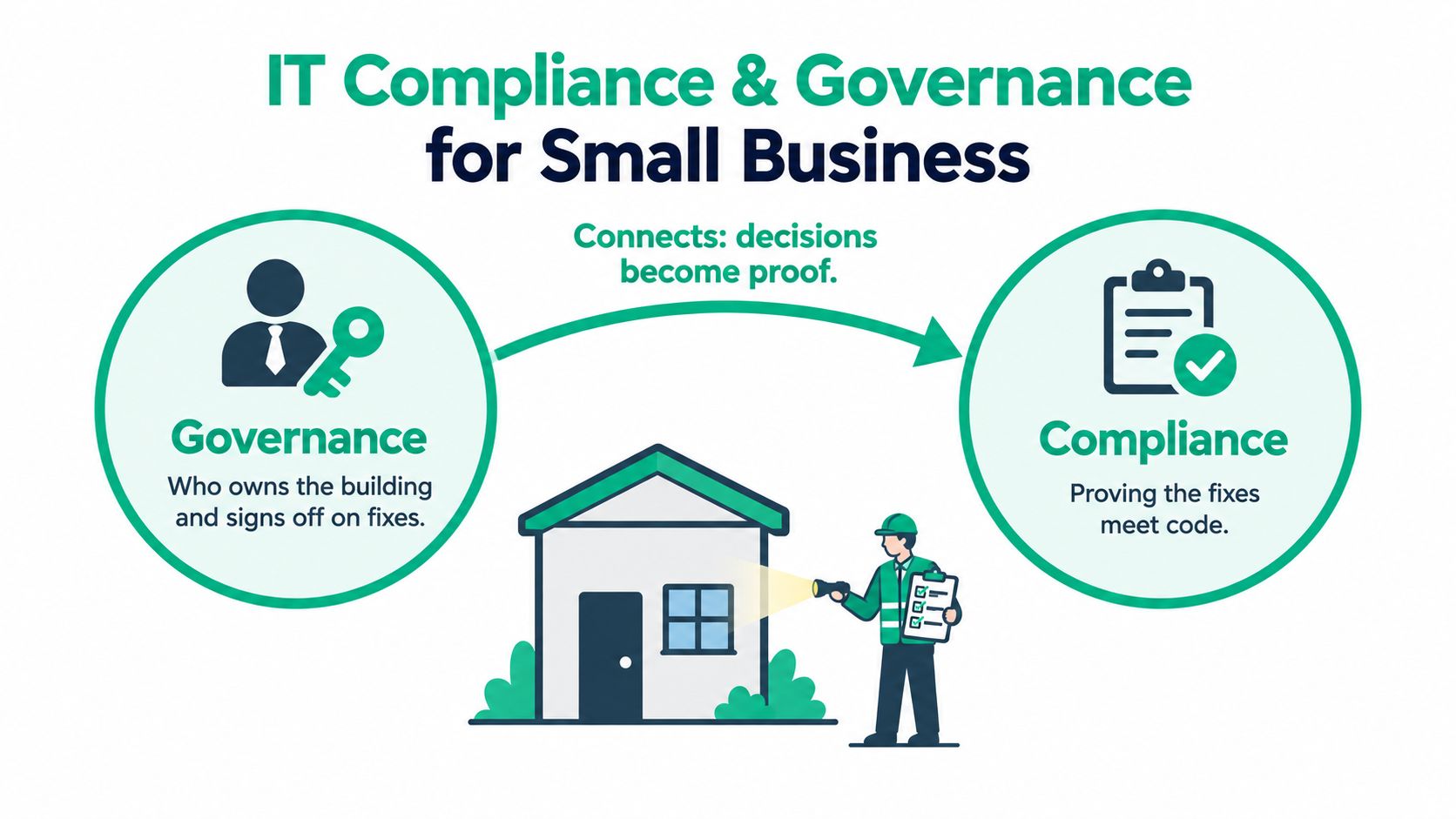
Think of a commercial building inspection. Governance is who owns the building and approves repairs. Compliance is showing that the repairs meet the required standard. If nobody has authority to approve a fix, a checklist won't keep the building safe. If the fix is completed but never documented, an inspector can't verify it.
That distinction is central to NIST Cybersecurity Framework 2.0. Its six Functions are Govern, Identify, Protect, Detect, Respond, and Recover. Govern puts leadership accountability, policy, roles, risk tolerance, and oversight alongside technical security work. The framework is designed for organizations at different sizes and levels of maturity, so a small Indiana business can adapt it without copying an enterprise program wholesale (NIST CSF 2.0).
Make ownership visible
For a Central Indiana company, governance should answer practical questions: Whose name is on the cyber risk register? Who can declare an incident? Who approves a temporary exception? Who explains the company's risk decisions to owners, a board, a bank, or a customer?
Once the decision-makers are clear, compliance becomes easier to organize. A policy that sits unread in a shared folder is not the same as a policy mapped to controls, assigned to owners, reviewed on a schedule, and supported by evidence such as access records or incident decisions.
A useful governance charter can name business ownership, IT responsibility, security duties, and supplier obligations. It can also define how often risk is reviewed and what events trigger escalation. When legal or regulatory language needs a plain-language starting point, an AI legal assistant for business owners may help organize questions for qualified counsel. It doesn't replace legal advice or a decision-maker.
The Regulations That Actually Touch Indiana SMBs
The alphabet soup gets easier when you start with the business activity that triggers the obligation. A clinic taking insurance, a retailer processing cards, and a manufacturer bidding on defense work don't face identical requirements. They can still build many of the same security controls.
HIPAA applies to covered healthcare entities and business associates that handle protected health information. Its Security Rule requires safeguards for electronic protected health information, and a practical evidence starting point is a documented risk analysis with an assigned remediation plan.
PCI DSS 4.0 concerns organizations that store, process, or transmit payment-card data, or that can affect the security of the cardholder-data environment. A small merchant should be ready to show its applicable assessment, who has access to payment systems, and how relevant security controls are maintained. For a task-oriented reference, see this PCI DSS compliance checklist for 2026.
CMMC applies to defense contractors and subcontractors whose Department of Defense work brings controlled information or contract security requirements into scope. The practical starting point is to identify the relevant systems and information, document responsibilities, and retain evidence supporting required security practices. Manufacturers pursuing defense work may also be familiar with quality certification; this overview of AS9100D certified additive manufacturers offers useful industry context, though quality certification is not a substitute for cybersecurity requirements.
The FTC Safeguards Rule applies to covered financial institutions under FTC jurisdiction and requires a written information security program with administrative, technical, and physical safeguards. A written plan, risk assessment, and records showing that safeguards are reviewed are sensible evidence to organize.
Indiana's breach-notification statute is relevant when a business maintains covered personal information and experiences a qualifying breach. The minimum preparation is not a generic response template. It's a documented escalation path that lets the company identify affected information, involve the right decision-makers, and get legal guidance on notification duties.
Overlap is where smaller firms can save effort. Identity controls, encryption, incident response, vendor oversight, backups, and evidence collection can support several obligations at once, but a shared control system doesn't make the regulations interchangeable.
Building a Shared Control System Instead of Five Silos
A workable crosswalk starts with the risk, not the framework's document structure. If an employee leaves, who removes their access? If a supplier handles sensitive data, who reviews that relationship? If a server is encrypted by ransomware, which recovery copy is protected from the same attack?
Map the controls the business operates, then note where they support HIPAA, PCI DSS 4.0, CMMC, or the FTC Safeguards Rule. The table is a working aid, not a legal determination of applicability.
Shared Control Crosswalk for Indiana SMBs
| Control area | HIPAA | PCI DSS 4.0 | CMMC | FTC Safeguards Rule | Evidence artifact |
|---|---|---|---|---|---|
| Identity and access | Limit access to protected health information | Restrict access to cardholder-data systems | Control access to covered information and systems | Limit access to customer information | User list, role assignments, access-review records |
| Authentication | Support appropriate access safeguards | Use strong authentication where required | Document and enforce authentication practices | Protect access to customer information | MFA settings, exception approvals |
| Encryption | Protect electronic protected health information as appropriate | Protect card data according to applicable requirements | Apply required protections to covered information | Protect customer information | Encryption settings, system configuration records |
| Logging and monitoring | Support detection and investigation | Monitor relevant security activity | Record and review relevant events | Detect and respond to security events | Alert history, ticket records, investigation notes |
| Backup and recovery | Support contingency planning | Protect system availability and data | Prepare for recovery of covered operations | Support security and availability | Backup reports, restore-test records |
| Vendor oversight | Review business-associate relationships | Assess relevant service providers | Manage supplier and contract risks | Oversee service providers handling customer information | Vendor assessments, contracts, review notes |
| Incident response | Document response and applicable reporting decisions | Follow response requirements applicable to the environment | Prepare to handle and report incidents as required | Respond to security events | Incident plan, exercise record, decision log |
A control only counts when it's implemented and there's evidence to support it. An access review should produce a dated record of who checked the accounts and what changed. Immutable off-site backups should have reports and restore-test results, not just a dashboard claiming the job completed. Bitdefender GravityZone can provide endpoint and policy information to review, while UniFi configuration backups can help document network changes.
For supplier checks, use a consistent intake and review process rather than an informal email thread. These IT vendor management practices for Indiana businesses can help structure that work. Keep the crosswalk in a format the team will maintain, whether that's a controlled spreadsheet or a compliance platform. The tool matters less than assigned owners, regular review, and retrievable records.
Running a Risk Assessment Your Insurer Will Actually Accept
An insurer-ready risk assessment isn't a pile of vendor reports. It's a documented decision process that starts with what the company relies on and ends with owners, treatment decisions, and follow-up.
Work from scope to decision
Start by defining which locations, teams, systems, and information are in scope. A Greenwood office might depend on an on-site server, Microsoft 365, employee laptops, UniFi switches and access points, a line-of-business application, and outside providers. If you leave a system out because nobody remembered it, the assessment can miss the route an incident takes.
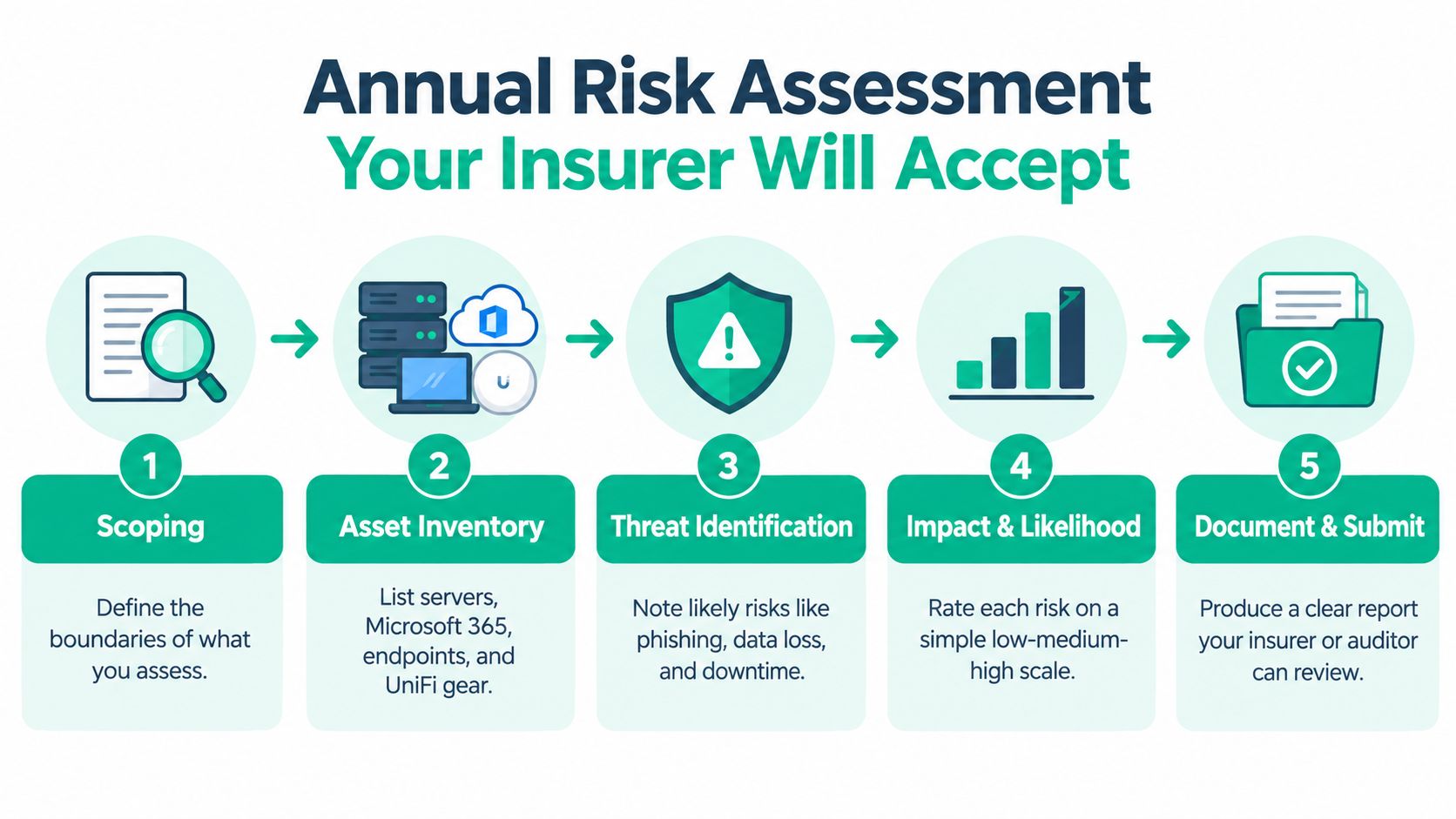
List realistic threats in plain English: a staff member approves a phishing prompt, a departing employee retains access, a supplier loses service, a backup cannot restore, or aging hardware fails during a busy period. Rate likelihood and business impact with a simple low, medium, or high scale, then document whether the business will mitigate, transfer, avoid, or formally accept the risk. Don't write “low” without explaining why.
A defensible output includes an approved risk register, named owners, accepted-risk memos with dates, and a remediation plan that management reviews regularly. A risk without an owner is a note, not a decision.
Check whether the technical evidence matches the paperwork
A mature assessment should look at the systems behind the controls. That means reviewing UniFi configuration and network records, Bitdefender GravityZone policy and device status, MFA enforcement, account privileges, and immutable off-site backup health. The reviewer should also confirm that the company can identify key dependencies and retrieve evidence without reconstructing events from scattered emails.
Practical rule: An insurer's form is a prompt to verify controls, not proof that the controls work.
The assessment should be refreshed when the business changes in a meaningful way, such as adding a supplier, adopting a new cloud service, or moving sensitive work to a different system. This risk assessment methodology for Indiana SMBs can help owners organize the process. The aim is a current picture of business risk, not a polished document that goes stale after approval.
Governing AI Use Without Banning the Tools
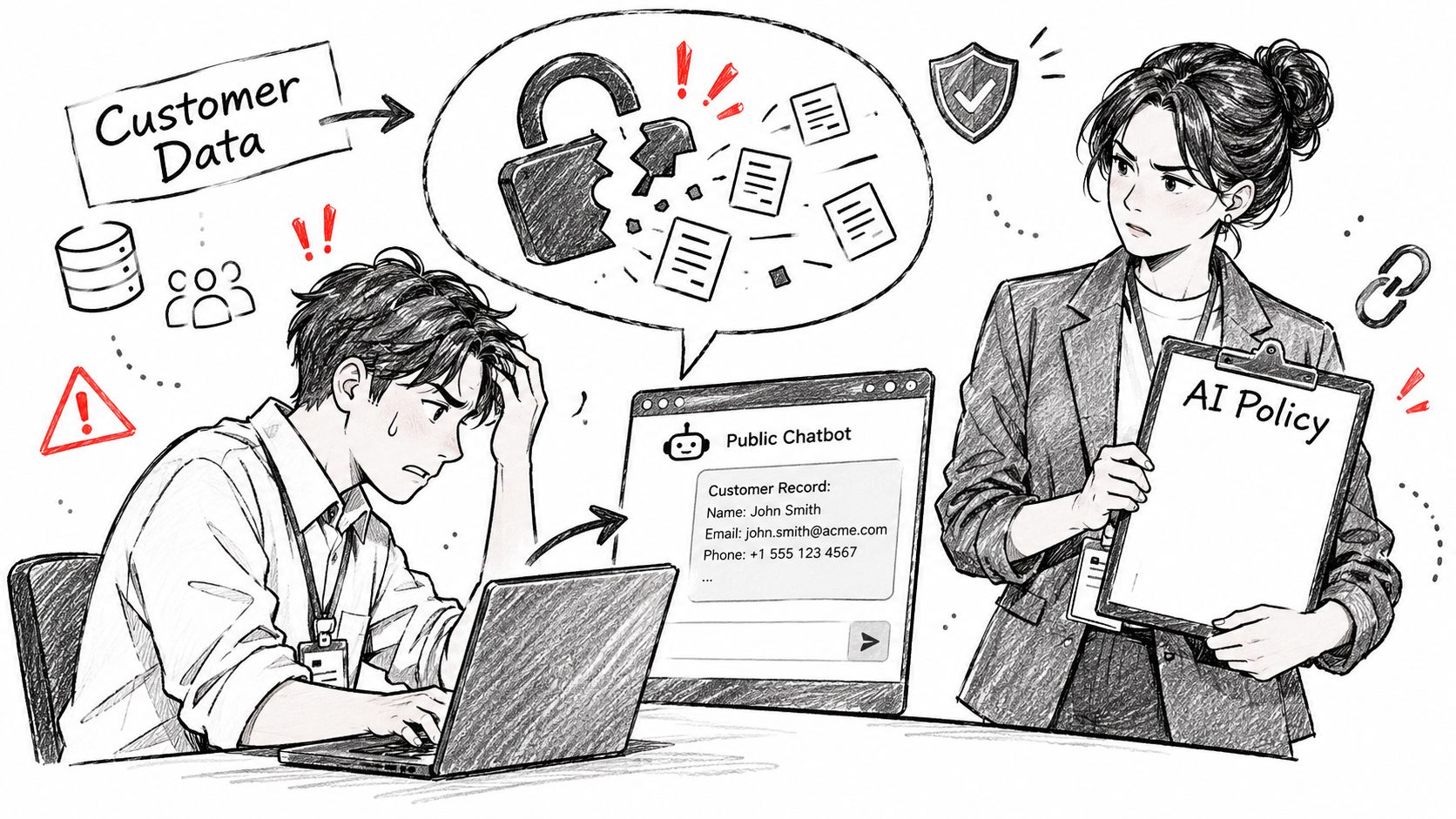
A policy that says “use AI responsibly” won't prevent an employee from pasting a customer record into a public chatbot. Nor will it catch AI-generated code entering production without a human review. The practical risk for a small business often comes from ordinary workplace use that nobody has inventoried or approved.
The available survey evidence points to a gap between adopting AI tools and putting governance around them. More than 83% of surveyed organizations use AI tools, while only about 25% report having a strong AI-governance framework (Compliance Week survey reports). Separate survey results in the same research summary indicate that formal policies can coexist with weaker review and data-restriction practices. The operational point is simple: a published policy isn't the same as enforced controls.
Build a small, usable governance loop:
- Inventory approved tools: Record each AI service, its business owner, the data it may receive, and who approved its use.
- Classify information: Tell staff which data they can enter, which needs approval, and which must stay out of public tools.
- Require human review: Have a responsible person check customer-facing content, automated decisions, and AI-generated code before release.
- Check the vendor: Review data handling, retention, security terms, and access arrangements before approving a service.
- Keep useful records: Log prompts or activity when the business need and privacy obligations justify it, and document approvals and exceptions.
The same loop can govern SaaS sprawl and shadow IT: identify the tool, assign an owner, set data rules, review supplier terms, and keep evidence. The AI governance spending and deployment challenges facing organizations are a useful reminder that policy and implementation are separate jobs.
For a small team, the key question isn't whether to ban every new tool. It's whether employees know what they can use, what information they can share, and who to call before a risky workflow becomes routine.
Your Compliance Roadmap from First Week to First Audit
A small business can build governance in stages. The order matters: assign ownership before buying more software, inventory systems before claiming coverage, and test recovery before assuming a backup will save the day.
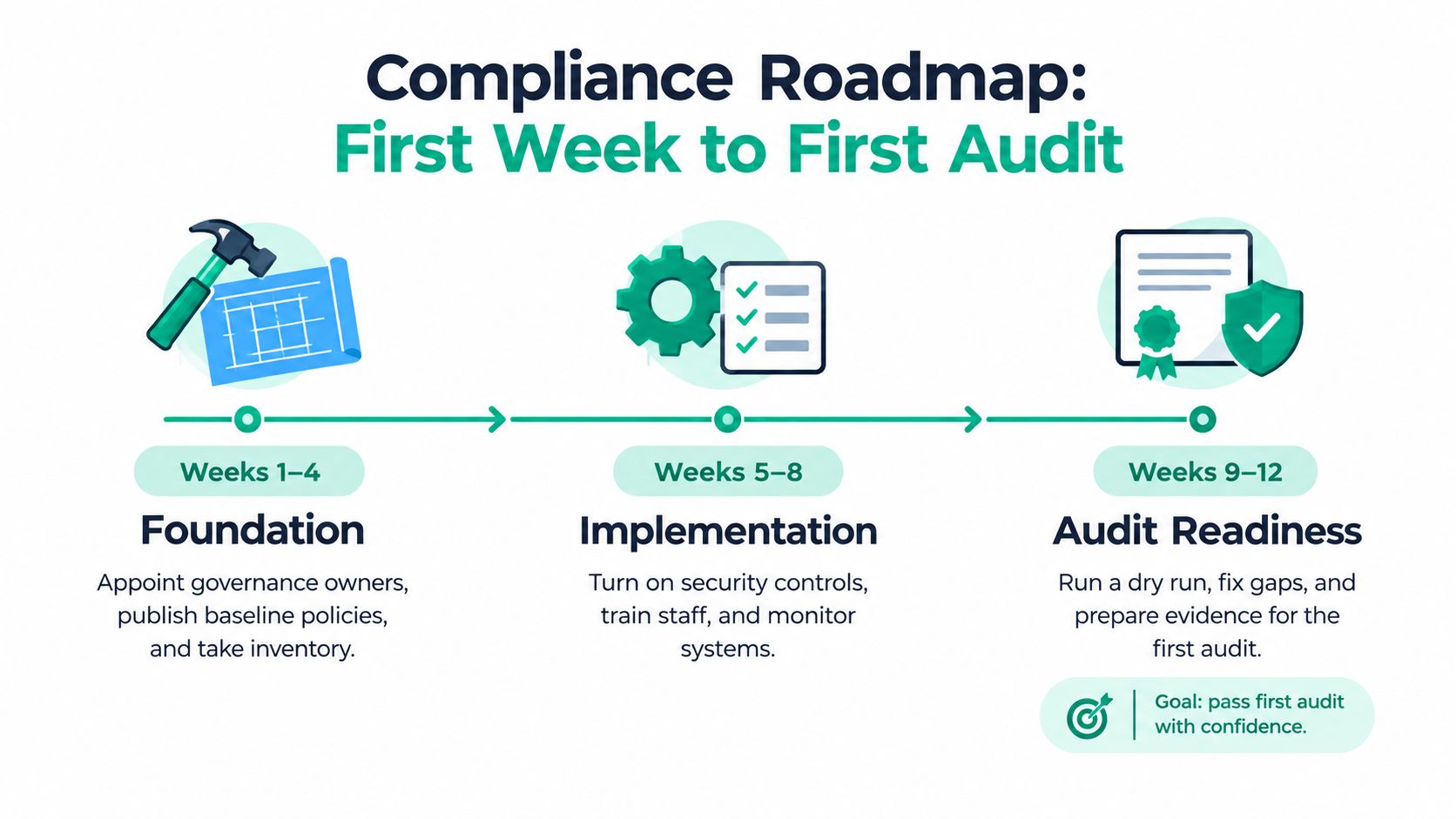
Foundation, weeks 1–4
Name the business owner for cyber risk, the technical owner for controls, and the person who can declare and coordinate an incident. Approve baseline security and incident-response policies, then inventory systems, suppliers, and sensitive information. A policy without an owner or evidence trail won't carry much weight in an audit.
Implementation, weeks 5–8
Turn on MFA across business-critical accounts, deploy immutable off-site backups, and write down the incident steps staff should follow. Make sure the procedure says whom to contact, what information to preserve, and how to escalate a suspected compromise. Test that key systems and data can be restored rather than relying on a successful-job notice.
Audit readiness, weeks 9–12
Run the first risk assessment, assign remediation owners, and close the most important gaps. Conduct a tabletop exercise: walk through a realistic outage or ransomware scenario, record decisions, and update the response plan based on where staff get stuck. This SOC 2 readiness checklist can help organize evidence and preparation, though the right requirements depend on the company and its customers.
After initial setup, keep a monthly evidence review. Check Bitdefender GravityZone reports, UniFi configuration snapshots, backup and restore-test results, access-review logs, and open risk items. For a small business, plan around 6–10 hours a month of review effort, shared between the people responsible for business decisions and IT operations. If the process consistently takes far longer, simplify the evidence workflow before adding another tool.
Keeping the Program Alive and Turning It Into ROI
Governance has business value when it keeps work moving. A company that knows its systems, watches for trouble, and practices recovery can make decisions faster during an outage than a company that starts by asking who has the admin password.
The cost of disruption can climb quickly. Downtime can cost up to $9,000 per minute for a 100-employee SMB, according to the verified figure in the cited background data. The point isn't to treat that as a prediction for every Indiana company. It's to recognize that outages stop people from serving customers, completing jobs, and billing for their time.
Build continuity around the systems the business depends on. Immutable off-site backups help protect recovery copies from tampering. SOC-as-a-Service monitoring gives the team a way to investigate alerts without expecting a small internal staff to watch every system. Zero Trust architecture and sensible network segmentation help limit unnecessary access, while tested restore procedures confirm that recovery steps work in practice.
NIST's incident-response guidance separates preparation from discovering, responding to, and recovering from an incident (NIST SP 800-61 Rev. 3). That distinction matters when an incident hits: monitoring can help surface a problem, but staff still need a clear process for containment, communication, and restoring operations. Monthly evidence reviews also give owners a chance to catch failed controls before an auditor, customer, or insurer does.
For a practical local starting point, request a Free Network Assessment or Security Risk Audit for your Greenwood or Indianapolis-area business. Finchum Fixes IT can review network dependencies, security controls, and recovery readiness so your team can reduce wasted tech time and plan IT costs with greater confidence.
Finchum Fixes IT provides compliance consulting, security assessments, managed IT, networking, and recovery support for Indiana businesses. If your business needs a workable control system instead of scattered checklists, visit Finchum Fixes IT to request a Free Network Assessment or Security Risk Audit for the Greenwood and Indianapolis area.