Building an Incident Response Team That Works
68% of responders were proactive, 86% of organizations tracked MTTR, and 63% were already using AI for incident response, so a modern incident response team is a named group of people, processes, and tools that detects, contains, and recovers from incidents. For most SMBs in Indiana, that means a small cross-functional pod plus outside help, not a full in-house SOC.
If your Greenwood office has aging servers, spotty Wi-Fi in an old brick building, or a file share that grinds the whole company to a halt when one laptop gets hit, you already know the core problem. The issue isn't whether you have “IT support.” It's whether anyone is ready to answer the phone at 2 a.m., isolate the mess, and get the business back to work without turning a bad night into a week of downtime.
What an Incident Response Team Actually Does
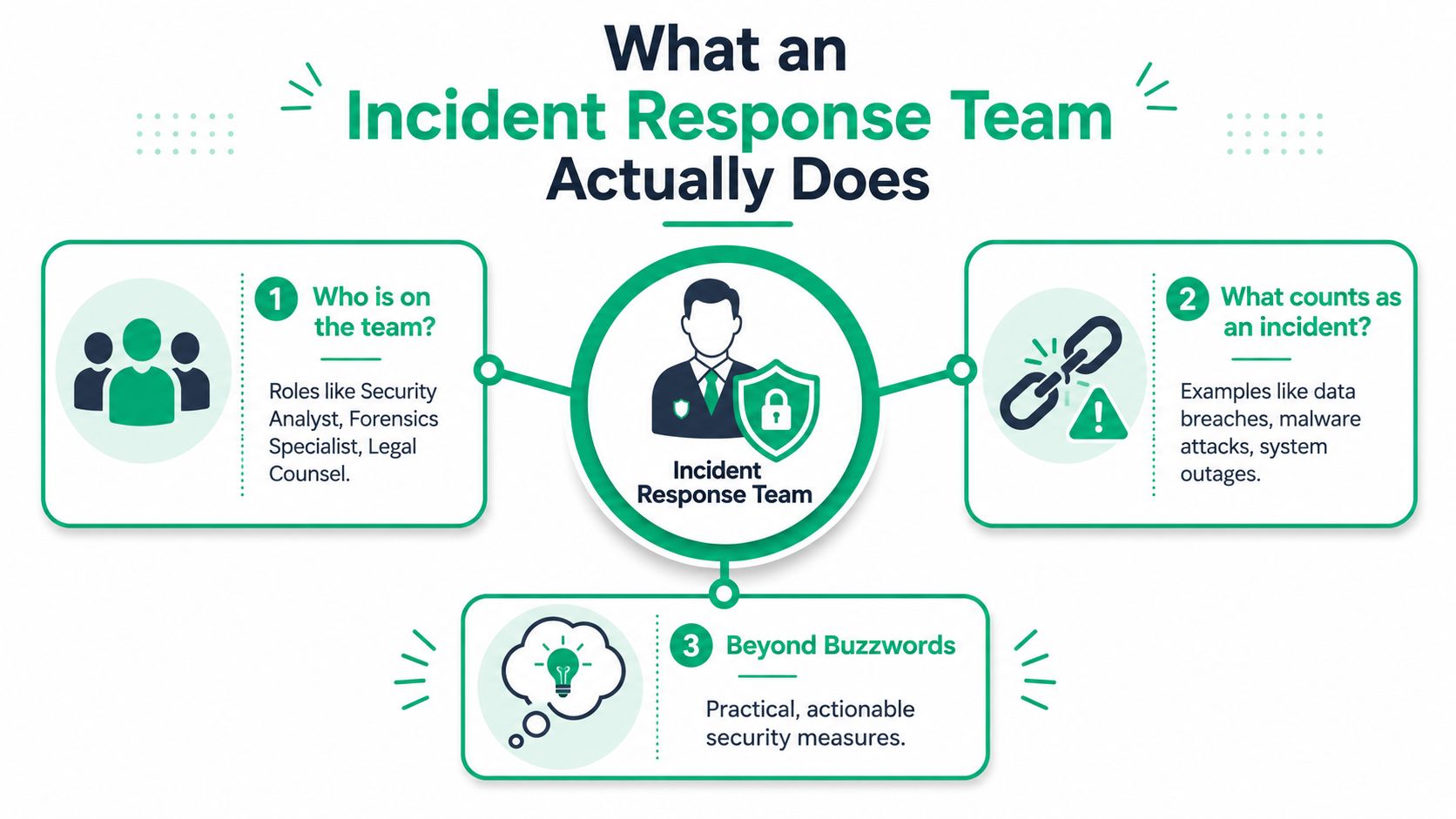
An incident response team is the group that owns the ugly part of IT, the part where speed matters more than politeness. Helpdesk closes tickets. An incident response team makes decisions under pressure, preserves evidence, keeps people informed, and restores service without making the blast radius bigger.
The work is narrower than most people think
A real team handles detection, containment, eradication or recovery, and post-incident learning. That lifecycle is the backbone of the role structure described in the standard incident response model, which separates preparation, detection and identification, containment and eradication, recovery, and lessons learned so the wrong person doesn't try to do every job at once Sygnia's incident response team structure.
That matters in a 25-to-150-person company because the team doesn't need more bodies, it needs cleaner handoffs. One person notices a suspicious login, another isolates the endpoint, another talks to leadership, and someone else keeps timestamps, screenshots, and decisions in order. If the same person is trying to triage alerts, write emails, and rebuild a server, something gets missed.
Incidents are business problems, not just hacker stories
Ransomware on a file share is an incident. A business email compromise that tricks accounting into paying the wrong vendor is an incident. A cloud outage that kills access to the CRM at 9:00 a.m. is an incident. A misconfigured firewall that blocks shipping labels is an incident. If it stops work, threatens data, or creates legal exposure, it belongs in the incident queue.
That's why this team is different from a generic helpdesk. Helpdesk solves known issues for known users. An incident response team owns uncertain events, decides what to shut down, who to notify, and when to bring in legal, insurance, or outside forensics. That's also why the team's job connects directly to continuity and ROI, because every minute spent guessing is a minute the business isn't billing, shipping, or closing deals.
The best way to think about it is simple. The team's job is triage, evidence handling, communication, and clean recovery. Everything else is noise.
If you want a practical starting point for the detection side, this local guide on threat detection and response for Indiana businesses is a solid companion piece.
Practical rule: if the event can trigger downtime, data exposure, or customer-facing disruption, treat it like an incident, not an “IT issue.”
The Incident Lifecycle Your Team Runs On
A mature team does not wing it. It runs the same play every time, with fewer mistakes and less confusion. For a small company, that matters more than elegant theory. You need a process that tells someone in Indianapolis who picks up the phone, who isolates the machine, and who keeps the rest of the business informed while the mess is still unfolding.
CISA's plan guidance treats incident response as something you document, review, and improve after the fact, which is the right mindset for a repeatable operating rhythm instead of a panic loop CISA incident response plan basics.
The phases are boring on purpose
Preparation means the company already knows who leads, where the runbooks live, and how to communicate if email is down. Detection and identification means the analyst confirms whether the alert is real or junk. Containment is the moment you cut off spread, usually by isolating a host, disabling a token, or blocking a bad account. Eradication removes the cause. Recovery restores service with checks, not wishful thinking.
The last piece, lessons learned, is where weak teams usually fail. A proper retrospective puts the timeline on the table, forces the team to correct it, and updates policy based on what happened. Skip that meeting and you will pay for the same mistake twice.
A Greenwood manufacturing example
A helpdesk tech gets an alert that a file server is encrypting data at 7:12 a.m. Tier 1 confirms the alert, captures the first evidence, and escalates. Tier 2 or the sysadmin isolates the server from the network. A technical lead checks whether backups are clean, while communications keeps executives from flooding the channel with side questions. The scribe logs every action because a clean timeline matters later.
The handoff is where most SMBs stumble. The person who sees the problem is rarely the person who can contain it. Google's incident response guidance puts that in plain terms, clear command, clear communications, and clear operations roles, plus a pre-set communication channel and escalation matrix Google SRE incident response workbook.
Artifacts matter more than drama
A good response produces containment tickets, forensic images, executive status notes, and a postmortem. That paperwork is not bureaucracy. It is the record that shows the team made the right calls under pressure and gives the next responder a better starting point.
Use this incident response plan template if you need to turn that lifecycle into a working document instead of a slide deck.
Roles and Responsibilities for a Lean SMB Team
A four-person company can't fake a Fort Knox command center, and it shouldn't try. In a lean Indianapolis-area business, the smartest setup is usually one experienced IT lead carrying incident command and technical direction, with a few clearly defined backups and outside escalation when the problem is bigger than the room.
Keep the seats few and the ownership obvious
The core roles are incident commander, communications lead, technical lead, endpoint or security lead, and scribe. The incident commander makes the call on scope and escalation. The technical lead handles servers, network, identity, and recovery. The communications lead keeps executives, staff, vendors, and customers from hearing three different stories. The scribe records the timeline, decisions, and open items.
A single IT manager in Johnson County often wears two hats, incident commander and technical lead. That's fine if the runbook says so in advance. It's a mess if everyone assumes someone else is in charge.
A lean RACI beats a crowded meeting
| Role | Primary Owner | Coverage Phase | Can Be Outsourced? |
|---|---|---|---|
| Incident Commander | IT manager or senior ops lead | Detection through recovery | No, but can be backed up |
| Communications Lead | Operations, HR, or executive admin | Containment through external updates | Yes, for drafting support |
| Technical Lead | Sysadmin or network lead | Detection through eradication | Partly |
| Endpoint or Security Lead | Security-minded admin or MSP analyst | Detection through containment | Yes |
| Scribe | Assigned admin or project coordinator | All phases | Yes |
That table matters because it shows who owns what before the alert hits. It also makes it easier to spot gaps. If nobody owns communications, the first confused vendor call becomes your new full-time job.
The scribe is the role everybody underestimates
The scribe doesn't fix the incident. The scribe prevents confusion from becoming its own incident. A clean log makes the postmortem sharper, reduces blame-shifting, and helps legal or insurance later if the event has reporting obligations.
Keep the scribe separate from the person doing containment. If the same person is both fighting the fire and writing the report, the report will be garbage.
This guide on managed service vs. staff augmentation is worth reading if you're trying to decide which of these seats must stay internal and which ones can be covered externally.
The blunt truth is that some roles are local, and some don't need to be. You keep command and business communications close to home. You outsource specialized forensics, after-hours monitoring, and overflow support when the internal team is too small to carry the load cleanly.
In-House Versus Partnering With a Managed Provider
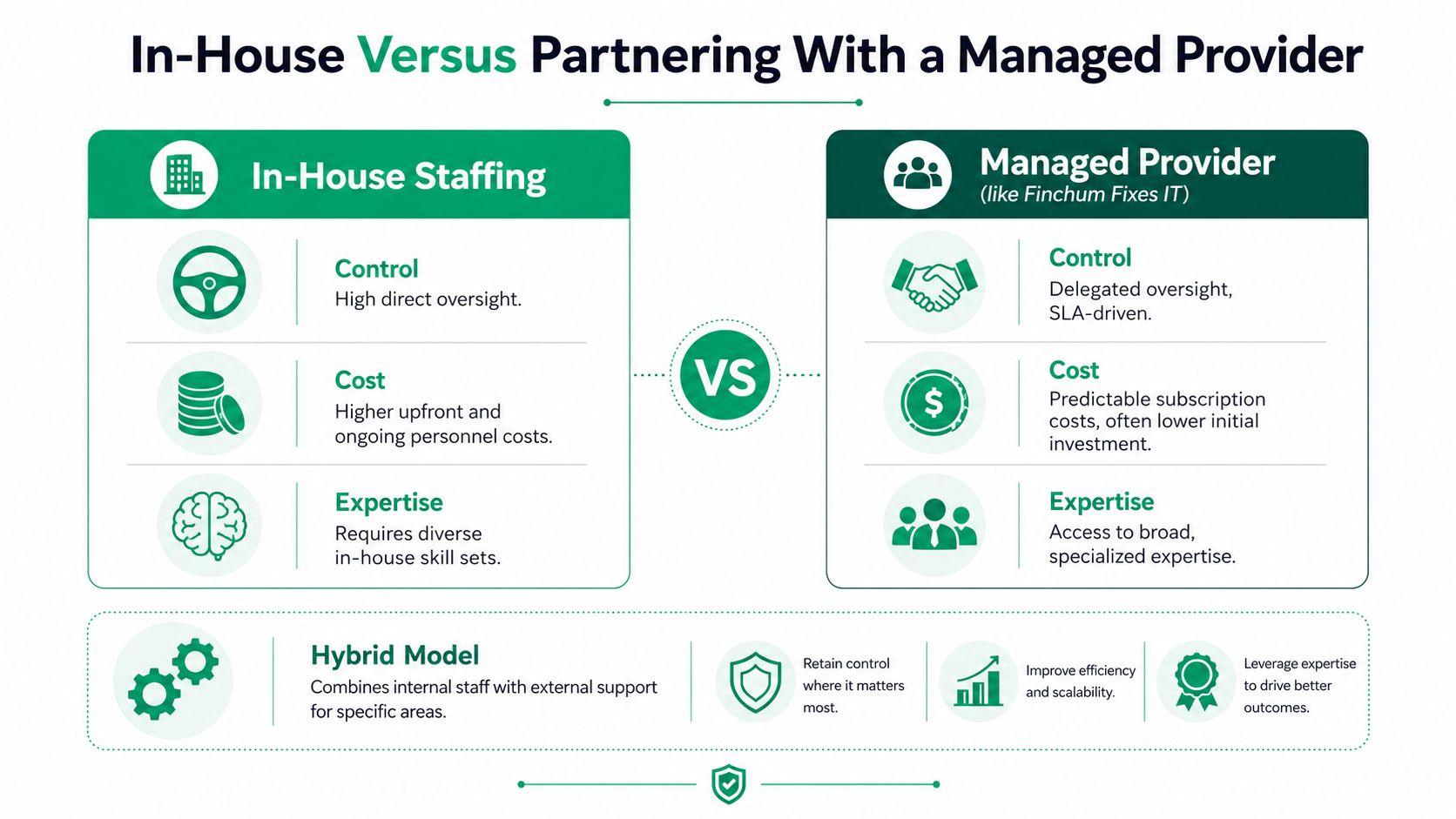
Most SMBs in the I-65 corridor don't need a heroic in-house SOC. They need a reliable model that answers the phone, limits damage, and doesn't leave two people on call every weekend. That decision is cleaner when you compare control, expertise, availability, and burnout side by side.
In-house staffing gives control, but it gets expensive fast
An internal team knows the business well. It knows the old printer in shipping, the flaky VPN, and the server nobody wants to touch. That's real value. The downside is obvious. You're paying for depth across networking, identity, endpoint defense, cloud, and forensics, even when the workload is quiet.
Managed coverage buys depth and schedule coverage
A managed provider is the better fit when you need 24/7 monitoring, faster triage, and specialist knowledge you can't staff yourself. Google's guidance is blunt about knowing your capabilities and pulling in external expertise when internal teams are overwhelmed, and Microsoft's advice lines up with that reality, especially for smaller organizations that need role-specific handbooks and clear ownership Google SRE incident response workbook.
For Indianapolis healthcare practices dealing with HIPAA, defense suppliers under CMMC pressure, or general businesses aligning to NIST CSF, the hybrid model is usually the least painful. Keep internal command and communications, then let outside specialists handle the overnight monitoring, advanced forensics, and surge work. That split keeps decision-making close while protecting the team from burnout.
Hybrid is the sweet spot for most local companies
A hybrid model works because it respects reality. Your staff knows the business impact. A partner brings tools, coverage, and fresh eyes. That matters when the incident spans endpoints, cloud services, and third-party systems, because the response now looks more like incident command than old-school IT ticket juggling Google Cloud's guidance on incident response gaps.
This managed service provider selection guide helps if you're sorting through vendors and don't want to buy a fancy contract that still leaves you on your own at 2 a.m.
One more hard truth. A predictable monthly retainer is easier to defend than a surprise overtime bill after a bad night. If your team is trying to guess, contain, and communicate all at once, external help is usually cheaper than pretending you can staff every skill in-house.
For another perspective on choosing internal versus external teams, this Technioz piece is useful, even though the topic is software development, because the trade-off logic is the same.
Tools, Runbooks, and the Stack an SMB Can Actually Afford
Good people with bad tools still lose time. The stack for a smaller company doesn't need to be flashy, it needs to be durable, visible, and usable when the primary systems are the problem.
The minimum stack is practical, not exotic
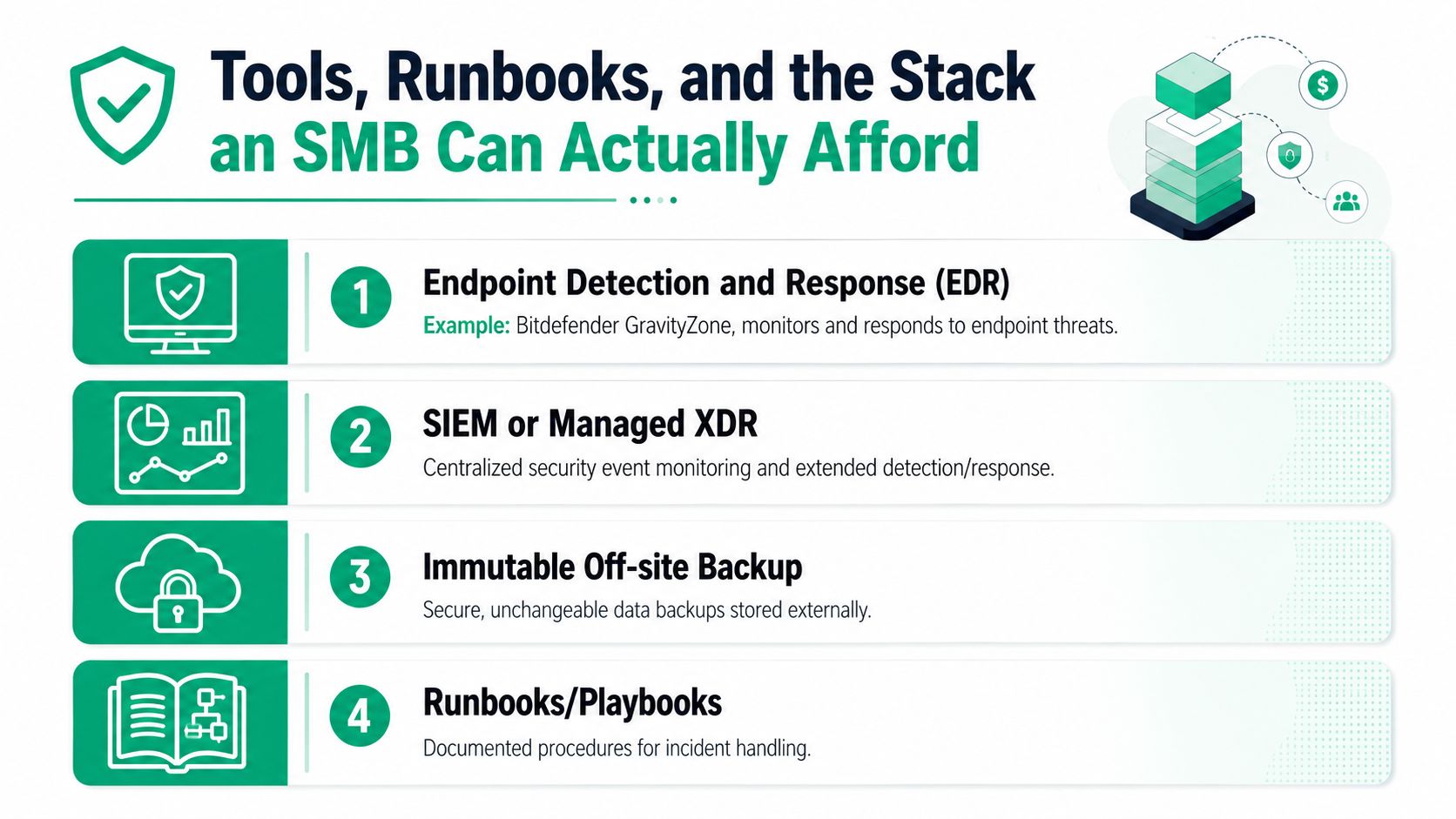
Start with endpoint detection and response, such as Bitdefender GravityZone, so compromised laptops don't sit invisible on the network. Add a SIEM or managed XDR so alerts from email, endpoints, cloud, and identity land in one place. Keep immutable off-site backups because ransomware recovery without clean backups is just a negotiation with a thief. Then make sure your ticketing system supports on-call scheduling, and your team has a secure out-of-band chat or call channel if email is dead.
Runbooks should cover the incidents you'll actually see
Write the first five for these scenarios, because these are the ones that hurt SMBs most, ransomware on a file server, business email compromise, SaaS account takeover, cloud workload misconfiguration, and an ISP or cloud-region outage. Each runbook should list trigger signs, who gets called, what gets isolated, where the evidence goes, and what “back to normal” means.
Store the runbooks somewhere the incident can't destroy. A documentation hub that lives outside the production email and file environment is essential. If the whole point of the event is that your main stack is unreliable, don't store your lifeboat on the same ship.
Zero Trust and mesh networking are about control, not buzzwords
Zero Trust architecture belongs in the default conversation now because flat trust inside the network is a liability. For branch sites and distributed offices, latency-optimized mesh nodes can help keep the wireless side steady, but only if the incident plan already knows how to segment and isolate affected gear. The network design should make containment easier, not harder.
This local list of network monitoring tools for Indiana businesses is a practical reference if you need to choose monitoring before the next outage decides for you.
Metrics and Compliance That Prove the Team Is Working
If you cannot measure the team, you are guessing. Executives do not need a long report. They need proof that the program cuts risk, shortens downtime, and keeps the company ready for an audit.
Track a few numbers and ignore the vanity stuff
The useful metrics are MTTD, MTTR, tabletop exercises completed, the share of runbooks tested in the last 12 months, and how many postmortem action items closed on time. Those numbers tell you whether the team spots issues quickly, recovers with discipline, and follows through after the incident ends. Atlassian-reported 2024 incident management statistics say 86% of organizations used MTTR as a core performance indicator, which is the right instinct because recovery speed is what leadership feels first Atlassian-reported incident management statistics.
The same source says 68% of responders were proactive, up 12% from the prior year, and 63% of organizations were already using AI for incident response while 34% planned to adopt it. That does not mean AI replaces discipline. It means teams are being judged on whether they can move fast, see clearly, and recover cleanly.
A Midwest SMB should also watch the basics that boardrooms understand. Track how long the phone rings before a human answers at 2 a.m., how fast critical systems get isolated, and whether the right person owns the decision instead of three people arguing in Slack. If you need outside support, a managed provider should be able to report those numbers without hiding behind buzzwords.
Compliance follows the same discipline
A good incident response program helps with HIPAA, CMMC, PCI-DSS, and NIST CSF alignment because the same habits support all of them, clear ownership, tested runbooks, and documented reviews. Canadian government planning guidance is especially practical here, because it calls for identifying valuable systems, defining likely incident types, assigning objectives and responsibilities, using multiple communication methods, and tracking measures like the number of incidents and time spent per incident Canadian cyber incident response planning guidance.
That is the part many executives miss. Metrics do not just prove maturity, they keep incident work from turning into random overtime with no record. If every outage becomes an untracked fire drill, your costs stay vague and your management conversations stay vague too.
Tabletop Exercises That Actually Build Muscle Memory
A polished plan that nobody has rehearsed is just a document. The team learns under pressure the first time, and that's the most expensive way to train.
Run three drills that match real life
Do a ransomware-on-file-server drill, a BEC wire-fraud drill, and a cloud-provider outage drill. Keep each one under three hours, and make sure every role has a prompt. The incident commander decides scope and escalation. The communications lead drafts the first internal update. The technical lead decides what to isolate. The scribe captures every action in order.
For the BEC drill, use a Greenwood-style Friday afternoon scenario. An accounting clerk's mailbox gets compromised, a spoofed vendor invoice lands in the queue, and the CFO wires $87,000 before anyone notices. The point isn't the dollar figure, it's the decision chain. Who freezes outbound payments, who calls the bank, and who tells leadership that the mail system is now a live incident?
Debrief hard, not politely
After each tabletop, ask three blunt questions. What did we know early and ignore? Where did the handoff slow down? What tool or runbook failed to help? If the same two people made every decision, the exercise failed, even if everybody felt busy.
Select-agent environments have a legal minimum of once a year for review and exercise, but realistic readiness for normal businesses is quarterly. That cadence builds memory without turning the exercise into theater select-agent incident response exercise guidance.
Don't let the exercise become a group chat where everyone talks and nobody owns anything.
Keep the scenarios fresh by changing the victim, the time of day, the source system, or the communication failure. A drill only works if it makes the team think, not repeat yesterday's script.
Putting the Program Together and Your Next Step in Greenwood
A workable program for a Greenwood or Indianapolis SMB doesn't start with a giant budget. It starts with a 90-day build plan and the discipline to finish it.
Use the first 90 days to get real
Weeks 1 through 4, inventory critical systems and write the first three runbooks. Focus on the systems that stop revenue, not the ones that look impressive in a meeting. Weeks 5 through 8, assign roles, set the communication channel, and stand up the tools that will support containment and recovery. Weeks 9 through 12, run the first tabletop and close the action items before you declare the program “done.”
That work is cheaper than the chaos it prevents. The business case is simple, because downtime can cost up to $9,000 per minute, and the waste is the tech time spent scrambling, repeating tasks, and guessing who owns what. A structured incident program converts that chaos into predictable monthly budgets, faster recovery, and fewer after-hours surprises.
Make the decision before the next alert
If you're a Johnson County or Hamilton County business owner, the wrong choice is waiting until a real incident forces the staffing model on you. Decide now whether command stays internal, whether 24/7 monitoring comes from a partner, and whether your backups, communication, and runbooks are outside the blast radius. That's how you keep a Friday night problem from becoming a Monday payroll problem.
Finchum Fixes IT helps Greenwood and Indianapolis-area businesses build incident response plans that work, from network assessments to security audits, monitoring, and recovery support. If you want a straight answer on what your team is missing, visit Finchum Fixes IT and ask for a Free Network Assessment or Security Risk Audit for your environment.