Machine Learning Business Applications: An Indiana Guide
A lot of Indiana business owners are sitting on the same problem without calling it by the right name.
The warehouse team keeps over-ordering one product and running short on another. A production line goes down because a motor was “fine yesterday.” The office Wi-Fi bogs down every afternoon in an old brick building off the I-65 corridor. The firewall logs pile up, but nobody has time to read them. Staff burn hours chasing bad data, fixing repeat mistakes, and reacting to issues that should have been caught earlier.
That’s a genuine opening for machine learning business applications. Not moon-shot science. Not Silicon Valley theater. Just better pattern recognition applied to the stuff that eats margin, time, and sleep.
For Johnson County business owners, the appeal is simple. If a tool can help prevent downtime, tighten forecasting, and flag network threats before they spread, it deserves a serious look. Downtime can cost up to $9,000 per minute. Even when the impact is smaller, lost production, missed orders, and wasted tech time still hit the bottom line hard.
A good machine learning project doesn’t start with “we need AI.” It starts with “this problem keeps costing us money.”
TL;DR
- Machine learning is practical for SMBs: You don’t need a giant team to use it well.
- Best-fit uses are operational: Inventory forecasting, predictive maintenance, and cybersecurity anomaly detection are strong starting points.
- ROI comes from continuity: Fewer outages, less wasted labor, and more predictable monthly IT planning.
- Clean data matters more than fancy tools: Bad data breaks good models.
- Small pilots beat big rollouts: Most failed AI projects start too broad.
- Compliance still matters: HIPAA, CMMC, and NIST CSF considerations don’t disappear because the software is smart.
Your Competitors on I-65 Are Already Using This Tech
Southside problem
A Greenwood business park tenant has three familiar headaches. Inventory is never quite right. Equipment failures show up without warning. The network slows down at the worst possible time. Staff work around the mess, but every workaround costs money.
The owner usually sees these as separate problems. They’re not. They’re all pattern problems.
Machine learning works best when a business keeps seeing the same kind of friction over and over, but the signals are buried in spreadsheets, sensor logs, order history, support tickets, or network events. That’s why this tech has moved out of big research labs and into regular operations. The global machine learning market was valued at $14.91 billion in 2021 and is projected to grow at a 38.1% CAGR, reaching $302.62 billion by 2030, according to Spherical Insights.
That growth doesn’t matter because it sounds impressive. It matters because it reflects something practical. More businesses are using machine learning to make daily decisions less sloppy.
Where local firms feel it first
A manufacturer in the Indy metro area usually doesn’t care about the phrase “advanced analytics.” They care about whether a failing bearing gets caught before the line stops.
A retailer in Greenwood doesn’t want a lecture on model architecture. They want fewer stockouts, fewer dead SKUs, and fewer Monday-morning surprises.
A law office, clinic, distributor, or contractor along the I-65 corridor wants the same thing. Less waste. Faster decisions. Better business continuity.
That’s where machine learning earns its keep:
- Inventory control: It spots patterns in demand that staff may miss.
- Maintenance planning: It flags equipment behavior that often shows up before failure.
- Cybersecurity: It notices weird traffic, odd logins, or unusual device activity.
- Service operations: It helps route work and prioritize issues based on likely urgency.
This isn’t just automation with a prettier label
Traditional automation follows rules. Machine learning finds patterns inside changing conditions.
That distinction matters in old buildings with spotty Wi-Fi, mixed hardware, and years of messy business data. Static rules break when reality gets messy. ML handles variation better, if the problem is chosen well and the data is decent.
If you want a practical look at where smart automation fits into a smaller operation, this piece on AI automation for small business boost efficiency and growth today is worth your time.
Demystifying Machine Learning for Indiana Business Owners
The simplest way to explain machine learning is this.
Traditional software is like writing a rigid employee handbook. You define every step in advance and hope reality behaves. Machine learning is more like training a new employee by showing lots of examples, then asking them to make good calls on new situations.
That’s why ML handles business mess better than hard-coded logic.
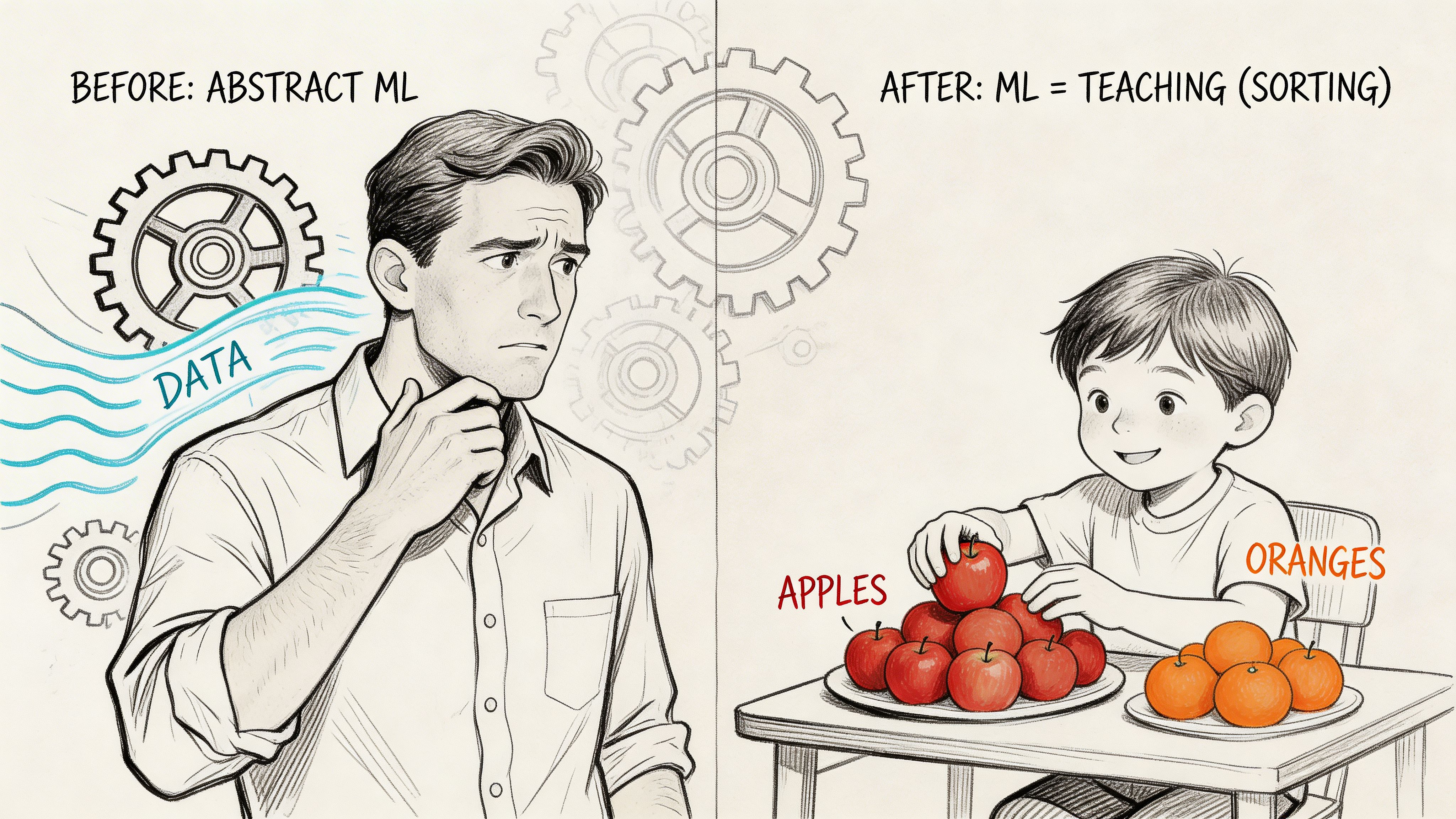
The fruit-sorting version
Say you run a distribution company in Greenwood and need to sort incoming orders into “likely urgent” and “not urgent.”
With old-school programming, you’d try to write fixed rules:
- order over a certain size
- customer in a certain category
- requested ship date within a certain window
That works until the exceptions pile up.
With machine learning, you feed the system examples of past orders and outcomes. It studies the patterns and learns what combinations usually point to urgency. It may notice details a human team didn’t formally define.
Two types that matter most in business
You don’t need a computer science degree to understand the two most common models used in business settings.
| Type | What it does | Indiana SMB example |
|---|---|---|
| Supervised learning | Learns from labeled examples | Ranking incoming sales leads as strong, average, or weak |
| Unsupervised learning | Finds patterns without labels | Grouping customers into natural segments based on buying behavior |
Supervised learning is useful when you know the answer you want to predict. Unsupervised learning helps when you’re looking for hidden clusters or unusual behavior.
That’s why a manufacturer may use one model to predict equipment issues and another to identify odd operating patterns on the plant floor or network.
Why business owners get tripped up
The confusion usually starts when vendors oversell the magic and skip the plumbing.
Machine learning needs:
- A repeatable business problem
- Usable historical data
- A way to act on the output
Without all three, the model turns into a science project.
Plain rule: If your team can’t explain what decision the model will improve, you’re not ready to build it.
For a helpful outside perspective on where smaller firms should start, this guide to AI consulting for small business does a nice job separating useful planning from hype.
If you’re trying to connect ML to everyday workflow changes, these 10 smart business process automation examples for Indiana companies in 2026 are a practical next step.
Six Ways to Put Machine Learning to Work in Your Business
Some machine learning business applications look flashy in demos and fall flat in real operations. The six below tend to hold up better because they tie directly to cost control, continuity, or revenue protection.
By 2025, 78% of organizations will use AI in at least one function, and support functions like customer service generate 38% of AI’s business value, followed by operations at 23% and marketing and sales at 20%, according to Aristek Systems.
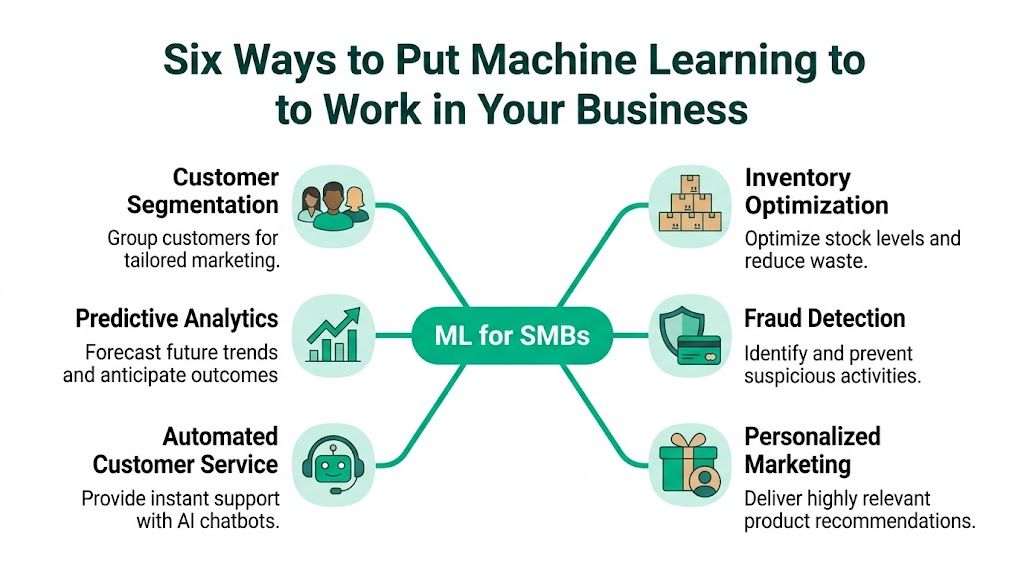
Customer segmentation
Definition: ML groups customers by shared behavior so marketing and sales teams stop treating everyone the same.
Indiana example: A Greenwood retailer can separate repeat buyers, bargain hunters, and seasonal shoppers, then send offers that match each group instead of blasting one generic campaign.
Predictive maintenance
This is one of the cleanest ROI plays in manufacturing and field service.
Definition: ML reviews equipment data and looks for patterns that often appear before a breakdown.
Indiana example: A Johnson County machine shop can use sensor and maintenance history to flag a press that’s drifting toward failure before it kills a shift.
Demand forecasting
Forecasting has always existed. ML improves it when demand changes for reasons that simple spreadsheet averages can’t catch.
Definition: ML estimates future demand by learning from past sales, timing, and operational patterns.
Indiana example: A distributor serving downtown Indy and Hamilton County can order more accurately around seasonal spikes, reducing both stockouts and stale inventory.
Process automation
This isn’t just chatbots. Good ML-powered automation helps route work, classify requests, and cut repetitive handling.
- For IT support: It can sort tickets by likely severity.
- For finance: It can flag anomalies for review.
- For operations: It can identify tasks that keep bouncing between people.
A local service business might use it to sort incoming requests from “schedule later” to “dispatch now,” so the staff isn’t triaging by gut feel.
Anomaly detection for cybersecurity
This is one of the most useful applications for businesses that already have too many alerts and not enough time.
Definition: ML learns what normal network and endpoint behavior looks like, then flags activity that doesn’t fit.
Indiana example: A UniFi network in an older office building may have normal daytime patterns for printers, laptops, APs, and file access. If one device suddenly starts behaving like it’s staging data exfiltration, anomaly detection can catch the deviation faster than manual review.
Security teams don’t need more noise. They need fewer alerts with better context.
This is also where tools like Bitdefender GravityZone, SOC-as-a-Service monitoring, and Zero Trust architecture become more valuable. The ML layer helps prioritize what deserves human attention.
Customer personalization
Personalization gets overused as a buzzword, but done right, it’s just relevance.
Definition: ML recommends products, messages, or next actions based on customer behavior.
Indiana example: An e-commerce business in the Indy metro area can show repeat buyers products that fit their usual purchasing patterns instead of pushing random items.
Which of the six usually wins first
For most SMBs, the strongest first use case depends on where the money is leaking.
| Business pain | Best first ML use |
|---|---|
| Surprise downtime | Predictive maintenance |
| Too much dead stock | Demand forecasting |
| Weak campaign performance | Customer segmentation |
| Security alert fatigue | Anomaly detection |
| Slow admin work | Process automation |
| Low repeat purchase rates | Customer personalization |
If your sales and service data already live inside a CRM, machine learning gets more useful faster. That’s one reason custom CRM software development that drives business growth matters. Clean structure makes smarter models possible.
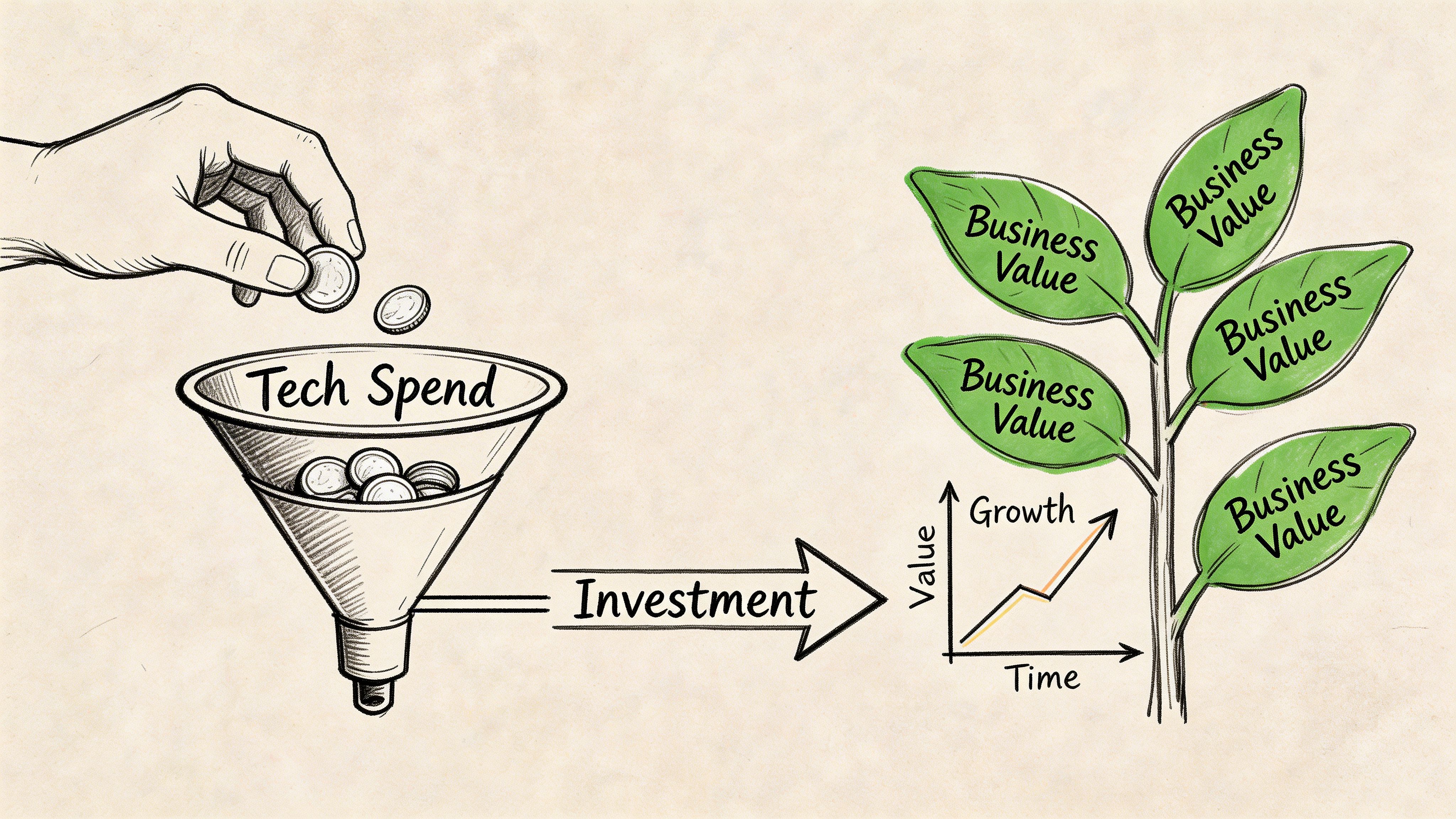
Converting Tech Spend into Measurable Business Value
A lot of software gets approved because it sounds modern. That’s a bad filter.
Machine learning should be judged the same way you’d judge a new truck, a new hire, or a server refresh. Does it reduce risk, protect revenue, or give the team back time they can use on higher-value work?
Downtime is where the math gets real
The clearest ROI often comes from avoiding stoppages.
If a machine learning model catches warning signs before a line goes down, that’s not an abstract efficiency gain. That’s preserved production time. If it predicts inventory gaps before a big order lands, that’s not a dashboard win. That’s saved revenue and a better customer experience.
The same logic applies in IT.
In cybersecurity, machine learning can help teams react much faster. DataCamp notes that ML algorithms can achieve detection rates exceeding 95% accuracy, reduce mean time to detect from days to minutes, and cut breach response times by 40% compared to traditional rule-based systems.
For a small or mid-sized business, that means less time between “something is wrong” and “we contained it.”
Where the budget shift happens
A smart machine learning project should move spending from reactive chaos to planned operations.
That usually shows up in three places:
- Less emergency labor: Fewer all-hands fire drills after outages or security events.
- Better asset life: Hardware, inventory, and support resources get used with more discipline.
- More predictable IT planning: Monthly budgets stabilize when surprises drop.
A business owner doesn’t need a perfect model. They need fewer expensive surprises.
That’s also why machine learning works best when it sits on top of mature IT habits. Clean backups, well-managed endpoints, strong Wi-Fi design, cloud visibility, and sensible ticketing matter first. If the foundation is shaky, the model just spots patterns in the mess.
This short video is useful if you’re weighing AI against other IT priorities.
The best ROI projects share the same traits
The strongest machine learning business applications usually have a few things in common.
-
The business pain is expensive
Frequent downtime, repeat stock errors, and security incidents are all costly enough to justify action.
-
The signal already exists
Good projects use data the company is already collecting, even if it needs cleanup.
-
Someone can act on the output
A warning only matters if a manager, technician, or system can do something with it.
That’s the frame I’d use before approving any ML spend. If the use case doesn’t fit those three tests, it probably belongs lower on the list.
For a broader planning lens, how to prioritize IT projects a playbook for Indiana businesses is a good companion read.
The Data and Tools You Need to Get Started
Most owners assume they need massive data lakes and a room full of data scientists. Usually, they don’t.
They need clean, usable, relevant data. That’s less glamorous, but it’s what makes the model worth trusting.
Start with what you already have
For an Indiana SMB, useful data often lives in scattered places:
- Sales systems: Orders, returns, pricing, customer history
- Support tools: Tickets, device events, service notes
- Operations records: Maintenance logs, production history, parts usage
- Security platforms: Endpoint alerts, login records, firewall events
- Spreadsheets: Messy, yes. Still useful.
In our 17 years of local service, one pattern has shown up over and over. The business usually has enough data to start. It just isn’t organized well enough to support decisions.
A forecasting project doesn’t need “big data.” It needs a reliable sales timeline, consistent product naming, and enough history to spot patterns. A cybersecurity model doesn’t need magic. It needs stable logs, endpoint telemetry, and a network baseline.
What clean data actually means
Clean data isn’t fancy. It means the records are complete enough, consistent enough, and current enough to support a decision.
A usable data foundation usually includes:
| Requirement | Why it matters |
|---|---|
| Consistent naming | Duplicate products or clients create false signals |
| Timestamps | Models need sequence and timing to find patterns |
| Few missing fields | Gaps can distort predictions |
| System integration | Sales, support, and operations data need context |
| Security controls | Sensitive data needs role-based access and audit trails |
This is also where cloud platforms help. Azure-based tooling, Microsoft data services, and custom pipelines can pull scattered business data into one controlled workflow. For some shops, low-code options are enough. For others, a custom application is the better route because it fits the existing workflow instead of forcing the staff into a generic one.
The IT foundation still matters
Machine learning doesn’t replace core infrastructure. It depends on it.
If your Wi-Fi drops in a warehouse, your sensor data gets spotty. If endpoints aren’t managed well, your security model trains on bad signals. If backups are weak, a failed integration can create a bigger mess than the one you were trying to solve.
That’s why smart ML rollouts usually sit on top of basics like:
- UniFi networking for stable site visibility
- Immutable off-site backups for rollback and recovery
- Zero Trust architecture for access control
- SOC-as-a-Service monitoring for ongoing threat review
- Bit-level data recovery planning for critical systems and storage failures
If the plumbing is bad, the prediction engine won’t save you.
That matters in regulated industries too. A healthcare office needs HIPAA-aware data handling. A defense contractor needs CMMC discipline. A general business should still align security work to the NIST CSF.
For firms in legal and compliance-heavy environments, this overview of AI tools for legal professionals is a useful example of how AI tooling has to fit workflow and risk, not just features.
A Phased Approach to Machine Learning Implementation
The fastest way to waste money on machine learning is to start with a vague goal and a giant scope.
That’s why so many projects stall. Caseware reports that 85% of AI projects fail to deliver on their intended promises, often because of poor data quality, weak strategy, and skill gaps.
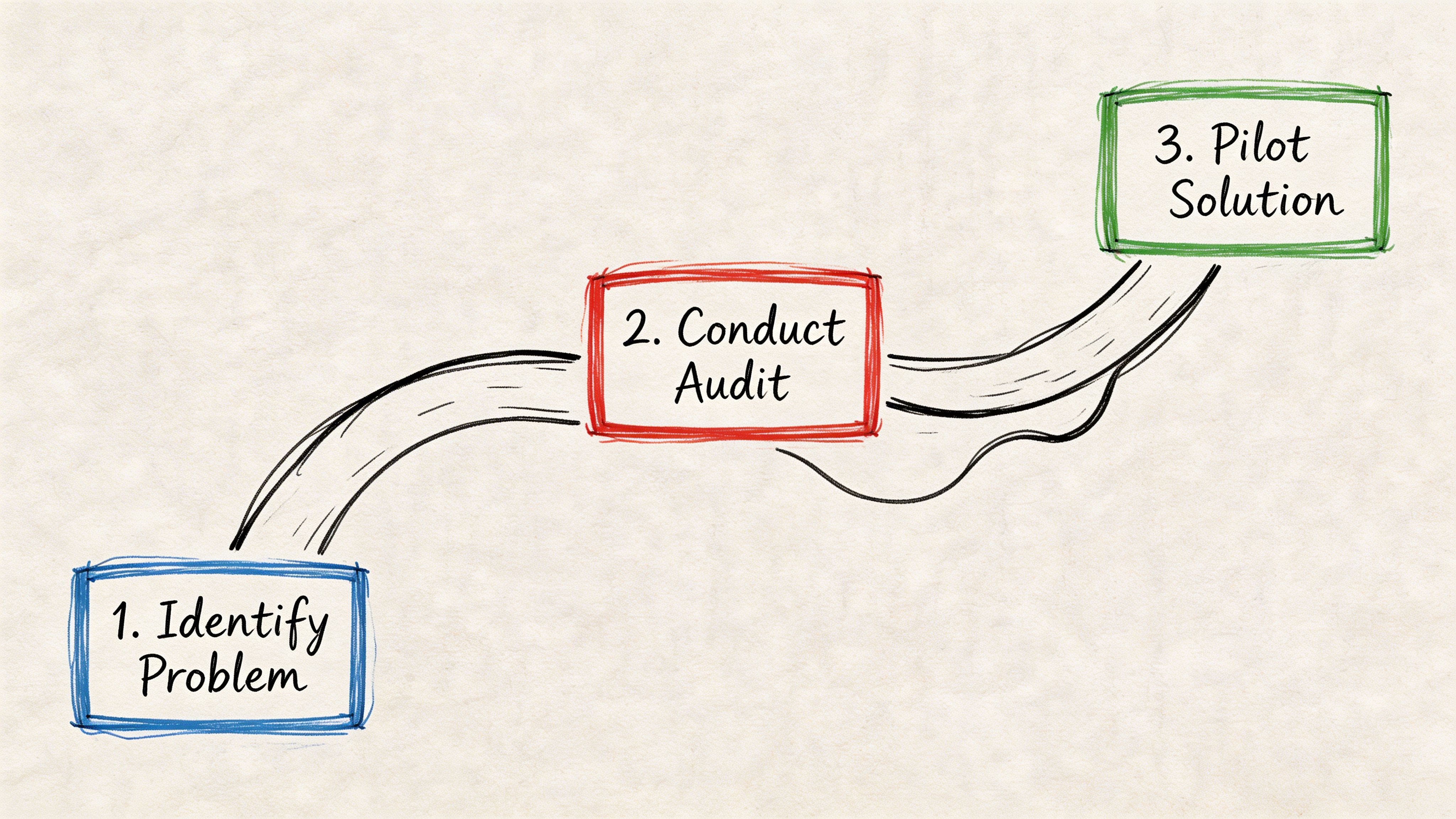
In our 17 years of local service, one lesson keeps holding up. Trying to boil the ocean is a recipe for failure. The companies that win start small, solve one painful problem, prove the value, and scale from there.
Phase one identifies one expensive problem
Don’t start with “we want AI in the business.”
Start with a narrow statement like:
- inventory levels are repeatedly wrong
- one production asset causes too many stoppages
- security alerts are too noisy to investigate properly
- support requests aren’t being prioritized well
A good first project has clear ownership and a clear business consequence.
Phase two audits the data and the environment
This is the part people rush, then regret.
You review where the data lives, how clean it is, who owns it, whether systems can share it, and whether the existing infrastructure is stable enough to support the project. Old server hardware, bad Wi-Fi coverage, weak endpoint hygiene, and fragmented backups all matter here.
A practical audit usually checks:
- Data quality
- System compatibility
- Security and access
- Workflow fit
Phase three pilots a small use case
The pilot should be limited enough that the team can learn without disrupting the business.
For example, don’t deploy anomaly detection across every office, device, and cloud app at once. Pilot it in one environment with known patterns. Don’t forecast every SKU in a product catalog. Start with one category that causes repeat headaches.
That controlled scope makes it easier to compare output to reality and adjust the model before broader use.
Phase four measures, validates, and scales
A pilot only matters if the business can judge whether it improved anything.
Use business-facing measures:
- reduced outages
- fewer urgent tickets
- better stock availability
- faster incident review
- less wasted staff time
A pilot should answer one question clearly. Did this help the business make a better decision, faster or more reliably?
Once that answer is yes, then you expand. Maybe the forecasting model grows to more product lines. Maybe the cybersecurity model covers more sites. Maybe a workflow classifier gets added to the service desk.
That phased approach is boring compared to flashy AI demos. It also works better.
Managing Risks and Meeting Compliance in Indiana
A lot of ML talk sounds like speed is the only thing that matters. It isn’t.
If a model makes bad calls, creates bias, or can’t explain its logic in a regulated setting, the “smart” system can turn into a legal and operational liability. That’s a serious issue for healthcare groups dealing with HIPAA, defense contractors watching CMMC requirements, and general businesses using the NIST CSF as their security baseline.
Black-box systems create real problems
The biggest mistake I see is assuming that a more complex model is automatically a better business choice.
According to the PMC article on AI risk and regulation, opaque black-box ML models can lead to up to 35% wrongful decisions in risk control, and explainable AI is becoming more important as regulations tighten.
That matters beyond formal audits.
If a finance workflow flags normal behavior as suspicious, staff lose trust in the system. If a hiring or credit-related process can’t explain why it made a recommendation, leadership inherits a risk they may not fully understand.
What safer implementation looks like
For Indiana businesses, safer ML usually means simpler, more auditable systems.
That includes:
- Explainable outputs: Staff should understand why a system flagged something.
- Human review: High-impact decisions shouldn’t be fully hands-off.
- Data minimization: Only use the information that’s necessary.
- Access control: Keep sensitive model inputs and outputs restricted.
- Documentation: Record what the model does, what data it uses, and how results are reviewed.
This is especially important in data recovery, migration, and cybersecurity work. If a business is using ML to prioritize incident handling or identify unusual activity, the process has to be traceable.
Compliance doesn’t sit outside the project
It belongs in the design.
A healthcare office should ask how model outputs are stored and reviewed under HIPAA expectations. A defense-adjacent manufacturer should ask whether the workflow aligns with CMMC obligations. A standard commercial business should still map its controls to the NIST CSF and document model-related risks.
If your current security posture is unclear, this a cyber security risk assessment template for Indiana businesses is a useful starting point.
Start Your Machine Learning Journey Today
Machine learning isn’t reserved for giant tech firms with giant budgets.
For businesses in Greenwood, Indianapolis, Johnson County, and the broader Central Indiana market, the better question is whether there’s a recurring problem expensive enough to justify a smarter way of handling it. Inventory chaos qualifies. Surprise equipment failures qualify. Network threats and alert fatigue definitely qualify.
The right machine learning business applications don’t replace good operators, solid infrastructure, or common sense. They help your team make better calls with less guesswork. That’s the point. More continuity. Fewer interruptions. Better use of staff time. A cleaner path from tech spend to business value.
If you’re considering your first project, keep it simple:
- Pick one problem
- Clean the data
- Pilot before scaling
- Make sure someone can act on the result
- Build with compliance in mind
That approach isn’t flashy. It’s practical. It also gives Indiana SMBs a much better shot at getting real value instead of buying another expensive experiment.
Let’s find the first win. A demand forecast. A predictive maintenance model. A security anomaly system. Start where the pain is obvious and the payoff is easy to see.
If your business is in Greenwood or the Indianapolis area, Finchum Fixes IT can help you identify the best starting point with a Free Network Assessment or Security Risk Audit. If you’re dealing with aging infrastructure, unstable Wi-Fi, endpoint risk, backup concerns, or a workflow that’s wasting staff time, their team can map out a practical path that supports machine learning without disrupting the business.