Managed Service vs Staff Augmentation: A Guide for Indy Business Owners
TL;DR: Your Quick Guide
- Managed Services: You hire an entire IT team that takes full ownership of your tech results for a flat monthly fee. Think long-term strategy, predictable budgeting, and guaranteed uptime. This is for business owners who want to offload risk and focus on growth.
- Staff Augmentation: You "rent" a specialist for a specific, short-term project. You get skilled hands but retain all the management overhead and responsibility for the final outcome. It's tactical, not strategic.
- The Real Cost: Downtime can cost your business up to $9,000 per minute. Managed services prevent this by proactively managing your systems—from UniFi networking to immutable backups—turning wasted tech time into billable hours and a predictable budget.
- The Right Choice for Indy: For most businesses along the I-65 corridor, a managed service partner is the smarter play for security, compliance (HIPAA, CMMC), and long-term stability.
Look, if you're a business owner anywhere along the I-65 corridor, you don't have time for fluff. You're busy, and you need a straight answer.
Managed services is like having a complete IT department on speed dial—a true partner focused on results. We handle everything from the big-picture strategy and cybersecurity down to the nitty-gritty network management, all for a predictable cost. Think long-term stability.
On the flip side, staff augmentation is more like calling in a specialist for a specific mission. You get temporary, skilled hands on deck for a project, but you're still the one steering the ship and responsible for the outcome.
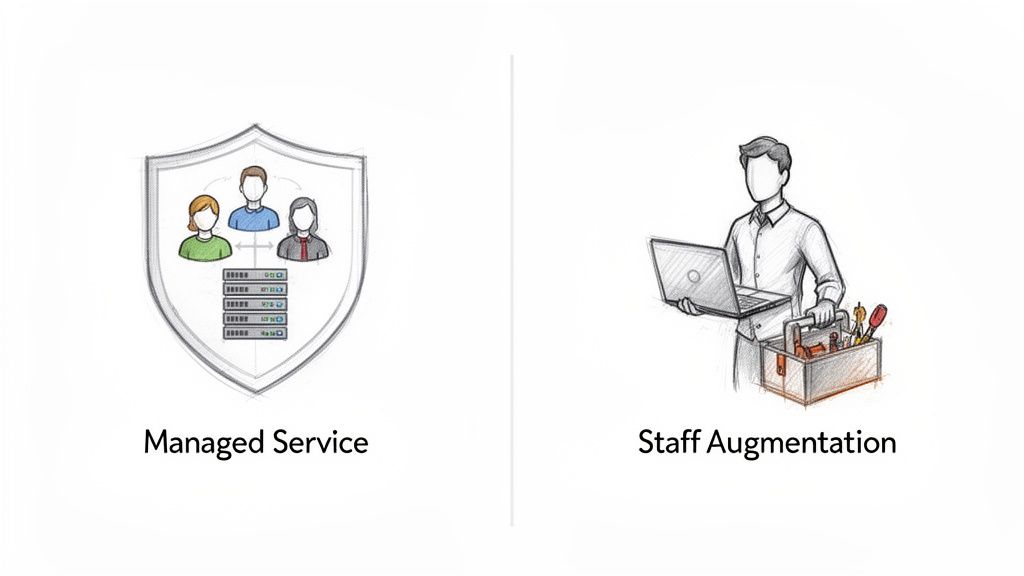
Understanding Your IT Outsourcing Options
For any decision-maker here in Johnson County, the choice is pretty clear. You go with managed services when you want strategic, hands-off IT oversight. You pick staff augmentation when you just need to fill a specific skills gap for a little while.
Getting this right is the difference between "wasted tech time" and more billable hours on your books. It's a fundamental business decision, similar to when companies weigh their options for Outsourcing Digital Marketing—it’s all about smart resource allocation.
The real distinction boils down to responsibility versus resources. With our managed IT services, we take the reins. We own the results, we guarantee the performance, and you get a clear, flat monthly fee. With staff augmentation, you’re essentially just renting an expert's time; the project's success or failure still lands squarely on your shoulders.
Solving The Southside IT Bottleneck
We've seen it a hundred times in business parks all over Greenwood: a clunky old server, shoved in a dusty closet, wheezing its last breath. Every time it unexpectedly reboots, you hold yours, hoping it comes back online. You're gambling with your company's most critical data, and your team's productivity grinds to a halt. When downtime can cost a business up to $9,000 per minute, that little hiccup suddenly becomes a five-alarm financial fire.
You know you can't keep kicking this can down the road. It's time to make a choice.
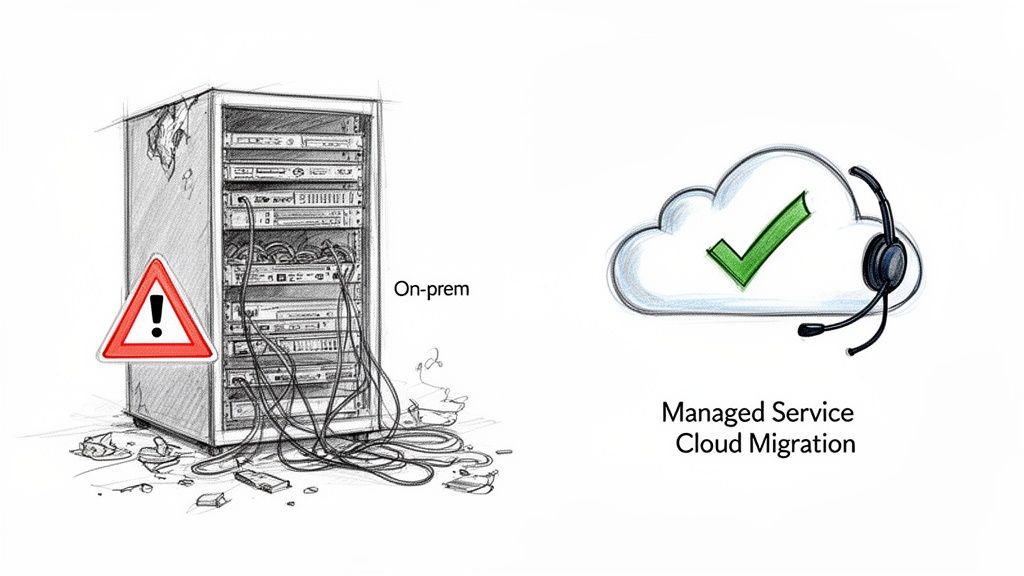
This is the classic fork in the road for Johnson County business owners: managed services or staff augmentation? Do you bring in a temporary contractor—staff augmentation—to strong-arm a data migration and finally junk that old hardware? Or do you find a partner—a managed service provider (MSP)—to not only fix the immediate mess but also build and oversee a reliable IT future for you?
The Two Paths Explained
Let's cut right to the chase. The real difference isn't just about who does the work; it's about who owns the result.
Staff augmentation is like calling in a hired gun for a specific mission. Need a database guru for a three-month project? You hire one. You're paying for their time and their skills, but that's it. The responsibility for managing them, integrating them into your team, and making sure the project actually succeeds? That's all on you. It's a temporary boost in firepower.
Managed services, on the other hand, is like getting an entire IT department in a box. When you team up with an MSP like us, you aren't just getting another body. You're bringing on a team that takes complete ownership of the outcome.
Key Insight: This is the big shift: you stop buying someone's time and start buying guaranteed results. With managed services, you're paying for things like guaranteed uptime and security, not just hours on a timesheet.
This means we’re on the hook for everything, from setting up a modern cloud system to ensuring you meet HIPAA compliance standards and keeping a watchful eye with 24/7 monitoring through our SOC-as-a-Service. We turn that unpredictable, budget-wrecking "tech wasted time" into a flat, predictable monthly expense that actually protects your profits. We wrestle with the complex tech so your team can get back to doing their real jobs. Our approach to computer repair in the Southport area follows this exact philosophy—we deliver solutions that last, not just quick patches.
The distinction couldn't be clearer. One path gives you a temporary tool. The other gives you a permanent solution that scales as you grow. The choice you make here will shape your company's efficiency, security, and ability to make money without being constantly tripped up by IT headaches.
A Head-to-Head Showdown: IT Sourcing Models
Let’s be honest, when you’re looking at bringing in outside IT help, those generic pro-and-con lists you find online are pretty useless. Business owners right here in Hamilton County and across the Indy metro need to know the real story: how does each model affect the bottom line, who’s on the hook when things go wrong, and what does it mean for the future of your business?
This isn't just a tech decision; it's a strategic move that impacts your finances and daily operations. So, let's get down to brass tacks and see which model actually makes sense for you.
Cost Structure: Predictable Budget vs. Volatile Bills
The first and most glaring difference is how the invoice looks. Staff augmentation is all about time and materials—you’re paying an hourly or daily rate. This can be great for a quick, defined project, like getting a specialist in for two weeks to get your UniFi network upgrade sorted out.
But for your day-to-day IT needs? That hourly rate can become a financial rollercoaster. A sudden security scare or a cranky server can blow your monthly tech budget to smithereens, turning IT into a liability that keeps you up at night. That kind of volatility makes any kind of long-term financial planning a real headache.
Managed services, on the other hand, works on a predictable, flat monthly fee. This is a total game-changer. Your IT costs stop being a wild variable and become a stable line item in your budget, just like your rent. This predictability lets you budget accurately and stops surprise IT bills from gobbling up your profits. Every dollar is tied to an outcome, not just a clock.
Accountability: Who Really Owns the Problem?
This is where the two models couldn't be more different. When you go with staff augmentation, you’re essentially renting a person's skills. The crucial thing to remember is that you keep 100% of the risk. If that project goes south or the network crashes, the buck stops with you. The contractor still gets paid for their time, whether the outcome was a success or a disaster.
The managed service model flips that script completely. The provider—the MSP—is accountable for the result.
When we partner with a business, we’re bound by a Service Level Agreement (SLA). That's a legal document guaranteeing performance. It means we own the responsibility for uptime, security, and making sure everything runs smoothly. If something breaks, it's on us to fix it—and, more importantly, to make sure it doesn't happen again.
You’re shifting from renting skills to buying guaranteed outcomes. You're not managing a person anymore; you're managing a result. Understanding this dynamic is key. You can see similar structures in other business services; exploring the differences between models like PEO vs. ASO can offer some great parallels on how liability and operations are handled in outsourcing.
Technical Expertise: One Specialist vs. an Entire Team
With staff augmentation, you get access to one expert. This is perfect when you have a very specific, isolated need, like a developer for a custom app or a data recovery pro for a one-time crisis.
The problem is, your company’s IT is rarely that simple. A cybersecurity threat isn't just one thing; it can touch your network, cloud setup, and all your computers. It’s highly unlikely that a single contractor is a master of all those trades.
A managed services partner, however, brings an entire team of certified experts to the table. In our 17 years of local service, we’ve built a crew with deep knowledge across the whole IT landscape:
- Cybersecurity: Certified pros who live and breathe tools like Bitdefender GravityZone and know how to implement a real Zero Trust security posture.
- Networking: Gurus who can design anything from simple office Wi-Fi to a complex, latency-optimized mesh network with UniFi hardware.
- Compliance: Specialists who actually understand the alphabet soup of regulations, whether it’s HIPAA for our healthcare clients or NIST CSF for general security.
- Data Protection: Technicians who are masters at setting up and managing bulletproof, immutable off-site backups to keep you in business no matter what.
This team approach means you’re never relying on a single person who could get sick, go on vacation, or just disappear. You get a deep bench of talent ready to jump in. To get the most out of this, it's all about good vendor management. You can learn more by checking out these crucial IT vendor management best practices for Indiana businesses.
It’s no surprise that 67% of companies now use MSPs for at least some of their IT. They see the strategic advantage. Better yet, these partnerships have helped 13% of businesses slash their IT expenses by more than half, proving just how efficient a managed model can be.
Managed Services vs Staff Augmentation: A Practical Comparison
Here’s a no-fluff look at how each IT model really performs across the criteria that matter most—from cost and accountability to the long-term value you get for your business.
| Business Criteria | Managed Services | Staff Augmentation |
|---|---|---|
| Cost Structure | Predictable, flat monthly fee (OpEx) | Variable, hourly/daily rate (CapEx/OpEx) |
| Accountability | Provider owns the outcome (SLA-driven) | You own the outcome and all risk |
| Expertise Access | Full team of diverse specialists | A single specialist for a specific task |
| Business Alignment | Strategic, long-term partnership | Tactical, short-term project-based |
| Risk Management | Proactive; MSP assumes risk for performance | Reactive; you manage all project/operational risk |
| Scalability | Easily scales up or down as needed | Rigid; tied to individual contractor availability |
| Management Overhead | Low; you manage the relationship & results | High; you manage the person, tasks, & quality |
As you can see, the choice isn't just about getting a task done. It’s about deciding whether you want to buy someone's time or invest in a guaranteed business outcome.
Real-World Scenarios: Making the Right Call in Indiana
Theory is one thing, but making the right call for your business right here in Central Indiana? That's what really matters. When you’re staring down an IT problem, the choice between managed services and staff augmentation isn't just a thought exercise—it’s about protecting your operations and your bottom line.
After 17 years of helping local businesses navigate these decisions, we've seen it all. Let's walk through some real-world situations to make this choice feel less like a quiz and more like common sense.
This quick decision guide can help you visualize that initial fork in the road between tactical project help and strategic, long-term operational support.
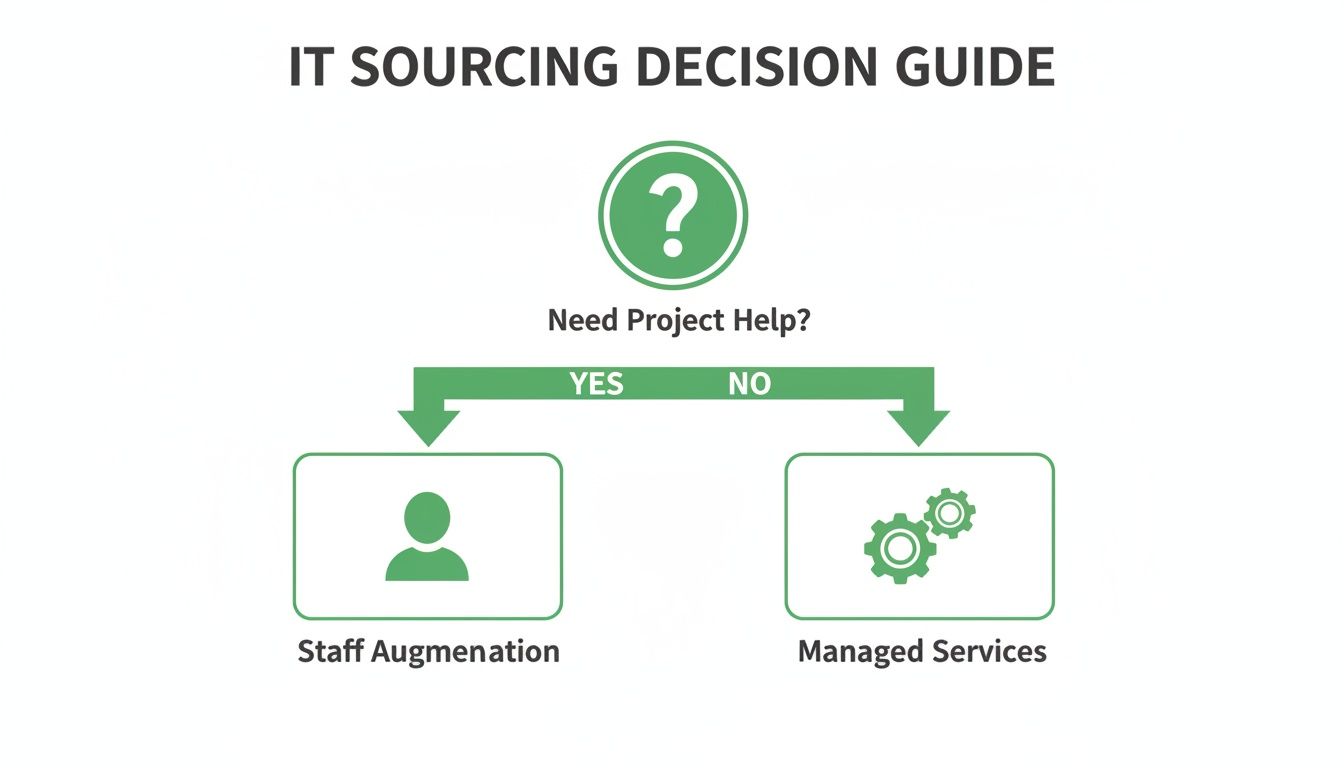
The flowchart really simplifies the first step. If you’re looking for someone to take the wheel and manage your IT comprehensively for the long haul, you're on the managed services highway. If you just need a temporary specialist for a specific project, staff augmentation is your direct off-ramp.
When to Go All-In with Managed Services
Managed services are the right move when you need a partner who's on the hook for the outcome, not just the hours. You're essentially outsourcing the result, taking the entire IT function off your plate so you can focus on what you do best.
Here are a few scenarios where this model is a no-brainer for Indiana businesses:
-
You're a Healthcare Practice in Indianapolis Needing Rock-Solid HIPAA Compliance: A medical office near Community Hospital North can't afford to "wing it" with patient data. You don't just need an IT guy; you need a team that lives and breathes HIPAA regulations. A managed service provider implements and maintains the required technical safeguards—like encrypted data transmission, strict access controls, and immutable off-site backups—and provides the documentation to ace any audit. We shoulder the compliance burden so you can focus on patient care.
-
You're a Defense Contractor in Johnson County Gearing Up for CMMC: If you’re doing business with the Department of Defense, achieving Cybersecurity Maturity Model Certification (CMMC) is non-negotiable. This demands a deep, ongoing security posture that a temporary contractor simply can't deliver. A managed services team builds and manages the entire secure environment, from implementing a Zero Trust architecture to providing SOC-as-a-Service monitoring, ensuring you hit and maintain those strict CMMC controls.
-
You're a Law Firm in Downtown Indy with High-Stakes Data: For a legal practice, data isn't just data—it’s privileged client information. Downtime from a ransomware attack or data loss from a server failure isn't just an inconvenience; it's a catastrophic business and reputational risk. Managed services provide the robust, multi-layered security and data recovery plans you need to guarantee business continuity, turning what would have been "wasted tech time" during a crisis back into billable hours.
We saw this firsthand when we had to disassemble a client’s failing RAID array at their Greenwood office. A temporary tech might have salvaged some files. But our managed approach meant we not only performed a bit-level data recovery but also migrated them to a more resilient cloud system with automated backups, permanently eliminating that risk.
When Staff Augmentation Makes Perfect Sense
Think of staff augmentation as a surgical tool—it’s a tactical scalpel, not a strategic overhaul. It’s the perfect solution when you have a well-defined, short-term need and your own team has the bandwidth to manage the extra person effectively.
Consider these local examples:
-
You're a Hamilton County Tech Startup on a Crazy Deadline: Your in-house dev team is brilliant, but you desperately need a specialist with deep experience in a niche coding language for a three-month mobile app sprint. Staff augmentation lets you bring in that expert gunslinger without the baggage of a full-time hire. You point them at the target, they deliver the code, and everyone shakes hands when the project ships. For more on structuring these kinds of projects, you might find our guide on choosing software development life cycle models helpful.
-
You're a Manufacturer on the I-65 Corridor with an Existing IT Team: Your in-house IT crew is swamped with day-to-day operations, but you have a mandate to upgrade the entire UniFi networking infrastructure across the plant. Augmenting your team with a certified networking engineer for a few weeks gets the project done fast, without derailing your team from their critical daily duties.
While staff augmentation offers fantastic flexibility for these kinds of scenarios, its cost-effectiveness has a shelf life. For short-term gigs, the pay-as-you-go model can save you 20-50% compared to hiring. But be warned: those hourly rates can become a financial trap in longer engagements, leading to ballooning costs and a major management headache.
Ultimately, the choice boils down to a simple question: are you looking to rent a pair of hands, or are you looking to buy a guaranteed outcome? One gives you a temporary tool; the other delivers a permanent solution.
The Hybrid Approach: Getting The Best Of Both Worlds
So, Managed Services or Staff Augmentation? It’s a common question, but honestly, for a lot of growing businesses right here in Johnson County, it’s not an either/or fight. The smartest play isn't picking a side; it's blending the two into a custom-fit hybrid model. Think of it as marrying the rock-solid stability of managed services with the on-demand firepower of staff augmentation.
This strategy gets one thing right: your IT needs aren't static. Some parts of your tech stack demand constant, eagle-eyed supervision, while other projects are just short-term sprints. A hybrid approach lets you nail both without making compromises.

Building Your Custom IT Solution
Let’s get practical. Picture a logistics company just off the I-65 corridor. For them, downtime isn't an option; it's a disaster. That's where we step in as their managed service partner to handle the absolute must-haves:
- 24/7/365 SOC-as-a-Service: Our Security Operations Center is always watching their network, stopping threats that could bring their entire fleet to a screeching halt.
- UniFi Network Management: We blanket their enormous warehouse with flawless, zero-lag mesh Wi-Fi, so scanners and systems never miss a beat.
- Immutable Off-Site Backups: Their priceless shipping data is locked down, backed up, and ready to be restored at a moment's notice. No disaster can sink them.
These are the foundational pieces that keep the lights on and turn wasted tech time into a well-oiled machine. But what happens when something new and unexpected pops up?
Let's say that same company decides it's time to build a custom inventory management app. It’s a specialized, six-month project. Instead of yanking our team off their critical security and network duties, they use staff augmentation to bring in a single, dedicated software developer. This pro slots right into their internal team, builds the app, and when the project’s done, the contract ends.
That’s the hybrid model in a nutshell: core stability from us, project-specific muscle from a temporary specialist. We see this all the time, and you can get a better feel for how these projects run in our guide to adaptive software development in Indiana.
Making The Hybrid Model Work
For a hybrid approach to really click, you need crystal-clear communication and defined roles. This isn't about creating a free-for-all; it's about smart resource allocation. When we set this up for clients, we draw firm lines in the sand. Our team remains the authority on the core infrastructure, security, and compliance, while the augmented specialist gets a clear, documented mission for their project.
Our Pro Tip: Think of it like building a house. Finchum Fixes IT is the general contractor. We pour the foundation, run the electrical, and set the plumbing—the critical systems that have to be perfect. The augmented staffer? That’s the master tile setter you hire for that one-of-a-kind bathroom renovation. Everyone has a distinct job, and nobody trips over each other.
This strategic mix is catching on because it solves that classic tug-of-war between control and outcome. We've seen hybrid models deliver 20-50% savings over a purely in-house team simply by using the right tool for the right job—managed services for the long haul and augmentation for the sprints.
Speed is another big factor. We can get an augmented team member onboarded in just one or two weeks for a fast start, while a managed service relationship is built over four to eight weeks to dial in robust SLAs and get fully integrated. By refusing to cram your business into a rigid box, we deliver a solution that optimizes both your budget and your brainpower, ensuring your tech is always pushing you forward.
So, Which One is Right for Your Indiana Business?
Let's be blunt: choosing between a managed service and staff augmentation isn't just a line item in your IT budget. It's a core business decision. Get it wrong, and you're not just dealing with tech headaches; you're staring down the barrel of catastrophic downtime that can bleed your company of up to $9,000 per minute.
The right choice turns that potential chaos into productive, billable hours. The wrong one leaves you scrambling, over budget, and stuck in a reactive loop instead of moving your business forward.
We've broken down the key differences. Staff augmentation is like calling in a specialist for a specific surgery—a skilled pair of hands for a defined, short-term project. Managed services, on the other hand, is a long-term wellness plan for your entire business. It's about building a tough, secure, and reliable operational backbone for whatever comes next.
Why Predictability is a Game-Changer
For the businesses we partner with, from bustling manufacturers along the I-65 corridor to busy healthcare practices in Indianapolis, the single biggest sigh of relief comes from one word: predictability. A managed service model takes the wild, unpredictable swings of IT capital expenses and flattens them into a stable, predictable operational cost. You can actually sleep at night knowing your budget is fixed, your systems are being watched 24/7, and you've got an entire bench of certified pros ready to jump in.
And this goes way beyond just fixing what's broken. It's a whole different mindset that includes:
- Getting Ahead of Threats: We don’t wait for the alarm bells. We put in place and actively manage advanced security tools like Bitdefender GravityZone and a Zero Trust framework to shut down threats before they can even get started.
- Nailing Down Compliance: For our clients in healthcare or defense, we handle the labyrinth of HIPAA and CMMC requirements. It's a massive weight lifted, letting them focus on their actual work.
- Keeping the Lights On, Period: With rock-solid solutions like immutable off-site backups and our SOC-as-a-Service monitoring, we make sure your business is always up and running.
Over our 17 years serving local companies, we've watched countless Johnson County businesses finally escape the break-fix treadmill. Shifting to a managed service isn't just about getting better tech—it's about getting your focus back and turning what was a headache into a real competitive edge.
Moving from Firefighting to Future-Proofing
When you boil it all down, the decision comes down to this: Are you just renting temporary skills, or are you ready to invest in guaranteed results?
Staff augmentation definitely has its moments for hyper-specific, short-term gaps. But if you’re playing the long game—thinking about the health, security, and stability of your business—a managed service partnership is the only move that makes strategic sense. It’s about having a dedicated team that gets your business and is contractually on the hook to keep things running smoothly.
For companies around Greenwood and Indianapolis who are done with reactive IT chaos and want to get ahead of the curve, the next step couldn't be easier. Stop wondering if your network is secure or on the verge of a breakdown.
Take the first step toward a more stable, secure, and profitable operation. Schedule a Free Network Assessment or a Security Risk Audit today, and let our local, proven team show you the real difference we can make.
Frequently Asked Questions
You've got questions about the whole managed services versus staff augmentation showdown, and we've got answers—the kind you'd get from someone who's seen it all. Here are a few of the most common things we hear from business owners around Indianapolis.
Can We Switch From Staff Augmentation to a Managed Service?
Of course. In fact, it’s a path we see many businesses take. A company in Johnson County might bring in a contractor to put out a fire, only to realize they need a real, long-term strategy, not just another temporary fix.
Making the switch means we’ll take a good, hard look at your current setup. From there, we'll establish clear service level agreements (SLAs) and carefully transfer the responsibilities from that one person to our entire team. Think of it as moving from renting temporary help to owning a guaranteed business outcome.
Key Insight: Switching models isn't just a change—it's an upgrade. You’re making a conscious decision to stop managing a person and start managing results. It’s how you trade unpredictable hourly bills for a single, predictable monthly number.
How Does an MSP Handle HIPAA or CMMC Compliance?
This one is a big deal, and it’s where the two models couldn't be more different. A temporary contractor might be a technical wizard, but they almost never bring deep, auditable compliance expertise to the table. When you hire them, the burden of meeting HIPAA or CMMC standards still falls squarely on you.
We, on the other hand, build compliance into the very fabric of our service. It’s not an add-on; it’s the foundation. We put the right technical controls in place—from Zero Trust architecture to immutable off-site backups—and we give you all the documentation to prove it. With 17 years of experience right here in Central Indiana, we've helped countless businesses navigate these minefields, taking the risk and the guesswork completely off their plate.
What Are the Hidden Costs of Staff Augmentation?
That hourly rate you see? It's just the tip of the iceberg. The real costs are hiding just below the surface.
You’re paying with your own team’s time spent managing the contractor. You’re paying with lost productivity every time a project stalls because they're juggling other clients. And the biggest hidden cost? The massive risk of knowledge drain. The second that contractor walks out the door, all their knowledge about your systems, your processes, and your quirks walks out with them. You're left starting from scratch.
At Finchum Fixes IT, we’re in the business of building long-term value, not just patching short-term holes. If you're tired of constantly reacting to IT problems and want to build a more secure, predictable, and profitable future for your Greenwood or Indianapolis business, the choice is pretty clear.