Vulnerability Assessment vs Penetration Testing Explained
TL;DR
- Vulnerability assessments find likely weaknesses across your network, endpoints, cloud apps, and configs. Think of them as the broad “what looks wrong?” service.
- Penetration tests try to exploit weaknesses the way an attacker would. Think of them as the “what can actually be broken into?” service.
- Best practice is monthly vulnerability assessments and annual or bi-annual penetration testing according to SentinelOne’s guidance on testing frequency.
- For Indiana SMBs, the right choice depends on compliance, budget, insurer demands, and downtime risk.
- If you handle HIPAA, CMMC, PCI DSS, or sensitive client data, relying on only one test usually leaves blind spots.
- The goal isn’t a report. The goal is fewer surprises, less downtime, and faster remediation.
A Johnson County business owner usually doesn’t wake up wanting to compare cybersecurity testing services. It lands on the desk because something else happened first. A cyber insurance renewal asks for proof of testing. A large customer sends over a security questionnaire. An IT manager flags aging firewall rules, old Windows servers, or spotty remote access. Suddenly, two terms show up over and over: vulnerability assessment and penetration test.
Most owners I talk to around Greenwood, Franklin, and the south side of Indy have the same first reaction. They sound interchangeable, they both cost money, and neither one feels tied to revenue until a problem hits production. Then the stakes get real fast. Downtime isn’t an abstract IT issue when your staff can’t access the ERP, your phones are dead, or your scheduling platform is locked up during business hours.
That’s the practical issue behind vulnerability assessment vs penetration testing. You’re not choosing between two technical buzzwords. You’re deciding how you want to find risk before someone else does, and how much evidence you need to satisfy a client, an auditor, or an insurer without overspending.
For many Indiana SMBs, the confusion gets worse because they’ve already had “security work” done. They may have Bitdefender GravityZone on endpoints, Microsoft 365 protections turned on, a decent firewall, maybe even UniFi networking with segmented SSIDs. That’s good. It still doesn’t answer whether your weak spots have been identified broadly, tested thoroughly, or translated into a remediation plan your team can effectively execute.
If you’re trying to sort that out, keep one mindset throughout this article: testing should protect business continuity first. Compliance matters. Insurance matters. Client demands matter. But a system outage still costs you more than the paperwork does. If your incident planning is still fuzzy, this cybersecurity incident response plan template for Indiana businesses is a useful companion read.
Your Cybersecurity Wake-Up Call Is Here What Now
The usual Southside version of this problem looks like this. A company in a Greenwood business park has grown from a handful of employees to a serious operation. They added cloud apps, remote users, maybe a line-of-business server that’s older than anyone wants to admit, and a Wi-Fi setup that was “good enough” when the building had half the staff. Then a customer asks, “Do you perform vulnerability assessments and penetration testing?”
That question exposes a gap fast.
The owner doesn’t know if they need one or both. The office manager forwards the email to whoever handles IT. The IT person says, “It depends.” Nobody likes that answer when a contract is on the line.
Why this catches businesses off guard
Security testing usually enters the conversation late. Not at the planning stage, but at the pressure stage. That pressure may come from:
- Client procurement teams asking for evidence that your environment is reviewed and tested
- Cyber insurers tightening underwriting language around controls and validation
- Compliance frameworks like HIPAA, CMMC, PCI DSS, or broader NIST CSF alignment
- Internal warning signs such as old VPNs, flat networks, stale admin accounts, or unsupported software
None of those are rare in the I-65 corridor. They’re normal signs of a business that grew faster than its security program.
Most companies don’t have a security problem because they ignored security. They have a security problem because operations kept moving and testing never caught up.
Why the wrong choice wastes money
A lot of SMBs buy the wrong service first because the names sound close. If you pay for a broad scan when your client really needs proof of exploitability, you’ll still be answering follow-up questions. If you jump straight to an in-depth pen test while basic patching and hygiene are a mess, you’ll spend premium dollars proving what a simpler assessment could have told you.
That’s where ROI enters the picture. Good testing shrinks uncertainty. It helps you prioritize what to fix first, what can wait, and what endangers uptime. That means less wasted tech time, fewer fire drills, and a more predictable monthly budget instead of random emergency invoices.
The local reality behind the acronyms
In central Indiana, I’ve seen the same pattern across healthcare clinics, small manufacturers, accounting firms, and professional services teams. The business isn’t asking for “advanced cybersecurity.” It’s asking:
- Are we exposed right now?
- What do we need for compliance?
- What’s the minimum that keeps us from getting burned?
- What’s the smart sequence if budget is tight?
Those are the right questions. The answer starts with understanding that one service finds weaknesses at scale, and the other proves how those weaknesses can be used against you.
The Unlocked Door List vs The Simulated Break-In
If you want the cleanest explanation of vulnerability assessment vs penetration testing, use a building analogy.
A vulnerability assessment is the exposed entry point list. A penetration test is the authorized break-in.
They both matter. They are not the same job.
What a vulnerability assessment actually does
A vulnerability assessment looks across your environment and identifies known weaknesses. That usually includes things like missing patches, outdated software, exposed services, weak configurations, risky ports, legacy protocols, and security settings that drifted over time.
Consider it similar to a security guard walking the perimeter with a checklist. They note every unsecured door, every open ground-floor window, every camera pointing the wrong direction, and every lock that looks too easy to bypass. They don’t necessarily climb through the window. They document the exposure.
For a business network, that can include:
- Endpoints like desktops, laptops, and servers
- Network gear such as switches, firewalls, and wireless infrastructure
- Cloud services including Microsoft 365 and other SaaS platforms
- Web applications and internet-facing systems
- Configuration drift in policies, permissions, and segmentation rules
The main output is a list. Usually a large one. It tells you where the weak spots are and which ones deserve attention first.
What a penetration test actually does
A penetration test starts with a different question. Not “what’s wrong?” but “what can be exploited, and what would happen next?”
That means a human tester behaves like an attacker within approved rules. They probe, chain weaknesses together, move laterally if possible, test privilege escalation paths, and determine whether a foothold in one area can lead to sensitive data, business systems, or domain-level access.
The physical analogy is simple. Instead of listing the accessible doors, the tester tries the handle, slips inside, checks whether the interior office is open, sees whether keys are hanging near the reception desk, and documents how far a real intruder could get.
Practical rule: A vulnerability assessment tells you what might be vulnerable. A penetration test tells you what that vulnerability can actually cost you.
Why business owners mix them up
Both services deal with security weaknesses. Both produce reports. Both may involve some overlapping tools. That overlap is what causes confusion.
The difference is in intent.
| Service | Core question | Usual output | Business value |
|---|---|---|---|
| Vulnerability Assessment | What known weaknesses exist? | Prioritized findings list | Broad visibility and ongoing hygiene |
| Penetration Testing | What can be exploited in practice? | Attack paths, proof, impact analysis | Real-world validation and control testing |
The simplest way to remember it
Use this mental shortcut:
- Assessment = inventory
- Pen test = demonstration
If your environment has never been reviewed properly, the inventory often comes first. If you need to validate whether your defenses hold up, the demonstration matters more.
That distinction gets clearer when you compare scope, method, timing, and cost side by side.
Vulnerability Assessment vs Pen Test A Side-by-Side Breakdown
A lot of Johnson County business owners hear both terms, compare the prices, and assume they are buying two versions of the same service. They are not. One gives you a prioritized list of known security gaps across the environment. The other answers a tougher business question: if someone targets your company, how far can they get and what would that exposure cost in downtime, fraud, disclosure, or compliance fallout?
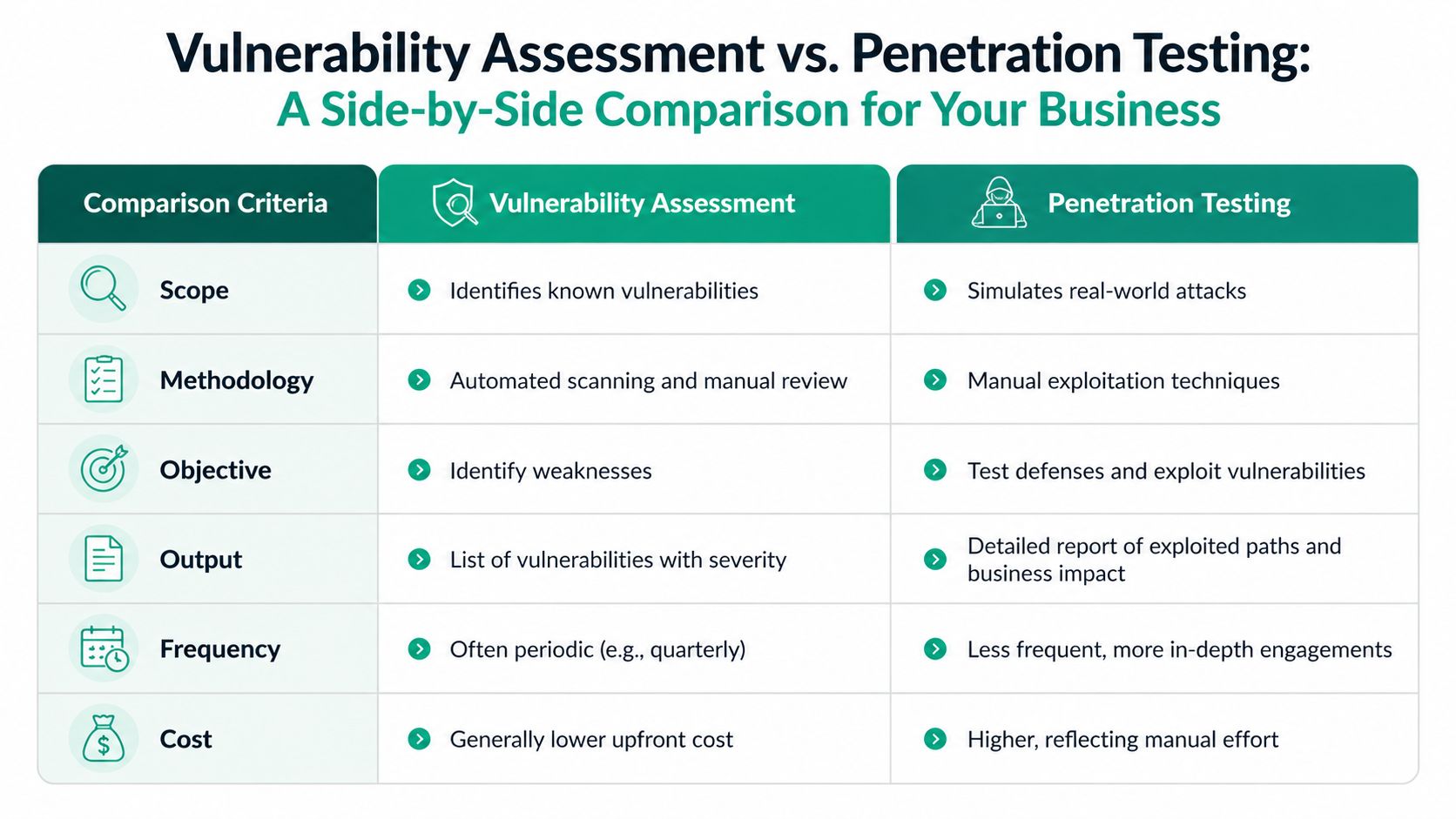
Vulnerability Assessment vs Penetration Test At a Glance
| Criterion | Vulnerability Assessment (The "List") | Penetration Testing (The "Test") |
|---|---|---|
| Scope | Broad review of systems, software, and configurations | Focused attempt to exploit selected targets and pathways |
| Methodology | Primarily automated scanning with analyst review | Manual, human-driven testing and exploitation |
| Objective | Identify and prioritize weaknesses | Validate defenses and prove business impact |
| Output | A list of findings, severities, and remediation items | A report showing exploited paths, impact, and attacker movement |
| Frequency | Best run regularly | Best run less often, but with greater depth |
| Cost profile | Lower upfront effort | Higher effort due to specialist time |
| Best fit | Ongoing security hygiene and visibility | Compliance validation, control testing, and high-risk environments |
What you are paying for
A vulnerability assessment buys breadth. It checks a wide range of assets and surfaces missing patches, weak configurations, outdated services, and known exposures. For a small or midsize Indiana business with limited security staff, that matters because broad visibility usually produces the fastest cleanup list.
A penetration test buys proof. The tester spends time chaining weaknesses together, validating whether controls fail under pressure, and documenting what an attacker could reach. That makes the price higher, but it also makes the output more useful when leadership needs to justify budget, prepare for an audit, or decide whether a security control is working.
That cost difference is why sequencing matters.
If patching, asset inventory, and account hygiene are still inconsistent, start with an assessment and fix the basics. If your leadership team wants to know whether those basics hold up against a real attack path, invest in a pen test.
Scope drives ROI
Assessments cast a wide net. They work well across mixed environments with on-prem servers, Microsoft 365, cloud workloads, aging laptops, remote users, and line-of-business applications. They support recurring maintenance and feed directly into patch management for business systems and software.
Pen tests go deeper in a narrower lane. A good engagement might focus on an external attack surface, a web application, internal privilege escalation after assumed compromise, or wireless access in an office or warehouse. You get less coverage, but more context on real business impact.
For many Indiana SMBs, that means the better first spend is not always the more advanced service. It is the service that answers the most urgent risk question for the least wasted effort.
Automation finds patterns. Humans find attack paths.
Vulnerability assessments rely heavily on scanners and analyst review. Tools are good at finding known issues at scale. They are efficient, repeatable, and useful for tracking progress over time. They also fit well alongside baseline controls such as EDR and the best antivirus software for small business, because those tools help reduce common endpoint risk but do not tell you how multiple weaknesses combine.
Penetration testing depends on human judgment. A tester notices weak handoffs between systems, permissions that do not match policy, exposed admin paths, and small mistakes that become serious when chained together. That is where businesses often get the clearest answer on whether segmentation, MFA exceptions, service accounts, web controls, and monitoring are holding up.
One exposed port rarely tells the full story. A chained attack path does.
Frequency should match business change
Assessments make sense on a regular schedule because environments change constantly. New software gets installed. Firewall rules stay open longer than planned. Dormant accounts stay active. A monthly or quarterly cadence is common, depending on the size of the environment and how quickly systems change.
Pen tests usually happen less often because they require more planning and specialist time. Many Indiana companies schedule them annually, after major infrastructure changes, before cyber insurance renewal, or ahead of a compliance review. That timing is practical. You run a pen test when the business needs validation, not just another list of findings.
Reports serve different decisions
A vulnerability assessment report is an operations document. It helps IT teams prioritize remediation, assign owners, and measure whether recurring issues are being fixed. It is useful for reducing the attack surface over time.
A penetration test report is a risk document. It shows what was attempted, what succeeded, what data or systems were exposed, and which controls failed to stop the attack path. That matters to owners, executives, auditors, and insurers because it connects technical weaknesses to business consequences.
A clean scan report should never be treated as proof that the environment is safe.
Where each service fits best
Use a vulnerability assessment when you need:
- Broad visibility across many assets
- A repeatable remediation process
- Better patching and configuration discipline
- A lower-cost starting point for security improvement
Use a penetration test when you need:
- Evidence of real exploitability
- Validation for compliance or insurance conversations
- Testing of specific high-risk systems
- Clear proof of business impact for leadership decisions
In practice, mature companies use both. They just do not use them for the same reason. The smart decision for a Greenwood, Franklin, or Whiteland business is to match the service to the current risk, budget, and compliance pressure instead of buying the one with the more impressive name.
The Real-World Impact on Your Indiana Business
This gets easier when you stop thinking in security jargon and start thinking in business scenarios.
A Hamilton County clinic, a defense supplier near the I-65 corridor, and a manufacturer in a Greenwood industrial park should not make this decision the same way. Their compliance pressure, downtime risk, and budget shape the right answer.
If you handle regulated data
Healthcare is the easiest example. A clinic dealing with HIPAA has protected health information, third-party integrations, staff turnover, email risk, and often a mix of cloud and on-prem systems. In that environment, broad visibility matters because small misconfigurations stack up fast. But broad visibility alone isn’t enough.
Automated vulnerability scanning tools detect only about 15% of actual cybersecurity vulnerabilities in an organization’s environment, according to Mitnick Security’s explanation of vulnerability assessments and penetration testing. That’s the practical reason a clinic shouldn’t rely on vulnerability assessments alone. If your business stores sensitive data, missing the majority of exploitable weaknesses is not a paperwork issue. It’s a continuity issue.
A regular assessment helps catch missing patches, exposed services, and configuration drift. A periodic pen test answers the harder question: if someone gets in, how far can they go?
If your contracts demand proof
Defense contractors and subcontractors around central Indiana face a different problem. CMMC conversations aren’t theoretical anymore. Prime contractors want evidence. Auditors want control validation. Internal policy statements don’t carry much weight if nobody has tested the environment.
For these companies, a penetration test carries more strategic value because it validates controls' ability to hold. A documented test of segmentation, remote access, privilege boundaries, and sensitive file access gives leadership something stronger than “we believe our settings are correct.”
That doesn’t make the assessment optional. It means the pen test often becomes the centerpiece because contractual pressure usually centers on demonstrable control effectiveness.
If your infrastructure is aging
A small manufacturer or distributor in Greenwood may have a different profile. Older line-of-business systems. Maybe a dusty server room. Maybe UniFi switches and access points that were installed years ago and never fully reworked as the company expanded. Maybe flat networking because separating shop-floor devices from office systems kept getting pushed down the list.
That’s where a vulnerability assessment often has the best immediate ROI. It gives you broad visibility without paying for the most resource-intensive service first. It helps identify outdated firmware, missing patches, weak wireless settings, open management interfaces, or firewall rules nobody remembers approving.
For teams cleaning up baseline security, a good assessment turns vague anxiety into a remediation roadmap.
If budget is tight, start where you’ll learn the most about your exposure. For many SMBs, that’s the assessment. If the stakes are higher, add the pen test before someone else performs one without permission.
Where endpoint security and patching fit
No testing service replaces basic controls. You still need strong endpoint protection, patch discipline, backups, MFA, least privilege, and monitoring. If you’re comparing endpoint options, this guide to the best antivirus software for small business is a decent practical overview of what smaller teams should evaluate.
Patching still does the daily heavy lifting. If that process is inconsistent, read this explanation of why patch management matters for Indiana businesses. Testing finds the weak spots. Patch management closes them.
A quick visual example helps. The short video below shows the kind of attack-path thinking many companies miss when they treat security as a checklist instead of a system.
What this means for ROI
The ROI is rarely “we bought a test and made money.” The ROI is that you avoid the kind of outage that halts payroll, shipping, scheduling, intake, or client communication. You also stop spending senior staff time on random security churn because the report gives your team an order of operations.
That’s what good security testing really buys. Better priorities. Less downtime risk. Fewer assumptions.
Inside the Process What to Expect from Each Service
Business owners usually get more comfortable with testing once they know what takes place. A lot of the fear comes from mystery. The process is more structured than many imagine.
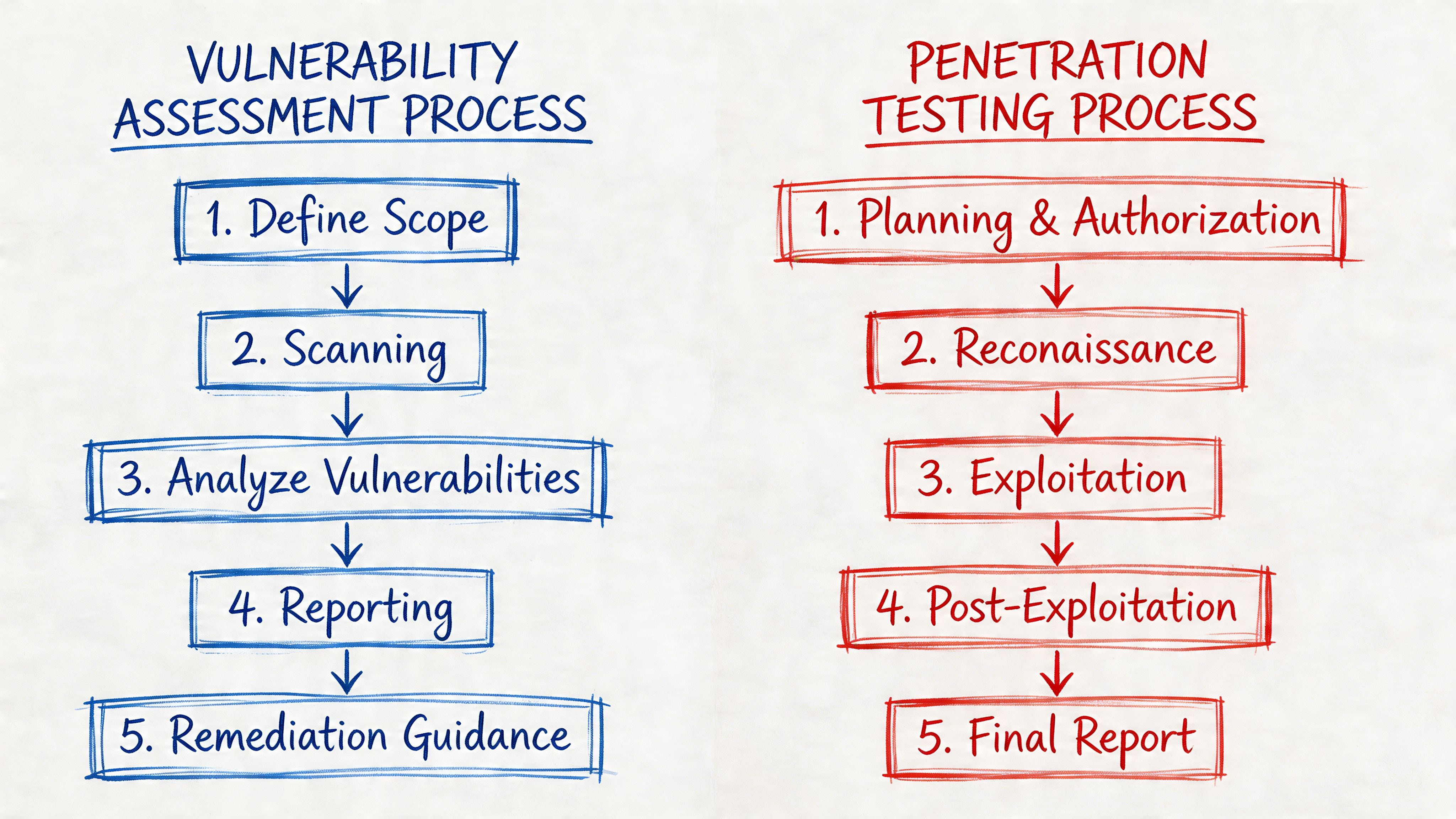
What a vulnerability assessment engagement looks like
A solid vulnerability assessment usually starts with scope. Which networks, subnets, public-facing assets, cloud tenants, applications, and endpoints are in play? If scope is sloppy, the report will be sloppy too.
Then comes scanning and review. Tools such as Nessus, Qualys, or OpenVAS are commonly used to identify known vulnerabilities and misconfigurations. Good providers don’t stop at raw scanner output. They review critical findings manually, remove obvious noise, and organize the issues into something your team can act on.
Typical phases look like this:
-
Scoping the environment
Internal assets, external assets, cloud services, wireless, and applications get defined up front. -
Automated scanning
Known issues are identified across the target environment. -
Manual validation of important findings
High-risk items get checked so your team doesn’t chase junk. -
Reporting and remediation guidance
Findings are grouped, prioritized, and translated into real next steps.
The final report should help your internal IT team, managed services provider, or compliance lead answer one basic question: what do we fix first Monday morning?
What a penetration test engagement looks like
Penetration testing is more deliberate. Before anyone touches a target, there should be written rules of engagement, timing windows, escalation contacts, and clear boundaries. That matters because the work is designed to simulate attacker behavior without disrupting production.
The flow usually includes:
- Rules of engagement that define what’s in scope, what’s off-limits, and who gets called if something unexpected happens
- Reconnaissance to understand the attack surface and map likely entry points
- Threat modeling to decide where effort should go based on your environment and likely adversary paths
- Exploitation where the tester attempts authorized compromise of selected weaknesses
- Post-exploitation analysis to see whether they can pivot, escalate privileges, or reach sensitive systems
- Debrief and reporting with evidence, impact, and recommended fixes
Human experience matters. A strong tester doesn’t just say, “Port open, service outdated.” They show how that weakness combines with identity, segmentation, and trust assumptions.
During a good pen test, the most useful finding is often not the first weakness. It’s the route from a small weakness to a big business consequence.
What the report should tell you
Whether it’s a VA or pen test, a report that only lists findings without context is weak. You need a document that helps three groups at once:
- Leadership needs business impact and priority
- IT staff need technical detail and remediation steps
- Compliance stakeholders need evidence that testing occurred and findings were reviewed
For web-facing systems especially, a specialized engagement often uncovers issues that generic infrastructure scans won’t catch. If your company develops or relies on customer-facing apps, these web application security best practices for Indiana businesses are worth reviewing alongside any testing plan.
Where advanced security architecture shows up
This is also where deeper technical work becomes visible. A mature review may expose problems in Zero Trust design, firewall segmentation, stale service accounts, insecure wireless roaming between latency-optimized mesh nodes, or poor alerting handoff to SOC-as-a-Service monitoring.
That’s the difference between “we ran a tool” and “we assessed the environment.” Good testing shows how the pieces interact. Identity, patching, endpoint security, wireless design, server hardening, and backup isolation all affect the final risk picture.
Choosing the Right Test An Actionable Checklist
A Greenwood business owner usually asks this question after something changes. A cyber insurance form gets stricter. A hospital client asks for proof of testing. A new cloud app goes live, and nobody is fully sure what is exposed. At that point, the decision is less about terminology and more about cost, risk, and what will stand up to a client, insurer, or auditor.
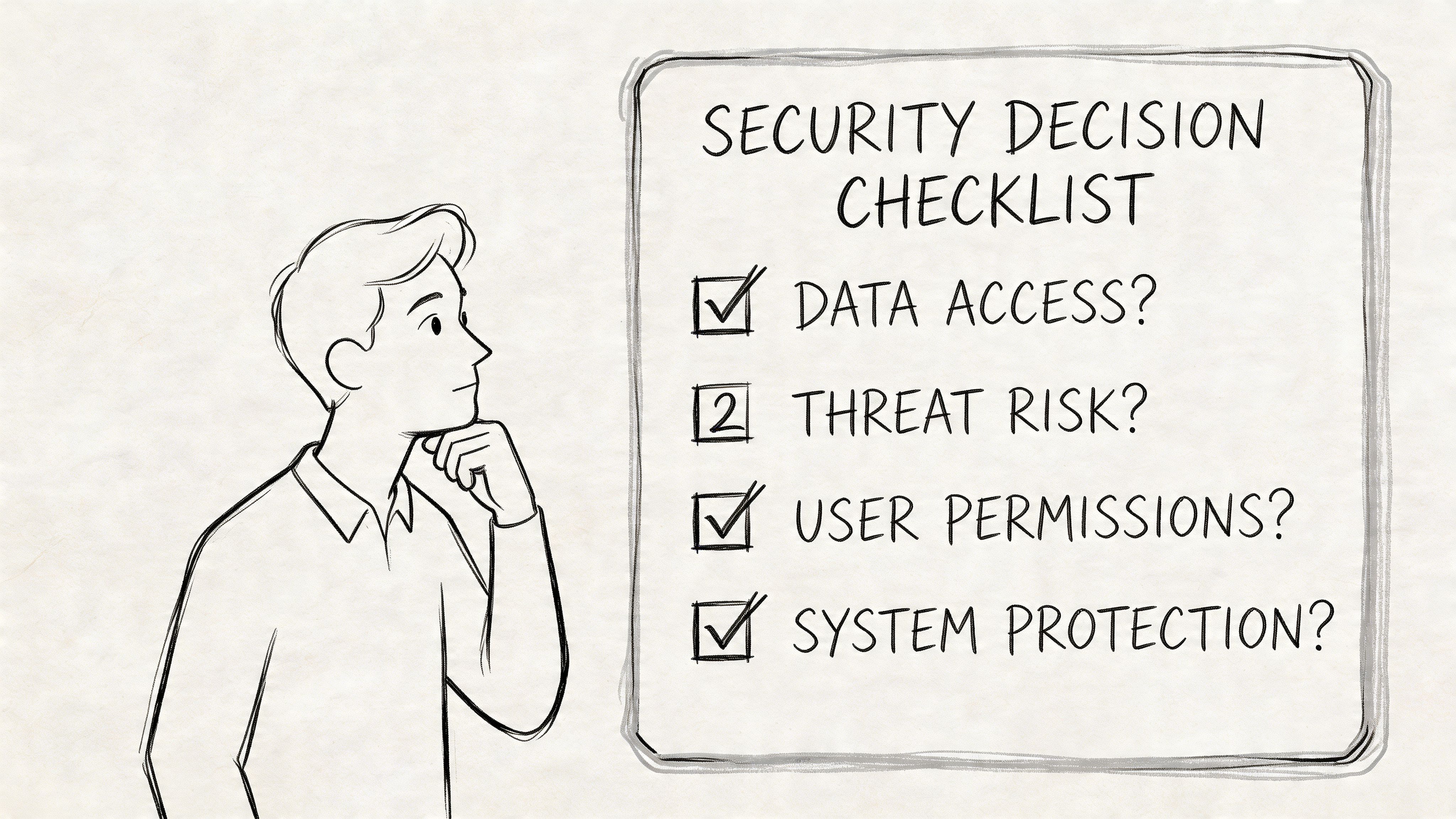
Ask these questions before you buy anything
Start with the business pressure, not the tool.
-
What is driving the request?
If a customer contract, cyber insurer, or compliance review asks for a specific type of testing, match that requirement first. "Security testing" is too broad to be useful. -
What would hurt if it were exposed or disrupted?
Patient records, payment data, legal files, CAD drawings, and Microsoft 365 email carry very different risk than public marketing content. -
How stable is your IT environment right now?
If patching is inconsistent, MFA is incomplete, and admin rights have grown over time, a vulnerability assessment usually gives better first-pass ROI. -
Have you had meaningful testing in the last 12 months?
If not, the highest-value move is to begin. Waiting for the perfect scope usually just extends exposure. -
Who will remediate the findings?
A report has limited value if your internal team, MSP, or outside consultant does not have time blocked to fix what gets found.
A practical decision matrix
This is the framework I use with Indiana SMBs that need to make a decision without wasting budget.
| Situation | Best starting point |
|---|---|
| You have never had formal security testing | Vulnerability assessment |
| A client or auditor wants proof that controls can be bypassed | Penetration test |
| You store regulated or high-impact data | Both, sequenced into a remediation plan |
| Your insurer or customer questionnaire is specific | Match the request exactly |
| You added locations, remote users, cloud apps, or new vendors this year | Assessment first, then a targeted pen test |
The primary decision is usually sequencing. Many Johnson County companies do better with an assessment first, fix the obvious gaps, then use a pen test to verify whether an attacker could still turn those gaps into business damage.
Why many SMBs end up needing both
A vulnerability assessment is broad and efficient. A penetration test is narrower, but it answers a more expensive question. Can someone use these weaknesses to reach payroll, email, file shares, customer data, or production systems?
That distinction matters for ROI. If your budget only covers one service, choose the one that answers your most immediate business risk. If you need visibility across a growing environment, start with the assessment. If you already know the environment is reasonably mature and need stronger evidence for compliance, customer trust, or board reporting, a pen test often carries more weight.
For many Indiana businesses, both services make sense over time because they support different decisions. One helps prioritize cleanup. The other helps validate whether that cleanup materially reduced risk.
Decision shortcut: If you face compliance pressure, handle sensitive data, and have not tested recently, plan for both services in sequence instead of treating them as interchangeable.
Use this checklist with your team
Bring these questions into your next IT or leadership meeting:
-
Compliance pressure
Do we answer to HIPAA, PCI DSS, CMMC, or a client that expects NIST-aligned controls? -
Operational risk
Which system outage would stop revenue, dispatch, scheduling, production, or customer service first? -
Recent change
Did we add remote access, cloud systems, a second location, warehouse devices, or a new vendor connection? -
Remediation budget
Can we pay for the test and the follow-up work, or only the report? -
Decision owner
Who will approve priorities, assign fixes, and confirm completion?
If your team needs a wider planning tool before choosing a service, this IT security audit checklist for Indiana businesses is a useful place to start.
Get Actionable Security Insights Not Just a Report
The biggest waste in cybersecurity is paying for a report nobody operationalizes.
That happens all the time. A scan gets run. A pen test gets delivered. Leadership nods. IT gets a PDF. Then the findings sit in a folder while the same flat network, old service accounts, weak wireless segmentation, and over-permissioned users stay in place for another quarter.
Good security testing should change operations. It should influence patching priorities, identity controls, firewall rules, backup isolation, vendor access, and monitoring. It should help you decide whether your environment needs better Zero Trust architecture, stronger Bitdefender GravityZone policy tuning, tighter Microsoft 365 controls, cleaner VLAN separation, or better SOC-as-a-Service escalation paths.
That’s especially true in central Indiana. Older brick buildings near downtown Indy create Wi-Fi headaches that require proper access point placement and latency-optimized mesh nodes, not guesswork. Fast-growing firms in Hamilton County often outgrow their original permissions model before anyone notices. Shops along the I-65 corridor add cloud systems, warehouse devices, and remote users faster than their security stack matures.
The right test gives you a map. The right follow-through lowers risk.
A solid risk review should answer:
- What is most likely to disrupt operations?
- Which weaknesses threaten compliance?
- What should be fixed now, this quarter, and later?
- What controls need validation after remediation?
If you’re trying to organize those questions before bringing in a provider, this cyber security risk assessment template for Indiana businesses is a practical starting point.
Security work pays off when it keeps your business running. That’s the metric owners care about. Less downtime. Less confusion. Fewer emergency calls. Better budget control. And a clearer answer when a client, insurer, or auditor asks what you’re doing to protect the business.
If your company is in Greenwood, Indianapolis, or anywhere nearby and you want clarity instead of another vague security PDF, talk with Finchum Fixes IT about a Free Network Assessment or a Security Risk Audit. The goal is simple: find the weak spots, prioritize the fixes, and build a defense that supports uptime instead of just checking a box.