NIST Cybersecurity Framework CSF for Indiana SMBs
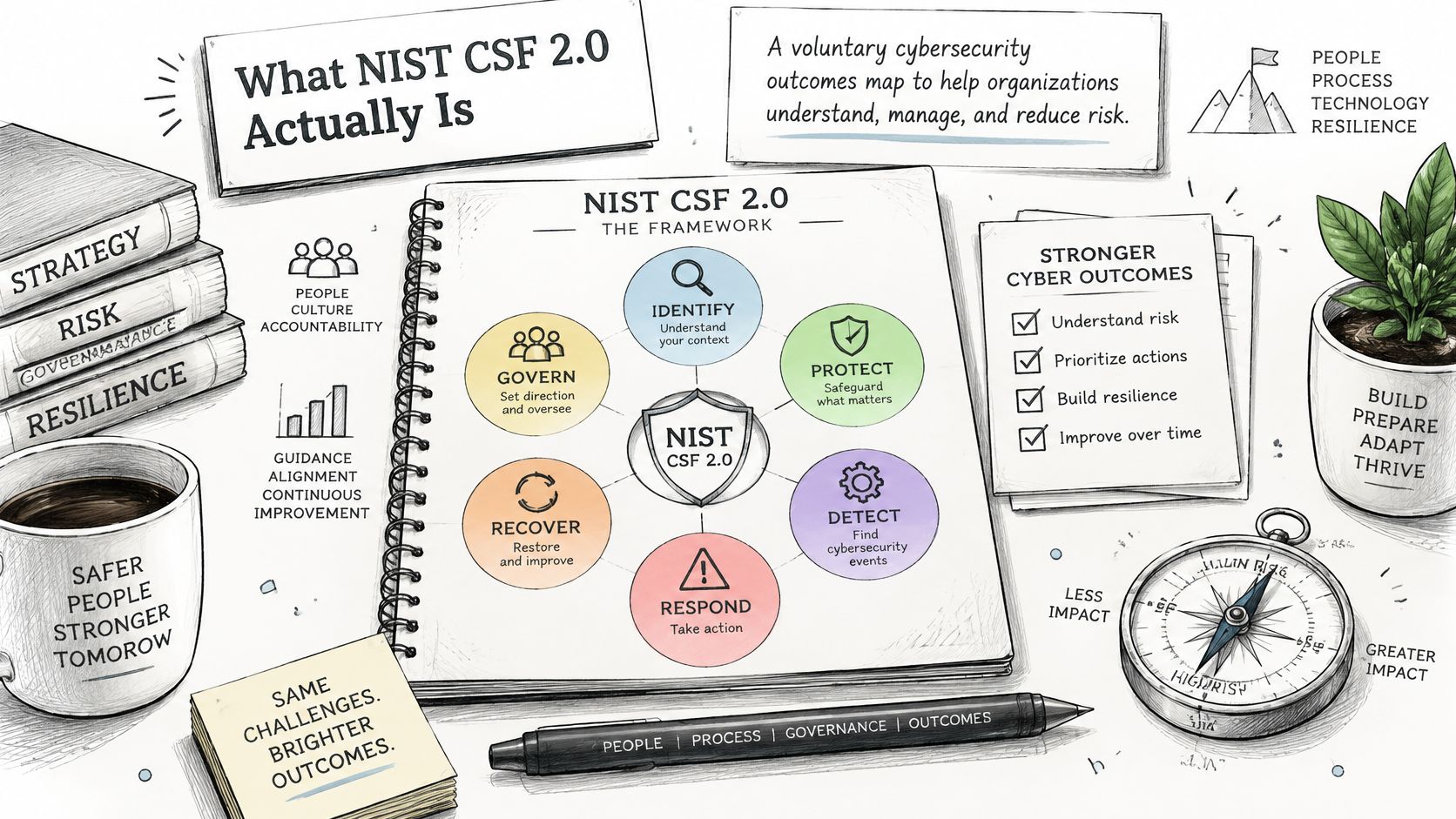
NIST CSF 2.0, released February 26, 2024, is a voluntary cybersecurity outcomes framework with six Functions, Current and Target Profiles, and four Tiers. It helps organizations decide what security should accomplish and how consistently it should run, without requiring a certification or a prescribed product list.
Your file server is grumbling again. Someone in the Greenwood office can't reach the estimating folder, the afternoon Wi-Fi slowdown has started, and your insurance questionnaire wants to know whether you follow NIST. You need the shop working, not another binder.
What NIST CSF 2.0 Actually Is
A Greenwood firm's aging server holds the job files staff need to keep work moving. Across town, an office in an old brick building loses wireless connections when employees enter the conference room. Both owners hear “cybersecurity” and think antivirus, while everyday infrastructure problems eat into productive hours.
The NIST Cybersecurity Framework (CSF) helps connect those technical problems to business decisions. Which service needs to stay available? Who approves replacing unsupported equipment? What evidence shows that a backup can restore the estimating application?
A business map, not a federal audit
The National Institute of Standards and Technology introduced CSF 1.0 in 2014 following a presidential Executive Order, published CSF 1.1 in 2018, and released CSF 2.0 on February 26, 2024. The newer version is intended for organizations across every sector, not only critical infrastructure.
A machine shop, nonprofit, school, or accounting office along the I-65 corridor can use the framework without pretending to run a power utility. Its value comes from connecting leadership decisions with day-to-day security work.
An insurer asking about NIST is not automatically announcing a federal audit. It may want evidence that you understand and manage your risks. Ask what evidence it needs before spending money on software to answer a vague checkbox.
Practical rule: Start with the business service you can't afford to lose. Then identify the people, systems, and suppliers that keep it running.
Fix the cause, then maintain the fix
For the Greenwood server, start by checking support status, storage health, application dependencies, replacement options, and whether recovery works. For the brick office, measure wireless coverage and interference, adjust access-point placement, and use wired backhaul where practical. A reboot may restore service today; it does not fix the design.
Downtime priorities depend on the work. A business that loses revenue or payroll whenever a particular operation stops will make different spending choices from an office that can work offline. Estimate your exposure using idle payroll, interrupted production, lost sales, and recovery labor.
Give each chosen outcome an owner, evidence of progress, and a monthly number tied to downtime. That number can show whether interruptions are becoming less frequent or taking fewer hours to resolve. Policies matter when they guide those decisions; a finished binder alone does not keep the shop running.
Six Functions and the Work Behind Each
Think of the Functions as stations in a busy kitchen. They operate together; the cook handling recovery doesn't get to ignore the person watching for smoke.
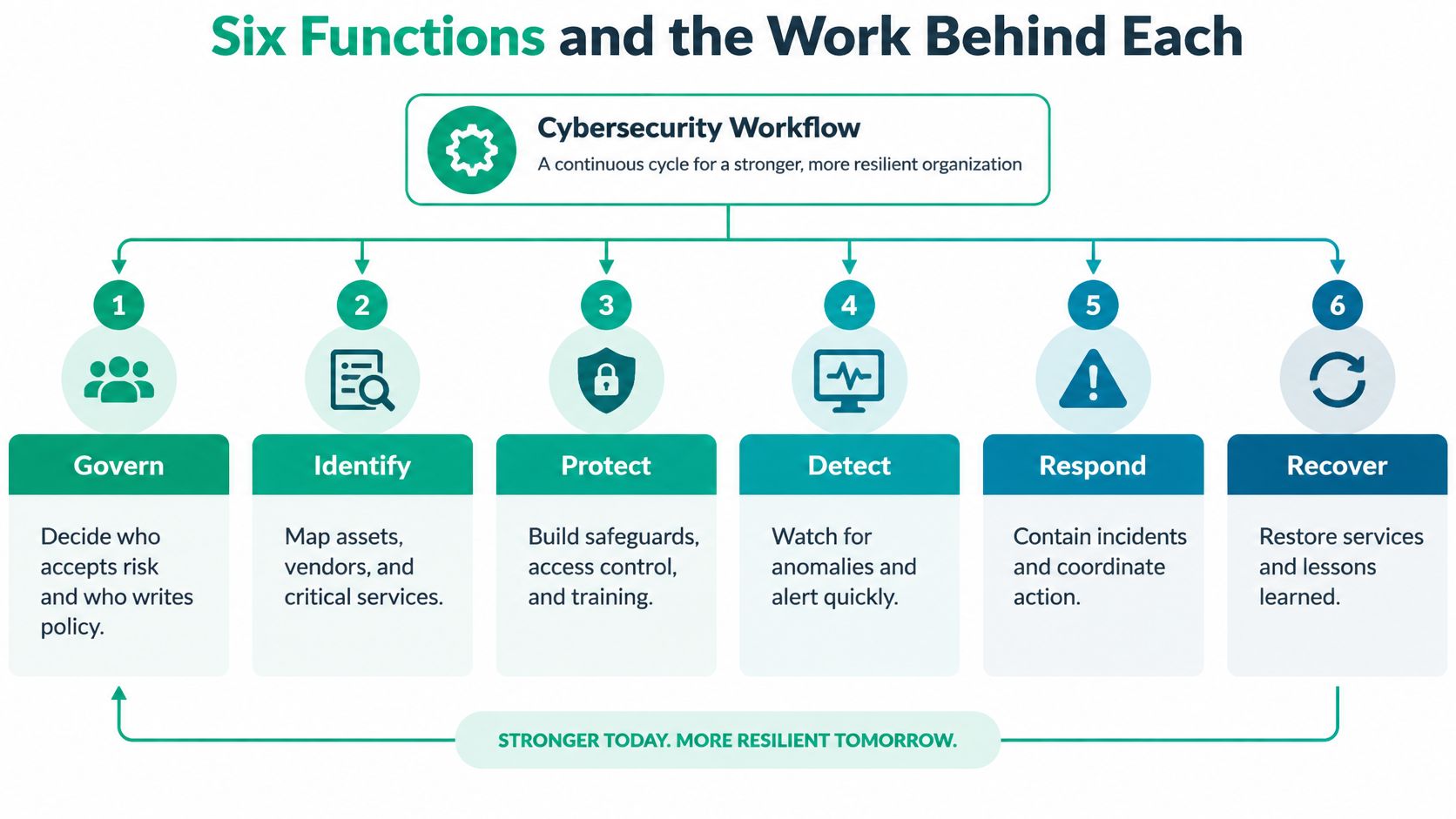
NIST's CSF news and framework guidance describes six Functions: Govern, Identify, Protect, Detect, Respond, and Recover, with Govern newly added in CSF 2.0 to put strategy, responsibility, oversight, and supply-chain risk alongside operational security.
The workflow makes the relationship easier to see.
NIST CSF 2.0 Functions for a small business
| Function | Plain job | SMB action | If you skip it |
|---|---|---|---|
| Govern (GV) | Decide risk, policy, and supplier rules | Name an owner and write a short risk policy | Nobody owns the breach call |
| Identify (ID) | Know assets, data, and dependencies | Inventory PCs, servers, SaaS, and payroll files | You protect the wrong things |
| Protect (PR) | Put safeguards on what matters | MFA, Bitdefender GravityZone, UniFi segments, patch calendar | A stolen login can open the shop |
| Detect (DE) | Find attacks and odd behavior | SOC-as-a-Service alerts and log review | An intruder can remain unnoticed |
| Respond (RS) | Contain the incident and communicate | Written call tree and customer-notice process | Panic and mixed messages |
| Recover (RC) | Restore priority operations | Immutable off-site backups and a tested restore order | Downtime continues while staff wait |
Govern starts before purchasing. At a Greenwood fabricator, someone must decide whether an unsupported production application can remain online, what compensating safeguards it needs, and when replacement becomes unavoidable. Otherwise, the IT technician inherits a business decision without business authority.
Identify catches dependencies that aren't obvious. A Johnson County payroll workflow might rely on a cloud portal, a local export folder, and an employee's authentication device. Listing only the server misses the actual service.
Protect turns those findings into safeguards. Bitdefender GravityZone can manage endpoint protection, while UniFi networking can separate guest devices from business systems when VLANs and firewall rules are configured correctly. Buying the equipment doesn't establish the separation; testing denied access does.
Detection needs someone who can act
At a downtown Indy office, Detect could mean SOC-as-a-Service monitoring that reviews suspicious sign-ins and endpoint behavior. Confirm who receives alerts, who investigates, and who has permission to isolate a machine. An unread alert is just an expensive notification.
Respond gives that person a usable containment plan. A Hamilton County professional firm needs to know who can disable an account, contact its insurer, preserve evidence, and approve customer communications. That reduces improvisation when employees are already anxious.
For another explanation of the framework's workflow, use the accompanying video.
Recover means returning a priority service to usable operation. Restoring a database without its application, permissions, or authentication dependency doesn't return anyone to billable work.
Different businesses can reach these outcomes with different products. A managed-service proposal should map each tool and recurring task to its primary Function, identify any additional Functions it supports, and explain the business interruption it helps prevent.
Tiers Categories and a Sane Target
A higher Tier isn't automatically a better purchase. You're choosing how rigorously cybersecurity risk management needs to run, not ordering the largest meal because it comes with more fries.
The NIST quick-start guides describe four Tiers: Partial, Risk-Informed, Repeatable, and Adaptive, and advise selecting appropriate rigor based on business risk, regulatory exposure, technology dependence, and resources.
CSF 2.0 Tiers and what they mean for an SMB
| Tier | How it runs | Good SMB target |
|---|---|---|
| Partial | Heroics and tribal knowledge | Tolerable for genuinely low-impact side systems |
| Risk-Informed | Risks are known; execution is uneven | A starting point after the initial inventory |
| Repeatable | Documented, owned, and done the same way | Identity, backups, patching, and incident response |
| Adaptive | Practice shifts as threats and the business change | Selectively, where changing threats could stop the company |
Don't confuse this with a separate score assigned to every device. Tiers characterize organizational risk governance and management; the table illustrates where investing in more consistent practices often makes sense.
Categories make the work more specific
Functions divide into Categories, and Categories divide into Subcategories describing outcomes. Categories address areas such as asset management, risk assessment, supply-chain risk management, data security, platform security, technology-infrastructure resilience, continuous monitoring, and incident recovery.
In plain language, the work gets narrower:
- Hardware inventory: Know which equipment supports the business and where it belongs.
- Remote access: Require appropriate authentication before someone reaches business systems.
- Recovery readiness: Establish whether protected data can be restored.
Those are practical examples, not verbatim Subcategory statements. They help translate the framework into work a technician and an owner can both understand.
An SMB handling customer financial information should generally favor repeatable practices for identity, backups, vulnerability remediation, and incident response. Ad hoc handling may be tolerable for a low-impact side system, but not if that system provides a route into sensitive operations.
A Hamilton County contractor and a downtown Indy clinic can use the same Tier vocabulary while prioritizing different risks. For a broader way to weigh those decisions, use this guide to cybersecurity risk management for Indiana SMBs.
Moving toward greater rigor means writing usable procedures and following them consistently. It doesn't mean adding a security logo to the website or chasing Adaptive everywhere while routine maintenance goes unfinished.
Profiles and the Numbers That Prove It
A finished policy set proves that somebody finished a policy set. It doesn't prove your receptionist's computer is protected or that your accounting system will come back after an outage.
NIST's small-business CSF guidance treats the framework as flexible and outcomes-based, not a certification checklist. That makes validated outcomes, rather than document counts, the useful basis for judging progress.
Turn the gap into a work order
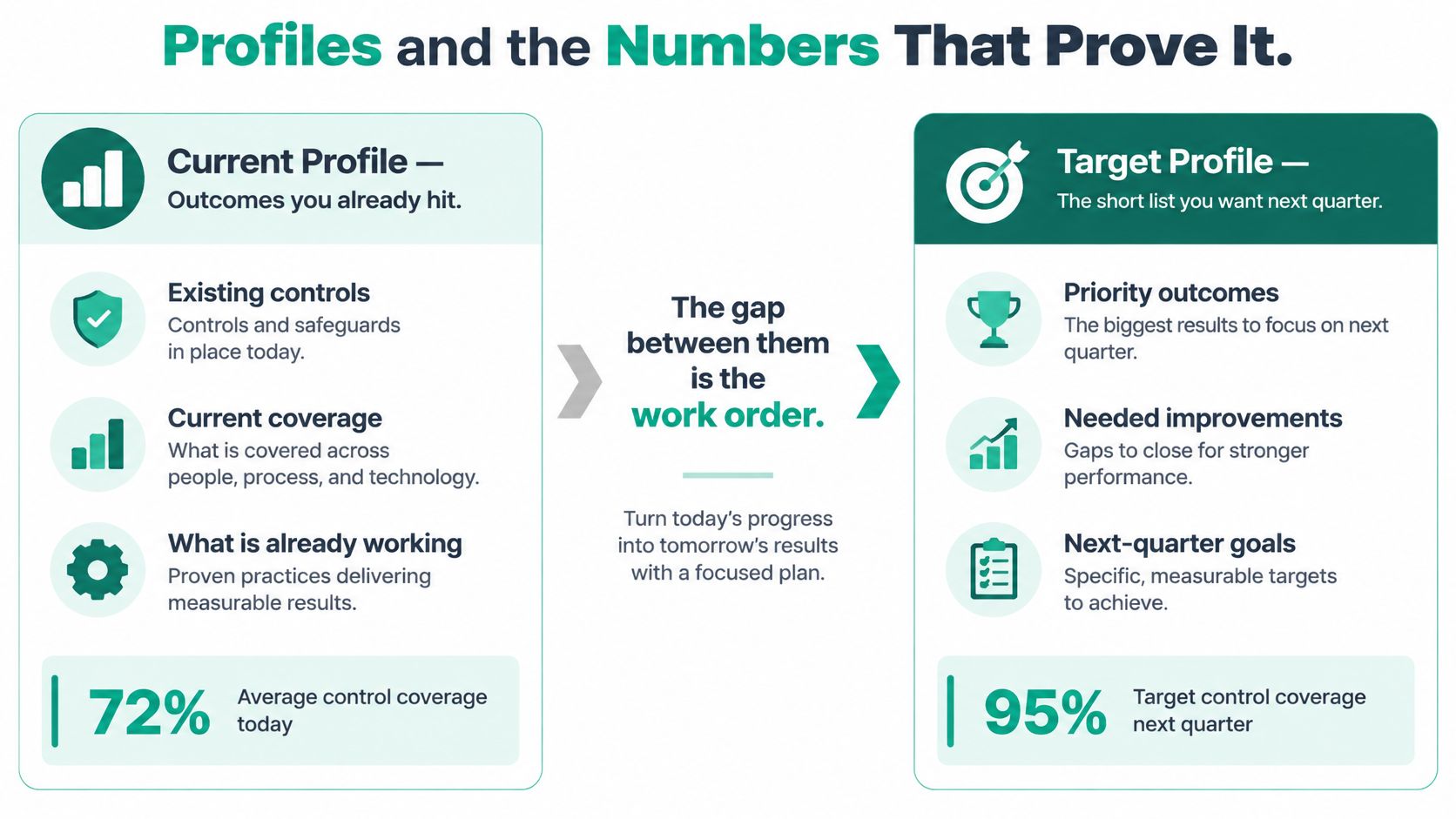
A Current Profile records the outcomes you already achieve. A Target Profile identifies the outcomes you want to achieve, selected according to business priorities and risk tolerance.
NIST's Small Business Quick-Start Guide is intended for organizations with modest or nonexistent cybersecurity programs, so a thin starting program isn't a reason to postpone this work. Keep the first Profile short enough that the owner will read it.
The difference between current and target is the work order.
The monthly operating sheet
Use a standing monthly review day, such as the first business Monday. The following is a suggested operating sheet, not a NIST-required reporting template.
| Measure | Accountable owner | Evidence source | Business consequence |
|---|---|---|---|
| Percentage of critical assets inventoried | IT lead | Asset register reconciled with GravityZone, UniFi clients, and cloud inventories | An unknown dependency delays restoration |
| Percentage of privileged accounts using phishing-resistant MFA | Identity administrator | Identity-provider authentication-method report | Administrator takeover and ransom exposure |
| Count of critical vulnerabilities past their remediation deadline | Managed IT lead | Vulnerability scan and remediation tickets | Exploitable systems remain in production |
| Mean time to detect and contain incidents | Security response lead | Alert timestamps and incident records | More systems affected and longer interruption |
| Percentage of backup restore tests that succeed | Recovery owner | Restore-test records and application validation | Payroll or customer work stays unavailable |
| Percentage of key suppliers reviewed | Business or procurement owner | Vendor register and assessment records | Supplier failure or missed customer due diligence |
Every row also needs a target, a due date for improvement, and an escalation rule. Give the measure an accountable person, not a department name that allows everyone to assume somebody else checked it.
For percentages, define the denominator. Inventoried critical assets means verified critical assets divided by the agreed critical-asset population, not whatever the discovery agent happened to find.
A successful backup job isn't a successful restore. Require evidence that the application opens and the business user can complete the relevant task.
If no incidents occurred during the reporting period, mark detection and containment time as not observed; don't report an artificial zero. Exercises can provide separate readiness measurements, clearly labeled as tests.
Platform dashboards can support the review, but they don't replace it. A Microsoft Secure Score explanation for SMBs helps distinguish a product's recommendations from business-wide recovery evidence.
Track time employees lose to recurring technical problems alongside these measures. That gives Johnson County business owners a practical way to compare planned remediation with emergency support, overtime, and customer work that never gets billed.
HIPAA CMMC and Vendors You Cannot Audit
CSF alignment isn't HIPAA compliance or a CMMC certification. Use the framework to organize security work, while treating each applicable legal, contractual, or assessment requirement as its own obligation.
For healthcare, coordinate the security program with the people responsible for HIPAA interpretation and compliance. For defense contractors, establish the actual contract and CMMC requirements before deciding which evidence and assessment work are necessary.
Map controls without claiming equivalence
The mappings below are organizing aids, not statements that a single control satisfies an entire obligation. In particular, MFA on remote access is a practical safeguard, not a claim that every HIPAA implementation has an identical MFA mandate.
CSF 2.0 mapping to HIPAA, CMMC and vendor duties
| Standard or duty | CSF 2.0 category | Example mapped control |
|---|---|---|
| HIPAA Security Rule access controls | PR.AA | Unique user IDs and MFA on remote access |
| HIPAA audit controls | DE.CM | Log review of ePHI access |
| HIPAA transmission security | PR.DS | Encryption of data in transit |
| Key vendor and cloud providers | GV.SC | Vendor Profile plus SOC report or contract clause |
| Applicable CMMC access and monitoring practices | PR.AA and DE.CM | Controlled access and retained monitoring evidence within the assessed scope |
A defense supplier responding to Hamilton County growth might discover weak account management through its Profile. A clinic near downtown Indy might prioritize electronic protected health information access and logging. Neither should mistake the mapping for an assessor's conclusion.
For orientation across different programs, Vigil Security's compliance standards comparison offers a useful comparison resource. Use the applicable standard and qualified advice for actual compliance decisions.
Ask vendors for proportionate proof
Email, payroll, remote access, cloud backup, and AI services often run outside your building. NIST's CSF FAQ explains that the framework still applies when another party operates the assets and supports using CSF outcomes to evaluate providers.
Build a short vendor Profile covering:
- Data and identity: Who can access your information, how they authenticate, and how privileged access is restricted.
- Protection and visibility: Encryption, available logs, vulnerability disclosure, and incident-notification commitments.
- Continuity: Backup ownership, restoration responsibilities, subcontractors, and service dependencies.
- Location and exit: Geographic data locations, export formats, retention, and secure offboarding.
Ask for evidence proportionate to the risk. A relevant assurance-report summary, penetration-test summary, recovery-test result, or enforceable contract provision can be more useful than a glossy security brochure.
Zero Trust architecture means evaluating access explicitly, granting only necessary permissions, and avoiding automatic trust based on network location. For a vendor connection, that includes limiting reachable systems and revoking access promptly when the relationship ends.
Immutable off-site backups can contribute to continuity, but retention settings, deletion permissions, capacity costs, and regulatory suitability still need scrutiny. Don't accept an immutable checkbox as a complete recovery design.
Use these IT vendor management practices for Indiana businesses to turn the questions into a repeatable purchasing and renewal process.
How an SMB Adopts CSF Without a Science Project
A slow shop-floor connection can stall work while an office PC keeps running normally. CSF adoption starts by identifying which business services are at risk, assigning someone to act, and checking whether the fix reduces disruption. Keep the work small enough to finish and concrete enough to test.
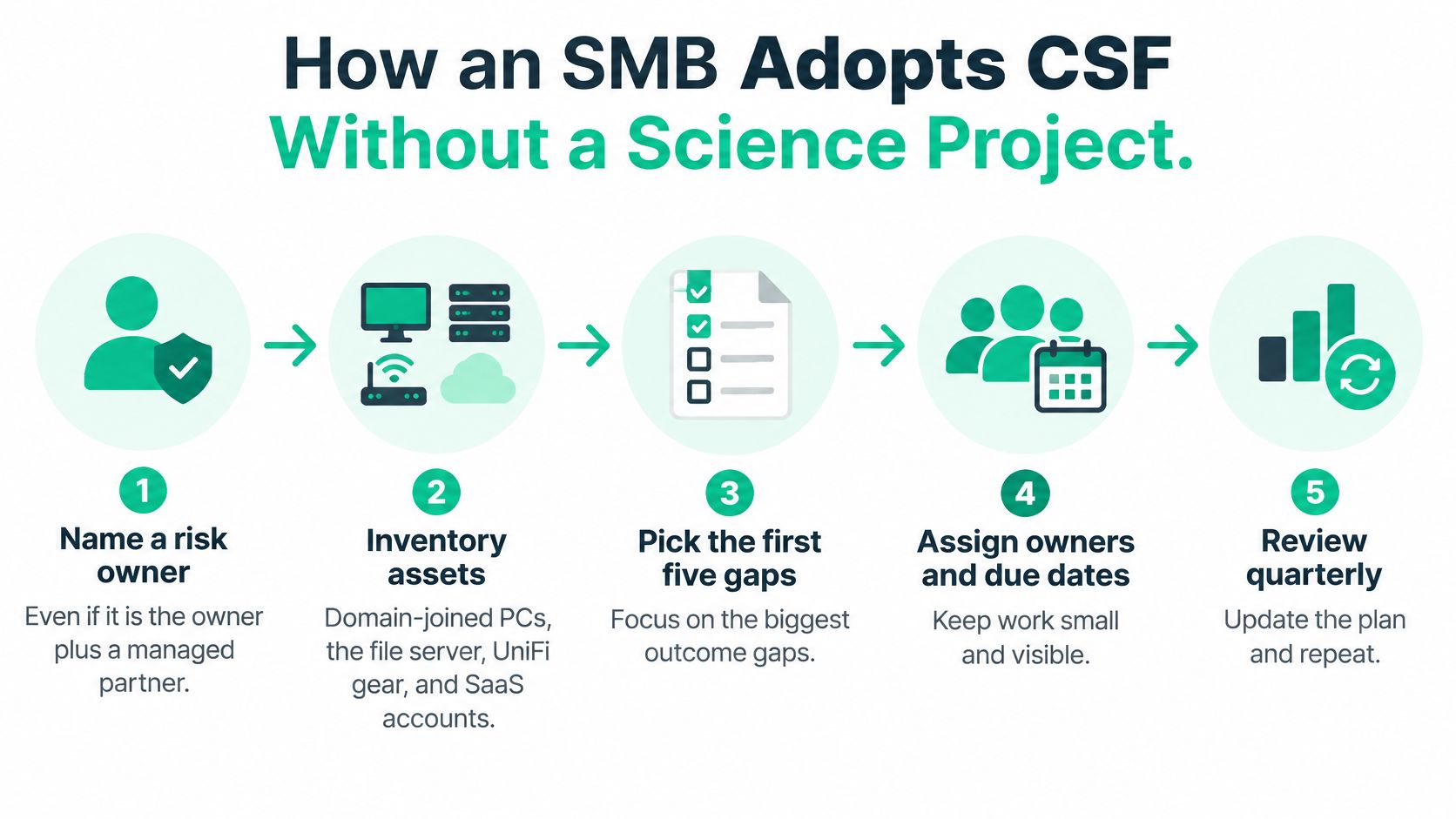
Establish the baseline
-
Name the risk owner. A managed partner can share the work, but someone with spending authority must accept or reject unresolved risk.
-
Inventory the environment. List domain-joined PCs, servers, UniFi equipment, SaaS accounts, custom applications, and the people who administer them. Note the business service each supports.
-
Diagnose the weak site before replacing equipment. Run
ipconfig /allin Windows Command Prompt to inspect the lease and default gateway. Useping -n 20 <gateway-IP>, replacing the placeholder locally, to check for packet loss from the affected desk. A failed ping alone does not prove a fault because some devices filter these requests. Runnetsh wlan show interfacesfor wireless connection details andnetsh wlan show networks mode=bssidto inspect visible access points and channels.Compare those results with UniFi Network client signal, retries, channel use, and wired uplink status. Check that Bitdefender GravityZone shows the endpoint as protected and updated, then review the last successful backup job and any unresolved warnings. Channel listings can suggest overlap, but they do not replace a wireless survey.
-
Write the Profiles. Record current outcomes and choose a short Target list with an owner, completion criteria, and a due date for each outcome. Put risks to revenue-producing work first.
Remediate and prove the result
-
Remove the recurring bottleneck. Replace unsupported server infrastructure with supported storage or an appropriate cloud service after checking application compatibility and migration rollback. In a brick building, review access-point placement, consider wired backhaul, and test firewall rules that separate guest and shop-floor traffic. Mesh nodes cannot compensate for every wall or overloaded uplink.
-
Harden access and maintenance. Enable suitable MFA for administrators and remote access, remove unnecessary privileges, and set deadlines for patching and vulnerability remediation. For hosted workloads, compare cloud security managed services for Indiana SMBs with the responsibilities your provider accepts.
-
Write the incident card and recovery order. Include offline contact details, who can isolate affected systems, escalation contacts, and business-approved service priorities. Payroll, email, and the line-of-business application may need different restoration sequences.
-
Restore into a safe test environment. The CISA ransomware guide recommends offline, encrypted backups and regular testing of backup availability and integrity. Keep appropriate offline or separately segmented copies, current recovery images, and checks against reinfection. If using immutable storage, check its retention settings, deletion permissions, capacity costs, and fit with your compliance requirements.
-
Review the operating sheet and adjust spending. Close verified gaps, investigate recurring failures, and update priorities when services or suppliers change. For each chosen outcome, track an owner, evidence of completion, and a monthly measure tied to downtime, such as service interruption hours. A finished policy is paperwork; a measured recovery improvement can show whether the work is paying off.
Recovery checkpoint: A RAID array provides storage availability, not an independent backup. Bit-level data recovery is a specialist fallback, not a continuity plan.
When comparing implementation options, Cloudvara's overview of cybersecurity solutions for small businesses can help frame provider discussions. Choose a service that produces the evidence and response capability the business needs, rather than paying for the longest feature list.
Book a Greenwood Security Risk Audit
A morning spent reconnecting shared drives is a morning not spent serving customers. When a production supervisor troubleshoots Wi-Fi or an owner arranges emergency hardware replacement, planned work slips too.
Start the financial discussion with hours lost, then account for emergency labor, delayed orders, recovery expenses, and rescheduled work. Compare those costs with planned maintenance and a predictable monthly service budget.
Buy a scoped outcome
A useful cybersecurity assessment for an Indiana business should identify which services could interrupt operations, explain the evidence behind each finding, and sort urgent fixes from longer-term improvements. Ask for configuration work and hardware replacement to be listed separately, so the estimate is clear.
The assessment can examine network design, endpoint policies, backup isolation, restoration capability, and incident escalation. Depending on the business, a managed plan might include UniFi network changes, Bitdefender GravityZone policy management, immutable off-site backups, scheduled restoration testing, or SOC-as-a-Service monitoring. Treat each as an option to evaluate, not an automatic purchase.
Bring a few useful items:
- Device information: A rough equipment list and the applications the business cannot operate without.
- Backup details: The product name, protected systems, and the date of the last deliberate restoration.
- Business obligations: Insurance questions, customer security requirements, and applicable HIPAA or CMMC responsibilities.
- Operational pain: Recurring outages, support tickets, and tasks employees repeatedly work around.
Leave with priorities, named owners, and evidence requirements. Tie each chosen outcome to a monthly measure of downtime, so CSF alignment tracks operating impact rather than a binder of finished policies. If no one owns a risk or can show that a restore works, make that a priority before the next outage sets the schedule.
Finchum Fixes IT provides IT support, networking, cybersecurity, and data recovery services for businesses. Visit Finchum Fixes IT to request a Network Assessment or Security Risk Audit scoped to your Greenwood or Indianapolis business. Bring your device list, backup details, and most persistent downtime problem.