Point to Point Networking: Your Private Data Highway for Business Uptime
TL;DR: Key Takeaways
- What It Is: A point-to-point (PTP) network is a private, dedicated data bridge connecting two specific locations, like your Greenwood office and your warehouse across town. It completely bypasses the public internet.
- Why It Matters for ROI: This direct link eliminates internet slowdowns and outages, which can cost businesses up to $9,000 per minute. It converts that "wasted tech time" back into billable hours and creates a predictable monthly IT budget.
- Local Problem Solved: For a Johnson County business with aging server hardware or a company in an old downtown Indy brick building with spotty Wi-Fi, a PTP link provides a stable, gigabit-speed connection that public internet can't match.
- Security & Compliance: Because data never touches the public internet, PTP networking is ideal for healthcare providers needing HIPAA compliance or defense contractors along the I-65 corridor managing CMMC requirements. We secure it further with Zero Trust architecture and tools like Bitdefender GravityZone.
Imagine your main office is in a Greenwood business park, but your critical warehouse operates a few miles away. The internet connecting them is slow and unreliable, constantly dropping video feeds and stalling inventory updates. This isn't just an annoyance; it’s a direct hit to your business continuity, costing you real money every time a connection fails. In our 17 years of local service, this is a problem we've seen cripple otherwise successful businesses across the Indianapolis metro area.
This guide explains how point to point networking solves this problem permanently. It's like building your own private data highway between two locations. No public traffic, no slowdowns, and no security risks from the open internet. It's the definitive way to guarantee uptime and turn a frustrating tech bottleneck into a competitive advantage.
What Exactly Is Point-to-Point Networking?
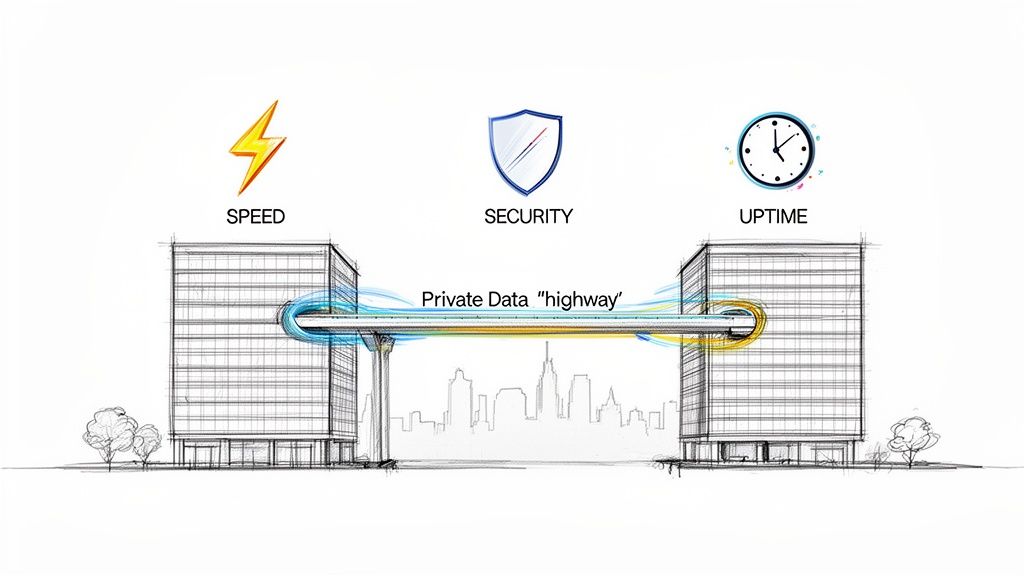
Let's cut through the jargon. At its heart, point-to-point networking is simply a direct, private data connection between two—and only two—locations. Think of it as a dedicated digital bridge connecting Point A to Point B, with no off-ramps or public traffic allowed.
Imagine your main office is in a bustling tech hub in downtown Indy, but your warehouse is humming away in an industrial park out in Plainfield. A point-to-point network creates a private data highway just for you, linking those two sites. All your inventory data, security camera feeds, and internal communications travel on this exclusive road, far away from the chaos of the public internet.
This direct link is the secret sauce. By carving out a private line, you get to bypass the traffic jams, security threats, and general unpredictability of a normal internet connection. It’s an investment in keeping your business running smoothly, turning flaky connectivity into a solid, high-performance asset you can count on.
The Problem With Relying on the Public Internet
Relying on standard business internet is like trying to get somewhere on I-465 during rush hour. Sometimes you sail through, but most of the time, you're stuck in traffic you have no control over. This shared pipeline creates slowdowns and leaves you wide open to outages. Every minute your team spends waiting for a file to download is a minute you can't bill.
And if your business handles sensitive information—like a healthcare provider bound by HIPAA or a defense contractor navigating CMMC compliance—the public internet is a huge security gamble. You’re sending critical data over the same public roads everyone else is using. A PTP network fixes this by creating a private lane exclusively for your data, ensuring both uptime and security.
Wired vs. Wireless PTP Connections
When we set up these dedicated links for businesses, we typically go one of two ways. The best route depends on distance, landscape, and budget.
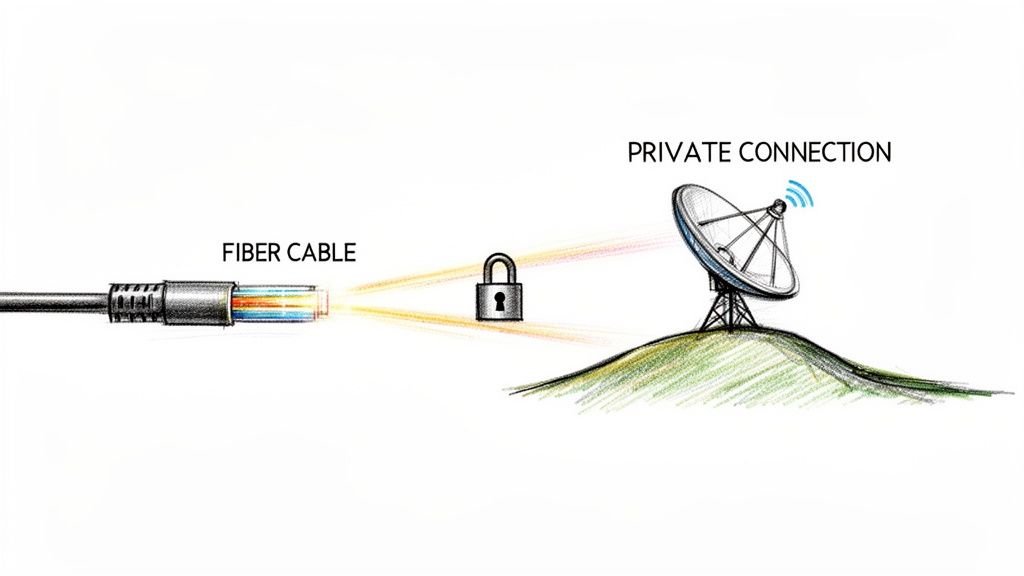
- Wired Point-to-Point (Fiber Optic): This is the champion of speed and reliability. We run a physical fiber optic cable directly between your two buildings. It gives you incredible bandwidth and is immune to interference, making it a no-brainer for connecting buildings on the same campus.
- Wireless Point-to-Point (Microwave/Radio): What happens when running a cable isn't practical? Maybe you need to cross a highway or connect buildings miles apart. That’s where a wireless bridge comes in. Using powerful UniFi hardware, we mount specialized antennas on each building that create a focused, high-speed radio link, giving you fiber-like speeds without the cost of digging trenches.
Both options achieve the same goal: a secure, fast connection that is all yours. Building this kind of solid infrastructure is a cornerstone of our networking and Wi-Fi services page.
Why a Direct Link Is More Secure and Reliable
The beauty of a point-to-point connection is that its security is built into the design. Because your data never has to venture out onto the public internet, you dramatically shrink the area where a cybercriminal could try to attack. Plus, you aren't sharing your pipeline with anyone else, so your speed is consistent and guaranteed.
We build these networks to stay up. By using tech like latency-optimized mesh nodes and top-notch UniFi networking gear, we bake reliability right into the system. This isn't an off-the-shelf setup; it's a carefully planned piece of your business's core infrastructure.
The real magic of a point-to-point network is control. You're no longer at the mercy of your internet provider's outages or peak-hour congestion. Your most critical operations get their own resilient, uninterrupted pathway.
This idea of a direct link has been a bedrock of technology for ages, from old-school RS-232 serial communication to modern data centers. The principle is the same: a clean, direct line is always better.
When Does a Point-to-Point Network Make Sense for Your Business?
A dedicated point-to-point network becomes a must-have the moment you realize business continuity is everything. For most Central Indiana businesses we work with, that lightbulb moment comes when the hidden costs of unreliable internet start to eclipse the price of a real, permanent fix.
Think about it this way. Downtime can bleed a business dry, with some estimates putting the cost at over $9,000 per minute. A point-to-point network creates a private, rock-solid data highway that doesn’t care if your ISP’s local hub is having a bad day. It delivers a huge return on investment by turning "wasted tech time"—your team staring at loading screens—back into productive, billable hours.
Real-World Examples from Around Indy
Point-to-point networking isn't just for downtown skyscrapers. We’ve built these systems for companies all over the Indianapolis metro area, solving specific, local headaches.
- Connecting Buildings on a Corporate Campus: A growing company in a Hamilton County office park just bought the building next door. Instead of spending a fortune trenching fiber, a wireless PTP link can bridge both buildings onto the same secure network in a few days.
- Linking an Office to a Warehouse: A manufacturer in Greenwood has their office on one side of a busy street and their production facility on the other. A PTP bridge gives them a blazing-fast, stable connection for their inventory systems, VoIP phones, and security cameras.
- Bringing Internet to a Remote Site: A construction crew sets up a job site trailer on the edge of Johnson County, miles from decent internet. A PTP link can beam a gigabit connection straight from their main office, giving the crew all the bandwidth they need.
If you're constantly battling spotty connections in an older building, check out our guide on how to improve Wi-Fi coverage for Indiana businesses.
When Security and Compliance Are Non-Negotiable
For some industries, a secure, private network isn't just a nice perk—it’s the law.
A healthcare provider, for instance, can use a dedicated link to move huge imaging files between clinics. Since that data never touches the public internet, it makes achieving HIPAA compliance much simpler. Likewise, a defense contractor along the I-65 corridor can build an isolated network between facilities to meet tough CMMC (Cybersecurity Maturity Model Certification) standards.
We saw this firsthand with a Greenwood manufacturer. Their ISP connection was constantly failing, halting their automated machinery. We replaced it with a dedicated UniFi wireless bridge, and their production line uptime shot up by over 15% in the first quarter alone. They stopped hemorrhaging money from connection drops.
The explosion of Internet of Things (IoT) devices is also pushing more local businesses toward this solution. As more sensors and cameras come online, you need direct, robust links to handle that data. The number of connected IoT devices is projected to jump from 16.6 billion in 2023 to nearly 39 billion by 2030, according to analysis on the explosive growth of IoT connectivity. Strong internal networks are no longer optional.
Comparing PTP With Other Networking Solutions
Picking the right network setup can be confusing. A point-to-point network is your private expressway, but it's not the only option. To make the right call for your company's uptime and budget, it helps to see how PTP stacks up.
Many businesses first try a Virtual Private Network (VPN). VPNs are cheap and create a "private" tunnel over your existing internet connection. The catch? You’re still on the public internet. Think of it as a carpool lane on a highway famous for traffic jams. When your productivity depends on that connection, performance bottlenecks become a real problem.
After 17 years of helping businesses here in Johnson County, we’ve seen more than a few companies get burned by relying on a sluggish VPN for critical operations. It’s why we almost always recommend a true PTP link for connecting key locations—it takes the performance gamble completely off the table.
Networking Solutions Head To Head Comparison
Let's put the main contenders side-by-side. Each has its uses, but the differences become crystal clear for guaranteed performance.
| Feature | Point-to-Point (PTP) | VPN over Internet | Leased Line (T1/MPLS) |
|---|---|---|---|
| Cost | Moderate one-time setup, then very low ongoing costs. Incredible long-term ROI. | Low upfront cost, but hidden costs from downtime and lost productivity can be huge. | Very high monthly recurring cost. Often too expensive for most SMBs. |
| Speed | Excellent. You get dedicated, guaranteed bandwidth that isn't shared with anyone. | Unpredictable and often slow. Speed is at the mercy of public internet traffic. | Consistent and reliable, but you pay a premium for speeds that are often slower than a modern PTP link. |
| Security | Highest level. It's an inherently secure link because your data never touches the public internet. | Moderate. Data is encrypted, but traveling over the public internet still increases your exposure. | Very high security. Like PTP, it's a private, dedicated circuit from a carrier. |
| Reliability | Extremely reliable. You control the whole link, making you immune to your ISP's outages. | Unreliable. It goes down every time your regular internet connection has a problem. | Very reliable, usually backed by a strict Service Level Agreement (SLA) from the provider. |
Then you have leased lines, like an old-school T1 or a more modern MPLS circuit. This is like renting your own private lane from the highway department. It's secure and dependable, but the monthly bills are often astronomical, putting them out of reach for most small and medium-sized businesses around Indianapolis. To dig deeper into this, check out our guide to secure data transfer for Indiana businesses.
Getting Your Point-to-Point Network Right: Design and Security
So, you're thinking about a point-to-point link? Great. But this isn't a plug-and-play project. To build a PTP network that's a real asset, you need serious planning. This is especially true here in Indiana, where we have to contend with wild weather and the ever-present threat of cyberattacks.
Engineering for Indiana's Four Seasons
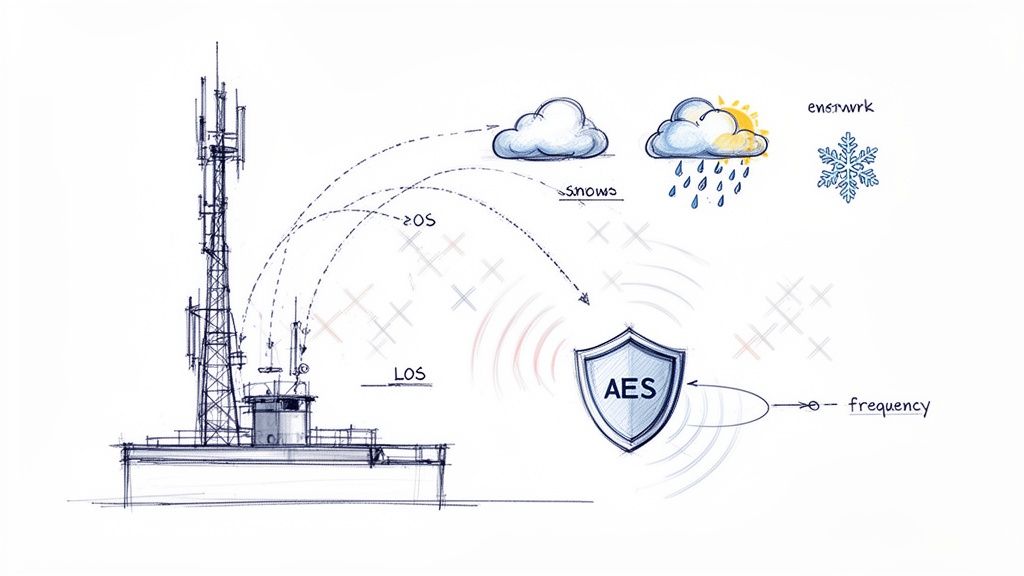
When we're setting up a wireless PTP link for a local business, the first thing on our checklist is Line of Sight (LOS). It’s exactly what it sounds like: a completely clear, straight line between the two antennas. A big oak tree that shot up over the summer or a new building going up in Franklin can kill a signal.
And then there's the weather. We have to plan for all of it.
- Weatherproofing: We don't mess around with flimsy hardware. We go straight for industrial-grade, outdoor-rated gear (certain models from the UniFi line are fantastic for this) that can handle everything from a blistering August thunderstorm to a January ice storm.
- Dodging Interference: Downtown areas and commercial parks are buzzing with radio signals. We have to be strategic, finding just the right frequency to cut through the noise so your connection stays rock-solid.
Adopting a "Zero Trust" Security Mindset
A point-to-point link is private, giving it a natural security advantage. But that’s just the starting point. We operate on a Zero Trust principle, which is a way of saying we don’t automatically trust anything on the network. This is a bedrock concept of serious security frameworks like the NIST CSF (Cybersecurity Framework).
After 17 years of doing this locally, I can tell you that the most dangerous assumption is thinking your network is safe just because it's private. That's an open invitation for trouble. A multi-layered defense is the only way to go.
Here’s how we put that philosophy into practice:
- Locking Down the Data: Every piece of data zipping across your PTP link is wrapped in AES-256 Encryption. This is the gold standard, making the information completely unreadable to anyone who might try to snoop on it.
- Protecting the Endpoints: The connection is only as secure as the devices on either end. We use powerful tools like Bitdefender GravityZone to make sure a compromised laptop at one office can't use the private link to spread an infection to your other location.
- Immutable Off-site Backups: In a worst-case scenario, having a clean, unchangeable copy of your data stored off-site is your ultimate safety net.
By merging a robust physical build with a modern, defense-in-depth security strategy, we create point-to-point networks that you can truly rely on. It’s a vital piece of a bigger security puzzle, which you can read more about in our guide to network security threats for Indiana businesses.
Get Your Free Network Assessment
Let's pull all this together. A point-to-point networking solution isn't just a tech upgrade; it's a direct investment in your company's ability to stay online and get work done. For businesses right here in Indiana, it’s the secret to guaranteeing uptime and building a network that can handle whatever you throw at it next.
Think about it. Making the jump from unpredictable, consumer-grade internet is a huge strategic win. All that time your team wastes staring at a loading screen suddenly becomes productive, billable work. This isn't just about padding your bottom line—it's about finally getting an IT budget that's stable and predictable.
Your Path to a More Reliable Network
Here’s the thing: most of the network bottlenecks we find at businesses around Greenwood and Indianapolis are completely fixable. You do not have to live with sluggish speeds and random connection drops that torpedo your team's focus.
Our process is simple. We figure out exactly what’s causing the headaches and build a permanent solution. Maybe you need to connect two buildings across a parking lot or securely link your main office to a new warehouse. The mission is always the same: to create a network that simply works.
A professionally designed point-to-point network isn't an expense. It's a competitive advantage that pays for itself in eliminated downtime and recovered productivity.
Take the First Step Today
Ready to find out what a genuinely reliable network feels like? If you're a business owner in the Greenwood or Indianapolis area, we invite you to schedule a Free Network Assessment. This is a no-pressure chat where our team takes a look at your current setup, finds the weak spots, and shows you exactly how a better network directly boosts your bottom line.
There’s no good reason to let a shaky internet connection call the shots. Find out how to build a better network by getting in touch with us for your free Security Risk Audit today.
Your PTP Networking Questions, Answered
When Johnson County business owners first look into a point-to-point network, a few straightforward questions always come up. After building these connections for 17 years right here in our community, we've got the answers down cold.
What's the Real Cost to Install a Point-to-Point Network?
Let's be upfront: the cost for a point-to-point networking setup can vary. But it's best to think of it as a one-time capital investment, not another monthly bill. You're building and owning a private bridge that pays you back for years.
The final price tag comes down to a few things:
- Distance and Terrain: Connecting two buildings in a Greenwood business park is a simpler job than beaming a signal several miles across rolling hills.
- The Hardware: We lean on tough, reliable gear like UniFi that's built for this work. The specific model we choose depends entirely on the speed you need.
- The Install Itself: Mounting antennas on a simple, flat roof is a different ballgame than working on a historic brick building in downtown Indy.
A basic wireless bridge might start in the low thousands. But here's the perspective that matters: when a single minute of downtime can cost a business up to $9,000, preventing just one major outage means the entire system has paid for itself.
How Fast Is a Wireless PTP Link, Really?
Modern wireless PTP links are blazing fast, often leaving standard fiber internet in the dust. It's normal to hit gigabit speeds (1,000 Mbps), and we can even push into multi-gigabit territory.
What does that mean for you? It means you can sling massive files between offices, run crystal-clear video surveillance, and support hundreds of users without a stutter. It’s more than enough horsepower for a healthcare provider handling sensitive HIPAA records or a manufacturer whose machinery relies on constant data flow.
How Long Until I'm Up and Running?
This is where wireless PTP really shines. Forget waiting months for the cable company to dig trenches and lay fiber. We can often have a secure, high-speed link fired up and fully operational in just a few days.
Once we do a quick site survey to make sure we have a clear line of sight, the physical installation and network configuration happen fast. For businesses that needed better connectivity yesterday, not next quarter, this speed is a game-changer.
We've seen it time and again: deploying a gigabit connection in a couple of days has saved clients from weeks of lost productivity they would have spent waiting on a traditional ISP. It turns a potential headache into a quick, decisive win.
Is This Secure Enough for My Company's Sensitive Data?
Absolutely. A PTP network is one of the most secure ways to link two locations. Your data is flying across a private, dedicated link that never touches the public internet. That alone eliminates a massive amount of risk.
But we don't stop there. We stack layers of security on top of that physical separation.
- AES-256 Encryption: Every bit of data sent over the link is scrambled with military-grade encryption.
- Zero Trust Architecture: We operate on a "never trust, always verify" model. Even on this private link, users and devices can only access the specific resources they need.
- Endpoint Security: We lock down the devices at each end of the bridge with powerful tools like Bitdefender GravityZone to ensure a threat can't sneak across.
This layered defense is essential for any business needing to meet strict compliance standards like NIST CSF or CMMC.
Ready to stop gambling with your business’s connectivity? The team at Finchum Fixes IT can show you how a dedicated point-to-point network provides the speed and reliability you need to grow. Schedule your Free Network Assessment with our local experts today. Learn more at https://finchumfixesit.com.