Ransomware Prevention Checklist: 10 SMB Controls
SMBs prevent ransomware by combining immutable off-site backups, rapid patching, MFA, least privilege, EDR, network segmentation, email controls, continuous monitoring, trained users, vendor safeguards, and tested incident response. The strongest ransomware prevention checklist connects each control to a measurable recovery result, not merely to a purchased tool.
An aging server in a Greenwood business park, weak remote access, or a flat network can turn one stolen credential into a company-wide outage. That risk is especially serious for Johnson County business owners operating along the I-65 corridor, where a locked scheduling system, inaccessible patient records, or unavailable production files quickly stops billable work.
Verizon's 2025 Data Breach Investigations Report found ransomware in 88% of analyzed SMB breaches, compared with 39% at larger organizations. Ransomware appeared in 44% of all analyzed breaches, up from 32% the previous year. The practical response isn't another antivirus installation. It's a managed sequence that supports the NIST CSF, HIPAA safeguards for healthcare, and CMMC expectations for defense contractors.
Downtime can cost up to $9,000 per minute, so prevention protects more than files. It protects payroll, customer commitments, billable hours, and predictable monthly budgets. A security program built around UniFi networking, Bitdefender GravityZone, immutable off-site backups, Zero Trust architecture, and SOC-as-a-Service monitoring gives a small business clearer control than a collection of disconnected alerts.
1. Immutable Off-Site Backup Architecture with 3-2-1 Strategy
A green backup dashboard doesn't prove recovery. It only proves that software reported a job as successful.
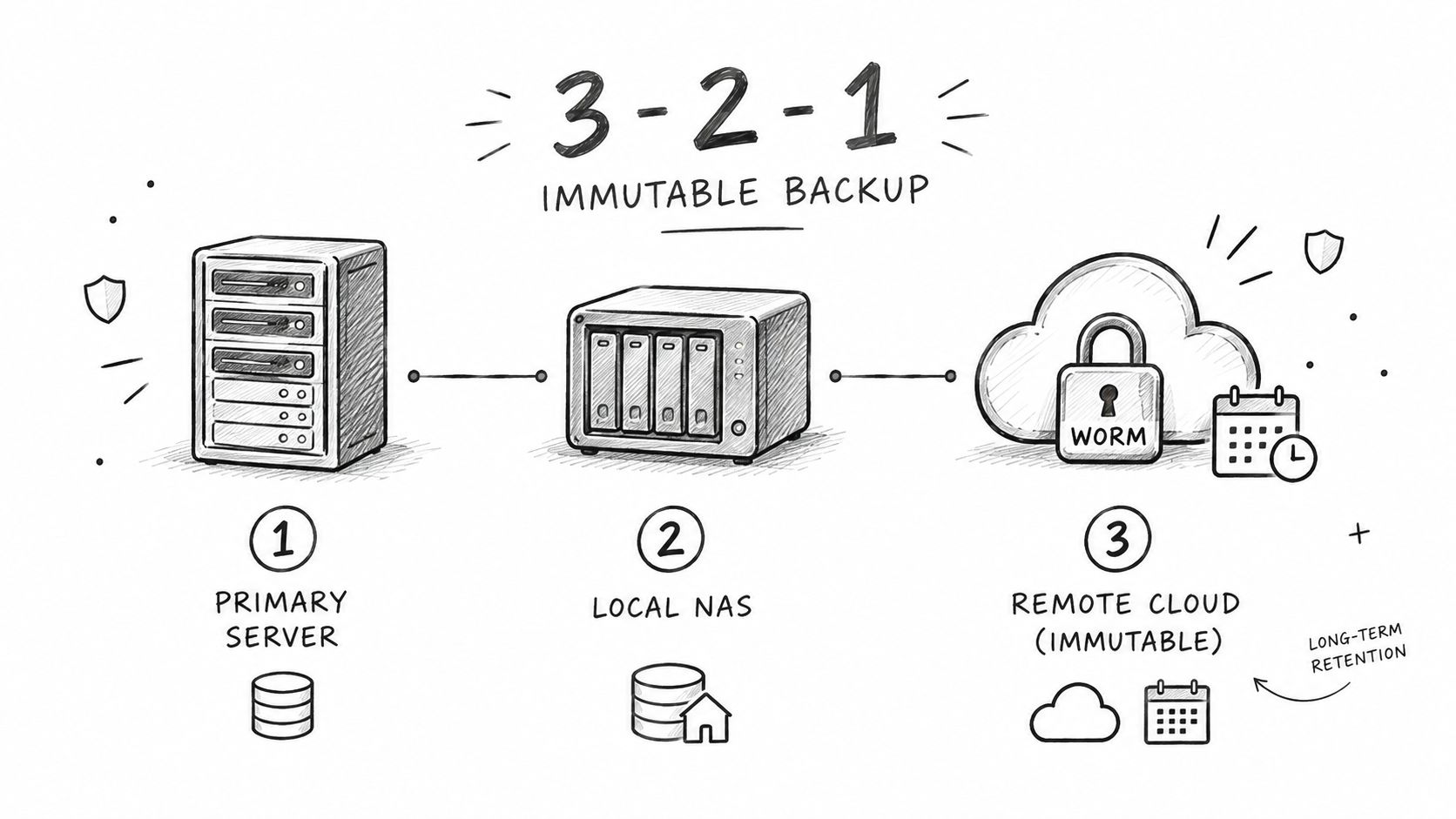
The ransomware prevention checklist starts with three copies of important data, on two different storage types, with one copy off-site. CISA describes this as the 3-2-1 approach and recommends scheduled recovery testing, isolated or encrypted copies, and the ability to roll back at least seven days in its backup guidance for small and medium-sized businesses. An immutable copy adds write-once, read-many protection, so attackers can't use stolen administrator access to delete or encrypt the recovery set.
A Greenwood clinic might keep production data on its server, a local NAS for fast restores, and an immutable cloud copy outside the production identity system. Veeam, AWS, Synology NAS, and Backblaze B2 can all fit different budgets, but architecture matters more than the logo. Backup credentials should be separate from ordinary Active Directory accounts, and the backup console should require MFA.
Practical rule: A backup program passes only when a named person can restore representative files and critical applications under pressure.
Measure restoration, not backup activity
Define an RPO, the maximum acceptable data loss, and an RTO, the maximum tolerable restoration time, for each critical workload. Run quarterly restore exercises using files, virtual machines, SaaS data, and application dependencies. Record restore duration, failed jobs, data loss, privileged-account use, and whether recovery works without compromised domain credentials.
NIST's ransomware risk management guidance says organizations should secure and isolate backups, test restoration, and verify recovery assets before returning systems to production. That distinction prevents a common failure: restoring the original compromise along with the files.
For Indiana businesses, immutable off-site backups turn emergency IT spending into a planned recovery service. Teams can protect billable hours instead of improvising with ransom negotiations. A practical SMB backup and recovery playbook should include retention, ownership, restore evidence, and a documented escalation path.
2. Zero Trust Architecture with MFA and Endpoint Device Verification
A password is a claim. MFA and device verification are evidence.
Zero Trust replaces broad internal trust with continuous checks for every user, device, application, and access request. Microsoft Entra ID with Conditional Access can require a compliant device, approved location, modern authentication, and stronger verification before a user reaches email, a cloud application, or a remote-access portal.
Start with Finance or HR rather than changing every access policy at once. Run Conditional Access in Report Only mode while reviewing sign-in logs and fixing legitimate exceptions. Then require app-based MFA or phishing-resistant methods for externally accessible identities and privileged accounts. Hardware security keys are appropriate for administrators, while TOTP can serve general users when stronger options aren't practical.
Close the remote-access doors
Review VPNs, firewalls, identity providers, SaaS tenants, remote-management tools, and RDP exposure. Disable legacy authentication after dependent applications support modern methods. Dormant administrator accounts, service accounts, and emergency break-glass accounts need owners, documented use rules, and separate monitoring.
A compromised credential should not automatically reach every system. Conditional Access, least privilege, endpoint posture checks, and separate administrative accounts reduce that blast radius. Flat networks and password-only policies fail in this scenario. They make an attacker look like a normal employee.
In a downtown Indy tech hub, a managed identity program can also reduce help-desk waste. Clear enrollment, recovery, and exception procedures keep staff productive while security teams remove risky workarounds. That improves predictable IT spending because access decisions become policy-driven rather than repeated emergency fixes.
3. Real-Time Endpoint Detection and Response with Behavioral Analytics
Traditional antivirus asks whether a file matches something known. EDR asks what a process is doing right now.
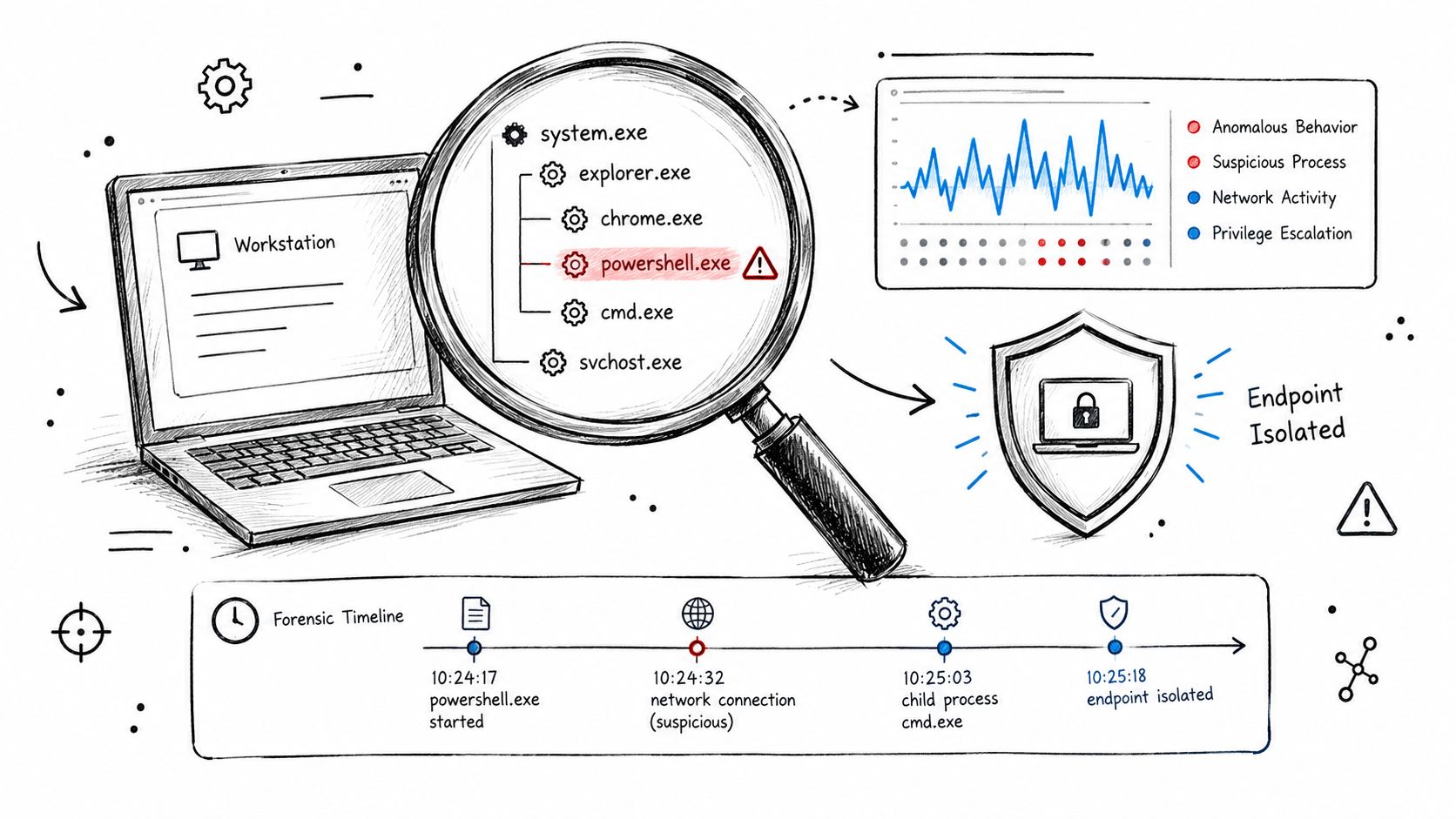
An endpoint detection and response agent should monitor process execution, file access, registry changes, network connections, and privilege activity on workstations and servers. Ransomware behavior often includes rapid file modification, unusual scripting, credential access, and attempts to disable defenses. Behavioral analytics can isolate a suspicious device before encryption reaches a file server.
Microsoft Defender for Endpoint, CrowdStrike Falcon, and Bitdefender GravityZone can support different licensing and operating models. The useful question isn't which console has the longest feature list. Ask whether every workstation, server, and remote device is enrolled, whether alerts reach a responder, and whether isolation has been tested on a production-like system.
Tune detection by business role
Set stronger sensitivity for file servers and domain controllers than for ordinary workstations, but don't create blind spots. Add approved-process exceptions carefully. A trusted script path can become an attacker's hiding place if administrators whitelist it without review.
A workable operating rhythm includes:
- Threat hunting: Search monthly for obfuscated PowerShell, unusual WMI activity, PsExec use, and unexpected administrator elevation.
- Centralized telemetry: Send EDR events to Splunk, Microsoft Sentinel, or another SIEM with identity and firewall context.
- Alert ownership: Assign a monitored responder and document the isolation decision for critical systems.
- Change testing: Test agent updates and policy changes in a sandbox before broad deployment.
A disconnected EDR agent is a security expense, not a detection capability.
Managed monitoring helps a Greenwood manufacturer or Hamilton County supplier avoid staffing a full security operations center. SOC-as-a-Service can review events overnight, when a small internal team is least likely to notice a suspicious process. That response speed protects production time and reduces the need for unplanned forensic work.
4. Advanced Email Security and Phishing Simulation with User Training
Email controls should inspect more than attachments. Malicious links, credential prompts, impersonation, and look-alike domains can all start the attack chain.
Use a gateway such as Proofpoint Essentials or Mimecast to scan attachments in a sandbox, inspect destinations, evaluate sender reputation, detect typosquatting, and flag suspicious impersonation. Add DMARC, but test domain alignment before enforcing a reject policy. A rushed DMARC change can block legitimate invoices, appointment messages, or customer replies.
The user layer matters because a filter won't catch every believable message. Security-awareness training should teach employees how to report suspicious messages immediately, verify urgent payment changes through a second channel, and recognize fake Microsoft 365 or vendor login pages. The spear-phishing guidance from Horus Intelligence provides useful context for attacks that target trust rather than obvious malware.
Turn training into a response measurement
Run simulations on unpredictable dates and vary the lure. A finance employee may receive a supplier invoice, while a manager receives an urgent wire-transfer request. Automatically enroll users who interact with a simulated lure in immediate training, then measure how quickly they report suspicious messages.
The FBI's 2024 Internet Crime Report recorded 859,532 complaints, more than $16.6 billion in reported losses, and 67 new ransomware variants during 2024. Those figures include broad internet crime reporting, not a prediction of one Indiana business's loss, but they show why awareness and reporting belong in the same control.
The best metric isn't a course-completion badge. Track time from message submission to triage, repeat reporting behavior, gateway actions, and whether related messages are removed from mailboxes. That converts training from an annual checkbox into a measurable reduction in wasted response time.
5. Privileged Access Management with Session Recording
Ransomware operators want administrator rights because administrator rights turn a local incident into a network event.
Privileged Access Management, or PAM, vaults administrator credentials, requires MFA for elevation, limits access to approved tasks, and records privileged sessions. BeyondTrust, CyberArk, and Delinea can support this model, but the implementation should begin with the highest-risk accounts, especially domain administrators, backup administrators, virtualization administrators, and remote-management accounts.
Remove shared passwords from spreadsheets and personal notes. Create separate named administrative accounts, rotate credentials after use, and require an approval path for unusual elevation. Just-In-Time access can keep an administrator's active privilege window short, with an operating target measured in hours rather than permanent access.
Review the evidence
Session recording only helps if someone reviews the right events. Send PAM alerts to the SIEM and investigate off-hours access, privilege elevation without a matching ticket, access from an unusual device, and attempts to reach backup or identity infrastructure.
PAM can slow a technician who needs to fix a production issue quickly. That trade-off is real. The answer isn't to remove controls during an outage. Create a documented emergency account process with dual approval, time-limited access, and a post-incident review.
For a downtown Indianapolis law firm or healthcare practice, this supports confidentiality as well as availability. HIPAA-covered organizations need controls around electronic protected health information, while legal firms need to limit access to privileged client data. A managed PAM process also makes access reviews less dependent on one overworked IT generalist.
The control is verified when every high-risk account has an owner, elevation requires an approved factor, sessions are recorded, and terminated staff lose access without manual guesswork.
6. Network Segmentation and Microsegmentation with Firewall Rules
A flat network turns one infected device into an outage that spreads. Segmentation contains the blast radius and gives Indiana SMBs a clearer recovery path when one system fails or gets encrypted.
Separate Finance, Operations, Development, guest Wi-Fi, management systems, backup infrastructure, and critical servers. In a Greenwood manufacturing facility, production equipment often needs stable connectivity and tightly scheduled change windows. Keep that in mind while still blocking routine workstation access to controllers, file shares, and backup consoles. The goal is continuity, not theoretical purity.
Map real traffic before writing rules. Use NetFlow, Wireshark, firewall logs, and input from application owners to identify what actually needs to talk. Then create a small set of zones, turn on logging first, and review denied flows before enforcement. Egress filtering matters here too. It can stop command-and-control traffic and make it harder for a compromised host to reach outside services without review.
Protect the control planes
Segment identity systems, hypervisors, RMM infrastructure, and backup administration with the same discipline. A VLAN by itself does not solve the problem if one shared admin path still crosses every segment. Firewall rules need to line up with separate credentials, MFA, and host isolation so an attacker cannot pivot through the management layer.
UniFi can be a practical fit for smaller offices. FortiGate or Palo Alto may make more sense where deeper inspection and tighter policy control are worth the spend. Choose the product that matches the traffic map and support capacity.
Our network segmentation guide for Indiana SMBs, covering zone design and rule review should end in tests you can verify: allowed zone pairs, approved ports, named exception owners, and a review date for every rule set. For wireless separation and guest access design, use this guide to enterprise WiFi security.
7. Patch Management and Vulnerability Scanning with Automated Deployment
Patching every application at the same speed sounds tidy. It isn't practical for every Indiana SMB.
Prioritize internet-facing assets, VPNs, firewalls, remote-management tools, identity systems, and known-exploited vulnerabilities. Verizon's 2025 DBIR analysis reported that vulnerability exploitation grew 34% and reached 20% of breaches. The report also found that vulnerability exploitation overtook credential abuse as the most common initial-access vector in its ransomware analysis.
Maintain an accurate asset inventory first. You can't patch a forgotten server, an unmanaged laptop, or a vendor appliance you don't know exists. Validate external exposure with approved scanning, then rank remediation by exploitability and business impact rather than by a flat severity list.
Automate safely
Use WSUS for Windows operating-system updates and tools such as Automox or Qualys for third-party application visibility and deployment. Pilot patches on representative devices, test production software in matching virtual machines, and schedule restarts outside operating hours. CNC equipment and specialized applications may need staged maintenance rather than blind automation.
Track:
- Coverage: Devices reporting current patch status.
- Exceptions: Systems with an owner, reason, compensating control, and expiration.
- Failure response: Failed deployments escalated to a named technician.
- Exposure validation: Internet-facing assets rechecked after remediation.
A patch-management guide for Indiana businesses should connect deployment to downtime avoided. Automatic maintenance costs less than repeatedly recovering an exposed server, and it turns unpredictable emergency labor into a controlled monthly service.
8. Data Classification and Encryption with DLP
Backups restore availability. They don't undo data theft.
Data Loss Prevention identifies PHI, PCI data, PII, trade secrets, financial records, and sensitive customer files. Classification labels can trigger encryption, restrict copying, and block exports to personal cloud accounts or removable media. That matters for double-extortion attacks, where criminals may threaten disclosure even if systems are eventually restored.
Start with the repositories that would cause the greatest legal, operational, or customer harm. Use automated discovery to find likely sensitive content, then have business owners review edge cases. A medical practice may prioritize electronic protected health information, while a defense supplier may focus on controlled technical information and CMMC-related access requirements.
Avoid breaking legitimate work
DLP controls should begin in monitoring mode. Review false positives involving approved vendors, billing platforms, document-management systems, and encrypted backups. Move to blocking only after owners understand the business workflow.
Test integrations with labeled and encrypted files. Confirm that backup jobs can read protected data, that restoration preserves labels, and that users can complete approved work without copying sensitive information into uncontrolled services. The Indiana SMB DLP guide can help map policies to local business processes.
Encryption reduces the usefulness of exposed data, but it doesn't replace MFA, EDR, or segmentation. It is a damage-limiting control that supports HIPAA, contractual security requirements, and customer trust while recovery teams restore operations.
9. Security Information and Event Management with 24/7 Monitoring
One alert rarely explains an intrusion. A sequence does.
A SIEM combines identity sign-ins, EDR events, firewall traffic, backup activity, and administrative changes. It can connect a suspicious login with a new mailbox rule, unusual LDAP query, mass file modification, or outbound connection. Microsoft Sentinel, Splunk, and managed SIEM services all require careful source selection and rule tuning.
Start with the logs that answer urgent questions:
- Identity: Was the account used from an unusual location or device?
- Endpoint: Did a process modify files or disable protection?
- Network: Did the device contact a suspicious destination?
- Backup: Did someone alter retention, repositories, or job schedules?
- Firewall: Did policy changes open a new path?
Monitoring standard: An alert needs a responder, a decision path, and a recorded outcome.
Run new correlation rules in detection mode while tuning false positives. Automate isolation only for high-confidence events and test the playbook before using it on production systems. An automatic response that disconnects a critical manufacturing system without context can create its own outage.
A small business doesn't need to build a downtown Indy security operations center to gain continuous coverage. An MSSP or SOC-as-a-Service provider can monitor overnight and escalate incidents when internal staff are unavailable. That converts 24/7 coverage from a full-time staffing problem into a predictable operating cost, while protecting the hours when an unnoticed compromise could spread.
10. Incident Response Planning, Tabletop Exercises and Playbooks
A ransomware event turns into a business continuity failure when nobody knows who can make the next decision.
Write down who can isolate an endpoint, disconnect a network segment, contact the insurer, notify legal counsel, coordinate with law enforcement, and approve restoration. Put out-of-band communication in the playbook because email and identity systems may be unavailable or compromised. For Indiana SMBs, this should also name the business owners who decide what comes back first, payroll, scheduling, patient systems, production, shared files, or customer communication. That is how a plan reduces downtime instead of adding debate during an outage.
NIST recommends developing, implementing, and exercising recovery plans with defined roles and decision paths. Its incident recovery guidance also calls attention to mission-critical services, offline or off-site backups, recovery-time measurement, and redundancy where the business case supports it.
Test the uncomfortable details
Run tabletop exercises twice a year with IT, leadership, operations, finance, legal, communications, and key vendors. Use realistic scenarios such as an EDR alert on a file server, a compromised Microsoft 365 admin account, or a restore that fails at the worst time. Good exercises expose stale phone numbers, missing credentials, unclear authority, vendor gaps, and dependencies nobody documented. Those findings should be tracked to closure, with owners and due dates, not left as meeting notes.
Keep the incident contact list current and review it quarterly. Coordinate with cyber-insurance contacts before an incident so notification requirements, approved vendors, legal review, and payment rules are known in advance. The FBI's reporting and evidence-preservation guidance supports preserving affected devices and logs, contacting incident-response personnel, notifying insurers and advisers according to policy, and reporting qualifying incidents.
A written approval rule for emergency payments matters too. Payment pressure rises fast when production stops or staff cannot access core systems, but payment is not a recovery plan. Tested restoration, clear authority, and a documented playbook are what keep spending predictable and get operations back under control.
Ransomware Prevention: 10-Point Controls Comparison
| Item | Implementation Complexity 🔄 | Resource Requirements ⚡ | Expected Outcomes ⭐ | Ideal Use Cases 📊 | Key Advantages & Tips 💡 |
|---|---|---|---|---|---|
| Immutable Off-Site Backup Architecture (3-2-1) | Medium–High, infra, policies, restore testing | High, cloud storage, bandwidth, appliances | ⭐⭐⭐ Prevents ransom leverage; restores in hours–days | Critical data owners (healthcare, legal, regulated SMEs) | WORM immutability + compliance-friendly; test restores quarterly |
| Zero Trust Architecture with MFA & Device Verification | High, identity & network redesign, policy tuning | High, identity platform, endpoint agents, SIEM | ⭐⭐⭐ Strong breach prevention; stops lateral movement | Remote-first, finance, high-risk or regulated environments | Enforce least-privilege; pilot per department and use hardware keys |
| Real-Time EDR with Behavioral Analytics | Medium, agent rollout, tuning, alert triage | Medium–High, per-device licenses, SOC/MSSP support | ⭐⭐⭐ Detects zero-days; rapid containment (minutes) | Organizations needing forensic detail and fast response | Enable threat hunting; set sensitivity by role; integrate to SIEM |
| Advanced Email Security & Phishing Simulation | Low–Medium, gateway setup + training program | Medium, per-user licensing for gateway + training | ⭐ High, blocks most delivery; large drop in click rates | All orgs; critical for finance, HR, execs | Vary simulation content; auto-enroll clickers into training |
| Privileged Access Management (PAM) with Session Recording | Medium–High, vaulting, JIT flows, integrations | Medium, per-privileged-user licenses, recording storage | ⭐⭐ Reduces credential escalation and insider risk | Environments with many admins/contractors or sensitive systems | Start with highest-risk accounts; keep JIT windows short |
| Network Segmentation & Microsegmentation | High, traffic mapping & firewall policy design | Medium–High, appliances, rule management overhead | ⭐⭐ Limits blast radius; blocks lateral spread | Networks with PHI/PCI/OT or mixed trust zones | Map flows first; test rules in logging-only before enforcement |
| Patch Management & Vulnerability Scanning | Low–Medium, tooling, staging, deployment process | Medium, patch platform, test/dev environments | ⭐⭐ Closes known exploit vectors; reduces exposure window | All orgs; especially internet-facing servers and critical apps | Pilot patches, schedule off-hours reboots, monitor failures |
| Data Classification & Encryption with DLP | Medium, discovery, labeling, policy tuning | Medium, scanning compute, DLP licensing | ⭐⭐ Reduces value of stolen data; prevents accidental leaks | Organizations handling PHI/PCI/PII or intellectual property | Phase blocking after monitor mode; combine automated & human review |
| SIEM + 24/7 Monitoring (MSSP/SOC) | High, integrations, rule tuning, analyst ops | High, licensing, storage, staff or MSSP fees | ⭐⭐⭐ Shortens detect/response; enables coordinated containment | Enterprises and regulated orgs needing continuous monitoring | Start with EDR/AD/firewalls logs; tune rules in detect-only period |
| Incident Response Planning & Tabletop Exercises | Low–Medium, documentation, cross-team exercises | Low, staff time, periodic external facilitation | ⭐⭐ Improves coordination; reduces mistakes and downtime | All orgs; required by insurers and many regulators | Run biannual tabletop exercises; update contact lists quarterly |
Turn the Checklist Into Uptime
A ransomware prevention checklist is useful only when someone can prove each control works. Score every item as missing, partial, or verified. “We own the software” is partial. “Every endpoint reports to EDR, alerts reach a responder, and isolation was tested” is verified.
Fix the gaps with the greatest effect on downtime first. For most Indiana SMBs, that means restore-tested immutable backups, MFA on external and privileged access, prioritized patching, endpoint detection, segmentation around critical systems, and named incident-response ownership. A company with limited funds shouldn't start by buying another dashboard. It should first confirm that recovery credentials work, backups are isolated, and an administrator's stolen password can't open every door.
Use measurable owners and dates:
- Backup owner: Records RPO, RTO, restore duration, and failed jobs.
- Identity owner: Tracks MFA coverage, privileged accounts, dormant users, and exceptions.
- Patch owner: Reports exposure, failed deployments, and overdue remediation.
- Security owner: Reviews EDR and SIEM events, containment results, and vendor access.
- Business owner: Confirms restoration priorities and acceptable downtime.
This sequence makes technology spending easier to defend. A managed monthly service can cover patching, monitoring, endpoint protection, backup administration, and testing without forcing a Greenwood business to hire a full internal security team. Predictable IT budgets are valuable, but the larger return is recovered billable time. Employees can serve customers, process orders, schedule patients, and ship products instead of waiting for an improvised recovery.
Compliance fits into the same operating model. HIPAA-covered entities need backup verification, restoration testing, disaster recovery, emergency operations, and periodic exercises, as explained in HHS ransomware guidance. CMMC-oriented defense contractors need controlled access, logging, vulnerability management, and incident handling that can be demonstrated rather than merely promised. General businesses can organize the same work around the NIST CSF Protect, Detect, Respond, and Recover functions.
In our 17 years of local service, the practical difference is rarely a dramatic security product. It's the boring evidence: a current asset list, a working restore, a current contact sheet, a firewall rule with an owner, and a technician who knows exactly what to do at 2 a.m. Bit-level data recovery may save a damaged device, but it won't replace a tested business-continuity plan. Likewise, a latency-optimized mesh network may fix a Southside Wi-Fi bottleneck, but it won't secure an unmanaged administrator account.
Businesses across Greenwood, Indianapolis, the I-65 corridor, and Hamilton County can reduce ransomware exposure by turning these controls into a recurring operating process. Start with the highest-impact gap, document the result, test it again, and keep the evidence ready for leadership, customers, insurers, and auditors.
Finchum Fixes IT provides managed cybersecurity, immutable off-site backups, email filtering, endpoint protection, networking, and recovery planning for businesses in the Greenwood and Indianapolis area. Schedule a Free Network Assessment or Security Risk Audit with Finchum Fixes IT to identify the controls most likely to prevent downtime and turn your ransomware checklist into a tested operating plan.