Best Antivirus Software for Small Business: Your 2026 Guide
**TL;DR**
- Traditional antivirus is a business liability. It can’t stop modern threats like fileless malware or zero-day exploits, leaving your Indiana business vulnerable.
- Modern security requires Endpoint Detection and Response (EDR), but a DIY approach creates “alert fatigue” without a dedicated security expert to manage it.
- A fully managed security service is the best solution. It bundles EDR, 24/7 expert monitoring, and full IT management into one predictable monthly cost.
- This approach prevents costly downtime (up to $9,000 per minute), converts wasted tech time into billable hours, and ensures compliance with standards like HIPAA or CMMC.
- The goal isn't just buying software; it's achieving business continuity and a strong return on investment by eliminating unpredictable security emergencies.
Your Guide to Small Business Antivirus in 2026
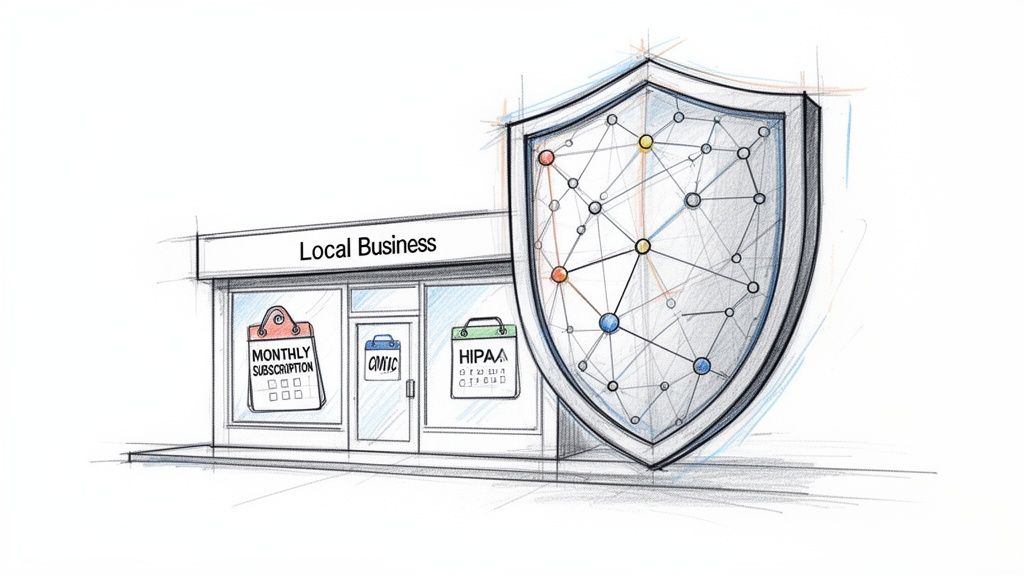
Choosing the best antivirus software for a small business in Central Indiana isn't about grabbing a familiar name off the shelf anymore. It’s a critical decision for your company’s survival. A single successful cyberattack can cause downtime costing up to $9,000 per minute. That kind of hit could shutter a growing business in Johnson County or halt a tech startup in downtown Indy.
This guide isn't another list of product reviews. We’re digging deeper. We'll show you why that aging antivirus program on the server in your Greenwood office park is a huge liability and break down modern security options like EDR and managed services so you can see the real return on investment.
A solid digital defense is just as crucial as your physical security. It works hand-in-hand with your network's first line of defense, which is why our guide on the best firewall for your small business is the perfect next read. Let's get started on turning your security from a constant headache into a powerful business advantage.
Why Your Old Antivirus Is a Major Business Liability
Let me paint a picture I’ve seen countless times in Johnson County business parks: a company running some basic, off-the-shelf antivirus on aging server hardware. Many Indiana business owners figure this is "good enough." In reality, it's a massive, costly gamble that practically rolls out the red carpet for cybercriminals.
That outdated software is a huge liability because today's digital threats are built to dance right around it. Traditional antivirus works like a bouncer with a photo album of known troublemakers. This is called signature-based detection, and it only stops threats it already knows about. Against new, sophisticated attacks, it's completely useless.
The Modern Threat Playbook
Today's cybercriminals aren't recycling old tricks. They have a sophisticated playbook designed to slip past outdated security, do their damage, and get out before anyone even knows they were there.
- Fileless Malware: This is the really sneaky stuff. It runs directly in your computer's memory (RAM) without installing a single file, leaving nothing behind for a traditional antivirus program to find.
- Zero-Day Exploits: These attacks target brand-new software vulnerabilities that don't have a patch yet. Since there's no "known troublemaker" signature, your old AV is blind.
- AI-Powered Phishing: Scammers are now using artificial intelligence to craft eerily convincing emails that trick your team into handing over passwords or kicking off a ransomware attack.
These aren't just hypotheticals; they are daily realities for businesses all along the I-65 corridor. The global antivirus market is set to hit $4.46 billion in 2026 for a reason, and a big part of that is because small businesses are a prime target. Attackers went after small and medium-sized businesses in 85% of all ransomware attacks last year because they know the defenses are often weaker. You can dig into this market trend in this detailed business report.
The Real Cost of Inaction
This isn't just a tech headache—it's a direct threat to your bottom line. A successful breach means crippling downtime, and for a small business, that can cost up to $9,000 per minute. This downtime converts billable hours into "wasted tech time," grinding your revenue-generating operations to a halt.
In our 17 years of local service, we’ve cleaned up these messes firsthand. When we disassembled a similar client's failing RAID array after a ransomware attack their unmanaged antivirus completely missed, we calculated the final recovery bill was ten times what a year of our managed protection would have cost them.
That downtime means lost billable hours, blown deadlines, and a damaged reputation. For a doctor's office in Hamilton County, it could mean a HIPAA violation. For a defense contractor near Crane, it puts CMMC compliance at risk. Protecting your business is about more than just scanning for viruses; it’s about a proactive, layered defense. You can find more on this in our guide to preventing ransomware for Indiana businesses.
Seeing how your old antivirus is holding you back is the first step. The next is learning how to reduce risk across your entire operation. The takeaway is simple: the threats have evolved, and your protection needs to catch up.
Comparing Security Options From Standalone AV to Managed EDR
Choosing the right "antivirus" for your small business feels like a trip to the hardware store for a project you don't understand. You know you need something, but the shelves are packed with options that all sound the same. The reality is, this isn't just about software; it's a strategic decision that directly impacts your budget, your team's productivity, and whether you'll be open for business tomorrow.
So, let's cut through the jargon. We'll walk through the four main ways you can protect your business, from the bargain-bin basics to the comprehensive security a growing Indiana enterprise truly needs. This is about what works in the real world, not just what looks good on a feature list.
Traditional Standalone Antivirus: The Risky Baseline
This is the classic, off-the-shelf software you can grab at any big-box store. You buy a few licenses, install them on your computers, and cross your fingers. While it feels like you're saving money, you're actually placing a risky bet that could cost your business dearly.
Who is making sure it's installed, updated, and actually running on every single device? That falls on you or someone on your team. It's a manual, time-sucking nightmare prone to human error. Even worse, its protection is skin-deep. It relies on old-school signature detection, which is like having a security guard who can only spot criminals he’s seen on a wanted poster. It’s utterly blind to modern, fileless malware and zero-day attacks that cybercriminals use against small businesses.
This flowchart says it all. Simply having antivirus isn't enough. If it's unmanaged or out of date, it’s a liability waiting to happen.
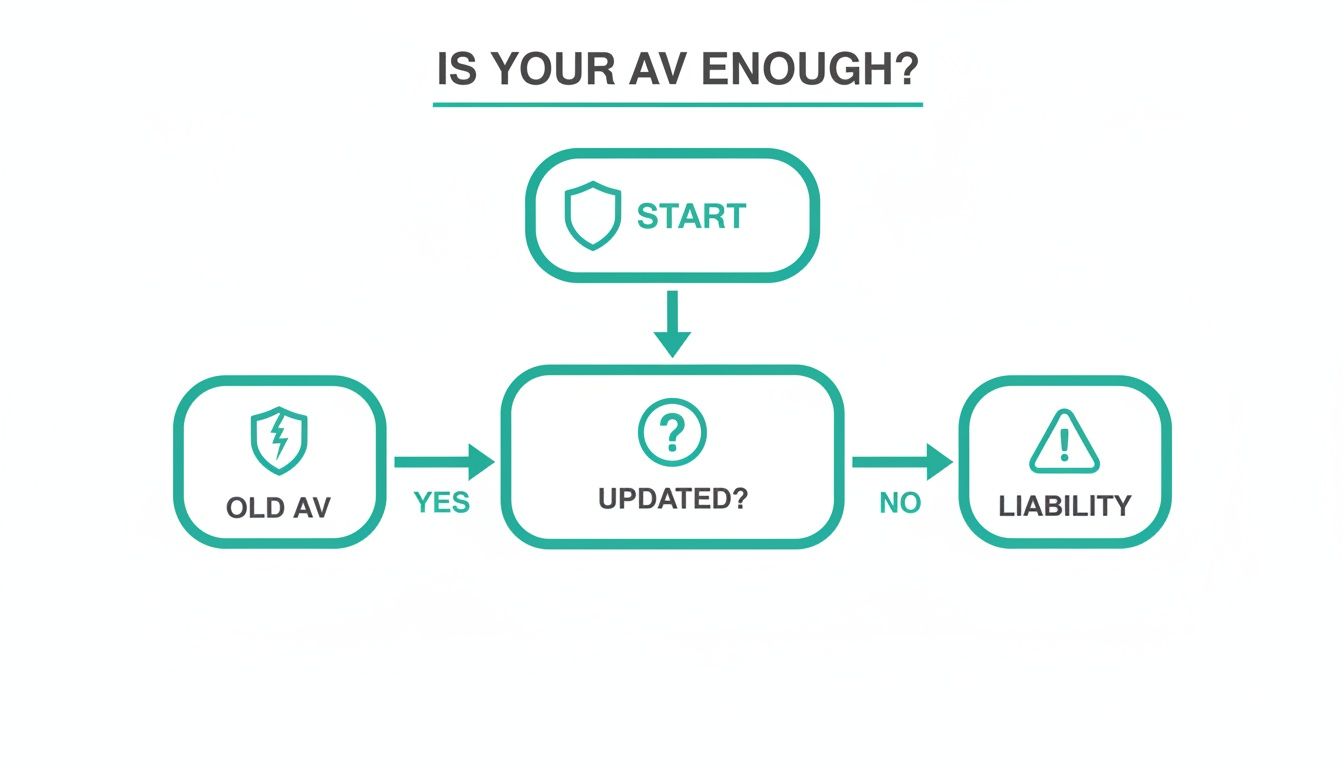
An unmanaged solution offers a false sense of security, which is often more dangerous than having no security at all.
Endpoint Detection and Response (EDR): The Powerful DIY Tool
Moving up the ladder, we find Endpoint Detection and Response (EDR) solutions like Bitdefender GravityZone. This is a massive leap forward. Instead of just looking for known threats, EDR is like having high-tech surveillance inside every computer, constantly monitoring for suspicious behavior. It can stop threats based on their actions, not just their names.
This is the kind of technology you need to fight a modern battle. But here’s the catch: owning a race car doesn’t make you a race car driver. EDR platforms generate a firehose of alerts that require a trained security pro to interpret and act on. For a business owner, this means either hiring a full-time (and expensive) security expert or trying to become one in your spare time.
We’ve seen Johnson County businesses invest in powerful EDR tools, only to turn off the notifications because they were getting buried in alerts. An unmonitored EDR is just expensive, noisy software—it doesn't stop an attack if no one is watching the screen.
Managed Detection and Response (MDR): Adding the Security Team
MDR is the logical next step. It takes a powerful EDR platform and adds a 24/7 team of experts in a Security Operations Center (SOC). These pros watch your alerts around the clock, investigate anything suspicious, and handle incidents for you. It solves the expertise problem that comes with a DIY EDR tool.
The problem? MDR services are often siloed. The SOC team is great at handling security alerts, but their job usually stops there. If a threat gets in because of an unpatched server or a poorly configured firewall, they’ll tell you about it, but you’re on your own to fix it. This leaves you playing coordinator between your MDR provider and your IT support, creating frustrating delays when every second counts.
Fully Managed Security: The All-In-One Solution
For the vast majority of small and medium-sized businesses in Indiana, this is the goal. A local Managed Services Provider (MSP) delivers a single, cohesive security strategy. We bundle best-in-class EDR software, 24/7 expert monitoring, and complete IT management into one package. Instead of just reacting to problems, this approach is designed to help you grow your business with managed IT services.
With a fully managed solution, the buck stops with one partner. There's no finger-pointing. If a threat is detected, the same team that spotted it has the keys to patch the vulnerability, reconfigure the network, and restore your data from immutable off-site backups. This integrated response isn't just effective; it's essential for meeting compliance standards like NIST CSF or HIPAA. Security becomes a predictable, monthly service that prevents downtime and guarantees you stay in business.
The market gets it. Small businesses are now the fastest-growing group adopting real security, with the antivirus market projected to jump from $4.5 billion in 2025 to $5.8 billion by 2034. With 43% of all cyber attacks aimed squarely at smaller companies, Indiana business owners are catching on: a managed, unified solution is the smartest way to block threats and eliminate costly downtime.
Small Business Security Options Compared
To help you see the differences in action, here’s a quick breakdown of what you get—and what you give up—with each approach. Use this to gauge the operational and financial fit for your business.
| Feature | Standalone Antivirus | Endpoint Detection & Response (EDR) | Managed Detection & Response (MDR) | Fully Managed Security (MSP) |
|---|---|---|---|---|
| Threat Detection | Signature-based (poor) | Behavior-based (excellent) | Behavior-based (excellent) | Behavior-based (excellent) |
| Management | Manual, by your team | Requires a dedicated IT security expert | Managed by a remote SOC | Managed by your local IT partner |
| Response | You clean up the mess | You investigate and respond to alerts | Remote SOC responds to threats | Integrated response across all IT systems |
| Business Impact | High risk of downtime and data loss | High overhead, "alert fatigue" | Effective but siloed from other IT | Prevents downtime, predictable cost |
| Best For | Not recommended for any business | Large enterprises with in-house SOC teams | Companies with IT staff but no security team | Most SMBs in Indiana needing a total solution |
As you can see, the "cheapest" option carries the highest risk, while a fully managed solution offers the most comprehensive protection and predictable business outcomes. It’s a shift from buying a product to investing in a partnership.
The ROI of Not Getting Hacked
Let's talk dollars and cents. It’s easy to see professional endpoint protection as another expense. But a properly managed security solution isn't a cost. It’s one of the smartest investments you can make in your company's survival and business continuity.
A single breach can kick off a financial nightmare that makes a predictable monthly security fee look like pocket change. We’re not just talking about the ransom. The real pain comes from the crippling downtime, lost productivity, emergency IT bills, and the long, slow climb of rebuilding customer trust.
The Staggering Cost of Downtime
When your systems go down, your business grinds to a halt. Every minute your team is stuck, unable to access files or help customers, you are hemorrhaging cash. For some small businesses, that downtime can cost as much as $9,000 per minute.
Imagine a logistics company along the I-65 corridor during their busiest season. A ransomware attack freezes their scheduling and dispatch software. Instantly, trucks are stranded and deliveries are missed. This isn't a far-fetched scenario; it's a business-ending catastrophe that a cheap, unmanaged antivirus is powerless to stop.
Then there's the "wasted tech time." Instead of focusing on billable hours, your people are stuck fiddling with tech problems. A managed security service gives you that time back, converting wasted hours into productive, profitable work and a predictable monthly budget.
From Unpredictable Disaster to Predictable Budget
We’ve spent 17 years pulling local businesses back from the brink, and the stories all have the same theme.
We once helped a Greenwood accounting firm recover from a ransomware attack. Their off-the-shelf antivirus had been secretly disabled by the malware for months, and nobody knew. The final bill for the recovery—including emergency bit-level data recovery and all their lost billable hours—was ten times what a full year of our managed security service would have cost them.
That’s a classic case of being penny-wise and pound-foolish. The firm thought they were saving a few bucks on a license, but they left themselves open to a massive, unpredictable financial hit. A stable monthly investment in our service would have prevented the whole crisis, turning a potential emergency into a simple, manageable operational expense.
The Hidden Price of a Data Breach
The costs don't stop once your systems are back online. If customer data or sensitive information gets stolen, you're looking at a new world of expensive problems.
- Regulatory Fines: If you're in healthcare or defense, a breach is a major compliance failure. The financial penalties for HIPAA and CMMC violations are severe.
- Reputational Damage: How many clients would stay if they found out their private info was leaked on your watch? It can take years to rebuild that trust.
- Data Recovery Costs: Trying to piece together data after an attack is a technical, time-consuming job. It’s much smarter to invest in prevention and solid, immutable off-site backups. You can learn more in our guide to enterprise data backup solutions that guarantee business uptime.
The "best antivirus software for small business" isn't a product. It’s an outcome: a business that keeps running. When you partner with a local expert to manage your security, you're making a direct investment in your company's continuity, profitability, and future.
How We Deploy and Manage Your Business Protection
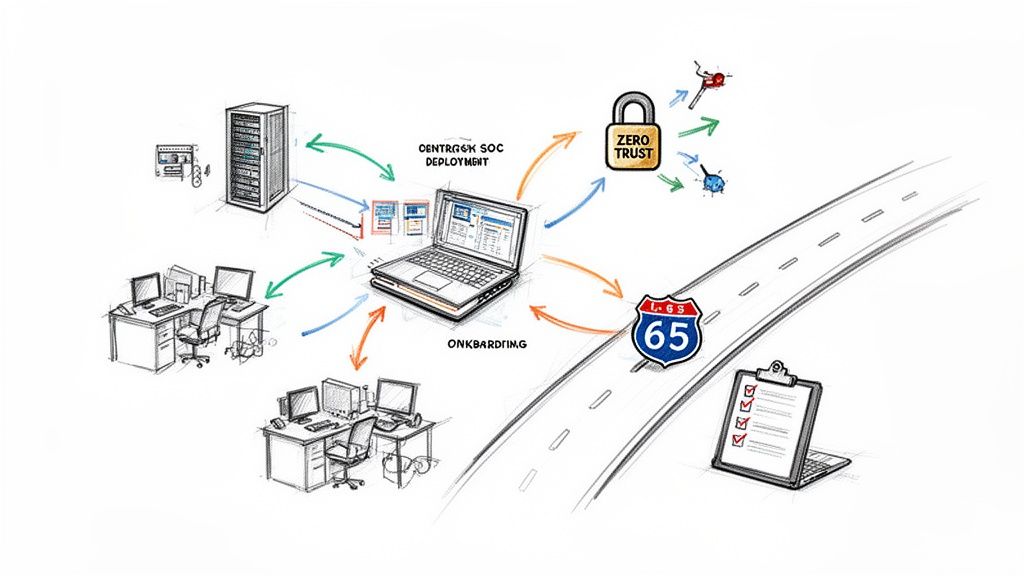
When we say we offer the best antivirus for small business owners in Indiana, we're not talking about just installing some software and calling it a day. We deliver a rock-solid security foundation, not a flimsy patch. Our process is built on 17 years of local service, fine-tuned to stop threats, keep you in business, and give you your time back.
This isn’t about software; it’s a full-blown, managed security strategy built around your business. Here's exactly how we do it.
Discovery and Assessment
Everything starts with a deep dive. We can’t protect what we don’t know, so our first job is to conduct a thorough network assessment to identify every single device connected to your business.
We’ll map it all—from the servers in a downtown Indy tech hub to the UniFi networking gear in an old brick building and the laptops of your remote team along the I-65 corridor. We often find hidden risks that boxed software misses, like that aging server in a Greenwood office park or unmanaged personal phones connecting to company email.
Strategic Deployment and Configuration
Once we have the full picture, we roll out a top-tier security solution like Bitdefender GravityZone. This is way more than clicking “install.” We painstakingly configure every policy to match your specific needs and compliance requirements.
This is where our local expertise shines.
- For a healthcare clinic: We lock down settings to help you meet strict HIPAA requirements, ensuring patient data is secure.
- For a defense contractor: We align every security control with rigorous CMMC standards, because protecting sensitive government information is non-negotiable.
- For a law firm: We set up rules to guarantee client confidentiality, sticking to professional ethics and frameworks like the NIST CSF.
Your protection is never one-size-fits-all. It’s a precision tool, custom-built for your business.
The Technology Behind Your Protection
We’re not the "set it and forget it" types. Our service is fueled by advanced security principles and constant human oversight, proving we’re more than just a “geek with a screwdriver.”
The heart of our strategy is a Zero Trust architecture. The philosophy is simple: "never trust, always verify." No person or device gets a free pass. Everything must prove its identity before accessing your network, which slams the door on a huge number of potential breaches.
Backing this up is our SOC-as-a-Service monitoring. Our Security Operations Center is staffed 24/7 by real people actively hunting for threats. They’re constantly watching, investigating suspicious activity, and neutralizing dangers before they can disrupt your business. It's the difference between a simple burglar alarm and a dedicated security team patrolling your property around the clock.
This proactive approach is essential. With 500 million new malware samples appearing each year, automated defenses can't keep up. Small businesses are a hot target, accounting for 61% of all U.S. data breaches last year. Our managed approach—combining behavior-based analysis with centralized control—is designed to stop these threats cold. You can dig into more data on SMB security trends on 360iResearch.com.
From that first assessment to our ongoing management, this entire process is designed to turn your “wasted tech time” into billable hours and transform unpredictable security fire drills into a stable, predictable line item on your budget.
Secure Your Indiana Business with a Professional Audit
Alright, we've walked through a ton of options. But let's get down to brass tacks. The best antivirus software for a small business in Indiana isn't something you buy off a shelf. It's a full-blown security service, managed by pros who guarantee your business keeps running.
Picking the right tool is just the starting line. You could have the fanciest EDR solution, but if it's not configured correctly, constantly monitored, and backed by a team that knows how to respond, it’s just expensive software making noise. Real protection is a partnership.
Stop Guessing, Start Knowing
For 17 years, we’ve been in the trenches with businesses across Greenwood and the greater Indianapolis area, helping them sort through this exact mess. We've seen the devastation a single, overlooked threat can cause—and we've also seen the relief on a business owner's face when they know someone has their back.
You wouldn’t represent yourself in court or handle your own corporate taxes, so why are you playing cybersecurity expert? Your time is worth far more than what you'd spend chasing down security alerts or losing sleep over a suspicious email.
A professional audit is your first step to getting that time back. It takes security off your "what if" list and puts it squarely in the "handled" column.
Seeing the Whole Picture of Your Business Risk
A real audit doesn't just look at your antivirus software. It has to cover the security and compliance of every tool your business touches. For instance, if you’re using web-based platforms for legal paperwork, the security of a tool like a Free AI Contract Generator becomes a piece of your company's risk puzzle.
A complete audit gives you that 360-degree view of your vulnerabilities. It allows you to make smart decisions that protect your entire operation, not just your computers. We deliver a clear, actionable plan that tackles every risk, turning tech headaches into a predictable, manageable line item in your monthly budget. If you want a sneak peek at how deep this process goes, check out your ultimate 10-point IT infrastructure audit checklist for 2026.
It's time to stop gambling with your company's future. Stop guessing if you're protected and get a definitive answer.
For businesses in the Greenwood/Indianapolis area, we offer a complimentary, no-obligation Security Risk Audit. We’ll hand you a clear report on your vulnerabilities and a straightforward plan to permanently secure your business.
Common Questions We Hear About Business Antivirus
Alright, let's cut to the chase. After we lay out the security landscape, business owners in Indiana usually have a few burning questions. We hear them all the time from folks in Greenwood to across Central Indiana, so let's tackle them head-on with the kind of no-fluff answers you'd get from us in person.
Can My Small Business Get By With Free Antivirus?
In a single word? Nope. Free antivirus is built for a home computer, not the network your livelihood depends on. It's missing the one thing you absolutely need: centralized management. Without it, you have no way of knowing if every device is actually updated and protected, a compliance disaster waiting to happen.
But here's the real kicker: its protection is tissue-paper thin. We see free AV fail constantly against modern ransomware and phishing scams. Using it for your business is an open invitation for a breach that will cost you a fortune in downtime and repairs, turning potential billable hours into wasted tech time.
What's The Real Difference Between Antivirus And EDR?
Think of old-school antivirus as a bouncer with a photo album of known troublemakers. If a threat's face is in the book, it gets stopped. But if a brand-new threat shows up, it waltzes right in. It's purely reactive.
Now, Endpoint Detection and Response (EDR) is completely different. It's like having a full-blown security team with live camera feeds across your entire network, actively watching for suspicious behavior. It doesn't need a photo to know something's wrong; it spots the new guy trying to jimmy a lock and neutralizes him on the spot. For any business in Hamilton County dealing with sensitive client info or trying to meet standards like HIPAA, EDR isn't a nice-to-have; it's a fundamental requirement.
How Much Should I Actually Budget For This?
Focusing on the "cost per license" is a classic mistake. It's a tempting number, but it ignores the hidden costs—namely, the hours you or your team will waste trying to manage, update, and respond to alerts from the software you just bought.
The smarter financial play is a fully managed security service. You're not just buying software; you're investing in a predictable monthly cost that includes the technology, 24/7 expert monitoring, and instant incident response. It turns a potential five-figure emergency into a stable, manageable operating expense that ensures business continuity.
Is My Small Business Really A Target For Hackers?
Yes. Absolutely, 100% yes. Hackers aren't just going after the big fish anymore. They specifically target small businesses because they're betting on weaker security. It's a volume game for them, and their automated attacks are constantly scanning for easy victims.
We see this every day with businesses from Johnson County to the downtown Indy tech hubs. Your size doesn't make you invisible; it makes you a perfect target for a quick payday. Professional, managed security isn't about being paranoid; it's about protecting your revenue, your reputation, and the business you've worked so hard to build.
Don't let your business become another statistic. It's time to stop guessing if you're protected and get a definitive answer from a local partner who has been there.
For businesses in the Greenwood/Indianapolis area, our Free Network Assessment is the first step toward building a real defense. Schedule Your Free Security Risk Audit Now