Risk Assessment Methodology for Indiana SMBs
You're dealing with risk whether you've documented it or not. A risk assessment methodology gives your Indiana business a repeatable way to identify what matters, estimate likelihood and impact, assign owners, choose affordable controls, and test recovery, so technical work protects revenue instead of becoming a pile of disconnected fixes.
A server hums in a Greenwood business park. Nearby, an old brick office building loses Wi-Fi whenever the lunch crowd hits the point-of-sale system. In both places, employees blame “the network,” someone restarts a switch, and work resumes until the next interruption.
That's not risk management. That's IT whack-a-mole.
When One Old Server Near I-65 Can Stop Payroll
At 8:12 on a Monday morning, an aging server near I-65 starts throwing errors. Payroll cannot open, scheduling slows, shared files disappear, and the production application stops responding. Across the office, employees restart devices while customers wait and managers search for a fix.
A weak wireless connection can create a similar mess. Checkout may freeze, cloud applications may disconnect, and a queue can form before anyone has identified the cause. One small technical failure can affect billing, deliveries, patient appointments, or a manufacturer's production line across Johnson County and into nearby Hamilton County growth areas.
Industry downtime calculators often model four- and five-figure costs per hour for small businesses, so any per-minute figure should serve only as a planning ceiling. The actual loss depends on the work interrupted, the people waiting, missed transactions, recovery time, and customer impact.
A risk assessment methodology gives the owner a practical set of questions:
- Which system could stop the business first?
- What event could cause that failure?
- How likely is that event?
- What would recovery cost in time and money?
- Who owns the corrective action?
- What evidence shows that the risk is lower afterward?
Those questions turn scattered technical concerns into an owner-ready priority list. A managed IT team can record the risks, assign work, schedule maintenance, and budget for recovery testing rather than waiting for another emergency ticket. Employees return to billable work instead of staring at a progress spinner.
The Greenwood version of the problem
Start with the environment: servers, endpoints, cloud applications, UniFi networking equipment, backups, vendors, facilities, and people. A wireless review should cover access, coverage, and deployment before the business buys more hardware. Teams can use this open network setup guide as a practical reference while checking those decisions.
Server age deserves the same attention. Routine patching and monitoring may keep equipment useful, but unsupported hardware or a failed backup can turn one device into a single point of failure. This Indiana SMB server maintenance guide helps owners separate normal upkeep from lifecycle work that needs a budget and deadline.
Why a method beats a checklist
A checklist may say “verify backups” or “review firewall rules.” A method asks which backups matter first, whether the database restores with permissions intact, who performs the test, and what happens if a vendor's cloud platform is unavailable.
That cadence brings ISO, NIST, and FAIR into one workable routine for Central Indiana shops, clinics, and offices. Owners can review priorities, document assumptions, test recovery, and approve the next affordable control without turning risk management into a once-a-year paperwork exercise.
What Risk Assessment Methodology Really Means
Think about a home inspection. The inspector doesn't stare at the roof and announce that the house is “secure.” They identify the structure, check conditions, consider weather and age, estimate what could happen, and recommend repairs in priority order.
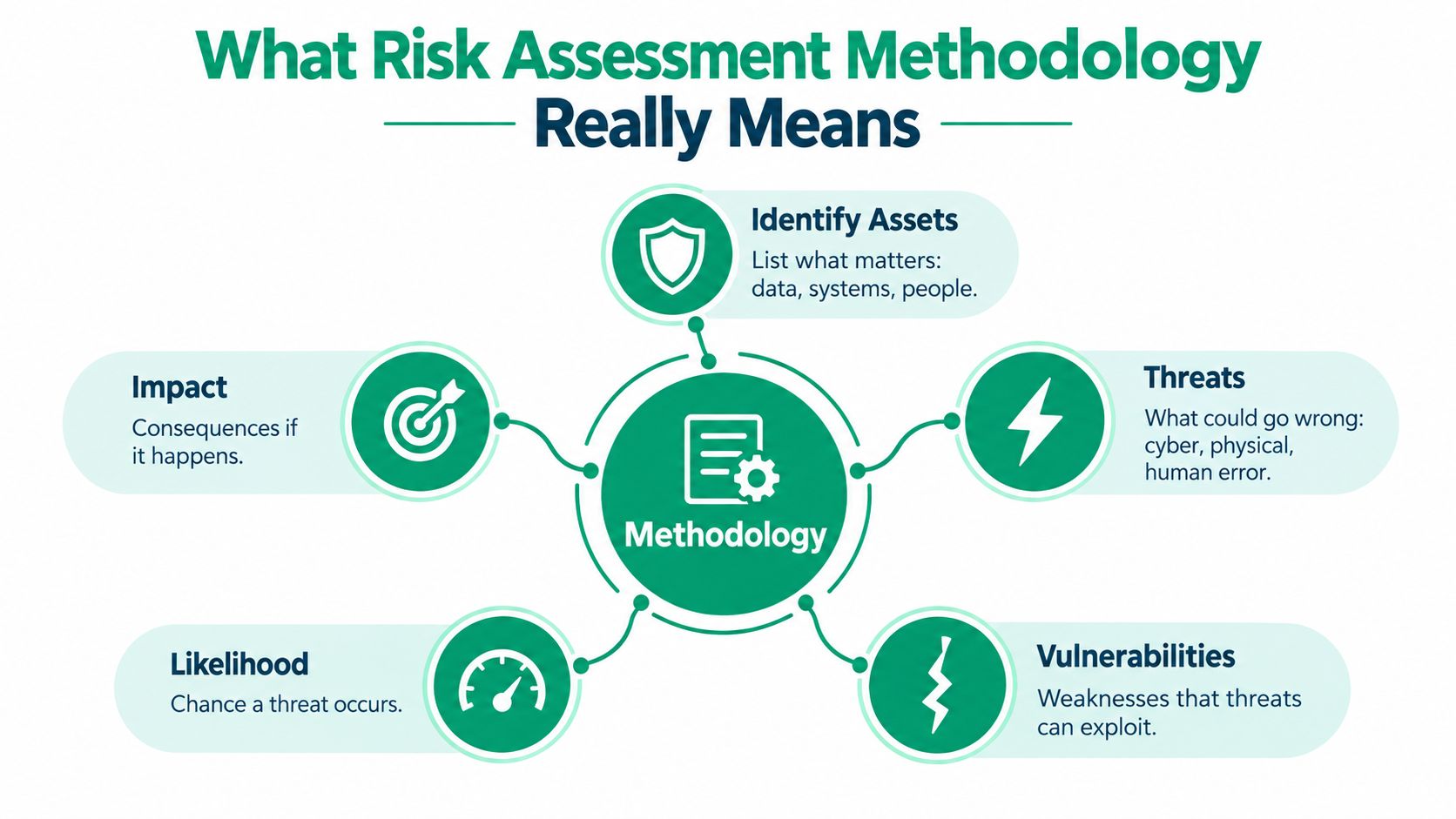
A business risk assessment works the same way. It looks at what matters, what could harm it, which weaknesses make harm possible, how likely the event is, and what the consequences would be.
The five moving parts
Assets are the things the business needs to operate. That includes customer records, payroll, line-of-business applications, servers, endpoints, cloud services, people, facilities, and network equipment.
Threats are possible causes of harm. Ransomware, accidental deletion, a power event, a dishonest employee, hardware failure, and a vendor outage belong in the same conversation.
Vulnerabilities are weaknesses that a threat can exploit. An unpatched remote-access tool, shared administrator credentials, unsupported hardware, flat network, or untested backup can all create exposure.
Likelihood asks how the event might happen, not how nervous it makes everyone feel. NIST SP 800-30 Rev. 1 separates whether a threat event occurs from whether it produces adverse impact, then combines those judgments into overall likelihood. Its guidance also calls for documenting assumptions, information sources, uncertainty, and scope in the NIST SP 800-30 Rev. 1 guide.
Impact includes more than an emergency repair bill. Consider unavailable operations, damaged data, affected customers, legal or contractual exposure, staff productivity, and the time needed to restore normal service.
Practical rule: A risk statement should connect a cause, an event, and a business consequence. “Old server” is an asset condition. “Server failure interrupts payroll and shared files” is a risk scenario.
Where ISO fits
ISO 31000:2009 was published on November 13, 2009, after developing from Australia and New Zealand's AS/NZS 4360:2004 framework through an international process involving technical advisers from more than 20 countries. ISO published ISO 31010 alongside it as a companion standard for risk-assessment techniques. The history and relationship are summarized in the ISO 31000 overview.
ISO 31000 is deliberately generic. A Greenwood manufacturer can apply its logic to production downtime, while a clinic can apply it to electronic health records and a professional office can apply it to customer data. In 2018, ISO revised the standard to emphasize senior-management involvement, strategic decisions, and integration into ordinary business processes.
In our 17 years of local service, the practical lesson has stayed simple: document the assumption, name the owner, record the review trigger, and avoid pretending that a score stays true forever.
Zero Trust architecture fits naturally here. Instead of trusting a device or user because it sits inside the office, the organization verifies identity, access, device condition, and requested resources. The technology supports the methodology, but the methodology decides which business problem the control must solve.
Comparing Leading Methods Without the Headache
Indiana SMBs don't need to choose a framework because it sounds impressive. They need a method that matches the decision in front of them. A clinic may need evidence around ePHI, a manufacturer may need to prioritize production continuity, and a defense contractor may need a path that informs CMMC preparation without confusing preparation with compliance.
NIST SP 800-30 Rev. 1 gives detailed structure for threat sources, events, vulnerabilities, predisposing conditions, likelihood, impact, assumptions, and maintenance. It fits organizations that want defensible technical analysis and a clear trail from weakness to treatment.
ISO 31000 provides a broad, sector-neutral logic for context, identification, analysis, evaluation, treatment, communication, and review. It works well when owners need to place cybersecurity beside financial, operational, compliance, and physical risks.
FAIR-style analysis is useful when leadership needs a financial comparison. It uses Loss Event Frequency, or how often a loss-producing event may occur, and Loss Magnitude, or the consequence when it does. Primary losses can include response labor, downtime, restoration, and replacement. Secondary losses can include legal, contractual, regulatory, and customer effects. The FAIR explanation of qualitative and quantitative analysis describes this causal approach.
A 5x5 matrix is the practical workhorse for many small teams. It helps people compare risks quickly, but a red square isn't a financial forecast. A business can use likelihood and impact ratings for triage, then apply FAIR-style ranges to the most important scenarios.
Which Risk Method Fits Your Indiana Business
| Method | Best For | Effort | SMB Takeaway |
|---|---|---|---|
| NIST SP 800-30 Rev. 1 | Technical risk analysis and evidence | Moderate to high | Use it when controls, assumptions, and threat paths need careful documentation |
| ISO 31000 | Enterprise-wide business risk | Moderate | Use it to put cyber, operations, compliance, and physical risks in one language |
| FAIR-style analysis | Budget and investment decisions | High for top risks | Use ranges for major scenarios instead of pretending a score is exact |
| 5x5 matrix | Fast prioritization | Low to moderate | Use written scoring definitions and named owners, not color alone |
For general business security, map findings to NIST CSF 2.0, which is designed for organizations of any size, sector, or maturity. Healthcare teams should connect findings to HIPAA's confidentiality, integrity, and availability requirements. Defense contractors can use the assessment to inform CMMC preparation, while recognizing that CMMC requires its own evidence and controls.
Don't confuse vulnerability testing with risk assessment. A vulnerability assessment versus penetration testing guide helps clarify why a scan finding still needs asset context, business impact, and an accountable response.
Your Practical SME Assessment Workflow That Works
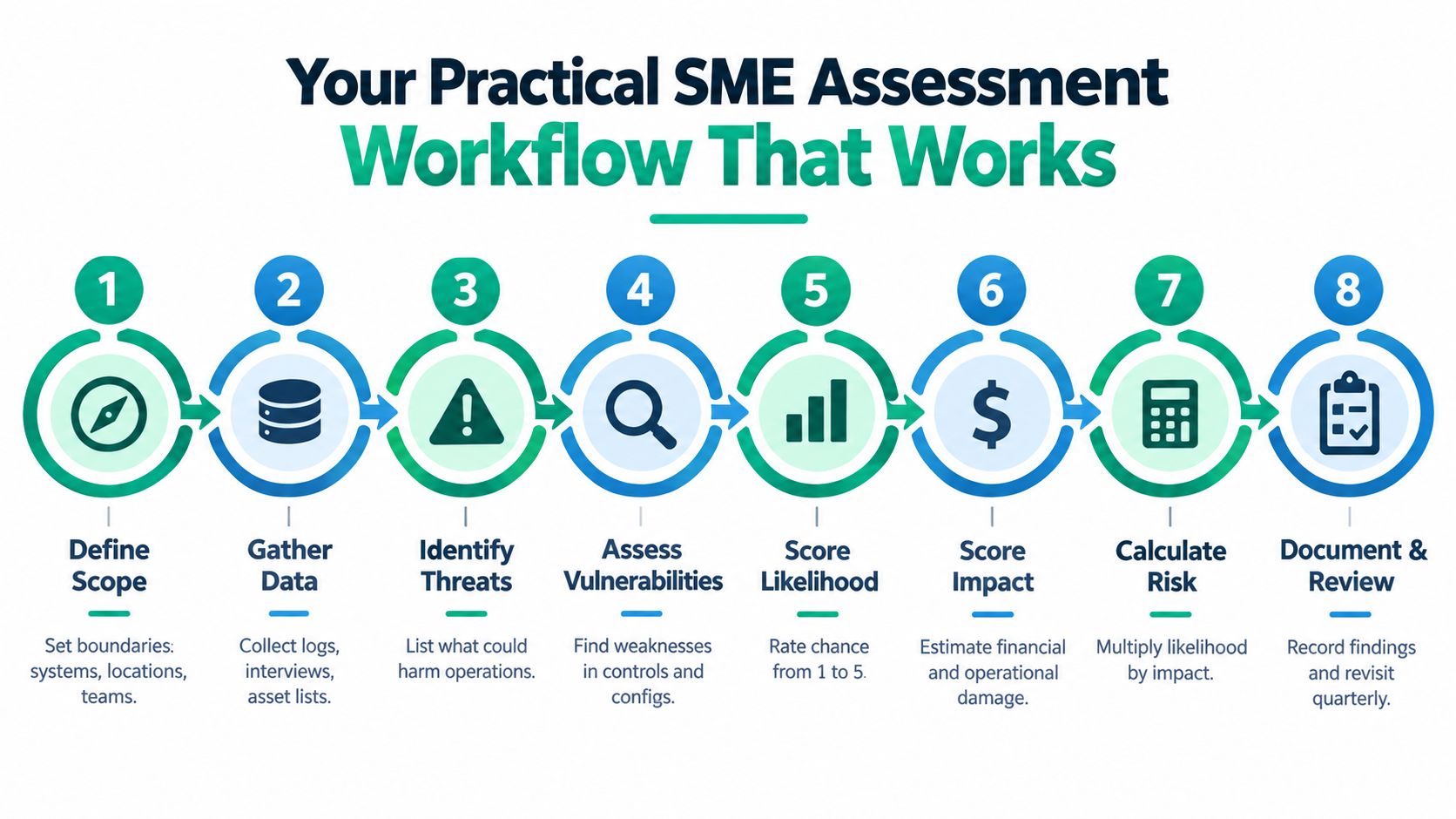
A useful workflow should fit a real Indiana business, not require a conference room full of consultants. HHS guidance adapted from NIST SP 800-30 presents eight concrete steps, and the sequence works for an aging server, a cloud workload, a UniFi network, endpoints, and backup systems.
Start with boundaries and evidence
1. Define the scope. Choose the location, systems, business process, or compliance boundary. A Greenwood clinic might scope ePHI, workstations, cloud applications, remote access, and backups. A small manufacturer might scope production scheduling, file services, networking, and vendor connections.
2. Gather data. Collect asset lists, cloud inventories, backup reports, endpoint policies, network diagrams, user interviews, incident records, and vendor agreements. Record where each fact came from and where uncertainty remains.
3. Identify threats. Write scenarios in business language. “Ransomware encrypts the shared file server” is more useful than “malware risk.” Other scenarios might include accidental deletion, ISP failure, Wi-Fi failure during checkout, or a cloud software outage.
4. Assess vulnerabilities and controls. Review patch status, unsupported operating systems, exposed remote access, administrator accounts, segmentation, MFA, endpoint protection, monitoring, and recovery documentation. Bitdefender GravityZone can contribute endpoint control and telemetry, but a product deployment doesn't prove that the business can restore payroll or production data.
A controlled discovery scan can help validate inventory. For authorized internal testing, a technician might use:
nmap -sV --top-ports 100 192.168.1.0/24
Use approved scope and change the private network range to match the environment. Don't scan systems you don't own or manage.
Score, treat, and keep the record alive
5. Estimate likelihood. Separate threat occurrence from successful exploitation and control failure. An attacker may reach a service, exploit a weakness, and still fail to cause harm because MFA, endpoint controls, segmentation, backups, and monitoring interrupt the chain.
6. Estimate impact. Ask what happens to operations, assets, individuals, customers, and other affected parties. For a clinic, unavailable records can disrupt scheduling, claims, communications, and clinical workflows even without a confirmed breach.
7. Determine the risk level. A written 5x5 scale can make scores consistent. Record inherent risk before controls and residual risk afterward. Don't let the matrix hide uncertainty.
8. Select measures and finalize documentation. Choose controls, assign a risk owner and action owner, set a review trigger, and record whether leadership accepts remaining exposure.
A simple register might include asset, scenario, threat, vulnerability, existing controls, likelihood rationale, impact rationale, inherent score, treatment, owner, due date, evidence, residual score, and review trigger.
Use this IT infrastructure audit checklist for 2026 as a practical prompt list, then adapt it to the systems your business depends on. Re-run the workflow after a major infrastructure change, application migration, staffing change, incident, or important vendor change.
Turning Risk Scores Into Dollars and Priorities
A risk register earns its keep when an owner can decide what to fund first. “Critical vulnerability” describes a technical condition. The business question is whether it could interrupt payroll, production, patient care, customer trust, or only cause a short-lived inconvenience.
Using the FAIR terms from the comparison above, break Loss Magnitude into primary and secondary losses for your top three scenarios. For a Greenwood clinic, a Wi-Fi outage might create a primary loss from idle staff, missed appointments, and delayed claims work. Secondary effects could include rescheduling patients, explaining delays to referring offices, and working through a backlog after service returns. Use actual hourly costs and a realistic outage duration when estimating the example. The goal is a useful range, not a pretend-precise number.
A 5x5 matrix remains helpful for comparison. A Wi-Fi failure may receive moderate likelihood and major impact, while a rare vendor incident may receive low likelihood and severe impact. The scores put both risks on the same page. The owner still needs to ask which control is affordable, how quickly it reduces exposure, and which dependency must be handled first.
Build the action order
A practical priority list weighs four questions:
- Business consequence: Could the event stop billing, production, scheduling, or customer service?
- Recovery time: Can staff resume work quickly, or must someone obtain replacement hardware or wait for a vendor?
- Implementation effort: Can the team apply the control during planned maintenance, or does it require a redesign?
- Dependency: Does segmentation rely on an accurate asset inventory? Does recovery rely on protected credentials?
A long vulnerability list can produce poor decisions. If every finding becomes urgent, ownership gets blurry and funding follows the loudest alert. Group related weaknesses into business scenarios, then fund the actions that reduce the largest practical exposure.
SOC-as-a-Service monitoring can support detection and escalation. Segmentation can limit how far an attacker or failed system reaches. Neither replaces recovery planning. A control earns its place when the business can state what it interrupts, what evidence verifies it, and how residual risk changed afterward. Useful cyber risk metrics for resellers can help teams report measurable signals without filling the dashboard with vanity counts.
Fund resilience instead of emergencies
Predictable monthly budgets make sense when they cover defined outcomes, including patching, endpoint protection, monitored alerts, backup verification, recovery testing, and lifecycle planning. Compare that spending with lost work and emergency response, rather than with the price of one appliance.
The IT budget and ROI guide for SMB resilience gives owners a practical way to connect technical priorities with planned spending. The best register is one an owner can read over coffee and use to approve the next action.
Testing If You Can Recover
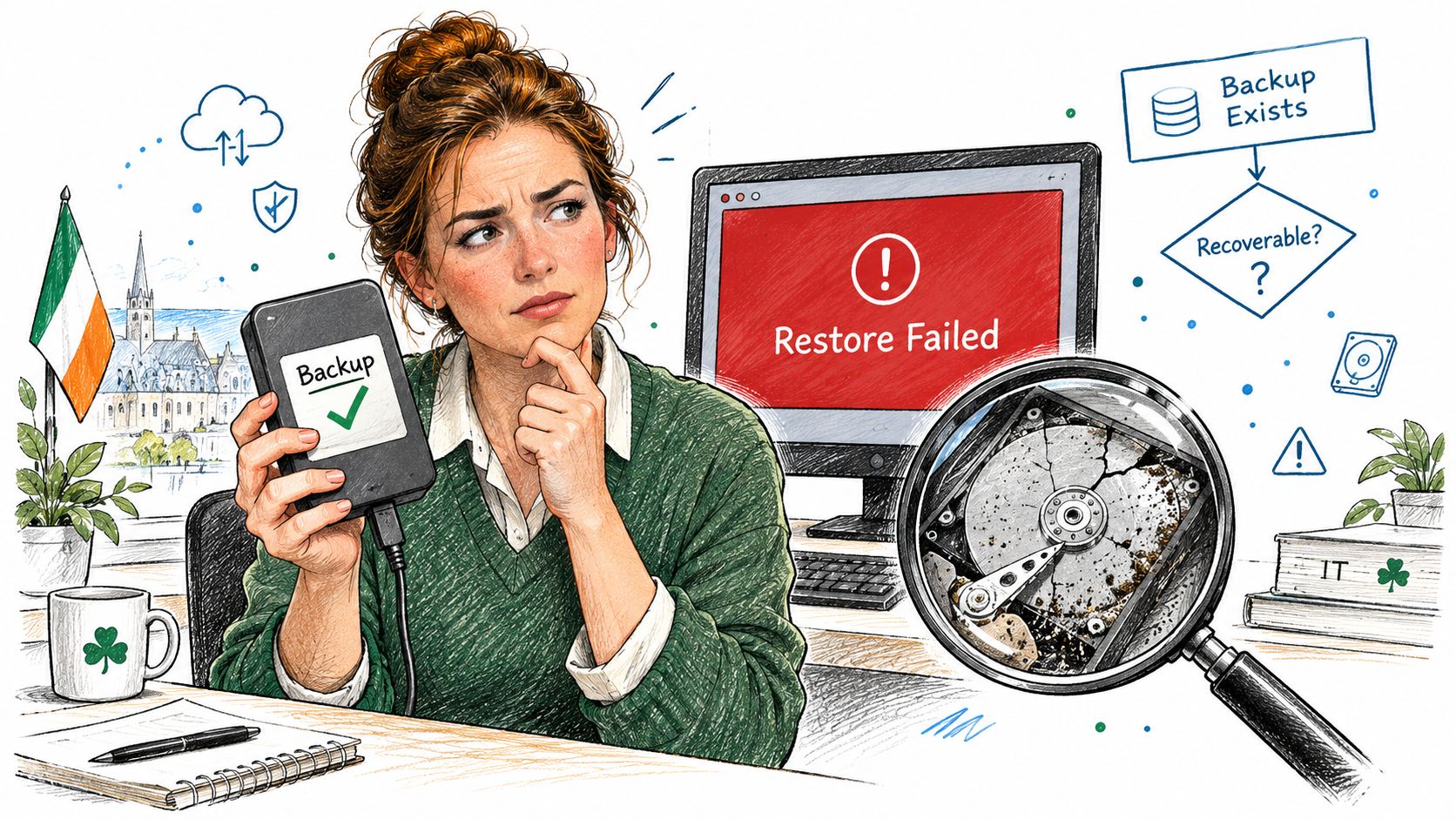
A backup job marked “successful” proves only that a process finished. Recovery testing asks a harder question: can the business restore usable files, databases, permissions, applications, and user access within its tolerable downtime?
A study of 29 Irish small businesses found that only two reported immutable or air-gapped backups, while 67% said they did not regularly test backups, as documented in the small-business backup and resilience study. Backup existence is not the same as recoverability.
Test the whole recovery chain
CISA recommends offline, encrypted backups and regular checks of their availability and integrity. A recovery design should cover immutable off-site backups or protected object storage, separate administrative credentials, retention policies, documented restoration priorities, and golden images for critical systems. Ordinary cloud synchronization can copy encrypted files and overwrite healthy versions, so synchronization alone does not provide recovery.
A controlled restore can follow this sequence:
- Isolate affected systems and preserve evidence.
- Identify the last known-good recovery point.
- Validate backup integrity before restoring production.
- Restore the most critical service first.
- Test files, databases, permissions, applications, and user access.
- Record restoration time, missing data, decisions, and follow-up work.
For hard-drive or RAID failures, bit-level data recovery may be needed before repair attempts. When we disassembled a similar client's failing RAID array, the important work was not swapping a drive. We preserved the array state, identified the failure pattern, and protected recoverable data before reconstruction could make the situation worse. Specialist resources such as BenchKey for data recovery can help teams recognize when a failed device needs controlled recovery instead of repeated rebooting.
Include vendors and the network
A small business also inherits risk from cloud platforms, software providers, managed services, internet providers, and suppliers. Ask what the vendor restores, what the customer must restore, how credentials are separated, and what evidence remains after a recovery test.
Downtown Indy tech hubs and older buildings can create practical network constraints. Latency-optimized mesh nodes may improve coverage where cabling is difficult, but wireless design still needs capacity planning, segmentation, monitoring, and a tested fallback. UniFi networking equipment can support that design, not replace it.
Use the RPO and RTO disaster recovery explanation to document how much data the business can lose and how long each critical service can remain unavailable. Then run the test, record the result, and state the remaining risk when the business chooses not to fund a gap.
Keep Risk Low With Managed IT in Greenwood
Risk assessment only pays off when someone maintains it. A lightweight cadence works well for many Greenwood and Indianapolis businesses:
- Monthly: Review the top risks, open treatment tasks, unusual alerts, vendor changes, and unresolved ownership.
- Quarterly: Test backups and restoration assumptions, review recovery evidence, and update the risk register after meaningful changes.
- Annually: Refresh the NIST CSF 2.0 profile. Clinics should review HIPAA risk analysis and safeguards. Defense shops should use findings to support CMMC preparation while tracking required evidence separately.
NIST CSF 2.0 is designed for organizations of any size, sector, or maturity and provides a common taxonomy of high-level cybersecurity outcomes for understanding, assessing, prioritizing, and communicating cyber risk, as described in HHS security guidance for regulated organizations. For healthcare, HHS requires an accurate and thorough assessment of threats and vulnerabilities affecting the confidentiality, integrity, and availability of ePHI, with documentation and ongoing safeguards.
A managed approach connects monitoring, endpoint controls, UniFi networking, immutable off-site backups, recovery exercises, and owner-ready reporting. Finchum Fixes IT offers security risk audits, managed IT support, networking, data recovery, and cybersecurity services for Indiana organizations, with urgent response averaging under two hours according to its published company information. The business result is fewer repeat tickets, less emergency labor, and more time for staff to serve customers.
If your Greenwood or Indianapolis business isn't sure which server, network, vendor, or backup risk deserves attention first, schedule a Free Network Assessment or Security Risk Audit with Finchum Fixes IT. You'll receive practical priorities tied to downtime, recovery, compliance, and a predictable plan for reducing exposure.