What Is Structured Cabling and Why Your Business Needs It
Let’s be honest. Take a peek behind your server rack. What you see is probably less of a "network" and more of a multi-colored bird's nest of cables. That chaotic tangle isn't just ugly—it's a ticking time bomb for your business, causing downtime that can cost up to $9,000 per minute. We see it all the time in older brick buildings around downtown Indy where spotty Wi-Fi brings productivity to a halt.
Structured cabling is the organized, professional system for your company's network wiring that fixes these problems permanently. It’s the difference between a spaghetti monster causing random outages and a clean, reliable system that just works, converting "wasted tech time" into billable hours.
- Structured cabling is a standardized system of cables and hardware that creates a reliable and scalable network foundation for your business.
- It eliminates the "spaghetti wiring" that causes frequent downtime, which can cost businesses over $9,000 per minute.
- A professional installation turns unpredictable IT chaos into a strategic asset, ensuring your network supports growth, simplifies troubleshooting, and maximizes your technology ROI.
- This organized approach is fundamental for business continuity and meeting compliance standards like HIPAA or CMMC. It converts wasted tech time into productive, billable hours and a predictable monthly budget.
That Rat's Nest of Wires Is Costing You Money
For too many Indianapolis businesses, that chaotic mess of wires is the real reason for spotty Wi-Fi, dropped VoIP calls, and infuriatingly slow network speeds. We see it constantly, from aging server hardware in a Greenwood business park to growing companies in Johnson County. A network that grew one cable at a time over the years eventually becomes an unsnarlable mess, creating a huge, hidden risk to your daily operations and business continuity.
Think about it: every minute a technician spends trying to figure out which mystery wire goes where is a minute you're paying for. Every time an employee stares at a loading screen, that’s productivity down the drain. That's the real cost of disorganized cabling.
The Problem with a "Whatever Works" Network
When your network has no rhyme or reason, tiny issues have a nasty habit of turning into full-blown disasters. We’ve seen this play out for businesses all along the I-65 corridor, and the story is always the same.
The usual headaches include:
- Constant Downtime: One loose connection or a mystery cable that gets unplugged can knock your entire team offline, costing you up to $9,000 per minute. A properly structured system keeps problems contained, so one faulty port doesn't bring the whole company to a halt.
- Glacial Performance: Using the wrong type of cable, having runs that are way too long, or running them right next to power lines absolutely kills your network speed. This slow-down affects everything from accessing shared files to making a simple phone call.
- Nightmare Troubleshooting: When something finally breaks, a technician has to play detective, manually tracing wires through a tangled mess. What should be a five-minute fix turns into a multi-hour project that costs you a fortune in "wasted tech time."
- Growth Grinds to a Halt: Need to add a new employee or a new printer? It shouldn't be a major construction project. A messy network actively works against you, making it painful and expensive to scale your business.
A disorganized network is an unpredictable expense generator and a massive source of frustration. Structured cabling gets to the root of these problems, giving you a stable, reliable foundation. It’s the first real step in turning your IT chaos into a predictable, high-performing part of your business.
The Building Blocks of a Modern Network
Forget thinking about individual wires. To really get what structured cabling is all about, you need to think like a city planner. A professionally cabled network isn't a tangled mess of back alleys; it's a meticulously planned city grid, designed from the ground up for reliability and future growth.
Think of your office as its own little metropolis. Every byte of data—whether it's a quick VoIP call or a massive design file—is a vehicle that needs to get from point A to point B without hitting traffic or getting lost. A structured cabling system is the network of highways, streets, and traffic signals that makes it all happen without a hitch.
The difference between a planned system and a free-for-all is night and day. This infographic shows it better than words ever could.

One of these pictures leads to headaches, constant troubleshooting, and frustrating downtime. The other is a clean, stable foundation that just works, letting you focus on your business.
The City Grid Analogy for Your Network
So, what does this "city grid" actually look like in your office? A structured cabling installation is really a collection of smaller subsystems, each playing a crucial role.
-
The Entrance Facility: This is the international airport of your network. It's the one secure spot where outside services, like your fiber internet connection, enter the building. This is where the service provider's responsibility ends and yours begins.
-
Backbone Cabling: These are the major interstates, like the I-65 corridor connecting different parts of town. Backbone cables are the high-capacity data movers (usually fiber optic) that run between floors or link different telecom closets. They create a super-fast data highway across your entire facility.
-
Horizontal Cabling: If the backbone is the interstate, the horizontal cabling is all the local streets branching off to every house and storefront. These are the cables running from a central wiring closet out to the wall jacks in offices, cubicles, and conference rooms, giving your computers, phones, and printers their connection to the wider network.
"A structured cabling system isn't just about being neat. It's a strategic blueprint for the future. By creating a clear hierarchy of pathways—from the main internet handoff all the way to a single desk—you eliminate bottlenecks and build a network that can actually keep up as your business grows."
The Hardware That Keeps Traffic Flowing
A city needs more than just roads; it needs stoplights, intersections, and street signs to manage the flow of traffic. Your network is no different. It relies on key pieces of hardware to direct the flow of data.
This isn't a minor expense, either. The global structured cabling market hit around $20 billion in 2026, with North America making up a whopping 38.2% of that spending. That tells you just how critical this foundation has become for any serious business. You can see for yourself how companies are prioritizing this investment.
Here’s the essential hardware that makes it all work:
- Server Racks: These are the steel skeletons of your network closet. They provide a sturdy, organized frame to safely house all of your critical server and networking gear.
- Patch Panels: A patch panel is basically an old-school telephone switchboard, but for your data. All the horizontal cables from your office wall jacks terminate here. This makes changes a breeze; instead of running a new wire 100 feet across the building, a tech can simply move a short patch cable from one port to another.
- Network Switches: These are the traffic cops of your network. We're big fans of UniFi networking hardware for its incredible performance and slick management tools. A switch takes data coming from one device and intelligently sends it only to the device that needs it, keeping everything moving efficiently.
By designing this system with purpose from the start, you're building a foundation that's not just ready for today, but for whatever comes next. You can see how we put these ideas into practice with our professional networking and Wi-Fi services.
Copper vs. Fiber: Picking the Right Lane for Your Data Highway
Let’s get one thing straight: not all network cables are the same. For a Johnson County business owner, grabbing the wrong type is a surprisingly common—and expensive—mistake. The cable that’s perfectly fine for your front desk computer might completely choke a high-resolution security camera or grind your team’s data-heavy projects to a halt.
This is where the real expertise in structured cabling comes in—it’s about matching the right tool for the right job. The big decision usually comes down to two main options: good old-fashioned copper and the new speed king, fiber optics. Each has its place, and knowing the difference is the first step toward building a network that actually works for you, not against you.
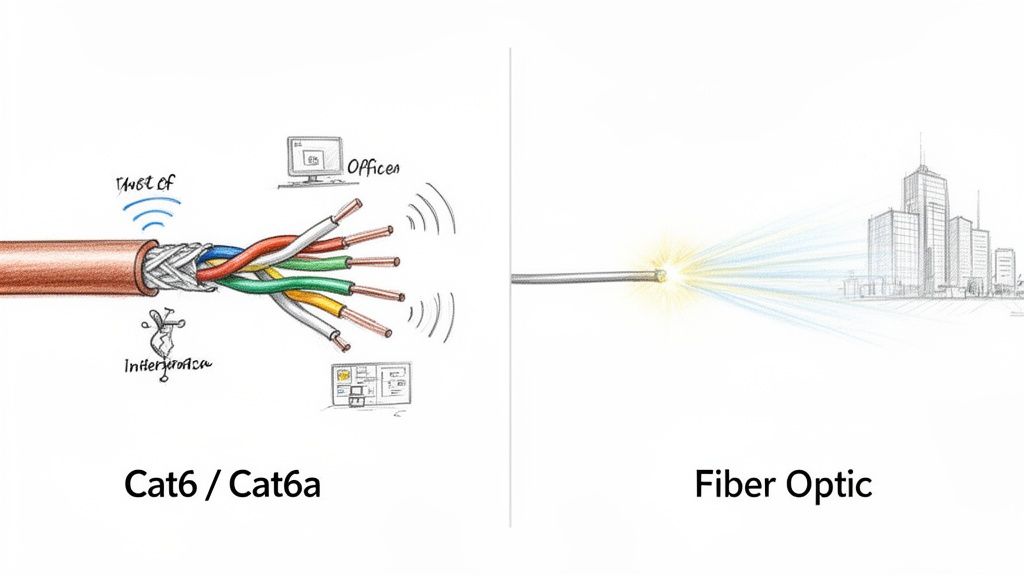
The Workhorse: Copper Cabling (Cat6 vs. Cat6a)
For most everyday office tasks, copper cabling is the reliable go-to. You've seen it a million times—that plastic-coated wire plugging into computers, VoIP phones, and printers. But even with something so familiar, the details matter.
-
Category 6 (Cat6): Think of this as the modern baseline for any serious business. It can handle speeds up to 10 Gigabits per second (Gbps), but only over shorter distances—about 160 feet. It’s a solid choice for connecting a desktop to a wall jack in a typical office.
-
Category 6a (Cat6a): That little "a" stands for "augmented," and it makes a world of difference. Cat6a also pushes 10 Gbps but keeps that speed cooking over the full 328-foot (100-meter) distance allowed by industry standards. Its thicker jacket also provides way better protection against electromagnetic interference (EMI), a huge headache in commercial spaces.
After our 17 years of local service, I can’t tell you how many clients in old downtown Indy brick buildings we’ve seen struggling with terrible network performance. The culprit? Interference from old electrical wiring, HVAC units, and even fluorescent lights was corrupting their data. A simple upgrade to properly shielded Cat6a solved the problem for good.
The Gold Standard: Fiber Optic Cabling
When you absolutely, positively have to move massive amounts of data at blistering speeds or across long distances, copper just can't keep up. That’s when you call in the champion: fiber optic cable.
Instead of sending electrical signals down a metal wire, fiber uses tiny pulses of light shot through a strand of pure glass. This is the underlying tech that makes modern high-speed communication possible.
- Mind-Blowing Speed: Fiber handles speeds that copper can only dream of, making it the ultimate choice for future-proofing your network for whatever comes next.
- Immune to Interference: Since it uses light, not electricity, fiber is completely immune to the EMI that drives copper crazy. This makes it insanely reliable.
- Goes the Distance: Copper taps out around 328 feet. A single run of fiber can carry a perfect signal for miles.
For a growing business in Hamilton County, this isn't just theory. Need to connect your main office to a warehouse across the parking lot? Fiber is the only way to go. To see this in action, check out our guide on how businesses use point-to-point networking solutions to create their own private data highways.
The table below breaks down the key differences to help you see where each type shines.
Copper vs Fiber Optic Cabling At-A-Glance
| Feature | Copper (Cat6/Cat6a) | Fiber Optic |
|---|---|---|
| Best For | Office desktops, printers, VoIP phones, short runs. | Data center backbones, building-to-building links, high-bandwidth needs. |
| Max Speed | 10 Gbps | 100+ Gbps and climbing. |
| Max Distance | ~328 ft (100 m) | Several miles. |
| Interference | Susceptible to EMI from power lines, motors, etc. | Completely immune to all electrical interference. |
| Cost | Lower initial material and installation cost. | Higher upfront cost, but offers immense long-term value. |
| Durability | Fairly durable but can be damaged by kinks or sharp bends. | Fragile glass core requires careful handling during installation. |
The explosive growth of cloud services and data centers is what’s really pushing fiber into the spotlight. In fact, the demand for structured cabling in data centers is expected to jump by 12.5% every year through 2030. This trend highlights why high-speed options like Cat6a and fiber are no longer luxuries—they’re necessities for any Indiana business that wants to keep up. You can read more about the industry statistics driving this shift.
Ultimately, choosing between copper and fiber isn’t an either/or fight. The smartest networks use a hybrid approach: affordable copper for individual workstations, with a high-speed fiber backbone tying it all together. Getting that mix right is the secret to a fast, reliable, and cost-effective network that’s ready for anything.
The True ROI of Professional Cabling
Sure, a clean server rack looks great, but what does that really do for your ROI? An organized rack is nice, but you're not in business to win neatness awards. A professional structured cabling system is a serious capital investment, and it has to deliver real, tangible returns by stamping out the hidden costs that bleed businesses dry.
Think about what happens when your network goes down. Every single minute is a cash drain. Industry studies show major network downtime can cost a business as much as $9,000 per minute. That "spaghetti monster" of tangled wires in your server closet? It's the perfect habitat for those kinds of expensive outages. One accidental unplug of a mystery cable can silence your phones and lock everyone out of their files, bringing your entire operation to a standstill.
Turning Wasted Time into Billable Hours
The most immediate payback you'll see from structured cabling is the death of "wasted tech time." When your network is a jumbled mess and something breaks, your IT tech has to play detective. They're on the clock, meticulously tracing wires through a rat's nest, guessing what plugs into where. You're paying for every second of that non-productive hunt.
With a properly structured system, every cable is labeled and every port on your patch panel is mapped to a specific wall jack. The difference is night and day.
- Before: A workstation drops offline. Your tech spends 90 minutes untangling a mess of blue cables to find the one bad connection. You just paid for an hour and a half of detective work.
- After: The same workstation goes offline. Your tech glances at the labeled port, identifies the connection in seconds, and has the user back online in 15 minutes. You just turned over an hour of pure expense back into productive, billable hours.
That efficiency sends ripples across your whole company. Your team isn't staring at loading spinners, waiting for the network to cooperate. They’re working, serving clients, and actually making you money.
Predictable Costs and Simplified Growth
For most business owners around Indianapolis, the most stressful part of IT is the unpredictable spending. A messy network makes it completely impossible to budget for growth. Need to add a new employee or move a department? It suddenly becomes a disruptive, expensive project with someone running new wires and spending hours troubleshooting the new setup.
A structured system flips that chaos into a predictable monthly budget.
Because the whole network is mapped out like a city grid, "Moves, Adds, and Changes" (MACs) become laughably simple and cheap. Shifting an employee to a new office is a five-minute job at the patch panel, not a mini construction project. This is a core part of getting your IT foundation right, which we cover in more detail in our guide to IT infrastructure management for slashing downtime.
This predictability allows you to stop treating IT as a reactive fire you're always putting out and start managing it as a strategic, operational budget. You can plan for growth knowing the costs will be minimal and the process will be smooth.
The Bedrock of Security and Compliance
You can't have real security or meet regulatory compliance with chaotic wiring. It’s just not possible. You simply cannot secure what you can't see, and a tangled network is a landscape of dangerous blind spots that threat actors adore.
For our healthcare clients in Hamilton County, for example, a structured network is step one for meeting strict HIPAA standards. It provides a clear, documented map of the network, making it possible to prove that patient data is properly segmented and locked down. For defense contractors, it’s a non-negotiable for CMMC requirements. For any business, it’s the physical framework needed to implement security best practices like the NIST CSF.
By creating an orderly and documented physical layer, structured cabling is what makes a true Zero Trust architecture possible. You can finally define and control every single connection point, guaranteeing that only the right people and devices get access. It's the first, most critical step in building an infrastructure that’s secure, compliant, and ultimately, more profitable.
Common Cabling Mistakes and How We Fix Them
After 17 years of service in the Indianapolis area, you get a sixth sense for network problems. We've been called out to fix more than our fair share of jobs done by well-meaning business owners or, even worse, the "lowest bidder" contractor who vanished after the check cleared. When we dissembled a similar client's failing setup, we found the same story: a chaotic web of wires creating more downtime than productivity.
These aren't just technical oopsies; they're ticking time bombs for your business. Let's walk through some of the cabling sins we see every week—and how we turn that chaos into a rock-solid asset.
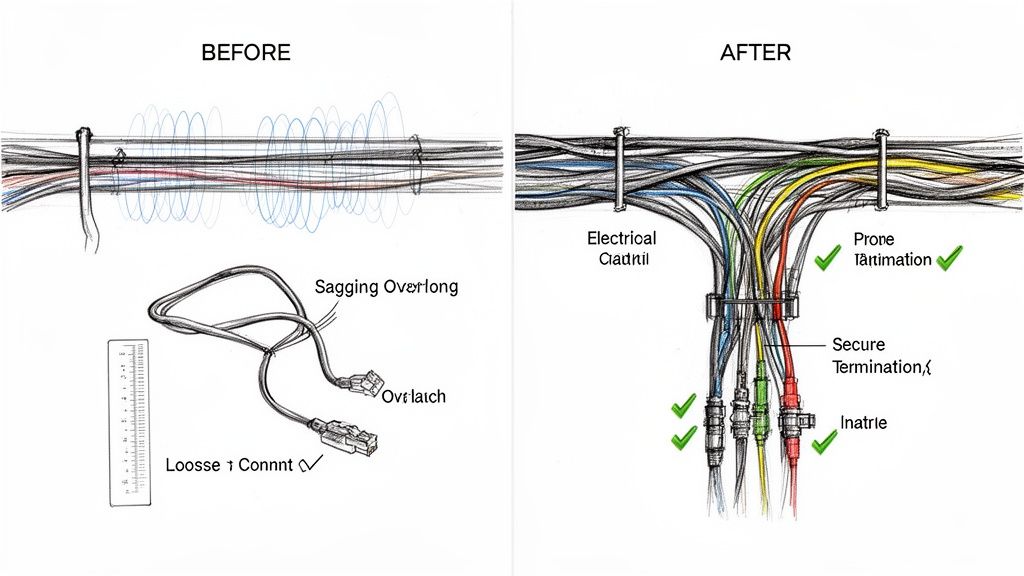
Mistake 1: Running Data and Power Cables Together
This one is everywhere, from brand new buildings in Hamilton County to older offices in downtown Indy. Someone decides to bundle the network cables right alongside high-voltage electrical lines. That’s a huge no-no.
It’s like trying to have a whisper-quiet conversation next to a revving engine. The electrical lines create a massive magnetic field, known as electromagnetic interference (EMI), that completely scrambles the data signal in your network cables. This mess results in sluggish speeds, dropped connections, and phantom issues that are a total nightmare to track down.
Our Fix: We meticulously re-route the data lines, following strict TIA/EIA standards that demand proper separation from power. In environments with a lot of electrical noise, we’ll use a high-grade shielded Cat6a cable, which has built-in armor to fight off EMI and keep your signal crystal clear.
Mistake 2: Stretching Cables Beyond Their Limits
Here's a classic shortcut: running a single Ethernet cable way past the industry-mandated limit of 100 meters (328 feet). The installer might think they're saving the client a few bucks by skipping an extra network switch, but they're actually building a permanent bottleneck into the system.
Think of it like a garden hose—the longer it gets, the weaker the water pressure is at the far end. Data signals work the same way; they degrade over distance in a process called attenuation. Push a cable too far, and you're left with cripplingly slow performance and constant disconnects.
Our Fix: We stick to the rules. No run ever exceeds 100 meters. Period. If a workstation is farther away, we install an intermediate closet with a network switch, like one from UniFi, to regenerate the signal. This ensures every single device gets the full-throttle bandwidth it’s supposed to, no matter how far it is from the server rack.
Mistake 3: Using the Wrong Cable for the Job
This one’s a bit more subtle, but just as destructive. We often find standard indoor-rated (CMR) cable being used for outdoor runs—connecting to a camera on a light pole or linking to a separate building, for instance. That thin plastic sheathing was never meant to handle Indiana's sun, rain, and ice.
It's a guaranteed failure. The jacket becomes brittle and cracks, moisture seeps in, and the copper corrodes. Your connection is toast. It's never a matter of if it will fail, but when.
Our Fix: Simple—we use the right tool for the job. Any cable that goes outside is a CMX-rated direct-burial or aerial cable. It's specifically built to fend off UV rays and extreme temperatures, giving you a weatherproof connection that lasts for years, not just a season.
Poor terminations are another network killer. A badly crimped connector is like a pinch in a drinking straw—it chokes the flow. While you can learn how to splice a network cable, one bad connection is all it takes to hamstring a multi-thousand-dollar network.
Doing your structured cabling right the first time isn't just an expense. It's an investment that saves you from paying twice: once for the cheap job, and again for a pro like us to come in and fix it for good.
Your Next Steps to a Future-Proof Network
So, what’s the real takeaway here? A jumbled mess of cables isn't just ugly; it’s a direct threat to your business's momentum. We've walked through the nuts and bolts of a professional setup, and it should be crystal clear that this isn’t a weekend project for your handiest employee. When every transaction, every customer call, and every file transfer depends on your tech, a solid network built on the principles of what is structured cabling isn't just a good idea—it's essential for business continuity.
The pressure on your network is only going one way: up. Think about the explosion of Internet of Things (IoT) devices, the all-in migration to cloud apps, and the endless hunger for more bandwidth. That train isn't slowing down. Your network needs to be ready for what's coming not just tomorrow, but five or ten years down the road.
Prepare for Tomorrow's Demands Today
Let's get real for a minute. Where is your business headed? Are you planning to install a new set of 4K security cameras? Will your team be expanding? Are you getting into heavy-duty data analysis that requires moving massive files? Every single one of these goals puts a fresh strain on the wiring hidden in your walls.
A professionally designed structured cabling system is what keeps you from hitting a wall—literally. It gives you a scalable foundation so you can:
- Add New Gear Without a Headache: No more calling in a contractor just to run one new Ethernet line.
- Handle Next-Gen Speeds: With Cat6a and fiber in place, you’re already set for the faster speeds that are inevitably coming.
- Count on Rock-Solid Reliability: Say goodbye to those random disconnects and maddening slowdowns that torpedo productivity.
As you map out your network's future, looking into professional network data cabling services is the difference between constant firefighting and having a true strategic asset. You can also get a head start by giving your current setup a hard look with Your Ultimate 10-Point IT Infrastructure Audit Checklist for 2026.
Stop Tolerating Unreliable IT
For businesses here in Greenwood and the greater Indianapolis area, the choice is simple. It's time to stop putting up with glitchy Wi-Fi, painfully slow file saves, and the daily frustration of a network that just can't keep up. You'd never accept a leaky roof ruining your inventory, so why accept a faulty network that cripples your team's ability to get work done?
A professionally cabled network isn't an expense; it's an investment in stability and growth you can actually count on. It’s the first step in turning wasted tech time into profitable, billable hours.
If you’re done with the network headaches and just want an IT infrastructure that works, it’s time to take back control.
Stop guessing and start building a network that’s ready for anything. Contact Finchum Fixes IT today for a Free Network Assessment, designed specifically for businesses in the Greenwood and Indianapolis area.
Got Questions About Structured Cabling? We've Got Answers.
When you're thinking about tearing out and replacing your business's entire network wiring, a few questions are bound to pop up. After 17 years of helping businesses all over the Indianapolis area, we've pretty much heard them all. Here are the big ones we get from local owners who are just plain done with fighting their network.
How Long Does a Cabling Installation Take?
That's the million-dollar question, isn't it? The honest-to-goodness answer is, "it depends." A small office setup out in Greenwood might just take us a couple of days. A massive, multi-floor headquarters downtown? That could be a project spanning a few weeks. The real goal isn't just speed—it's getting it done right with the least amount of chaos for you.
We always kick things off with a detailed site survey. This isn't just a quick walkthrough; we map out every single cable path and work directly with your team to schedule the noisy work for nights or weekends. The plan is to be practically invisible, so your business keeps humming along without a hiccup. You'll barely know we're there... until you experience that rock-solid new network speed.
Can You Install Cabling in an Old or Historic Building?
Oh, absolutely. We've got more than a little "been-there, done-that" experience with the beautiful, quirky, and often challenging old buildings you find all over Indianapolis. Whether we're dealing with thick plaster walls, nearly non-existent crawl spaces, or the delicate task of preserving historical charm, we know the playbook.
It’s a totally different ballgame. It requires a certain finesse you only get from experience. We’ve wired countless historic properties downtown, carefully running shielded Cat6a cable to dodge ancient, noisy electrical lines and finding clever ways to hide everything without leaving a trace. It’s a puzzle, and frankly, it's one we love to solve.
Is Structured Cabling Necessary If We Use Wi-Fi?
We hear this one all the time, and it's a huge misconception. The answer is a resounding yes—it's more crucial than ever. Your fancy, top-of-the-line Wi-Fi system is only as strong as the wired connection that powers it.
Think of it this way: your UniFi wireless access points are like a set of amazing, high-end speakers. The structured cabling is the high-fidelity, oxygen-free copper wire connecting them back to the amplifier. If you connect those killer speakers with a cheap, flimsy wire you found in a junk drawer, you'll get nothing but static and tinny sound. The speakers are wasted.
For business-grade Wi-Fi that never drops, lags, or crawls, you need a lightning-fast and stable wired backbone. That is exactly what a professionally installed structured cabling system delivers.
A reliable network isn't just a nice-to-have—it's the engine that runs your entire operation. If you're tired of dropped connections and endless IT headaches, it's time to bring in the local pros who live and breathe this stuff.
Ready to finally put your network problems in the rearview mirror? Finchum Fixes IT is here to help. Contact us for a Free Network Assessment and let's talk about building a faster, more dependable network for your Greenwood or Indianapolis-area business.