Your Guide to a Bulletproof Managed Services Agreement Template
TL;DR: Key Takeaways
- A generic managed services agreement template is risky; customize it to your specific Indiana business needs to prevent downtime, which can cost up to $9,000 per minute.
- Your agreement must define a clear Scope of Services and measurable Service Level Agreements (SLAs) to hold your IT provider accountable for performance and business continuity.
- For Central Indiana businesses, the contract must address local challenges (like spotty Wi-Fi in old downtown Indy buildings) and industry-specific compliance standards like HIPAA or CMMC.
- Demand modern cybersecurity protections like Zero Trust architecture, 24/7 SOC-as-a-Service monitoring, and tools like Bitdefender GravityZone, not just basic antivirus.
- A solid agreement converts unpredictable tech spending into a flat monthly fee, turning wasted tech time into billable hours and predictable ROI.
A managed services agreement template is a decent starting point, but let’s be honest—it’s just a start. For any serious Johnson County business, relying on a generic contract is like building a house on a shaky foundation. A properly customized agreement is what truly protects your operations and ensures business continuity.
It’s the document that turns unpredictable, budget-busting tech bills into a flat monthly fee. More importantly, it’s your best defense against downtime, which can bleed a business dry at a rate of up to $9,000 per minute, by converting wasted tech time into billable hours.
Why Generic MSA Templates Are a Ticking Time Bomb
Snagging a free managed services agreement template off the internet can feel like a savvy shortcut. Quick, easy, and done. But for any serious Indiana business, it’s a massive gamble. After 17 years of local service, we’ve seen the wreckage these generic documents can cause. They aren't just paperwork; they're a ticking time bomb waiting for a crisis to light the fuse.
The real problem is that these one-size-fits-all agreements are hopelessly vague. They're full of fuzzy language that leaves you completely exposed right when you need help the most. For a Greenwood business park client with aging server hardware, a generic contract is useless. When that server finally gives up the ghost, is bit-level data recovery actually included? If a ransomware attack locks you down, what’s the guaranteed response time? A free template almost never has those answers in writing.
The Compliance Gap for Indiana Businesses
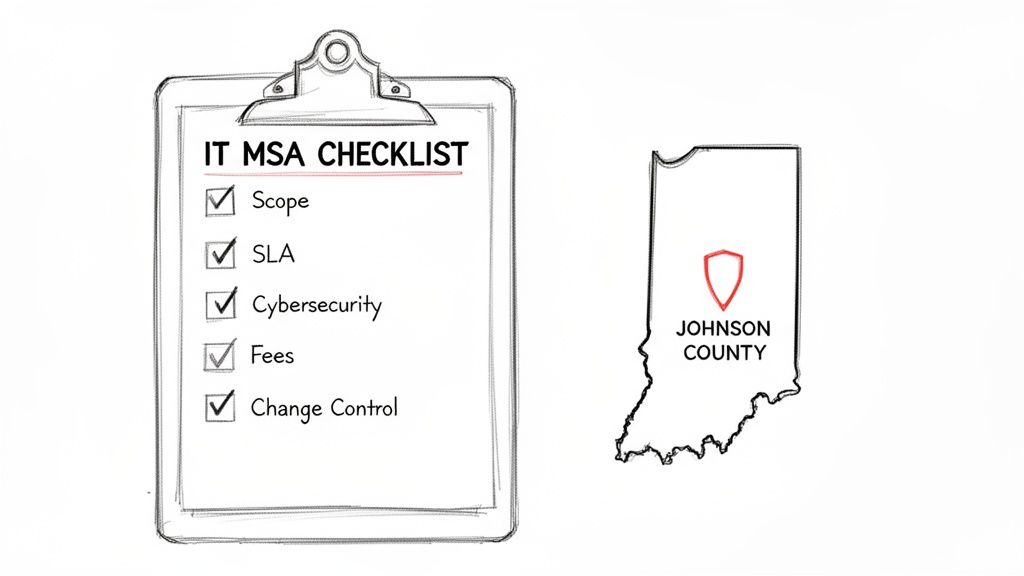
A generic managed services agreement almost always trips up on industry-specific compliance. For businesses up and down the I-65 corridor and across Central Indiana, this isn't just a detail—it's a huge risk that directly impacts your ROI.
Think about it:
- Healthcare Clinics: A boilerplate template won't even mention the specific data security rules required by HIPAA. A single breach could bring on crippling fines, destroy patient trust, and halt operations.
- Defense Contractors: If you're in the defense supply chain in Johnson County, you have to meet CMMC (Cybersecurity Maturity Model Certification) standards. A generic MSA gives you zero confidence that your IT provider’s services are aligned with those strict government protocols.
- Overall Security: The NIST CSF (Cybersecurity Framework) offers a rock-solid security playbook for any business. Your agreement needs to spell out exactly how your provider helps you meet those standards, from endpoint protection with tools like Bitdefender GravityZone to ensuring you have immutable off-site backups.
In our experience, the biggest failure of generic templates is their inability to address unique operational realities. An MSA for a law firm in a downtown Indy tech hub has vastly different priorities than one for a manufacturing plant in a Greenwood business park with aging server hardware. The contract must reflect your specific needs to guarantee business continuity. We cover more ways to grow with managed IT services for small business.
From Vague Promises to Concrete Guarantees
That lack of specificity is where the danger really lies. A downloaded template can't possibly know about the unique quirks of your operation, whether it’s fighting with spotty Wi-Fi in an old brick building in Fountain Square or needing a Zero Trust architecture to shield sensitive client data. For more on contract specifics, see these drafting tips for airtight agreements.
This is why customizing your MSA isn't just a "nice-to-have"—it's a core part of keeping your business running and profitable. A tailored agreement transforms wishy-washy promises into solid contractual duties. It's how you turn "wasted tech time" into a predictable budget and get your team back to productive, billable hours.
The numbers don't lie. The global managed services market is expected to reach $704.2 billion by 2031, according to this managed services market analysis. More businesses are relying on MSPs for business continuity. With that kind of growth, a well-built, custom agreement is the only way to make sure you're getting the value and ROI you're paying for.
Getting Into the Nitty-Gritty: What Your Agreement Really Says
A managed services agreement isn't just another document to sign and file away. It's the literal blueprint for your company’s IT health and stability. When we sit down with a business owner here in Greenwood or up in Hamilton County, we don't just slide a contract across the table. We walk through it, line by line, to make sure it all makes perfect sense.
Let's pull apart the key clauses you absolutely need to understand.
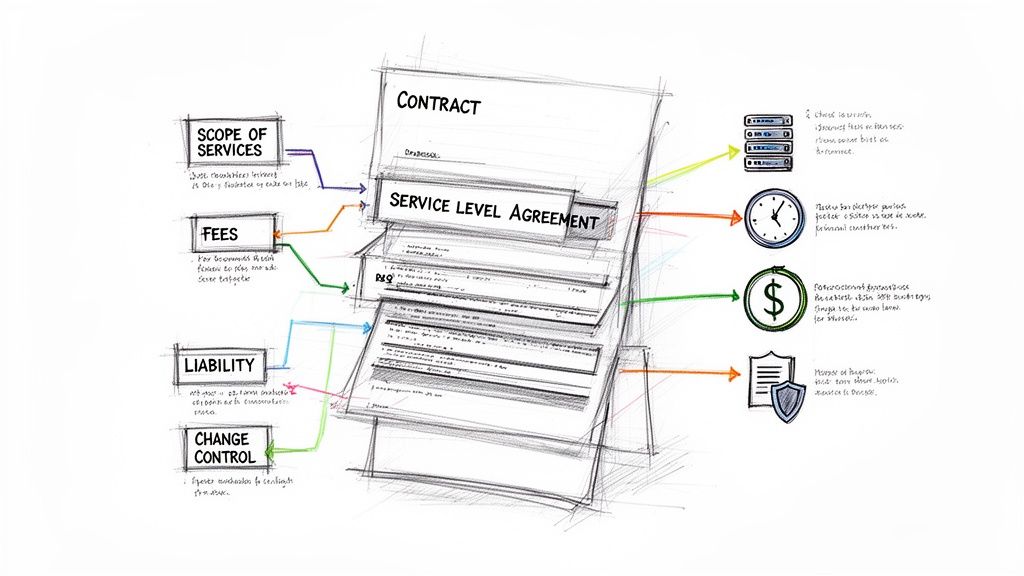
A vague agreement is a worthless agreement. It’s the difference between a true IT partner who has your back and a "geek with a screwdriver" who just shows up to fix what's already broken. Your contract has to be crystal clear so it protects your business, prevents downtime, and keeps your IT costs predictable.
Defining the Scope of Services
This clause is the heart of the whole deal. It needs to spell out, in painstaking detail, every single piece of hardware, software, and service your provider is responsible for. If you see fuzzy language like "network management," your alarm bells should be ringing.
A rock-solid scope clause will itemize everything:
- Hardware Covered: Every server, PC, firewall, and piece of UniFi networking gear needs to be on this list. If it's not listed, it’s not covered. Simple as that.
- Software Management: This should cover patching, critical updates, and even license management for your operating systems, software development tools, and major business applications.
- Security Services: What exactly are they doing to protect you? The scope should name the tools, like Bitdefender GravityZone for endpoint protection, and the services, like 24/7 SOC-as-a-Service monitoring.
- Data Protection: How often are backups happening? Where are they stored? The scope must define the backup frequency, the use of immutable off-site backups, and the step-by-step process for data recovery from cloud computing platforms.
I’ll never forget reviewing an agreement for a manufacturing client in Johnson County. Their old provider’s contract vaguely mentioned "server support." When we dissembled a similar client’s failing RAID array, we saw firsthand how ambiguity costs money. The provider hit them with a massive project fee for the rebuild. That ambiguity cost them nearly a full day of production—a direct hit to their ROI.
Locking in Service Level Agreements (SLAs)
Once you know what is covered, the next question is how well it's covered. That’s where your Service Level Agreements (SLAs) come in. These are your guarantees—the promises your provider is legally obligated to keep.
SLAs are your best defense against slow service and the crippling cost of downtime, which can hit a staggering $9,000 per minute for some businesses. They translate vague promises into hard, measurable numbers that protect your business continuity.
For example, an SLA must define response times for different problems. A broken printer is an annoyance. Your entire network going down is a five-alarm fire. The SLA sets the expectation for how fast your provider has to acknowledge the issue and, more importantly, resolve it. We've found that breaking down service tiers helps clients see the value, something we discuss in our guide to the real managed IT services cost in Indiana.
Essential SLA Metrics for Indiana Businesses
This table shows some common, measurable metrics that ensure your provider is held accountable for keeping your business running smoothly.
| Service Metric | Bronze Tier (Standard) | Silver Tier (Business Critical) | Gold Tier (Enterprise) |
|---|---|---|---|
| Network Uptime Guarantee | 99.5% | 99.9% | 99.99% |
| Critical Issue Response Time | < 2 Hours | < 30 Minutes | < 15 Minutes |
| Critical Issue Resolution Time | 8 Business Hours | 4 Hours | 2 Hours |
| Backup Recovery Point Objective (RPO) | 24 Hours | 4 Hours | 15 Minutes |
| Security Patching Cadence | Monthly | Weekly | Within 72 Hours of Release |
These numbers aren't just for show; they are your insurance policy against lost productivity and revenue.
Clarifying Fees and Change Control
Nobody likes getting a surprise bill. The Fee Structure in your agreement should be crystal clear, laying out your flat monthly fee and defining exactly what falls outside that scope and would be considered a separate, billable project. This is how you finally tame unpredictable IT spending and turn it into a fixed budget item, improving your ROI.
Just as crucial is the Change Control process. Your business will evolve, and your technology needs will change right along with it. We helped a client along the I-65 corridor expand into a new building. Because their agreement had a clear change control process, adding new users, computers, and network lines was a simple, streamlined procedure—not the chaotic, expensive emergency it could have been.
Liability and Termination Clauses
Let's talk about the less exciting, but absolutely critical, parts of the contract. The Limitation of Liability clause sets the financial boundaries of responsibility if something goes terribly wrong. While no provider can take on unlimited liability, the terms have to be fair. This is especially vital for businesses dealing with HIPAA or CMMC compliance, where a data breach can have devastating financial fallout.
Finally, every good agreement has a clear exit strategy. The Termination clause is your escape hatch. It should outline how you can end the contract, both "for cause" (if the provider repeatedly fails to meet their SLAs) and "for convenience" (if you simply outgrow the partnership). A standard 30 to 90-day notice period for convenience gives you the flexibility you need, ensuring you’re never shackled to a provider that no longer fits your business.
The Critical Cybersecurity Protections Your MSA Must Have
Let's be blunt: a managed services agreement that doesn't focus on cybersecurity is a liability. Your modern MSA needs a robust, multi-layered cybersecurity section that acts as a fortress for your entire operation, ensuring business continuity.
If you’re an Indiana business handling sensitive data of any kind—customer info, financial records, proprietary designs—this part of the agreement is completely non-negotiable. This is where you legally define your provider's duty to protect you from the threats that keep Johnson County business owners up at night. This is about embedding a full-blown defense strategy into your contract, not just checking a box for software.
It’s Time to Move Beyond Basic Antivirus
First things first: get rid of the old-school mindset that a simple antivirus program is enough. It's not. Modern cyber threats are far too sophisticated, and your managed services agreement must demand a security stack that can keep up.
This conversation should start with advanced endpoint protection. Your agreement needs to get specific, naming the actual tools being used, like Bitdefender GravityZone, which does much more than just scan for viruses—it offers anti-exploit, anti-ransomware, and risk analytics. The contract must explicitly state that this software will be installed, monitored, and kept updated on every single company device.
Beyond that, your MSA absolutely has to mandate 24/7 monitoring. This is where a SOC-as-a-Service (Security Operations Center) comes in. Think of it as having a team of digital security guards watching your network around the clock, actively hunting for trouble. If this isn't in the contract, you're not getting a real ROI on your security spend.
Adopting a "Never Trust, Always Verify" Mindset
A truly modern cybersecurity posture is built on a Zero Trust architecture. The philosophy is simple: don't automatically trust anyone or anything, even if it's already inside your network. Every request for access must be verified.
We once helped a Greenwood-based financial services firm recover from a breach. Their previous IT provider used a classic "castle-and-moat" security model. When an employee's password was stolen, the hacker waltzed right in and had free rein. A Zero Trust model, which we later put in place, would have segmented the network and demanded re-authentication at every turn, stopping the attack and preventing costly downtime.
Your agreement should require your IT partner to:
- Enforce Multi-Factor Authentication (MFA): This is non-negotiable for IT Support. MFA must be required for all critical apps, email, and remote access.
- Implement Network Segmentation: By isolating different parts of your network, you can contain a breach if one occurs, preventing it from spreading.
- Follow the Principle of Least Privilege: Users should only have access to the specific data and systems they need to do their jobs, and nothing more.
This proactive approach shrinks your attack surface dramatically and is a must-have for any business in Hamilton County or the greater Indy area that’s serious about protecting its data.
Defining Scans and Your Incident Response Playbook
An MSA can't just be about prevention; it has to lay out the game plan for when a threat is detected. The agreement needs to mandate regular vulnerability scans of your network and systems. These scans are like a home inspection for your digital infrastructure, proactively searching for weak spots—like unpatched software or misconfigured firewalls—before attackers do. Specify the frequency, whether it’s quarterly or monthly.
This is also where a crystal-clear Incident Response Plan (IRP) becomes vital. Your MSA should either include the IRP as an exhibit or formally require the provider to build one with you. This plan is your playbook for a crisis, defining roles, communication protocols, and the exact steps to take. To get a better idea of what this looks like, check out our guide on creating a cybersecurity incident response plan template.
The fact is, cybersecurity services are the fastest-growing slice of the managed services pie, as shown in the latest managed service provider trends report. This boom is a direct answer to escalating threats, making advanced threat detection and automated response capabilities must-haves in your contract.
Planning for Recovery and Proving Compliance
Finally, your agreement must address the worst-case scenario: what if everything is gone? This section has to detail the provider's data recovery processes with absolute clarity. Vague promises about "data backup" won't cut it.
Insist on language that describes bit-level data recovery capabilities and the use of immutable off-site backups—these are copies that ransomware can't touch. The agreement must also define your Recovery Time Objective (RTO) and Recovery Point Objective (RPO), so you know exactly how fast you'll be back online and how much data (if any) you stand to lose. It's also smart to understand how protections like cyber liability insurance can provide a financial safety net.
For Indiana businesses in regulated fields, this section is doubly important. If you’re a healthcare provider, the agreement must specify how your provider will ensure HIPAA compliance. If you’re in the defense supply chain, it must address CMMC requirements. By building these protections directly into your managed services agreement, you turn a simple service contract into a powerful shield for your entire business.
Making the Agreement Work for Your Indiana Business
Alright, let's get down to brass tacks. That template agreement is a great starting point, but now it's time to mold it into a tool that actually serves your business here in Indiana. A one-size-fits-all contract is a recipe for frustration and lost ROI. Every business is unique, and this is your chance to make sure your specific needs are baked right into the legal language.
Think about it. A medical practice over in Carmel has completely different IT headaches than a manufacturing plant down in Greenwood. The whole point of this exercise is to get those day-to-day operational realities onto the page, turning a generic contract into a genuine asset for your company.
Turning Local Problems into Contractual Promises
I see the same stories play out all over Central Indiana. There’s the law firm in a beautiful old building downtown, but their Wi-Fi constantly drops during important video calls with clients. Or the distribution center off the I-65 corridor, where warehouse workers are pulling their hair out because inventory scanners keep losing connection, grinding productivity to a halt.
These aren't just minor irritations; they're real business problems that cost you money and kill your team's momentum. Your agreement has to be the permanent fix.
- For the law firm: The contract shouldn't just vaguely mention "Wi-Fi management." It needs to be specific. Demand the installation of latency-optimized mesh nodes explicitly designed to push a strong, reliable signal through old brick and plaster walls.
- For the warehouse: The scope of work must include a hard guarantee of 99.9% wireless uptime in all critical coverage zones. This makes your provider directly accountable for your team's ability to get their work done.
In our 17 years of serving local businesses, the most successful partnerships always start with a deep dive into the client's actual workspace and workflow. I’ll never forget walking the floor of a Hamilton County logistics company with their shift manager. We literally mapped out every single dead zone that was costing them time. That real-world data went straight into their service level agreement, ensuring business continuity.
A Customization Checklist for Indiana Industries
Every industry has its own rulebook and operational quirks. Your managed services agreement has to get this right. Use this checklist as a starting point to make sure your specific world is covered.
- Healthcare (Carmel/Fishers): Does the agreement explicitly reference HIPAA? It absolutely must. Look for details on business associate agreements (BAAs), security risk assessments, and the secure handling of electronic health records (EHR).
- Manufacturing (Greenwood/Plainfield): Does it guarantee uptime for your production line systems? Be sure it specifies response times for operational technology (OT) issues, which are often more urgent than standard IT problems.
- Legal & Financial Services (Downtown Indy): The contract must require proof of data encryption, both for data sitting on a server and data moving across the network via cloud computing. It should also mandate clear protocols for secure data handling and destruction to protect your clients’ privacy.
- Defense Contractors (Johnson County): Is CMMC compliance mentioned? The agreement should clearly outline how the provider will help you achieve and maintain the required cybersecurity maturity level.
This whole process boils down to a simple, continuous loop: scan for weak spots, monitor what's happening on your network, and have a rock-solid plan to recover if something goes wrong.
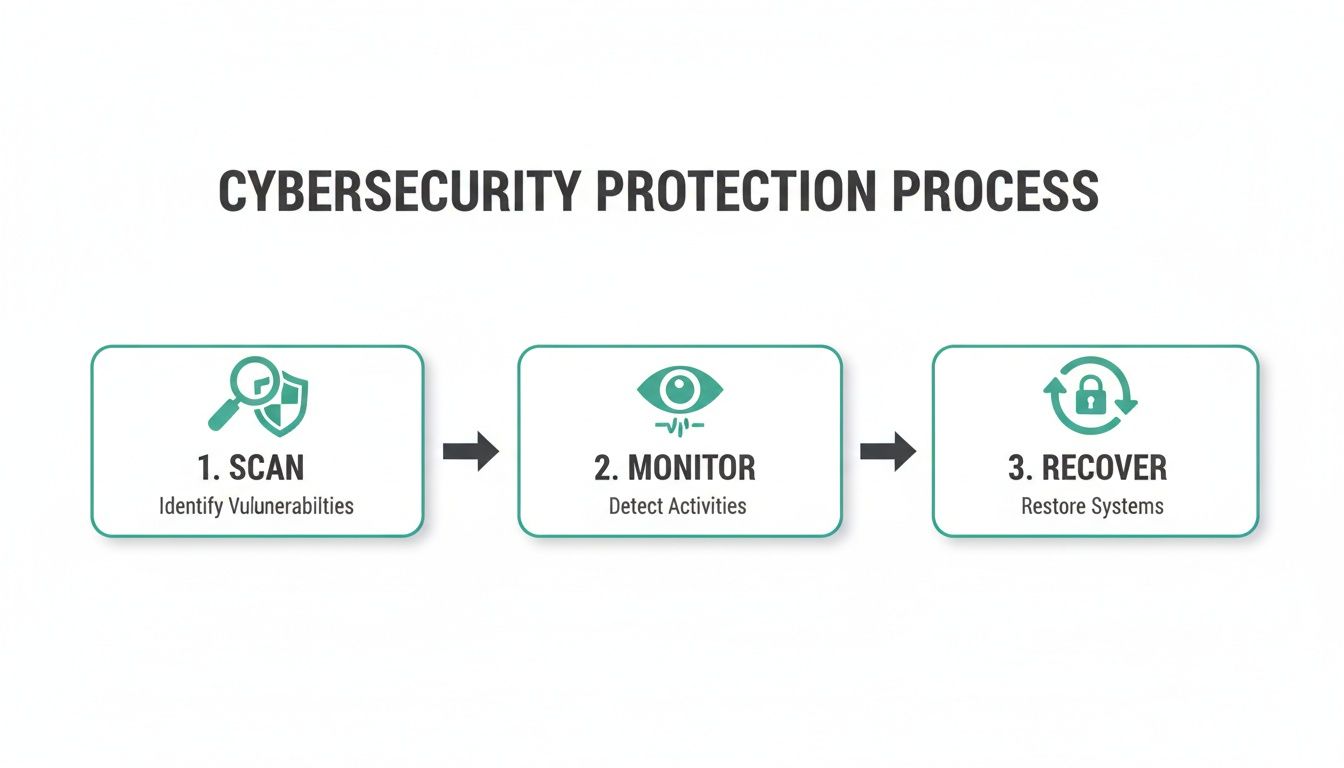
This simple flow—Scan, Monitor, Recover—is the heart of any good cybersecurity strategy. It moves you from a reactive, firefighting mode to a proactive defense that’s built right into your agreement.
Negotiating for Growth and Sanity
Once you've defined exactly what you need, you're in the driver's seat for negotiations. Don't be shy about asking for terms that fit your budget and your future. A good IT partner wants you to succeed and will work with you. For instance, if you're a growing company, push for a scalable pricing model that doesn't hammer you with fees every time you hire a new employee.
Ultimately, this agreement should be a living document that helps you hit your goals. By clearly defining your unique needs, you stop wasting time on tech headaches and gain predictable budgets and more productive hours. A well-crafted MSA isn't just about fixing computers; it’s a strategic move for business continuity. Speaking of planning, you might also get a lot of value from our guide to building a bulletproof Indiana business IT roadmap for 2026.
Before you sign on the dotted line, it’s always smart to get a second opinion. A thorough audit can confirm your needs and uncover risks you might have missed. A Security Risk Audit is designed specifically for businesses in the Greenwood/Indianapolis area to do just that, ensuring your final agreement is built to protect and support your operation from day one.
Negotiating Your Agreement and Finalizing the Deal
Alright, you've hammered out a draft of your managed services agreement. You've taken our template and molded it to fit your Indiana business like a glove. Now for the fun part: sitting down with your potential IT provider to talk terms and get it signed.
Think of this less as a high-stakes negotiation and more as the first real test of your new partnership. A great provider will welcome your questions. They'll expect a conversation. If they get defensive or refuse to discuss specific clauses, consider it a giant red flag flapping in the wind.
It’s a Conversation, Not a Confrontation
This meeting is where you build the foundation for what will hopefully be a long and successful relationship. Your goal isn't to "win," but to make sure the contract is crystal clear, fair, and actually helps you hit your business goals.
Zero in on the areas that directly affect your day-to-day operations and your wallet. Here are a few key points you absolutely need to clarify before signing anything:
- The "Escape Hatch": What happens if things go south? Confirm you have a clear way to end the agreement "for cause" if they aren't meeting their promises. You also need a "for convenience" clause with a reasonable notice period, like 60-90 days, in case your business needs a major pivot.
- Intellectual Property: If your provider develops custom code or scripts just for you during a software development project, who gets to keep it when the contract ends? Get this spelled out now to avoid a messy ownership fight down the road.
- Periodic Reviews: The best agreements build in time for quarterly or semi-annual business reviews. This forces both of you to check in, ensuring the contract evolves with your business instead of becoming a dusty, irrelevant document.
I’ve been on both sides of the table for over 17 years, and I can tell you this: the best IT partnerships come from agreements where everyone feels like they're getting a great deal. This document should be about driving real value and ROI, not just listing a bunch of obligations.
Don't Go It Alone
Before you put pen to paper, it's never a bad idea to get a final sanity check from an outside expert. A fresh pair of eyes can spot things you might have overlooked and confirm the services you're about to pay for are what you actually need. For some businesses, this might even involve looking at different service models, like we cover in our guide to managed services vs. staff augmentation.
The managed services market is massive, according to the latest MSP industry statistics report. For you, this means established Indiana providers should have solid, proven frameworks. Don’t settle for anything less than complete professionalism.
This is your last chance to make sure every promise is in writing, every metric is measurable, and every service is clearly defined. A good agreement is your insurance policy against downtime and your roadmap for making IT a predictable, growth-driving part of your business.
If you’re a business in the Greenwood or Indianapolis area, we can help. A Security Risk Audit is a no-strings-attached way to get an expert review and ensure your managed services agreement is truly ready to protect your operations.
Frequently Asked Questions
When Johnson County business owners sit down with us to talk about a managed services agreement, a few questions almost always pop up. Let's tackle them head-on.
What Is the Most Important Clause in a Managed Services Agreement?
It’s tempting to flip straight to the pricing page, but trust me on this one. The two sections that can make or break your entire IT partnership are the Scope of Services and the Service Level Agreement (SLA). They are the absolute heart of your managed services agreement template.
Think of the Scope as your "What's Included" list. It spells out, in black and white, exactly what your provider is responsible for. Will they manage your UniFi networking gear? Are they on the hook for data recovery? If it’s not in the scope, it’s not covered—and that's how surprise bills happen, wrecking your ROI.
The SLA, on the other hand, is your insurance policy against downtime. It puts real numbers and consequences to promises, guaranteeing response times and system uptime to ensure business continuity. Without it, you have no recourse when things go wrong.
How Long Should a Managed Services Agreement Last?
You’ll typically see initial contracts for one to three years. A one-year term offers more flexibility, which is great when you're starting out. A three-year term, however, usually comes with a better price. For any business owner in Hamilton County, you know that growth and change are the only constants, so the real power isn't in the term length—it's in the termination clause.
Over our 17 years serving local businesses, we've seen how a bad contract can trap a growing company. Always insist on a "termination for cause" clause if your provider fails to meet their SLAs. More importantly, get a "termination for convenience" option (like with 60-90 days' notice) that gives you a clean exit if your business needs a change of direction.
Can I Negotiate the Terms in an MSA?
Absolutely—and you should! Any agreement from a provider is just their opening offer. Any IT partner worth their salt along the I-65 corridor fully expects you to come back with questions and negotiate terms on pricing, service levels, and scope to better fit your business.
In fact, if a potential provider is completely rigid and refuses to discuss reasonable changes, consider that a massive red flag. A great IT relationship is a partnership, and the negotiation table is your first real test of whether they’re willing to act like a true partner.
Ready to get a second opinion on your tech needs before you sign? Finchum Fixes IT offers a no-risk way to validate your IT strategy. We provide a Security Risk Audit specifically for businesses in the Greenwood/Indianapolis area. Get started at finchumfixesit.com.