Zero Trust Network Architecture for SMBs
A controller in Greenwood opens a spreadsheet, a remote estimator in Carmel connects from a coffee shop, and a Chicago vendor downloads one shipment file. Zero trust network architecture makes each request prove its identity, device health, context, and authorization, then grants only the specific access required, whether the resource sits on-site, in Microsoft 365, AWS, Azure, or a hosted application.
A common Southside bottleneck is an aging server or flat office network that still assumes anything inside the building is safe. A practical managed approach replaces that assumption with documented policies, segmented access, continuous monitoring, tested recovery, and a rollout that protects daily operations instead of interrupting them.
Why SMBs Need Zero Trust Network Architecture
A Johnson County manufacturer starts Monday with three routine requests: a controller needs a finance folder, an estimator needs the quoting application, and a shipping vendor needs one document library. On a flat network, all three may cross the same broad trust boundary. If a password is stolen or a laptop is infected, the intruder can search for file shares, administrative systems, backups, and servers the original user never needed.
That design fit a time when applications sat behind one office firewall. An Indiana business may now run Microsoft 365 for email, AWS or Azure applications, hosted QuickBooks for finance, and legacy workloads in a colocation rack. Employees connect from home, vendors receive temporary access, and SaaS platforms exchange data through APIs. The policy problem is keeping these paths consistent, so a permission change in one environment does not leave a weaker exception somewhere else.
Zero trust network architecture removes trust from network location. Each request is evaluated against identity, device condition, application, resource sensitivity, and other available context. Access is denied by default unless policy allows it, and the design assumes an attacker may already have a foothold.
Practical rule: A successful sign-in proves who presented credentials. It does not prove that the request is safe, necessary, or appropriate for the resource.
For an Indiana manufacturer along the I-65 corridor, this approach can support supplier expectations while limiting movement between production technology and office systems. A medical practice can narrow access to patient systems and reduce unnecessary HIPAA exposure. A retailer or payment processor can apply the same controls to PCI-related systems, while a defense supplier can align access governance with CMMC expectations. General businesses can use the NIST CSF to organize identification, protection, detection, response, and recovery.
The architecture also shapes insurance and continuity planning. Underwriters may ask for evidence that privileged access, multifactor authentication, endpoint controls, segmentation, logging, and recovery procedures operate together. This Indiana small business cybersecurity checklist offers a starting point, but it becomes useful only when mapped to actual users, systems, vendors, and workflows.
The business case is practical. Downtime can cost businesses up to about $9,000 per minute, according to the cited industry estimate, so limiting lateral movement and restoring operations quickly protects revenue as well as data. Zero trust cannot prevent every outage or incident. It can contain a bad access decision within a smaller area, reduce policy drift across hybrid systems, and make recovery less disruptive.
Understanding the Core Principles
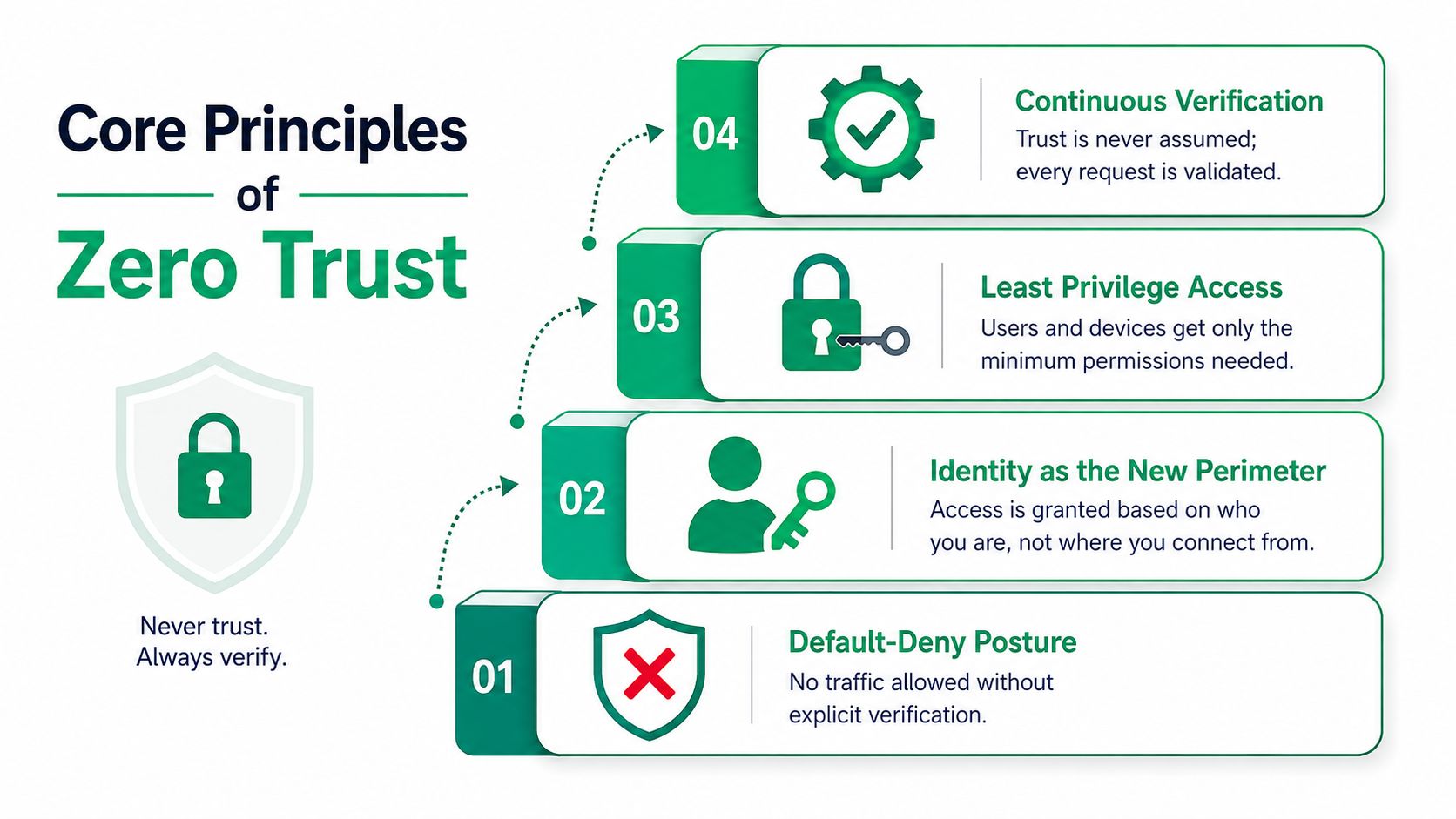
Zero trust works as a ladder. The first rung is a default-deny posture. A user, device, application, or vendor doesn't receive access because it connects through the office switch, a UniFi wireless network, or a company VPN.
Identity replaces the old perimeter
Think of an office as a coworking building. Everyone may enter the lobby, but each door requires a badge. A sensitive room checks the badge again, confirms the visitor's appointment, and records the entry. A contractor doesn't receive a master key after signing in once.
In practice, identity becomes the control point. Entra ID, Okta, or another identity provider can require MFA, evaluate device compliance, and assign a user to a defined role. A third-party bookkeeper might reach a finance application but not engineering shares. A new sales representative might access CRM records without receiving permission to browse payroll or server administration.
The aim isn't to make employees authenticate constantly without reason. The aim is to remove broad, invisible trust. A remote worker may use an application-specific connection instead of a full VPN tunnel, while an unmanaged personal laptop may receive browser-only access or no access to sensitive data.
Least privilege limits the damage
Least privilege means users and devices receive the minimum permission required for a task. Administrators should use separate privileged accounts, vendors should receive time-limited access, and service accounts should have narrowly defined functions rather than interactive access across the environment.
Microsegmentation applies the same principle to traffic. An OT VLAN can communicate with approved manufacturing systems while remaining isolated from front-office laptops. A compromised workstation can be blocked from backup infrastructure and database administration even if the employee's password is valid.
Verification continues after sign-in
Continuous verification considers changing conditions. A request from a compliant company laptop during normal business activity may receive a different decision from a login through an unknown device followed by an unusual download. Monitoring, device posture, session signals, and resource sensitivity all contribute to the decision.
These principles should be managed as one policy layer, not as disconnected products. A useful review of ARPHost's layered security approach shows why controls need to reinforce one another. Businesses can also use this guide to identity and access management tools when comparing platforms, but the correct tool still depends on the applications and identities already in use.
Key Components of a Zero Trust Architecture
A workable design connects six components. Its strength comes from the handoffs between them, especially when the same access decision must apply across an Indiana office, cloud applications, SaaS platforms, private workloads, and vendor connections. More security consoles do not solve inconsistent rules.
Identity and multifactor authentication
The identity provider maintains users, groups, service accounts, and authentication methods. MFA protects the entry point, while conditional access can require a managed device before allowing access to SQL Server or an administrative portal. Phishing-resistant MFA provides stronger protection against stolen credentials. Microsoft has reported that over 99% of identity-based attacks could be blocked by phishing-resistant MFA. That control protects sign-in, but it cannot govern every workload, application permission, or third-party dependency.
Policy engine and administrator
The policy engine evaluates each request. The policy administrator turns that decision into an action, such as issuing a token, opening an application-specific connection, or denying access. Effective rules combine identity, device state, application, location, risk, and resource sensitivity.
A small business might allow an employee in the accounting group to use payroll from a compliant device, while requiring additional approval for an administrator connecting to production. The rule must reach every relevant enforcement point. Otherwise, the written policy is only documentation, and office, cloud, or vendor access can drift apart.
Enforcement points
Next-generation firewalls, secure web gateways, ZTNA brokers, application proxies, and endpoint controls enforce the decision. A gateway can expose one private application without exposing the whole network. A firewall can restrict traffic between a front-office VLAN and an OT VLAN.
Many smaller deployments fail here. Identity says “allowed,” but a firewall rule remains broad. A cloud security group may also permit traffic that the central policy never reviewed. Custom portals and APIs require their own application controls. A practical DevArmor's enterprise application security guide belongs in the design conversation because network access alone does not address application weaknesses.
Segmentation across environments
Microsegmentation can use VLANs and firewall zones on-site, cloud security groups in AWS or Azure, and software-defined perimeters for private applications. Policies should describe business relationships, such as “shipping application to approved database,” instead of relying only on a subnet that may change.
That distinction helps a manufacturer keep production systems separate from office laptops while preserving the narrow connections employees need to do their jobs.
Monitoring and SIEM
Logs from identity providers, endpoints, firewalls, SaaS platforms, and cloud services should reach a SIEM or SOC-as-a-Service monitoring workflow. A contractor downloading SharePoint files at 2 a.m. deserves investigation when the activity conflicts with the approved role and schedule.
Bitdefender GravityZone can contribute endpoint telemetry, but endpoint protection alone cannot explain why a cloud token reached a sensitive application. The monitoring layer must connect the events and give an administrator enough context to respond without stopping unrelated business activity.
Cloud workload controls
Cloud security posture management, or CSPM, checks configuration risk. Cloud infrastructure entitlement management, or CIEM, examines permissions across cloud identities and resources. Together, they help identify excessive access, exposed services, and policy differences between AWS, Azure, SaaS platforms, and local infrastructure.
A single policy source of truth should govern these components where practical. Otherwise, an SMB accumulates exceptions across Entra ID, firewall rules, SaaS settings, cloud security groups, and vendor portals, then loses track of which rule protects the data. For network access control fundamentals, this Indy SMB guide to network access control provides useful operational context.
Comparing ZTNA Deployment Models
ZTNA is an architecture pattern, not one universal product. The right deployment model depends on the applications, users, endpoints, private infrastructure, and support capacity available to the business.
| Deployment model | Best fit | Main trade-off |
|---|---|---|
| Cloud-delivered proxy | SaaS-heavy businesses using Microsoft 365, Salesforce, and browser-based services | Depends on provider availability, endpoint signals, and suitable regional points of presence |
| Software-defined perimeter | Private applications across data centers, branches, and cloud workloads | Requires more application mapping, policy design, and endpoint support |
| Integrated identity-centric platform | Regulated organizations seeking unified user, device, application, and network decisions | Consolidation can simplify administration, but a platform gap can affect many controls |
| VPN replacement | Remote users who need controlled access to specific internal applications | Replacing the VPN doesn't automatically secure east-west traffic or SaaS sessions |
A cloud-delivered proxy often suits a Hamilton County company with distributed staff and mostly SaaS workflows. Policies follow the user and device rather than forcing all traffic through a central office. A software-defined perimeter makes more sense when a manufacturer has private applications in a colocation rack and branch operations that need narrow application paths.
Agentless access can help vendors and unmanaged devices, but it may provide less device assurance. Agents can provide stronger posture information, though they create deployment and support work. Latency matters too. One edge-cloud study found connection-establishment overhead with about 4% to 10% latency overhead in tested scenarios, while streaming performance was negligibly affected, according to the Aalto University experimental study. A separate 5G-focused implementation reported roughly 3 to 5 milliseconds per hop from enforcement points and mutual TLS, while minimal-latency scenarios remained under 10 milliseconds end to end, using the same source.
Before selecting a model, answer five questions:
- Protected resources: Are you securing SaaS sessions, private applications, administrative interfaces, or all three?
- Identity evidence: Can the design verify users, devices, service accounts, and vendors?
- Enforcement location: Does policy act at the endpoint, gateway, application, cloud workload, or network?
- Telemetry retention: Can the team investigate denied and approved requests?
- Operational ownership: Can a small IT team maintain the rules and respond to failures?
A well-designed authorization flow prevents access decisions from becoming a collection of improvised role exceptions. Businesses comparing remote-access options can also review this small business VPN guide, while remembering that VPN access is only one part of the architecture.
Planning the Migration Roadmap
A safe migration starts with observation, not an immediate lockdown. Build an inventory of employees, contractors, service accounts, devices, applications, data flows, branch sites, cloud services, privileged identities, and existing VPN paths. Include printers, cameras, production equipment, server-to-server traffic, SaaS integrations, and backup systems that don't appear on the employee directory.
Phase one builds visibility
Mark sensitive resources first. Payroll, customer records, patient systems, administrative consoles, backups, and production databases deserve different treatment from a public marketing site. Document who needs each resource, from which device, through which application, and during what business process.
Use a repeatable discovery workflow:
- Export users, groups, privileged roles, and inactive accounts from the identity provider.
- Review DHCP leases, switch tables, UniFi controller records, endpoint management data, and cloud asset inventories.
- Map application dependencies, including database connections, APIs, certificates, and scheduled jobs.
- Compare observed traffic with written business requirements.
- Record unknown assets and exceptions instead of allowing them.
Phase two strengthens identity
Require MFA, centralize identity where possible, verify device compliance, define roles, and document privileged-access approval. Separate administrators from standard users. Create break-glass accounts and protect them with documented procedures, offline recovery information, and monitoring.
Phase three segments valuable systems
Start around high-value systems instead of trying to redesign every VLAN at once. Isolate backups, administrative interfaces, production technology, and sensitive databases. A deny rule that blocks a legitimate shipping workflow can stop operations, so observe the traffic and confirm dependencies before enforcement.
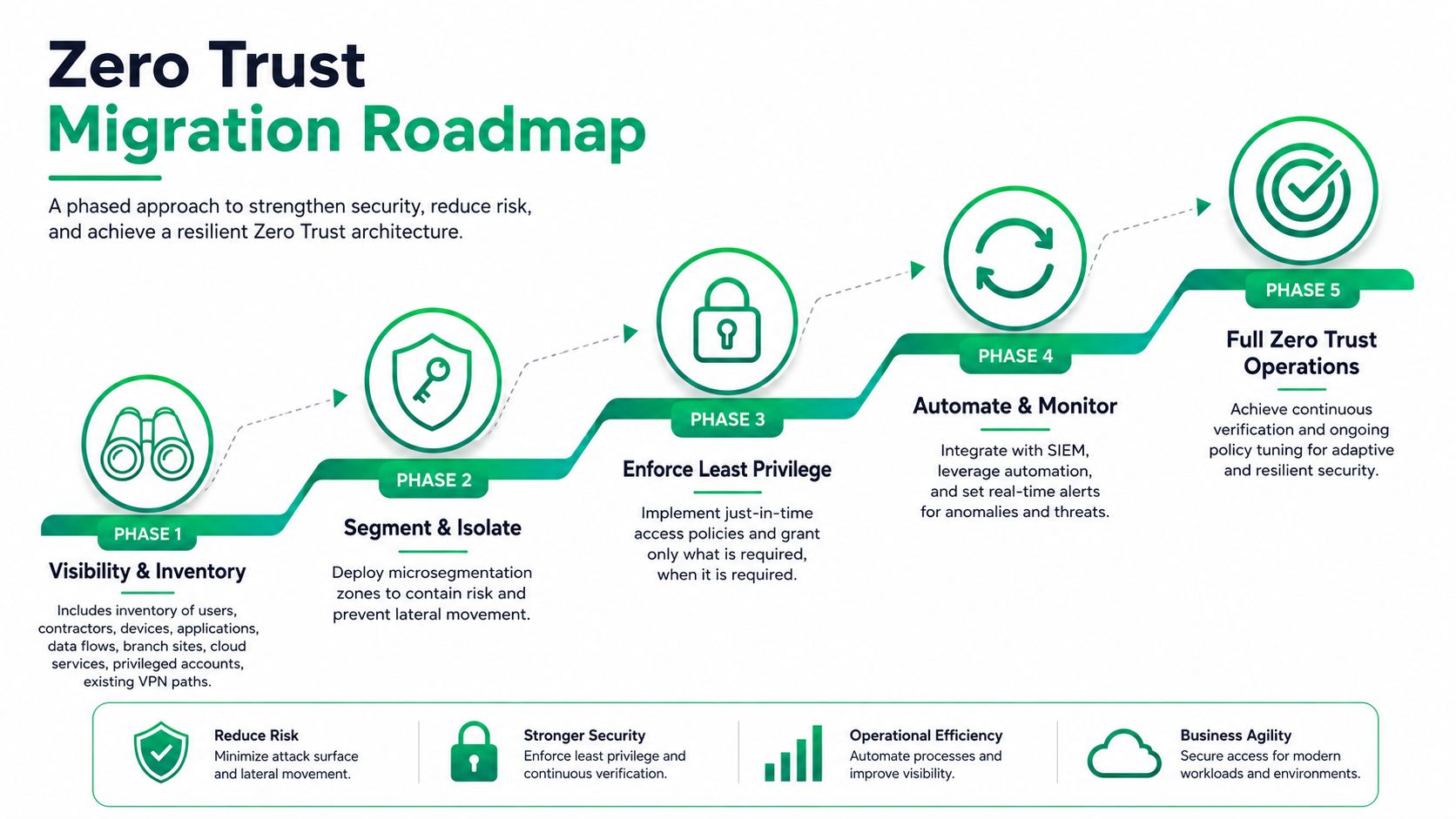
Phases four and five expand carefully
Pilot one department or private application. Measure sign-in failures, support tickets, policy exceptions, application response, and access that users still require. Then expand from remote access to SaaS applications, internal applications, and east-west traffic.
Keep a tested fallback path and communicate changes before employees encounter them. Review orphaned accounts, unused permissions, broken dependencies, and vendor access every month. An Indiana business planning broader modernization can use this Indiana business IT roadmap to connect security work with infrastructure and continuity priorities.
The NIST sequence matters here. NIST published SP 800-207 on August 11, 2020, after draft releases on September 23, 2019 and February 13, 2020, creating a formal reference point for zero trust architecture. That progression shows why a phased program is more durable than a rushed product purchase. NIST SP 800-207 defines the logical components that organizations can adapt to existing environments.
Benefits for Business Continuity and ROI
The business value appears when an access decision fails safely. A Greenwood medical office may need a contractor to use one scheduling application, but that contractor doesn't need visibility into patient records, file servers, or backup infrastructure. A policy that blocks the wrong application while permitting the approved workflow protects both care delivery and security.
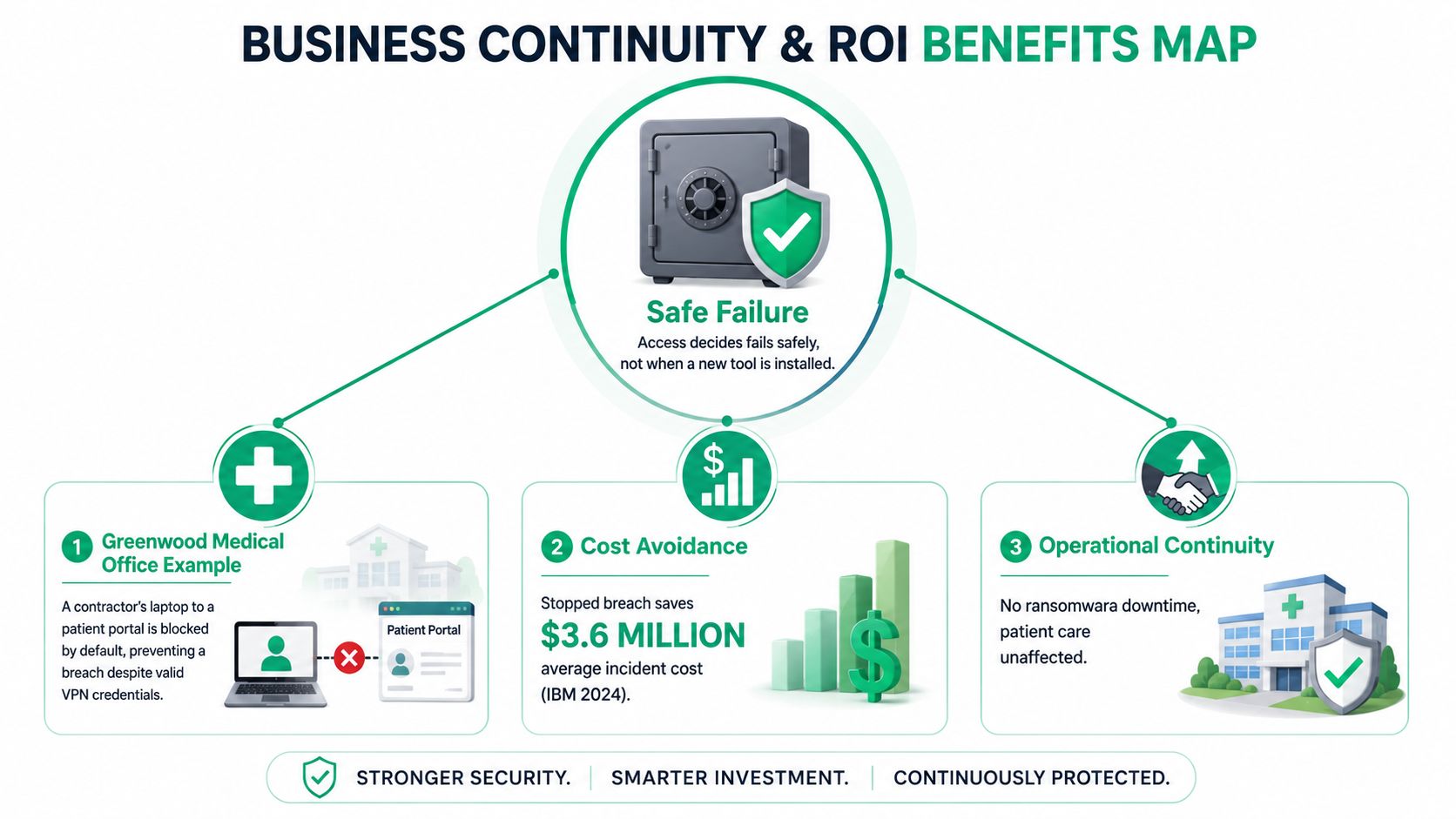
Microsegmentation can contain ransomware between office systems, cloud applications, and backup infrastructure. Monitoring supplies evidence for incident response, HIPAA reviews, CMMC preparation, NIST CSF governance, and cyber-insurance questionnaires. Immutable off-site backups add a separate recovery layer, but they must remain restorable when production identity systems or network policies are unavailable.
Business continuity planning should include:
- Break-glass access: Maintain emergency accounts with controlled storage, monitoring, and a documented approval process.
- Identity-provider resilience: Test what happens if the identity provider, MFA service, or primary internet connection is unavailable.
- Independent recovery: Keep backup administration and restoration paths separate from ordinary production permissions.
- Operational measurement: Track access reviews, denied-request patterns, recovery tests, and the time required to remove a former employee or vendor.
- Work-hour recovery: Reduce repetitive access reconciliation and avoid sending technicians into emergency troubleshooting when a policy can prevent the incident.
Zero trust won't automatically reduce every software license or eliminate every response expense. It can reduce broad VPN dependency, shorten investigation paths, limit the scope of a compromised account, and convert wasted technology time into productive or billable hours. Predictable monthly budgets become easier to manage when the business replaces surprise incident work with scheduled reviews, monitoring, maintenance, and tested recovery.
The trade-off is real. Identity cleanup, endpoint readiness, policy governance, staff training, and application testing require budget and attention before the controls produce visible savings. The strongest return comes from measuring whether the organization can deny unsafe access without denying normal work, then proving it through recovery exercises.
Watch the operational argument in context before selecting a platform:
Operating Zero Trust Without Policy Drift
Zero trust breaks down when yesterday's rule survives after an employee, contractor, application, or business process changes.
A Carmel accounting firm encountered this during a scheduled review. A contractor rule created for tax-season support still reached a production database after the engagement ended. The rule looked reasonable by itself, but the identity roster and application requirement had changed. A policy review found the mismatch before the stale permission became an incident.
Three misconceptions create much of this drift:
- Zero trust means zero access: Employees and vendors still receive access. Each permission should be specific, justified, observable, and easy to change.
- One dashboard solves governance: A dashboard displays events. It cannot determine whether a business owner still approves an exception or whether an application dependency remains legitimate.
- Cloud defaults match internal policy: AWS, Azure, Microsoft 365, and SaaS platforms provide useful controls, but their defaults do not automatically reflect HIPAA, CMMC, PCI, or company-specific requirements.
A practical drift-control routine
Use SCIM-driven provisioning where supported, so approved identity changes reach applications without manual account creation. Run quarterly access recertification against the current employee list, contractor roster, SaaS footprint, device inventory, and privileged roles. Review deny-by-default segmentation after network, application, or production changes.
Maintain an exception register listing the owner, business reason, affected resource, compensating control, and sunset date. An exception without an expiration date can become permanent policy through neglect. Tie evidence collection to audit cycles, keeping logs, approvals, access reviews, recovery tests, and incident drills ready when an insurer, customer, or auditor requests them.
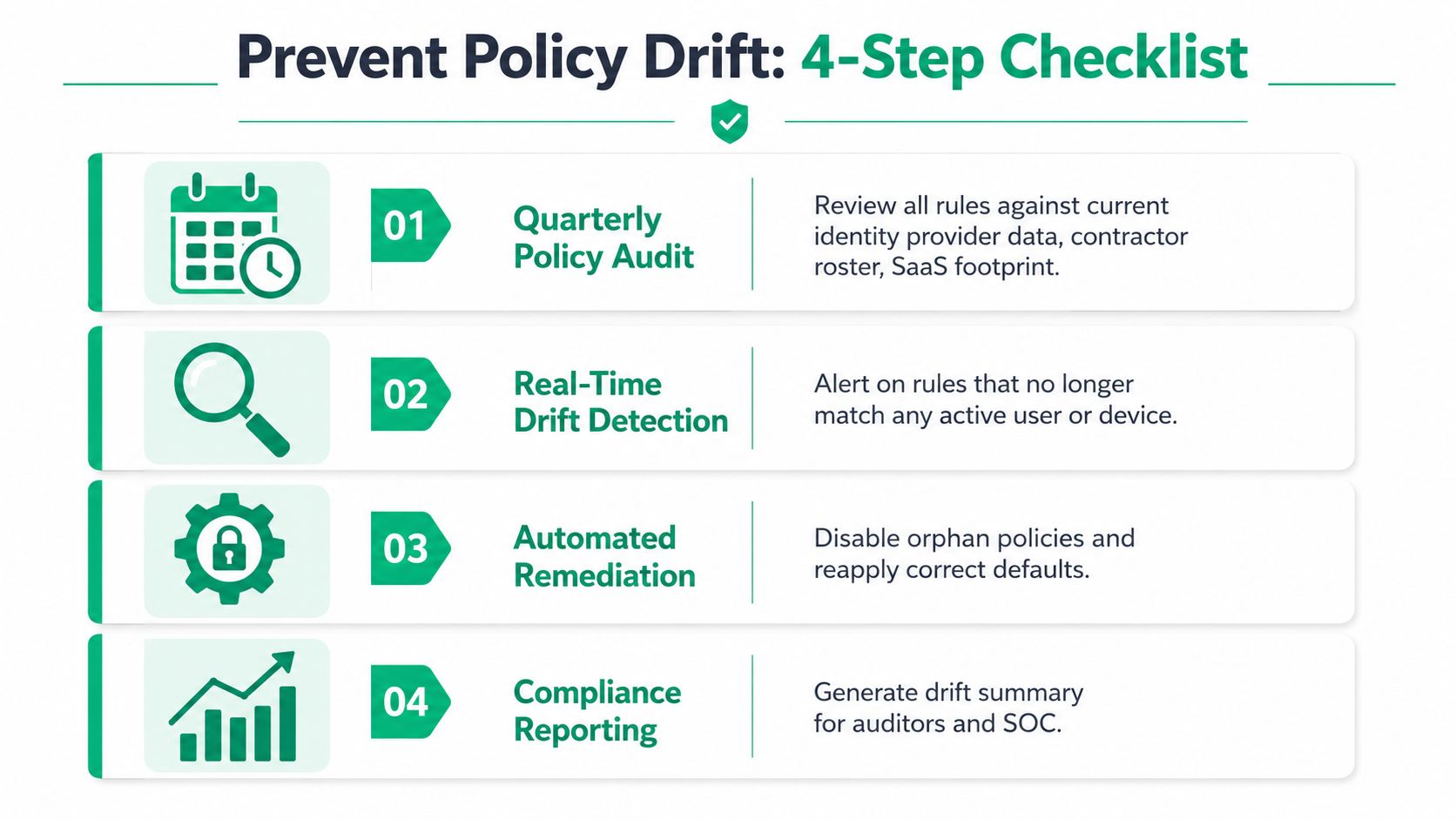
The operator's recurring checklist
- Reconcile identities, devices, service accounts, vendors, and privileged access.
- Test microsegmentation from representative endpoints and workloads.
- Set latency budgets for authentication, policy evaluation, and application connections.
- Verify logging from identity, endpoint, firewall, cloud, and SaaS controls.
- Drill incident response, including break-glass use and backup restoration.
- Remove orphaned policies and close exceptions that no longer support a business process.
Dynamic workloads require the same discipline. Ephemeral containers, serverless functions, SaaS and API dependencies, and third-party integrations can change faster than static network rules. Identity controls remain important because credential abuse contributes to breaches, as noted earlier, but credentials alone do not establish trust for a changing workload.
NIST's cloud-native guidance recommends coordinating network-tier and identity-tier policies, gateways, service identities, and authentication and authorization tokens through central infrastructure. NIST SP 800-207A also supports granular application-level policies. That approach helps a business maintain one coherent policy across office networks, cloud applications, hybrid infrastructure, SaaS platforms, and third-party access instead of copying disconnected rules into every location.
Businesses in Greenwood and Indianapolis can schedule a Free Network Assessment or Security Risk Audit with Finchum Fixes IT to map users, cloud applications, vendors, segmentation, recovery paths, and policy gaps. The assessment can become a phased zero trust plan with managed monitoring, immutable off-site backups, and controls designed to protect uptime without slowing an I-65 corridor business down.