A Business Owner's Guide to Mobile App Development in Indiana
TL;DR: The Bottom Line Up Front
A custom mobile app is not a tech luxury; it's a strategic tool for Indiana businesses to stop operational downtime, which can cost up to $9,000 per minute. By automating manual tasks—like a Fishers contractor's paperwork or a Greenwood service company's dispatch—an app converts wasted tech time into billable hours and predictable revenue. This guide explains how to plan, build, and secure an app that delivers a clear ROI. We cover everything from budgeting and choosing the right local partner to implementing military-grade security like Zero Trust architecture and ensuring HIPAA or CMMC compliance. The goal is to build a tool that fixes your specific operational bottlenecks and provides a measurable financial return.
Let's be honest, building a mobile app for your business isn't about looking cool or chasing the latest tech trend. It's a strategic move to plug the leaks in your daily operations—leaks that are quietly draining your profits. Think of a custom app not as a fancy new expense, but as a powerful engine built to turn wasted administrative hours into billable work and predictable revenue.
Why Your Indiana Business Needs a Mobile App Now
If you're running a business anywhere along the I-65 corridor, I can almost guarantee you're losing money to processes that belong in a museum. It’s the technician sitting in his truck in a Johnson County business park, filling out paper forms by hand. It’s the manager trying to wrangle three different spreadsheets just to create a weekly schedule. It’s your sales team fumbling for answers because they can't check inventory on the spot. This isn't just a minor headache; it's a hole in your wallet.
Putting off a mobile solution means you're actively choosing to be less efficient. Every single day your team is stuck with clunky, manual tasks is a day full of lost time—hours that could have been spent serving another customer or closing one more deal. Downtime from these inefficiencies can cost up to $9,000 per minute, turning "wasted tech time" into a major financial drain.
The Southside Problem-Solution: A Fishers Contractor's Paperwork Nightmare
Picture a thriving contractor in Fishers. They’re good at what they do, and the jobs are rolling in. The problem? They’re drowning in paper. Every job kicks off a tidal wave of physical work orders, change order forms, and sign-off sheets. This is a classic technical bottleneck we see all over the Indy metro area.
At the end of a long day, their technicians have to drive all the way back to the office just to dump a pile of paper on a desk. Then, someone in the office has to burn hours deciphering handwriting and punching all that information into a computer.
We’ve been helping local businesses for 17 years, and this is a story we've heard a hundred times. That time spent shuffling paper and driving back and forth isn't just unproductive; it’s a roadblock that actively stops the company from taking on more work and making more money.
A custom-built mobile app solves this mess for good. A technician can pull up the next job, fill out a digital form, get the customer’s signature on the screen, and submit it all from their phone before they even pull away from the curb. The data zips directly to the office, kicking off the invoice and payroll process automatically.
Look at what this one simple change does:
- Buys Back Billable Hours: Technicians easily get back an hour or more every day. That's time for another service call, directly boosting revenue.
- Kills Costly Errors: No more typos from manual data entry, which means no more billing arguments or payment delays.
- Speeds Up Your Cash Flow: Invoices can go out the very same day the work is done, not a week later when the paperwork finally gets processed.
The result isn't just a shiny new app. It's a more productive team, healthier cash flow, and a serious competitive edge in the crowded Central Indiana market. You get a direct, measurable return on your investment by converting wasted hours into profit.
Your App's Journey from Idea to Launch
Turning a brilliant idea into a working mobile app isn't some dark art—it’s a step-by-step process. For any Indiana business owner, knowing this process is the best way to avoid expensive mistakes. Let’s bring this down to earth with another common Southside Problem-Solution scenario: chaotic technician scheduling for a Greenwood service company dealing with aging server hardware.
You can probably picture the daily mess. The office manager is juggling phone calls from an old brick building with spotty Wi-Fi, frantic texts, and a whiteboard that looks like a crime scene map just to get technicians dispatched. This old-school approach leads to missed appointments, wasted gas on bad routes, and a constant stream of "Where are you?" calls that torpedo productivity. A custom mobile app is the clear solution, but getting it right means following a solid roadmap.
Starting with a Solid Blueprint
The first step has nothing to do with code. It's all about listening. We start by mapping out every single detail of how you work right now. For our Greenwood company, that means sitting with the dispatchers and even riding shotgun with the technicians.
We dig in with real-world questions:
- What exact info does a tech need for each job?
- How do they currently signal that a job is done?
- What’s the step-by-step process for creating and sending an invoice from the field?
This kind of deep dive makes sure the app we build solves your actual problems, not just the ones we might guess you have. From there, we design a user experience (UX) that’s dead simple. The goal is an app so intuitive that a technician stuck in traffic on the I-65 corridor can figure it out in minutes, no instruction manual needed.
This planning phase is everything. Getting a handle on the Software Development Life Cycle is a must for any business starting this journey, as it gives you the structure to turn an idea into a real, working product.
The "How": Choosing the Right Tools for the Job
With a clear plan in hand, we can finally talk tech. One of the first big decisions is whether to build a native app (one for iPhones, another for Androids) or a cross-platform app (one codebase for both). For our Greenwood service company, a cross-platform approach using something like React Native usually hits the sweet spot. It's quicker to build and simpler to maintain, which means it costs your business less. Simple as that.
Next up is the tech stack—the database, the backend programming language, the cloud services. We build on scalable cloud backends, which is a way of saying your app can handle two technicians or two hundred without breaking a sweat. This isn't just "geek with a screwdriver" work; it involves high-level architecture.
In our 17 years of helping Central Indiana businesses, we've seen what happens when you rush the process. When we dissembled a similar client’s failing RAID array, we found the root cause wasn't hardware failure but a poorly designed app overwhelming the system. A methodical, 'measure twice, cut once' approach from day one is the only way to get a real return on your investment.
Connecting the Dots with Secure Integrations
The real magic of a business app is how it talks to the systems you already use. We use secure Application Programming Interfaces (APIs) to build a seamless data highway between them. For our Greenwood client, this means their new mobile app would plug right into their accounting software.
This diagram shows just how powerful that transition is—moving from messy paperwork to a smooth, revenue-generating machine.
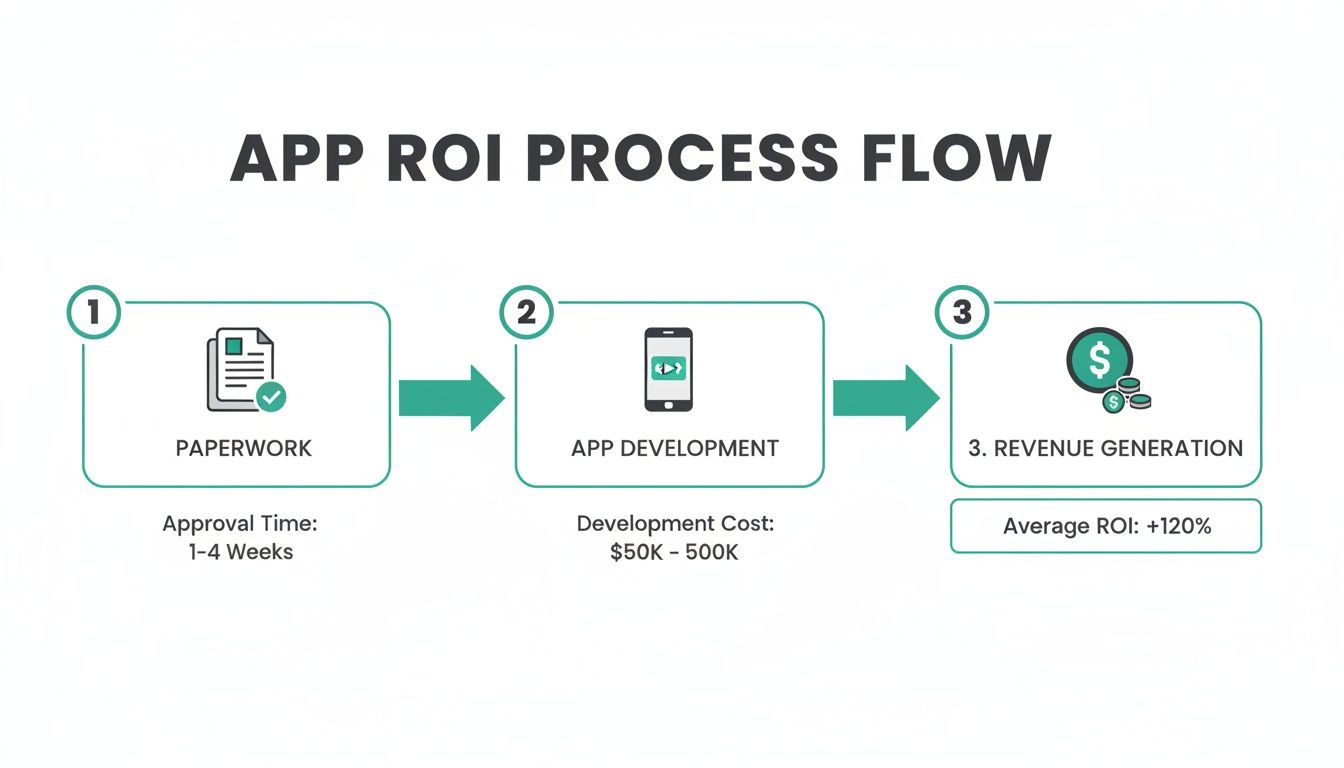
When a technician taps "complete" on a job, the API automatically generates an invoice in the accounting system. No more manual data entry, no more delays, and no more costly human errors. This is how a well-built app doesn't just put a digital wrapper on your old process; it creates a brand new, and far more profitable, one.
If you want to dig deeper into this structured process, check out our guide on choosing software development life cycle models for Indiana businesses.
Protecting Your Business with Fortified App Security
Let's talk about the one thing that can make or break your entire mobile app project: security. It’s not just a box to check off a list; it’s the foundation. One tiny crack in your app's armor can lead to a full-blown disaster, from leaking your customers' private data to grinding your operations to a halt. For Indiana businesses, a security failure isn't just a technical problem—it's a threat to your reputation and your bottom line.
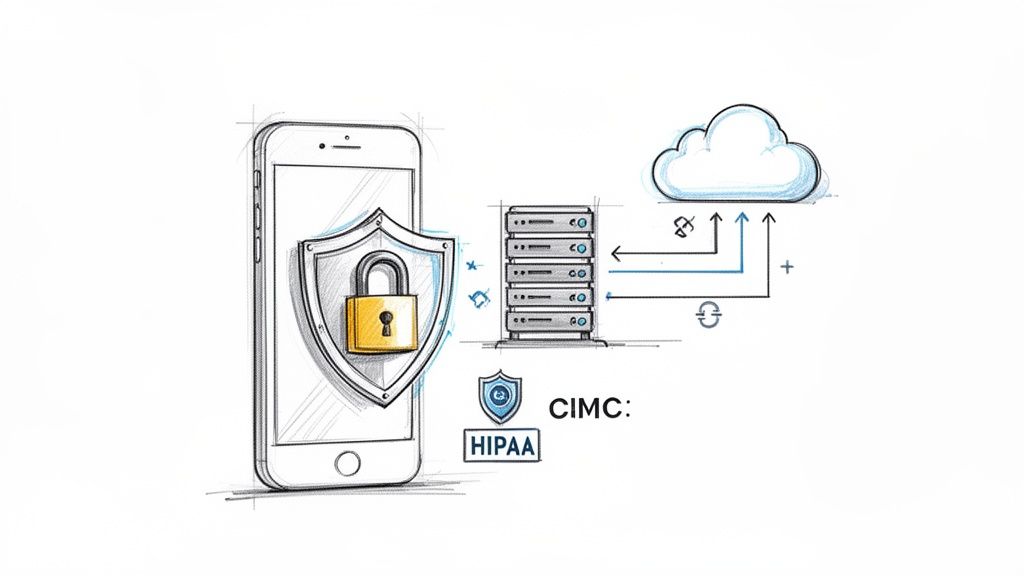
Think about it. A healthcare provider in a Hamilton County growth area has entirely different security needs than a defense contractor near the Crane Naval Surface Warfare Center. One needs an app that's HIPAA-compliant from the first line of code to protect patient privacy. The other won't even get a foot in the door without meeting the military-grade standards of CMMC (Cybersecurity Maturity Model Certification).
We get this because we live and breathe this stuff. We don't slap a generic security sticker from Bitdefender GravityZone on your app. We build it from the ground up to meet your specific rules and regulations, adhering to frameworks like the NIST CSF.
The "How": Implementing a Zero Trust Architecture
The old way of thinking about security was like a castle with a moat. Once you were inside the walls, you were trusted and could roam freely. Frankly, that’s an outdated model just waiting to be exploited. We build apps using a Zero Trust architecture, and the name says it all: we trust nothing and no one by default.
The philosophy is simple but incredibly effective: verify, then trust. And then verify again.
- Strict Identity Checks: Every single time a user or device tries to access anything, they have to prove who they are. No exceptions.
- Least-Privilege Access: We operate on a "need-to-know" basis. Users only get access to the bare minimum data and functions required for their job. A field tech doesn’t need your company’s financial data, so the app won't even show it as an option.
- Micro-segmentation: We build digital bulkheads into your app's network. If a breach happens in one area, it’s sealed off and can't spread to infect other critical systems.
This isn’t just about stopping hackers from getting in; it's about making it nearly impossible for them to do any real damage if they somehow do. It protects you from outside attacks and internal threats alike, preventing downtime and keeping your business running.
Secure Coding Is Non-Negotiable
A beautiful app with Swiss cheese for code is worthless. Most data breaches aren't the work of a genius hacker in a dark room; they're the result of someone exploiting sloppy, rushed code. That’s why we bake secure coding practices into our process from the very start.
In our 17 years of local service, we've seen firsthand how a single, poorly written line of code in an app can shatter a business's reputation overnight. We aren't just developers; we're your first line of defense against the financial and reputational damage of a data breach.
Our team is trained to write code that inherently fights back against common attacks like SQL injection and cross-site scripting. We then hammer on that code with rigorous reviews and penetration testing to find and plug any holes before your app ever sees the light of day. If you want a better grasp of the current threats, check out these essential cybersecurity tips for small business owners in Indiana.
This obsessive attention to detail doesn't stop once the app is launched. Through our SOC-as-a-Service (Security Operations Center) monitoring, we provide 24/7 threat hunting. The moment our systems flag suspicious activity, our team is on it, neutralizing the threat before it can cause downtime and disrupt your business.
Budgeting for Your Mobile App Investment
Alright, let's get to the question every Johnson County business owner asks right out of the gate: "So, what's this actually going to cost?" It’s the elephant in the room, and you deserve a straight answer, not some vague number scribbled on a napkin. We believe in talking about budgets openly, like we're mapping out a plan over coffee.
An app isn't just an expense; it’s an investment in your business continuity. A smart investment upfront is your best defense against the staggering cost of operational downtime, which can hit an unbelievable $9,000 per minute. This is about turning wasted hours fiddling with bad tech into productive, billable work and a predictable monthly budget for IT.
What Drives the Cost
The final price tag on a custom app comes down to complexity. I like to think of it like building a custom vehicle. Are we building a simple, rugged work truck just for your internal team? Or are we designing a high-performance sports car for the public, loaded with every feature imaginable?
The main things that will shape your budget are:
- The Bells and Whistles: Every feature you add, from user logins and payment gateways to real-time GPS tracking, adds to the development timeline and, naturally, the cost.
- iOS vs. Android (or Both): Building for a single platform is the most straightforward. Creating two separate native apps is more involved, while a cross-platform build can be a great middle-ground.
- Connecting to Your Systems: If you need the app to talk to your existing accounting software, CRM, or inventory system, that requires careful, secure API integration work.
- Security and Compliance: There's a world of difference between a simple internal checklist app and one that needs to be HIPAA or CMMC compliant to handle sensitive data.
If you really want to get into the nitty-gritty of what influences these figures, there are some great resources that break down how much does app development cost in detail.
From Cost Center to Profit Center: Calculating the ROI
Here's the most important mindset shift: stop seeing an app as a cost. A well-built business app is an efficiency engine that pays for itself, often faster than you’d think.
Take this real-world example. A $50,000 investment in a custom field service app allowed a local company’s five technicians to complete just one extra job per day. At $100 profit per job, that’s an extra $500 in their pocket every single day. That adds up to $2,500 a week, meaning the app completely paid for itself in just 20 weeks. After that? It's a pure profit-generating machine, turning wasted time into billable hours.
This isn't just a hypothetical. We've seen this kind of math play out for businesses right here in the Indianapolis area. It's about making smart investments that deliver predictable, measurable returns. For more context on structuring IT investments, our guide on the real managed IT services cost in Indiana offers some valuable perspective.
To give you a clearer picture, we've put together some ballpark figures for different types of business apps.
Sample Mobile App Development Cost and Timeline Estimates
This table gives you a starting point for what to expect. Think of these as common investment ranges that show how an app's complexity affects both the budget and the calendar.
| App Type | Description | Estimated Cost Range | Estimated Timeline |
|---|---|---|---|
| Simple Internal Tool | A single-purpose app for your team, like a digital checklist or a basic data entry form. Minimalist design with no complex integrations. | $25,000 - $50,000 | 2-4 Months |
| Field Service App | An app for technicians in the field, featuring job scheduling, customer data, digital forms, signature capture, and integration with office systems. | $50,000 - $125,000 | 4-8 Months |
| Complex E-commerce App | A customer-facing app with user profiles, a full product catalog, secure payment processing, and integrations with inventory and shipping. | $125,000 - $250,000+ | 8-12+ Months |
Of course, these are just estimates. The true cost and timeline will always depend on your unique needs, but this should help you frame your initial conversations and planning.
Finding the Right App Development Partner in Indiana
Picking a partner for your mobile app development for business is one of those gut-check decisions. For business owners in Johnson and Marion County, this is where the rubber meets the road. It's the difference between a tool that actually makes you money and a frustrating, expensive science project.
Frankly, it's about learning to spot the difference between a "geek with a screwdriver" and a true enterprise-grade partner.
A good partner doesn't just sling code; they get in the trenches with you to understand your business. They ask the tough questions and are just as obsessed with your ROI as you are. They should have a real track record right here in Central Indiana and be able to show you successful projects with businesses you might even know.
This isn't about chasing the lowest bid. It’s about finding a team that can build something solid—an app that prevents downtime, makes your team more efficient, and turns wasted tech time into billable hours.
Beyond the Code: What Really Matters
When you’re talking to potential developers, you have to cut through the sales fluff and zero in on what will actually determine success or failure. We've seen it all, and it almost always boils down to these three things.
- Proven Local Experience: Do they understand the unique headaches of a logistics company running the I-65 corridor? Or the growth challenges of a services firm in a Hamilton County growth area? Have they actually been inside a business like yours?
- Deep Compliance Knowledge: A real pro knows that compliance isn't just a box to check at the end. They should speak your language, whether it's NIST CSF for securing your business, HIPAA for handling patient data, or CMMC for defense contracts.
- Technical Integration Chops: Can they make your new app talk to your old systems without everything crashing? We're talking about everything from your UniFi networking equipment to the aging server hardware humming in your closet.
We once had to bail out a client in a downtown Indy tech hub whose developer literally vanished. They were left with a mission-critical app, a completely undocumented API, and no way to update it. After 17 years of serving local businesses, nothing surprises us. We had to reverse-engineer the entire system from bit-level data just to make a simple change. It was a costly, time-sucking disaster that was 100% avoidable.
The Gritty Value of a Local Expert
In a world of remote teams and offshore call centers, it's tempting to think a developer is a developer, no matter their zip code. This is a massive mistake. When your app is the backbone of your daily operations, you need someone who can be there—actually be there—when things go sideways.
Think about it. Your field service app goes down on the busiest Friday of the month. Do you want to be filling out a support ticket for a faceless company halfway around the world? Or do you want to call a person you know by name, who's just a short drive away?
Here's what that Central Indiana authority really gets you:
- Real Accountability: You know who we are, and you know where to find us. No hiding behind an email address.
- Faster Response: We're in your time zone. We can be on-site in your Greenwood office when a problem can't be solved over the phone.
- Deeper Understanding: We don't just work in the local business climate—we live in it. We get the specific challenges facing Johnson County business owners.
Building a business app is a serious investment. You need more than a coder; you need a strategic partner who will provide the guidance and long-term support to make sure that investment pays off for years to come. To see exactly how we approach these projects, check out our custom software development services.
Measuring App Success and Ensuring Long-Term Value
So, your shiny new app is live. Pop the champagne? Not so fast. Getting the app into the hands of your team or customers is the starting line, not the finish. The real work is making sure this tool actually makes your Indiana business money for years to come.
This isn't about chasing vanity metrics like download counts. It's about measuring what truly matters to your bottom line.
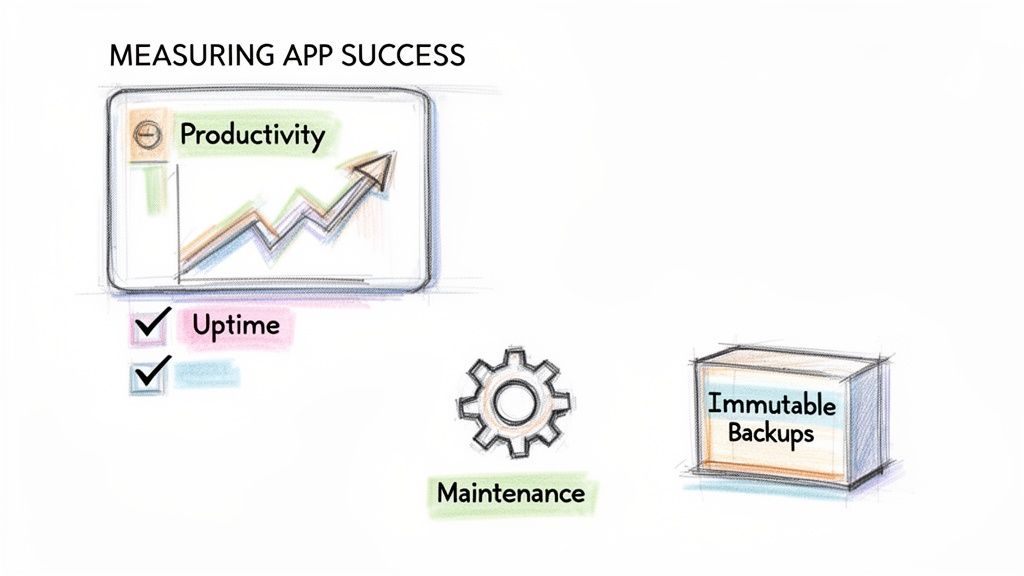
This final, crucial step in your mobile app development for business journey is what separates a one-time expense from a powerhouse investment. A well-supported app avoids catastrophic downtime, which can drain a business by as much as $9,000 per minute. It's an investment that keeps paying you back.
Tracking the Metrics That Matter
We’ll help you ignore the noise and focus on the key performance indicators (KPIs) that show a direct impact. Forget abstract numbers; we’re talking about tangible results you can see in your daily work and feel in your bank account.
- Productivity Gains: Are your field techs finishing more jobs each day? We can build in analytics to track how long jobs take, how much time is spent on the road, and how long paperwork takes. You’ll see exactly how many hours the app is saving your team.
- Reduced Operational Errors: How many invoicing mistakes or incorrect supply orders did you have last month? We track the "oops" moments. A drop in these errors means less time cleaning up messes and more satisfied customers.
- Increased Customer Orders: If the app is for your customers, we're watching conversion rates, average order values, and how often they come back to buy again. This proves the app is directly generating fresh revenue.
- Higher Client Satisfaction: We'll keep an eye on app store reviews, how many support tickets you're getting, and direct customer feedback. A smooth, helpful app builds a rock-solid reputation across Central Indiana.
The Critical Role of Ongoing Support
Here’s a hard truth: an app is not a Crock-Pot you can "set and forget." It's a living, breathing piece of software that needs regular care to keep performing and protect your investment. Without proactive maintenance, your app will eventually break, and all that productivity and revenue will grind to a halt.
In our 17 years of serving local businesses, we’ve seen the fallout from developers who disappear after launch day. A new iOS or Android update rolls out, their app crashes, and they have absolutely no one to call. That’s why we consider support a core part of the project, not some optional add-on.
Our ongoing support makes sure your app stays secure, functional, and effective, no matter what comes next.
Business Continuity and Data Protection A huge—and often forgotten—part of long-term value is protecting the data your app creates. Think about it: customer lists, job histories, financial records. This is the lifeblood of your business. We shield it with immutable off-site backups.
Put simply, we create unchangeable copies of your data and store them in a totally separate, secure location. If a disaster hits your Greenwood office—from a fried server to a ransomware attack—your app’s data is safe and can be restored in a snap. This is bit-level data recovery at its best, and it's the ultimate safety net for your digital operations. To build a solid foundation from the start, check out these top 10 best practices for software development.
Your App Development Questions, Answered—The No-Nonsense Edition
Over the years, we've heard just about every question in the book from Indiana business owners curious about mobile apps. We figured it was time to put the most common ones in one place and give you the straight-talk answers you’re looking for.
How Long Does This Actually Take?
This is the big one, isn't it? The honest answer is: it depends. Think of it like building a custom home.
- A simple, internal tool—say, a digital safety checklist for your crew—is like a tidy ranch home. You’re looking at 2-4 months.
- A more involved app, like one for field service techs that handles scheduling and pulls up customer history, is more of a two-story build. That’ll probably take 4-8 months.
- A full-blown, customer-facing e-commerce app with all the bells and whistles? That’s your custom mansion on Geist. Expect that to be in the 8-12 month range, or even longer.
Every feature you add—payment gateways, connections to other software, or strict HIPAA compliance—adds another room to the house, extending the timeline. We’ll map it all out beforehand so there are no surprises.
Can a New App Talk to My Old Software?
Not only can it, but it must. The last thing you need is another island of data that doesn't connect to anything else. That just creates more work.
We do this using what are called API integrations. It’s like building a secure, private bridge between your new app and your existing systems, whether it's your accounting software, CRM, or even your UniFi networking gear.
For example, a logistics company running up and down the I-65 corridor needs its new driver app to feed data directly into its dispatching platform. Without that connection, someone is stuck typing the same information into two different screens, which is just asking for mistakes and wasted time.
With 17 years of local service under our belts, we've untangled some real spaghetti messes. We’ve seen beautiful new apps fail because they couldn't communicate with a company's older servers, creating more headaches than they solved. Making sure all your tech plays nicely together from day one is a huge part of what we do.
What Happens if My App Breaks or Needs an Update?
An app isn’t a toaster oven you buy and forget about. It's a living piece of software that needs attention. When Apple or Google pushes a major operating system update, it can sometimes throw a wrench in the works for apps that aren't prepared for it.
That's where ongoing support comes in. It’s your business continuity insurance.
Our support plans cover the essentials: squashing bugs, patching security vulnerabilities, and updating the app to keep it humming along on the latest devices. We also maintain immutable off-site backups of your application and its data. So, if a tornado hits your office or a server gives up the ghost, your information is safe and sound, ready to be restored so you can get back to work.
Your business deserves a tool that actually fixes problems instead of creating new ones. The team at Finchum Fixes IT has been building custom software and solving tech headaches for businesses in Greenwood, Indianapolis, and the surrounding areas for years.
Ready to see how a mobile app could eliminate downtime and convert wasted tech time into billable hours? Schedule a Free Network Assessment with our team today. We’ll take a look under the hood of your current workflow and give you a no-nonsense plan for businesses in the Greenwood/Indianapolis area.