Endpoint Protection Service: An Indiana SMB Guide
A Friday afternoon in Greenwood, an employee opens a phishing attachment, a scheduling server starts misbehaving, and the office manager discovers that nobody is watching the security console. An endpoint protection service combines device-level software with continuous monitoring and human response, so the attack can be contained before it becomes a business shutdown.
Aging servers in a Greenwood business park, mixed Windows and macOS laptops, remote contractors, and unreliable Wi-Fi in old brick buildings create the same problem across the I-65 corridor. Many Indiana SMBs have antivirus installed, but they don't have verified coverage, tuned policies, or someone responsible for the alert at 2 AM.
I treat endpoint protection as operational insurance. The question isn't whether a dashboard looks polished. It's whether your team can keep working, protect patient or contract data, and turn wasted tech time into billable hours under a predictable monthly budget.
What an Endpoint Protection Service Actually Does
A four-operatory dental practice near Smith Valley Road loses access to its scheduling and imaging servers after an employee opens a phishing attachment. The affected laptop begins encrypting files, but the endpoint protection service isolates it, stops the encryption process, blocks attempted movement toward the server, and alerts a technician while the office manager is still trying to understand what happened.
That response is the difference between a contained endpoint incident and a practice-wide outage. The service watches laptops, desktops, servers, mobile devices, and other connected equipment. It applies security policies, detects suspicious behavior, gathers evidence, and gives a human responder the tools to isolate the device and guide recovery.
Software is only half the service
The agent installed on each endpoint is the sensor and first line of defense. It can inspect process creation, command lines, file writes, registry changes, and network connections, creating telemetry that supports investigation and response. Modern systems don't rely only on known malware signatures. They look for behavior that resembles credential theft, ransomware, or unauthorized persistence.
The second half is the operating model. Someone must review alerts, decide whether activity is malicious, isolate systems, contact the client, document actions, and verify that remediation worked. A product that generates alerts without ownership is an expensive notification system.
Practical rule: Buy the response process, not just the agent.
That process should connect endpoint protection with identity controls, email security, patching, network controls, and immutable off-site backups. If attackers disable or bypass the endpoint agent, independent telemetry from other security layers can help reveal what happened, as discussed in research on EDR evasion and independent telemetry.
For a useful visual reference, this infographic on data protection strategies from Freeform Company shows how endpoint controls fit into broader data protection planning. Greenwood owners can also review these endpoint security best practices for Indianapolis SMBs before comparing providers.
The business result is straightforward. A protected endpoint is less likely to become the entry point that stops scheduling, shipping, estimating, billing, or production. Endpoint protection converts a chaotic emergency into a managed operating expense.
The Building Blocks Inside Modern Endpoint Protection
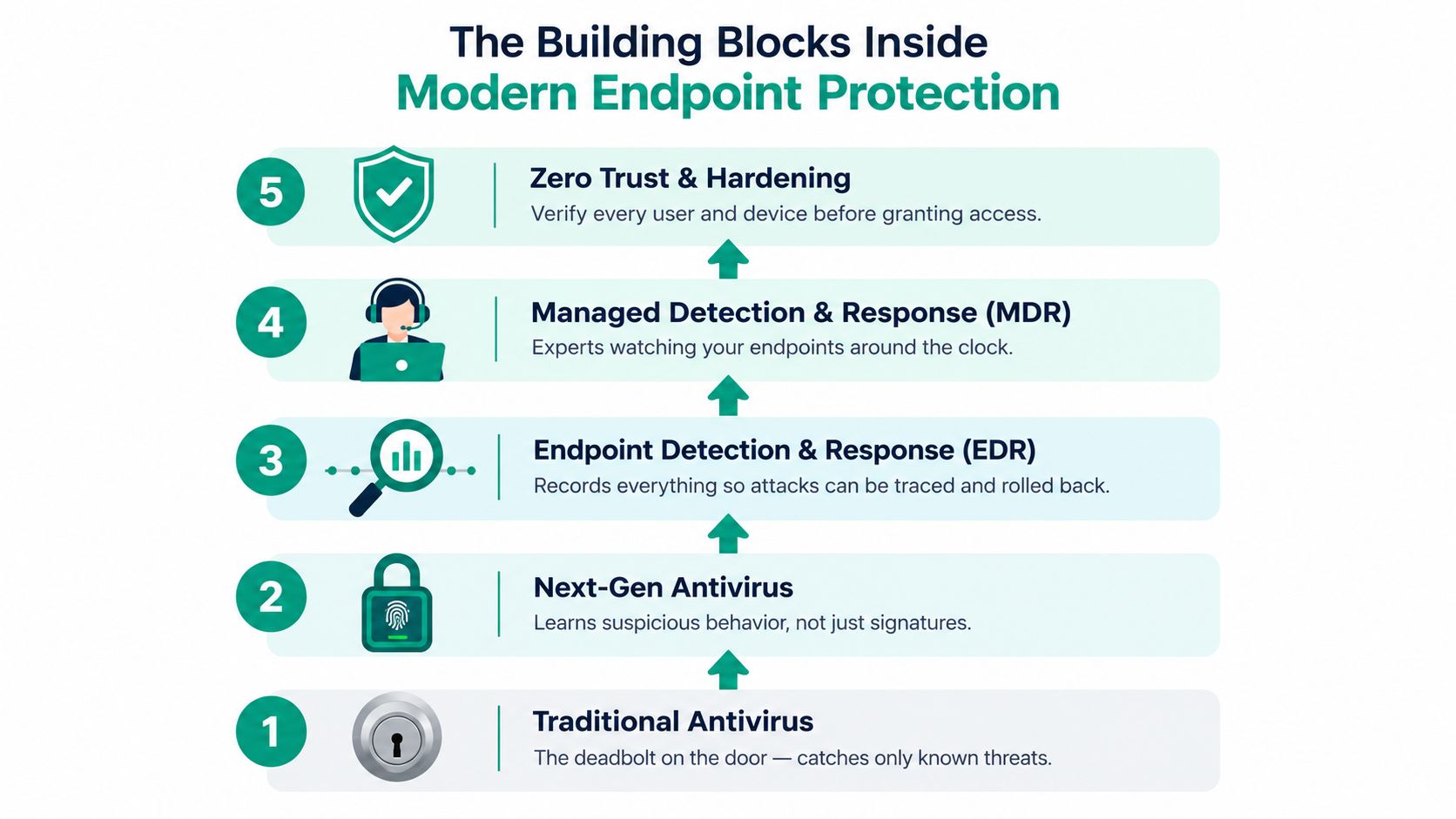
Modern endpoint protection has layers. Each layer solves a different failure, and skipping one usually creates a blind spot.
Start with prevention
Traditional antivirus is the deadbolt. It compares files with known signatures and blocks recognized threats. It still has value, but it won't reliably explain what a never-before-seen script is doing or how a compromised account is moving through the network.
Next-generation antivirus and an Endpoint Protection Platform, or EPP, add behavioral rules and surrounding controls. That can include host firewall enforcement, web filtering, exploit prevention, application control, and device policies. Think of it as a smart lock, camera, and alarm working together rather than a single lock on the front door.
Patch management closes the open windows. An endpoint with an old browser, operating system, or business application can remain exposed even when antivirus is active. Deployment also needs verification. A console saying that a patch was sent isn't proof that the installation completed.
Add detection and people
Endpoint Detection and Response, or EDR, records activity so an analyst can reconstruct an incident. It can show which process launched, what command ran, which files changed, and where the connection went. Analysts can isolate a host, terminate a process, collect forensic details, and investigate related devices.
Managed Detection and Response, or MDR, adds human review and response. That's the security guard watching live footage, reviewing recordings, and calling the building owner when something doesn't fit normal behavior. A managed detection and response guide for Indiana businesses explains why monitoring and response belong in the same conversation.
Extended Detection and Response, or XDR, joins endpoint, email, identity, and network signals. This matters when a phishing message, stolen credential, and suspicious login are parts of the same attack chain.
The final layer is Zero Trust architecture. Every user and device must prove it should access a resource, regardless of whether it sits inside an office or at home. Encryption and device control protect data if a laptop disappears from a vehicle at Greenwood Park Mall.
See how endpoint telemetry works in practice before deciding what your office needs:
During a real attack, the layers stack. Web filtering blocks the malicious page, EPP flags the downloaded file, EDR records the process chain, MDR confirms the behavior, identity controls restrict access, and network controls limit spread. No single layer deserves the entire burden.
Managed Versus In-House Endpoint Protection
The financial question starts with interruption, not licensing. Unplanned downtime for larger organizations is commonly estimated at about $9,000 per minute, and the basic calculation is minutes of downtime multiplied by cost per minute, as explained in Atlassian's downtime cost guidance.
That figure isn't a promise about what your Greenwood shop or Johnson County clinic loses. It is a useful framing device. When staff can't access files, scheduling, phones, payment systems, or production tools, payroll continues while billable work stops.
Four criteria matter more than ownership pride
An in-house team gives you direct control, but coverage depends on staffing, skills, holidays, and escalation discipline. A generalist who handles help desk tickets, Microsoft 365 issues, printers, and endpoint alerts can't provide dependable overnight security operations without additional support.
A managed endpoint protection service gives you a defined operating model and a predictable per-device fee. You still need to inspect the contract, escalation path, and exclusions. "Managed" shouldn't mean that alerts disappear into a vendor queue.
| Criterion | Managed Endpoint Service | In-House Endpoint Team |
|---|---|---|
| Cost structure | Predictable monthly per-device budgeting | Separate licensing, staffing, training, and coverage costs |
| Staffing | Provider supplies monitoring and escalation coverage | Employer recruits, retains, and schedules security personnel |
| Response | Contracted workflow with named escalation terms | Depends on who is available and authorized to act |
| Compliance fit | Reporting and evidence collection can be built into the service | Internal team must create, maintain, and present evidence |
The recommendation for most Indiana SMBs
For most SMBs along the I-65 corridor, managed or co-managed protection is the practical choice. A fully in-house model makes sense when the business already has security staff, documented response procedures, and coverage that doesn't collapse outside office hours.
A co-managed arrangement works well when an internal IT lead wants control of policy and user support while an external SOC handles threat monitoring and escalation. A provider should show how its service maps to NIST CSF, HIPAA, or CMMC requirements when those frameworks apply. Sources describing managed programs commonly connect endpoint protection, monitoring, response, and remediation to those frameworks, including NIST CSF and managed security services.
Ask for the response contract in writing. The vendor should define who can isolate a device, who contacts your leadership, how evidence is preserved, and what happens when the alert arrives overnight. A discovery conversation about choosing a managed service provider should produce answers, not a glossy feature list.
The return comes from avoiding idle payroll and emergency recovery. Endpoint protection is part of business continuity because it keeps a security event from becoming an operations event.
Deploying Endpoint Protection Across a Central Indiana Office
A rollout fails when the provider treats every device as identical. A clinic in Whiteland, a machine shop in Franklin, and a professional office near downtown Indy may all use Microsoft 365, but their servers, point-of-sale equipment, bandwidth, and maintenance windows differ.
Build the inventory before installing agents
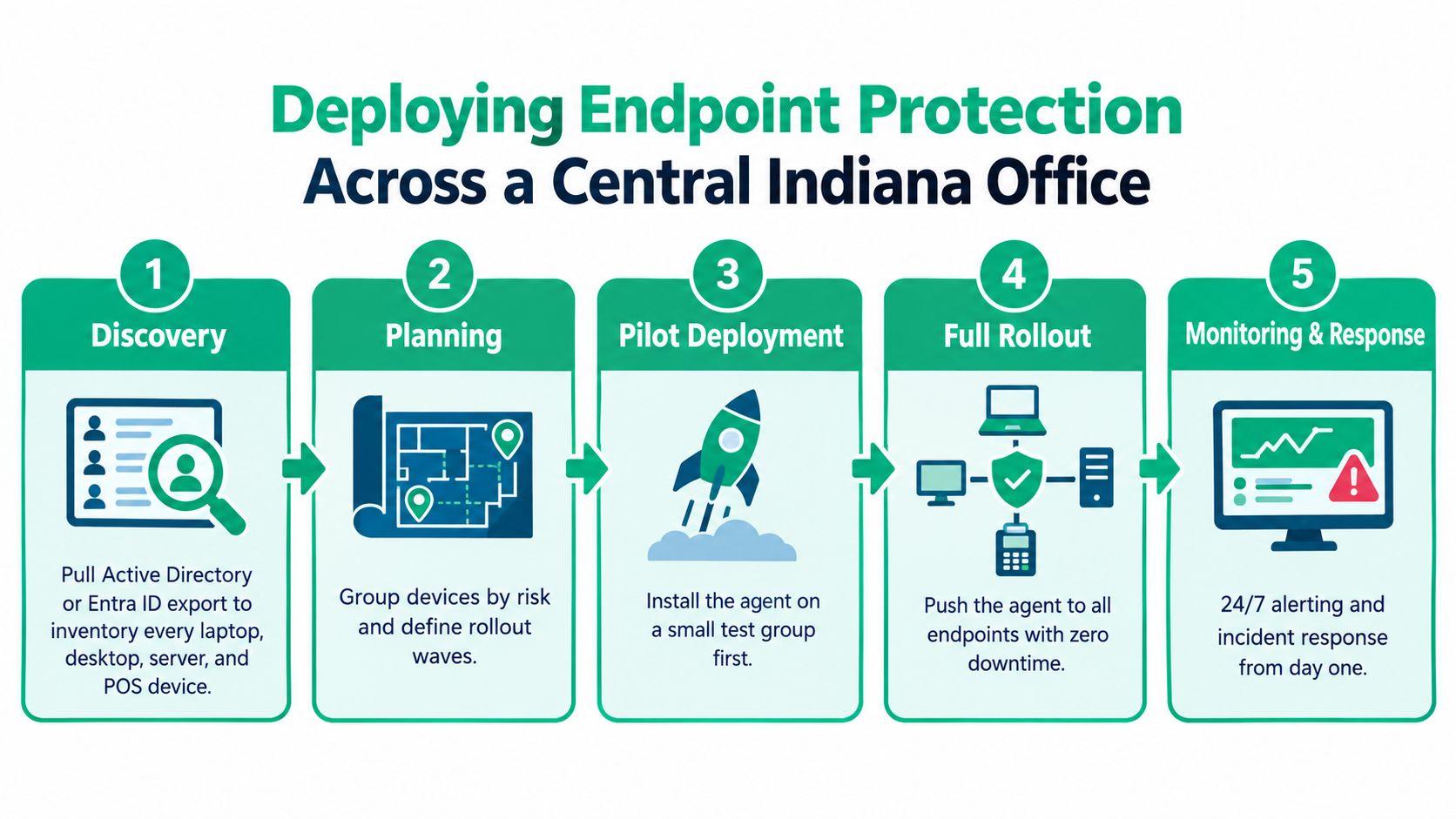
Start with an Active Directory or Entra ID export. Reconcile it against RMM records, Microsoft Intune, network discovery, and the actual equipment in each office. Include laptops, desktops, servers, remote contractor devices, and POS systems.
Then classify devices by operating system, business criticality, ownership, and compatibility. Older domain controllers and line-of-business applications deserve testing before broad deployment. A missing endpoint isn't a minor inventory issue. It's an unmonitored doorway.
Use staged deployment rings
Install the agent on a pilot group of power users first. Select different hardware, operating systems, and work patterns. Confirm that business applications, VPN access, printing, file shares, and performance remain stable.
Push the broader fleet in waves through RMM or Intune. Deploying to every machine at once is a common mistake because one bad exclusion or incompatible agent can affect the whole office. Staging lets the technical team catch the problem while the blast radius remains small.
In a Bitdefender GravityZone-style console, configure separate policy templates by operating system and risk profile. Review ransomware behavior monitoring, web filtering, host firewall settings, device control, tamper protection, and justified exclusions. Every exclusion should have an owner, reason, approval date, and review point.
Identity and network controls complete the rollout. Use Entra ID for identity-aware policy decisions, and pair endpoint telemetry with firewall or DNS filtering. Where office Wi-Fi is weak, UniFi networking and latency-optimized mesh nodes can improve connectivity, but they don't replace endpoint controls.
Test installation bandwidth and compatibility before the maintenance window. That simple check prevents a security project from becoming the outage it was supposed to prevent.
Endpoint Protection and Compliance for Indiana Regulated SMBs
Compliance teams don't need a security dashboard full of green icons. They need evidence showing which devices are protected, which policies apply, what changed, and how the business responded.
For general business security, NIST CSF provides a practical structure for organizing protection, detection, response, and recovery. Endpoint telemetry, patch reports, configuration baselines, isolation records, and remediation tickets can support that structure when the provider retains them consistently.
Healthcare practices along the I-65 corridor have a different exposure. HIPAA requires safeguards around systems handling protected health information, and managed endpoint monitoring can support incident readiness. Device control, audit logs, encryption, and tamper protection should connect to written policies and documented review.
Defense suppliers in Indianapolis and nearby manufacturing communities face CMMC pressures. CMMC Level 2 assessment is tied to the 110 requirements in NIST SP 800-171 Rev. 2, as described in CMMC and endpoint security guidance for managed environments. Endpoint monitoring and malicious-code protection support the technical picture, but a service contract or signed Statement of Work is only one piece of scoping evidence, not a complete certification.
| Framework | Requirement | Endpoint Control That Provides Evidence | Evidence Type |
|---|---|---|---|
| NIST CSF | Identify and protect business devices | Asset inventory, policy baselines, patch management | Inventory export and configuration report |
| HIPAA | Protect systems handling health information | Encryption, device control, monitoring, incident response | Policy record, audit log, incident ticket |
| CMMC Level 2 | Support system monitoring and malicious-code protection | EDR telemetry, anti-malware policy, alert response | Console report, response record, remediation history |
Security and compliance are not interchangeable
A compliant-looking report doesn't guarantee that an attacker can't compromise an account or exploit a missed device. Compliance gives you a framework for control design and evidence. Security requires those controls to work under pressure.
The strongest programs generate screenshots, log exports, configuration baselines, and exception records as part of routine operations. Documented policies plus automated evidence beat a binder of PDFs assembled the week before an audit. For Indiana businesses comparing obligations, compliance and security guidance for Indiana SMBs is a useful starting point.
Choosing the Right Endpoint Protection Service in Indiana
Choose the provider that can explain its response procedure without opening a sales deck. A polished console matters less than a clear answer to this question: who decides what happens when a suspicious process appears at 2 AM?
Ask for proof in the contract
A real service should define alert triage, containment authority, escalation contacts, evidence retention, and client communication. Ask for the response-time SLA in minutes, not vague language such as “next business day.” Read the actual contract language and identify fees for forensic work, emergency changes, and recovery support.
Local presence matters for Indiana SMBs. A provider that can reach a Greenwood office, understand Johnson County business conditions, and coordinate with a local technician offers a different operating model from a national NOC that only sees a ticket number. Regional support is especially useful when endpoint isolation intersects with a server, phone system, UniFi networking, or a physical workstation.
Check the service against your environment:
- Human monitoring: Confirm that a staffed SOC reviews alerts and has named escalation contacts.
- Industry scope: Ask for experience with HIPAA healthcare, CMMC defense suppliers, or financial controls relevant to your business.
- Integration: Verify support for Microsoft 365, Entra ID, Intune, Cisco, SonicWall, existing RMM tools, and backup systems.
- Pricing clarity: Require per-endpoint pricing and a written list of excluded services.
- Recovery coordination: Confirm how the provider works with immutable off-site backups and data recovery teams.
Pick the service model that matches your bench
| Service Model | Best Fit | Typical Monthly Cost per Endpoint | Response Responsibility |
|---|---|---|---|
| Fully managed | SMBs without security operations staff | Request a written per-endpoint quote | Provider monitors, triages, and escalates |
| Co-managed | Businesses with an internal IT lead | Request a written shared-service quote | Internal team and provider follow an agreed RACI |
| Pure-software licensing | Organizations with dedicated security staff | Vendor-defined license pricing | Customer owns monitoring and response |
No verified price is universal across vendors, so don't accept an invented benchmark. Get a quote based on endpoint count, operating systems, server coverage, compliance reporting, and response requirements.
Finchum Fixes IT offers managed IT services that include endpoint detection and response, patching, email security, and technical support. Treat that as one option to evaluate, not a reason to skip contract review. Request a discovery call rather than a sales demo, and bring your current endpoint inventory, compliance requirements, and incident escalation questions.
Common Endpoint Protection Mistakes Indiana SMBs Make
The most common mistakes aren't caused by careless owners. They come from confusing installed software with operational coverage.
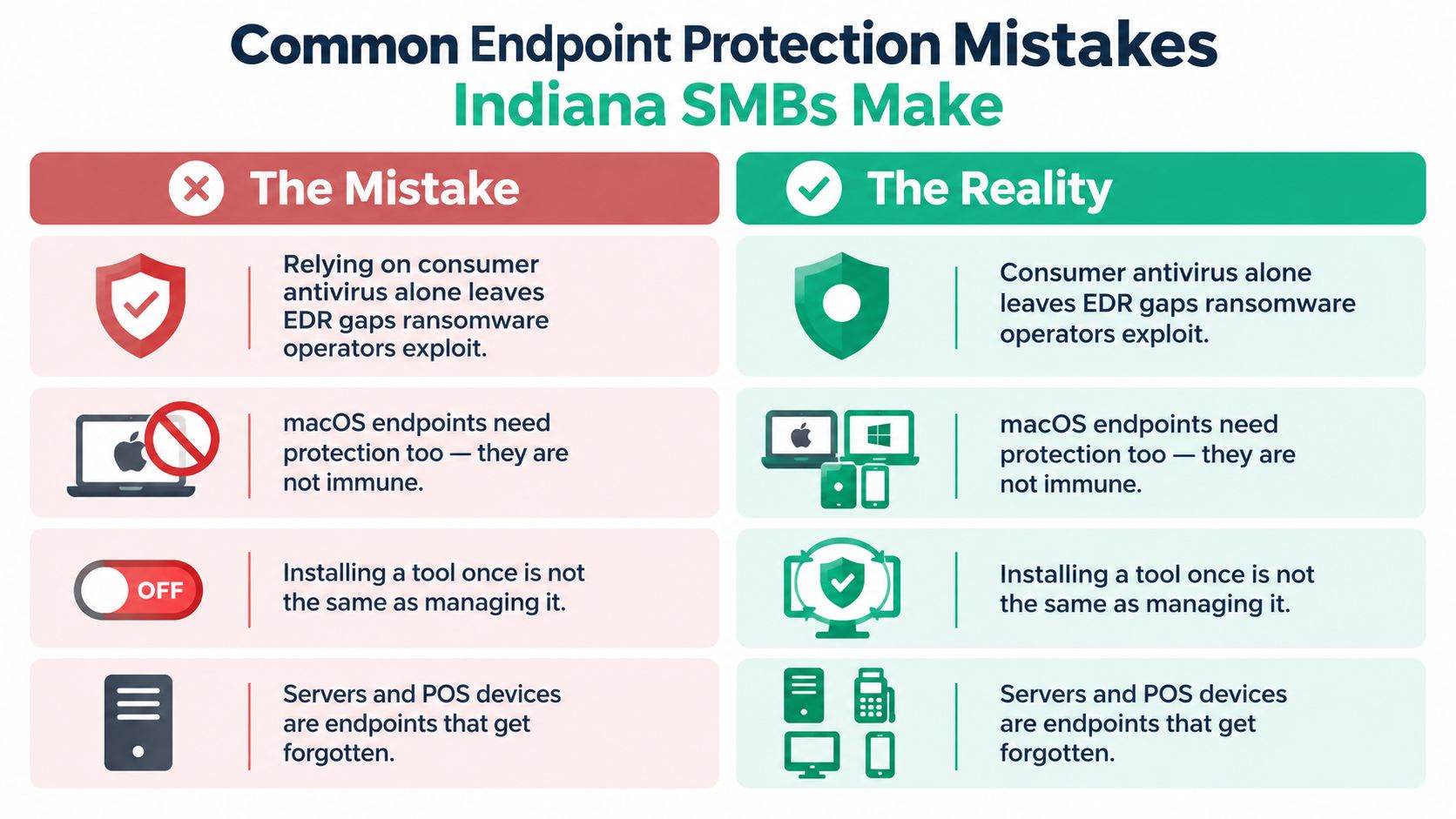
Consumer antivirus alone is enough. It can block known malware, but it doesn't replace EDR telemetry, centralized policy management, investigation, or human response. Ransomware operators don't need to use a file that already appears on a signature list.
Macs don't need protection. Phishing, credential theft, malicious browser extensions, and unauthorized access don't stop at a Windows boundary. macOS endpoints need an agent, patching, encryption, and identity controls that match the rest of the fleet.
Free tools provide a complete program. Windows Defender in passive mode or basic Malwarebytes Free may have a place in a layered design, but they don't automatically provide centralized reporting, verified coverage, compliance evidence, or 24/7 response.
Local habits that create avoidable gaps
An internal IT generalist in a Johnson County office often handles printers, user accounts, Microsoft 365, backups, and hardware failures. Asking that person to triage endpoint alerts on top of help-desk duties creates an overnight gap, even when everyone is working hard.
Another failure is treating endpoint protection as a one-time installation. Policies need tuning, agents need updates, exclusions require review, and alerts need ownership. Servers and POS devices also get forgotten because teams focus on employee laptops.
A good endpoint protection service closes those coverage gaps across the full device estate. It also supports broader resilience work, including bit-level data recovery when a storage device fails and immutable off-site backups when ransomware reaches production systems.
Coverage beats confidence. If nobody can prove an endpoint is enrolled, patched, monitored, and assigned to an owner, the dashboard doesn't represent your real security posture.
The answer isn't to shame a business for using a basic tool. The answer is to identify what the tool doesn't cover and assign the missing work to people with time, authority, and a documented response process.
Next Steps for Your Business and a Local Offer
Start Monday morning with a short operational review. Don't wait for a phishing event, an auditor, or a failed server to reveal that your inventory is incomplete.
-
Inventory every endpoint. Include laptops, desktops, servers, POS systems, mobile devices, and remote contractor equipment. Reconcile Active Directory or Entra ID with RMM, Intune, network, and purchasing records.
-
Assess current coverage. Identify which devices run only basic antivirus, which have EDR, which lack encryption, and which haven't checked in recently. Review patch status and verify that remediation completed.
-
Enable multifactor authentication. Apply MFA to identity providers and administrative access first, then address exceptions with documented compensating controls. Endpoint security can't compensate for an unprotected identity.
-
Test the 2 AM question. Call the current escalation number and ask who can isolate a device, contact leadership, preserve evidence, and coordinate recovery outside business hours. If the answer is unclear, your operating model has a gap.
-
Request written compliance mapping. Ask how endpoint controls support NIST CSF, HIPAA, or CMMC requirements relevant to your business. Require reports that show devices, policies, alerts, actions, and exceptions.
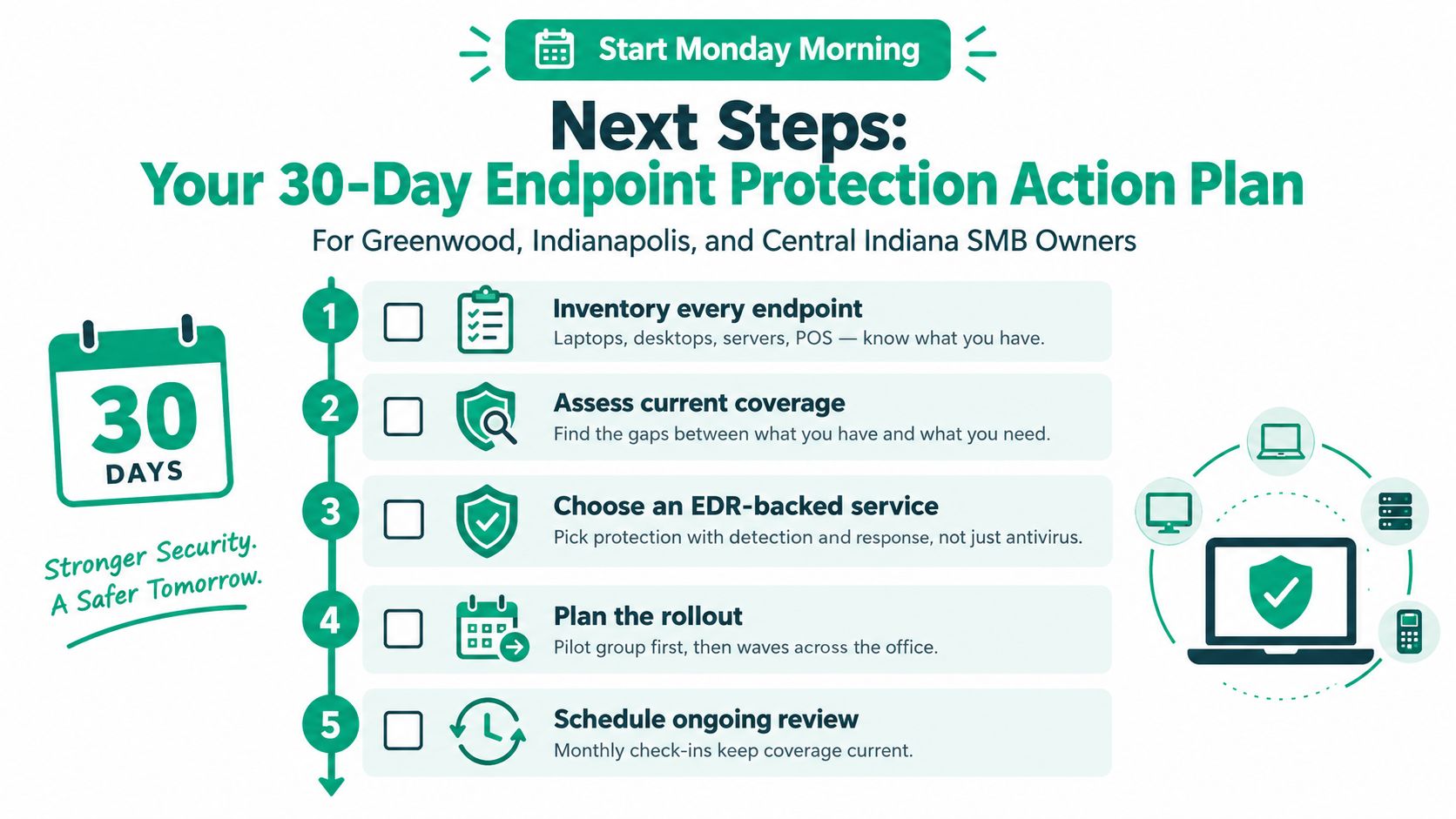
A practical 30-day plan starts with inventory and risk review, pilots the chosen agent, rolls it out in controlled waves, and schedules ongoing review. The endpoint protection service should connect to identity security, network controls, patching, incident response, and immutable off-site backups rather than operating as an isolated antivirus purchase.
For businesses in Greenwood, Indianapolis, and the surrounding Central Indiana market, managed services from Finchum Fixes IT can be evaluated alongside other providers using the criteria above. The useful question is not whether a vendor has a modern dashboard. It's whether the service can keep your people productive, produce defensible evidence, and respond when your office is closed.
Finchum Fixes IT provides endpoint detection and response, patching, email security, managed IT support, and cybersecurity guidance for Indiana businesses. Schedule a Free Network Assessment or Security Risk Audit for your Greenwood or Indianapolis office, and visit Finchum Fixes IT to start a working review of your endpoints, identities, network controls, and compliance evidence.