What Is Managed Detection and Response? An Indiana Guide
A lot of Johnson County business owners already have security tools. They've got antivirus on laptops, a firewall in the rack, Microsoft 365 protections turned on, and maybe some alerts going to an inbox nobody checks after hours.
Then a user clicks the wrong attachment at 4:47 p.m. on a Friday.
The server gets sluggish. Remote staff can't open files. Someone in accounting reports a weird sign-in prompt. Now the question isn't whether you bought security software. The question is whether anyone is actively protecting the business, right now, while the problem is still small enough to contain.
You don't need more blinking dashboards. You need someone who can tell the difference between noise and a real threat, then do something about it.
TL;DR
- Managed Detection and Response (MDR) is a 24/7 security service that monitors, investigates, and responds to threats across endpoints, networks, cloud systems, and identities.
- It's different from traditional tools because MDR acts on confirmed threats, instead of just sending alerts and hoping your team sees them.
- For Indiana SMBs, MDR helps reduce downtime, support business continuity, and make security spending more predictable.
- It also supports organizations that need stronger monitoring for HIPAA, CMMC, or NIST CSF-aligned programs.
- If your team can't investigate suspicious activity at 2 a.m., MDR fills that gap with a staffed security operation.
Your Business is Under Attack Are You Notified or Protected
It's 5:12 p.m. on a Thursday in Johnson County. Your office manager is trying to finish payroll. A salesperson clicks a fake invoice. Ten minutes later, Microsoft 365 starts throwing strange sign-in prompts, a shared folder goes missing, and nobody is sure whether this is a routine glitch or the start of a real incident.
That distinction decides whether you lose an evening or lose a week.
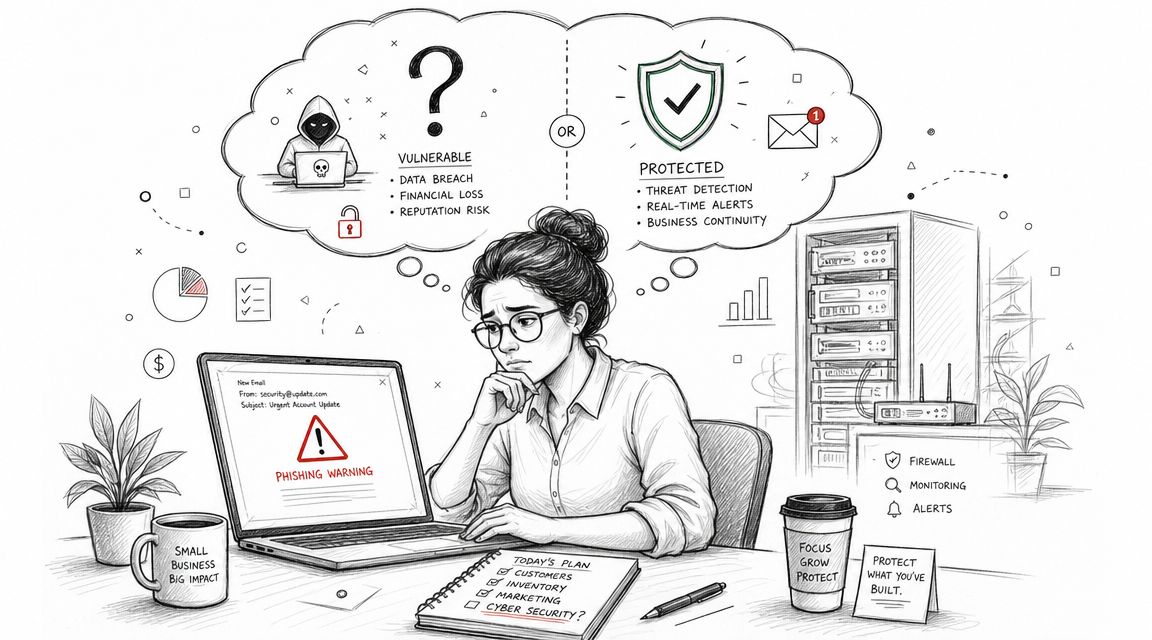
I see this with Indiana SMBs all the time. The business has some protection in place. Antivirus is running, email filtering is active, and the firewall is logging events. But once an attacker gets past the first layer, the key question is simple. Who is watching closely enough to catch it, confirm it, and contain it before operations take a hit?
Alerts alone do not solve that problem.
The problem isn't detection alone
In my experience, small and midsize businesses in Central Indiana rarely have a fully staffed internal security operations center. They usually rely on an internal IT generalist, a managed IT provider, or both. Those teams keep the business running. They reset accounts, patch systems, replace failed hardware, support remote staff, and deal with every other daily interruption that lands in the help desk queue.
Very few of them are staffed to investigate suspicious activity at 2:00 a.m. or during a holiday weekend.
That gap matters more than many owners realize. A phishing login can turn into account takeover. A compromised PC can start reaching out to command-and-control infrastructure. An attacker who gets into one mailbox may use it to target vendors, payroll, or patient records. If you want a broader baseline before getting into MDR, what is network security is a useful starting point. For a local view, this guide to security threats to a network for Indiana businesses reflects the kinds of issues I see across offices, clinics, and manufacturing environments here.
What changes with MDR
MDR changes the operating model. Instead of depending on someone to notice an alert after the fact, you have a service built to monitor, investigate, and respond while the incident is still manageable.
That has real business value.
If your team gets a notification Monday morning about activity that started Friday night, the attacker had a full weekend to move through email, endpoints, cloud apps, and file shares. If a response team catches it quickly, they can isolate a device, disable a user session, force credential resets, and cut off the spread before it turns into downtime.
For Indiana businesses, the stakes are practical, not theoretical. A medical practice in Greenwood may have to deal with HIPAA exposure if patient data is involved. A manufacturer supporting defense contracts may need stronger monitoring and incident response discipline to support CMMC requirements. A small accounting firm may need to keep tax-season operations running without losing client trust.
Practical rule: If your current security tools still depend on somebody checking alerts after hours, you are buying notification. You are not buying protection.
That's the difference business owners need to understand first.
What MDR Actually Is Beyond the Buzzwords
A lot of Indiana owners hear "managed detection and response" and assume it means one more security tool. It means a service team takes responsibility for finding suspicious activity, confirming what is real, and taking action before a small problem turns into downtime, data loss, or a compliance issue.
That distinction matters.
Traditional security tools can generate alerts. MDR adds people, process, and authority around those alerts so someone is actively sorting signal from noise and responding while the incident is still containable. For a Greenwood medical office, that can mean catching account abuse before it becomes a HIPAA mess. For a machine shop tied to defense work, it can mean documenting monitoring and response discipline that supports CMMC expectations.
You're buying response ownership
The cleanest definition is practical. MDR is an outsourced security operations function built for businesses that need real monitoring and incident response but do not have the budget, staff, or after-hours coverage to run that internally.
What you are paying for is clear accountability. When suspicious behavior shows up at 2 a.m., someone is reviewing it, investigating it, and following an agreed response plan. That is a very different purchase from software that merely logs events and waits for your team to notice them on Monday.
A solid MDR service usually includes:
- Continuous monitoring: Endpoints, Microsoft 365, cloud apps, firewalls, identity systems, and other event sources are watched around the clock.
- Investigation: Analysts validate whether an alert is benign activity, user error, or an active threat.
- Threat hunting: The team looks for attacker behavior that may not trigger a basic rule or signature.
- Response actions: Depending on the service agreement, the provider can isolate a device, disable an account, kill a malicious process, or direct your staff through containment.
- Reporting and documentation: You get incident records your business can use for audits, insurance questions, and internal follow-up.
Why Indiana SMBs need the plain-English version
A lot of businesses around Greenwood, Franklin, and the south side of Indianapolis sit in an awkward middle ground. They have enough devices, cloud apps, remote access, and vendor connections to be exposed, but not enough internal security depth to investigate alerts after hours.
That is the gap MDR is designed to fill.
If you are already comparing support models, this guide to IT managed services for Indiana businesses helps clarify where general IT support ends and security operations begins.
Here is the blunt version.
If your provider can tell you an alert happened but cannot tell you who investigates it, who contains it, and what happens next, you still own the hardest part.
For Indiana SMBs, that ownership gap carries direct business risk. HIPAA-regulated practices need more than antivirus if staff accounts, patient data, and email are in play. Manufacturers dealing with defense supply chains need stronger visibility, faster response, and better documentation than a basic help desk can provide. Even firms outside regulated industries need to protect uptime, keep cyber insurance requirements in reach, and avoid the cost of a drawn-out incident.
MDR makes sense because it turns security from passive monitoring into an active service with a defined job: detect, investigate, contain, and document.
The Human and Tech Engine Behind MDR
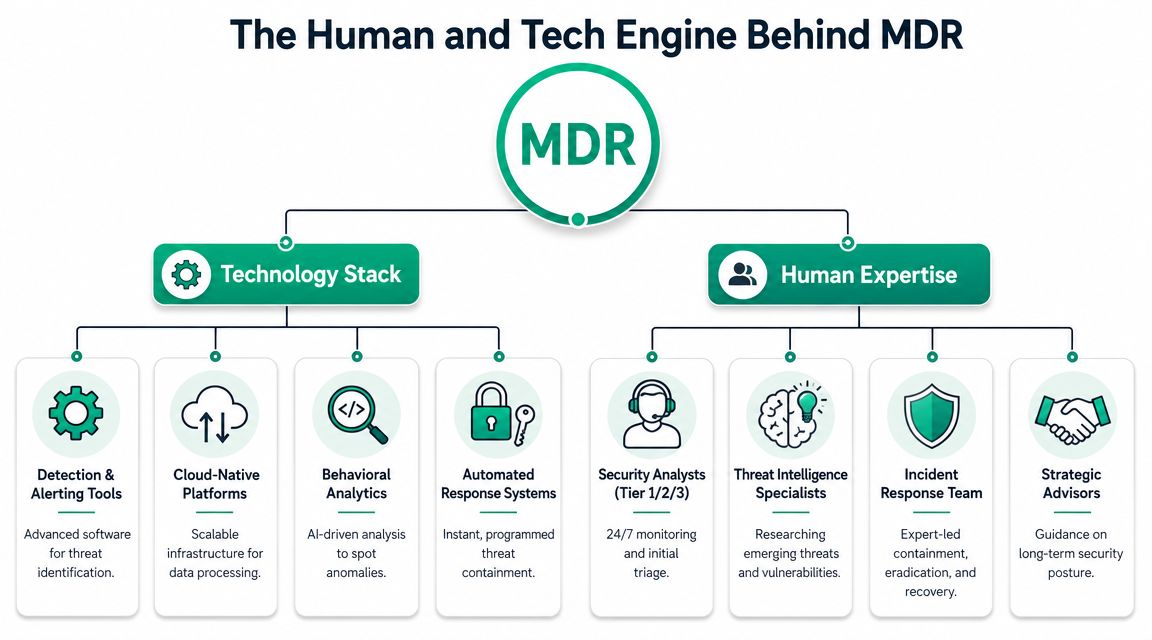
An MDR service earns its keep when it can sort a flood of raw security events into a few incidents that deserve action, then put the right hands on those incidents fast. That takes two things working together. The tooling has to collect the right signals, and the people reviewing those signals have to know what matters for your business.
The tools collect the signals
Under the hood, MDR usually pulls telemetry from endpoints, firewalls, Microsoft 365, servers, cloud apps, and identity systems. The goal is simple. Build enough visibility to catch suspicious behavior early, before a bad login turns into encrypted files, stolen records, or a week of cleanup.
For a Greenwood medical office, that may mean watching endpoint activity, email account behavior, and access to patient data. For an Indiana machine shop bidding into defense work, it may also mean tighter visibility into remote access, privileged accounts, and unusual file movement. The same service category applies, but the data sources and response priorities should reflect HIPAA, CMMC, cyber insurance questions, and the systems that keep revenue moving.
A typical MDR stack includes:
- EDR platforms: Tools such as Bitdefender GravityZone, Microsoft Defender for Endpoint, or SentinelOne watch device behavior and flag suspicious activity.
- Log correlation: SIEM-style collection pulls in events from firewalls, servers, cloud services, and identity providers so analysts can see the full chain, not just one alert in isolation.
- Threat intelligence: Known attacker techniques and indicators add context and help separate routine noise from behavior that deserves investigation.
- Response controls: Host isolation, session termination, account restrictions, and containment playbooks help stop spread while the issue is being reviewed.
That matters more than it sounds.
Many Indiana SMBs have grown into a messy mix of Microsoft 365, remote laptops, vendor access, line-of-business software, and multiple locations. Each system produces signals. Without a process to correlate them, your team gets fragments instead of answers.
A short walkthrough helps make the moving parts easier to see:
The analysts make judgment calls machines can't
Tools surface activity. Analysts decide whether it is normal, suspicious, or the start of an incident.
Red Canary explains the distinction clearly. MDR is built to respond to threats, not just detect them. That includes continuous telemetry collection, analytics and threat intelligence to reduce false positives, human validation of alerts, and response actions such as isolating a host to limit attacker persistence (Red Canary on MDR).
This human layer is where weak services usually show up. If your provider can generate alerts but cannot explain who investigates after hours, who can isolate a device, or how an incident gets documented for an auditor or insurer, you are still carrying the hard part internally.
A mature SOC-as-a-Service model often includes:
- Tier 1 and Tier 2 analysts who triage alerts and separate junk from incidents worth escalation.
- Threat hunters who look for patterns the tooling did not fully connect on its own.
- Incident responders who know when to isolate a machine, disable an account, block access, and escalate to your IT point of contact.
- Security advisors who turn incidents into practical follow-up, such as policy changes, MFA fixes, hardening work, and better recovery steps.
If you're weighing endpoint tooling as part of the stack, this guide to finding the best endpoint protection software for Indiana businesses in 2026 is a useful companion read.
For local businesses, the business value is not the number of dashboards involved. It is whether a suspicious sign-in, a malicious attachment, or an unusual PowerShell event gets investigated fast enough to protect operations, preserve evidence, and support compliance when someone asks what happened and how it was contained.
Zero Trust architecture sounds abstract until an attacker steals one password. Then it becomes very concrete. Good MDR assumes no login, device, or session gets blind trust.
MDR vs MSSP vs SIEM What Indiana Businesses Really Need
Buyers often get tripped up at this point. They hear MDR, MSSP, SIEM, EDR, and sometimes XDR, and it all starts sounding like the same soup in different bowls. It isn't.
The easiest way to compare them is to ask one question. Who owns the work when something suspicious happens?
The operational difference that matters
Arctic Wolf's quoted Gartner definition frames MDR as remotely delivered SOC functions for rapid detection, analysis, investigation, and response through disruption and containment, and highlights the common buyer confusion between MDR, EDR, and MSSP. The practical question is, “What do I get that my team doesn't already?” (Arctic Wolf MDR glossary).
That's the right question for a Hamilton County company in growth mode or a Greenwood manufacturer running lean. If your internal team can manage routine IT but can't investigate security incidents all night and all weekend, then the difference between alerting and active response is huge.
Security Service Comparison What's the Right Fit
| Capability | SIEM/Antivirus | MSSP | MDR |
|---|---|---|---|
| Primary role | Tooling that detects and logs activity | Monitors and often forwards alerts | Monitors, investigates, and responds |
| Who reviews suspicious activity | Usually your team | Often shared, but your team may still own follow-up | Provider SOC analysts |
| Threat hunting | Limited or none unless your team does it | Varies by provider | Common part of the service |
| Containment action | Depends on your internal staff | Often advisory | Usually guided or hands-on, depending on scope |
| Best fit | Small environments with internal security skill | Teams that want outsourced monitoring | Businesses that need 24/7 investigation and response |
| Main weakness | Alert fatigue and missed follow-up | Can still leave response burden on you | Requires clear scope, integrations, and trust in provider processes |
What works and what doesn't
What works:
- MDR for lean teams: Internal IT handles users, patching, and vendors. MDR handles security monitoring and response.
- MSSP for visibility-heavy shops: Useful if you mainly want managed logs and alerting and already have security people.
- SIEM for mature environments: Strong if you have staff who know how to tune detections, review logs, and run incident response.
What doesn't work:
- Buying a tool and assuming it equals a program
- Expecting a help desk to function like a 24/7 SOC
- Paying for monitoring with no response authority
- Treating incident response like a document you wrote once and never tested
If you need to tighten the response side, this article on incident response planning for Indy SMBs helps define what your provider should support versus what your internal team must still own.
An alert without an owner is just a delayed outage.
The ROI of MDR: Preventing Downtime and Ensuring Compliance
A Greenwood medical office loses access to patient records at 7:40 on a Tuesday. A machine shop off I-65 has file shares encrypted before first shift is fully clocked in. In both cases, the first business question is the same. How long are we down, and who is already working the problem?
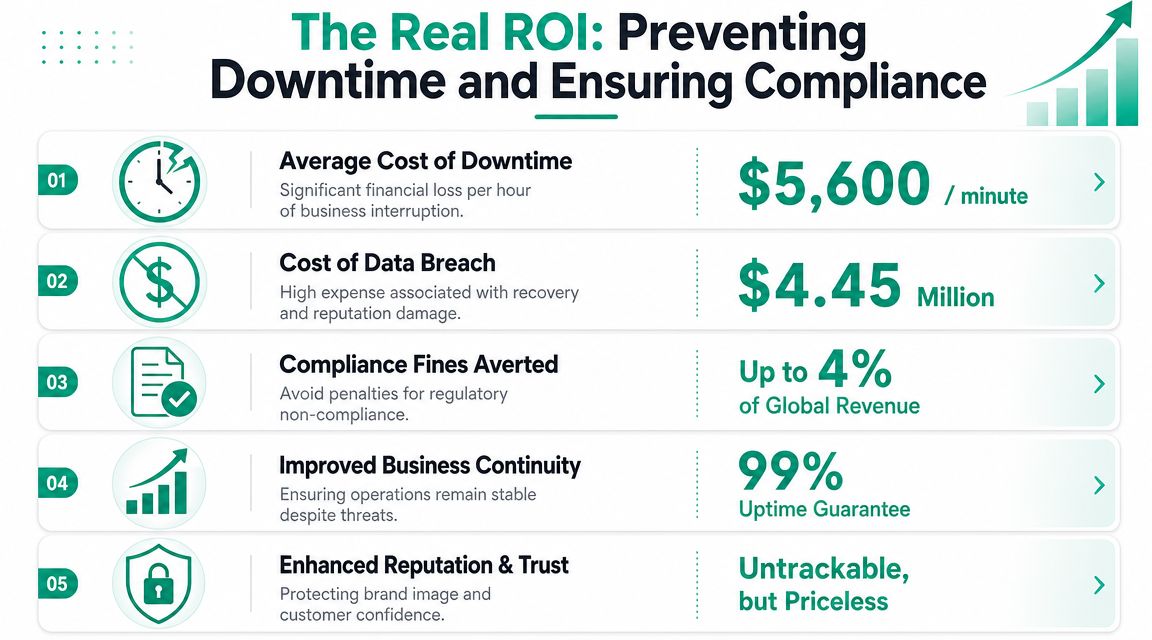
That is where MDR earns its keep. Owners do not pay for it because the acronym sounds advanced. They pay for faster detection, faster containment, and fewer bad days that turn into missed revenue, overtime, cleanup costs, and hard conversations with customers.
IBM reports that organizations with extensive use of security AI and automation saw a lower average cost of a data breach, with a gap of nearly $1.9 million compared with organizations that did not use those capabilities (IBM Cost of a Data Breach Report). That is not a promise that every Indiana SMB will save that exact amount. It is a useful indicator of the business value of catching and containing incidents sooner.
ROI starts with uptime
A lot of security spending gets labeled overhead by people who have never had to explain a full day of outage to staff or clients. For most small and midsize businesses, the cleaner way to judge MDR is simple. Does it reduce disruption, protect billable work, and shorten the time between detection and action?
In practice, that usually shows up in four places:
- Less downtime from contained incidents: A compromised laptop is a problem. A compromised laptop that reaches shared files, cloud apps, and admin accounts is a business interruption.
- Less strain on internal IT: Your IT person or small team can stay focused on users, vendors, and operations instead of chasing every suspicious alert after hours.
- More predictable costs: A monthly MDR service fee is easier to budget than emergency forensics, recovery labor, legal review, and lost production.
- Faster decisions during an incident: The playbook, contacts, and response authority are already defined before something goes sideways.
There is a trade-off. MDR is not a substitute for backups, patching, MFA, segmentation, or tested recovery procedures. It works best as the response layer that supports those controls and helps you use them under pressure.
Compliance is part of the return
For Indiana businesses, ROI is not only about uptime.
Healthcare practices around Indianapolis and Johnson County need monitoring and incident response processes that support HIPAA requirements. Defense manufacturers and subcontractors need evidence that security events are monitored, investigated, and handled in a disciplined way if CMMC is on the horizon. Many other firms use NIST CSF as the management framework because it gives leadership and auditors a shared structure for detection, response, and recovery.
MDR does not make a company compliant by itself. It does make it easier to prove that someone is watching, investigating, documenting, and responding. That matters during audits, cyber insurance reviews, vendor security questionnaires, and customer due diligence.
As a sign of how standard this service has become, Gartner projected in 2021 that 50 percent of organizations would be using MDR services for threat monitoring, detection, and response by 2025 (Gartner forecast quoted in its 2021 MDR Market Guide summary). We are past that target date now, but the larger point holds. MDR is no longer reserved for large enterprises with deep security benches.
If uptime planning is already on your radar, this guide to business continuity vs disaster recovery is worth your time. It explains why fast detection and response belong in the same business discussion as backups, recovery timelines, and operational resilience.
A Selection Checklist for Indiana Businesses
A bad MDR purchase usually looks fine in the sales meeting. The problem shows up later, at 2:13 a.m., when someone clicks a phishing link, a server starts beaconing out, and your only “response” is an email alert waiting in a shared inbox until morning. Indiana business owners do not need another security tool that creates more noise. They need a provider that can make decisions, act fast, and document what happened well enough for insurance, audits, and leadership review.
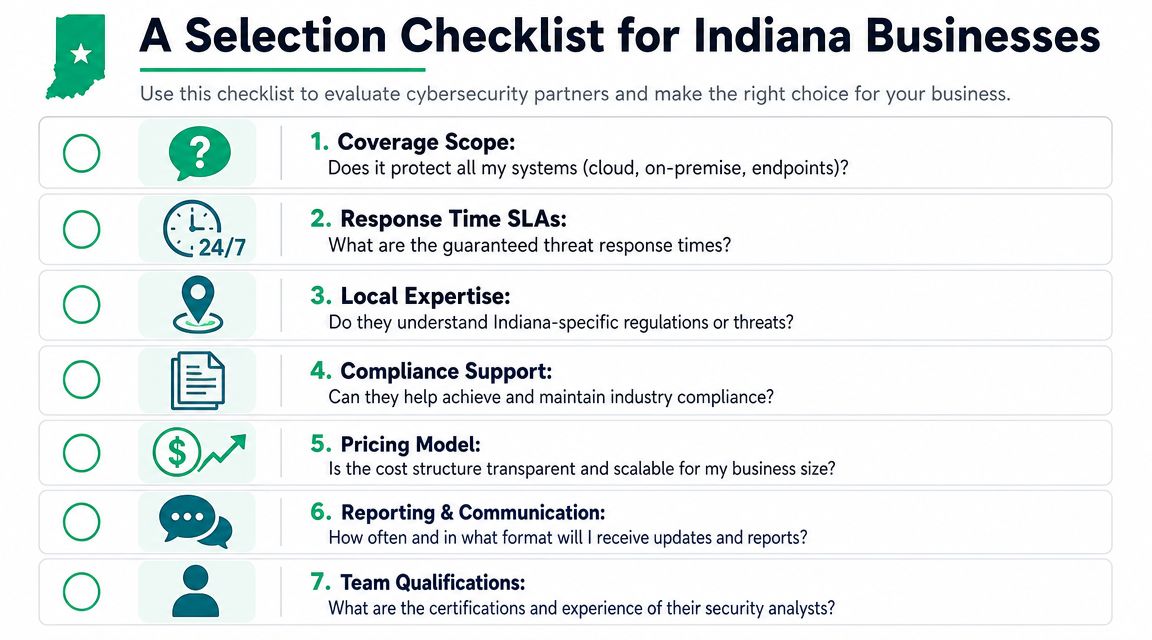
Questions worth asking before you sign
As noted earlier, strong MDR services are judged on three basics. Coverage at all hours. Visibility across the systems you use. Clear authority to respond when a threat is active. That is the floor, not the ceiling.
Use this checklist in the sales process:
- Who is watching after hours? Ask whether the SOC is staffed overnight, on weekends, and on holidays. If coverage relies on on-call escalation instead of active monitoring, get that in writing.
- What systems are covered? Endpoints matter, but Indiana SMBs often have risk sitting in Microsoft 365, email, firewalls, identity platforms, servers, and cloud apps. If a provider only sees laptops, you are paying for a partial view.
- What can you do without waiting on us? Get specific. Can they isolate a device, kill a malicious process, disable a user account, block a bad IP, or contain suspicious activity in Microsoft 365? Or do they only recommend actions and wait for your approval?
- What does an incident report look like? Ask for a sanitized sample. It should show timeline, affected assets, actions taken, business impact, and next-step recommendations your IT team can use.
- How do you support HIPAA or CMMC requirements? Healthcare practices in Johnson County need audit trails, escalation records, and documented handling of security events. Defense contractors and subcontractors need response processes that stand up to CMMC scrutiny. “We help with compliance” is too vague. Ask what evidence they produce.
- How do you fit into the stack we already have? Many local businesses are not starting from scratch. They already use Microsoft 365, line-of-business apps, on-prem servers, remote access tools, and mixed network gear. Make the provider explain integration limits before you sign.
- What happens in onboarding? Good onboarding includes asset review, log source validation, contact lists, escalation paths, response approvals, and confirmation that high-risk systems are visible.
Price matters, but cheap MDR can get expensive fast. If the service misses your cloud activity, cannot respond directly, or hands your office manager a vague alert at 1 a.m., you still own the interruption, the cleanup, and the compliance fallout.
Local fit matters more than most vendors admit
Indiana SMBs have a different operating reality than large enterprise buyers. A Greenwood medical office may need after-hours containment with careful handling of patient systems. A machine shop supporting a defense supplier may care more about protecting production, remote access, and audit evidence. A law firm in Johnson County may need rapid response with minimal disruption during business hours. The right fit depends on how your company runs day to day.
After years working with Central Indiana businesses, I can tell you the best question is usually the simplest one.
“When something goes wrong at 2 a.m., what exactly will you do before you call us?”
Listen for specifics. If the answer is clear, operational, and tied to your environment, keep talking. If it sounds polished but vague, keep shopping.
Secure Your Business with a Local Greenwood Expert
MDR gives Indiana SMBs something they used to associate only with larger enterprises. Real 24/7 monitoring. Real investigation. Real response. Not just a stack of software and a pile of alerts.
That matters in Greenwood, along the I-65 corridor, and across the Indianapolis metro because most businesses here don't need a theoretical security strategy. They need their team to stay productive, their systems to stay available, and their compliance obligations to stay under control. They need fewer surprises and a tighter plan for when something suspicious hits the network.
The practical value of managed detection and response is simple. It helps stop small problems from turning into business interruptions. It supports continuity. It turns security from a vague fear into an operational process with named owners, clear playbooks, and predictable monthly cost.
If your current setup still depends on someone noticing an alert after the fact, it's time to tighten the gap.
If you're in Greenwood or the greater Indianapolis area and want a straight answer on where your security stands, Finchum Fixes IT can help with a Free Network Assessment or a Security Risk Audit specific to your business. Protect your revenue, reduce wasted tech time, and build a security program that responds when it counts.