GDPR Compliance for US Companies: 2026 Indiana Guide

- GDPR can apply to an Indiana business if you handle personal data from people in the EU through your website, services, apps, or support systems.
- The risk isn't just legal. Weak privacy controls often mean weak security controls, which raises breach and downtime exposure.
- Start with data mapping. Follow every form, inbox, CRM, backup, and vendor that touches customer data.
- Vendor contracts matter. GDPR Article 28 requires proper Data Processing Agreements with processors.
- Security controls are part of compliance. Encryption, resilient backups, testing, and rapid restoration all matter under Article 32.
- Small businesses struggle most with operations. DSAR responses, retention rules, and vendor oversight create the primary day-to-day burden.
- Treat GDPR like business continuity. Better controls reduce chaos, protect trust, and turn surprise IT work into a predictable plan.
A Johnson County business owner gets a solid inquiry from Germany. Good budget. Serious buyer. The email chain moves fast until procurement asks a simple question: “Can you confirm your GDPR posture?”
That's the moment a lot of Indiana companies realize this isn't just some far-off EU legal issue. It lands right on a Greenwood desk, usually after years of collecting contact forms, storing email archives, syncing files to the cloud, and letting vendors pass data around without much documentation. A company can be careful, honest, and still be exposed.
The hard part is that GDPR doesn't just ask whether you mean well. It asks whether you know where personal data lives, why you have it, who can touch it, how long you keep it, and how fast you can respond when something goes wrong. If you can't answer those questions, you don't have a privacy program. You have hope and scattered systems.
That matters because the penalty side is real. GDPR can reach fines of up to 4% of worldwide annual revenue or €20 million per violation, as noted in Corporate Compliance Insights on U.S. GDPR unpreparedness. For a local company, the bigger day-to-day threat is often operational. One bad data incident can freeze email, lock up files, knock out line-of-business systems, and burn hours your staff should be billing, selling, or shipping.
In our 17 years of local service across Greenwood, Indianapolis, and the south side, one pattern keeps repeating. Businesses think compliance is a paperwork project. It's not. It's an operations project with legal consequences. The companies that handle it well usually fix more than policy. They tighten security, clean up old data, standardize vendor contracts, and stop the little IT messes that turn into expensive outages.
Introduction
For gdpr compliance for us companies, the smartest starting point is simple. Stop treating GDPR like a giant European mystery and start treating it like a business process problem.
A small Indiana firm usually doesn't fail here because it's reckless. It fails because the owner has three systems that don't talk to each other, an old server in a closet, a website form that dumps into two inboxes, and a cloud vendor agreement nobody has read since it was signed. That's normal. It's also exactly why this issue sneaks up on people.
The local version of a global problem
Around Greenwood and the I-65 corridor, I see the same setup over and over. A company grows in pieces. First it adds Microsoft 365. Then a CRM. Then remote support software. Then a cloud backup product. Then somebody's nephew adds website analytics and cookies. Before long, personal data is moving through half a dozen tools, and nobody can say with confidence which ones matter under GDPR.
That's where owners get stuck. They ask the wrong first question.
Not “Do I have a privacy notice?”
Ask, “Where is EU personal data touching my systems?”
Practical rule: If your staff can't trace customer data from intake to deletion, you're not ready for a GDPR conversation with a serious buyer.
What works and what doesn't
What works is boring on purpose. Inventory systems. Map data flows. Review vendors. Lock down access. Encrypt what matters. Test backups. Set retention rules. Train staff. Then review it again.
What doesn't work is the shortcut approach:
- Copy-paste policies: A generic policy from the internet won't fix a messy CRM, shadow IT, or old backup sprawl.
- Checkbox consent banners: Cookie popups alone don't solve data mapping, DSAR handling, or breach response.
- One-and-done projects: GDPR isn't something you finish once and forget. New apps, new vendors, and new workflows reopen the issue.
- Leaving it to one person: The office manager, web developer, or MSP can't carry this alone. Ownership has to cross legal, operations, and IT.
For Indiana businesses, the return on getting this right isn't just avoiding penalties. It's fewer firefights, cleaner systems, and less wasted tech time. It's easier budgeting. It's stronger answers during sales due diligence. It's one less reason for a prospect in Europe, or a larger domestic client, to move on to a competitor.
Why an EU Law Reaches Your Business on the I-65 Corridor
A Greenwood owner gets an email from a prospect in Germany through the website contact form. Sales replies, the message lands in Microsoft 365, the lead goes into a CRM, and the marketing team starts tracking follow-up activity. That entire chain can pull an Indiana company under GDPR.
The law cares about what you do with EU personal data, not where your office sits.
The trigger is often smaller than people expect
A business does not need a European branch, foreign payroll, or a warehouse overseas. A simple website, a hiring page, a support portal, or a shared cloud app can be enough if EU residents submit personal data into those systems.
The European Commission states that GDPR can apply to organizations outside the EU when they offer goods or services to people in the EU, or monitor their behavior, as outlined on the European Commission GDPR page. For a small Indiana company, "monitor behavior" can mean more than owners expect. Website analytics, ad tracking, cookies, chat tools, and session recording software all deserve a closer look.
That matters on the I-65 corridor because local businesses often grow into cross-border data handling by accident. A manufacturer starts selling replacement parts online. A managed service provider supports a U.S. client with employees in Ireland. A recruiting firm accepts resumes from applicants in France. Nobody set out to become an international privacy shop, but the systems say otherwise.
Where GDPR shows up in ordinary operations
The risk usually starts in familiar places:
- Web forms and analytics: Contact requests, quote forms, cookie tools, visitor tracking, and chat widgets
- Support and service work: Help desk tickets, remote access sessions, cybersecurity monitoring, and software support tied to EU-based users
- Hiring: Job applications, resumes, screening notes, and applicant emails
- Shared business systems: CRMs, ERPs, file shares, project platforms, and cloud storage used with global customers or vendors
For small businesses, the core challenge is operational sprawl. Data enters through one tool, gets copied into three more, and then sits in backups and old mailboxes long after anyone remembers why it was kept. That is where a privacy problem becomes an IT problem.
A local company does not need a Paris office to have a GDPR issue. It needs EU personal data passing through everyday systems that nobody has fully mapped or controlled.
The Southside version of the problem
Around Indianapolis, I still see the same pattern. An older website sits on neglected hosting. The sales team shares one inbox. Department heads sign up for low-cost SaaS tools without review. Backups run for years with no retention policy. Access rights grow, but rarely shrink.
Those choices create direct GDPR exposure because they make it hard to answer basic questions. What personal data do you hold? Who can access it? Why are you keeping it? Can you delete it when required? Can you prove what happened after a breach?
Here is how common local setups translate into compliance trouble:
| Common local setup | Hidden GDPR issue |
|---|---|
| Old website on aging server hardware | Unknown logs, weak access control, and no clear retention rules |
| Shared sales inbox | Personal data spread across unmanaged email folders |
| Cheap cloud apps chosen by department heads | No processor review, unclear data handling terms, and weak admin control |
| Flat network with broad access | Too many employees can reach customer data |
| Backups kept forever | No storage limitation and no reliable deletion process |
This is why GDPR work for Indiana businesses usually starts with IT operations, not legal drafting. Policies matter, but policy language will not fix broad permissions, stale backups, missing audit logs, or vendors that refuse to sign the right terms.
For many owners, the practical trade-off is simple. Spend time now on data mapping, system cleanup, vendor review, and tighter security controls, or spend more later trying to explain a preventable mess to a customer, regulator, or buyer during due diligence. Finchum and similar cybersecurity teams can help close that gap because the work is fundamentally technical. You need visibility into where data lives, controls around who can touch it, and a process your staff can realistically follow.
The GDPR Rulebook Versus US Privacy Laws
Most Indiana owners don't need another lecture on legal theory. They need a translation.
GDPR feels foreign because it doesn't think like most U.S. business owners are used to thinking. In the U.S., privacy rules are often sector-specific or state-specific. HIPAA covers healthcare. CMMC shapes defense contractor security expectations. State laws like California's rules focus on consumer privacy in different ways. GDPR starts from a broader premise. If you process covered personal data about people in the EU, you need a lawful reason, strong controls, and a way to prove it.
That proof piece is where many companies stumble. By Q4 2022, over 91% of legally obligated U.S. businesses were underprepared for GDPR, often relying on manual processes, and total fines had surpassed €4.5 billion. The same source also notes that 79% of U.S. consumers worry about how their data is used, which is why privacy now hits trust and sales, not just legal exposure, as summarized by forms.app's GDPR statistics roundup.
What GDPR feels like to a US operator
HIPAA users usually understand controlled access, audit concerns, and patient privacy. CMMC-minded teams understand documented controls, accountability, and supply chain security. NIST CSF users understand identify, protect, detect, respond, and recover.
GDPR overlaps with all of that, but it pushes harder on the individual's rights.
For example, a healthcare office in Indiana may already be careful with patient data under HIPAA. But GDPR's right to erasure can create a stricter expectation around deletion requests than many U.S. firms are used to handling in ordinary business systems. A defense contractor may already document systems for CMMC readiness, but GDPR asks a different question too. Why are you collecting this data in the first place, and can the individual challenge how you use it?
GDPR vs US Privacy Laws A Quick Comparison
| Provision | GDPR (EU) | CCPA/CPRA (California) | HIPAA (US Healthcare) |
|---|---|---|---|
| Who it covers | Organizations processing covered personal data of people in the EU under its scope | Businesses meeting California law thresholds and handling covered consumer data | Covered entities and business associates in healthcare |
| Core mindset | Privacy as a broad individual right with accountability duties | Consumer privacy and notice rights in a state law context | Protection of health information in regulated healthcare settings |
| Lawful basis required | Yes. You need a reason for processing | Different structure than GDPR | Built around permitted healthcare uses and disclosures |
| Right to access | Strong individual access rights | Consumer access rights exist | Patients have access rights to protected health information |
| Right to deletion | Stronger and broader in many cases, with exceptions | Deletion rights exist, with exceptions | Not framed the same way as GDPR erasure |
| Vendor contract focus | Very strong. Processor terms matter directly | Service provider terms matter | Business Associate Agreements matter |
| Breach expectations | Includes strict reporting obligations under GDPR rules | State-level and sector-specific duties may apply | HIPAA breach notification rules apply |
| Security posture | Technical and organizational measures tied to risk | Reasonable security expectations | Administrative, physical, and technical safeguards |
If your team already works with PCI DSS compliance planning for Indiana businesses, you already know the pattern. Regulations differ, but the businesses that do well build repeatable controls instead of chasing one-off checklists.
Where owners get tripped up
A few common misunderstandings come up fast:
- “We already follow HIPAA, so we're covered.” Not necessarily. HIPAA and GDPR overlap in discipline, not in scope or rights handling.
- “We're a contractor, so CMMC covers this.” CMMC helps with security maturity, but it doesn't replace GDPR obligations around lawful basis, DSARs, and privacy notices.
- “We're too small to matter.” Small size may reduce complexity, but it doesn't erase scope if the data activity triggers the rule.
Good compliance work borrows from the same habits across frameworks. Document what you do, restrict access, review vendors, and stop collecting data you don't need.
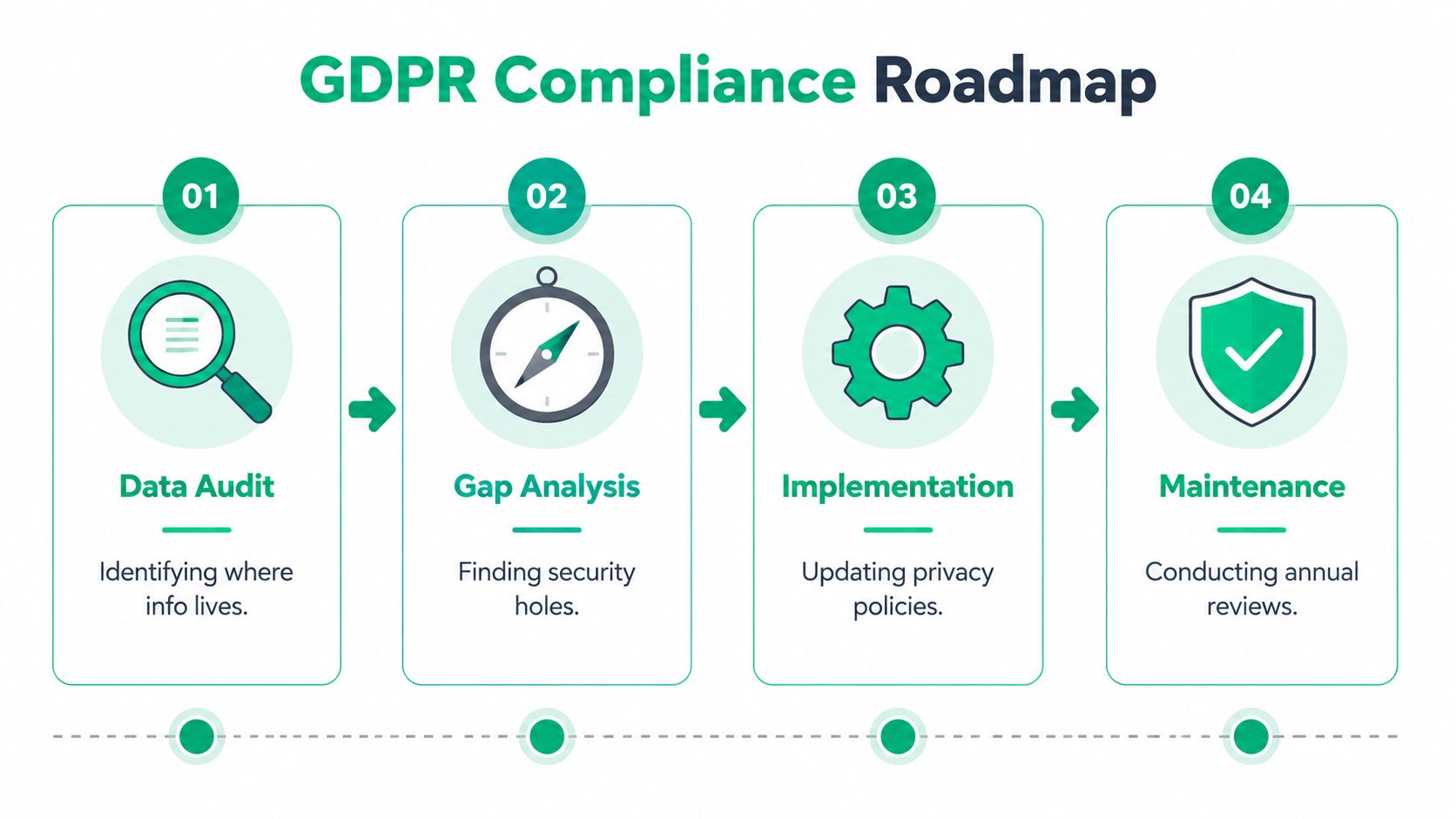
Your Actionable GDPR Compliance Roadmap
Most small businesses freeze because GDPR sounds huge. In practice, the work becomes manageable when you run it as an operations project.
The first pass doesn't need a giant committee. It needs a whiteboard, your system list, your vendor list, and somebody willing to ask annoying questions about every form, spreadsheet, backup, and inbox.
Step one follows the data
Start at the edge. Website forms. Support tickets. Email intake. CRM entries. Backup jobs. Mobile devices. Shared drives. Cloud folders. Old exports.
When we help Johnson County businesses with data mapping, we almost always find forgotten data in old spreadsheets, sent-item archives, or line-of-business tools nobody reviewed during the original software rollout. That's normal. It's also why a privacy notice alone won't save you.
Focus on these questions:
- Where does the data enter? Contact forms, phone intake, support portals, cookies, app usage, repair intake notes.
- Where does it land next? Email, CRM, PSA, SharePoint, local file server, cloud backup, development environment.
- Who can see it? Named users, shared accounts, vendors, contractors, remote staff.
- How long does it stick around? Live records, archives, backups, old laptops, exported CSVs.
Step two defines why you have it
Once you know where the data lives, pin down why you're processing it. If a company can't explain the reason for a data set, that's often a sign it shouldn't keep it.
The practical application of privacy-by-design involves only collecting what you need. Use it for the reason you told people. Don't keep it forever because storage is cheap. Cheap storage creates expensive review problems later.
For businesses building or updating systems, this is also where an internal project plan matters. A clean Indiana business IT roadmap helps because privacy work falls apart when ownership is vague.
Step three prepares for higher-risk work
Some activities deserve a deeper review before launch. A new app. Behavioral tracking. Sensitive data handling. Large-scale monitoring. AI features touching personal data. That's where a Data Protection Impact Assessment becomes part of good operations, not just legal paperwork.
The practical value of a DPIA is simple. It forces the team to stop and think before a new workflow creates long-term risk.
Field note: The cheapest time to fix a privacy problem is before the system goes live. After launch, every change touches users, vendors, training, and contracts.
Step four builds the response muscle
A key, underestimated challenge for small U.S. IT providers is the operational burden of tasks like responding to Data Subject Access Requests within the one-month deadline, and even occasional EU data in logs can create a real compliance obligation, as highlighted by eMarketer's discussion of U.S. GDPR readiness.
That burden is where many SMBs break down. They can draft a policy. They can't reliably answer:
- Can we find all data tied to one person across all systems?
- Can we correct or delete it where appropriate?
- Can we prove what we did and when we did it?
For a practical roadmap, assign ownership for each of those tasks before you need them. If your answer depends on one employee remembering where things are stored, the process isn't ready.
Building a GDPR-Ready Digital Fortress
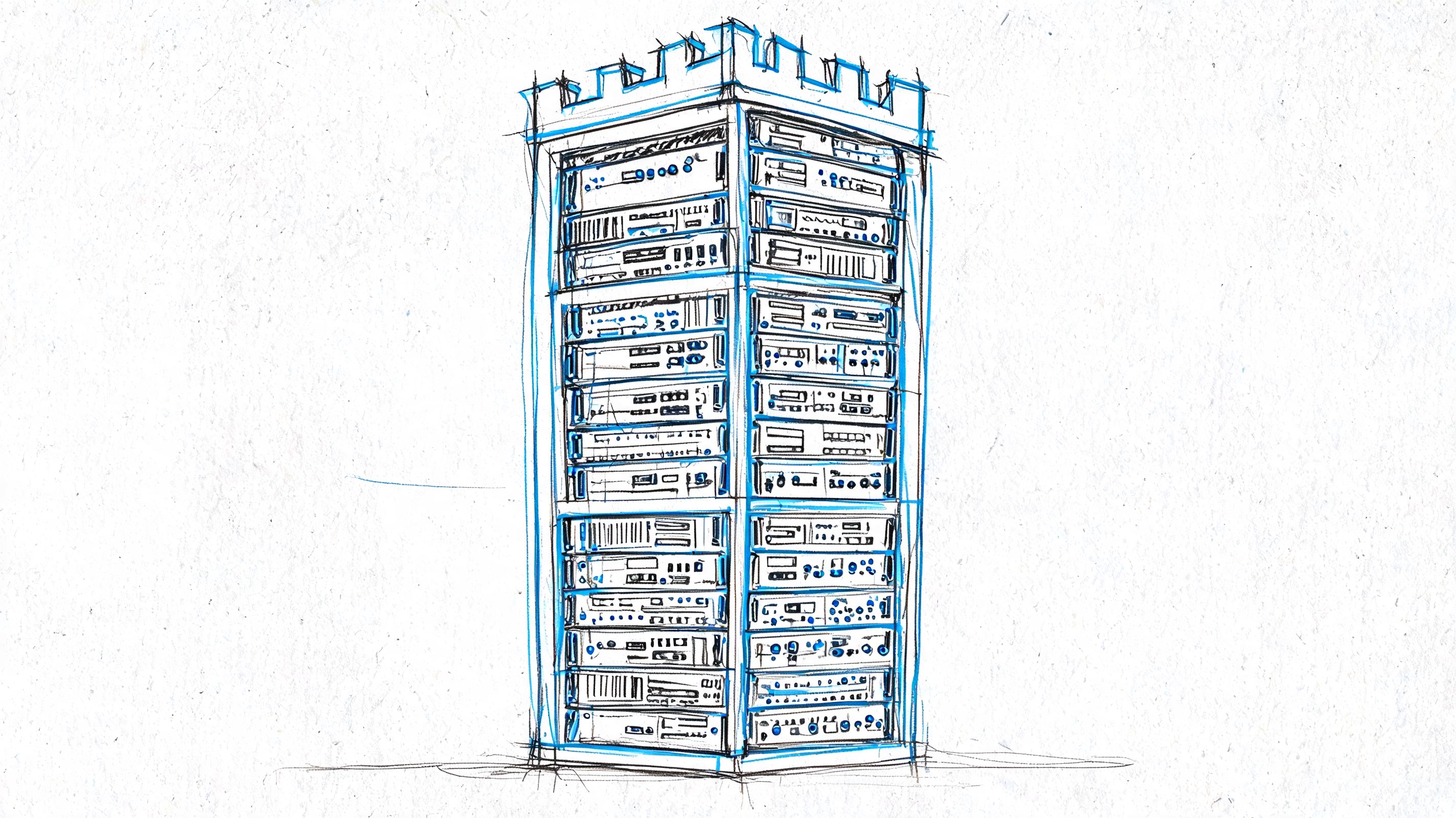
GDPR talks about “appropriate technical and organizational measures.” That sounds legalistic, but in plain English it means your systems can't be sloppy.
If your network is flat, your backups are shaky, your endpoints are unmanaged, and your team shares access too loosely, you don't just have a security problem. You have a compliance problem. Article 32 ties privacy directly to resilience, restoration, and protection.
What strong controls look like in the real world
For SMBs in Greenwood and Indianapolis, this usually starts with infrastructure, not policy binders.
A serious baseline often includes Zero Trust architecture, MFA, endpoint protection such as Bitdefender GravityZone, segmented UniFi networking with VLANs, and immutable off-site backups that can survive ransomware. On the Wi-Fi side, WPA3 belongs in current designs when the environment supports it. On the monitoring side, SOC-as-a-Service can help catch odd behavior early enough to matter.
The point isn't to buy shiny tools. The point is to reduce blast radius.
A 2023 ENISA report found 85% of breaches stem from weak controls, while compliant firms reduce incident costs by 30%, and GDPR Article 32 requires measures like encryption and resilience. The same source framing also points to backups with an RTO under 4 hours and WPA3 as practical examples in Termly's overview of GDPR obligations for U.S. firms.
The controls that pay for themselves
Here's where business owners often change their tune. They start with “How much will compliance cost?” Then they see what better controls prevent.
- Segmented networks: If the front desk machine gets compromised, VLAN separation can keep the attacker away from finance, backups, and line-of-business systems.
- Immutable backups: If ransomware hits, you want restore points the attacker can't rewrite.
- Endpoint detection: Bitdefender GravityZone or similar tools can flag behavior before a small incident becomes a multi-day outage.
- Access discipline: Least privilege limits how much damage one phished account can do.
- Restoration testing: A backup that hasn't been tested is a guess, not a recovery plan.
For teams using Microsoft 365 and document collaboration heavily, Ollo on SharePoint GDPR is a useful outside read because it gets into the practical side of securing document environments where permissions and retention can drift over time.
A lot of owners think security spend is just insurance. It's not. It's uptime protection. Every hour your staff can't access files, email, ERP, or scheduling tools turns into lost work, delayed invoices, and wasted labor.
Security is where compliance becomes operational
One reason I like talking about GDPR through the lens of infrastructure is that it exposes what's real. Anybody can claim they care about privacy. Fewer companies can restore systems cleanly after an incident, prove access was limited, and show that retention rules match reality.
This short overview is a good companion if you're reviewing your current stack against basic gaps in logging, access, backups, and testing: IT security audit checklist for Indiana business owners.
A quick visual helps here because owners often understand recovery architecture faster when they can see it in motion.
Managing Your Vendors and The Data Processing Agreement
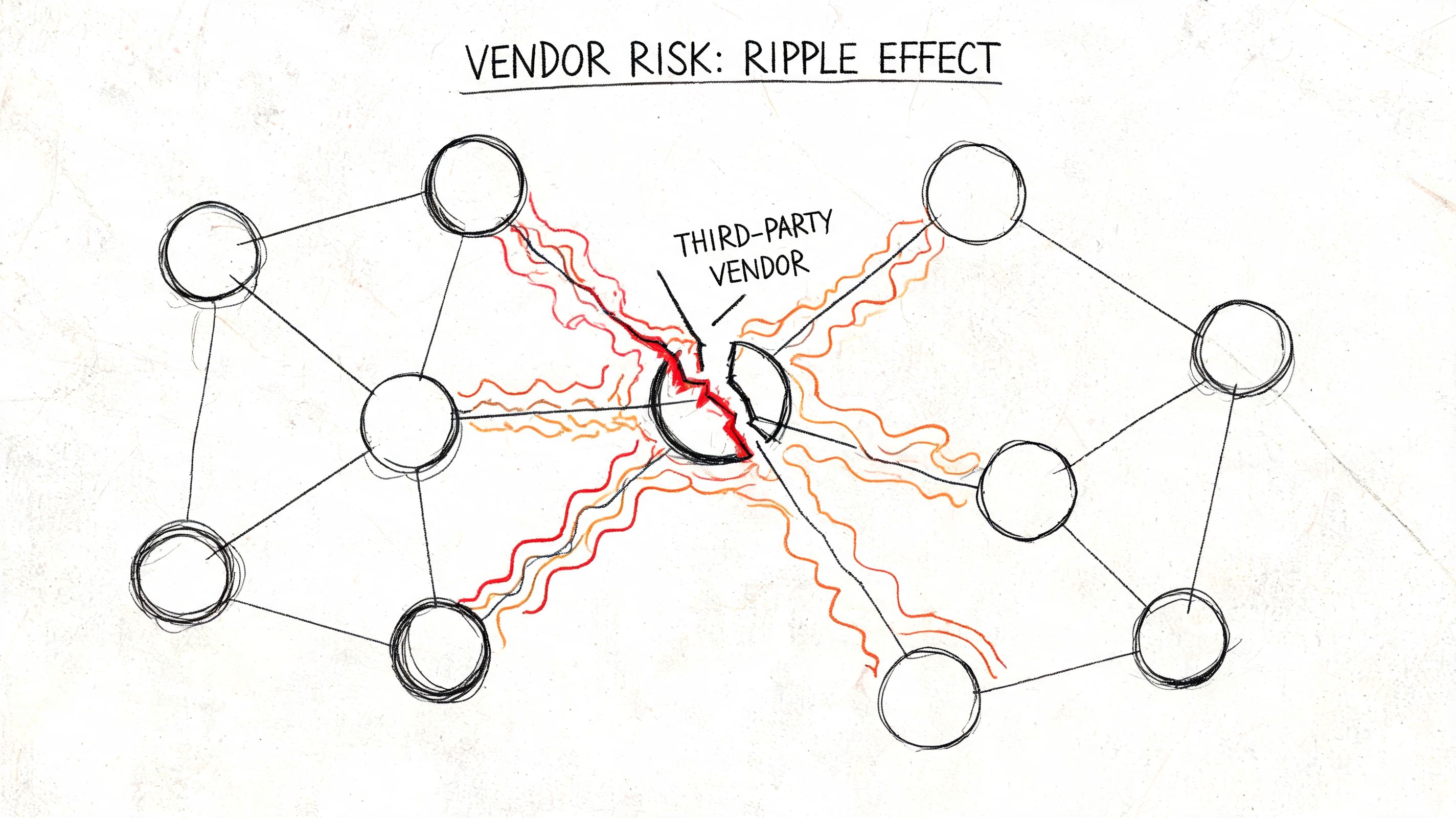
A lot of businesses clean up their internal systems and still miss the biggest hole. Their vendors.
Your CRM, backup provider, cloud file platform, ticketing system, outsourced developer, marketing automation tool, and AI platform may all touch personal data. If they do, vendor risk isn't side work. It's central to gdpr compliance for us companies.
Why processor contracts matter more than most owners think
GDPR Article 28 requires specific terms in Data Processing Agreements. The processor must act on documented instructions, maintain confidentiality, use proper security measures, assist with rights requests and breach duties, allow appropriate oversight, and support return or deletion of data at the end of the relationship.
That sounds abstract until you audit a real vendor stack.
In one anonymized review for a small business, the weak spot wasn't the firewall or the backup appliance. It was a business app chosen years earlier that stored customer records in a way nobody had documented well, with contract terms that were thin on processor obligations. The software worked fine. The paperwork and accountability around it did not.
According to Dickinson Wright's overview of GDPR Article 28 obligations for U.S.-based companies, 70% of GDPR fines between 2020 and 2023 were related to inadequate processor contracts, and using a compliant DPA template plus encrypting client backups during migration can reduce breach risk by 40% to 60%.
What a decent vendor review actually checks
A useful vendor review isn't a spreadsheet of logos. It asks pointed questions:
- What data does this vendor touch? Names, emails, IP-related data, support logs, payment details, health-related information, or repair notes.
- What role are they in? Controller, processor, or sub-processor in the actual workflow.
- What contract governs that role? DPA, service agreement, addendum, or nothing at all.
- What happens at exit? Data return, deletion, export support, and backup handling.
- Can they support your obligations? DSAR assistance, breach notification support, audit cooperation.
The vendor that “only stores data” can still create your biggest exposure if the contract is weak and the security controls are vague.
Don't leave vendor risk to procurement alone
Achieving compliance requires legal, operations, and IT to work together. Procurement may care about cost and terms. IT may care about integration and security. Leadership should care about whether a vendor creates hidden liability.
If you're cleaning this up, this practical guide to IT vendor management best practices for Indiana businesses is worth reviewing alongside your contract and security review process.
The mistake I see most often is assuming Microsoft, Google, a popular CRM, or a household-name SaaS platform must already be “handled.” Sometimes they are. Sometimes one setting, one addendum, or one undocumented workflow says otherwise. Popular doesn't mean aligned to your obligations.
Your Next Step Toward Compliance in Indianapolis
GDPR isn't just a Europe problem. It's an operations problem with legal teeth.
For Indiana businesses, the practical path is clear. Know whether EU personal data touches your business. Map where it goes. Tighten contracts with vendors. Build security controls that stand up during a real incident. Review the process regularly instead of waiting for a customer questionnaire, a breach, or a legal scare to force the issue.
This also isn't a one-time cleanup. New website tools, new cloud apps, and new marketing workflows reopen old risks. If your team runs email campaigns, donation tools, or event promotions, resources like ensuring campaign GDPR compliance can help marketing teams understand where privacy obligations sneak into day-to-day outreach.
The businesses that handle this best don't treat compliance as dead paperwork. They build it into managed operations, security reviews, onboarding, backups, and vendor approvals. That's how you protect uptime, preserve trust, and stop wasting staff hours on preventable IT chaos.
If your environment still depends on reactive support and scattered documentation, it's time to move toward a more stable operating model with managed IT services for Indiana businesses.
Frequently Asked GDPR Questions
What if I only have one or two customers in the EU
Small volume doesn't automatically remove the obligation. If you process covered personal data from people in the EU in a way that falls under GDPR, the rule can still matter. The practical issue is usually scope. Figure out exactly what data you collect, where it sits, and which systems or vendors touch it.
Is certification under the EU-US Data Privacy Framework enough
No. It may help with transfer issues in some situations, but it doesn't replace your broader GDPR duties. You still need lawful processing, rights handling, security controls, retention discipline, and proper vendor terms. A lot of businesses assume one certification solves everything. It doesn't.
My web developer is in another country. Who is responsible
Responsibility depends on roles, but you can't assume the outside developer absorbs the risk for you. If your business decides why and how personal data is processed, you may be acting as the controller for that activity. That means you need clear agreements, defined responsibilities, and visibility into what the developer and their tools are doing with the data.
How often should we review GDPR compliance
Review it whenever your data use changes in a meaningful way. New website features, new vendors, major software changes, AI features, acquisitions, and shifts in retention practices all justify a fresh look. Even without major changes, an annual review is a practical operating habit because permissions drift, systems change, and old data piles up.
If you're a Greenwood or Indianapolis-area business and you're not sure where EU data is landing, don't guess. Finchum Fixes IT can help you sort out the real risks in your network, vendors, backups, and day-to-day workflows. Protect your business and your clients. Schedule a confidential, Free Network Assessment and Security Risk Audit today.