Password and Biometrics: A Modern Security Guide for Central Indiana Businesses
TL;DR: Your Key Takeaways
- The Problem: Relying on passwords alone is a direct threat to your business continuity, leading to downtime that can cost up to $9,000 per minute. For businesses in the Indy metro area, weak and stolen passwords are the #1 cause of data breaches.
- The Solution: Combine passwords with biometrics (fingerprints, face scans) using Multi-Factor Authentication (MFA). This approach, rooted in a Zero Trust architecture, slams the door on most cyberattacks, turning wasted tech time from password resets into billable hours.
- The Business Case: For healthcare or defense contractors in Indiana, this isn't optional. Biometric MFA is critical for meeting compliance standards like HIPAA and CMMC. It provides undeniable proof of access, protects your revenue, and creates a predictable security budget.
Let’s cut to the chase. For any business in Central Indiana, from a Greenwood business park to the I-65 corridor, relying on passwords alone is like leaving the front door unlocked with a "please rob us" sign on it. We've seen it firsthand: an old brick building with spotty Wi-Fi is one thing, but an aging server secured by nothing but "Password123!" is a direct threat to your operations.
Passwords are the weakest link in your security chain. The only truly effective defense is a smart combination of passwords and biometrics—think fingerprints or facial recognition. This isn't just about fancy tech; it's about business continuity and protecting your bottom line.
This simple diagram shows the journey from flimsy, password-only security to a modern, layered defense.
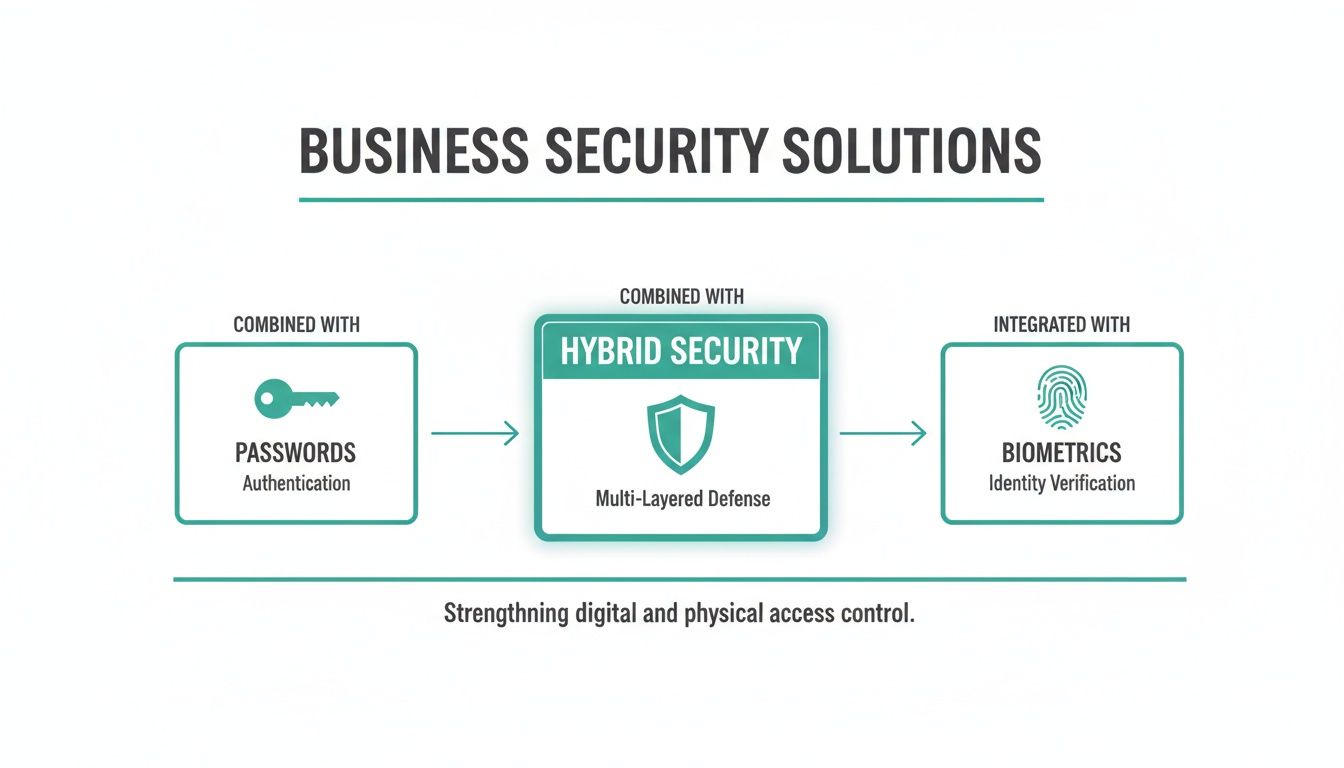
As you can see, it's not a matter of choosing one over the other. Real security comes from layering them. In the rest of this guide, we'll break down exactly how to move your business from the vulnerable left side of that image to the secure, resilient right side.
The Hidden Costs of Your Old-School Password Policy
Let's picture a logistics company over in a Greenwood business park. They know their server hardware is getting a bit long in the tooth, but the real ticking time bomb is their security. Employees are using the same simple passwords everywhere—for work systems, for social media, you name it.
One day, a popular website gets breached, and an employee’s login gets leaked. Just like that, a hacker now has the keys to the company’s entire shipping database. Operations grind to a halt, costing thousands per minute in downtime. This isn’t some far-fetched horror story; it's a technical bottleneck we've seen cripple businesses all up and down the I-65 corridor.
The hard truth is that relying only on passwords is a fundamentally broken strategy. For businesses here in Johnson County, it’s a direct invitation for cyberattacks that cause immediate, expensive downtime.
Why Your Password Rules Just Aren't Working
You've probably tried to fix this. You've enforced complexity rules—minimum lengths, special characters, and those dreaded forced changes every 90 days. But here’s the kicker: these policies often do more harm than good. They don't create stronger security; they create password fatigue. Your team gets so overwhelmed that they start making predictable, risky choices just to keep up.
Think about it from their perspective. Your employees aren't trying to be careless. They're just trying to get through their workday. When they’re forced to juggle dozens of complex credentials, they fall back on bad habits. They write passwords on sticky notes, save them in a spreadsheet, or create dead-simple patterns a hacker could guess in minutes, like "Summer2024!".
This human element is exactly what attackers prey on. They use automated tools to run a few classic plays:
- Credential Stuffing: Hackers grab billions of leaked username and password combos from old data breaches and "stuff" them into your company's login pages, hoping for a match. It’s like trying every key on a giant, stolen keyring.
- Phishing: A crafty email lands in an employee's inbox, tricking them into handing over their login details on a fake website that looks just like the real thing.
- Insider Threats: Whether it’s a disgruntled employee or just an accident, someone with a weak or shared password can expose sensitive data without any fancy hacking at all.
The Staggering Numbers Behind Password Problems
The scale of this issue is just massive. Even with all the warnings, a stunning 80-85% of people admit to reusing passwords across multiple accounts. Attackers are having a field day with this, using a pool of stolen credentials that exploded from 1.5 billion in 2023 to 3.1 billion in 2024.
With the average person now juggling over 250 passwords, it's no wonder that '123456' is still used millions of times. Every single one of these weak or reused passwords is a potential back door into your network, putting your revenue, client data, and reputation on the line.
If you want to build a stronger first line of defense, our guide on the 10 best practices for password management is a great place to start.
The real cost isn't just the risk of a breach, which can cost up to $9,000 per minute. It’s the daily drain on productivity. Every password reset ticket, every locked account, and every minute an employee spends trying to remember a login is "wasted tech time" that could have been a billable hour. This operational drag directly hurts your bottom line, day after day, turning your IT budget from a predictable expense into a reactive money pit.
How Biometrics Can Overhaul Your Company’s Defenses
So, how do we finally get a handle on the password problem? The real fix isn't about piling on more rules or just buying another piece of software. It’s about a fundamental shift in your security mindset—moving away from a system that trusts people by default to one that assumes threats are always lurking.
This modern security philosophy is called a Zero Trust architecture. Picture a high-security building right here in downtown Indy. It doesn't matter if you're flashing a company ID; every single time you want to open a door, security is there to check exactly who you are and if you're really supposed to be there. Zero Trust applies that same logic to your network, treating every login with a healthy dose of suspicion until it's proven legit.
For a Johnson County business owner, this means no user or device gets a free pass. Access to your critical data requires strict verification every single time. That’s where the powerful duo of passwords and biometrics enters the scene.
Forging an Ironclad Defense with MFA
The heart of this strategy is Multi-Factor Authentication (MFA). It's a beautifully simple concept with seriously powerful results: you require more than one piece of evidence to prove you are who you say you are. Instead of just relying on "something you know" (like a password), you layer on a second, much tougher, line of defense.
- Something you are: This is where biometrics truly shine. A fingerprint scan or a quick facial recognition check is a unique identifier that's nearly impossible for a hacker to fake or steal.
- Something you have: This is typically your smartphone getting a push notification, a physical security key plugged into a USB port, or a code from an authenticator app.
When you combine a password with a biometric scan, you've just built a formidable barrier. A crook on the other side of the world might get lucky and snatch a password from a data breach, but they sure don't have your employee's fingerprint. This one simple step stops the vast majority of automated cyberattacks cold, preventing the kind of operational downtime that costs Indiana businesses thousands.
In our 17 years of serving local businesses, we’ve seen the incredible impact of this approach firsthand. After we helped a client configure their Bitdefender GravityZone security suite to require biometric MFA, we watched their unauthorized login attempts plummet by a staggering 99.9% overnight. That’s not just a minor improvement; it's a total game-changer for their security.
The Real-World Impact on Business Continuity
Adopting a Zero Trust model with biometric MFA isn't just a technical tweak—it's a direct investment in your business continuity and ROI. The whole point is to prevent downtime and turn that "wasted tech time" back into billable hours.
Think about it: a manufacturing firm on the south side can't afford to have its production line grind to a halt because of a ransomware attack that started with one stolen password. By requiring a fingerprint scan to access the control systems, they ensure only authorized personnel can make changes. This blocks both malicious attacks and costly accidents, keeping the line moving and revenue flowing. You can learn more about protecting your systems by reading our guide to endpoint security best practices for Indianapolis SMBs.
This strategy also makes your IT budget far more predictable. Instead of scrambling to pay for costly breach cleanups, you're proactively investing in a defense that pays for itself by preventing those very disasters. It’s the difference between buying a fire extinguisher and paying to rebuild your office after it's burned to the ground.
What's Really Going On Under the Hood? Passwords vs. Biometrics
To genuinely lock down your business, you have to know your enemy—and your tools. Just dropping a new security widget into your network without understanding how it ticks is like trying to fly a plane by just looking at the pretty buttons. Let's pop the hood on passwords and biometrics to see why one is a creaky old lock and the other is a modern fortress.
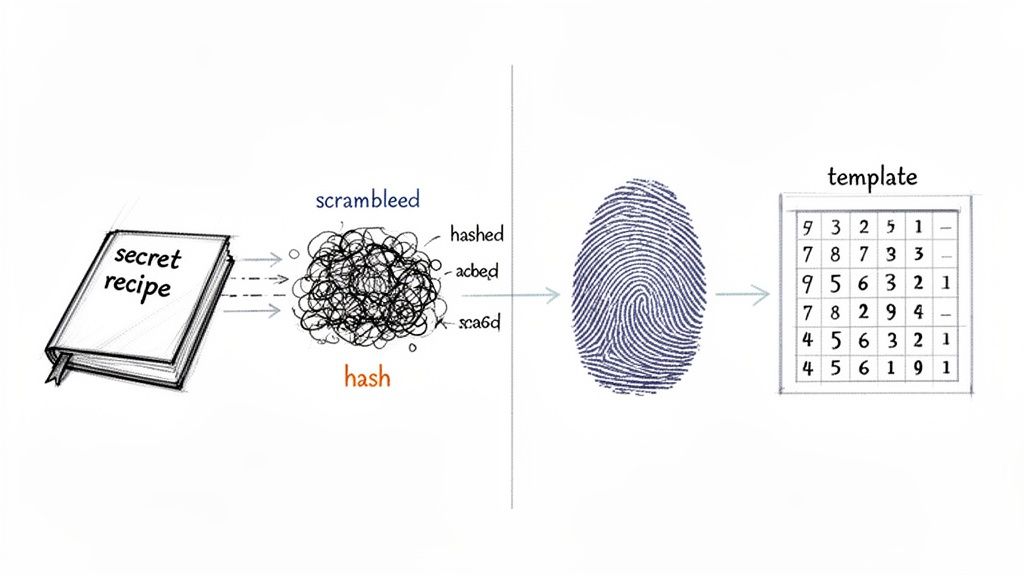
When you create a password, your computer doesn’t just scribble it down on a digital notepad. It runs it through a process called hashing, which basically turns it into a unique, jumbled-up string of characters. It’s like a one-way street; you can easily turn your password into a hash, but you can’t turn that hash back into your original password.
Of course, hackers got wise to this. If two people use "Password123," it creates the same hash. So, we started adding salting—a little pinch of random data mixed in with your password before it gets hashed. This trick ensures that even if two people have the same password, the final hashes are completely different, stopping attackers from cracking them in big batches.
So, How Does My Fingerprint Unlock My Phone?
Now for the fun part. A huge misconception we hear from business owners is that their phone or computer stores a little picture of their fingerprint or a selfie of their face. Nope! Thank goodness it doesn't work that way.
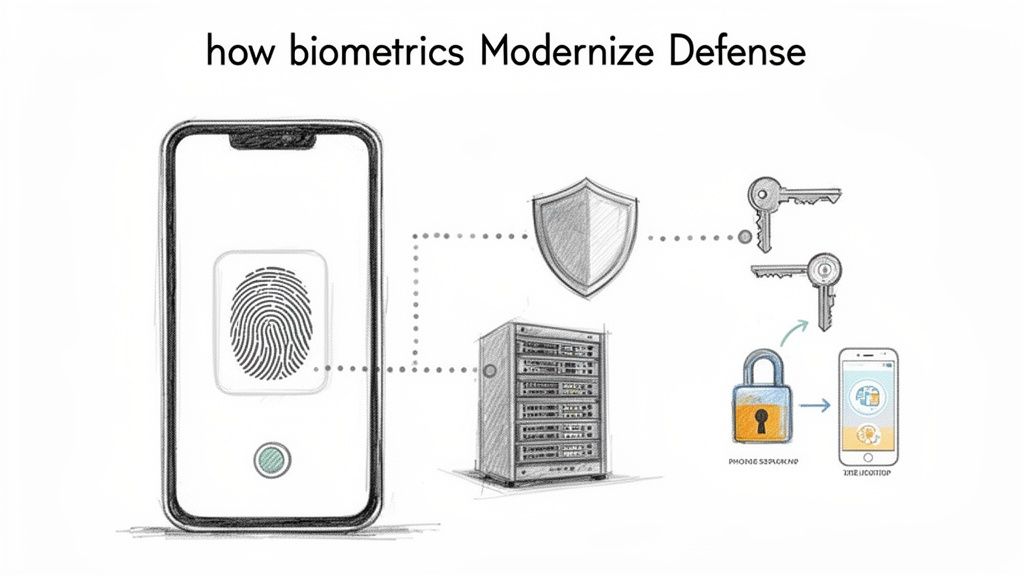
Instead, a biometric scanner maps out the unique points of your feature—like the tiny loops and arches on your fingertip or the specific distance between your eyes. It then converts that map into an encrypted string of numbers. We call this a biometric template. It’s your unique biological signature, turned into code.
It is mathematically impossible to reverse-engineer a biometric template back into a physical fingerprint or face. If a hacker somehow stole that template data, it would be a meaningless string of characters to them. This is the secret sauce that makes biometrics so powerful.
This difference is why we're seeing a seismic shift in security. By 2026, a staggering 74% of all data breaches are expected to come from stolen or weak passwords, making them your single biggest liability. Meanwhile, passwordless options are exploding. The FIDO Alliance notes that 93% of user accounts are now ready for passkeys, with millions of people ditching passwords every month. The writing's on the wall. For a deeper dive into these market shifts, check out the full report on password management.
The Two Flavors of Biometrics
Not all biometrics are created equal. They generally fall into two buckets, each with its own strengths for protecting your business.
-
Physiological Biometrics: This is the stuff you’re born with—your unique physical traits. Think fingerprint scans, facial recognition, or even iris scanners. Because these features are stable and incredibly hard to fake, they're the go-to for controlling access to important devices and data.
-
Behavioral Biometrics: This is the cool, cutting-edge stuff that analyzes how you do things. It looks at your unique patterns, like the rhythm of your typing, how you move your mouse, or even the way you walk. This is often used for "continuous authentication," working quietly in the background to make sure the person using a computer is still the right person.
We've seen firsthand how these systems work—and what happens when they fail. When we dissembled a similar client’s failing RAID array, we saw how bit-level data recovery was their last line of defense. Understanding the nuts and bolts is how we diagnose the different security threats to a network for Indiana businesses and build solutions that actually work. After all, you can't build a strong wall until you know what kind of cannonballs the enemy is firing.
Keeping Indiana’s Regulators Happy with Strong Authentication
If you're running a business anywhere from Hamilton County to the tech hubs in downtown Indy, you know security isn't just about preventing a server crash. It’s about compliance. Let's be blunt: failing to meet regulatory standards isn't an option when the alternative is crippling fines and a trashed reputation. That's why strong authentication using both passwords and biometrics has shifted from a "nice-to-have" to an absolute must.
Take a medical practice in Carmel. Under HIPAA, they have to prove exactly who accessed sensitive patient records and when. A simple password just won't fly—it can be shared, stolen, or scribbled on a sticky note. Biometric logs, on the other hand, provide concrete, undeniable proof that a specific person, and only that person, laid eyes on the data. That kind of non-repudiation is precisely what auditors want to see.
It's the same story for defense contractors along the I-65 corridor who are wrangling with CMMC (Cybersecurity Maturity Model Certification) requirements. To protect controlled unclassified information (CUI), you have to lock down access. A fingerprint scan to get into a firewalled server is a tangible, auditable security measure that helps satisfy those tough demands.
Aligning Your Security with the Right Frameworks
For almost every other business in Indiana, the NIST Cybersecurity Framework (NIST CSF) is the gold-standard roadmap. It places a huge emphasis on protecting your assets and managing who gets in. When you combine passwords with biometrics, you're directly hitting two of its core functions: "Protect" and "Detect."
Here’s how we make that happen for our clients:
- Rock-Solid Identity Proofing: We set up systems that tie a digital identity to a real, live person using their unique biometrics. This creates a crystal-clear audit trail that’s easy to defend.
- Layered Access Control: By mandating MFA with a biometric factor through tools like Bitdefender GravityZone, we make sure that even if a password gets swiped, your crown jewels stay locked up tight.
- Bulletproof Data Protection: We don’t just stop at the front door. We pair strong authentication with other tools, like immutable off-site backups. So, even if ransomware gets through, you have clean, untouchable data copies protected by access controls no hacker can crack.
This hybrid approach is taking over the industry. A staggering 94% of enterprises now have workloads in the cloud, but old, bad habits die hard—global password reuse rates are still stuck somewhere between 60-78%. This gap creates a massive need for security that works for both old-school and modern systems.
In our 17 years of local service, we've seen auditors' eyes light up when they see biometric access logs. It gives them a level of certainty a password-only system can never match, which makes your compliance checks a whole lot smoother.
Making Compliance Practical, Not Painful
Rolling out these controls doesn't have to throw a wrench in your team's workflow. Modern tools slide right into the systems you already use. For example, an employee can log into their computer with a fingerprint using Windows Hello for Business, and poof—they're automatically authenticated for all their apps without typing a single password. To ensure your business is up to snuff, it's smart to explore different authentication solutions that are built for compliance.
This isn't just about pleasing auditors. It’s a powerful defense against ransomware, which should be a top concern for any business with sensitive data. By securing the point of entry, you stop attackers before they can ever get the foothold they need.
Building a security posture that regulators will love starts with knowing your weak spots. Our guide on creating a cyber security risk assessment template for Indiana businesses is the perfect place to start that all-important process.
Ready to Secure Your Business? It’s Time to Act.
Alright, we’ve walked through the good, the bad, and the ugly of modern business security. Now, the ball's in your court. Sticking with a flimsy, password-only security model isn't just risky anymore—it's a direct threat to your revenue, your reputation, and your very ability to operate here in Central Indiana.
The cost of sitting on your hands is staggering. Think about it: a single breach can bring everything to a halt, costing you up to $9,000 per minute in downtime. That's before we even talk about losing irreplaceable data or getting hit with massive compliance fines under regulations like HIPAA or CMMC. The real question isn't if an attack will happen, but whether you'll be ready when it does.
For over 17 years, Finchum Fixes IT has been the go-to local expert for businesses all over the Indianapolis area. We bring big-league security solutions like SOC-as-a-Service monitoring but deliver them with the personal, boots-on-the-ground support you can only get from a team that lives and works right here. We’ve seen the aftermath when security fails, and more importantly, we know exactly how to stop it from happening in the first place.
Your Roadmap to Real Security
Making the jump from easily-cracked passwords to a powerhouse combo of passwords and biometrics can feel like a huge undertaking. But it all starts with one simple, crucial step: a professional evaluation. This is the only way to find those sneaky vulnerabilities lurking in your network before a hacker does. This isn't just about installing some software; it’s about crafting a security strategy that's built specifically for how you do business.
Don’t gamble with your company's future. Every day you put this off is another day you’re leaving the door wide open for an attack that could shut you down, wipe your data, and vaporize the trust you’ve built with your customers. A proactive defense is always smarter—and cheaper—than cleaning up a disaster.
Beefing up your defenses is a must. While a robust authentication strategy is your cornerstone, you can get a head start by implementing these 10 Actionable Cybersecurity Tips. That’s a great foundation, but for a truly ironclad shield, you need an expert on your side. To see how we build that shield, check out our deep dive into our cybersecurity services.
Stop crossing your fingers and hoping for the best. Contact us today for a complimentary Security Risk Audit for your Greenwood or Indianapolis-area business. Let’s create a clear roadmap to protect what you've worked so hard to build.
Got Questions? We've Got Answers
After 17 years of being the go-to IT team for Johnson County businesses, we've heard just about every question there is on modern security. When it comes to passwords and biometrics, these are the ones that pop up most often. Let's get right to it.
Can a Thief Really Steal My Fingerprint and Use It?
That’s the million-dollar question, isn't it? It's a smart one to ask, and the answer gets right to the heart of how this tech actually works. The professional-grade biometric systems we install don't snap a little picture of your fingerprint and save it. Forget that idea entirely.
Instead, they act like a cartographer, mapping out the unique ridges and valleys of your finger—the minutiae—and then converting that map into an encrypted digital code. It’s a one-way street; you can turn the fingerprint into code, but you can't turn that code back into a fingerprint. So, even if a super-hacker managed to swipe that data, they’d just have a jumble of useless numbers and letters.
On top of that, we only recommend systems with "liveness detection." This is the cool part. It makes sure the finger or face it's scanning is attached to a real, living, breathing person—not some clever silicone copy or a deepfake video. This makes trying to fool the system incredibly difficult.
What's This Going to Cost Me? Is Biometric Security Expensive?
The price tag on biometric security has plummeted in recent years. In fact, you've probably already paid for most of the hardware. The high-quality fingerprint readers and facial recognition cameras built into your team’s laptops and smartphones are often more than capable of handling business-grade security. We can usually piggyback on that existing tech, which keeps your upfront costs way down.
But the real question isn't about cost. It’s about Return on Investment (ROI).
Think about the ROI this way: What’s the cost of preventing just one data breach that causes a day of downtime? Easily tens, if not hundreds, of thousands of dollars in lost revenue, recovery fees, and potential fines. One single disaster averted can pay for your entire security upgrade, and then some. A proper security investment converts "wasted tech time" into billable hours and a predictable monthly budget.
This is where a Security Risk Audit comes in. It gives you a crystal-clear cost-benefit analysis for your specific setup, so you know you're putting your money where it counts most.
Will Biometrics Get Me in Trouble with HIPAA or CMMC?
Quite the opposite! In many situations, biometrics are actually the best way to meet these tough compliance rules. Standards like HIPAA for healthcare and CMMC for government contractors are sticklers for strong access controls and audit trails that can't be argued with.
A password can be written on a sticky note, shared, or stolen. But you can't exactly loan someone your eyeball for the afternoon. Biometrics offer non-repudiable proof of identity. That's a fancy way of saying it’s virtually impossible for an employee to claim, "Hey, that wasn't me who logged in!" For our clients along the I-65 corridor, this is a massive win during an audit. It provides the concrete proof regulators are looking for.
Okay, But What If the Scanner Breaks? Are We Locked Out?
That’s a critical point, and it’s something we plan for from the very beginning. Any security system worth its salt has a backup plan. A single point of failure is a rookie mistake, and it’s not one we make.
Let's say the fingerprint scanner on a door at your Greenwood facility suddenly goes on the fritz. Your team won't be stuck outside. They'd simply use a fallback method, like a secure keycard or an authentication code sent to a company-owned phone. It's all about building layers, using a solid Multi-Factor Authentication (MFA) strategy. A single hardware glitch should never bring your business to a grinding halt.
Your business can't afford to gamble with outdated security. At Finchum Fixes IT, we transform your defenses from a liability into a business asset. Get a clear roadmap to protect your assets by scheduling a complimentary Security Risk Audit specifically for your business in the Greenwood/Indianapolis area.