Cybersecurity Assessment Services: Indiana Business Guide
A warehouse office along the I-65 corridor is quiet until the inventory system rejects every login. The owner calls it a software problem, but the actual issue may be a compromised account, exposed remote access, or an untested recovery plan. Cybersecurity assessment services find those weaknesses, rank them by business impact, and turn them into practical fixes that protect continuity.
For a Johnson County business owner, security isn't an abstract technical exercise. It determines whether staff can ship orders, answer patients, process payroll, or serve customers when an incident hits. A useful assessment connects controls to those operating realities, then keeps reducing exposure after the report is delivered.
Why Your Indianapolis Business Needs a Security Checkup
A mid-sized logistics firm near the I-65 corridor suddenly loses access to its inventory management system. Employees restart computers, test the wireless network, and call the software vendor. Meanwhile, someone may be encrypting files, disabling accounts, or moving through the network from a stolen credential.
Downtime has a direct financial impact. A widely cited Ponemon Institute estimate places the average downtime cost for medium and large organizations at nearly $9,000 per minute, using the formula minutes of downtime multiplied by cost per minute. The same source estimates that small businesses can lose about $137 to $427 per minute. Those figures come from Atlassian's explanation of downtime cost, and they show why a security review belongs in continuity planning, not just the IT budget.

What the checkup actually examines
Cybersecurity assessment services evaluate your digital infrastructure before an attacker does. The work can include security controls, endpoint configurations, identity systems, cloud services, network devices, backup processes, policies, and operational practices. A qualified assessment may map findings to NIST SP 800-53, NIST SP 800-171, CIS Critical Security Controls v8, or the NIST AI Risk Management Framework, creating evidence that supports compliance decisions and audit preparation. Assured Information describes assessment work against recognized security frameworks.
The local warning signs are familiar: aging server hardware in a Greenwood business park, unsupported software, shared administrator passwords, or spotty Wi-Fi in an old brick building downtown. A UniFi networking refresh may solve coverage and segmentation problems, but only after someone identifies where the current design fails.
Threats also vary by location and industry. A practical overview of common Atlanta cybersecurity risks is useful because phishing, ransomware, exposed services, and weak access controls aren't limited to one metro area. For a small business starting from scratch, this 2026 small business cybersecurity checklist provides a useful companion to a formal review.
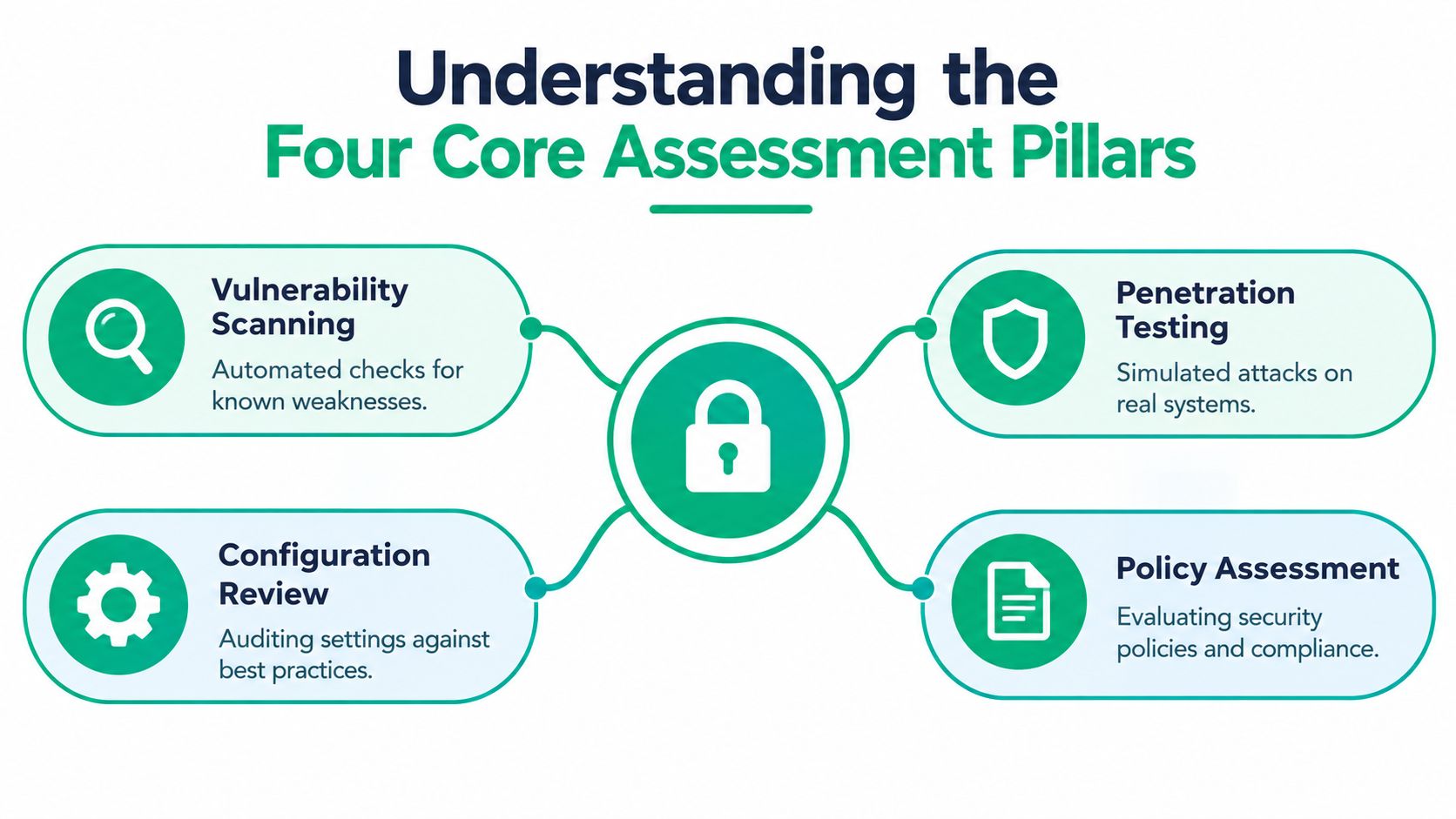
Understanding the Four Core Assessment Pillars
A vulnerability scan answers one narrow question: which known weaknesses can an automated tool detect? A complete assessment asks harder questions. Can an attacker reach the weakness? What data or process would be affected? Would existing controls detect the activity? Can the business restore operations?
Vulnerability scanning
Automated scanning checks systems, applications, and devices for known flaws, missing patches, weak services, and other detectable conditions. It gives an assessor useful breadth, but it can produce false positives and usually lacks business context. A scan might identify an outdated application without showing whether the system holds patient records, controls production, or sits behind a compensating control.
Penetration testing
Penetration testing uses controlled attack techniques against agreed targets. Testers may examine authentication, privilege escalation, exposed applications, segmentation, and paths to sensitive data. The value isn't the drama of “breaking in.” It's proof that a weakness can be chained with another weakness to create a real attack path. Read this comparison of vulnerability assessments and penetration testing before approving a scope that includes only automated scanning.
Configuration review
Misconfiguration causes plenty of avoidable exposure. A review checks firewall rules, Microsoft 365 settings, endpoint policies, cloud permissions, administrator roles, logging, wireless segmentation, and backup administration. It compares the current state with suitable practices, rather than assuming a purchased security product is configured correctly.
Policy and evidence assessment
Policies must match actual operations. Reviewers examine password and access procedures, incident response, vendor handling, retention, security awareness, recovery testing, and evidence quality. A company may have a policy requiring restore tests, yet lack logs proving that anyone performed them. That gap matters during an audit and during a crisis.
Framework-based scoring can add useful granularity. Some providers assess against NIST CSF 2.0 and CIS Controls v8, while ATT&CK-based evaluations test detection, protection, and response against realistic adversary behavior at the technique level. ITecs explains framework and ATT&CK-oriented assessment approaches. The practical answer is a layered engagement, not a single scan sold as a security program.
The High Cost of Inaction for Indiana SMBs
A ransomware incident doesn't need to destroy every server to hurt a Johnson County company. If employees lose access to scheduling, accounting, inventory, or customer records, the business may stop serving customers while owners coordinate containment. A Hamilton County firm facing rapid growth can also accumulate cloud accounts, vendors, and endpoints faster than its internal controls mature.
The financial case starts with interruption. The downtime estimates cited earlier make the exposure concrete, but the calculation itself belongs to each business. Ask which systems stop revenue, which staff cannot work without them, how long manual processes can continue, and whether customers will move to another provider.
Practical rule: Rank a finding by the business process it can interrupt, not by how alarming the scanner makes it sound.
What a proactive budget protects
An assessment helps direct limited funds toward controls with operational value. That may mean enforcing multifactor authentication, separating guest and business wireless networks, replacing an unsupported firewall, restricting administrator privileges, or improving restore procedures. It may also mean accepting a low-impact risk formally instead of spending money on a tool that doesn't address the main exposure.
Ransomware recovery requires more than hoping a cloud sync exists. Immutable backups cannot be modified or deleted during a defined retention period, even by administrators, which makes them resistant to ransomware aimed at backup repositories. A practical program also follows the 3-2-1 rule, with three copies of data, two media types, and one offsite or cloud copy, alongside encryption, documented retention, and periodic restore testing. Data Hygienics outlines immutable backups and these backup practices.
That work protects more than compliance. It preserves billable hours, customer commitments, payroll operations, and predictable monthly planning. Owners should also keep a tested incident process close at hand. This SMB ransomware recovery guide can help organize immediate decisions, but an assessment should identify which recovery steps are realistic before an incident forces them.
The Assessment Process and Deliverables You Receive
A useful engagement begins before anyone runs a scanner. The assessor and business owner agree on systems, locations, data types, operating constraints, testing windows, and emergency contacts. That scope protects production systems from careless testing and makes the final report easier to act on.
A practical workflow
-
Scope the engagement. Identify offices, servers, cloud platforms, endpoints, wireless networks, critical applications, vendors, and compliance goals. State what isn't included so nobody mistakes a limited review for a full test.
-
Discover the environment. Build an asset inventory and map trust relationships. Include shadow SaaS, remote access, administrative accounts, backup systems, and data flows. Unknown assets create blind spots that a polished report won't fix.
-
Test controls. Run authenticated and unauthenticated scans where appropriate, review configurations, inspect identity controls, and perform approved penetration testing. A diagnostic workflow may include validating endpoint status in Bitdefender GravityZone, reviewing firewall and UniFi controller settings, checking backup job history, and confirming that a sample restore works.
-
Analyze business risk. Translate technical findings into affected processes, likely attack paths, data sensitivity, recovery dependencies, and ownership. A critical server with weak access controls deserves a different response from an isolated workstation with a minor configuration issue.
-
Report and remediate. Deliver an executive summary, technical findings, evidence, risk rankings, owners, target dates, dependencies, and a remediation roadmap. Cloudvara's practical security checklists and templates can help teams prepare documentation, but templates don't replace environment-specific testing.
The strongest report gives management a decision tool rather than a warehouse of screenshots. Each finding should explain what was observed, why it matters, how an attacker could use it, what fix is recommended, and how the team will verify closure.
What to demand from the final package
Expect an asset register, scope statement, methodology, prioritized findings, control mapping, evidence notes, and a recovery-focused action plan. Ask whether the assessor will help validate fixes after remediation. A finding that remains open in a shared spreadsheet is not risk reduction.
For Indiana organizations preparing internal reviews, this cybersecurity risk assessment template for Indiana businesses offers a starting structure. The deliverable becomes valuable when it drives a scheduled change, a named owner, and a verification step.
How Finchum Fixes IT Approaches Security Evaluations
Local conditions shape technical risk. A Greenwood business park may still depend on aging server hardware, while an older downtown Indy building may have concrete, brick, and cabling constraints that create dead zones. In our 17 years of local service, the practical fix has often required joining security work to networking, endpoint management, recovery, and user support instead of treating each as a separate ticket.

Findings must become operating controls
A remediation plan may pair UniFi networking with segmented wireless networks, properly placed access points, and latency-optimized mesh nodes where cabling isn't practical. It may recommend replacing unsupported hardware, tightening Microsoft 365 access, or applying Zero Trust architecture so users and devices earn access based on identity, device health, and business need.
Endpoint protection also needs operational context. Bitdefender GravityZone uses a single-agent architecture to combine risk management, endpoint protection, and XDR across physical, virtual, and cloud environments. Its Network Attack Defense feature detects brute-force attempts, network exploits, password stealers, drive-by downloads, bots, and Trojans. Bitdefender's GravityZone platform documentation describes those capabilities and shows why consolidation can reduce tool sprawl.
Backups receive the same scrutiny. An assessment should verify permissions, encryption, retention, offsite placement, and restore evidence, then recommend immutable off-site backups where the threat model requires them. Data recovery planning should also distinguish logical recovery from bit-level data recovery, which examines storage media at a lower level when ordinary file access fails.
The assessment doesn't end with a PDF. It should feed patching, identity changes, alert handling, recovery exercises, and monthly risk review. The technical team needs a queue it can execute, while the owner needs a clear view of cost, business interruption, and remaining exposure.
A short visual explanation can help nontechnical leaders understand why assessment and response belong together:
Finchum Fixes IT is one Indiana option for combining computer diagnostics, networking, cybersecurity, data recovery, and ongoing support. The right provider should explain what it will monitor, who responds to alerts, how changes are documented, and how the service supports business continuity.
Navigating Compliance Standards Like HIPAA and NIST
Compliance starts with the information your company handles, not with a favorite framework. A general business may use NIST CSF to organize security outcomes, a healthcare practice may need HIPAA safeguards and evidence, and a defense contractor may need CMMC practices aligned with applicable federal requirements.
| Framework | Best For | Key Focus |
|---|---|---|
| NIST CSF | General business security programs | Identifying, protecting, detecting, responding, and recovering from cybersecurity risk |
| HIPAA | Healthcare organizations handling protected health information | Administrative, physical, and technical safeguards, plus documented handling of health information |
| CMMC | Defense contractors handling applicable federal or controlled information | Demonstrable cybersecurity practices, system scope, access control, protection, and assessment readiness |
The overlap is useful, but it can also confuse teams. Access control, logging, incident response, vendor management, backup, and training may appear under several requirements. A good assessment maps one underlying control to multiple obligations without pretending that one policy document proves every implementation detail.
Evidence is part of the risk
Reviewers should inspect configuration exports, access reviews, training records, incident tickets, backup reports, restore results, vendor records, and policy approvals. A written requirement with no operating evidence is weaker than a smaller, well-documented control set.
Email deserves specific attention because phishing often bypasses otherwise solid endpoint defenses. Review authentication, mailbox permissions, forwarding rules, administrator roles, and user reporting workflows. This guide to email authentication provides useful background for teams evaluating sender and mailbox protections.
The output should show which framework drives each recommendation, which requirements overlap, what evidence exists, and what remains unresolved. That reduces audit friction while keeping security work tied to actual exposure.
From Assessment to Continuous Security and Protection
A one-time assessment creates a baseline. It doesn't stop a new cloud service from appearing, an administrator account from accumulating privileges, or a newly exposed endpoint from entering the environment. Bitdefender's 2025 report says 67% of respondents believe AI-driven attacks have increased, while organizations are focused on reducing attack surface. Bitdefender's 2025 Cybersecurity Assessment Report captures that shift from static review toward ongoing exposure reduction.
That change matters for SMBs with limited staff. Continuous monitoring, patch governance, identity review, backup validation, and SOC-as-a-Service monitoring keep findings connected to daily operations. Managed detection and response adds a response path when an alert needs investigation, containment, or escalation. This Indiana guide to managed detection and response explains that operating model in practical terms.
The business result is straightforward. Fewer preventable incidents mean fewer interruptions, less wasted technical time, and a more predictable monthly budget. Your security program should show what changed, what remains exposed, and which action protects the next critical business process.
If your company operates in Greenwood or Indianapolis, schedule a Free Network Assessment or Security Risk Audit before a locked account becomes a shutdown. Ask for an assessment that connects findings to remediation, recovery, and continuous monitoring.
Finchum Fixes IT provides cybersecurity assessments, network diagnostics, endpoint protection, recovery planning, and ongoing IT support for businesses in the Greenwood and Indianapolis area. Visit Finchum Fixes IT to request a Free Network Assessment or Security Risk Audit and start turning unknown exposure into a practical continuity plan.