How to Choose a Software Development Company: An Indy Guide
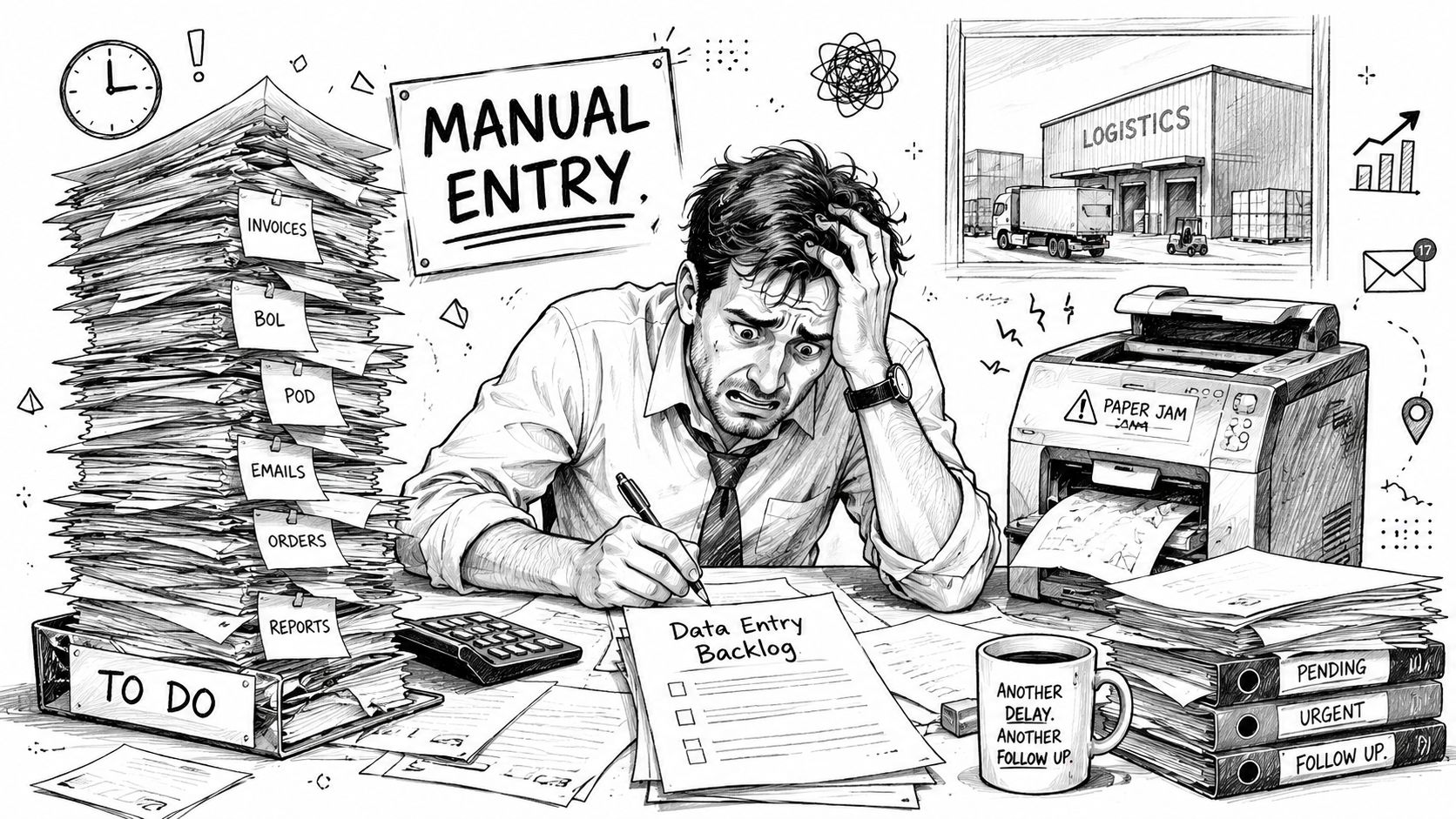
A lot of Johnson County owners start shopping for a software firm at the exact wrong moment. They're already frustrated. The team is retyping orders from one system into another, dispatch is juggling spreadsheets, and someone in the office keeps saying, “There has to be a better way than this.”
There is. But hiring the first development shop with a slick website usually trades one bottleneck for another.
Custom software can turn wasted tech time into productive hours, tighten up handoffs, and protect business continuity when your process is currently held together by inbox rules, sticky notes, and one employee who “just knows how it works.” If that weak link breaks, downtime gets expensive fast. In real businesses, downtime can cost thousands of dollars per minute. That's why the right software partner isn't just writing code. They're helping you remove operational risk.
Your Custom Software Project Starts Here
A Greenwood company in a business park off the I-65 corridor doesn't need a lecture on digital transformation. They need the routing mess fixed.
Usually the problem looks like this. Sales enters customer info in one tool. Operations copies it into another. Drivers get updates by phone or text. Billing cleans up the mistakes later. Nothing crashes outright, but the whole system bleeds time every day. That's the kind of slow-motion failure that kills margin.
TL;DR
- Start with the problem, not the vendor. Define the workflow bottleneck, users, budget, timeline, and must-have features first.
- Shortlist carefully. Look for Indiana-relevant experience, strong communication, similar project work, and proof they can support the app after launch.
- Ask hard questions. Dig into methodology, security controls, QA process, compliance readiness, and who's actually doing the work.
- Compare proposals apples to apples. Normalize scope, pricing model, support terms, and ownership language.
- Use a scoring matrix. Weight technical fit, experience, cost, communication, and culture before signing a contract.
- Protect continuity. Good software should reduce downtime, remove manual work, and give you a more predictable operating model.
A solid custom app can fix that permanently. It can connect dispatch to billing, validate data before bad entries spread, and give managers one dashboard instead of six partial truths. If the company also needs secure remote access, SOC-as-a-Service monitoring, or tighter endpoint controls around the app, those pieces need to be designed in from day one, not bolted on later.
What Indiana businesses usually get wrong
Most owners start by asking, “Who's the best developer around Indy?” That's too early.
The better question is, “What business failure are we trying to stop?” In healthcare, that may be a workflow that creates HIPAA exposure. For a defense supplier, it may be poor documentation and access controls that create CMMC headaches. For a manufacturer, it may be disconnected shop-floor reporting that causes expensive delays.
A custom build only pays off when it removes a specific drag on operations.
What a good project changes
When the software is right, your staff stops doing detective work. They stop hunting down the latest spreadsheet, guessing which number is current, or waiting on one person to manually reconcile everything. That's where ROI comes from. Not from “innovation theater,” but from fewer mistakes, less downtime, and more hours spent on actual revenue work.
If you're still trying to map out where technology fits into the bigger picture, this guide on building an Indiana business IT roadmap for 2026 is a smart place to get your bearings.
Define Your Project Before You Search
The fastest way to burn money on software is to hire a developer before you've defined the job.
The practical sequence is straightforward. First define scope, budget, timeline, and required skills, then evaluate vendors. That order shows up consistently in software selection guidance, and it matters because outsourcing is mainstream. One industry summary citing ISG reports says 92% of G2000 companies use technology outsourcing according to Ciklum's software development company selection guidance. Big organizations treat this as strategic procurement. Smaller Indiana businesses should too.
Write down the business case
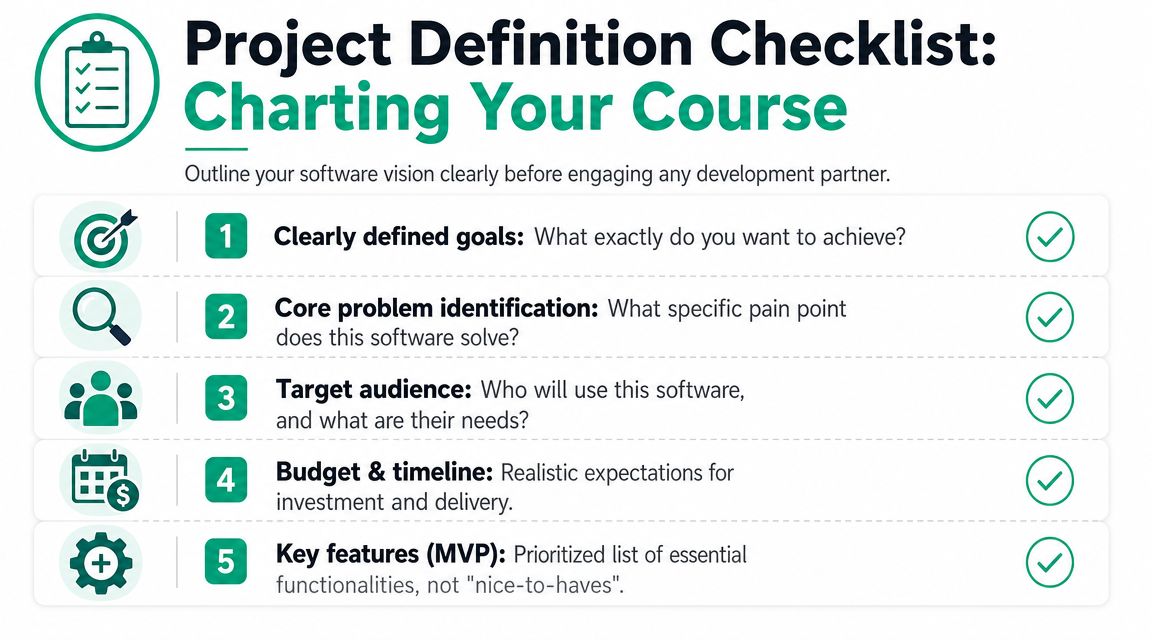
Before you look at a single portfolio, answer these questions in plain English:
- What's breaking now. Name the current bottleneck. Manual re-entry, missed follow-ups, poor inventory visibility, routing errors, slow reporting, weak audit trail.
- Who uses the software. Office staff, drivers, managers, patients, field techs, customers, vendors. Different users need different permissions and screens.
- What success looks like. Faster handoffs, cleaner records, fewer support calls, better compliance evidence, less dependence on tribal knowledge.
- What absolutely must integrate. QuickBooks, Microsoft 365, a CRM, barcode scanners, mobile devices, UniFi networking environments, document systems, or line-of-business databases.
That document doesn't need to be pretty. It needs to be clear.
Good software projects start as business documents, not technical documents.
Set the floor and the ceiling
Most bad projects start with fantasy budgeting. Either the owner expects enterprise-grade software for bargain pricing, or the vendor hears a vague idea and fills the gaps with assumptions.
Set three boundaries up front:
-
Budget range
Give a real range, not “we're open.” That forces honest conversations. -
Timeline reality
If the software is tied to a contract, hiring cycle, location opening, or compliance milestone, say that immediately. -
Must-have skills
If you need mobile capability, cloud hosting, API integrations, AI-assisted workflow, Bitdefender GravityZone-aware endpoint environments, or immutable off-site backup alignment for supporting data, spell it out.
Separate MVP from wish list
A lot of owners drown their own project with good ideas. You don't need every feature in phase one.
Use this filter:
| Feature type | Keep it in MVP if... | Push it later if... |
|---|---|---|
| Core workflow | It removes the bottleneck immediately | It's nice but not necessary for launch |
| Compliance function | It supports HIPAA, CMMC, or auditability | It can wait without creating exposure |
| Reporting | Staff needs it to do the job daily | Leadership just wants nicer dashboards |
| Automation | It replaces repetitive manual effort | It saves time but doesn't block operations |
The team that can't help you think through phased delivery probably won't manage scope well either.
For a closer look at project-method fit, this article on choosing software development life cycle models for Indiana businesses is worth your time.
Building Your Shortlist in Central Indiana
Once the project is defined, then you go hunting.
That part has gotten harder, not easier. The outsourced software market is massive, and one industry roundup projects it will reach $977 billion by 2031 according to Keyhole Software's outsourcing statistics roundup. In a market that large, polished sales talk is cheap. Bad matches get expensive.
Why local context still matters
You don't need every developer to be on the Southside. But for Indiana SMBs, local context helps more than people admit.
A vendor that understands businesses along the I-65 corridor usually asks better questions about staffing, bandwidth, physical sites, warehouse Wi-Fi dead zones, old brick building signal problems, and mixed environments where cloud apps still depend on one aging on-prem server. That's different from selling software to a coastal startup with a fully remote team and no compliance burden.
In our 17 years of local service, we've seen the same thing repeatedly. The firms that work well around Greenwood, Franklin, Indianapolis, and Hamilton County growth areas tend to understand operations first and code second.
Where to look beyond Google
Build your first pass from a few channels, not one:
- Regional referrals from accountants, MSPs, compliance consultants, and business attorneys who've seen these contracts go well or badly.
- Local portfolio checks from downtown Indy tech hubs and established firms serving Indiana manufacturers, healthcare groups, logistics companies, and service businesses.
- Professional network overlap where you can ask a real client, “Did they communicate well when things got messy?”
- Specialty capability research if your project needs emerging skill sets such as outsourcing Web3 and AI expertise alongside standard application work.
What belongs on the shortlist
Don't build a giant comparison spreadsheet with twenty names. Build a serious shortlist.
A practical target is a small field of candidates who can handle your problem. Look for these signs:
- Relevant work. Not just “we build apps,” but evidence of similar complexity, similar users, or similar compliance concerns.
- Communication discipline. Fast replies during sales aren't enough. You want clear answers, defined contacts, and willingness to discuss process.
- Post-launch maturity. If they disappear after go-live, you're buying a future outage.
- Technical range. Can they discuss hosting, integration, access control, monitoring, and recovery, not just front-end screens?
If a vendor only talks about features and never about support, recovery, or change control, they're selling a launch, not a system.
A helpful local lens on the hiring side is this guide to hiring a custom application developer in Indiana.
The Vetting Playbook Questions You Must Ask
The interview stage is where weak vendors start wobbling.
A strong firm can explain how they work in operational terms. A weak one hides behind buzzwords, vague estimates, and “don't worry, we've got it.” That's not enough when your dispatch flow, patient data, or production reporting is on the line.
Ask about process like an operator, not a buyer
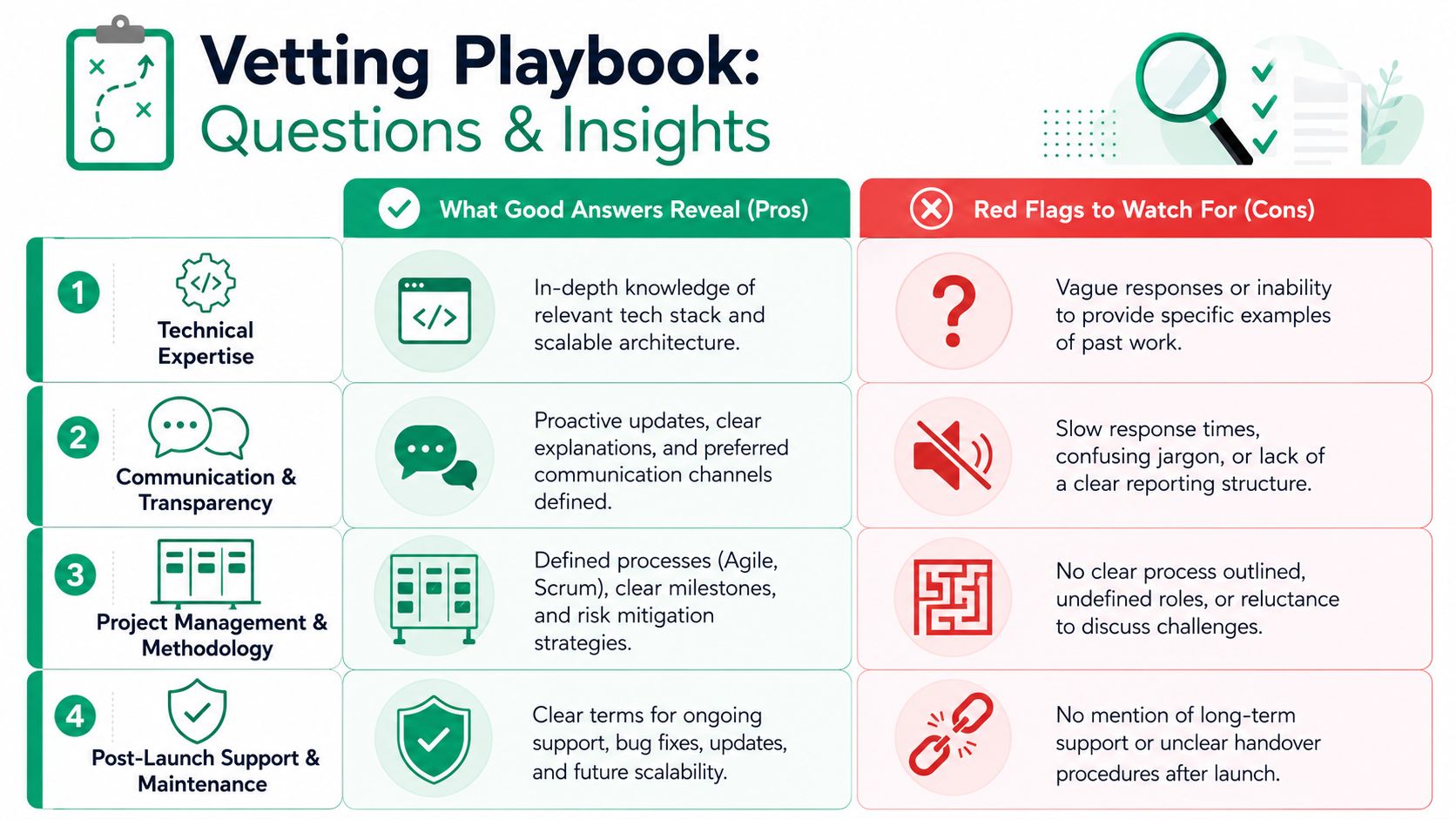
Methodology is a real technical discriminator. Agile or Scrum fits projects with changing requirements, while Waterfall works better when scope is stable and fully defined, as outlined in Monday.com's software development methodologies guide. The trap is accepting process claims without proof.
Ask these questions:
- How do you break work into reviewable increments?
You want a concrete answer, not “we're Agile.” - What happens when requirements change mid-project?
Good firms have a change process. Weak ones improvise. - How often do I see progress?
Frequent demos beat status emails full of abstractions. - What does post-launch support look like?
If the answer is fuzzy now, it'll be worse later.
Here's a useful primer on adaptive software development in Indiana if you want to pressure-test a vendor's claims.
A quick visual overview helps when you're preparing those interviews:
Ask technical questions that expose depth
Don't ask, “Can you build this?” Every vendor will say yes.
Ask instead:
- How would you structure the architecture so it can scale without rebuilding core pieces?
- What testing happens before code moves into production?
- How do you handle performance issues, logging, and rollback if a release misbehaves?
- What integrations have caused problems on similar projects, and how did you handle them?
The right team should be able to talk through QA rigor, architecture choices, and deployment discipline without sounding annoyed.
Ask who is actually doing the work
This one matters more than owners think.
- Who's the lead engineer?
- Will I meet the project manager before signing?
- Are senior people building the core pieces, or just selling the engagement?
- What happens if a key developer leaves?
If you never meet anyone technical before the contract, that's a warning sign.
Practical rule: Interview the delivery team, not just the sales team.
Ask about security and compliance in plain terms
If you're in healthcare, defense, finance, or anything customer-facing, security can't be an afterthought.
Ask:
- How do you handle access control and least privilege?
- What does your secure coding and code review process look like?
- How do you support HIPAA, CMMC, or alignment with NIST CSF expectations where relevant?
- How are secrets, dependencies, and third-party components managed?
A serious team can discuss Zero Trust architecture, vulnerability handling, logging, and recovery in language your operations people can understand.
Evaluating Proposals and Spotting Red Flags
A Carmel medical practice, a Greenwood manufacturer, and a contractor near the I-65 corridor can all ask for "the same app" and get three proposals that barely resemble each other. One includes discovery, QA, deployment, and post-launch support. Another prices only the build. A third looks affordable until you realize the vendor left out training, documentation, and security work.
Read proposals side by side only after you normalize them.
Compare scope before you compare price
Put every proposal into the same review format so you can clearly see what is included.
| Proposal area | What to check |
|---|---|
| Discovery | Are requirements validation, process mapping, and technical planning included? |
| Build | Which features are clearly in scope, and which ones are excluded? |
| QA | Is testing defined by type, ownership, and acceptance criteria? |
| Deployment | Who handles release management, environment setup, and rollback planning? |
| Support | Are bug fixes, response times, maintenance terms, and handoff details written down? |
This step saves Indiana SMBs from a common mistake. Comparing one vendor's full delivery plan against another vendor's coding estimate.
Low bids usually hide work somewhere. It shows up later as change orders, rushed fixes, missed deadlines, or a messy handoff to your internal IT team.
Read the proposal for operational gaps
Good proposals explain how the project will run, not just what will be built. If the document is thin on delivery mechanics, expect trouble once the work starts.
Watch for these red flags:
- Vague timeline language like "delivery based on alignment" with no milestone definitions
- No named roles beyond sales or account management
- No support terms after go-live
- No ownership language for source code, credentials, documentation, and deployment assets
- Security reduced to an NDA instead of secure development, access control, and vulnerability handling
- One-line pricing with no breakdown by phase, workstream, or assumptions
I pay close attention to assumptions and exclusions. That is where vendors often bury the actual cost. If a proposal says API work, data cleanup, user training, or cloud configuration is "outside current scope," the project is already more expensive than the headline number suggests.
Security proof matters more than security language
For Indiana companies dealing with HIPAA, CMMC, customer data, or regulated operations, a proposal should show how the vendor reduces risk during delivery. Generic statements about "following best practices" are not enough.
A stronger proposal explains how the team handles code review, dependency updates, secret management, logging, incident response, and release controls. That aligns with the broader secure-by-design direction discussed in Vention's guide to selecting the right software development company.
Software risk rarely sits only in the code your vendor writes. It also sits in third-party packages, cloud services, build pipelines, and admin access. If the proposal ignores those areas, you are reviewing a partial plan.
For a practical benchmark, this guide to software development practices that drive growth in 2026 is a useful check against thin proposals.
Cheap proposals often create expensive dependencies
A bid that comes in far below the others deserves scrutiny, especially if your business cannot tolerate downtime or rework.
Sometimes the vendor misunderstood the job. Sometimes they priced phase one low to get in the door and planned to make margin back through change requests. Sometimes they left out the work that keeps systems stable, such as testing depth, monitoring, documentation, environment management, and support after launch.
That matters even more if the software touches your broader IT stack. Finchum Fixes IT is one example of a provider businesses may consider when the project also affects networking, cybersecurity, endpoint management, backup, or business continuity. In those cases, the application vendor does not operate in a vacuum. Your app still depends on identity controls, reliable Wi-Fi, device health, and recovery planning.
The best proposal is rarely the cheapest one. It is the one that makes cost, ownership, and operating risk clear before you sign.
The Final Decision A Scoring Matrix and Contract Essentials
Gut feel is useful. It's just not enough.
The cleanest way to choose a software development company is to score finalists against weighted criteria. One practical framework uses technical fit (30%), experience (25%), cost (20%), communication (15%), and culture (10%), based on Imenso Software's step-by-step vendor selection method. That structure helps stop a very common mistake. Over-weighting price while under-checking communication.
Sample Vendor Scoring Matrix
| Criteria | Weight | Vendor A Score (1-5) | Vendor A Total | Vendor B Score (1-5) | Vendor B Total |
|---|---|---|---|---|---|
| Technical fit | 30% | 5 | 1.50 | 3 | 0.90 |
| Experience | 25% | 4 | 1.00 | 5 | 1.25 |
| Cost | 20% | 3 | 0.60 | 4 | 0.80 |
| Communication | 15% | 5 | 0.75 | 2 | 0.30 |
| Culture | 10% | 4 | 0.40 | 3 | 0.30 |
| Total | 100% | 4.25 | 3.55 |
Use the matrix after the interviews, not before. Otherwise you're scoring marketing.
What to weigh heavily for Indiana SMBs
If I were advising a Greenwood manufacturer, a Southside medical office, or a contractor serving defense-related work, I'd push these to the top of the stack:
- Technical fit first. Their team needs to match your stack, integrations, and hosting reality.
- Industry experience next. HIPAA, CMMC, and audit-sensitive workflows change how software gets designed.
- Communication discipline. Weekly ambiguity will sink a project faster than imperfect code.
- Support maturity. If the app goes down, who responds, how fast, and what's the recovery path?
Culture matters too, but don't confuse “nice people” with “operationally reliable.”
A vendor earns trust by making risk visible early, not by acting confident late.
Contract terms that are not optional
Before anyone writes code, lock down the agreement.
Make sure the contract states:
- IP ownership clearly. You should know who owns source code, documentation, and custom deliverables.
- Support obligations in plain language. Spell out response expectations, bug handling, and maintenance boundaries.
- Change management so scope changes don't become arguments.
- Termination rights if the relationship goes sideways.
- Security responsibilities including access, data handling, and incident reporting expectations.
- Handover requirements for credentials, repositories, documentation, and deployment knowledge.
If a vendor resists clarity here, that's the decision.
The practical tie-breaker
When two firms score close, pick the one that communicates risk better.
Not the one with the flashier mockups. Not the one with the friendlier salesperson. Pick the team that can tell you where the project might slip, what they need from your staff, how they protect continuity, and how they'll support the system once real users start leaning on it.
That's how you choose a software development company that helps your business run better, not just launch something new.
If your software project also touches Wi-Fi reliability, aging servers, endpoint security, cloud migrations, backup strategy, HIPAA or CMMC concerns, get a second set of eyes before you sign with anyone. Businesses in the Greenwood and Indianapolis area can start with a Free Network Assessment or a Security Risk Audit from Finchum Fixes IT. It's a practical way to spot the infrastructure and security issues that can turn a promising software project into downtime later.