Hybrid Cloud Security: The SMB Playbook for 2026
If your Greenwood office still runs a few things in the server closet while the rest lives in the cloud, hybrid cloud security is what keeps those pieces from turning into separate failure points. It's the mix of identity, monitoring, encryption, and recovery controls that protects data and workloads whether they sit on a rack in Johnson County or in Microsoft Azure.
A lot of local owners only notice the problem when one side breaks. The ERP in the back room goes dark, the cloud email still works, and suddenly the whole team is stuck in a split-brain outage that burns time, cash, and patience.
What Hybrid Cloud Security Actually Means for Your Business
Hybrid cloud security is the set of people, processes, and tools that keep data, identities, and workloads safe across both on-premises systems and cloud services. It only works when the rules are consistent across environments, because a server room and a cloud tenant should never be treated like separate worlds with separate trust models. For Indiana teams weighing cloud migration, the practical side of that shift is laid out well in this overview of the real benefit of cloud migration for Indiana businesses.
That matters in real life. I've seen a Greenwood manufacturer keep production-facing apps on-prem for control, move collaboration to Microsoft 365, and then discover that one bad identity change could disrupt both sides at once. The money problem is never theoretical, either, because downtime can chew through cash fast enough to hurt a small operation before lunch.
The modern hybrid model exists because SMBs want the best of both sides. Sensitive records often stay on-prem for compliance or control, while email, file sharing, backup copies, and less sensitive workloads move to the cloud for flexibility and easier recovery. That's why this isn't a vendor-whitepaper topic, it's a business continuity topic first and a compliance topic second.
The stakes are real. The cloud security market was estimated at $36.08 billion by 2024, which shows how much investment is going into protecting these mixed environments AppSecure security statistics. A major milestone came in 2017 when the Cloud Controls Matrix helped formalize public-cloud security benchmarking across multi-cloud and hybrid environments, and that still matters because the same control language has to work across both sides of the house.
Practical rule: If you can't describe who owns identity, logging, backup, and recovery in one sentence, you don't have hybrid cloud security, you have shared confusion.
That definition matters because the attack surface is no longer limited to one data center or one cloud tenant. Hybrid security is the control layer that keeps a migration from becoming a split system with different assumptions, different gaps, and different recovery paths.
The Threat Landscape Hitting Hybrid Environments in 2026
The three patterns I keep seeing on the I-65 corridor are boring on paper and expensive in practice. Misconfigured cloud storage, stolen admin credentials, and ransomware that starts with cloud identity all hit the same weak spot, the gap between what the business thinks is protected and what is enforced.
Cloud risk is mainstream now, not rare. A 2025 roundup reported that 82% of data breaches involved cloud-stored data, cloud intrusions increased by 75% from 2022 to 2023, and misconfigurations accounted for about 23% of cloud security incidents Sprinto cloud security statistics. That same source cited a $4.35 million global average breach cost in 2025, with regulated industries such as healthcare and finance often facing losses of $10 million or more per incident Sprinto cloud security statistics.
Why the first mistake costs the most
Misconfigured storage is the classic hybrid problem because it crosses ownership boundaries. A team locks down the on-prem file server, then leaves a cloud bucket or backup repository too open, and the breach lands in the part of the stack nobody was watching closely enough.
Credential theft is worse when admins move between environments. One stolen account can reach email, remote support, cloud console access, and legacy systems if the business has never flattened identity into a single control plane.
Why small teams feel this harder
A 25-person business can defend against these threats, but only if it stops pretending each platform protects itself. The cost is not just breach recovery, it's the downtime that follows, and in some environments that cost can rise to $9,000 per minute of outage. That's why security leaders care about both prevention and speed of recovery, not just lock-and-key controls.
For a practical view of how incident response changes the outcome, the Indiana threat detection and response guide is a useful local reference. It fits neatly with the business case here, because if detection is slow, the bill gets ugly no matter where the breach started.
The rest of the guide follows the controls that shrink that blast radius, instead of adding another dashboard and calling it progress.
Shared Responsibility and Where Your Job Stops
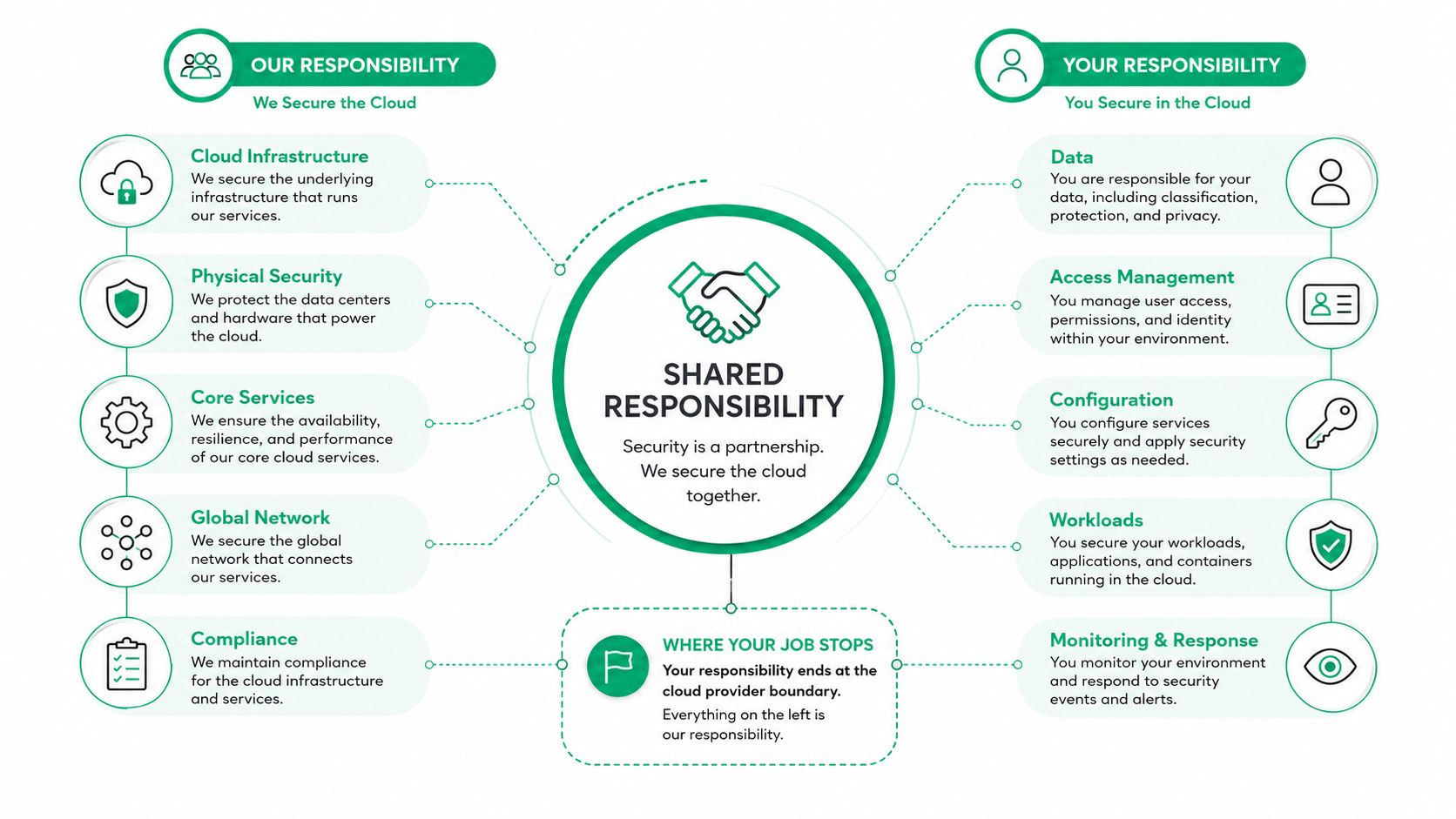
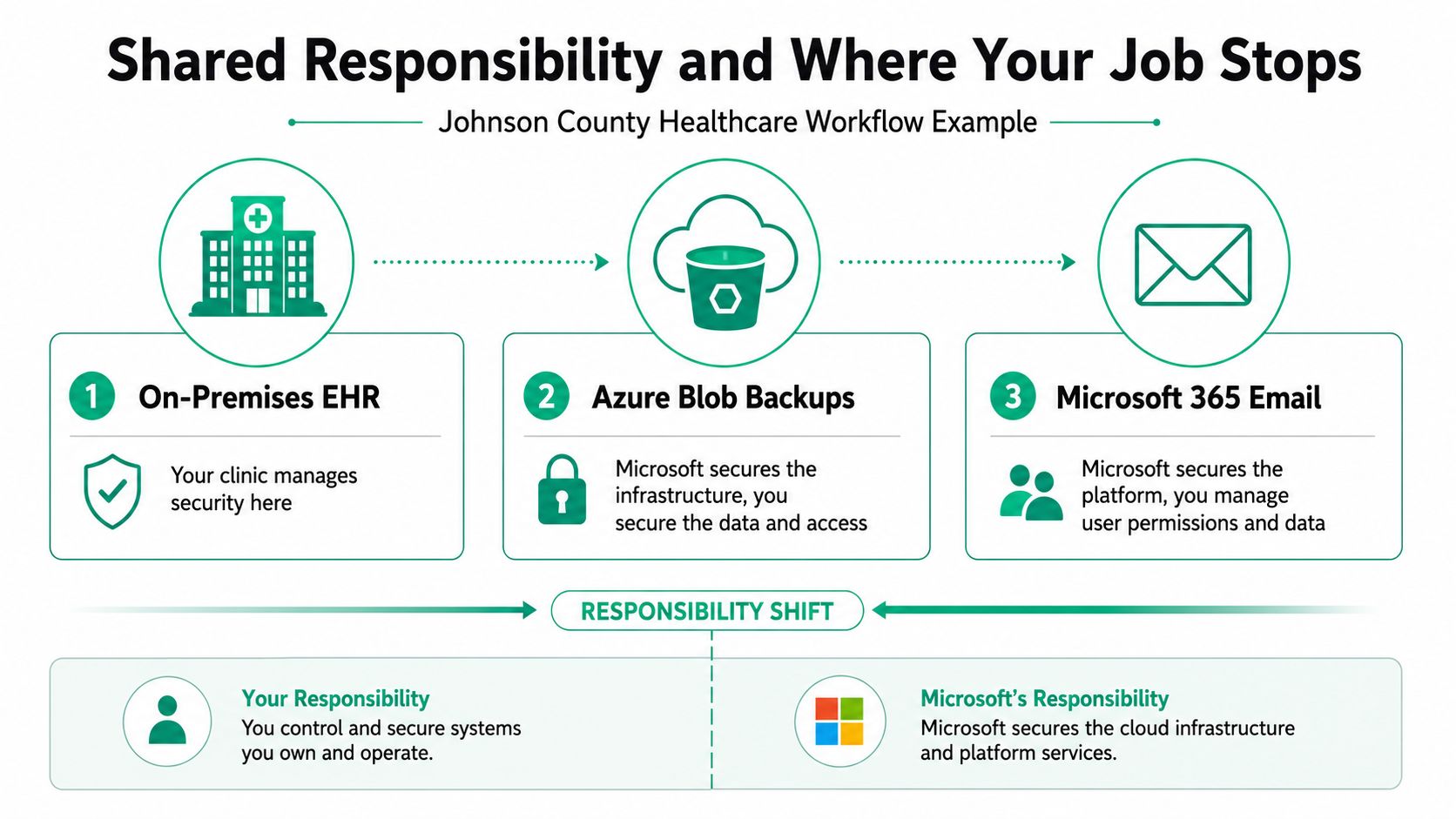
A Johnson County clinic running its EHR on-prem, backing up to Azure Blob, and using Microsoft 365 for email has three different security boundaries in play at once. Microsoft patches the SaaS platform, the cloud provider secures the storage infrastructure, and the clinic still owns identity, data classification, and access policy across every layer.
That's where most cleanups start. The customer assumed a vendor was handling a setting, the vendor assumed the customer knew the tenant default, and nobody noticed the gap until someone abused it.
What stays on your side
Your team owns the tenant settings, the admin roles, the break-glass accounts, and the audit trail. If those basics aren't documented, then a cloud move just creates a faster way to repeat old mistakes.
The legal side can matter too, because a breach response isn't only a technical event. When a local business wants a plain-English view of breach handling and disclosure concerns, By Design Law Firm's breach overview is a useful outside reference for the non-technical side of the conversation.
What the provider covers
The cloud provider secures the platform layer, but that does not mean your data, users, or permissions are magically covered. SaaS, storage, and hosting all come with the same hard truth, the customer still has to configure access, retention, and logging correctly.
A small IT team usually gets burned when it treats shared responsibility like legal fine print instead of operating reality. The safer habit is to ask who owns each control before anything goes live, then verify it in writing and in the console.
Most hybrid breaches start in the gap between “the vendor handles that” and “someone else already checked it.”
The practical part is simple, though not easy. Configure the tenant, review admin accounts, keep logs centralized, and confirm that the backup side can be restored under pressure.
For teams trying to formalize that operating model, this managed detection and response guide for Indiana businesses gives a good frame for what the monitoring side should look like.
The Five Control Families That Actually Stop Incidents
Hybrid cloud security works when five control families are treated as one system, not five separate projects. The NSA guidance on hybrid and multi-cloud environments points toward centralized identity, minimized inter-environment data flow, uniform access policy, and centralized log aggregation for monitoring and threat hunting NSA hybrid and multi-cloud guidance. That lines up with Zero Trust and NIST SP 800-207, where trust is earned per request instead of assumed by location Zero Trust overview.
Identity
Identity is the first gate because stolen credentials are still the easiest way in. A practical SMB setup uses federated identity, single sign-on, conditional access, and least privilege so users don't carry broad access across every platform they touch.
For example, identity and access management tools for Indiana SMBs matter most when one admin account can reach both a line-of-business app and a cloud console. That's where break-glass accounts and role cleanup matter more than another password rule.
Network segmentation
Segmentation keeps a small mistake from becoming a full outage. UniFi gateway firewalls, VLANs, and tighter east-west rules make sense when the accounting server should never talk to a guest Wi-Fi subnet or a dev workload unless there's a reason.
Encryption
Encryption protects data in transit and at rest, but only if key handling is disciplined. In a healthcare or defense-adjacent shop, you ask who controls the keys, who can rotate them, and what happens if the cloud provider has an outage but not a breach.
Logging and monitoring
Logging only helps if the logs are centralized and usable. A SIEM-fed workflow with standardized ingestion catches the stuff that siloed dashboards miss, which is exactly why fragmented telemetry creates blind spots.
Workload protection
Workload protection covers endpoints, servers, and cloud workloads with tools like Bitdefender GravityZone, runtime policies, and posture checks. If a Greenwood office laptop, a virtual server, and a cloud-hosted app all need the same outcome, then the control has to follow the workload, not the building.
| Control Family | What It Covers | Example Tool for SMBs |
|---|---|---|
| Identity | Sign-in, admin roles, MFA, least privilege | Microsoft Entra ID |
| Network Segmentation | Internal traffic flow and east-west limits | UniFi gateway firewalls |
| Encryption | Data at rest, in transit, and key handling | Native cloud encryption plus managed keys |
| Logging and Monitoring | Central audit trails, alerting, threat hunting | SIEM with cloud log ingestion |
| Workload Protection | Endpoint and server defense, posture checks | Bitdefender GravityZone |
If you want a broader perspective on how these controls fit into a business environment, Purple's data and security overview is a solid context piece.
The pattern is simple. Centralize the control, reduce the exception list, and stop assuming each environment should be defended with a different playbook.
Matching the Controls to HIPAA, CMMC, and NIST CSF
HIPAA, CMMC, and NIST CSF all push the same discipline, even if they speak different languages. Healthcare owners care about patient data, defense subcontractors care about controlled access and proof of process, and general SMBs usually want a baseline that doesn't break operations while improving security.
The same five controls show up everywhere
Identity maps cleanly to all three, because if sign-in and admin access are sloppy, the rest of the framework gets shaky. Logging and monitoring also show up in each one, because auditability is what separates a configured control from a hopeful one.
Encryption is the easy box to check and the easiest one to fake. The hard part is knowing where the keys live, who can read the data, and whether access is limited enough to survive a real investigation.
Owner question: If the vendor vanished tomorrow, could your team still prove who accessed what, where the backups live, and how fast the data could be restored?
That question usually exposes the same gap across all three frameworks, the business thinks it bought compliance, but what it really bought was a shared environment that still needs a manager.
The practical tie-in is that audit readiness and uptime readiness are the same work, just scored differently. If a setting is weak enough to fail an audit, it's usually weak enough to create a recovery problem after an outage.
For a plain-language view of how Indiana firms approach that overlap, compliance and security for Indiana SMBs is a helpful companion read.
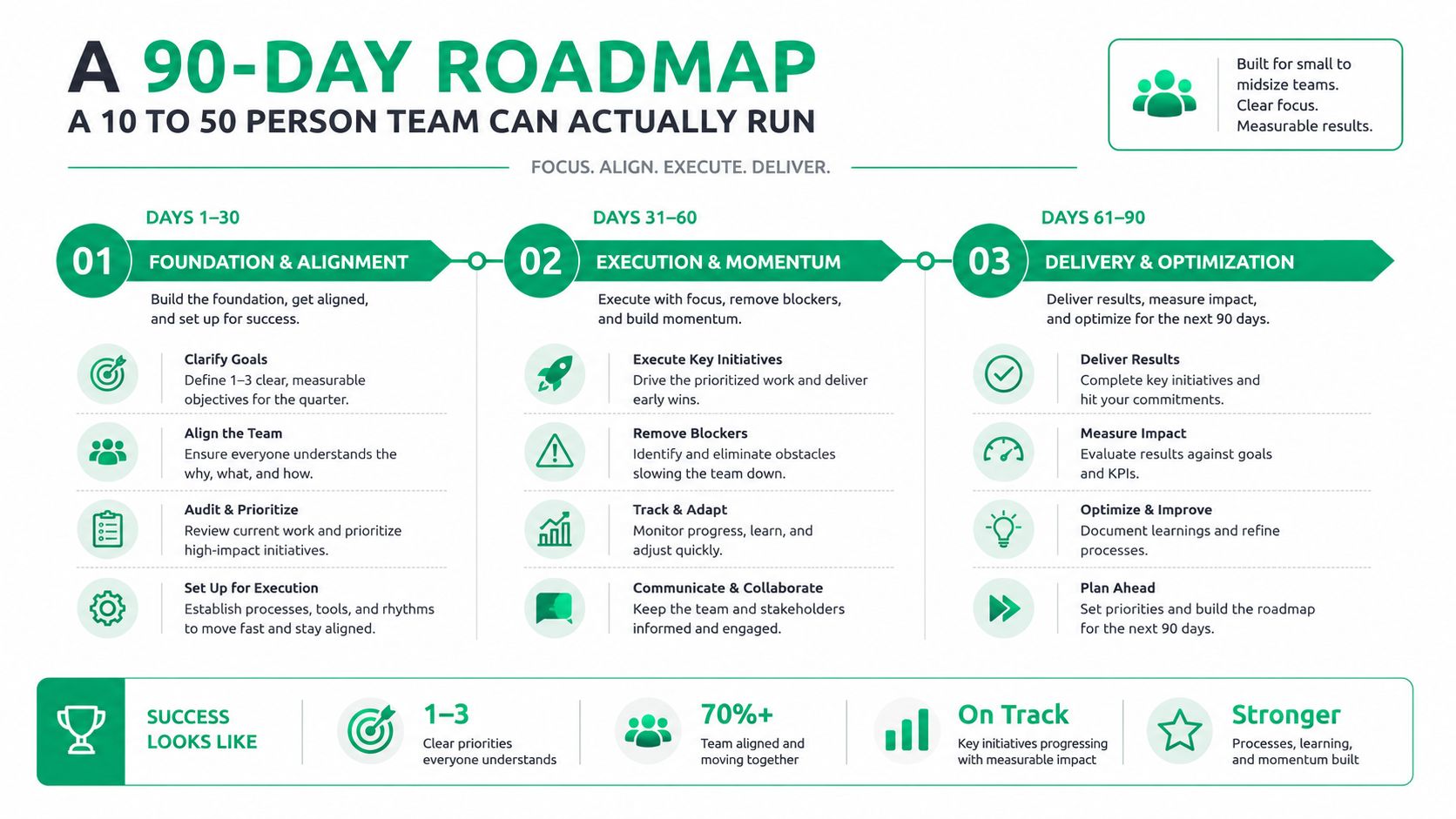
A 90-Day Roadmap a 10 to 50 Person Team Can Actually Run
A small team doesn't need a giant transformation program. It needs a sequence that cuts risk early, avoids rework, and creates a monthly budget you can live with.
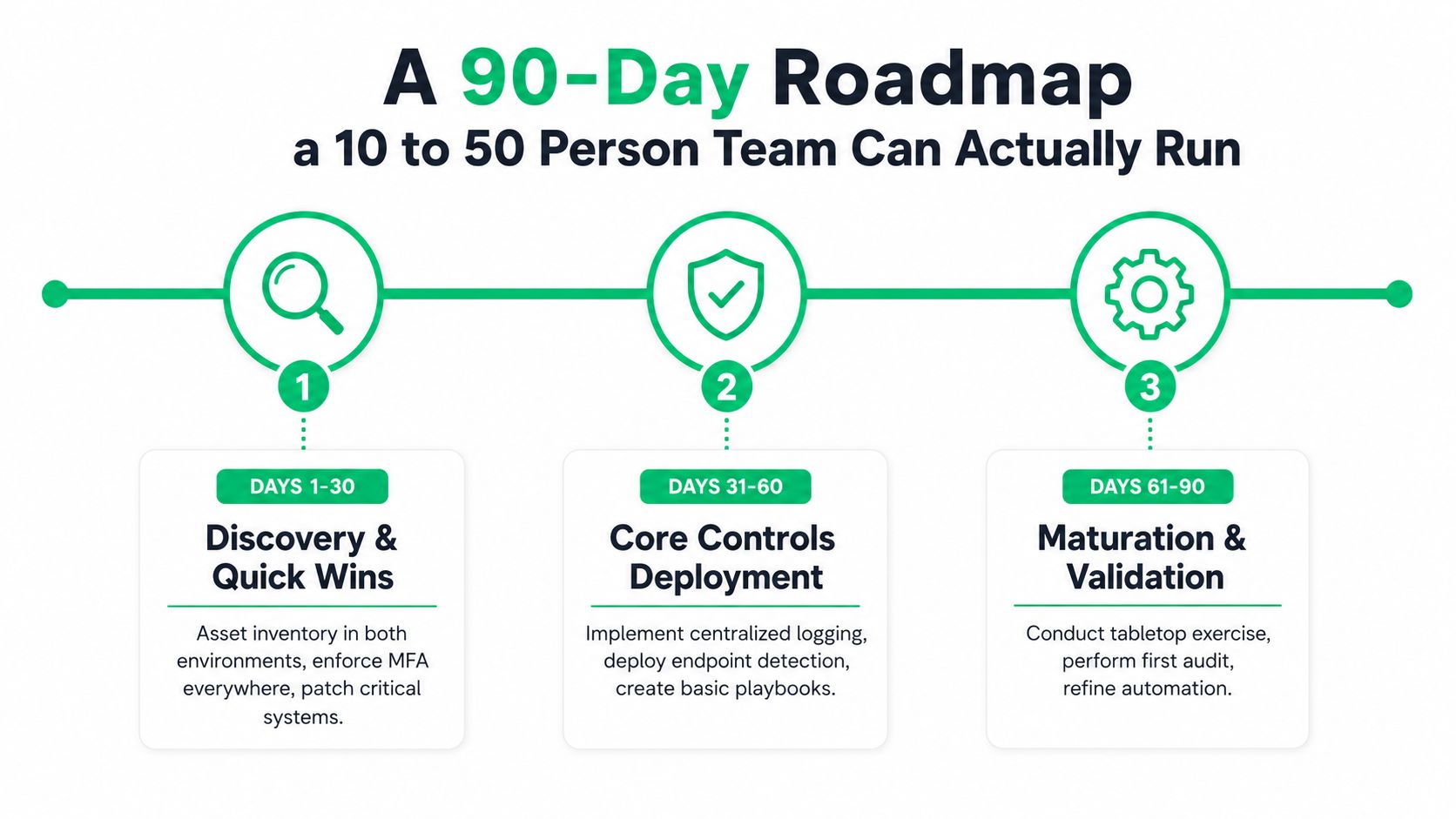
Days 1 to 30
Start with asset inventory across both environments, then turn on MFA everywhere and unify audit logging. If you don't know what exists, you can't protect it, and if you can't see sign-ins and admin actions in one place, you'll miss the first warning.
This is also the easiest phase to budget because most of the work is configuration and cleanup, not new infrastructure. For many SMBs, that means trading surprise break-fix bills for a predictable service line.
Days 31 to 60
Segment the on-prem network with a UniFi gateway, put posture checks in place, and validate backup and replication against a documented RPO and RTO. The business starts seeing the recovery side of security at this point, because backup that hasn't been tested is just storage with a comforting label.
Use CSPM-style checks to catch drift and tie that to the actual operating environment. Tenable's guidance on hybrid and multi-cloud security aligns with this by recommending pre-deployment IaC scanning and continuous posture monitoring so insecure settings get caught before or right after they go live Tenable hybrid and multi-cloud security.
Days 61 to 90
Lock in policy-as-code, test your incident response runbooks, and run a tabletop exercise tied to the cost of outage. If a minute of downtime can hit $9,000, then practice is not optional theater, it's how you keep a small interruption from becoming a very expensive day.
In our 17 years of local service, the shops that win are the ones that rehearse before they need the plan. Finchum Fixes IT's two-hour urgent response and local service history matter here because the recovery plan has to fit actual operations, not a slide deck.
Budget reality: A strong 90-day rollout should feel like a monthly operating decision, not a capital panic.
For SMBs in Greenwood and across the I-65 corridor, that usually means the right mix of hardening, monitoring, and support is cheaper than one bad outage plus the cleanup.
Where AI Changes the Game and What to Do About It
The old hybrid security model assumed teams had enough time to notice trouble, sort through alerts, and patch on a comfortable schedule. That's not how it works anymore, especially when AI-assisted attacks compress reaction time and make analyst burnout part of the risk picture.
Recent reporting argues that hybrid-cloud defenses are being outpaced by AI-era pressure, citing 82% of breaches linked to blind spots, a 15-minute detection window that may already be too slow, 40% of alerts going uninvestigated, 71% analyst burnout, and a recommendation to shorten patch cycles to 72 hours VentureBeat on hybrid cloud security in the AI era. The useful takeaway isn't panic, it's that small teams need triage, not more noise.
What to change
SOC-as-a-Service monitoring makes sense when a business can't staff a 24/7 internal SOC. Automated patch cycles under 72 hours reduce the “we'll get to it next week” problem that attackers love, and policy-as-code helps block risky changes before they ship.
That's the core shift. The winning model is less about staring at more dashboards and more about removing obvious bad states before people can create them. If a Greenwood office, a field laptop, or a cloud app drifts out of policy, the system should flag it or stop it without asking the owner to babysit every change.
For Central Indiana SMBs, the partner model is the practical answer because the payroll math doesn't support a round-the-clock in-house team. Better automation, better triage, and faster remediation keep the security bill predictable and the business open.
Turning Security Spend Into Uptime and Predictable Bills
Hybrid cloud security pays off when it protects revenue, not just checkboxes. A well-built program cuts wasted tech time, keeps staff working billable hours instead of waiting on recovery, and replaces surprise emergency invoices with a predictable monthly number.
That matters in Greenwood, but it matters just as much for Johnson County business owners, Hamilton County growth corridors, and downtown Indy tech hubs that can't afford a long outage. The win is continuity, because a clean recovery plan and a tighter control set do more for ROI than another panic purchase after a breach.
If the choice is between an eight-hour mess and a steady operating model, the steady model wins every time. The right hybrid stack protects the business before, during, and after the incident, and that's where the security spend starts looking like a business tool instead of a sunk cost.
If you want a real-world view of where your hybrid setup is exposed, Finchum Fixes IT can walk your Greenwood or Indianapolis business through a Free Network Assessment or Security Risk Audit with a focus on continuity, access control, and recovery. Start with Finchum Fixes IT and use the first conversation as a working session, not a sales pitch.