Managed IT Services for Government: A 2026 Guide
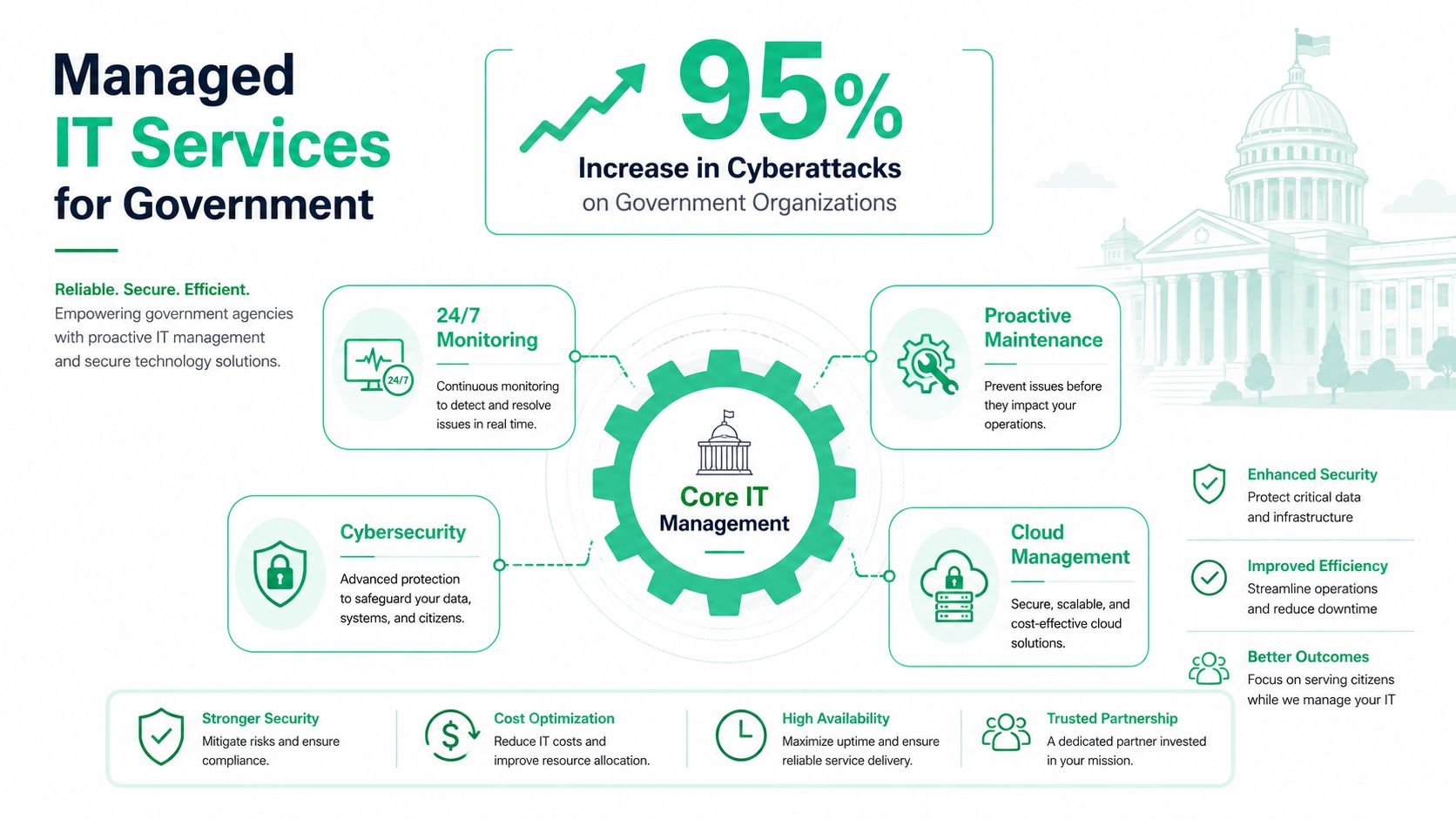
Government IT doesn't fail in flashy ways. It fails when a sheriff's office can't pull records, a clerk's workstation freezes during a busy morning, or a storm takes out a network nobody budgeted to harden. With a 95% increase in cyberattacks targeting the government sector from 2021 to 2022 and ransomware incidents affecting state and local governments averaging 7.3 days in length, managed IT services for government have become a continuity decision, not a housekeeping choice. Spectrum Enterprise's government infographic
Managed IT services for government means an outside provider takes responsibility for some or all of an agency's technology operations, then proves it with monitoring, support, patching, security controls, recovery planning, and service-level commitments. In a public-sector setting, that can range from help desk coverage and endpoint management to cloud operations, cybersecurity, and infrastructure modernization. The point isn't to hand off chaos, it's to create a predictable operating model that keeps services running for citizens.
What Managed IT Services for Government Entails
Government buyers used to treat managed services as a polite word for outsourcing the help desk. That view is too narrow for the work public agencies are trying to do now. The better model covers uptime pressure, security pressure, and staffing pressure at the same time, and it has to survive procurement rules that do not forgive vague scopes.
The urgency is real. Spectrum's government-focused materials point to a 95% increase in cyberattacks targeting the government sector from 2021 to 2022, while KnowBe4 found that ransomware incidents affecting state and local governments averaged 7.3 days in length. That combination explains why agencies in the I-65 corridor, downtown Indy tech hubs, and the rest of Central Indiana are buying more than coverage. They are buying a way to keep services running when staff, systems, and budgets are all under pressure. Spectrum Enterprise's government infographic
What the service boundary includes
In practice, managed IT services can cover 24/7 monitoring, patching, device management, cloud operations, backup and recovery, network operations, and incident response. Federal civilian guidance says agencies are already using MSPs for security operations, backup and disaster recovery, cloud enablement, ransomware mitigation, data analytics, and software development. Federal civilian managed services whitepaper
That breadth matters because the old break-fix model falls apart the moment an agency needs a patch, an audit trail, and a restore point in the same week. A managed model defines who owns the ticket, who owns the service, and who owns the handoff when something slips outside normal business hours. That is the difference between a contract that sounds good in an RFP response and a contract that holds up in a real county office.
Why the hybrid model wins in government
The most useful technical model for public agencies is a hybrid, multi-cloud XaaS operating model. Peraton's government services materials describe why agencies can scale capacity up or down, keep mission systems in agency data centers when needed, and pay for consumed capacity instead of overprovisioning fixed infrastructure. Peraton on managed services for government
That is the modernization benefit, but the procurement benefit matters just as much. Agencies do not need to replace every server, lift every workload, or rebuild every application to get value. They need a service model that can carry legacy systems, cloud workloads, and edge devices without forcing one architecture on everything. That gives buyers room to phase work, split scopes by function, and avoid signing a contract that is broader than the agency can govern.
Practical rule: if your agency cannot describe who watches the alerts, who owns the patch window, and who restores data after hours, you do not have managed services. You have a vendor with a phone number.
The talent problem makes that even clearer. Spectrum's infographic also says 95% of IT leaders report skill shortages affecting operations. For many agencies, managed IT services are the way to fill specialized gaps in cybersecurity, infrastructure monitoring, and support capacity without pretending those gaps will disappear inside the current hiring cycle. If you are pressure-testing how that model fits your own controls and staffing, a practical starting point is Finchum Fixes IT's compliance and security guidance for Indiana SMBs.
Compliance and Security Requirements for Public Sector IT
A managed provider can't just say it knows security. It has to build security into the operating model, or the agency ends up paying twice, once for the service and again for the cleanup.
Build around the standards, not around vendor slogans
For general security posture, local governments and state agencies should anchor on NIST CSF. Law enforcement environments bring CJIS requirements into the conversation, and any health-related data pushes HIPAA into scope. Those aren't decorative acronyms. They drive access control, logging, identity governance, encryption, retention, and response procedures.
A managed provider also needs to work like a control system, not a call center. That means Zero Trust architecture, MFA across all endpoints, and SIEM integration across endpoints, firewalls, cloud workloads, and identity platforms. A public-sector service design should also include continuous monitoring, firmware and patch management, and incident response playbooks matched to the agency's topology. For a practical view of how those controls get translated into day-to-day operations, see this Indiana SMB security overview.
If you're evaluating vendors, Bidwell's security services sectors helps frame how security capabilities are packaged across different environments, especially when you are comparing broad service claims against actual operational coverage.
Fix the environment that keeps breaking compliance
A lot of compliance pain in Indiana starts with mundane infrastructure. I've seen aging server hardware in a Greenwood business park, and I've seen spotty Wi-Fi in old brick buildings where every wall eats signal and every closet holds a surprise switch. Managed services fix those problems permanently when the provider treats them as architecture issues, not as isolated tickets.
That means documenting the baseline, standardizing the endpoint stack, and tying every device into the same monitoring and patch cadence. It also means replacing scattered backup habits with a real recovery design, because ransomware resilience and compliance aren't separate conversations in public sector IT, they're the same conversation with different auditors.
Here's the part many vendors skip. If an agency's identity systems, backups, and logging aren't all governed together, the compliance program looks neat on paper and falls apart during an incident. The contract has to specify who owns the controls, who verifies them, and who proves them after a bad day.
Core Service Types Every Government Agency Should Evaluate
Not every agency needs every managed service. A small town office, a county department, and a statewide agency have different risk profiles, different staffing, and different budget pressure. The trick is matching the service to the mission instead of buying a giant package because the proposal looked polished.
Compare the services before you sign
| Service Type | What It Covers | Typical SLA Target | Best For |
|---|---|---|---|
| Managed SOC or SOC-as-a-Service | Alert monitoring, escalation, triage, response workflows | Severity-based acknowledgment and response | Agencies with sensitive data and limited internal security staff |
| Endpoint management | Device hardening, patching, AV/EDR, policy enforcement | Scheduled patch windows and rapid remediation | Mixed device fleets and remote users |
| Immutable off-site backups | Backup orchestration, restore testing, ransomware-resistant storage | Verified backup success and restore validation | Any agency that can't afford prolonged downtime |
| Managed networking and Wi-Fi | Switches, wireless design, segmentation, guest access | Uptime and rapid circuit/device troubleshooting | Old buildings, scattered sites, public counters |
| Cloud migration and operations | Hosting, platform management, storage, identity integration | Availability, change windows, cost governance | Agencies moving away from aging local servers |
| Software development and data analytics | Custom apps, workflow tools, reporting, integrations | Delivery milestones and defect handling | Agencies with recurring process gaps or reporting pain |
If you're comparing detection platforms, this Indiana guide to managed detection and response is a useful benchmark for understanding where managed monitoring ends and real incident handling begins.
What good technical execution looks like
A serious managed SOC doesn't just watch dashboards. It defines alert thresholds, triage steps, and escalation owners. A serious backup service doesn't just copy files. It proves restores, protects immutability, and coordinates recovery order for line-of-business systems.
For networking, the difference between “good enough” and useful is often the Wi-Fi design. UniFi networking can work well in municipal buildings when the provider uses it as part of a larger design, with segmentation, proper AP placement, and latency-optimized mesh nodes where cabling is limited. If the site is too small for a complex stack, don't buy a complex stack. Buy the right one and document the handoff.
Cloud migration should do one thing especially well, turn capital-heavy refresh cycles into predictable operating costs. If the agency still wants some mission systems in-house, that's fine. The point is to stop overbuying hardware for workloads that don't need it.
Operational test: if the vendor can't tell you how it backs up, tests, patches, and escalates each service type, the service catalog is just marketing.
A useful government-managed-services shortlist usually includes Bitdefender GravityZone for endpoint protection, immutable backups for recovery, network operations for sites that keep growing, and cloud operations for agencies that need elasticity without losing control. In some cases, custom software development and analytics support belong in the scope too, especially where manual workflows still eat staff time every week.
The Procurement Problem Most Vendors Will Not Discuss
Public-sector managed services fail most often at the procurement stage. Agencies need contracts that survive procurement review, fiscal-year funding cycles, and the reality of split budgets.
Why the contract model matters more than the demo
Most vendor pitches focus on monitoring, cloud, and uptime. That may sound useful, but it skips the part where the agency has to buy, govern, renew, and eventually exit the service. Federal News Network's public-sector coverage notes that agencies are leaning on managed services for cloud infrastructure, backup and recovery, cybersecurity, networks, and software development, which shows how broad the demand has become. The harder question is how to structure the deal so it works inside government procurement. Federal News Network on agency managed services demand
co-managed and fully managed models serve different operating realities. Co-managed fits agencies that still have internal staff and need help with specific functions. Fully managed fits agencies with deeper staffing gaps that need the provider to own the operating layer. A lot of agencies in Johnson County and along the I-65 corridor need a hybrid of those two, not a sales rep's canned answer.
Build for procurement, not just operations
Contracts fail when they ignore budget fragmentation, exit rights, and service boundaries. They also fail when the pricing model hides how costs move as scope changes. Public-sector KPMG guidance says agencies can reduce operational costs without sacrificing performance by optimizing staffing and managing ongoing needs at a predictable cost, and another government-industry source explains that managed services convert capital expenditures into operational expenditures. KPMG government managed services
That predictability matters to procurement officers, but only if the contract is written cleanly. Firm fixed pricing helps because it gives transparency and cuts down on invoice arguments that waste everyone's time. It also makes renewal conversations easier, because the agency can compare performance against known terms instead of chasing a moving target.
For a local contract-management perspective, these vendor management best practices for Indiana businesses line up well with public-sector governance, especially around ownership, documentation, and escalation.
Agencies should also insist that the provider bundle the physical hardware, software stack, and operations layer into one service boundary when modernization requires it. That reduces integration friction and makes it easier to add or retire capacity without re-architecting the whole environment. If the vendor cannot explain the exit plan, you are buying dependency, not service.
AI for Government Contracting can help teams compare vendor language against the contract terms they need, especially when procurement language gets fuzzy and the service boundary is doing too much hidden work.
Building Your RFP Checklist and SLA Framework
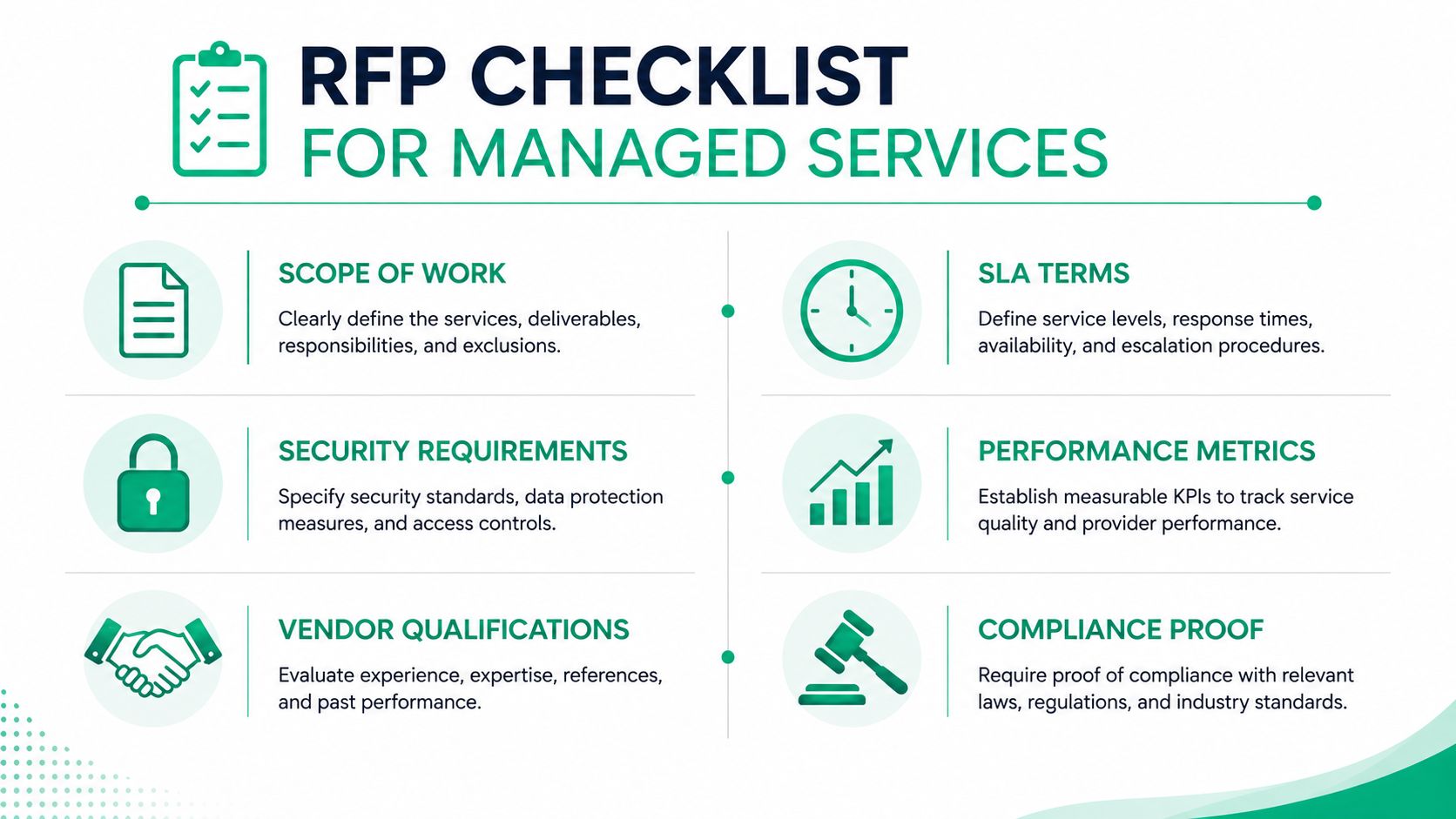
A government RFP should force the vendor to reveal its alert thresholds, patch cadence, incident-response documentation, and evidence trail for audits and renewals.
Put the right requirements in the RFP
Start with the operating basics. Require continuous monitoring with defined alert thresholds, proactive firmware and patch management, SIEM integration, incident-response documentation, backup verification, and reporting cadence. If the agency has special needs, add identity controls, cloud workload monitoring, and recovery coordination for mission-critical departments.
The SLA needs to be written around severity, not vague service language. For a Severity 1 outage, a 15-minute acknowledgment and a 4-hour resolution target give the agency something concrete to measure and enforce. Without that, the vendor can keep the ticket open while everyone waits for someone to “look into it.” For a cleaner contract structure, pair the SLA with a managed services agreement template so the legal terms match the service terms.
Make the vendor prove performance
Track the metrics that show whether the service is being delivered:
- Mean time to resolution, because speed matters when the counter is open and the phones are ringing.
- Patch compliance rates, because missed updates create avoidable risk.
- Backup verification success rates, because a backup that has never been restored is only a theory.
- User satisfaction scores, because ticket closure is not the same as service quality.
If you need help lining up solicitation language with the service terms you actually want, AI for Government Contracting can help buyers compare response structure without turning the process into guesswork.
Protect the agency during transitions
The contract should spell out transition assistance, knowledge transfer, data return, and renewal notice periods. It should also define service credits and penalties in plain language, because vague remedies do not change vendor behavior.
A clean RFP does more than buy support. It sets the operating rules, the reporting standard, and the exit terms, so the agency can hold the provider accountable before a service problem turns into a political one.
Implementation Roadmap for Indiana Local Governments
The cleanest implementations I have seen in local government start with process, not with tools. Procurement, scope, and responsibility all have to be clear before anyone touches production systems, especially in Indiana municipalities that keep public safety, courts, utilities, and the front desk running on the same network.
Discovery comes before confidence
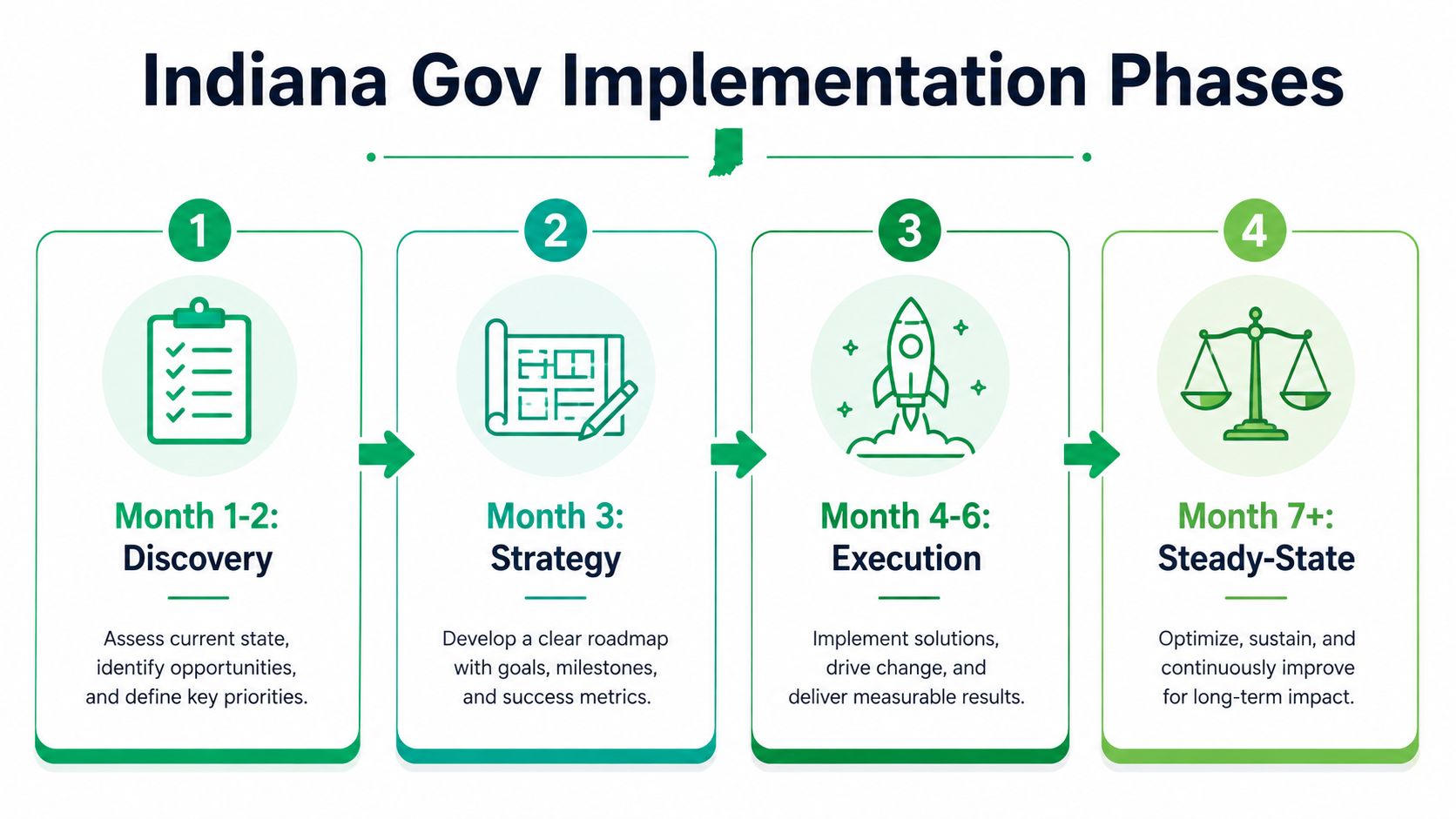
The first phase is a real inventory, not a spreadsheet exercise. The provider maps server age, network topology, backups, endpoint health, identity systems, and compliance gaps. In downtown Indy tech hubs and the Hamilton County growth corridors, the fastest-growing agencies usually have the messiest combinations of old systems and new cloud subscriptions.
That inventory has to answer a practical question. What can move now, what needs to stay in place, and what must be stabilized before any change goes live? A provider earns trust by documenting those trade-offs plainly instead of promising instant modernization.
Transition should be boring, and that's good
During transition, backups get verified, monitoring turns on, and the managed team starts handling defined alerts. The agency should not see a big-bang cutover unless there is a strong reason for it. Good providers coordinate with department leads, schedule change windows around public service hours, and keep the old path available until the new one proves itself.
That is also the point where business continuity and ROI stop being abstract contract language. Downtime costs can be substantial, and every avoided outage changes the budget picture fast. The value shows up in fewer interruptions for staff, fewer service calls from the public, and monthly costs that are easier to forecast.
Steady state is where the contract proves itself
Once the environment settles, the provider should tune alert thresholds, harden identity controls, and establish a reporting rhythm a department head can read. That cadence matters because government leaders need a service they can govern, not a black box with a support portal.
For a practical local planning reference, this Indiana IT roadmap guide matches the way municipalities should sequence upgrades without overwhelming staff.
The projects that go right usually treat the first six months as operations design, not a shopping exercise. The provider does more than install tools. It takes on repetitive work, stabilizes the environment, and gives the agency time back.
Your Next Step Toward Reliable Government IT
Managed IT services for government work when they're tied to continuity, compliance, and procurement discipline. The agencies that do this well stop buying random fixes and start buying a service model that can handle cyber risk, staffing shortages, aging infrastructure, and audit pressure at the same time. That's the win, fewer surprises and a budget that makes sense month after month.
For Greenwood and Indianapolis area government teams, the next move should be simple. Get a Free Network Assessment or a Security Risk Audit from a local provider that understands municipal workflows, public-sector compliance, and the realities of older buildings and mixed environments along the I-65 corridor. The right review will show you what's stable, what's exposed, and what should be fixed before the next outage does the planning for you.
Finchum Fixes IT helps Indiana organizations with managed IT services, cybersecurity, networking, data recovery, and custom support that fits real-world operations. If your agency or department needs a clearer plan for uptime, security, or procurement-ready service design, visit Finchum Fixes IT and ask about a Free Network Assessment or Security Risk Audit for the Greenwood and Indianapolis area.